
Class : 9 – Math (English) : Lesson 4. Linear Equations in Two Variables

EXPLANATION & SUMMARY
🔵 Detailed Explanation
🔵 1) Introduction 🌿
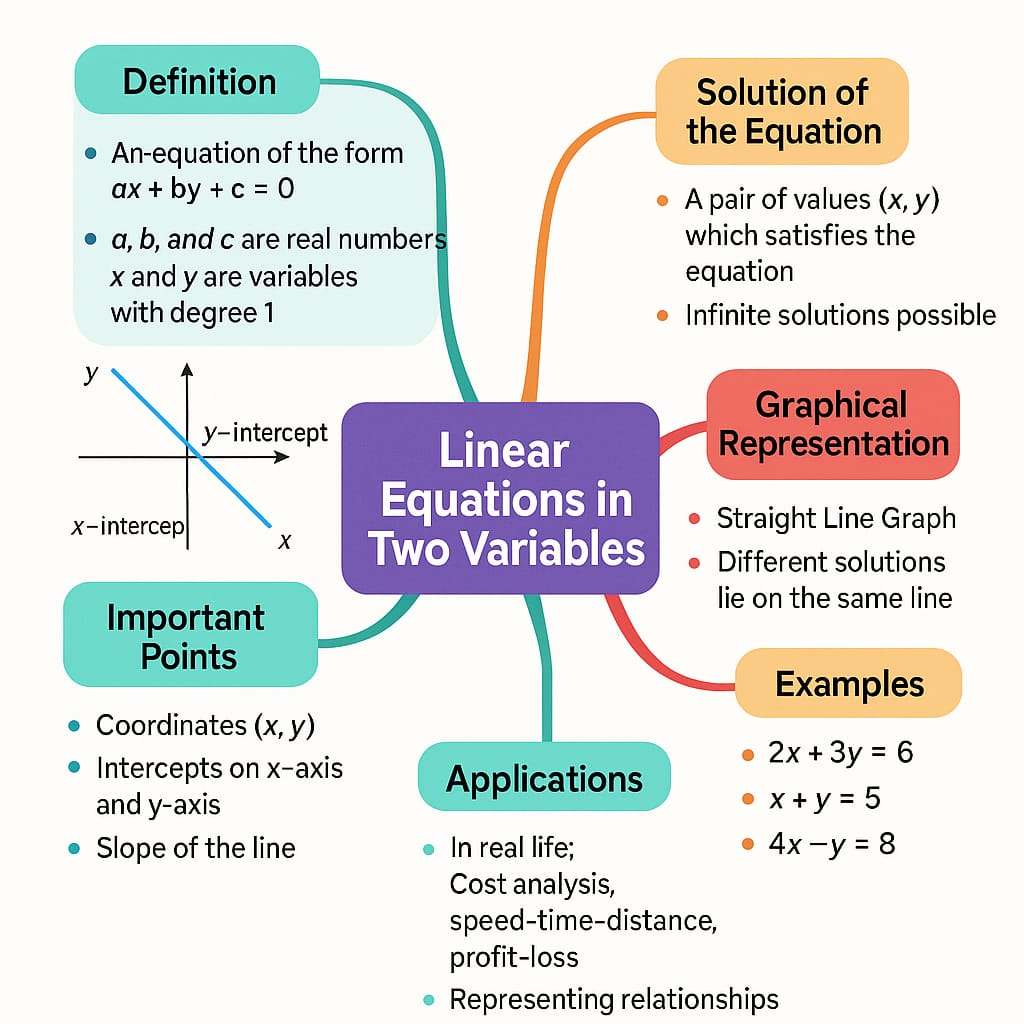
• A linear equation in two variables is an equation of the form ax + by + c = 0, where a, b, c ∈ ℝ and at least one of a, b ≠ 0.
• Examples: 2x + 3y − 5 = 0, x − y + 7 = 0.
• Real-life: Budget problems (x=apples, y=bananas) or train tickets (x=adults, y=children) fit this form.
🟢 2) Variables and Solutions ⚡
• Variables x and y can take infinitely many pairs (x,y) satisfying ax+by+c=0.
• Each solution corresponds to a point on a plane.
• ✔ Example: For 2x + 3y = 6 → choose x=0 ⇒ 3y=6 ⇒ y=2 ⇒ solution (0,2). Choose y=0 ⇒2x=6 ⇒ x=3 ⇒(3,0).
🟡 3) Graphical Representation ➡️
• Plot several solutions, join with a straight line.
• Every point on the line is a solution.
• ✏️ Note: Two variables → line; one variable → point on a line (number line).
🔴 4) Finding Solutions 🌿
1️⃣ Choose any value for x, solve for y.
2️⃣ Choose another x, solve for y.
3️⃣ Plot the points, draw line.
💡 Concept: Because a linear equation is first degree, only two points are needed to draw its graph, but a third is used for accuracy.
🔵 5) Intercepts ✔️
• x-intercept: Set y=0 → solve for x.
• y-intercept: Set x=0 → solve for y.
Example: 3x + 2y −6=0 ⇒ y=0 ⇒x=2 ⇒x-intercept=2; x=0 ⇒2y−6=0 ⇒y=3 ⇒y-intercept=3.
🟢 6) Parallel & Coincident Lines 🧠
• Lines ax+by+c=0 and a₁x+b₁y+c₁=0 are:
– Parallel if a/b = a₁/b₁ ≠ c/c₁.
– Coincident if a/b = a₁/b₁ = c/c₁.
– Intersecting otherwise.
🟡 7) Practical Problems 🌿
Example: The sum of two numbers is 10 and difference is 4. Let numbers=x,y.
x + y=10, x − y=4 ⇒ Solve graphically or algebraically.
🔴 8) Applications ✔️
• Budgeting, mixtures, rates of motion, ticket problems, workforce tasks.
• Coordinate geometry uses these lines to represent relationships.
🔵 9) Important Observations ✏️
• Infinite solutions.
• Every linear equation represents a straight line.
• Points on axes are special cases (x=0 or y=0).
🟢 10) Real-Life Illustration 🌿
Suppose taxi fare: ₹50 fixed + ₹10/km. Equation: y=10x+50, where x=km, y=fare. Plotting gives straight line showing cost pattern.
🟡 11) Common Mistakes 🔴
• Mixing variables’ positions when plotting.
• Using only one point—line undefined.
• Forgetting negative signs.
🔵 12) Practice Ideas ⚡
1️⃣ Draw the graph of 2x+y=6.
2️⃣ Find intercepts of x+2y=8.
3️⃣ Solve 3x−2y=12 and x+y=6 graphically.
4️⃣ Model “sum of angles of triangle =180°” as equation.
🟢 13) Higher-Order Insight 🧠
• Two linear equations in two variables intersect at a point (unique solution), are parallel (no solution), or coincident (infinite solutions).
• Systems form the base of analytic geometry and algebraic methods in higher classes.
🔴 14) Historical Note 🌿
Descartes’ Cartesian plane allowed algebraic equations like ax+by+c=0 to represent geometric lines, uniting two mathematical branches.
🟡 15) Recap of Graphing Steps ✔️
• Rewrite equation to express y in terms of x or vice versa.
• Choose x-values, compute y-values.
• Plot points, draw line.
• Mark intercepts for clarity.
🔵 16) Applications Beyond Class 🏗
• Economics: Demand–supply curves.
• Physics: Uniform motion graphs.
• Engineering: CAD drawings.
• Gaming: Collision detection between lines.
✨ 17) Closing Thought 🌿
Linear equations in two variables transform word problems into visual, solvable forms, preparing you for advanced topics.
🟣 Summary (~300 words)
Definition & Form
• Linear equation in two variables: ax+by+c=0, a,b≠0 not simultaneously.
• Infinitely many solutions—each a point on a straight line.
Graphical Representation
• Two points determine the line.
• Intercepts found by setting variables zero.
• Points plotted on Cartesian plane follow quadrant sign rules.
Relations Between Lines
• Intersecting → unique solution.
• Parallel → no solution.
• Coincident → infinitely many solutions.
Applications
• Real-life budgeting, fares, mixture problems, and rates.
• Physics motion and economics graphs.
Common Errors
• Interchanging x,y while plotting.
• Using only one point.
• Ignoring sign of intercepts.
Mastering these builds foundations for simultaneous equations, slopes, and analytic geometry.
📝 Quick Recap
🔵 Form: ax+by+c=0 (a,b not both 0).
🟢 Graph: plot ≥2 solutions → straight line.
🟡 Intercepts: set one variable zero.
🔴 Lines relation: intersecting/parallel/coincident.
🔵 Infinite solutions → every point on line.
✨ Applications: budgeting, fares, physics, economics.
————————————————————————————————————————————————————————————————————————————
TEXT BOOK QUESTIONS
Exercise 4.1
🔵 Question 1
The cost of a notebook is twice the cost of a pen. Write a linear equation in two variables to represent this statement. (Take the cost of a notebook to be ₹ x and that of a pen to be ₹ y.)
🟢 Answer
🔵 Step 1: Cost of notebook = x, cost of pen = y.
🔵 Step 2: Notebook cost is twice pen cost ⇒ x = 2y.
✔️ Final: x − 2y = 0
🔵 Question 2(i)
Express 2x + 3y = 9.35 in ax + by + c = 0 form and indicate values of a, b, c.
🟢 Answer
🔵 Step 1: Already in standard form ⇒ 2x + 3y − 9.35 = 0.
🟡 Check: a = 2, b = 3, c = −9.35.
✔️ Final: a = 2, b = 3, c = −9.35
🔵 Question 2(ii)
x − (y/5) − 10 = 0
🟢 Answer
🔵 Step 1: Standard form is x − (1/5)y − 10 = 0.
🟡 Values: a = 1, b = −1/5, c = −10.
✔️ Final: a = 1, b = −1/5, c = −10
🔵 Question 2(iii)
−2x + 3y = 6
🟢 Answer
🔵 Step 1: Rewrite ⇒ −2x + 3y − 6 = 0.
🟡 Values: a = −2, b = 3, c = −6.
✔️ Final: a = −2, b = 3, c = −6
🔵 Question 2(iv)
x = 3y
🟢 Answer
🔵 Step 1: Bring all terms to LHS ⇒ x − 3y = 0.
🟡 Values: a = 1, b = −3, c = 0.
✔️ Final: a = 1, b = −3, c = 0
🔵 Question 2(v)
2x = −5y
🟢 Answer
🔵 Step 1: 2x + 5y = 0.
🟡 Values: a = 2, b = 5, c = 0.
✔️ Final: a = 2, b = 5, c = 0
🔵 Question 2(vi)
3x + 2 = 0
🟢 Answer
🔵 Step 1: Rewrite as 3x + 0·y + 2 = 0.
🟡 Values: a = 3, b = 0, c = 2.
✔️ Final: a = 3, b = 0, c = 2
🔵 Question 2(vii)
y − 2 = 0
🟢 Answer
🔵 Step 1: Rewrite as 0·x + y − 2 = 0.
🟡 Values: a = 0, b = 1, c = −2.
✔️ Final: a = 0, b = 1, c = −2
🔵 Question 2(viii)
5 = 2x
🟢 Answer
🔵 Step 1: Rewrite as 2x − 5 = 0 ⇒ 2x + 0·y − 5 = 0.
🟡 Values: a = 2, b = 0, c = −5.
✔️ Final: a = 2, b = 0, c = −5
Exercise 4.2
🔵 Question 1
Which one of the following options is true, and why?
y = 3x + 5 has
(i) a unique solution, (ii) only two solutions, (iii) infinitely many solutions
🟢 Answer
🔵 Step 1: A linear equation in two variables represents a straight line in a plane.
🔵 Step 2: Every point on that line is a solution ⇒ infinitely many solutions.
✔️ Final: Option (iii) — infinitely many solutions, because each point (x, 3x + 5) satisfies the equation.
🔵 Question 2
Write four solutions for each of the following equations:
(i) 2x + y = 7 (ii) πx + y = 9 (iii) x = 4y
🟢 Answer
✏️ Tip: Choose convenient values for one variable, solve for the other.
🔵 (i) 2x + y = 7
🟢 Take x = 0 ⇒ y = 7 ⇒ (0, 7)
🟢 Take x = 1 ⇒ y = 5 ⇒ (1, 5)
🟢 Take x = 2 ⇒ y = 3 ⇒ (2, 3)
🟢 Take x = 3 ⇒ y = 1 ⇒ (3, 1)
🔵 (ii) πx + y = 9
🟢 Let x = 0 ⇒ y = 9 ⇒ (0, 9)
🟢 Let x = 1 ⇒ y = 9 − π ⇒ (1, 9 − π)
🟢 Let x = 2 ⇒ y = 9 − 2π ⇒ (2, 9 − 2π)
🟢 Let x = 3 ⇒ y = 9 − 3π ⇒ (3, 9 − 3π)
🔵 (iii) x = 4y
🟢 Let y = 0 ⇒ x = 0 ⇒ (0, 0)
🟢 Let y = 1 ⇒ x = 4 ⇒ (4, 1)
🟢 Let y = 2 ⇒ x = 8 ⇒ (8, 2)
🟢 Let y = −1 ⇒ x = −4 ⇒ (−4, −1)
🔵 Question 3
Check which of the following are solutions of x − 2y = 4 and which are not:
(i) (0, 2) (ii) (2, 0) (iii) (4, 0) (iv) (√2, 4√2) (v) (1, 1)
🟢 Answer
🔵 (i) (0, 2): 0 − 2(2)= −4 ≠ 4 ⇒ ❌ Not a solution.
🔵 (ii) (2, 0): 2 − 0= 2 ≠ 4 ⇒ ❌ Not a solution.
🔵 (iii) (4, 0): 4 − 0= 4 ⇒ ✔ Solution.
🔵 (iv) (√2, 4√2): √2 − 8√2= −7√2 ≠ 4 ⇒ ❌ Not a solution.
🔵 (v) (1, 1): 1 − 2= −1 ≠ 4 ⇒ ❌ Not a solution.
✔️ Final: Only (4, 0) is a solution.
🔵 Question 4
Find the value of k if x = 2, y = 1 is a solution of the equation 2x + 3y = k.
🟢 Answer
🔵 Step 1: Substitute x=2, y=1 ⇒ 2(2) + 3(1)= 4 + 3= 7.
✔️ Final: k = 7
————————————————————————————————————————————————————————————————————————————
OTHER IMPORTANT QUESTIONS FOR EXAMS
🔵 Question 1 (Section A)
What is the standard form of a linear equation in two variables?
🟢 Answer:
✳️ ax + by + c = 0, where a, b, c are real and a, b are not both zero.
🔵 Question 2 (Section A)
How is a solution of a linear equation in two variables represented?
🟢 Answer:
✳️ As an ordered pair (x, y) that satisfies the equation.
🔵 Question 3 (Section A)
Is (2, 1) a solution of 3x − y = 5?
🟢 Answer:
✳️ Substitute: 3(2) − 1 = 6 − 1 = 5
✔️ Yes, (2, 1) satisfies the equation.
🔵 Question 4 (Section A)
Write the x-intercept of 2x + 3y = 6.
🟢 Answer:
✳️ Put y = 0: 2x = 6 ⇒ x = 3
✔️ x-intercept = (3, 0)
🔵 Question 5 (Section A)
How many solutions does a linear equation in two variables have?
🟢 Answer:
✳️ Infinitely many (all points on its straight line).
🔵 Question 6 (Section A)
State whether x = 0, y = 4 lies on x + y = 4.
🟢 Answer:
✳️ Substitute: 0 + 4 = 4 (true)
✔️ Yes, (0, 4) lies on the line.
🟡 Section B — Short Answer-I (2 marks each)
🔵 Question 7
Check whether (−1, 4) is a solution of 2x + y = 3 and of x − 2y = −9.
🟢 Answer:
✳️ For 2x + y = 3: 2(−1) + 4 = −2 + 4 = 2 ≠ 3
✳️ For x − 2y = −9: (−1) − 2(4) = −1 − 8 = −9 ✔️
✔️ Not a solution of the first; is a solution of the second.
🔵 Question 8
Find the y-intercept of 5x − 2y = 10 and write the intercept point.
🟢 Answer:
✳️ Put x = 0: −2y = 10
✳️ y = −5
✔️ y-intercept = (0, −5)
🔵 Question 9
Find two distinct solutions of x + y = 7.
🟢 Answer:
✳️ Take x = 0 ⇒ y = 7 ⇒ solution (0, 7)
✳️ Take x = 3 ⇒ y = 4 ⇒ solution (3, 4)
✔️ Two solutions: (0, 7) and (3, 4)
🔵 Question 10
Form the linear equation whose solution set is all points with y = 2x.
🟢 Answer:
✳️ Required relation: y − 2x = 0
✔️ Equation: 2x − y = 0 (or y − 2x = 0)
🔵 Question 11
The sum of two numbers is 9 and one number is 4 more than the other. Form the linear equation in x, y.
🟢 Answer:
✳️ Let numbers be x and y.
✳️ Sum condition: x + y = 9
✳️ “One is 4 more than the other”: x − y = 4 (or y − x = −4)
✔️ Linear equations: x + y = 9, x − y = 4
🔵 Question 12
Find two points on the line 3x + y = 12 and use them to write the slope-intercept form.
🟢 Answer:
✳️ Put x = 0 ⇒ y = 12 ⇒ point (0, 12)
✳️ Put y = 0 ⇒ 3x = 12 ⇒ x = 4 ⇒ point (4, 0)
✳️ Convert to y = mx + c: y = −3x + 12
✔️ Two points: (0, 12) and (4, 0); slope-intercept form: y = −3x + 12
🔵 Question 13 (Section C)
Write the linear equation whose graph passes through (2, 5) and has slope −3.
🟢 Answer:
✳️ ➤ Slope-intercept form: y − y₁ = m(x − x₁)
✳️ ➤ Substitution: y − 5 = −3(x − 2)
✳️ ➤ Simplify: y − 5 = −3x + 6 ⇒ y = −3x + 11
✔️ Equation: y = −3x + 11
🔵 Question 14 (Section C)
Find the slope of the line joining (−2, 7) and (4, −5).
🟢 Answer:
✳️ ➤ Formula: m = (y₂ − y₁)/(x₂ − x₁)
✳️ ➤ Substitution: (−5 − 7)/(4 − (−2)) = (−12)/6 = −2
✔️ Slope: −2
🔵 Question 15 (Section C)
Determine whether the points A(2, −1), B(5, 3), C(8, 7) are collinear.
🟢 Answer:
✳️ Slope AB = (3 − (−1))/(5 − 2) = 4/3
✳️ Slope BC = (7 − 3)/(8 − 5) = 4/3
✳️ Slopes equal ⇒ points are collinear.
✔️ Final: Yes, A, B, C are collinear.
🔵 Question 16 (Section C)
Form a pair of linear equations for: “The sum of two numbers is 12, and their difference is 4.”
🟢 Answer:
✳️ Let numbers = x, y.
✳️ Sum: x + y = 12.
✳️ Difference: x − y = 4.
✔️ Equations: x + y = 12, x − y = 4
🔵 Question 17 (Section C)
Draw the graph of x + y = 6. Find the area of the triangle formed with the coordinate axes.
🟢 Answer:
✳️ Intercepts: x-intercept: set y = 0 ⇒ x = 6 ⇒ (6, 0).
✳️ y-intercept: set x = 0 ⇒ y = 6 ⇒ (0, 6).
✳️ Base and height = 6 each.
✳️ Area = ½ × base × height = ½ × 6 × 6 = 18.
✔️ Area: 18 square units
🔵 Question 18 (Section C)
Find the equation of the line parallel to 3x + 4y = 12 and passing through (−2, 5).
🟢 Answer:
✳️ Rewrite: 3x + 4y = 12 ⇒ y = −3/4 x + 3 ⇒ slope m = −3/4.
✳️ Parallel line ⇒ same slope.
✳️ Point-slope: y − 5 = −3/4(x + 2).
✳️ Multiply: 4(y − 5) = −3(x + 2) ⇒ 4y − 20 = −3x − 6 ⇒ 3x + 4y − 14 = 0.
✔️ Equation: 3x + 4y − 14 = 0
🔵 Question 19 (Section C)
Find the value of k if the line 2x + 3y = k passes through (−1, 4).
🟢 Answer:
✳️ Substitution: 2(−1) + 3(4) = k ⇒ −2 + 12 = 10.
✔️ k = 10
🔵 Question 20 (Section C)
The line through (3, −2) is perpendicular to the line 5x − 2y + 7 = 0. Find its equation.
🟢 Answer:
✳️ Original line slope: 5x − 2y + 7 = 0 ⇒ y = (5/2)x + (7/2) ⇒ slope m₁ = 5/2.
✳️ Perpendicular slope: m₂ = −2/5.
✳️ Equation: y + 2 = (−2/5)(x − 3).
✳️ Multiply: 5(y + 2) = −2(x − 3) ⇒ 5y + 10 = −2x + 6 ⇒ 2x + 5y + 4 = 0.
✔️ Equation: 2x + 5y + 4 = 0
🔵 Question 21 (Section C)
Find the coordinates where the line x − 2y = 4 meets the x-axis and y-axis.
🟢 Answer:
✳️ On x-axis (y = 0): x − 0 = 4 ⇒ x = 4 ⇒ (4, 0).
✳️ On y-axis (x = 0): 0 − 2y = 4 ⇒ y = −2 ⇒ (0, −2).
✔️ Points: (4, 0) and (0, −2)
🔵 Question 22 (Section C)
Find the equation of the line passing through (−3, 2) and (5, −6).
🟢 Answer:
✳️ Slope m = (−6 − 2)/(5 − (−3)) = (−8)/8 = −1.
✳️ Point-slope: y − 2 = −1(x + 3) ⇒ y − 2 = −x − 3 ⇒ y = −x − 1.
✔️ Equation: y = −x − 1
🔵 Question 23 (Section D)
Solve the system 2x + 3y = 12 and 3x − 2y = 1 by the elimination method. Verify the solution in both equations.
🟢 Answer:
✳️ ➤ Make coefficients of y equal: multiply the first by 2 and the second by 3.
• 2(2x + 3y) = 2(12) ⇒ 4x + 6y = 24
• 3(3x − 2y) = 3(1) ⇒ 9x − 6y = 3
✳️ ➤ Add the two equations:
(4x + 6y) + (9x − 6y) = 24 + 3 ⇒ 13x = 27
✳️ ➤ Simplification:
x = 27 ÷ 13 = 27/13
✳️ ➤ Substitute in 2x + 3y = 12:
2(27/13) + 3y = 12
54/13 + 3y = 12
3y = 12 − 54/13 = (156 − 54)/13 = 102/13
y = (102/13) ÷ 3 = 102/39 = 34/13
✳️ ➤ Verification:
• 2x + 3y = 2(27/13) + 3(34/13) = (54 + 102)/13 = 156/13 = 12 ✔️
• 3x − 2y = 3(27/13) − 2(34/13) = (81 − 68)/13 = 13/13 = 1 ✔️
✔️ Final: x = 27/13, y = 34/13
🔵 Question 24 (Section D)
A shopkeeper sells pens at ₹10 each and notebooks at ₹15 each. On a day he sells total 20 items and collects ₹240. Find the number of pens and notebooks sold.
🟢 Answer:
✳️ ➤ Let pens = x, notebooks = y.
✳️ ➤ Form equations:
➤ Quantity: x + y = 20
➤ Amount: 10x + 15y = 240
✳️ ➤ Solve: from x + y = 20 ⇒ y = 20 − x.
Substitute in 10x + 15y = 240:
10x + 15(20 − x) = 240
10x + 300 − 15x = 240
−5x = −60 ⇒ x = 12
Then y = 20 − 12 = 8
✔️ Final: Pens = 12, Notebooks = 8
OR
🔵 Alternative Question 24
Find k such that the system 2x + 3y = 7 and 4x + 6y = k has infinitely many solutions.
🟢 Answer (Alt):
✳️ ➤ For infinitely many solutions: ratios of coefficients (a₁:a₂ = b₁:b₂ = c₁:c₂).
Here: a₁:a₂ = 2:4 = 1:2, b₁:b₂ = 3:6 = 1:2 ⇒ must have c₁:c₂ = 7:k = 1:2.
✳️ ➤ So k = 14.
✔️ Final (Alt): k = 14
🔵 Question 25 (Section D)
Find the equation of the line passing through point (1, 2) and the point of intersection of lines x + y = 5 and 2x − y = 1.
🟢 Answer:
✳️ ➤ First find intersection P(x, y) of the two lines.
From x + y = 5 ⇒ y = 5 − x.
Substitute in 2x − y = 1: 2x − (5 − x) = 1 ⇒ 2x − 5 + x = 1 ⇒ 3x = 6 ⇒ x = 2
Then y = 5 − 2 = 3 ⇒ P(2, 3)
✳️ ➤ Find slope m of line through (1, 2) and (2, 3):
m = (3 − 2)/(2 − 1) = 1
✳️ ➤ Equation (point–slope):
y − 2 = 1(x − 1) ⇒ y = x + 1
✔️ Final: y = x + 1
🔵 Question 26 (Section D)
Solve the system by substitution: x − 2y = 4 and 3x + y = 7. Check your answer.
🟢 Answer:
✳️ ➤ From x − 2y = 4 ⇒ x = 4 + 2y.
✳️ ➤ Substitute in 3x + y = 7:
3(4 + 2y) + y = 7
12 + 6y + y = 7
12 + 7y = 7 ⇒ 7y = −5 ⇒ y = −5/7
✳️ ➤ Then x = 4 + 2(−5/7) = 4 − 10/7 = (28 − 10)/7 = 18/7
✳️ ➤ Check:
• x − 2y = 18/7 − 2(−5/7) = 18/7 + 10/7 = 28/7 = 4 ✔️
• 3x + y = 3(18/7) + (−5/7) = (54 − 5)/7 = 49/7 = 7 ✔️
✔️ Final: x = 18/7, y = −5/7
OR
🔵 Alternative Question 26
For the system (k)x + 2y = 6 and 3x + (k)y = 12, find k for which the system has:
(i) a unique solution, (ii) no solution, (iii) infinitely many solutions.
🟢 Answer (Alt):
✳️ ➤ Compare ratios: a₁/a₂ = k/3, b₁/b₂ = 2/k, c₁/c₂ = 6/12 = 1/2.
• Unique solution if a₁/a₂ ≠ b₁/b₂ ⇒ k/3 ≠ 2/k ⇒ k² ≠ 6 ⇒ k ≠ ±√6.
• Infinitely many if k/3 = 2/k = 1/2.
From k/3 = 1/2 ⇒ k = 3/2 and 2/k = 1/2 ⇒ k = 4 (contradiction). No common k ⇒ none.
• No solution if k/3 = 2/k ≠ 1/2 ⇒ k² = 6 but 1/2 ≠ 1/2? (indeed 1/2 ≠ 1/2 is false); here ratios of a,b equal but not equal to c-ratio ⇒ k = ±√6 gives no solution.
✔️ Final (Alt): Unique: k ≠ ±√6; No solution: k = ±√6; Infinitely many: no value of k
🔵 Question 27 (Section D)
A line has x-intercept 4 and passes through (2, 3). Find its y-intercept and the equation.
🟢 Answer:
✳️ ➤ Intercept form: x/a + y/b = 1, where a = 4, b = y-intercept.
✳️ ➤ Substitute (2, 3):
2/4 + 3/b = 1 ⇒ 1/2 + 3/b = 1 ⇒ 3/b = 1/2 ⇒ b = 6
✳️ ➤ Equation: x/4 + y/6 = 1.
✳️ ➤ Standard form: multiply by 12 ⇒ 3x + 2y = 12
✔️ Final: y-intercept = 6; Equation: 3x + 2y = 12
🔵 Question 28 (Section D)
Graph the lines x + 2y = 8 and x − y = 2. Find their point of intersection and the area of the triangle formed by the line x + 2y = 8 with the coordinate axes.
🟢 Answer:
✳️ ➤ Solve intersection:
From x − y = 2 ⇒ x = y + 2.
Substitute in x + 2y = 8 ⇒ (y + 2) + 2y = 8 ⇒ 3y + 2 = 8 ⇒ y = 2; x = 4.
Intersection: (4, 2)
✳️ ➤ Intercepts of x + 2y = 8:
x-intercept: y = 0 ⇒ x = 8 ⇒ (8, 0)
y-intercept: x = 0 ⇒ 2y = 8 ⇒ y = 4 ⇒ (0, 4)
✳️ ➤ Area with axes:
Area = ½ × base × height = ½ × 8 × 4 = 16
✔️ Final: Intersection (4, 2); Area = 16 square units
OR
🔵 Alternative Question 28
Find the equation of the line perpendicular to 2x + 5y − 10 = 0 and passing through (−1, 4).
🟢 Answer (Alt):
✳️ ➤ Slope of 2x + 5y − 10 = 0: y = (−2/5)x + 2 ⇒ m₁ = −2/5
✳️ ➤ Perpendicular slope: m₂ = 5/2 (m₁·m₂ = −1).
✳️ ➤ Equation: y − 4 = (5/2)(x + 1)
Multiply 2: 2y − 8 = 5x + 5 ⇒ 5x − 2y + 13 = 0
✔️ Final (Alt): 5x − 2y + 13 = 0
🔵 Question 29 (Section D)
Show that the lines 3x + ky − 6 = 0 and kx − 3y + 4 = 0 are perpendicular when k² = 9. Hence find the corresponding slopes.
🟢 Answer:
✳️ ➤ Slopes:
Line₁: 3x + ky − 6 = 0 ⇒ y = (−3/k)x + 6/k ⇒ m₁ = −3/k
Line₂: kx − 3y + 4 = 0 ⇒ y = (k/3)x + 4/3 ⇒ m₂ = k/3
✳️ ➤ Product: m₁·m₂ = (−3/k)·(k/3) = −1 for any k ≠ 0.
✳️ ➤ If k² = 9 ⇒ k = ±3, both lines defined and m₁·m₂ = −1 ⇒ perpendicular.
✳️ ➤ Slopes for k = 3: m₁ = −1, m₂ = 1.
For k = −3: m₁ = 1, m₂ = −1.
✔️ Final: Perpendicular for k = ±3; slopes (−1, 1) in either order.
🔵 Question 30 (Section D)
“The sum of two numbers is 27 and their difference is 5. Find the numbers.” Also state the general form of the two equations.
🟢 Answer:
✳️ ➤ Let numbers be x, y.
✳️ ➤ Form equations:
➤ Sum: x + y = 27
➤ Difference: x − y = 5
✳️ ➤ Solve (add): (x + y) + (x − y) = 27 + 5 ⇒ 2x = 32 ⇒ x = 16
✳️ ➤ Substitute: 16 + y = 27 ⇒ y = 11
✔️ Final: Numbers = 16 and 11; Equations: x + y = 27, x − y = 5
————————————————————————————————————————————————————————————————————————————