
Class 12 : Physics (English) – Chapter 1: Electric Charges and Fields

EXPLANATION & SUMMARY
Introduction to Electrostatics
Electricity begins with the concept of electric charge. Electrostatics is the study of charges at rest. This chapter lays the foundation for understanding the forces, fields, and principles associated with electric charges.
Electric Charge and Its Properties
Electric charge is a fundamental property of matter, just like mass. It exists in two forms: positive and negative. Charges of the same kind repel each other, while unlike charges attract.
Key Properties of Electric Charge:
Additivity: Charges can be added algebraically. For example, +2C and -3C result in -1C total charge.
Conservation: Total electric charge is conserved in an isolated system. Charge can neither be created nor destroyed, only transferred.
Quantization: Charge exists in discrete packets, i.e., it is quantized. The smallest unit is the charge of an electron (e = 1.6 × 10⁻¹⁹ C). Any charge (q) = ne, where n is an integer.
Invariance: Electric charge is unaffected by the state of motion. It remains the same in all reference frames.
Methods of Charging a Body
Friction: Rubbing two different materials transfers electrons, e.g., rubbing glass with silk.
Conduction: Charging by direct contact between a charged and a neutral body.
Induction: A charged body induces opposite charge on a nearby conductor without touching it.
Coulomb’s Law
Coulomb’s law gives the force between two point charges:
F = (1/4πε₀) × (q₁q₂/r²)
Where:
F = force between charges
q₁ and q₂ = magnitudes of two point charges
r = distance between the charges
ε₀ = permittivity of free space = 8.854 × 10⁻¹² C²/N·m²
This law shows:
The force is directly proportional to the product of charges.
Inversely proportional to the square of the distance.
It acts along the line joining the charges.
Vector Form of Coulomb’s Law
The vector form of force F on charge q₁ due to q₂ is:
F₁₂ = (1/4πε₀) × (q₁q₂/|r₁₂|³) × r₁₂
Where r₁₂ is the position vector from q₁ to q₂.
This law satisfies Newton’s third law: F₁₂ = -F₂₁
The Principle of Superposition
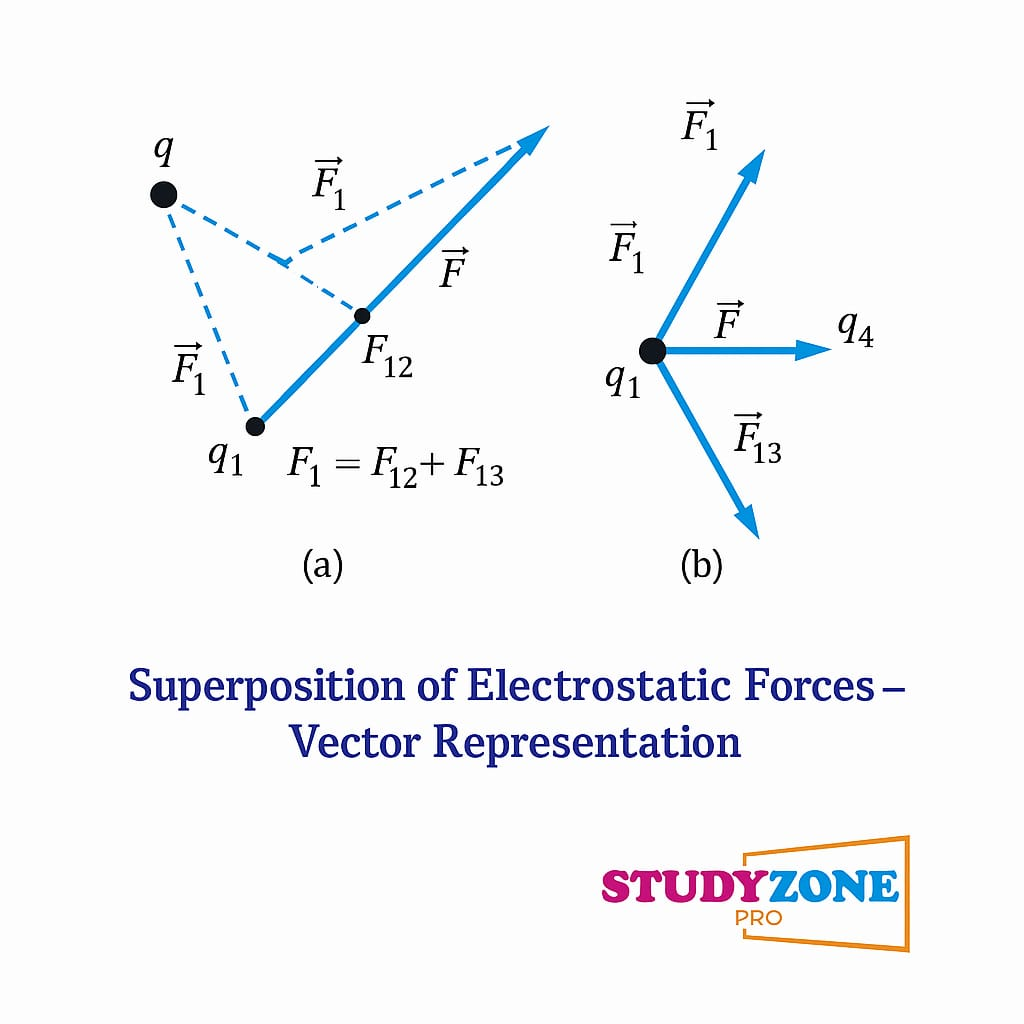
In systems with more than two charges, total force on a charge is the vector sum of all individual forces.
If multiple charges q₁, q₂, q₃, …, qₙ exert forces F₁, F₂, …, Fₙ on charge q, then:
F_total = F₁ + F₂ + … + Fₙ
This principle allows calculation of net force even in complex charge configurations.
Electric Field
The electric field is the region around a charge where other charges feel a force.
Electric Field due to a Point Charge q:
E = (1/4πε₀) × (q/r²) r̂
Where:
E is the electric field vector
r̂ is a unit vector from charge to the point of observation
It is a vector quantity and follows superposition principle.
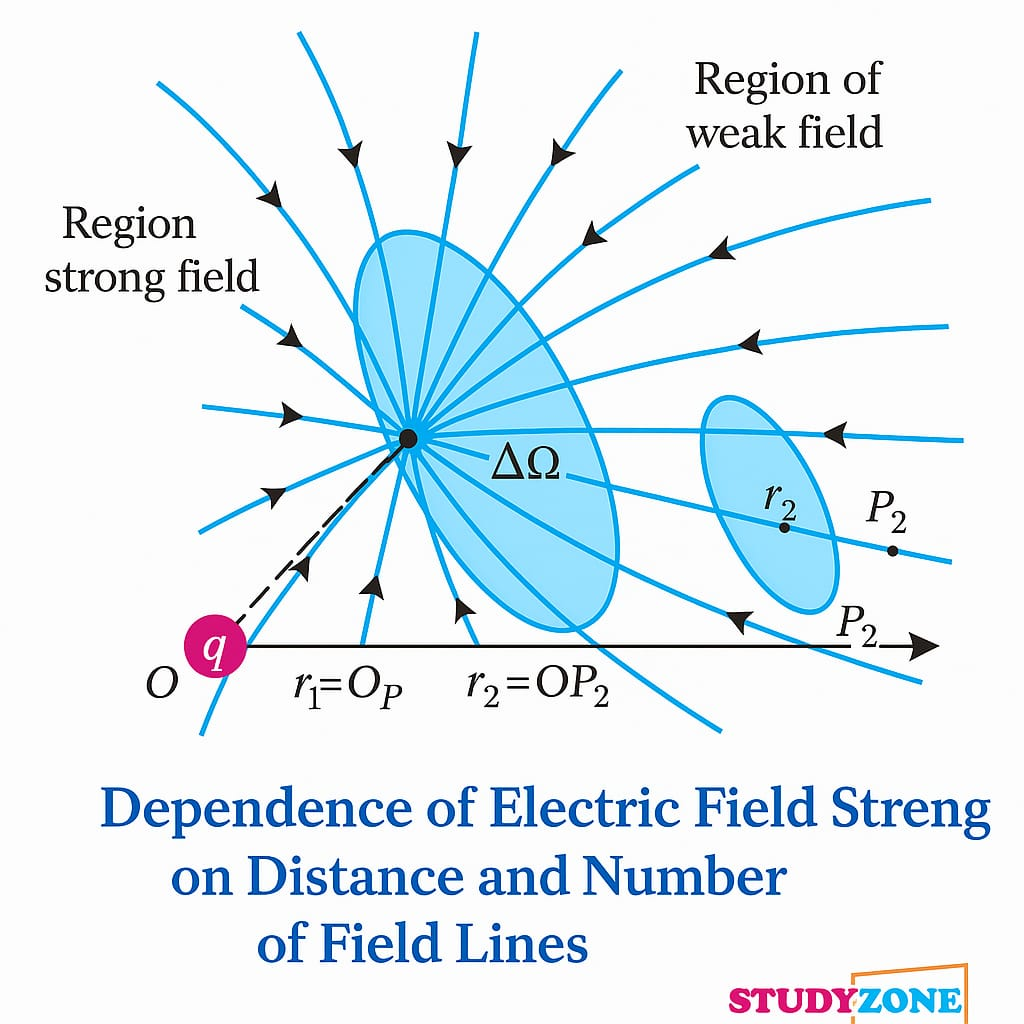
Electric Field Lines
Visual representation of the electric field:
Begin on positive and end on negative charges
Never intersect
Denser lines = stronger field
Tangent to a field line = direction of electric field
For a single positive charge: radial outward lines
For a dipole: lines curve from positive to negative
Electric Dipole
A pair of equal and opposite charges (+q and -q) separated by a small distance 2a.
Dipole Moment (p) = q × 2a
It is a vector directed from -q to +q.
Electric Field Due to a Dipole
At an axial point (on the line joining charges):
E_axial = (1/4πε₀) × (2p/r³)
At an equatorial point (perpendicular bisector):
E_equatorial = (1/4πε₀) × (p/r³)
Both fields vary as 1/r³ and show directionality based on the position.
Torque on a Dipole in Uniform Electric Field
When placed in a uniform electric field E, a dipole experiences a torque τ:
τ = p × E
Magnitude: τ = pE sinθ
This torque tends to align the dipole along the field direction.
Electric Flux
Electric flux (Φ_E) is the total number of electric field lines crossing a given area.
Φ_E = E · A = EA cosθ
It is a scalar and depends on field strength, area, and angle.
Gauss’s Law
Gauss’s Law relates the total electric flux through a closed surface to the enclosed charge:
∮ E · dA = q_enclosed / ε₀
This law is very useful for calculating electric fields in symmetric charge distributions.
Applications of Gauss’s Law
Electric Field due to a Point Charge
Using a spherical Gaussian surface:
E × 4πr² = q/ε₀ ⇒ E = (1/4πε₀) × (q/r²)
Same result as Coulomb’s law.
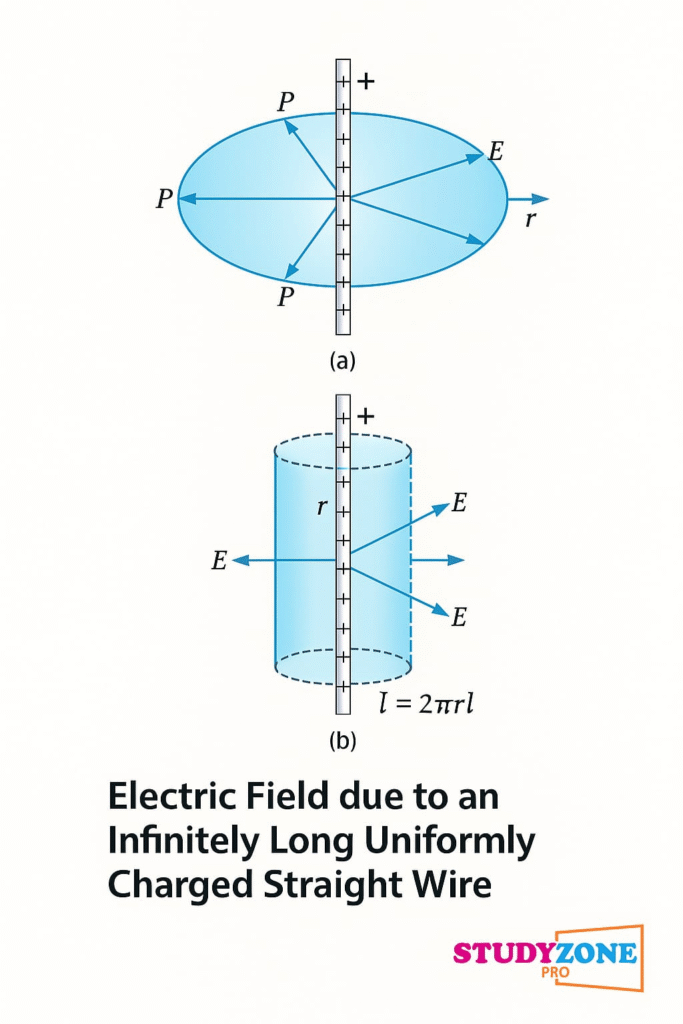
Field due to an Infinite Line Charge
Linear charge density λ:
E = λ / (2πε₀r)
Field due to an Infinite Plane Sheet of Charge
Surface charge density σ:
E = σ / (2ε₀)
Field due to Two Parallel Sheets (Oppositely Charged)
Net field between plates = σ/ε₀, and zero outside.
Charge Distribution and Conductors
Inside a conductor, the electric field is zero.
Excess charge resides on the outer surface.
Electric field is perpendicular to surface.
Surface charge distributes uniformly on a spherical conductor.
Cavity Inside a Conductor
Electric field inside a cavity with no charge = 0
If a charge is placed inside the cavity, an opposite charge is induced on the inner surface, and an equal charge on the outer surface.
Important Definitions Recap
Charge (q): Basic unit of electricity
Electric Field (E): Force per unit positive test charge
Electric Dipole Moment (p): q × 2a
Electric Flux (Φ): E × A cosθ
Permittivity (ε₀): Constant describing medium’s ability to permit electric field lines
✍ SUMMARY
Electric charge is a basic property of matter, existing in two types: positive and negative. It follows conservation, quantization, and additivity.
Charging can be done via friction, conduction, or induction.
Coulomb’s Law gives the electrostatic force between two point charges: F = (1/4πε₀)(q₁q₂/r²). It is central to electrostatics.
Electric field (E) at a point is the force per unit charge: E = (1/4πε₀)(q/r²). It is a vector and obeys superposition.
Field lines help visualize the direction and strength of electric fields. Denser lines indicate stronger fields.
An electric dipole consists of two equal and opposite charges separated by a distance. It has a dipole moment p = q × 2a.
Dipoles create electric fields that vary as 1/r³. In uniform electric fields, they experience torque τ = pE sinθ.
Electric flux (Φ) is the number of field lines crossing a surface: Φ = E·A = EA cosθ.
Gauss’s Law states: The total flux through a closed surface equals q_enclosed / ε₀. It simplifies electric field calculations in symmetric cases.
Using Gauss’s Law:
Field due to a point charge: E = (1/4πε₀)(q/r²)
Infinite line: E = λ/(2πε₀r)
Infinite plane sheet: E = σ/(2ε₀)
Between oppositely charged plates: E = σ/ε₀
Inside conductors, the electric field is zero and excess charge resides on the outer surface.
Electric shielding is achieved using conductors. The field inside a cavity remains zero if it contains no charge.
This chapter builds the foundation for all electrostatic phenomena, including electric potential and capacitors.
—————————————————————————————————————————————————————————————————————————————-=
TEXTBOOK QUESTIONS
Question 1.1
What is the force between two small charged spheres having charges of 2 × 10⁻⁷ C and 3 × 10⁻⁷ C placed 30 cm apart in air?
Solution:
Given:
q1 = 2 × 10⁻⁷ C
q2 = 3 × 10⁻⁷ C
r = 30 cm = 0.3 m
Coulomb’s law:
F = (1/4πε₀) × (q1 × q2)/r²
where 1/4πε₀ = 9 × 10⁹ N·m²·C⁻²
F = (9 × 10⁹) × (2 × 10⁻⁷ × 3 × 10⁻⁷)/(0.3)²
F = (9 × 10⁹) × (6 × 10⁻¹⁴)/0.09
F = 6 × 10⁻³ N
Answer: 6 × 10⁻³ N (repulsive)
Question 1.2
The electrostatic force on a small sphere of charge 0.4 μC due to another small sphere of charge –0.8 μC in air is 0.2 N. (a) What is the distance between the two spheres? (b) What is the force on the second sphere due to the first?
Solution:
(a) Given:
q1 = 0.4 μC = 4 × 10⁻⁷ C
q2 = –0.8 μC = –8 × 10⁻⁷ C
F = 0.2 N
Coulomb’s law:
F = (1/4πε₀) × |q1 × q2|/r²
0.2 = (9 × 10⁹) × (3.2 × 10⁻¹³)/r²
r² = (9 × 10⁹ × 3.2 × 10⁻¹³)/0.2 = 0.0144
r = √0.0144 = 0.12 m
(b) By Newton’s third law, the force on the second sphere is also 0.2 N (attractive).
Answer: (a) 0.12 m, (b) 0.2 N (attractive)
Question 1.3
Check that the ratio ke²/Gmₑmₚ is dimensionless. Determine its value. What does it signify?
Solution:
k = 1/4πε₀ (units: N·m²·C⁻²), e (C), G (N·m²·kg⁻²), mₑ and mₚ (kg)
ke² has units [ML³T⁻²], Gmₑmₚ also [ML³T⁻²], so the ratio is dimensionless.
k = 8.99 × 10⁹ N·m²·C⁻²
e = 1.602 × 10⁻¹⁹ C
G = 6.67 × 10⁻¹¹ N·m²·kg⁻²
mₑ = 9.11 × 10⁻³¹ kg, mₚ = 1.67 × 10⁻²⁷ kg
Ratio = (8.99 × 10⁹ × (1.602 × 10⁻¹⁹)²) / (6.67 × 10⁻¹¹ × 9.11 × 10⁻³¹ × 1.67 × 10⁻²⁷) ≈ 2.27 × 10³⁹
This ratio compares the electrostatic and gravitational forces between a proton and an electron.
Answer: Dimensionless, value ≈ 2.27 × 10³⁹, signifies electrostatic force is much stronger than gravitational force.
Question 1.4
(a) Explain the meaning of the statement ‘electric charge of a body is quantised’.
(b) Why can one ignore quantisation of electric charge when dealing with macroscopic charges?
Solution:
(a) Electric charge exists in discrete packets; the smallest possible charge is e = 1.6 × 10⁻¹⁹ C. Any charge q = n·e, where n is an integer.
(b) For macroscopic charges (e.g., 10⁻⁶ C), n is extremely large (~10¹³), so the discrete nature is negligible and charge can be treated as continuous.
Answer: (a) Charge is an integer multiple of e. (b) For large n, quantisation is negligible.
Question 1.5
When a glass rod is rubbed with a silk cloth, charges appear on both. Explain how this is consistent with the law of conservation of charge.
Solution:
Rubbing transfers electrons from the glass rod to the silk. The glass loses electrons (becomes positively charged), silk gains electrons (becomes negatively charged). The total charge before and after remains zero.
Answer: Charge is conserved because the total charge of the system remains unchanged; electrons are transferred, not created or destroyed.
Question 1.6
Four point charges qA = 2 μC, qB = –5 μC, qC = 2 μC, and qD = –5 μC are located at the corners of a square ABCD of side 10 cm. What is the force on a charge of 1 μC placed at the centre of the square?
Solution:
Distance from centre to each corner = (10√2)/2 = 5√2 cm = 0.05√2 m
By symmetry, the forces from charges of equal magnitude and opposite sign cancel each other out.
Net force on the central charge is zero.
Answer: 0 N
Question 1.7
(a) An electrostatic field line is a continuous curve. That is, a field line cannot have sudden breaks. Why not?
(b) Explain why two field lines never cross each other at any point.
Solution:
(a) Electric field is continuous; a break would imply the field is undefined or zero at that point, which is not possible.
(b) If two field lines crossed, the field at that point would have two directions, which is impossible.
Answer: (a) Field lines must be continuous because the field is continuous. (b) Field lines never cross because the field has a unique direction at any point.
Question 1.8
Two point charges qA = 3 μC and qB = –3 μC are located 20 cm apart in vacuum.
(a) What is the electric field at the midpoint O of the line joining the charges?
(b) If a test charge of 1.5 × 10⁻⁹ C is placed at O, what is the force experienced by it?
Solution:
(a) Distance from O to each charge = 10 cm = 0.1 m
Field due to qA: EA = (9 × 10⁹ × 3 × 10⁻⁶)/(0.1)² = 2.7 × 10⁶ N/C (away from A)
Field due to qB: EB = (9 × 10⁹ × 3 × 10⁻⁶)/(0.1)² = 2.7 × 10⁶ N/C (toward B, which is also away from A)
Net field at O: E = EA + EB = 5.4 × 10⁶ N/C (from A to B)
(b) Force on test charge: F = q × E = 1.5 × 10⁻⁹ × 5.4 × 10⁶ = 8.1 × 10⁻³ N (from A to B)
Answer: (a) 5.4 × 10⁶ N/C (A to B), (b) 8.1 × 10⁻³ N (A to B)
Question 1.9
A system has two charges qA = 2.5 × 10⁻⁷ C and qB = –2.5 × 10⁻⁷ C located at points A(0, 0, –15 cm) and B(0, 0, +15 cm), respectively. What are the total charge and electric dipole moment of the system?
Solution:
Total charge = qA + qB = 0
Distance between charges = 30 cm = 0.3 m
Dipole moment magnitude: p = q × 2a = 2.5 × 10⁻⁷ × 0.3 = 7.5 × 10⁻⁸ C·m
Direction: From negative to positive, i.e., from B to A, which is along negative z-axis
Dipole moment vector: p = –7.5 × 10⁻⁸ k̂ C·m
Answer: Total charge = 0, Dipole moment = –7.5 × 10⁻⁸ k̂ C·m
Question 1.10
An electric dipole with dipole moment 4 × 10⁻⁹ C·m is aligned at 30° with a uniform electric field of magnitude 5 × 10⁴ N/C. Calculate the torque on the dipole.
Solution:
Torque τ = pE sinθ
τ = 4 × 10⁻⁹ × 5 × 10⁴ × sin30°
τ = 2 × 10⁻⁴ × 0.5 = 1 × 10⁻⁴ N·m
Answer: 1 × 10⁻⁴ N·m
Question 1.11
A polythene piece rubbed with wool is found to have a negative charge of 3 × 10⁻⁷ C.
(a) Estimate the number of electrons transferred (from or to) the piece from the wool.
(b) Is there a transfer of mass from wool to polythene?
Solution:
(a) Number of electrons = total charge / charge per electron
n = 3 × 10⁻⁷ / 1.6 × 10⁻¹⁹ = 1.875 × 10¹² ≈ 1.9 × 10¹² electrons
(b) Mass of one electron = 9.1 × 10⁻³¹ kg
Total mass = n × mass of electron = 1.9 × 10¹² × 9.1 × 10⁻³¹ = 1.7 × 10⁻¹⁸ kg
Yes, there is a transfer of mass from wool to polythene.
Answer: (a) 1.9 × 10¹² electrons, (b) Yes, 1.7 × 10⁻¹⁸ kg transferred
Question 1.12
(a) Two insulated charged copper spheres A and B have their centres separated by a distance of 50 cm. What is the mutual force of electrostatic repulsion if the charge on each is 6.5 × 10⁻⁷ C? The radii of A and B are negligible compared to the distance of separation.
(b) What is the force of repulsion if each sphere is charged double the above amount, and the distance between them is halved?
Solution:
(a) Given values:
q₁ = 6.5 × 10⁻⁷ C
q₂ = 6.5 × 10⁻⁷ C
r = 50 cm = 0.5 m
Apply Coulomb’s law:
F = (1/4πε₀) × (q₁ × q₂)/r²
F = (9 × 10⁹) × (6.5 × 10⁻⁷)²/(0.5)²
F = (9 × 10⁹) × (4.225 × 10⁻¹³)/0.25
F = 1.52 × 10⁻² N
(b) Modified conditions:
q₁’ = q₂’ = 2 × 6.5 × 10⁻⁷ = 1.3 × 10⁻⁶ C
r’ = 25 cm = 0.25 m
F’ = (9 × 10⁹) × (1.3 × 10⁻⁶)²/(0.25)²
F’ = (9 × 10⁹) × (1.69 × 10⁻¹²)/0.0625
F’ = 2.43 × 10⁻¹ N
Answer: (a) 1.52 × 10⁻² N, (b) 2.43 × 10⁻¹ N
Question 1.13
Figure 1.30 shows tracks of three charged particles in a uniform electrostatic field. Give the signs of the three charges. Which particle has the highest charge to mass ratio?
Solution:
For charged particles in a uniform electric field, the deflection indicates:
Particles deflecting in one direction have the same sign charge
Particles deflecting in opposite direction have opposite sign charges
Greater deflection indicates higher charge to mass ratio
From the figure:
Particle 1: Deflects in one direction → positive charge
Particle 2: Deflects in same direction as 1 → positive charge
Particle 3: Deflects in opposite direction → negative charge
Particle 3 shows maximum deflection, hence highest q/m ratio.
Answer: Particle 1: positive, Particle 2: positive, Particle 3: negative. Particle 3 has highest q/m ratio.
Question 1.14
Consider a uniform electric field E = 3 × 10³ î N/C.
(a) What is the flux of this field through a square of 10 cm on a side whose plane is parallel to the yz plane?
(b) What is the flux through the same square if the normal to its plane makes a 60° angle with the x-axis?
Solution:
Given:
E = 3 × 10³ î N/C (along x-axis)
Square side = 10 cm = 0.1 m
Area = 0.01 m²
(a) Plane parallel to yz plane:
Normal to plane is along x-axis, so θ = 0°
Φ = E·A = EA cos(0°) = (3 × 10³) × 0.01 × 1 = 30 N·m²/C
(b) Normal makes 60° with x-axis:
Φ = EA cos(60°) = (3 × 10³) × 0.01 × 0.5 = 15 N·m²/C
Answer: (a) 30 N·m²/C, (b) 15 N·m²/C
Question 1.15
What is the net flux of the uniform electric field of Exercise 1.14 through a cube of side 20 cm oriented so that its faces are parallel to the coordinate planes?
Solution:
For a cube in uniform electric field E = 3 × 10³ î N/C:
Two faces perpendicular to x-axis: one face has flux +EA, other has flux -EA
Four faces parallel to x-axis: flux = 0 (E perpendicular to normal)
Net flux = (+EA) + (-EA) + 0 = 0
Answer: 0 N·m²/C
Question 1.16
Careful measurement of the electric field at the surface of a black box indicates that the net outward flux through the surface of the box is 8.0 × 10³ N·m²/C.
(a) What is the net charge inside the box?
(b) If the net outward flux through the surface of the box were zero, could you conclude that there were no charges inside the box? Why or Why not?
Solution:
(a) Using Gauss’s law: Φ = q_enclosed/ε₀
q_enclosed = Φ × ε₀ = (8.0 × 10³) × (8.85 × 10⁻¹²) = 7.08 × 10⁻⁸ C
(b) No, zero flux only means net charge is zero, not absence of charges.
Equal positive and negative charges inside would give zero net flux.
Answer: (a) 7.08 × 10⁻⁸ C, (b) No, zero flux means net charge = 0, not no charges
Question 1.17
A point charge +10 μC is a distance 5 cm directly above the centre of a square of side 10 cm. What is the magnitude of the electric flux through the square? (Hint: Think of the square as one face of a cube with edge 10 cm.)
Solution:
Using the hint: Imagine square as one face of cube with charge at center.
By symmetry, flux distributes equally through all 6 faces.
Total flux through cube = q/ε₀ = (10 × 10⁻⁶)/(8.85 × 10⁻¹²) = 1.13 × 10⁶ N·m²/C
Flux through one face = Total flux/6 = 1.88 × 10⁵ N·m²/C
Answer: 1.88 × 10⁵ N·m²/C
Question 1.18
A point charge of 2.0 μC is at the centre of a cubic Gaussian surface 9.0 cm on edge. What is the net electric flux through the surface?
Solution:
Using Gauss’s law: Φ = q_enclosed/ε₀
Φ = (2.0 × 10⁻⁶)/(8.85 × 10⁻¹²) = 2.26 × 10⁵ N·m²/C
Note: Size of cube doesn’t affect flux, only enclosed charge matters.
Answer: 2.26 × 10⁵ N·m²/C
Question 1.19
A point charge causes an electric flux of -1.0 × 10³ N·m²/C to pass through a spherical Gaussian surface of 10.0 cm radius centred on the charge.
(a) If the radius of the Gaussian surface were doubled, how much flux would pass through the surface?
(b) What is the value of the point charge?
Solution:
(a) Flux depends only on enclosed charge, not surface size.
Flux remains same = -1.0 × 10³ N·m²/C
(b) Using Gauss’s law: q = Φ × ε₀
q = (-1.0 × 10³) × (8.85 × 10⁻¹²) = -8.85 × 10⁻⁹ C = -8.85 nC
Answer: (a) -1.0 × 10³ N·m²/C, (b) -8.85 nC
Question 1.20
A conducting sphere of radius 10 cm has an unknown charge. If the electric field 20 cm from the centre of the sphere is 1.5 × 10³ N/C and points radially inward, what is the net charge on the sphere?
Solution:
For conducting sphere, field outside behaves like point charge at center.
Given: E = 1.5 × 10³ N/C (inward), r = 0.2 m
Using E = kq/r²:
|q| = Er²/k = (1.5 × 10³) × (0.2)²/(9 × 10⁹) = 6.67 × 10⁻⁹ C
Since field points inward, charge is negative.
q = -6.67 × 10⁻⁹ C = -6.67 nC
Answer: -6.67 nC
Question 1.21
A uniformly charged conducting sphere of 2.4 m diameter has a surface charge density of 80.0 μC/m².
(a) Find the charge on the sphere.
(b) What is the total electric flux leaving the surface of the sphere?
Solution:
Given: Radius = 1.2 m, σ = 80.0 × 10⁻⁶ C/m²
(a) Total charge = σ × surface area
Surface area = 4πr² = 4π × (1.2)² = 18.1 m²
q = (80.0 × 10⁻⁶) × 18.1 = 1.45 × 10⁻³ C = 1.45 mC
(b) Using Gauss’s law: Φ = q/ε₀
Φ = (1.45 × 10⁻³)/(8.85 × 10⁻¹²) = 1.64 × 10⁸ N·m²/C
Answer: (a) 1.45 mC, (b) 1.64 × 10⁸ N·m²/C
Question 1.22
An infinite line charge produces a field of 9 × 10⁴ N/C at a distance of 2 cm. Calculate the linear charge density.
Solution:
For infinite line charge: E = λ/(2πε₀r)
Given: E = 9 × 10⁴ N/C, r = 0.02 m
λ = E × 2πε₀r = (9 × 10⁴) × 2π × (8.85 × 10⁻¹²) × 0.02
λ = 1.0 × 10⁻⁵ C/m = 10 μC/m
Answer: 10 μC/m
Question 1.23
Two large, thin metal plates are parallel and close to each other. On their inner faces, the plates have surface charge densities of opposite signs and of magnitude 17.0 × 10⁻²² C/m². What is E:
(a) in the outer region of the first plate
(b) in the outer region of the second plate
(c) between the plates?
Solution:
Each plate produces field E = σ/(2ε₀)
Using superposition:
(a) Outer region of first plate: Fields from both plates cancel
E = 0
(b) Outer region of second plate: Fields from both plates cancel
E = 0
(c) Between plates: Fields from both plates add up
E = σ/ε₀ = (17.0 × 10⁻²²)/(8.85 × 10⁻¹²) = 1.92 × 10⁻¹¹ N/C
Answer: (a) 0, (b) 0, (c) 1.92 × 10⁻¹¹ N/C
————————————————————————————————————————————————————————————————————————————
OTHER IMPORTANT QUESTIONS
(CBSE MODEL QUESTIONS PAPER)
ESPECIALLY MADE FROM THIS LESSON ONLY
Q1. Which of the following quantities is a scalar?
(A) Electric field
(B) Electric force
(C) Electric flux
(D) Electric potential gradient
Answer: (C) Electric flux
Q2. The SI unit of electric charge is:
(A) Ampere
(B) Coulomb
(C) Volt
(D) Farad
Answer: (B) Coulomb
Q3. What is the value of electric field inside a conductor in electrostatic equilibrium?
(A) Zero
(B) Infinite
(C) Constant
(D) Equal to applied field
Answer: (A) Zero
Q4. Which law states that the total electric flux through a closed surface is equal to 1/ε₀ times the net charge enclosed?
(A) Coulomb’s Law
(B) Gauss’s Law
(C) Ampere’s Law
(D) Faraday’s Law
Answer: (B) Gauss’s Law
Q5. A charge +Q is placed at the centre of a cube. The electric flux through one face of the cube is:
(A) Q/ε₀
(B) Q/2ε₀
(C) Q/3ε₀
(D) Q/6ε₀
Answer: (D) Q/6ε₀
Q6. The electric field lines due to an isolated negative point charge:
(A) Emanate radially outward
(B) Emanate tangentially
(C) Terminate radially inward
(D) Form closed loops
Answer: (C) Terminate radially inward
Q7. Assertion (A): Electric field is a vector quantity.
Reason (R): Electric field has both magnitude and direction.
(A) Both A and R are true, and R is the correct explanation of A.
(B) Both A and R are true, but R is not the correct explanation of A.
(C) A is true, R is false.
(D) A is false, R is true.
Answer: (A) Both A and R are true, and R is the correct explanation of A.
Q8. The force between two point charges placed in vacuum is 4 N. If the distance between them is doubled, the force becomes:
(A) 1 N
(B) 2 N
(C) 8 N
(D) 16 N
Answer: (A) 1 N
Q9. The dimensional formula of permittivity of free space (ε₀) is:
(A) M⁻¹L⁻³T⁴A²
(B) M⁻¹L⁻²T²A²
(C) MLT⁻²A⁻²
(D) ML⁻²T⁻²A²
Answer: (A) M⁻¹L⁻³T⁴A²
Q10. The electric field due to a dipole on its axial line is:
(A) Zero
(B) Opposite to dipole moment
(C) Along the direction of dipole moment
(D) Perpendicular to dipole axis
Answer: (C) Along the direction of dipole moment
Q11. Work done in moving a test charge along an equipotential surface is:
(A) Maximum
(B) Minimum
(C) Zero
(D) Infinite
Answer: (C) Zero
Q12. If the charges on each of two particles are doubled and distance is halved, the force between them becomes:
(A) 2 times
(B) 4 times
(C) 8 times
(D) 16 times
Answer: (D) 16 times
Q13. Assertion (A): Electric field lines never intersect each other.
Reason (R): At any point, only one direction of electric field is possible.
(A) Both A and R are true, and R is the correct explanation of A.
(B) Both A and R are true, but R is not the correct explanation of A.
(C) A is true, R is false.
(D) A is false, R is true.
Answer: (A) Both A and R are true, and R is the correct explanation of A.
Q14. Which of the following arrangements has zero net dipole moment?
(A) Linear CO₂
(B) H₂O molecule
(C) Bent shape molecule
(D) Ammonia molecule
Answer: (A) Linear CO₂
Q15. The nature of force between two like charges is:
(A) Attractive
(B) Repulsive
(C) Zero
(D) None of these
Answer: (B) Repulsive
Q16. Case-based MCQ:
A point charge +Q is placed at the origin.
What is the direction of electric field at a point on x-axis?
(A) Tangential to field lines
(B) Radially outward
(C) Radially inward
(D) Circular around charge
Answer: (B) Radially outward
Q17. The number of electric field lines leaving a +1 μC charge is:
(A) 1.13 × 10⁵
(B) 9 × 10⁹
(C) 1.13 × 10⁶
(D) 9 × 10⁶
Answer: (C) 1.13 × 10⁶
Q18. The electric field just outside the surface of a charged conductor is:
(A) Tangential to the surface
(B) Radially inward
(C) Zero
(D) Perpendicular and outward
Answer: (D) Perpendicular and outward
Q19. Derive the expression for electric field intensity due to a point charge at a distance r from it.
Answer:
Let a point charge +q be placed at the origin. The electric field at a point P at a distance r is given by Coulomb’s Law:
E = (1 / (4πε₀)) × (q / r²)
The direction is along the line joining the charge and the point P, radially outward if q > 0, inward if q < 0.
Q20. Define electric dipole moment. Write its SI unit.
Answer:
Electric dipole moment (p) is the product of the magnitude of one charge and the separation between the two charges.
p = q × 2a (vector from –q to +q)
SI unit: Coulomb metre (C·m)
Q21. Calculate the electric field at a point 0.2 m away from a point charge of 3 × 10⁻⁶ C in vacuum.
Answer:
E = (1 / (4πε₀)) × (q / r²)
= (9 × 10⁹) × (3 × 10⁻⁶) / (0.2)²
= (9 × 10⁹) × (3 × 10⁻⁶) / 0.04
= (27 × 10³) / 0.04 = 6.75 × 10⁵ N/C
Q22. Write two differences between a conductor and an insulator in terms of electric charge.
Answer:
In a conductor, electric charges move freely; in an insulator, they do not.
The electric field inside a conductor is zero in electrostatic equilibrium, whereas it may not be zero in an insulator.
Q23. What is the force between two charges 2 μC and –3 μC placed 0.1 m apart in air?
Answer:
F = (1 / (4πε₀)) × |q₁q₂| / r²
= (9 × 10⁹) × (2 × 10⁻⁶) × (3 × 10⁻⁶) / (0.1)²
= (9 × 10⁹ × 6 × 10⁻¹²) / 0.01
= 54 × 10⁻³ / 0.01 = 5.4 N (Attractive)
Section C: Questions 24–28 (3 Marks Each)
Q24. Using Gauss’s law, derive an expression for the electric field due to an infinitely long straight uniformly charged wire.
Answer:
Let λ be the linear charge density. Consider a Gaussian cylindrical surface of radius r and length L.
Total flux: Φ = E × (2πrL)
Enclosed charge: q = λL
By Gauss’s Law:
E × (2πrL) = λL / ε₀
⇒ E = λ / (2πε₀r)
Q25. Two point charges +4 μC and –4 μC are separated by 10 cm. Calculate the electric dipole moment and write its direction.
Answer:
q = 4 × 10⁻⁶ C, 2a = 10 cm = 0.1 m
Dipole moment: p = q × 2a = 4 × 10⁻⁶ × 0.1 = 4 × 10⁻⁷ C·m
Direction: From –4 μC to +4 μC
Q26. Derive the expression for torque on a dipole placed in a uniform electric field.
Answer:
Torque τ = p × E
Magnitude: τ = pE sinθ
Where p is the dipole moment, E is the electric field, and θ is the angle between p and E.
Q27. Three charges +2 μC, –3 μC, and +4 μC are placed at the vertices of an equilateral triangle of side 0.1 m. Calculate the net force on the +2 μC charge. (Take only magnitude)
Answer:
Let’s use vector addition:
F₁ due to –3 μC:
F₁ = (9 × 10⁹)(2 × 10⁻⁶)(3 × 10⁻⁶)/(0.1)² = 5.4 N
F₂ due to +4 μC:
F₂ = (9 × 10⁹)(2 × 10⁻⁶)(4 × 10⁻⁶)/(0.1)² = 7.2 N
Using vector addition at 60°,
F = √(F₁² + F₂² + 2F₁F₂cos60°)
= √(5.4² + 7.2² + 2×5.4×7.2×0.5)
= √(29.16 + 51.84 + 38.88) = √119.88 ≈ 10.95 N
Q28. Derive the expression for electric field on the axial line of an electric dipole.
Answer:
For a dipole of moment p = q × 2a,
At a point at distance r (r >> a) on the axial line:
E = (1 / (4πε₀)) × (2p / r³)
Direction: Along dipole moment if positive, opposite if negative.
Q29. Case-based question:
A uniformly charged spherical shell of radius R carries a total charge Q.
(a) What is the electric field at a point outside the shell (r > R)?
(b) What is the electric field at a point on the surface (r = R)?
(c) What is the electric field at a point inside the shell (r < R)?
(d) Justify the nature of the field variation with distance.
Answer:
(a) E = (1 / (4πε₀)) × (Q / r²)
(b) E = (1 / (4πε₀)) × (Q / R²)
(c) E = 0 (inside a conductor, field is zero in electrostatic equilibrium)
(d) Outside the shell, electric field varies as 1/r². It is maximum on the surface and zero inside.
Q30. Case-based question:
Two point charges q₁ = +1 μC and q₂ = –2 μC are placed 0.3 m apart in air.
(a) Calculate the electric field at the midpoint.
(b) State the direction of the net field.
(c) Will there be any point where the electric field is zero? Justify.
(d) What is the nature of force between q₁ and q₂?
Answer:
(a) Distance from each charge to midpoint = 0.15 m
E₁ = (9 × 10⁹)(1 × 10⁻⁶) / (0.15)² = 4 × 10⁵ N/C (away from q₁)
E₂ = (9 × 10⁹)(2 × 10⁻⁶) / (0.15)² = 8 × 10⁵ N/C (toward q₂)
Net field = E₂ – E₁ = 4 × 10⁵ N/C (towards q₂)
(b) Direction: From midpoint toward q₂ (right)
(c) Yes, field becomes zero at a point beyond the –2 μC charge (closer to smaller charge), not between the charges since fields add in same direction.
(d) Force is attractive between unlike charges.
Q31. Case-based question:
An electric dipole consists of charges +q and –q separated by 2a and is placed in a uniform electric field E.
(a) Derive the expression for the torque acting on the dipole.
(b) What is the work done in rotating the dipole from θ = 0° to θ = 90°?
(c) What is the potential energy at θ = 180°?
(d) In which position is the dipole in stable equilibrium?
Answer:
(a) τ = pE sinθ, where p = q × 2a
(b) Work done = U₂ – U₁ = –pE cosθ (from θ = 0° to θ = 90°)
= –pE (cos90° – cos0°) = –pE(0 – 1) = pE
(c) U = –pE cosθ = –pE cos180° = +pE
(d) Stable equilibrium when θ = 0° (dipole aligned with the field)
Section E: Long Answer Questions (5 Marks Each)
Q32. Derive the expression for the electric field due to a uniformly charged thin infinite plane sheet using Gauss’s law.
Answer:
Consider a Gaussian pillbox (cylinder) of area A with flat faces parallel to the sheet.
Let surface charge density = σ
Electric field on both sides = E
Total flux: Φ = E × A (top) + E × A (bottom) = 2EA
Enclosed charge = σA
By Gauss’s law:
Φ = q/ε₀ ⇒ 2EA = σA/ε₀ ⇒ E = σ / (2ε₀)
Direction: Perpendicular to the plane on both sides.
Q33. Two point charges 2 × 10⁻⁷ C and –3 × 10⁻⁷ C are placed 30 cm apart in vacuum. Calculate:
(a) The magnitude and direction of force on each
(b) Electric field at the midpoint
(c) Potential energy of the system
Answer:
(a) F = (1 / (4πε₀)) × |q₁q₂| / r²
= (9 × 10⁹)(6 × 10⁻¹⁴) / (0.3)² = 6 × 10⁻³ / 0.09 = 0.0667 N (Attractive)
(b) Midpoint is 15 cm from each.
E₁ = (9 × 10⁹)(2 × 10⁻⁷)/(0.15)² = 8 × 10³ N/C
E₂ = (9 × 10⁹)(3 × 10⁻⁷)/(0.15)² = 12 × 10³ N/C
Net E = E₂ – E₁ = 4 × 10³ N/C towards –3 × 10⁻⁷ C
(c) U = (1 / (4πε₀)) × (q₁q₂ / r) = (9 × 10⁹)(–6 × 10⁻¹⁴)/0.3 = –1.8 × 10⁻³ J
Q34. Define electric flux. Derive the expression for electric flux through a spherical surface enclosing a point charge.
Answer:
Electric flux (Φ) is the total number of electric field lines passing through a surface.
Φ = ∮ E · dA
For a point charge q at the center of a spherical surface of radius r,
E = (1 / (4πε₀)) × (q / r²), constant over surface.
Total flux:
Φ = E × 4πr² = (1 / (4πε₀)) × (q / r²) × 4πr² = q / ε₀
Q35. Explain how Coulomb’s law is verified using a torsion balance. Derive the vector form of the law and explain the significance of each term.
Answer:
Coulomb used a torsion balance to measure the force between charged spheres.
He found that force ∝ q₁q₂ and ∝ 1/r².
Coulomb’s Law (Vector Form):
F⃗ = (1 / (4πε₀)) × (q₁q₂ / r²) × r̂
Where:
F⃗ is force vector
q₁, q₂ are point charges
r is distance between them
r̂ is unit vector from q₁ to q₂
ε₀ is permittivity of free space
Significance:
Direction of force depends on sign of charges
Like charges: repulsion, unlike charges: attraction
Force acts along the line joining the charges
————————————————————————————————————————————————————————————————————————————