
Class 12 : Physics (English) – Chapter 14: Semiconductor Electronics: Materials, Devices and Simple Circuits

EXPLANATION & SUMMARY
🌿 Introduction
The field of semiconductor electronics has revolutionized modern life. Every computer, smartphone, satellite, and medical imaging device depends on semiconductors. Their uniqueness lies in controllable conductivity — they can behave like insulators or conductors depending on temperature, light, electric fields, or impurity doping.
In this chapter, we study:
🔵 Classification of materials and energy bands
🟢 Intrinsic vs extrinsic semiconductors
🔴 p–n junction and its properties
🟡 Devices like diodes, rectifiers, Zener diodes, BJTs, and logic gates
⚡ Classification of Materials
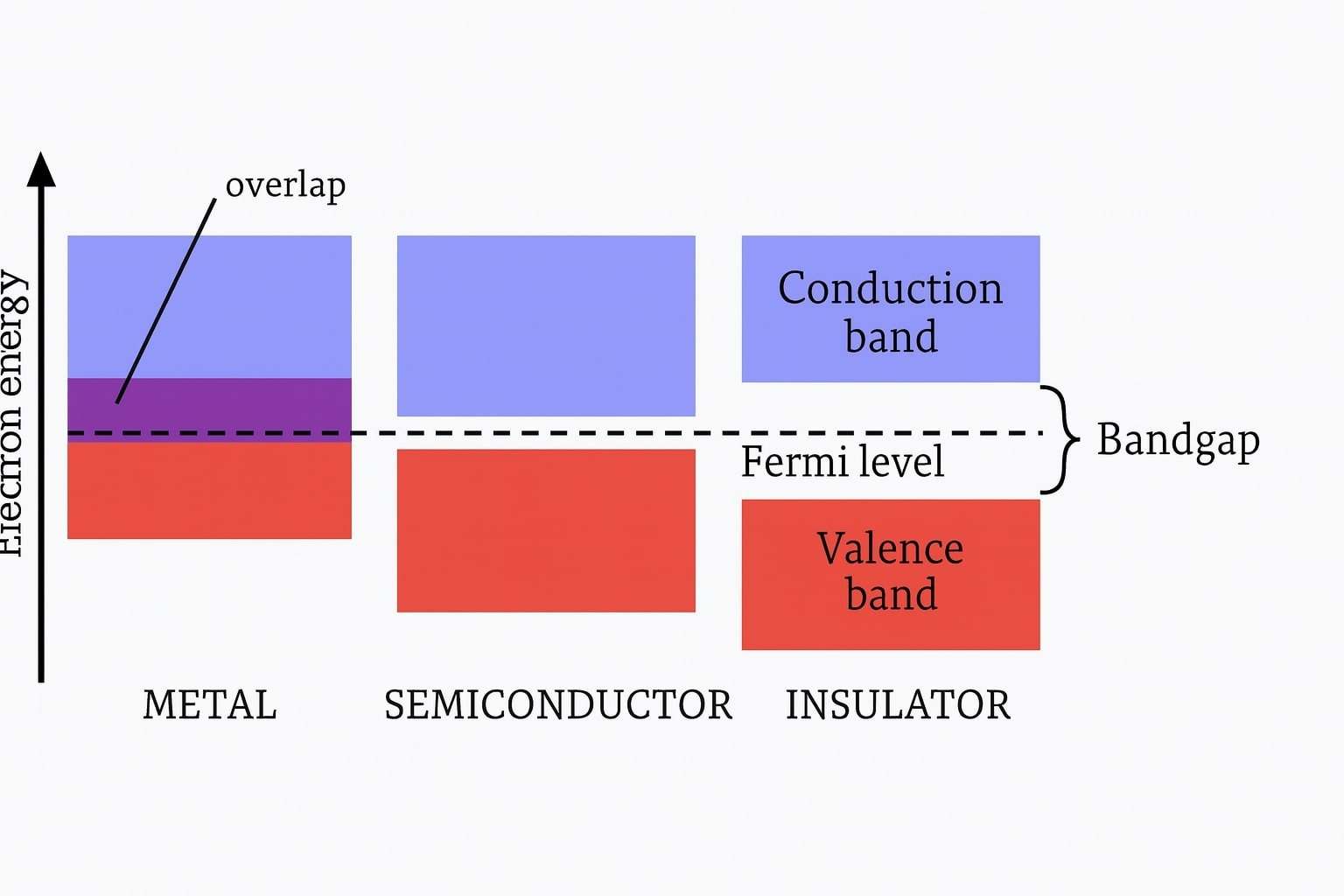
Conductors
➡️ Examples: Copper, Aluminum.
➡️ Band gap ≈ 0 eV.
➡️ High density of free electrons, conduction occurs easily.
Insulators
➡️ Examples: Wood, Glass, Plastic.
➡️ Band gap > 5 eV.
➡️ No conduction under normal conditions.
Semiconductors
➡️ Examples: Silicon (Eg ≈ 1.1 eV), Germanium (Eg ≈ 0.7 eV).
➡️ Moderate conductivity.
➡️ Conductivity increases with temperature (opposite to metals).
➡️ Conductivity can be engineered by doping.
✏️ Note: Semiconductors are the “engineered materials” that enabled the electronics age.
🧠 Energy Band Theory
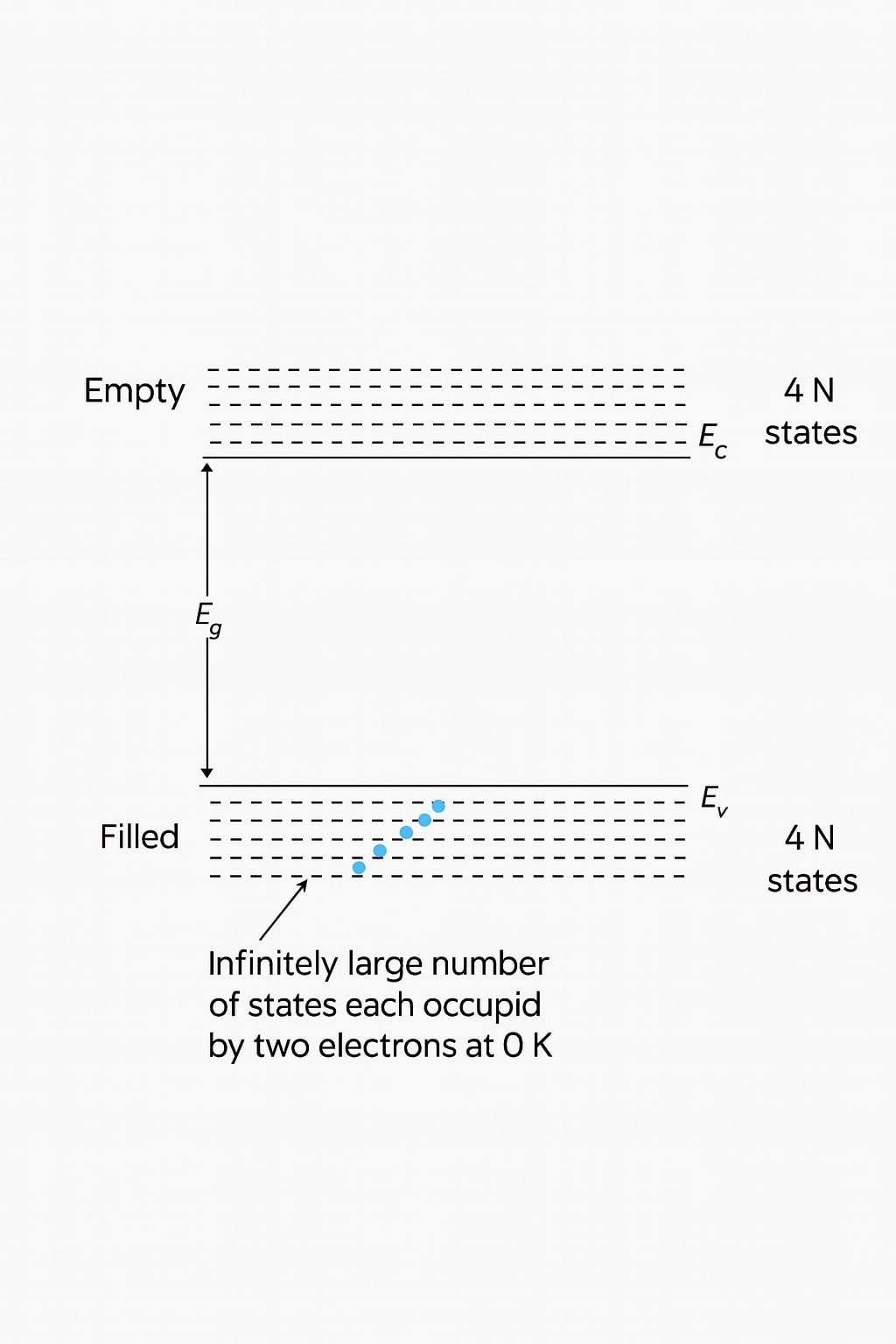
💡 Concept: In a crystal, discrete energy levels form bands.
Valence Band: Highest occupied band.
Conduction Band: Free electrons move here.
Band Gap (Eg): Separation between conduction and valence band.
✔️ Metals: Eg ≈ 0 (overlap).
✔️ Insulators: Eg > 5 eV.
✔️ Semiconductors: Eg ≈ 1 eV.
At room temperature, some electrons gain energy to jump to conduction band, leaving behind holes. Both contribute to current.
🔬 Intrinsic & Extrinsic Semiconductors
Intrinsic Semiconductor
➡️ Pure Si or Ge.
➡️ Conduction only by thermally generated electron-hole pairs.
➡️ Limited conductivity.
Extrinsic Semiconductor
➡️ Doped with impurities to enhance conductivity.
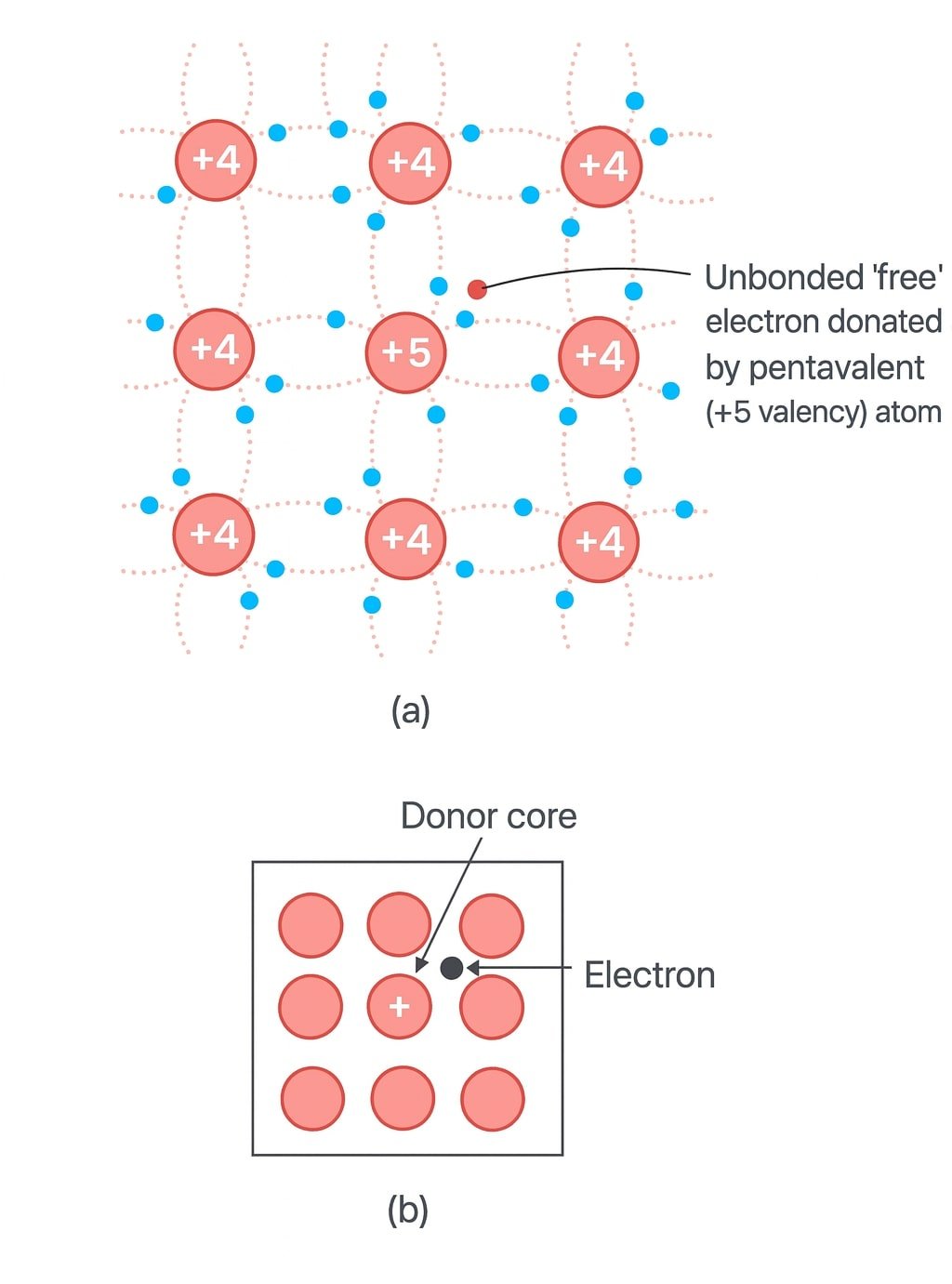
n-type: Pentavalent dopant (P, As, Sb). Extra electrons → majority carriers.
p-type: Trivalent dopant (B, Al, In). Extra holes → majority carriers.
✔️ Charge neutrality remains intact — the crystal stays electrically neutral.
🌐 The p–n Junction
When p-type and n-type are joined:
➡️ Electrons move from n → p, holes move from p → n.
➡️ This forms the depletion region (region without mobile carriers).
➡️ Ions left behind create a built-in electric field.
➡️ A potential barrier develops:
≈ 0.3 V (Ge)
≈ 0.7 V (Si)
✏️ Note: This barrier must be overcome for current flow.
🔋 p–n Junction Diode
Forward Bias
p connected to +ve terminal, n to –ve.
Barrier reduces.
Current flows once applied voltage > barrier (≈0.3 V Ge, 0.7 V Si).
Reverse Bias
p connected to –ve, n to +ve.
Barrier widens.
Only minority carriers contribute to a small, almost constant reverse saturation current.
✔️ Diode is the simplest but most important semiconductor device.
🔌 Rectifiers
Half-wave rectifier
➡️ Uses one diode.
➡️ Current flows only during one half of AC cycle.
➡️ Output: Pulsating DC.
➡️ Efficiency ≈ 40%.
Full-wave rectifier
➡️ Uses two diodes (center-tap) or four diodes (bridge).
➡️ Both half cycles contribute.
➡️ Output smoother.
➡️ Efficiency ≈ 80%.
✏️ Note: Rectifiers are usually followed by filters to obtain steady DC.
🛡️ Zener Diode
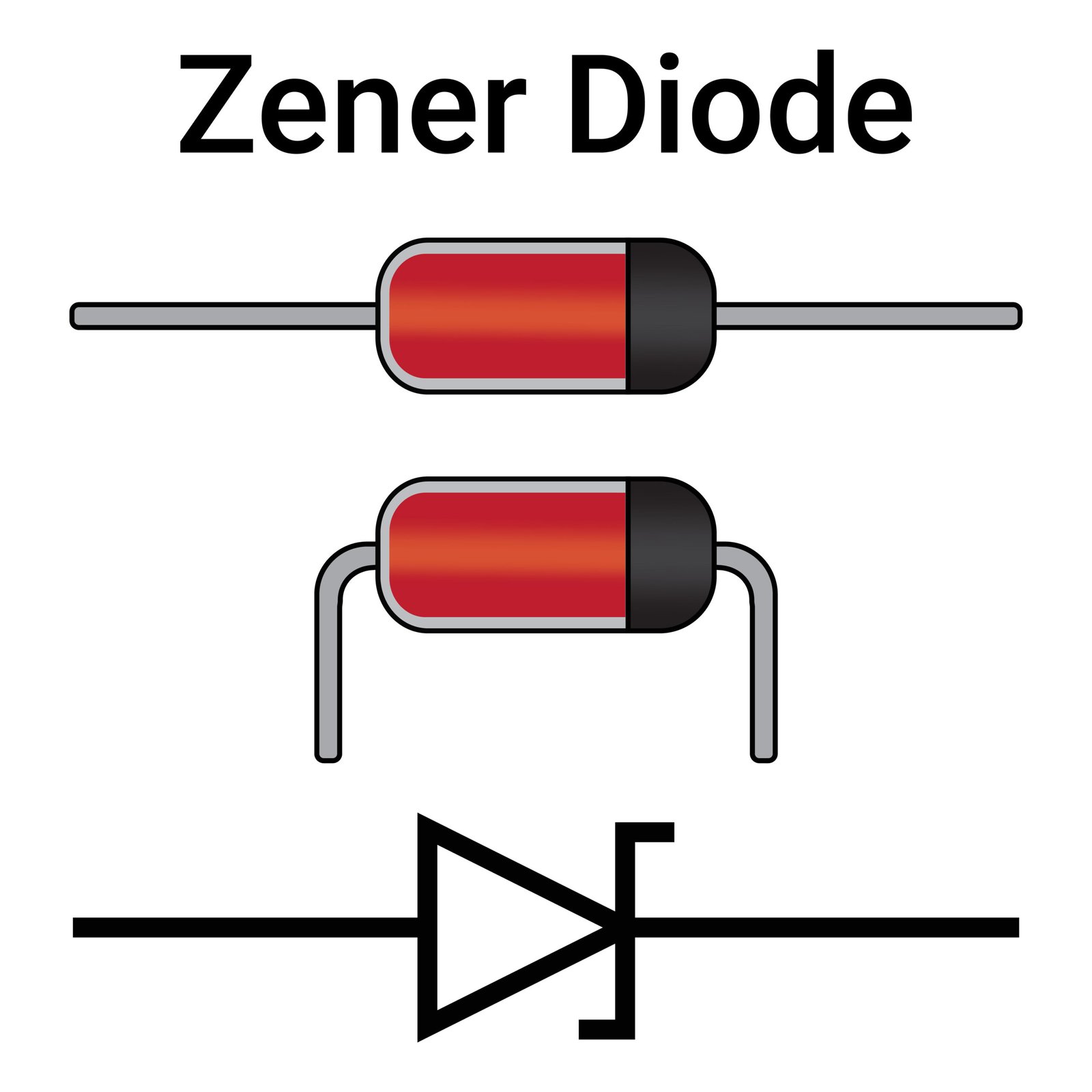
💡 Concept: Special diode designed to operate in reverse bias at a fixed Zener voltage.
Below Zener voltage: only leakage current flows.
At Zener breakdown: current increases sharply but voltage remains nearly constant.
✔️ Used as a voltage regulator in power supplies.
📡 Bipolar Junction Transistor (BJT)
Structure:
Three regions: Emitter (heavily doped), Base (thin & lightly doped), Collector (moderately doped).
Types: npn and pnp.
Working:
➡️ A small base current controls a large collector current.
➡️ Relation: IE = IC + IB.
➡️ Current gain β = IC/IB (20–200 typical).
Applications:
✔️ Amplifier (boosts weak signals).
✔️ Switch (used in digital circuits, ON/OFF).
💡 Concept: This small-base, large-collector current relation is the foundation of modern electronics.
🖥️ Logic Gates
Operate on binary inputs (0,1).
Basic Gates
🔵 AND: Output 1 only if all inputs 1.
🟢 OR: Output 1 if any input 1.
🔴 NOT: Inverts input.
Universal Gates
🟠 NAND and NOR: Any logic circuit can be built using only NAND or NOR.
Truth Tables
✔️ AND Gate
(0,0) → 0
(0,1) → 0
(1,0) → 0
(1,1) → 1
✔️ OR Gate
(0,0) → 0
(0,1) → 1
(1,0) → 1
(1,1) → 1
✔️ NOT Gate
0 → 1
1 → 0
✔️ NAND Gate
(0,0) → 1
(0,1) → 1
(1,0) → 1
(1,1) → 0
✔️ NOR Gate
(0,0) → 1
(0,1) → 0
(1,0) → 0
(1,1) → 0
✏️ Note: NAND and NOR are called universal because they can replicate any gate.
🛠️ Applications in Daily Life
✔️ Microprocessors & memory chips (millions of transistors).
✔️ Solar cells (renewable energy).
✔️ LEDs (displays, lighting).
✔️ Photodiodes (sensors, remotes).
✔️ Amplifiers in communication devices.
✔️ Switching in digital computers & automation.
Summary (~300 words)
🔑 Key Points
🔵 Materials: Conductors, Insulators, Semiconductors.
🟢 Band Theory: Valence band, conduction band, band gap.
🔴 Intrinsic and extrinsic semiconductors.
🟡 Doping: n-type and p-type carriers.
✔️ p–n Junction: Depletion region, barrier potential (~0.3 V Ge, ~0.7 V Si).
✔️ Diodes: Forward bias → conduction, Reverse bias → small constant current.
✔️ Rectifiers: Half-wave and full-wave convert AC to DC.
✔️ Zener diode: Maintains constant voltage in breakdown.
✔️ BJT: Three-terminal device; small base current controls large collector current.
✔️ Logic Gates: AND, OR, NOT, NAND, NOR (with truth tables).
🌿 Importance
Semiconductors are the core of digital technology.
They enabled computers, communication, renewable energy devices.
From household appliances to satellites, they power modern civilization.
📝 Quick Recap
✔️ Semiconductors lie between conductors & insulators.
✔️ Doping → n-type & p-type.
✔️ Barrier potentials: ~0.3 V (Ge), ~0.7 V (Si).
✔️ Diodes → Forward bias conduction, Reverse bias → minority current.
✔️ Rectifiers, LEDs, Zener regulators → Diode applications.
✔️ BJT → Amplifier & Switch.
✔️ Logic Gates (AND, OR, NOT, NAND, NOR) → Digital foundation.
————————————————————————————————————————————————————————————————————————————
QUESTIONS FROM TEXTBOOK
Question 14.1
In an n-type silicon, which of the following statements is true:
🔵 (A) Electrons are majority carriers and trivalent atoms are the dopants.
🟢 (B) Electrons are minority carriers and pentavalent atoms are the dopants.
🟠 (C) Holes are minority carriers and pentavalent atoms are the dopants.
🔴 (D) Holes are majority carriers and trivalent atoms are the dopants.
Answer 14.1
➡️ In n-type semiconductors, doping is done with pentavalent atoms (like P, As, Sb).
➡️ This introduces extra electrons as majority carriers, while holes become minority carriers.
✔️ Correct option: 🟠 (C) Holes are minority carriers and pentavalent atoms are the dopants.
Question 14.2
Which of the statements given in Exercise 14.1 is true for p-type semiconductors?
🔵 (A) Electrons are majority carriers and trivalent atoms are the dopants.
🟢 (B) Electrons are minority carriers and pentavalent atoms are the dopants.
🟠 (C) Holes are minority carriers and pentavalent atoms are the dopants.
🔴 (D) Holes are majority carriers and trivalent atoms are the dopants.
Answer 14.2
➡️ In p-type semiconductors, doping is done with trivalent atoms (like B, Al, In).
➡️ This results in holes as majority carriers, and electrons act as minority carriers.
✔️ Correct option: 🔴 (D) Holes are majority carriers and trivalent atoms are the dopants.
Question 14.3
Carbon, silicon and germanium have four valence electrons each. These are characterised by valence and conduction bands separated by energy band gaps equal to (Eg)C, (Eg)Si and (Eg)Ge. Which of the following statements is true?
🔵 (A) (Eg)Si < (Eg)Ge < (Eg)C 🟢 (B) (Eg)C < (Eg)Ge < (Eg)Si 🟠 (C) (Eg)C > (Eg)Si > (Eg)Ge
🔴 (D) (Eg)C = (Eg)Si = (Eg)Ge
Answer 14.3
➡️ Band gap values:
Carbon (diamond): ≈ 5.5 eV
Silicon: ≈ 1.1 eV
Germanium: ≈ 0.7 eV
Thus, order: (Eg)C > (Eg)Si > (Eg)Ge.
✔️ Correct option: 🟠 (C) (Eg)C > (Eg)Si > (Eg)Ge.
Question 14.4
In an unbiased p–n junction, holes diffuse from the p-region to n-region because:
🔵 (A) Free electrons in the n-region attract them.
🟢 (B) They move across the junction by the potential difference.
🟠 (C) Hole concentration in p-region is more as compared to n-region.
🔴 (D) All the above.
Answer 14.4
➡️ The diffusion of holes is driven by multiple factors:
Concentration gradient (more holes in p-region than in n-region).
Attraction by electrons in n-region.
Effect of the built-in potential difference.
✔️ Correct option: 🔴 (D) All the above.
Question 14.5
When a forward bias is applied to a p–n junction, it:
🔵 (A) Raises the potential barrier.
🟢 (B) Reduces the majority carrier current to zero.
🟠 (C) Lowers the potential barrier.
🔴 (D) None of the above.
Answer 14.5
➡️ Applying forward bias decreases the depletion width.
➡️ This lowers the potential barrier, allowing majority carriers to cross the junction easily.
✔️ Correct option: 🟠 (C) Lowers the potential barrier.
Question 14.6
In half-wave rectification, what is the output frequency if the input frequency is 50 Hz? What is the output frequency of a full-wave rectifier for the same input frequency?
Answer 14.6
➡️ Half-wave rectifier:
Only one half cycle of AC is used.
Output frequency = Input frequency = 50 Hz.
➡️ Full-wave rectifier:
Both half cycles contribute.
Output frequency = 2 × Input frequency = 100 Hz.
Final Answer:
Half-wave rectifier output frequency = 50 Hz
Full-wave rectifier output frequency = 100 Hz
————————————————————————————————————————————————————————————————————————————
OTHER IMPORTANT QUESTIONS
(CBSE MODEL QUESTIONS PAPER)
ESPECIALLY MADE FROM THIS LESSON ONLY
Q1. Which of the following has the largest band gap?
🔵 (A) Germanium
🟢 (B) Silicon
🟠 (C) Carbon (diamond)
🔴 (D) Gallium
Answer: 🟠 (C) Carbon (diamond)
Q2. In an n-type semiconductor, the majority carriers are:
🔵 (A) Holes
🟢 (B) Electrons
🟠 (C) Protons
🔴 (D) None
Answer: 🟢 (B) Electrons
Q3. Barrier potential of a Si diode at room temperature is approximately:
🔵 (A) 0.3 V
🟢 (B) 0.5 V
🟠 (C) 0.7 V
🔴 (D) 1.1 V
Answer: 🟠 (C) 0.7 V
Q4. A p-type semiconductor is formed by doping with:
🔵 (A) Pentavalent atom
🟢 (B) Trivalent atom
🟠 (C) Tetravalent atom
🔴 (D) Hexavalent atom
Answer: 🟢 (B) Trivalent atom
Q5. Which diode is used as a voltage regulator?
🔵 (A) Photodiode
🟢 (B) LED
🟠 (C) Zener diode
🔴 (D) Tunnel diode
Answer: 🟠 (C) Zener diode
Q6. The output frequency of a full-wave rectifier for input 50 Hz is:
🔵 (A) 25 Hz
🟢 (B) 50 Hz
🟠 (C) 100 Hz
🔴 (D) 200 Hz
Answer: 🟠 (C) 100 Hz
Q7. In forward bias, the width of depletion layer:
🔵 (A) Increases
🟢 (B) Decreases
🟠 (C) Becomes zero
🔴 (D) Remains unchanged
Answer: 🟢 (B) Decreases
Q8. In reverse bias, current is mainly due to:
🔵 (A) Majority carriers
🟢 (B) Minority carriers
🟠 (C) Protons
🔴 (D) Holes
Answer: 🟢 (B) Minority carriers
Q9. The energy band gap of Si is:
🔵 (A) 0.3 eV
🟢 (B) 0.7 eV
🟠 (C) 1.1 eV
🔴 (D) 5.5 eV
Answer: 🟠 (C) 1.1 eV
Q10. Which is the universal gate?
🔵 (A) AND
🟢 (B) OR
🟠 (C) NAND
🔴 (D) NOT
Answer: 🟠 (C) NAND
Q11. Which device converts sunlight directly into electricity?
🔵 (A) Photodiode
🟢 (B) LED
🟠 (C) Solar cell
🔴 (D) Zener diode
Answer: 🟠 (C) Solar cell
Q12. The emitter of a transistor is:
🔵 (A) Lightly doped
🟢 (B) Moderately doped
🟠 (C) Heavily doped
🔴 (D) Undoped
Answer: 🟠 (C) Heavily doped
Q13. In logic gates, binary input “0” means:
🔵 (A) High voltage
🟢 (B) Low voltage
🟠 (C) Infinite resistance
🔴 (D) Open circuit
Answer: 🟢 (B) Low voltage
Q14. In common emitter configuration, the output is taken from:
🔵 (A) Collector–Base
🟢 (B) Emitter–Base
🟠 (C) Collector–Emitter
🔴 (D) None
Answer: 🟠 (C) Collector–Emitter
Q15. Which gate gives output “0” only when all inputs are “1”?
🔵 (A) AND
🟢 (B) OR
🟠 (C) NAND
🔴 (D) NOR
Answer: 🟠 (C) NAND
➡️ Explanation: AND gives “1” when all inputs = 1, but NAND gives the inverse → output “0” only when all inputs = 1.
Q16. In an npn transistor, majority carriers in emitter are:
🔵 (A) Holes
🟢 (B) Electrons
🟠 (C) Protons
🔴 (D) Neutrons
Answer: 🟢 (B) Electrons
Q17. Which region of a transistor is thin and lightly doped?
🔵 (A) Emitter
🟢 (B) Base
🟠 (C) Collector
🔴 (D) None
Answer: 🟢 (B) Base
Q18. The Boolean expression for OR gate is:
🔵 (A) A • B
🟢 (B) A + B
🟠 (C) A′
🔴 (D) AB′
Answer: 🟢 (B) A + B
Section B (Q19–Q23: Short Answers)
Q19. Why does conductivity of a semiconductor increase with temperature?
Answer: More valence electrons get excited across band gap, creating electron–hole pairs, so conductivity increases.
Q20. Advantage of full-wave rectifier over half-wave rectifier.
Answer: Utilizes both half cycles of AC, higher efficiency (~80%), smoother DC output.
Q21. What happens to depletion width in reverse bias?
Answer: Depletion region widens as potential barrier increases.
Q22. Function of base region in transistor.
Answer: Base is thin and lightly doped → allows carriers from emitter to reach collector, controls current with small IB.
Q23. Name the gate inverse of AND.
Answer: NAND.
Section C (Q24–Q28: Mid-length)
Q24. Explain I–V characteristics of diode.
Answer:
➡️ Forward bias: negligible current until threshold (0.3 V Ge, 0.7 V Si), then exponential rise.
➡️ Reverse bias: tiny reverse saturation current (minority carriers), sharp increase after breakdown.
Q25. Input 60 Hz to half-wave rectifier. What is output frequency of full-wave rectifier?
Answer: f_out = 2 × 60 Hz = 120 Hz.
Q26. Explain Zener diode as voltage regulator.
Answer: In reverse bias at Zener voltage Vz, current increases sharply but voltage across Zener remains nearly constant → output voltage stable even if input/load changes.
Q27. Transistor has IC = 4.9 mA, IB = 0.1 mA. Find β.
Answer: β = IC / IB = 4.9 / 0.1 = 49.
Q28. Write truth table for NOR gate.
Answer:
(0,0) → 1
(0,1) → 0
(1,0) → 0
(1,1) → 0
Section D (Q29–Q31: Long Answers)
Q29. Explain construction and working of solar cell.
Answer:
➡️ Construction: Thin p–n junction on semiconductor, transparent cover, metal contacts.
➡️ Working: Sunlight photons create e–h pairs; junction field separates them; emf produced; connected load gives current.
Q30. Explain transistor as amplifier.
Answer:
➡️ In CE mode, input is applied at base–emitter, output at collector–emitter.
➡️ Small IB change → large IC change (IC = βIB).
➡️ Output signal is amplified version of input.
Q31. Explain working of full-wave rectifier.
Answer:
➡️ Center-tap or bridge circuit: diodes conduct alternately.
➡️ Both half cycles pass through load in same direction.
➡️ Output: pulsating DC of frequency 2f.
Section E (Q32–Q33: Case/Application)
Q32. A silicon diode is forward biased. Barrier potential = 0.7 V. If input rises from 0 to 1 V, explain diode current.
Answer:
➡️ For V < 0.7 V → negligible current.
➡️ After 0.7 V → current rises exponentially up to 1 V.
Q33. In transistor amplifier, Vin = 10 mV, Vout = 2 V. Find voltage gain.
Answer:
Av = Vout / Vin = 2 / 0.01 = 200.
————————————————————————————————————————————————————————————————————————————