
Class 12 : Physics (English) – Chapter 12: Atoms

EXPLANATION & SUMMARY
🟢 Rutherford’s Scattering Experiment (With Derivation)

Setup: A thin gold foil bombarded with α-particles.
Observations:
Most α-particles passed straight through → atom mostly empty.
Some deflected at small angles → nucleus repels positive charge.
A very few deflected backward → nucleus very dense, tiny.
Derivation of Scattering Formula (outline in NCERT):
Force between α-particle and nucleus:
F = (1/4πε₀) (Z₁Z₂e²/r²)
Closest approach distance (r₀): when KE = PE.
(1/2)mv² = (1/4πε₀)(Z₁Z₂e²/r₀)
r₀ = (1/4πε₀)(Z₁Z₂e²) / (1/2)mv²
For gold (Z=79) and α-particle (Z=2), distance of closest approach calculated in experiments is ~3 × 10⁻¹⁴ m, showing nuclear size is extremely small compared to atom (~10⁻¹⁰ m).
🔴 Atomic Spectra
Formula:
1/λ = RZ²(1/n₁² – 1/n₂²)
Example: For hydrogen (Z=1), Balmer line for n₁=2, n₂=3:
1/λ = R(1/2² – 1/3²) = R(1/4 – 1/9) = R(5/36).
Thus λ ≈ 656 nm, a visible red line.
🟡 Bohr’s Model with Step Derivation
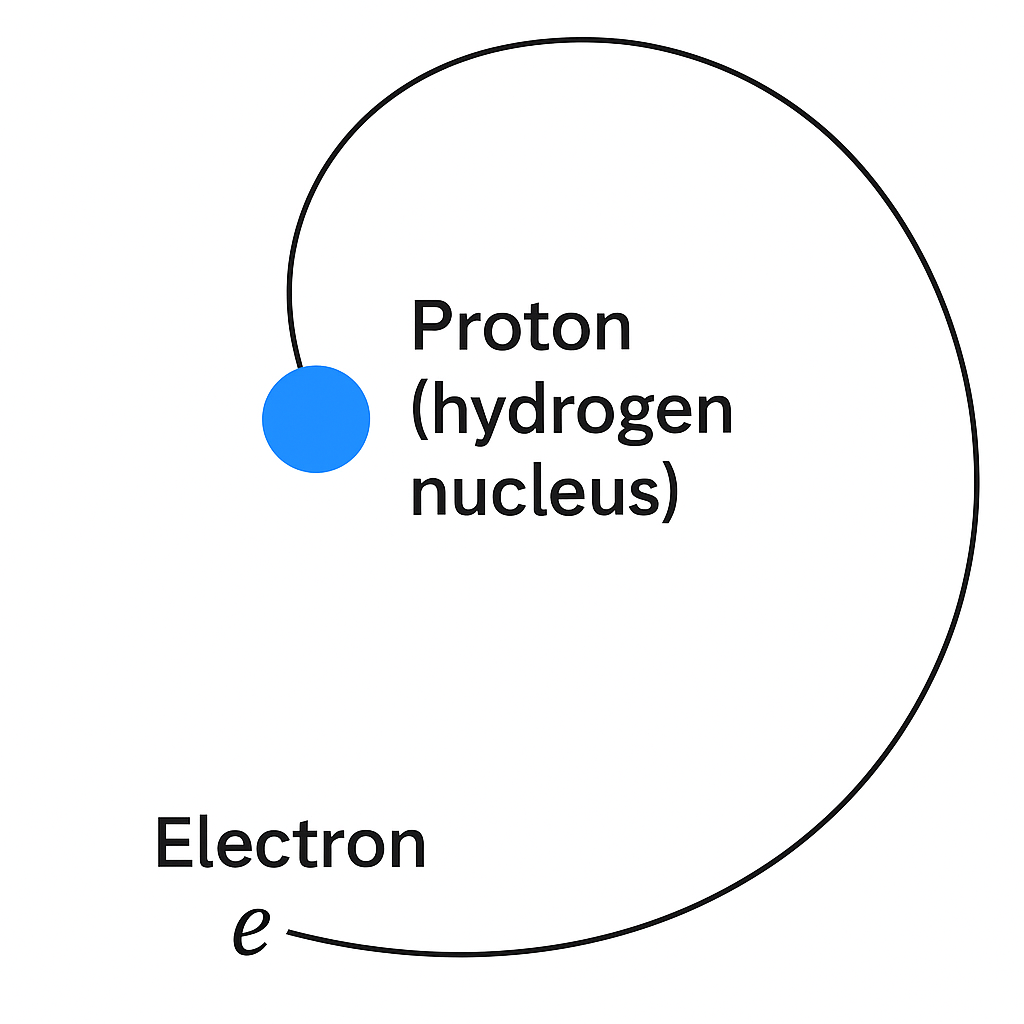
Angular Momentum Quantization:
L = mvr = nh/2π
Centripetal Force:
mv²/r = (1/4πε₀)(Ze²/r²)
Substituting v from angular momentum:
m(vr) = nh/2π → v = nh/(2πmr).
Solve to get:
Radius of nth orbit:
rn = (ε₀h²n²)/(πme²Z)
Velocity of nth orbit:
vn = e²Z/(2ε₀h)(1/n)
Total Energy:
En = –(13.6 eV × Z²)/n²
Thus for hydrogen (Z=1, n=1), E₁ = –13.6 eV.
Ionization energy: energy required to remove electron from ground state = 13.6 eV.
🔵 de Broglie Hypothesis

Electron wave: λ = h/p.
Stable orbit → circumference = integer multiple of wavelength:
2πrn = nλ.
Thus Bohr’s quantization has wave interpretation.
🟢 Quantum Mechanical Model
Electrons as standing waves described by Schrödinger’s ψ.
|ψ|² gives probability density.
Orbits replaced by orbitals (s, p, d, f shapes in higher study).
🔴 Franck–Hertz Experiment
Electrons accelerated through mercury vapor. Current decreased at ~4.9 V → electrons lose energy equal to excitation of mercury. Proved quantized energy levels.
🟡 Applications
Explains atomic emission/absorption spectra.
Basis for astrophysical spectroscopy.
Foundation for modern quantum mechanics.
Used in developing semiconductors and nuclear science.
✨ Summary (~300 words, Concise & Revision-Friendly)
Rutherford’s α-scattering experiment proved atoms have a dense central nucleus, with electrons outside and most of the atom empty. But classical theory predicted such atoms should collapse due to radiation.
Spectroscopy revealed discrete lines, notably hydrogen series (Lyman in UV, Balmer in visible, Paschen/Brackett/Pfund in IR). Rydberg’s formula expressed these lines mathematically.
Bohr solved the stability issue by proposing quantized orbits. His postulates included angular momentum quantization (nh/2π) and energy exchange only during transitions. Derivations yielded expressions for orbit radii, electron velocity, and energy levels. He explained hydrogen’s spectrum precisely, predicting ionization energy (13.6 eV).
de Broglie interpreted Bohr’s quantization using matter waves: only those orbits that support standing waves are stable.
Quantum mechanics replaced exact orbits with orbitals. Schrödinger’s equation provided probability distributions for electrons.
Franck–Hertz experiment gave strong evidence for discrete levels, confirming theoretical ideas.
Applications include spectroscopy, astrophysics, electronics, and quantum science.
📝 Quick Recap
🔵 Rutherford: nucleus discovered; distance of closest approach formula.
🟢 Spectra: Hydrogen lines explained by Rydberg formula.
🔴 Bohr: quantized orbits; En = –13.6 eV/n².
🟡 de Broglie: wave interpretation of quantization.
✔️ Schrödinger: orbitals, probability clouds.
💡 Franck–Hertz: experimental proof.
————————————————————————————————————————————————————————————————————————————
QUESTIONS FROM TEXTBOOK
Question 12.1
Choose the correct alternative from the clues given at the end of each statement:
(a) The size of the atom in Thomson’s model is ……… the atomic size in Rutherford’s model. (much greater than / no different from / much less than)
(b) In the ground state of ……… electrons are in stable equilibrium, while in ……… electrons always experience a net force. (Thomson’s model / Rutherford’s model)
(c) A classical atom based on ……… is doomed to collapse. (Thomson’s model / Rutherford’s model)
(d) An atom has a nearly continuous mass distribution in a ……… but has a highly non-uniform mass distribution in ……… (Thomson’s model / Rutherford’s model).
(e) The positively charged part of the atom possesses most of the mass in ……… (Rutherford’s model / both the models).
Answer 12.1
🔵 (a) Much greater than
🟢 (b) Thomson’s model, Rutherford’s model
🟠 (c) Rutherford’s model
🔴 (d) Thomson’s model, Rutherford’s model
✔️ (e) Rutherford’s model
Question 12.2
Suppose you are given a chance to repeat the alpha-particle scattering experiment using a thin sheet of solid hydrogen in place of the gold foil. (Hydrogen is a solid at temperatures below 14 K.) What results do you expect?
Answer 12.2
🔵 Hydrogen nuclei are single protons (Z = 1), much lighter than gold nuclei (Z = 79).
🟢 Alpha particles are heavier than protons, so deflection is negligible.
🟠 Most α-particles would pass straight through without deflection.
✔️ Final: Negligible scattering would be observed.
Question 12.3
An electron of 2.3 eV separates two energy levels in an atom. What is the frequency of radiation emitted when the atom makes a transition from the upper level to the lower level?
Answer 12.3
✏️ Step 1: ΔE = 2.3 eV = 2.3 × 1.6 × 10^−19 J = 3.68 × 10^−19 J.
✏️ Step 2: ν = ΔE / h = (3.68 × 10^−19) / (6.626 × 10^−34).
✏️ Step 3: ν ≈ 5.55 × 10^14 Hz.
✔️ Final: Frequency = 5.55 × 10^14 Hz.
Question 12.4
The ground state energy of hydrogen atom is –13.6 eV. What are the kinetic and potential energies of the electron in this state?
Answer 12.4
🔵 Total energy, E = –13.6 eV.
🟢 Kinetic energy, T = –E = 13.6 eV.
🟠 Potential energy, U = 2E = –27.2 eV.
✔️ Final: T = 13.6 eV, U = –27.2 eV.
Question 12.5
A hydrogen atom initially in the ground level absorbs a photon, which excites it to the n = 4 level. Determine the wavelength and frequency of photon.
Answer 12.5
✏️ Step 1: Energy difference.
E₁ = –13.6 eV, E₄ = –13.6/16 = –0.85 eV.
ΔE = E₄ – E₁ = 12.75 eV.
✏️ Step 2: Convert to joules.
ΔE = 12.75 × 1.6 × 10^−19 = 2.04 × 10^−18 J.
✏️ Step 3: Frequency.
ν = ΔE/h = (2.04 × 10^−18)/(6.626 × 10^−34) ≈ 3.08 × 10^15 Hz.
✏️ Step 4: Wavelength.
λ = c/ν = (3 × 10^8)/(3.08 × 10^15) ≈ 9.74 × 10^−8 m = 97.4 nm.
✔️ Final: ν = 3.08 × 10^15 Hz, λ = 97.4 nm (UV region).
Question 12.6
(a) Using the Bohr model calculate the speed of the electron in a hydrogen atom in the n = 1, 2, and 3 levels.
(b) Calculate the orbital period in each of these levels.
Answer 12.6
🔵 Step 1: Speed formula.
v_n = v₁ / n, where v₁ = 2.19 × 10^6 m/s.
🟢 Step 2: Radii of orbits.
r_n = a₀n², a₀ = 5.29 × 10^−11 m.
🟠 Step 3: Orbital period.
T_n = 2πr_n / v_n.
For n = 1:
v₁ = 2.19 × 10^6 m/s.
r₁ = 5.29 × 10^−11 m.
T₁ = 2π × 5.29 × 10^−11 / 2.19 × 10^6 ≈ 1.52 × 10^−16 s.
For n = 2:
v₂ = 1.095 × 10^6 m/s.
r₂ = 2.12 × 10^−10 m.
T₂ = 2π × 2.12 × 10^−10 / 1.095 × 10^6 ≈ 1.21 × 10^−15 s.
For n = 3:
v₃ = 7.30 × 10^5 m/s.
r₃ = 4.77 × 10^−10 m.
T₃ = 2π × 4.77 × 10^−10 / 7.30 × 10^5 ≈ 4.10 × 10^−15 s.
✔️ Final:
Speeds: v₁ = 2.19 × 10^6, v₂ = 1.095 × 10^6, v₃ = 7.30 × 10^5 m/s.
Periods: T₁ = 1.52 × 10^−16 s, T₂ = 1.21 × 10^−15 s, T₃ = 4.10 × 10^−15 s.
Question 12.7
The radius of the innermost electron orbit of a hydrogen atom is 5.3 × 10^−11 m. What are the radii of the n = 2 and n = 3 orbits?
Answer 12.7
🔵 r₂ = 4 × 5.3 × 10^−11 = 2.12 × 10^−10 m.
🟢 r₃ = 9 × 5.3 × 10^−11 = 4.77 × 10^−10 m.
✔️ Final: r₂ = 2.12 × 10^−10 m, r₃ = 4.77 × 10^−10 m.
Question 12.8
A 12.5 eV electron beam is used to bombard gaseous hydrogen at room temperature. What series of wavelengths will be emitted?
Answer 12.8
✏️ Step 1: Excitations.
1 → 2 requires 10.2 eV.
1 → 3 requires 12.09 eV.
1 → 4 requires 12.75 eV.
Since 12.5 eV < 12.75 eV, excitation possible up to n = 3.
✏️ Step 2: De-excitations.
3 → 2: Balmer (λ ≈ 656 nm).
3 → 1: Lyman (λ ≈ 102.6 nm).
2 → 1: Lyman (λ ≈ 121.6 nm).
✔️ Final: Wavelengths emitted = 656 nm (Balmer), 102.6 nm & 121.6 nm (Lyman).
Question 12.9
In accordance with Bohr’s model, find the quantum number corresponding to the earth’s revolution around the sun in an orbit of radius 1.5 × 10^11 m with orbital speed 3 × 10^4 m/s. (Mass of earth = 6.0 × 10^24 kg.)
Answer 12.9
✏️ Step 1: Angular momentum of earth.
L = mvr = 6.0 × 10^24 × 3 × 10^4 × 1.5 × 10^11 = 2.7 × 10^40 kg·m²/s.
✏️ Step 2: Bohr condition.
n = 2πL/h = (2π × 2.7 × 10^40) / 6.626 × 10^−34.
✏️ Step 3: Calculation.
n ≈ 2.6 × 10^74.
✔️ Final: Quantum number for earth’s orbit ≈ 2.6 × 10^74.
————————————————————————————————————————————————————————————————————————————
OTHER IMPORTANT QUESTIONS
(CBSE MODEL QUESTION PAPER)
ESPECIALLY MADE FROM THIS LESSON ONLY
🟡 Section A (Q1–Q18: MCQs)
Question 1. Which experiment established the existence of the nucleus in an atom?
🔵 (A) J.J. Thomson’s discharge tube experiment
🟢 (B) Rutherford’s α–particle scattering experiment
🟠 (C) Millikan’s oil drop experiment
🔴 (D) Franck–Hertz experiment
Answer: (B) Rutherford’s α–particle scattering experiment
Question 2. In Rutherford’s experiment, most α-particles passed undeflected because:
🔵 (A) Nucleus is very small in size compared to atom
🟢 (B) Atom is solid and uniform
🟠 (C) Atom is a dense sphere
🔴 (D) Electrons stopped them
Answer: (A) Nucleus is very small in size compared to atom
Question 3. The failure of Rutherford’s model was due to:
🔵 (A) Inability to explain electron’s charge
🟢 (B) Inability to explain stability of atom
🟠 (C) Lack of experimental proof
🔴 (D) Nucleus not discovered
Answer: (B) Inability to explain stability of atom
Question 4. Bohr’s quantisation condition for angular momentum is:
🔵 (A) mvr = n/h
🟢 (B) mvr = nh/π
🟠 (C) mvr = nh/2π
🔴 (D) mvr = 2πnh
Answer: (C) mvr = nh/2π
Question 5. The radius of the first Bohr orbit of hydrogen atom is:
🔵 (A) 0.053 nm
🟢 (B) 0.53 Å
🟠 (C) 5.3 × 10⁻⁹ m
🔴 (D) 0.0053 Å
Answer: (B) 0.53 Å
Question 6. The energy of an electron in the nth orbit of hydrogen is proportional to:
🔵 (A) 1/n
🟢 (B) 1/n²
🟠 (C) n²
🔴 (D) n
Answer: (B) 1/n²
Question 7. Which spectral series of hydrogen lies in the visible region?
🔵 (A) Lyman
🟢 (B) Balmer
🟠 (C) Paschen
🔴 (D) Brackett
Answer: (B) Balmer
Question 8. The energy required to ionize a hydrogen atom in the ground state is:
🔵 (A) 13.6 eV
🟢 (B) 3.4 eV
🟠 (C) 27.2 eV
🔴 (D) 10.2 eV
Answer: (A) 13.6 eV
Question 9. The energy difference between n=3 and n=2 level in hydrogen atom is:
🔵 (A) 1.51 eV
🟢 (B) 10.2 eV
🟠 (C) 12.09 eV
🔴 (D) 1.89 eV
Answer: (A) 1.51 eV
Question 10. The Rydberg constant has value (approx):
🔵 (A) 1.097 × 10⁷ m⁻¹
🟢 (B) 9.1 × 10⁻³¹ kg
🟠 (C) 6.63 × 10⁻³⁴ J·s
🔴 (D) 3 × 10⁸ m/s
Answer: (A) 1.097 × 10⁷ m⁻¹
Question 11. The ionisation energy of hydrogen atom is:
🔵 (A) +13.6 eV
🟢 (B) −13.6 eV
🟠 (C) +27.2 eV
🔴 (D) −27.2 eV
Answer: (A) +13.6 eV
Question 12. The lowest energy state of an atom is called:
🔵 (A) Excited state
🟢 (B) Ground state
🟠 (C) Ionised state
🔴 (D) Stable state
Answer: (B) Ground state
Question 13. In Bohr’s theory, the frequency of emitted photon corresponds to:
🔵 (A) Sum of energies of two orbits
🟢 (B) Difference of energies of two orbits
🟠 (C) Product of energies of two orbits
🔴 (D) Average of energies of two orbits
Answer: (B) Difference of energies of two orbits
Question 14. The negative sign in Bohr’s energy expression indicates:
🔵 (A) Electron has positive energy
🟢 (B) Electron is unbound
🟠 (C) Electron is bound to nucleus
🔴 (D) Electron has no mass
Answer: (C) Electron is bound to nucleus
Question 15. Which of the following transitions gives the highest energy photon in hydrogen?
🔵 (A) n=2 → n=1
🟢 (B) n=3 → n=2
🟠 (C) n=4 → n=2
🔴 (D) n=5 → n=4
Answer: (A) n=2 → n=1
Question 16. The series limit of Balmer series corresponds to:
🔵 (A) n=2 → ∞
🟢 (B) n=∞ → 2
🟠 (C) n=1 → ∞
🔴 (D) n=3 → ∞
Answer: (B) n=∞ → 2
Question 17. Which postulate of Bohr explains the stability of atom?
🔵 (A) Quantisation of angular momentum
🟢 (B) Radiation of energy in all paths
🟠 (C) Presence of neutrons
🔴 (D) Equal distribution of mass
Answer: (A) Quantisation of angular momentum
Question 18. Which scientist first proposed that electrons revolve in specific energy orbits without radiating?
🔵 (A) Rutherford
🟢 (B) Planck
🟠 (C) Bohr
🔴 (D) Einstein
Answer: (C) Bohr
🟢 Section B (Q19–Q23: Short Answer)
Question 19. State one drawback of Rutherford’s atomic model.
Answer: ⚡ It could not explain stability of atom. Revolving electrons should radiate energy and collapse, but real atoms are stable.
Question 20. Write Bohr’s two postulates of the atomic model.
Answer:
✳️ Electrons revolve only in certain stable orbits without radiation.
✳️ Angular momentum is quantised: mvr = nh/2π.
Question 21. Radius of second orbit of hydrogen atom.
Answer:
rₙ = 0.53 Å × n²/Z
= 0.53 × 4/1
= 2.12 Å
Question 22. Define excitation energy and ionisation energy.
Answer:
✔️ Excitation energy → minimum energy to move electron from ground to higher orbit.
✔️ Ionisation energy → energy to remove electron from ground state to infinity (13.6 eV for H).
Question 23. Why are energy levels negative?
Answer: 💡 Negative energy shows electron is bound to nucleus. Zero corresponds to free electron at infinity.
🔵 Section C (Q24–Q28: Mid-Length)
Question 24. Derive expression for frequency of emitted radiation (n₂ → n₁).
Answer:
Eₙ = −13.6/n² eV
ΔE = 13.6 (1/n₁² − 1/n₂²) eV
ν = ΔE/h
Question 25. Energy of electron in 3rd orbit.
Answer:
E₃ = −13.6/9 eV
= −1.51 eV
Question 26. Wavelength of transition n=3 → n=2 (Balmer line).
Answer:
1/λ = R (1/2² − 1/3²)
= 1.523×10⁶ m⁻¹
λ = 656 nm (visible red)
Question 27. Velocity of electron in 1st Bohr orbit.
Answer:
Formula: vₙ = e² / (2ε₀h) × (Z/n)
Substitute values:
= (1.6×10⁻¹⁹)² / (2×8.85×10⁻¹²×6.63×10⁻³⁴) × (1/1)
= 2.3 × 10⁶ m/s
Final: 2.3 × 10⁶ m/s
Question 28. First line of Lyman series (n=2 → n=1).
Answer:
1/λ = R(1/1² − 1/2²)
= 8.23×10⁶ m⁻¹
λ = 121 nm (UV)
🔴 Section D (Q29–Q31: Long Answer)
Question 29. Derive expression for radius of nth orbit.
Answer:
➡️ Centripetal = Electrostatic: mv²/r = ke²/r²
➡️ Bohr condition: mvr = nh/2π
➡️ Solve: rₙ = (ε₀h² / πme²) × n²/Z
➡️ For H: rₙ = 0.53 Å × n²
Question 30. Derive expression for energy of electron in nth orbit.
Answer:
➡️ Potential energy U = −ke²/r
➡️ Kinetic energy KE = ke²/(2r)
➡️ Total: E = KE + U = −ke²/(2r)
➡️ Substitute rₙ → Eₙ = −13.6 Z²/n² eV
Question 31. Explain hydrogen spectrum using Bohr’s theory.
Answer:
✔️ Electrons occupy quantised levels.
✔️ Transition n₂ → n₁ releases photon of ΔE = hν.
✔️ Formula: 1/λ = RZ²(1/n₁² − 1/n₂²).
✔️ Explains series: Lyman (UV), Balmer (visible), Paschen/Brackett/Pfund (IR).
✳️ Section E (Q32–Q33: Case/Application)
Question 32. H atom in n=4 de-excites to n=1. Find lines & highest energy photon.
Answer:
(a) Number of lines = n(n−1)/2 = 6
(b) Highest ΔE = n=4 → n=1
ΔE = 13.6 (1 − 1/16) = 12.75 eV
Question 33. H atom excited to n=5. Find (a) longest λ, (b) shortest λ.
Answer:
(a) Longest λ = lowest ΔE = n=5 → n=4
1/λ = R(1/16 − 1/25)
λ = 4050 nm (IR)
(b) Shortest λ = highest ΔE = n=5 → n=1
1/λ = R(1 − 1/25)
λ = 95 nm (UV)
————————————————————————————————————————————————————————————————————————————