
Class 12 : Chemistry (English) – Chapter 5: Coordination Compounds

EXPLANATION & SUMMARY
✨ Introduction
🔵 Coordination compounds are fascinating chemical species where a central metal atom/ion is surrounded by neutral molecules or anions called ligands, held together via coordinate covalent bonds.
🟢 These compounds are important in biological systems (hemoglobin, chlorophyll), industrial catalysis (Wilkinson’s catalyst, Ziegler–Natta catalyst), analytical chemistry (qualitative analysis with complex ions), and in extraction metallurgy.
🌿 Key Terms
💡 Coordination entity: Central atom/ion + ligands (e.g., [Cu(NH₃)₄]²⁺).
✏ Coordination number (CN): Number of ligand donor atoms directly attached to the central atom.
🟠 Ligands: Species donating electron pairs.
Monodentate: Cl⁻, NH₃.
Bidentate: C₂O₄²⁻, en (ethane-1,2-diamine).
Polydentate: EDTA⁴⁻.
🔴 Chelation: Formation of ring structures by multidentate ligands.
⚡ Oxidation number: Charge of central atom assuming all ligands removed in neutral form.
📌 Coordination polyhedra: Common ones: octahedral, tetrahedral, square planar.
🧪 Nomenclature Rules (IUPAC)
Write cation before anion.
Ligands named alphabetically before metal.
Neutral ligands use molecule name, exceptions: H₂O → aqua, NH₃ → ammine, CO → carbonyl.
Anionic ligands end with “-o” (Cl⁻ → chloro, CN⁻ → cyano).
Oxidation state of metal shown in Roman numerals.
📌 Example: [Co(NH₃)₆]Cl₃ → hexaamminecobalt(III) chloride.
🌟 Bonding Theories
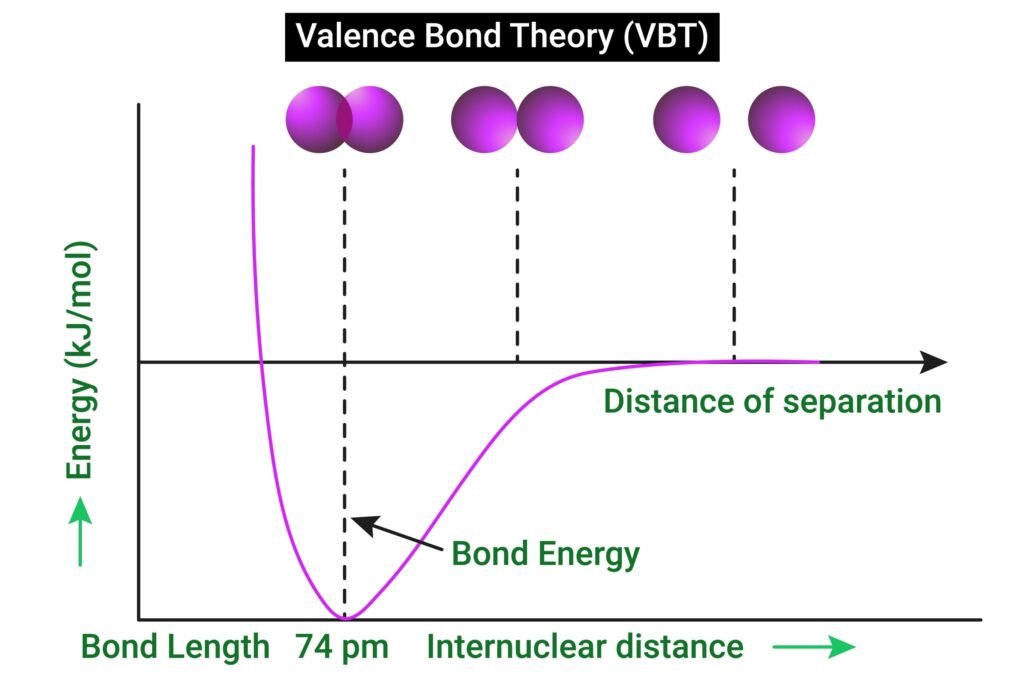
Valence Bond Theory (VBT)
🟦 Explains hybridisation of metal orbitals to accommodate ligands.
Octahedral: d²sp³ or sp³d²
Tetrahedral: sp³
Square planar: dsp²
📌 Example: [Ni(CN)₄]²⁻ → dsp² hybridisation (low-spin, diamagnetic).
Crystal Field Theory (CFT)
💡 Metal–ligand interaction is purely electrostatic.
🟩 In an octahedral field, d-orbitals split into:
Lower t₂g (dxy, dxz, dyz)
Higher e_g (dx²–y², dz²)
🟨 Splitting energy = Δ₀.
📌 If Δ₀ > pairing energy → low-spin; If Δ₀ < pairing energy → high-spin.
Example: [Fe(CN)₆]³⁻ → low-spin (t₂g⁵ e_g⁰).
Example: [FeF₆]³⁻ → high-spin (t₂g³ e_g²).
Molecular Orbital Theory (MOT)
🟠 Explains bonding more accurately (σ and π interactions).
Predicts colour, magnetism, stability of complexes.
🎨 Colour and Magnetism
🔵 Colour: Due to d–d transitions when light excites an electron between split d-orbitals.
🟢 Paramagnetism: From unpaired d-electrons (μ = √(n(n+2)) BM).
🔴 Diamagnetism: All electrons paired.
⚗ Isomerism in Coordination Compounds
Structural isomerism
Ionisation, Solvate, Linkage, Coordination, Coordination position.
Stereoisomerism
Geometrical: cis–trans (e.g., [Pt(NH₃)₂Cl₂]).
Optical: Non-superimposable mirror images (e.g., [Co(en)₃]³⁺).
🌍 Applications
🟦 Biological: Hemoglobin (Fe²⁺), Chlorophyll (Mg²⁺), Vitamin B₁₂ (Co³⁺).
🟩 Medicinal: Cisplatin (anticancer drug).
🟨 Industrial: Catalysts → Wilkinson’s catalyst, Ziegler–Natta catalyst.
🟧 Analytical: Detection of metal ions in qualitative analysis.
📝 Summary
Coordination compounds consist of a central metal atom/ion surrounded by ligands.
Ligands classified as monodentate, bidentate, polydentate; chelation increases stability.
Nomenclature follows IUPAC rules; oxidation state in Roman numerals.
Bonding explained by VBT (hybridisation), CFT (d-orbital splitting), MOT (σ, π bonding).
Colour arises from d–d transitions; magnetism from unpaired electrons.
Isomerism: structural (ionisation, linkage, solvate, etc.) and stereoisomerism (geometrical, optical).
Applications: biological (hemoglobin, chlorophyll), medicinal (cisplatin), industrial (catalysts), analytical (qualitative analysis).
f-block contraction affects d-block similarities.
🎯 Quick Recap
🟢 Ligands donate electron pairs → form coordinate bonds.
🔵 CFT explains colour (d–d transitions).
🟠 VBT explains hybridisation.
🔴 Isomerism: structural + stereoisomerism.
⚡ Uses: medicines, catalysts, bio-systems.
————————————————————————————————————————————————————————————————————————————
QUESTIONS FROM TEXTBOOK
Question 5.1
Explain the bonding in coordination compounds in terms of Werner’s postulates.
Answer
🔵 Werner’s Postulates:
🟢 Metals exhibit two types of valencies:
Primary valency → Ionisable (oxidation state).
Secondary valency → Non-ionisable, fixed in space (coordination number).
🟠 Secondary valencies are satisfied by ligands and determine geometry.
🔴 Compounds with same metal but different secondary valency show different properties.
📌 Example: [CoCl₃·6NH₃] → Ionises as [Co(NH₃)₆]Cl₃ → Co³⁺ primary valency satisfied, CN=6 secondary valency.
Question 5.2
FeSO₄ solution mixed with (NH₄)₂SO₄ solution in 1:1 molar ratio gives the test of Fe²⁺ ion but CuSO₄ solution mixed with aqueous ammonia in 1:4 molar ratio does not give the test of Cu²⁺ ion. Explain why.
Answer
🔵 In FeSO₄ + (NH₄)₂SO₄ → Double salt (Mohr’s salt, FeSO₄·(NH₄)₂SO₄·6H₂O) forms.
🟢 Double salts ionise completely in solution → Fe²⁺ ions free → Test positive.
🟠 In CuSO₄ + 4NH₃ → [Cu(NH₃)₄]²⁺ (complex ion) forms.
🔴 Complex ions do not dissociate → Cu²⁺ not available → No test.
Question 5.3
Explain with two examples each of the following: coordination entity, ligand, coordination number, coordination polyhedron, homoleptic and heteroleptic.
Answer
🔵 Coordination entity: Central atom + ligands. Example: [Co(NH₃)₆]³⁺, [CuCl₄]²⁻.
🟢 Ligands: Donors of electron pair. Example: NH₃, Cl⁻.
🟠 Coordination number: Number of donor atoms bonded. Example: [Co(NH₃)₆]³⁺ → CN=6; [Ni(CO)₄] → CN=4.
🔴 Coordination polyhedron: Spatial arrangement. Example: Octahedral in [Fe(CN)₆]³⁻, Square planar in [PtCl₄]²⁻.
⚡ Homoleptic: Same type ligands only, [Co(NH₃)₆]³⁺.
📌 Heteroleptic: Different ligands, [CoCl₂(en)₂]⁺.
Question 5.4
What is meant by unidentate, bidentate and ambidentate ligands? Give two examples for each.
Answer
🔵 Unidentate: One donor atom. Examples: Cl⁻, NH₃.
🟢 Bidentate: Two donor atoms. Examples: Ethylenediamine (en), C₂O₄²⁻.
🟠 Ambidentate: Can donate through two atoms but one at a time. Examples: NO₂⁻ (N or O donor), SCN⁻ (S or N donor).
Question 5.5
Specify the oxidation numbers of the metals in the following coordination entities:
(i) [Co(H₂O)(CN)(en)₂]²⁺
(ii) [PtCl₂]²⁻
(iii) [Cr(NH₃)₆]Cl₃
(iv) [CoBr₂(en)₂]⁺
(v) K₃[Fe(CN)₆]
Answer
✏ Step-by-step:
(i) [Co(H₂O)(CN)(en)₂]²⁺ → Let Co = x
x + 0 + (–1) + 0 = +2 → x = +3 → Oxidation = +3
(ii) [PtCl₂]²⁻ → x + 2(–1) = –2 → x = 0 → Oxidation = 0
(iii) [Cr(NH₃)₆]Cl₃ → Complex cation charge = +3 → Cr oxidation = +3
(iv) [CoBr₂(en)₂]⁺ → x + 2(–1) = +1 → x = +3
(v) K₃[Fe(CN)₆] → [Fe(CN)₆]³⁻ → x + 6(–1) = –3 → x = +3
✅ Final: Co(+3), Pt(0), Cr(+3), Co(+3), Fe(+3).
Question 5.6
Using IUPAC norms write the formulas for the following:
(i) Tetrahydroxidozincate(II)
(ii) Potassium tetrachloridopalladate(II)
(iii) Diamminedichloridoplatinum(II)
(iv) Potassium tetracyanidoniccolate(II)
(v) Pentaamminenitrito-O-cobalt(III)
(vi) Hexaamminecobalt(III) sulphate
(vii) Potassium trioxalatochromate(III)
(viii) Hexaammineplatinum(IV)
(ix) Potassium hexacyanidoferrate(III)
(x) Tetrabromidocuprate(II)
Answer
(i) [Zn(OH)₄]²⁻
(ii) K₂[PdCl₄]
(iii) [Pt(NH₃)₂Cl₂]
(iv) K₂[Ni(CN)₄]
(v) [Co(NH₃)₅(NO₂)]²⁺
(vi) [Co(NH₃)₆]₂(SO₄)₃
(vii) K₃[Cr(C₂O₄)₃]
(viii) [Pt(NH₃)₆]⁴⁺
(ix) K₃[Fe(CN)₆]
(x) [CuBr₄]²⁻
Question 5.7
Using IUPAC norms write the systematic names of the following:
(i) [Co(NH₃)₆]Cl₃
(ii) [Pt(NH₃)₂Cl(NO₂)]Cl
(iii) [Ti(H₂O)₆]³⁺
(iv) [Co(NH₃)₄Cl(NO₂)]Cl
(v) [Mn(H₂O)₆]³⁺
(vi) [Co(en)₃]³⁺
(vii) [NiCl₄]²⁻
(viii) [Ni(CO)₄]
(ix) [Cr(NH₃)₆]Cl₃
Answer
(i) Hexaamminecobalt(III) chloride
(ii) Diamminemonochloridonitrito-N-platinum(II) chloride
(iii) Hexaaquatitanium(III) ion
(iv) Tetraamminechloridonitrito-N-cobalt(III) chloride
(v) Hexaaquamanganese(III) ion
(vi) Tris(ethane-1,2-diamine)cobalt(III) ion
(vii) Tetrachloridonickelate(II)
(viii) Tetracarbonylnickel(0)
(ix) Hexaamminechromium(III) chloride
Question 5.8
List various types of isomerism possible for coordination compounds, giving an example of each.
Answer
🟦 Structural isomerism
Ionisation: [Co(NH₃)₅Br]SO₄ vs [Co(NH₃)₅SO₄]Br
Solvate: [Cr(H₂O)₆]Cl₃ vs [Cr(H₂O)₅Cl]Cl₂·H₂O
Linkage: [Co(NH₃)₅(NO₂)]Cl₂ vs [Co(NH₃)₅(ONO)]Cl₂
Coordination: [Cr(NH₃)₆][Co(CN)₆] vs [Co(NH₃)₆][Cr(CN)₆]
🟩 Stereoisomerism
Geometrical: cis-[Pt(NH₃)₂Cl₂] vs trans-[Pt(NH₃)₂Cl₂]
Optical: cis-[Co(en)₂Cl₂]⁺ enantiomers
Question 5.9
How many geometrical isomers are possible in the following coordination entities?
(i) [Cr(C₂O₄)₃]³⁻
(ii) [Co(NH₃)₃Cl₃]
Answer
(i) [Cr(C₂O₄)₃]³⁻ → Chelating bidentate ligands only → No geometrical isomerism.
(ii) [Co(NH₃)₃Cl₃] → Facial (fac) and meridional (mer) → 2 isomers possible.
Question 5.10
Draw the structures of optical isomers of:
(i) [Cr(C₂O₄)₃]³⁻
(ii) [PtCl₂(en)₂]²⁺
(iii) [Cr(NH₃)₂Cl₂(en)]⁺
Answer
🔵 Optical isomers (non-superimposable mirror images):
(i) [Cr(C₂O₄)₃]³⁻ → Δ and Λ forms.
(ii) [PtCl₂(en)₂]²⁺ → cis form only gives optical isomers.
(iii) [Cr(NH₃)₂Cl₂(en)]⁺ → cis form gives optical isomers.
Question 5.11
Draw all the isomers (geometrical and optical) of:
(i) [CoCl₂(en)₂]⁺
(ii) [Co(NH₃)₄Cl₂]⁺
(iii) [Co(NH₃)₂Cl₂(en)]⁺
Answer
🔵 (i) [CoCl₂(en)₂]⁺
Geometrical: cis, trans.
Optical: Only cis form gives optical isomers (Δ and Λ).
🟢 (ii) [Co(NH₃)₄Cl₂]⁺
Geometrical: cis and trans.
Optical: None.
🟠 (iii) [Co(NH₃)₂Cl₂(en)]⁺
Geometrical: cis and trans.
Optical: cis form shows optical isomerism.
Question 5.12
Write all the geometrical isomers of [Pt(NH₃)₂BrCl(NO₂)] and state how many of them exhibit optical isomerism.
Answer
🔵 Square planar [Pt(NH₃)₂BrCl(NO₂)] can have three geometrical isomers:
cis–BrCl
cis–BrNO₂
cis–ClNO₂
🟢 Optical isomerism: None, because square planar complexes generally do not show chirality unless all four ligands are different.
Question 5.13
Aqueous copper sulphate solution (blue in colour) gives:
(i) A green precipitate with aqueous potassium fluoride.
(ii) A bright green solution with aqueous potassium chloride.
Explain these experimental results.
Answer
💡 Stepwise:
In CuSO₄ solution → [Cu(H₂O)₆]²⁺ (blue).
With KF → Formation of [CuF₆]⁴⁻ (green precipitate due to partial substitution of H₂O).
With KCl → Formation of [CuCl₄]²⁻ (bright green solution).
🎯 Colour change arises from ligand substitution altering d–d transitions.
Question 5.14
What is the coordination entity formed when excess of aqueous KCN is added to an aqueous solution of copper sulphate? Why is it that no precipitate of copper sulphide is obtained when H₂S(g) is passed through this solution?
Answer
🔵 Excess KCN + CuSO₄ → [Cu(CN)₄]³⁻ forms (stable complex).
🟢 In this complex, free Cu²⁺ ions are absent.
🟠 Hence H₂S cannot precipitate CuS because Cu²⁺ required for precipitation is not available.
Question 5.15
Discuss the nature of bonding in the following coordination entities on the basis of valence bond theory:
(i) [Fe(CN)₆]⁴⁻
(ii) [FeF₆]³⁻
(iii) [Co(C₂O₄)₃]³⁻
Answer
🔵 (i) [Fe(CN)₆]⁴⁻
Fe²⁺ → d⁶.
CN⁻ = strong field ligand → pairing occurs.
Hybridisation: d²sp³ (inner orbital complex).
Geometry: Octahedral, low spin, diamagnetic.
🟢 (ii) [FeF₆]³⁻
Fe³⁺ → d⁵.
F⁻ = weak field ligand → no pairing.
Hybridisation: sp³d² (outer orbital complex).
Geometry: Octahedral, high spin, paramagnetic.
🟠 (iii) [Co(C₂O₄)₃]³⁻
Co³⁺ → d⁶.
Oxalate (C₂O₄²⁻) = strong field bidentate ligand.
Pairing occurs → d²sp³ hybridisation.
Octahedral, low spin, paramagnetic (some unpaired electrons remain).
Question 5.16
Draw a figure to show the splitting of d orbitals in an octahedral crystal field.
Answer
🟦 In an octahedral field:
d orbitals split into:
t₂g set (lower energy): dxy, dxz, dyz.
e_g set (higher energy): dx²–y², dz².
Energy gap = Δ₀ (octahedral splitting energy).
📌 Diagram (to be drawn by student in exam):
t₂g (lower, 3 orbitals) → gap Δ₀ → e_g (higher, 2 orbitals).
Question 5.17
What is spectrochemical series? Explain the difference between a weak field ligand and a strong field ligand.
Answer
🔵 Spectrochemical series: Arrangement of ligands in order of increasing field strength (Δ splitting power).
💡 Order: I⁻ < Br⁻ < Cl⁻ < F⁻ < OH⁻ < H₂O < NH₃ < en < CN⁻ < CO.
🟢 Weak field ligands:
Small Δ, cause high-spin complexes.
Example: F⁻, Cl⁻.
🟠 Strong field ligands:
Large Δ, cause low-spin complexes.
Example: CN⁻, CO.
Question 5.18
What is crystal field splitting energy? How does the magnitude of Δ₀ decide the actual configuration of d orbitals in a coordination entity?
Answer
🔵 Crystal Field Splitting Energy (Δ₀): Difference in energy between t₂g and e_g orbitals in an octahedral field.
🟢 If Δ₀ < pairing energy → electrons remain unpaired → high-spin complex. 🟠 If Δ₀ > pairing energy → electrons pair up in t₂g before occupying e_g → low-spin complex.
Question 5.19
[Cr(NH₃)₆]³⁺ is paramagnetic while [Ni(CN)₄]²⁻ is diamagnetic. Explain why.
Answer
🔵 [Cr(NH₃)₆]³⁺ → Cr³⁺ (d³), NH₃ (weak field ligand) → No pairing → 3 unpaired electrons → Paramagnetic.
🟢 [Ni(CN)₄]²⁻ → Ni²⁺ (d⁸), CN⁻ (strong field ligand) → Pairing occurs → dsp² hybridisation → 0 unpaired electrons → Diamagnetic.
Question 5.20
A solution of [Ni(H₂O)₆]²⁺ is green but a solution of [Ni(CN)₄]²⁻ is colourless. Explain.
Answer
🔵 [Ni(H₂O)₆]²⁺ → Weak field ligand → Δ small → d–d transition possible → Colour observed (green).
🟢 [Ni(CN)₄]²⁻ → Strong field ligand → Large Δ → Electronic transitions not in visible region → Appears colourless.
Question 5.21
[Fe(CN)₆]⁴⁻ and [Fe(H₂O)₆]²⁺ are of different colours in dilute solutions. Why?
Answer
🔵 Colour depends on d–d transitions.
🟢 In [Fe(CN)₆]⁴⁻ → CN⁻ (strong field ligand) → Large Δ → Transition corresponds to one wavelength.
🟠 In [Fe(H₂O)₆]²⁺ → H₂O (weaker ligand) → Smaller Δ → Different transition wavelength.
🎯 Hence colours differ due to ligand field strength altering d-orbital splitting.
Question 5.22
Discuss the nature of bonding in metal carbonyls.
Answer
🔵 Bonding explained by synergic effect:
🟢 CO donates lone pair of electrons from C atom → σ-bond to metal.
🟠 Back-donation: Metal d-orbitals → π* antibonding orbital of CO → π-backbond.
⚡ This dual interaction strengthens M–C bond but weakens C–O bond.
Question 5.23
Give the oxidation state, d orbital occupation and coordination number of the central metal ion in the following complexes:
(i) K₃[Co(C₂O₄)₃]
(ii) [Ni(NH₃)₆]Cl₂
(iii) [CoF₆]³⁻
(iv) [Mn(H₂O)₆]SO₄
(v) cis-[CrCl₂(en)₂]Cl
Answer
(i) K₃[Co(C₂O₄)₃] → Co³⁺, d⁶, CN=6.
(ii) [Ni(NH₃)₆]Cl₂ → Ni²⁺, d⁸, CN=6.
(iii) [CoF₆]³⁻ → Co³⁺, d⁶, CN=6.
(iv) [Mn(H₂O)₆]SO₄ → Mn²⁺, d⁵, CN=6.
(v) cis-[CrCl₂(en)₂]Cl → Cr³⁺, d³, CN=6.
Question 5.24
Write down the IUPAC name, oxidation state, electronic configuration, and coordination number of the following complexes. Also give stereochemistry and magnetic moment:
(i) K₃[Cr(C₂O₄)₃]·3H₂O
(ii) [CrCl₃(py)₃]
(iii) K₄[Mn(CN)₆]
(iv) [Co(NH₃)₃Cl₃]
(v) Cs[FeCl₄]
Answer
(i) Potassium trioxalatochromate(III) trihydrate → Cr³⁺, d³, CN=6, Octahedral, paramagnetic (3 unpaired).
(ii) Tris(pyridine)trichloridochromium(III) → Cr³⁺, d³, CN=6, Octahedral, paramagnetic.
(iii) Potassium hexacyanomanganate(II) → Mn²⁺, d⁵, CN=6, Octahedral, paramagnetic.
(iv) Triamminetrichloridocobalt(III) → Co³⁺, d⁶, CN=6, Octahedral, paramagnetic/diamagnetic depending on spin.
(v) Caesium tetrachloridoferrate(III) → Fe³⁺, d⁵, CN=4, Tetrahedral, paramagnetic.
Question 5.25
Explain the violet colour of [Ti(H₂O)₆]³⁺ on the basis of crystal field theory.
Answer
🔵 Ti³⁺ → d¹ system.
🟢 In octahedral field, electron present in one t₂g orbital.
🟠 Absorption of visible light promotes it to e_g orbital → d–d transition.
🎯 The complementary colour observed is violet.
Question 5.26
What is meant by the chelate effect? Give an example.
Answer
💡 Chelate effect = Extra stability of complexes with multidentate ligands due to ring formation.
🟢 Example: [Cu(en)₂]²⁺ is more stable than [Cu(NH₃)₄]²⁺ because chelation reduces entropy loss and increases bond strength.
Question 5.27
Discuss briefly, giving one example in each case, the role of coordination compounds in:
(i) Biological systems
(ii) Medicinal chemistry
(iii) Analytical chemistry
(iv) Extraction/metallurgy of metals
Answer
🔵 Biological: Hemoglobin (Fe²⁺ complex with porphyrin).
🟢 Medicinal: Cisplatin [Pt(NH₃)₂Cl₂] → anticancer drug.
🟠 Analytical: Complexometric titrations using EDTA.
🔴 Metallurgy: Cyanide complexes [Ag(CN)₂]⁻ in silver extraction.
Question 5.28
How many ions are produced from the complex Co(NH₃)₆Cl₂ in solution?
(i) 6, (ii) 4, (iii) 3, (iv) 2
Answer
🟦 Complex: [Co(NH₃)₆]Cl₂ → gives [Co(NH₃)₆]²⁺ + 2Cl⁻.
🎯 Number of ions = 3.
✅ Correct answer: (iii) 3.
Question 5.29
Amongst the following ions which one has the highest magnetic moment value?
(i) [Cr(H₂O)₆]³⁺
(ii) [Fe(H₂O)₆]²⁺
(iii) [Zn(H₂O)₆]²⁺
Answer
🟦 [Cr(H₂O)₆]³⁺ → d³ → 3 unpaired → μ = √(3(3+2)) = 3.87 BM.
🟩 [Fe(H₂O)₆]²⁺ → d⁶ → 4 unpaired → μ = √(4(4+2)) = 4.90 BM.
🟧 [Zn(H₂O)₆]²⁺ → d¹⁰ → 0 unpaired → μ = 0.
🎯 Highest magnetic moment = [Fe(H₂O)₆]²⁺.
Question 5.30
Amongst the following, the most stable complex is:
(i) [Fe(H₂O)₆]³⁺
(ii) [Fe(NH₃)₆]³⁺
(iii) [Fe(C₂O₄)₃]³⁻
(iv) [FeCl₆]³⁻
Answer
🔵 Stability order: chelating ligands > neutral ligands > anions.
🟢 Most stable: [Fe(C₂O₄)₃]³⁻ (oxalate is bidentate, chelate effect).
Question 5.31
What will be the correct order for the wavelengths of absorption in the visible region for the following:
[Ni(NO₂)₆]⁴⁻, [Ni(NH₃)₆]²⁺, [Ni(H₂O)₆]²⁺ ?
Answer
💡 Stronger ligand → higher Δ → shorter wavelength absorbed.
🔵 NO₂⁻ > NH₃ > H₂O (ligand strength).
🟠 Wavelength order (longest → shortest):
[Ni(H₂O)₆]²⁺ > [Ni(NH₃)₆]²⁺ > [Ni(NO₂)₆]⁴⁻.
————————————————————————————————————————————————————————————————————————————
OTHER IMPORTANT QUESTIONS FOR EXAMS
(CBSE MODEL QUESTIONS PAPER)
ESPECIALLY MADE FROM THIS LESSON ONLY
📘 CODE 3 — Chemistry Class 12
Section A (Q1–Q16) — MCQs (16 × 1 = 16 marks)
Options for Assertion–Reason Questions:
Both Assertion (A) and Reason (R) are true, and R is the correct explanation of A
Both A and R are true, but R is not the correct explanation of A
A is true, but R is false
A is false, but R is true
Question 1. The IUPAC name of [Co(NH₃)₆]Cl₃ is:
Hexaamminecobalt(III) chloride
Hexaamminecobalt(II) chloride
Hexaamminecobalt trichloride
Cobalt(III) hexammine chloride
Answer: 1
Question 2. Which of the following is a chelating ligand?
NH₃
CN⁻
en (ethane-1,2-diamine)
H₂O
Answer: 3
Question 3. Which of the following shows optical isomerism?
[Pt(NH₃)₂Cl₂]
[Co(en)₃]³⁺
[NiCl₄]²⁻
[Fe(CN)₆]³⁻
Answer: 2
Question 4. In [Cu(NH₃)₄]²⁺, the coordination number of Cu is:
2
3
4
6
Answer: 3
Question 5. The oxidation state of Fe in K₃[Fe(CN)₆] is:
+2
+3
+4
0
Answer: 2
Question 6. Which of the following is a strong field ligand?
H₂O
OH⁻
NH₃
CN⁻
Answer: 4
Question 7. Assertion (A): [Fe(CN)₆]⁴⁻ is diamagnetic.
Reason (R): CN⁻ causes pairing of 3d electrons.
Answer: 1
Question 8. Assertion (A): [Ni(CN)₄]²⁻ is square planar.
Reason (R): CN⁻ is a strong field ligand.
Answer: 1
Question 9. Which geometry is shown by [Ni(CO)₄]?
Tetrahedral
Square planar
Octahedral
Trigonal bipyramidal
Answer: 1
Question 10. Which one is coloured?
[Zn(H₂O)₆]²⁺
[Ti(H₂O)₆]³⁺
[Cu(NH₃)₄]²⁺
Both 2 and 3
Answer: 4
Question 11. Which is not an ambidentate ligand?
SCN⁻
NO₂⁻
CN⁻
en
Answer: 4
Question 12. Which is the correct order of ligand strength?
I⁻ < Br⁻ < Cl⁻ < CN⁻
CN⁻ < NH₃ < H₂O < Br⁻
Br⁻ < Cl⁻ < OH⁻ < CO
NH₃ < CN⁻ < CO < I⁻
Answer: 1
Question 13. Which isomerism is not shown by [Co(NH₃)₆]³⁺?
Ionisation
Linkage
Optical
Geometrical
Answer: 2
Question 14. In [FeF₆]³⁻, the number of unpaired electrons is:
2
3
4
5
Answer: 4
Question 15. The hybridisation of Ni in [Ni(CN)₄]²⁻ is:
sp³
dsp²
d²sp³
sp³d²
Answer: 2
Question 16. The colour of [Ti(H₂O)₆]³⁺ is due to:
Charge transfer
d–d transition
Crystal defect
Ionisation
Answer: 2
Section B (Q17–Q21) — Very Short Answer (2 marks each)
Question 17. What is meant by the coordination number of a central atom?
Answer
🟦 Definition: Number of ligand donor atoms directly attached to the central metal ion.
🟢 Example: [Fe(CN)₆]³⁻ → CN=6.
Question 18. Differentiate between double salts and coordination compounds.
Answer
🟦 Double salts: Ionise completely; lose identity in solution. Eg. Mohr’s salt.
🟩 Coordination compounds: Retain identity as complex ion; do not dissociate completely. Eg. [Cu(NH₃)₄]SO₄.
Question 19. What is a chelate ligand? Give one example.
Answer
🟦 Chelating ligand = Multidentate ligand that forms ring with central ion.
🟩 Example: C₂O₄²⁻ (oxalate).
Question 20. Write the IUPAC name of [Cr(NH₃)₄Cl₂]Cl.
Answer
🟦 Complex: [Cr(NH₃)₄Cl₂]Cl
🟩 IUPAC Name = Tetraamminedichloridochromium(III) chloride.
Question 21. Name one biologically important coordination compound of Fe and one of Mg.
Answer
🟦 Hemoglobin → Fe²⁺ complex.
🟩 Chlorophyll → Mg²⁺ complex.
Section C (Q22–Q28) — Short Answer (3 marks each)
Question 22. What are ambidentate ligands? Give two examples.
Answer
🟦 Ligands with two possible donor atoms, but bind through only one at a time.
🟩 Examples: NO₂⁻ (N or O donor), SCN⁻ (S or N donor).
Question 23. Write the hybridisation, magnetic behaviour and geometry of [Fe(CN)₆]³⁻.
Answer
🟦 Fe³⁺ = d⁵.
🟩 CN⁻ = strong field ligand → pairing occurs.
🟧 Hybridisation = d²sp³.
🔴 Geometry = Octahedral.
⚡ Magnetic behaviour = 1 unpaired electron → paramagnetic.
Question 24. Differentiate between homoleptic and heteroleptic complexes with examples.
Answer
🟦 Homoleptic: Same type of ligands. Eg. [Co(NH₃)₆]³⁺.
🟩 Heteroleptic: Different ligands. Eg. [Co(NH₃)₄Cl₂]⁺.
Question 25. Give the formula and IUPAC name of potassium trioxalatochromate(III).
Answer
🟦 Formula = K₃[Cr(C₂O₄)₃].
🟩 Name = Potassium trioxalatochromate(III).
Question 26. What is linkage isomerism? Give one example.
Answer
🟦 Isomerism due to ambidentate ligands binding through different atoms.
🟩 Example: [Co(NH₃)₅(NO₂)]²⁺ (nitro) vs [Co(NH₃)₅(ONO)]²⁺ (nitrito).
Question 27. Explain why [Ni(CO)₄] is diamagnetic but [NiCl₄]²⁻ is paramagnetic.
Answer
🟦 [Ni(CO)₄]: Ni²⁺ (d⁸), CO strong field → pairing → dsp² → diamagnetic.
🟩 [NiCl₄]²⁻: Ni²⁺ (d⁸), Cl⁻ weak field → no pairing → sp³ → paramagnetic.
Question 28. Give two differences between crystal field theory (CFT) and valence bond theory (VBT).
Answer
🟦 VBT: Based on hybridisation concept, qualitative, does not explain colour.
🟩 CFT: Based on d-orbital splitting, quantitative, explains colour and magnetism.
Section D (Q29–Q30) — Case-Based Questions (2 × 4 = 8 marks)
Question 29.
Read the passage and answer:
When aqueous copper sulphate is treated with excess ammonia, a deep blue solution forms. Similarly, Fe³⁺ salts give blood red colour with thiocyanate ions.
(i) Write the formula of the complex formed with Cu²⁺ and ammonia.
(ii) Explain the colour of the solution formed.
(iii) Write the formula of the complex formed with Fe³⁺ and thiocyanate.
Answer
🟦 (i) Complex formed = [Cu(NH₃)₄(H₂O)₂]²⁺.
🟩 (ii) Colour arises due to d–d transitions in the octahedral crystal field.
🟧 (iii) Complex formed = [Fe(SCN)(H₂O)₅]²⁺ → gives blood-red colour.
Question 30.
Study the following passage and answer:
Potassium dichromate is a widely used oxidising agent. In acidic solution, it oxidises iodide ions to iodine and Fe²⁺ to Fe³⁺.
(i) Write the balanced ionic equation for oxidation of I⁻ by dichromate.
(ii) Write the balanced ionic equation for oxidation of Fe²⁺ by dichromate.
(iii) Why is K₂Cr₂O₇ orange in colour?
Answer
🟦 (i) Cr₂O₇²⁻ + 14H⁺ + 6I⁻ → 2Cr³⁺ + 3I₂ + 7H₂O
🟩 (ii) Cr₂O₇²⁻ + 14H⁺ + 6Fe²⁺ → 2Cr³⁺ + 6Fe³⁺ + 7H₂O
🟧 (iii) Orange colour due to charge transfer transition in Cr₂O₇²⁻.
Section E (Q31–Q33) — Long Answer (3 × 5 = 15 marks)
Question 31.
Explain the bonding in metal carbonyls.
OR
Explain the crystal field splitting in octahedral complexes.
Answer
🟦 Bonding in metal carbonyls
CO acts as a ligand through C atom → donates lone pair into vacant orbital of metal (σ donation).
Metal back-donates electrons from filled d-orbitals into π* antibonding orbital of CO (π-back bonding).
This synergic bonding stabilises the complex, weakens C–O bond, strengthens M–C bond.
Evidence: IR stretching frequency of C–O bond decreases compared to free CO.
✅ OR
🟩 Octahedral field splitting
d-orbitals split into lower energy t₂g (dxy, dxz, dyz) and higher energy e_g (dx²–y², dz²).
Energy difference = Δ₀ (CFSE).
Weak field ligands → small Δ₀ → high-spin complexes.
Strong field ligands → large Δ₀ → low-spin complexes.
Question 32.
Discuss isomerism in coordination compounds with examples.
OR
Explain the applications of coordination compounds in biological systems, medicine, industry and analysis.
Answer
🟦 Isomerism in coordination compounds
Structural isomerism
Ionisation: [Co(NH₃)₅SO₄]Br vs [Co(NH₃)₅Br]SO₄
Linkage: [Co(NH₃)₅(NO₂)]Cl₂ vs [Co(NH₃)₅(ONO)]Cl₂
Solvate: [Cr(H₂O)₆]Cl₃ vs [Cr(H₂O)₅Cl]Cl₂·H₂O
Stereoisomerism
Geometrical: cis-/trans- [Pt(NH₃)₂Cl₂]
Optical: [Co(en)₃]³⁺ shows enantiomers.
✅ OR
🟩 Applications
Biological: Hemoglobin (Fe²⁺ complex), Chlorophyll (Mg²⁺ complex).
Medicine: Cisplatin [Pt(NH₃)₂Cl₂] → anticancer.
Industry: Catalysts like Wilkinson’s catalyst, Ziegler–Natta.
Analysis: EDTA in complexometric titrations; [Fe(SCN)(H₂O)₅]²⁺ in detection of Fe³⁺.
Question 33.
Explain why [NiCl₄]²⁻ is paramagnetic and [Ni(CN)₄]²⁻ is diamagnetic.
OR
Describe the postulates of Werner’s coordination theory.
Answer
🟦 [NiCl₄]²⁻
Ni²⁺ → d⁸.
Cl⁻ = weak field ligand → sp³ hybridisation (tetrahedral).
No pairing → 2 unpaired electrons → paramagnetic.
🟩 [Ni(CN)₄]²⁻
Ni²⁺ → d⁸.
CN⁻ = strong field ligand → pairing occurs → dsp² hybridisation (square planar).
All electrons paired → diamagnetic.
✅ OR
🟧 Werner’s postulates
Metals show two types of valencies: primary (ionisable) and secondary (non-ionisable, fixed in space).
Secondary valency determines coordination number and geometry.
Complexes with same metal but different secondary valencies differ in properties.
Examples: [CoCl₃·6NH₃] ionises as [Co(NH₃)₆]Cl₃ → CN=6 (octahedral).
————————————————————————————————————————————————————————————————————————————
NEET QUESTIONS FROM THIS LESSON
Q1. The complex [Fe(CN)₆]⁴⁻ is:
🔵 (A) Paramagnetic, sp³d² hybridised
🟢 (B) Diamagnetic, d²sp³ hybridised
🟠 (C) Paramagnetic, d²sp³ hybridised
🔴 (D) Diamagnetic, sp³d² hybridised
Answer: (B) Diamagnetic, d²sp³ hybridised
Year: 2024 | Shift: 2 | Set: Q
Q2. Which of the following complexes shows linkage isomerism?
🔵 (A) [Co(NH₃)₅Cl]Cl₂
🟢 (B) [Co(NH₃)₅(NO₂)]Cl₂
🟠 (C) [CoCl₂(NH₃)₄]Cl
🔴 (D) [Co(H₂O)₆]Cl₃
Answer: (B) [Co(NH₃)₅(NO₂)]Cl₂
Year: 2024 | Shift: 1 | Set: P
Q3. The IUPAC name of [Cr(NH₃)₆]Cl₃ is:
🔵 (A) Hexaamminechromium(III) chloride
🟢 (B) Hexaamminechromium chloride(III)
🟠 (C) Chromium(III) hexaammine chloride
🔴 (D) Chromium(III) chloride ammine
Answer: (A) Hexaamminechromium(III) chloride
Year: 2023 | Shift: 2 | Set: N
Q4. The coordination number of Fe in [Fe(C₂O₄)₃]³⁻ is:
🔵 (A) 2
🟢 (B) 3
🟠 (C) 4
🔴 (D) 6
Answer: (D) 6
Year: 2023 | Shift: 1 | Set: M
Q5. Which complex does not show optical isomerism?
🔵 (A) [PtCl₂(en)₂]²⁺
🟢 (B) [Co(en)₃]³⁺
🟠 (C) [Cr(C₂O₄)₃]³⁻
🔴 (D) [Co(NH₃)₆]³⁺
Answer: (D) [Co(NH₃)₆]³⁺
Year: 2022 | Shift: 2 | Set: O
Q6. The geometry of [Ni(CO)₄] is:
🔵 (A) Square planar
🟢 (B) Tetrahedral
🟠 (C) Octahedral
🔴 (D) Trigonal bipyramidal
Answer: (B) Tetrahedral
Year: 2022 | Shift: 1 | Set: P
Q7. Which is the correct formula of potassium trioxalatoferrate(III)?
🔵 (A) K₂[Fe(C₂O₄)₃]
🟢 (B) K₃[Fe(C₂O₄)₃]
🟠 (C) K₄[Fe(C₂O₄)₃]
🔴 (D) K[Fe(C₂O₄)₃]
Answer: (B) K₃[Fe(C₂O₄)₃]
Year: 2021 | Shift: 2 | Set: R
Q8. The crystal field splitting energy in octahedral complexes is denoted by:
🔵 (A) Δ₀
🟢 (B) Δₜ
🟠 (C) Δsp
🔴 (D) Δp
Answer: (A) Δ₀
Year: 2021 | Shift: 1 | Set: Q
Q9. Which of the following complexes is square planar?
🔵 (A) [NiCl₄]²⁻
🟢 (B) [PtCl₄]²⁻
🟠 (C) [Zn(NH₃)₄]²⁺
🔴 (D) [CoCl₄]²⁻
Answer: (B) [PtCl₄]²⁻
Year: 2020 | Shift: 2 | Set: O
Q10. The ionisation isomer pair is:
🔵 (A) [Co(NH₃)₅Br]SO₄ and [Co(NH₃)₅SO₄]Br
🟢 (B) [Co(NH₃)₆]Cl₃ and [Cr(NH₃)₆]Cl₃
🟠 (C) [Fe(CN)₆]³⁻ and [Fe(CN)₆]⁴⁻
🔴 (D) [Cu(NH₃)₄]²⁺ and [Ni(NH₃)₄]²⁺
Answer: (A) [Co(NH₃)₅Br]SO₄ and [Co(NH₃)₅SO₄]Br
Year: 2020 | Shift: 1 | Set: N
Q11. The effective atomic number of Ni in [Ni(CO)₄] is:
🔵 (A) 26
🟢 (B) 28
🟠 (C) 36
🔴 (D) 38
Answer: (C) 36
Year: 2019 | Shift: 2 | Set: P
Q12. Which type of isomerism is shown by [Cr(H₂O)₄Cl₂]Br and [Cr(H₂O)₄BrCl]Cl?
🔵 (A) Hydrate isomerism
🟢 (B) Coordination isomerism
🟠 (C) Ionisation isomerism
🔴 (D) Linkage isomerism
Answer: (C) Ionisation isomerism
Year: 2019 | Shift: 1 | Set: M
Q13. The hybridisation of Ni in [Ni(CN)₄]²⁻ is:
🔵 (A) dsp²
🟢 (B) sp³
🟠 (C) sp²d
🔴 (D) sp³d²
Answer: (A) dsp²
Year: 2018 | Shift: 2 | Set: R
Q14. The number of geometrical isomers possible for [Pt(NH₃)₂Cl₂] is:
🔵 (A) 1
🟢 (B) 2
🟠 (C) 3
🔴 (D) 4
Answer: (B) 2
Year: 2018 | Shift: 1 | Set: Q
Q15. Which complex is optically active?
🔵 (A) [CoCl₂(NH₃)₄]⁺
🟢 (B) [Co(en)₃]³⁺
🟠 (C) [Co(NH₃)₆]³⁺
🔴 (D) [Cr(H₂O)₆]³⁺
Answer: (B) [Co(en)₃]³⁺
Year: 2017 | NEET
Q16. The IUPAC name of [Pt(NH₃)₂Cl₂] is:
🔵 (A) Dichlorodiamineplatinum(II)
🟢 (B) Diaminedichloroplatinum(II)
🟠 (C) Diamminedichloroplatinum(II)
🔴 (D) Dichloroplatinum(II) diamine
Answer: (C) Diamminedichloroplatinum(II)
Year: 2017 | NEET
Q17. Which one is the Werner’s coordination complex?
🔵 (A) [Cu(NH₃)₄]SO₄
🟢 (B) K₂[Zn(CN)₄]
🟠 (C) [Fe(CN)₆]³⁻
🔴 (D) [CoCl₃·6NH₃]
Answer: (D) [CoCl₃·6NH₃]
Year: 2016 | NEET
Q18. The geometry of [Fe(CO)₅] is:
🔵 (A) Square planar
🟢 (B) Trigonal bipyramidal
🟠 (C) Tetrahedral
🔴 (D) Octahedral
Answer: (B) Trigonal bipyramidal
Year: 2016 | AIPMT
Q19. The number of unpaired electrons in [Fe(CN)₆]³⁻ is:
🔵 (A) 0
🟢 (B) 1
🟠 (C) 2
🔴 (D) 5
Answer: (B) 1
Year: 2015 | AIPMT
Q20. Which complex shows geometrical isomerism?
🔵 (A) [Co(NH₃)₆]³⁺
🟢 (B) [CoCl₂(NH₃)₄]⁺
🟠 (C) [Co(en)₃]³⁺
🔴 (D) [Cr(H₂O)₆]³⁺
Answer: (B) [CoCl₂(NH₃)₄]⁺
Year: 2015 | AIPMT
Q21. Which is not an inner orbital complex?
🔵 (A) [Co(NH₃)₆]³⁺
🟢 (B) [Fe(CN)₆]⁴⁻
🟠 (C) [Ni(CO)₄]
🔴 (D) [Mn(H₂O)₆]²⁺
Answer: (D) [Mn(H₂O)₆]²⁺
Year: 2014 | AIPMT
Q22. Which complex ion is square planar and diamagnetic?
🔵 (A) [NiCl₄]²⁻
🟢 (B) [Ni(CN)₄]²⁻
🟠 (C) [Zn(NH₃)₄]²⁺
🔴 (D) [Cu(NH₃)₄]²⁺
Answer: (B) [Ni(CN)₄]²⁻
Year: 2014 | AIPMT
Q23. The ionisation isomer of [Co(NH₃)₅Br]SO₄ is:
🔵 (A) [Co(NH₃)₅SO₄]Br
🟢 (B) [Co(NH₃)₅Cl]Br
🟠 (C) [Co(NH₃)₄Br₂]SO₄
🔴 (D) [Co(NH₃)₆]Cl₃
Answer: (A) [Co(NH₃)₅SO₄]Br
Year: 2013 | AIPMT
Q24. Which is a chelating ligand?
🔵 (A) CN⁻
🟢 (B) NO₂⁻
🟠 (C) en
🔴 (D) NH₃
Answer: (C) en
Year: 2012 | AIPMT
Q25. The coordination number of Pt in [PtCl₂(NH₃)₂] is:
🔵 (A) 2
🟢 (B) 3
🟠 (C) 4
🔴 (D) 6
Answer: (C) 4
Year: 2012 | AIPMT
Q26. The number of geometrical isomers possible for [Pt(NH₃)₂Cl₂] is:
🔵 (A) 1
🟢 (B) 2
🟠 (C) 3
🔴 (D) 4
Answer: (B) 2
Year: 2011 | AIPMT
Q27. Which complex does not exhibit optical isomerism?
🔵 (A) [Cr(C₂O₄)₃]³⁻
🟢 (B) [Co(en)₃]³⁺
🟠 (C) [PtCl₂(en)₂]²⁺
🔴 (D) [Co(NH₃)₆]³⁺
Answer: (D) [Co(NH₃)₆]³⁺
Year: 2011 | AIPMT
Q28. The formula of chloropentaamminecobalt(III) chloride is:
🔵 (A) [CoCl(NH₃)₅]Cl₂
🟢 (B) [Co(NH₃)₆]Cl₃
🟠 (C) [Co(NH₃)₅Cl₂]Cl
🔴 (D) [Co(NH₃)₄Cl₂]Cl
Answer: (A) [CoCl(NH₃)₅]Cl₂
Year: 2010 | AIPMT
Q29. Which type of isomerism is exhibited by [Co(NH₃)₅Cl]SO₄ and [Co(NH₃)₅SO₄]Cl?
🔵 (A) Hydrate
🟢 (B) Linkage
🟠 (C) Coordination
🔴 (D) Ionisation
Answer: (D) Ionisation
Year: 2010 | AIPMT
Q30. The oxidation state of Co in [Co(NH₃)₆]Cl₃ is:
🔵 (A) +1
🟢 (B) +2
🟠 (C) +3
🔴 (D) +4
Answer: (C) +3
Year: 2009 | AIPMT
Q31. The complex with square planar geometry is:
🔵 (A) [NiCl₄]²⁻
🟢 (B) [Ni(CN)₄]²⁻
🟠 (C) [CoCl₄]²⁻
🔴 (D) [Zn(NH₃)₄]²⁺
Answer: (B) [Ni(CN)₄]²⁻
Year: 2009 | AIPMT
Q32. Which one is not an ambidentate ligand?
🔵 (A) CN⁻
🟢 (B) SCN⁻
🟠 (C) NO₂⁻
🔴 (D) NH₃
Answer: (D) NH₃
Year: 2008 | AIPMT
Q33. Which of the following complexes will be most stable according to the chelate effect?
🔵 (A) [Cu(NH₃)₄]²⁺
🟢 (B) [Cu(en)₂]²⁺
🟠 (C) [CuCl₄]²⁻
🔴 (D) [Cu(H₂O)₄]²⁺
Answer: (B) [Cu(en)₂]²⁺
Year: 2008 | AIPMT
Q34. Which of the following is an example of coordination isomerism?
🔵 (A) [Cr(H₂O)₆]Cl₃ and [CrCl₃(H₂O)₃]
🟢 (B) [Co(NH₃)₆][Cr(CN)₆] and [Cr(NH₃)₆][Co(CN)₆]
🟠 (C) [Co(NH₃)₅(NO₂)]Cl₂ and [Co(NH₃)₅(ONO)]Cl₂
🔴 (D) [Co(NH₃)₄Cl₂]Cl and [Co(NH₃)₅Cl]Cl₂
Answer: (B) [Co(NH₃)₆][Cr(CN)₆] and [Cr(NH₃)₆][Co(CN)₆]
Year: 2007 | AIPMT
Q35. The number of unpaired electrons in [Cr(H₂O)₆]³⁺ is:
🔵 (A) 0
🟢 (B) 1
🟠 (C) 3
🔴 (D) 5
Answer: (C) 3
Year: 2007 | AIPMT
Q36. Which of the following complexes will not be coloured in aqueous solution?
🔵 (A) [Cu(H₂O)₆]²⁺
🟢 (B) [Ti(H₂O)₆]³⁺
🟠 (C) [Zn(H₂O)₆]²⁺
🔴 (D) [Cr(H₂O)₆]³⁺
Answer: (C) [Zn(H₂O)₆]²⁺
Year: 2006 | AIPMT
Q37. The number of ionisable Cl⁻ ions in [CoCl₂(en)₂]Cl is:
🔵 (A) 0
🟢 (B) 1
🟠 (C) 2
🔴 (D) 3
Answer: (B) 1
Year: 2006 | AIPMT
Q38. The ligand which is not polydentate is:
🔵 (A) EDTA
🟢 (B) en
🟠 (C) C₂O₄²⁻
🔴 (D) NH₃
Answer: (D) NH₃
Year: 2005 | AIPMT
Q39. The geometry of [CoCl₄]²⁻ is:
🔵 (A) Square planar
🟢 (B) Tetrahedral
🟠 (C) Octahedral
🔴 (D) Trigonal bipyramidal
Answer: (B) Tetrahedral
Year: 2005 | AIPMT
Q40. The complex that will have zero crystal field stabilisation energy is:
🔵 (A) [Mn(H₂O)₆]²⁺
🟢 (B) [Zn(H₂O)₆]²⁺
🟠 (C) [Co(H₂O)₆]²⁺
🔴 (D) [Fe(H₂O)₆]²⁺
Answer: (B) [Zn(H₂O)₆]²⁺
Year: 2004 | AIPMT
Q41. The number of geometrical isomers of [PtCl₂(NH₃)₂] is:
🔵 (A) 1
🟢 (B) 2
🟠 (C) 3
🔴 (D) 4
Answer: (B) 2
Year: 2004 | AIPMT
Q42. Which of the following complexes will exhibit optical isomerism?
🔵 (A) [PtCl₂(NH₃)₂]
🟢 (B) [Co(en)₃]³⁺
🟠 (C) [Cu(NH₃)₄]²⁺
🔴 (D) [Zn(NH₃)₄]²⁺
Answer: (B) [Co(en)₃]³⁺
Year: 2003 | AIPMT
Q43. The oxidation state of Ni in [Ni(CO)₄] is:
🔵 (A) 0
🟢 (B) +1
🟠 (C) +2
🔴 (D) +4
Answer: (A) 0
Year: 2003 | AIPMT
Q44. Which among the following is a neutral ligand?
🔵 (A) CN⁻
🟢 (B) H₂O
🟠 (C) NO₂⁻
🔴 (D) Cl⁻
Answer: (B) H₂O
Year: 2002 | AIPMT
Q45. The coordination number of Fe in [Fe(CN)₆]³⁻ is:
🔵 (A) 4
🟢 (B) 5
🟠 (C) 6
🔴 (D) 7
Answer: (C) 6
Year: 2002 | AIPMT
Q46. The complex used in photography is:
🔵 (A) [Ag(NH₃)₂]⁺
🟢 (B) [Cu(NH₃)₄]²⁺
🟠 (C) [Fe(CN)₆]³⁻
🔴 (D) [Ni(CO)₄]
Answer: (A) [Ag(NH₃)₂]⁺
Year: 2001 | AIPMT
Q47. The splitting of d-orbitals in octahedral field leads to:
🔵 (A) Two t₂g and three e g orbitals
🟢 (B) Three t₂g and two e g orbitals
🟠 (C) Two eg and three t₂g orbitals
🔴 (D) Equal splitting
Answer: (B) Three t₂g and two e g orbitals
Year: 2001 | AIPMT
Q48. Which of the following ligands is hexadentate?
🔵 (A) en
🟢 (B) oxalate
🟠 (C) EDTA
🔴 (D) NO₂⁻
Answer: (C) EDTA
Year: 2000 | PMT
Q49. The number of ions produced from [Co(NH₃)₆]Cl₃ in solution is:
🔵 (A) 2
🟢 (B) 3
🟠 (C) 4
🔴 (D) 5
Answer: (C) 4
Year: 1999 | PMT
Q50. The oxidation state of Pt in [PtCl₂(NH₃)₂] is:
🔵 (A) 0
🟢 (B) +1
🟠 (C) +2
🔴 (D) +4
Answer: (C) +2
Year: 1998 | PMT
————————————————————————————————————————————————————————————————————————————
JEE MAINS QUESTIONS FROM THIS LESSON
Q1. The IUPAC name of [Co(NH₃)₅Cl]Cl₂ is:
🔵 (A) Pentamminechloridocobalt(III) chloride
🟢 (B) Chloropentamminecobalt(III) chloride
🟠 (C) Cobalt(III) chloride pentammine
🔴 (D) Cobalt(III) pentamminechloride chloride
Answer: (A) Pentamminechloridocobalt(III) chloride
Year: 2024 | Shift: 2 | Set: B
Q2. Which complex does not show optical isomerism?
🔵 (A) [Cr(C₂O₄)₃]³⁻
🟢 (B) [Co(en)₃]³⁺
🟠 (C) [PtCl₂(en)₂]²⁺
🔴 (D) [Co(NH₃)₆]³⁺
Answer: (D) [Co(NH₃)₆]³⁺
Year: 2024 | Shift: 1 | Set: A
Q3. The hybridisation of Ni in [Ni(CO)₄] is:
🔵 (A) sp³
🟢 (B) dsp²
🟠 (C) sp²d
🔴 (D) sp³d²
Answer: (A) sp³
Year: 2023 | Shift: 2 | Set: C
Q4. Which one among the following is an inner orbital complex?
🔵 (A) [Mn(H₂O)₆]²⁺
🟢 (B) [Co(NH₃)₆]³⁺
🟠 (C) [NiCl₄]²⁻
🔴 (D) [Zn(NH₃)₄]²⁺
Answer: (B) [Co(NH₃)₆]³⁺
Year: 2023 | Shift: 1 | Set: D
Q5. Which of the following complexes exhibits ionisation isomerism?
🔵 (A) [Co(NH₃)₅Br]SO₄
🟢 (B) [Ni(CO)₄]
🟠 (C) [Fe(CN)₆]³⁻
🔴 (D) [Cu(NH₃)₄]²⁺
Answer: (A) [Co(NH₃)₅Br]SO₄
Year: 2022 | Shift: 2 | Set: B
Q6. The effective atomic number of Ni in [Ni(CN)₄]²⁻ is:
🔵 (A) 26
🟢 (B) 28
🟠 (C) 36
🔴 (D) 38
Answer: (C) 36
Year: 2022 | Shift: 1 | Set: C
Q7. The geometry of [Fe(CO)₅] is:
🔵 (A) Octahedral
🟢 (B) Square planar
🟠 (C) Trigonal bipyramidal
🔴 (D) Tetrahedral
Answer: (C) Trigonal bipyramidal
Year: 2021 | Shift: 2 | Set: A
Q8. Which complex is square planar and diamagnetic?
🔵 (A) [NiCl₄]²⁻
🟢 (B) [Ni(CN)₄]²⁻
🟠 (C) [Cu(NH₃)₄]²⁺
🔴 (D) [Co(NH₃)₆]³⁺
Answer: (B) [Ni(CN)₄]²⁻
Year: 2021 | Shift: 1 | Set: B
Q9. The number of geometrical isomers for [Pt(NH₃)₂Cl₂] is:
🔵 (A) 1
🟢 (B) 2
🟠 (C) 3
🔴 (D) 4
Answer: (B) 2
Year: 2020 | Shift: 2 | Set: C
Q10. The type of isomerism shown by [Co(NH₃)₄Cl₂]⁺ is:
🔵 (A) Linkage
🟢 (B) Ionisation
🟠 (C) Geometrical
🔴 (D) Coordination
Answer: (C) Geometrical
Year: 2020 | Shift: 1 | Set: A
Q11. Which among the following is a chelating ligand?
🔵 (A) NH₃
🟢 (B) CN⁻
🟠 (C) en
🔴 (D) NO₂⁻
Answer: (C) en
Year: 2019 | Shift: 2 | Set: B
Q12. The number of unpaired electrons in [Fe(CN)₆]³⁻ is:
🔵 (A) 0
🟢 (B) 1
🟠 (C) 2
🔴 (D) 5
Answer: (B) 1
Year: 2019 | Shift: 1 | Set: D
Q13. The ionisation isomer of [Co(NH₃)₅SO₄]Br is:
🔵 (A) [Co(NH₃)₅Br]SO₄
🟢 (B) [Co(NH₃)₄SO₄]Br₂
🟠 (C) [Co(NH₃)₆]Cl₃
🔴 (D) [Co(NH₃)₅Cl]Br₂
Answer: (A) [Co(NH₃)₅Br]SO₄
Year: 2018 | Shift: 2 | Set: A
Q14. The colour in transition metal complexes is due to:
🔵 (A) f–f transitions
🟢 (B) d–d transitions
🟠 (C) Charge transfer
🔴 (D) Both (B) and (C)
Answer: (D) Both (B) and (C)
Year: 2018 | Shift: 1 | Set: C
Q15. The coordination number of Fe in [Fe(C₂O₄)₃]³⁻ is:
🔵 (A) 2
🟢 (B) 3
🟠 (C) 4
🔴 (D) 6
Answer: (D) 6
Year: 2017 | Shift: 2 | Set: A
Q16. The IUPAC name of [Pt(NH₃)₂Cl₂] is:
🔵 (A) Dichlorodiamineplatinum(II)
🟢 (B) Diamminedichloroplatinum(II)
🟠 (C) Diaminedichloroplatinum(II)
🔴 (D) Dichloroplatinum(II) diamine
Answer: (B) Diamminedichloroplatinum(II)
Year: 2017 | Shift: 1 | Set: B
Q17. Which complex is optically active?
🔵 (A) [Co(NH₃)₆]³⁺
🟢 (B) [CoCl₂(en)₂]⁺
🟠 (C) [Cr(C₂O₄)₃]³⁻
🔴 (D) Both (B) and (C)
Answer: (D) Both (B) and (C)
Year: 2016 | Shift: 2 | Set: C
Q18. The number of ions produced from [Co(NH₃)₆]Cl₃ in solution is:
🔵 (A) 2
🟢 (B) 3
🟠 (C) 4
🔴 (D) 5
Answer: (C) 4
Year: 2016 | Shift: 1 | Set: A
Q19. Which of the following ligands is ambidentate?
🔵 (A) NO₂⁻
🟢 (B) NH₃
🟠 (C) H₂O
🔴 (D) Cl⁻
Answer: (A) NO₂⁻
Year: 2015 | Shift: 2 | Set: B
Q20. The complex showing linkage isomerism is:
🔵 (A) [Co(NH₃)₅(NO₂)]Cl₂
🟢 (B) [Co(NH₃)₆]Cl₃
🟠 (C) [Cr(H₂O)₆]Cl₃
🔴 (D) [Ni(CO)₄]
Answer: (A) [Co(NH₃)₅(NO₂)]Cl₂
Year: 2015 | Shift: 1 | Set: D
Q21. Which of the following is a neutral ligand?
🔵 (A) H₂O
🟢 (B) CN⁻
🟠 (C) NO₂⁻
🔴 (D) Cl⁻
Answer: (A) H₂O
Year: 2014 | AIEEE
Q22. The number of optical isomers possible for [Co(en)₃]³⁺ is:
🔵 (A) 1
🟢 (B) 2
🟠 (C) 3
🔴 (D) 4
Answer: (B) 2
Year: 2014 | AIEEE
Q23. Which one is tetrahedral?
🔵 (A) [NiCl₄]²⁻
🟢 (B) [Ni(CN)₄]²⁻
🟠 (C) [PtCl₄]²⁻
🔴 (D) [Cu(NH₃)₄]²⁺
Answer: (A) [NiCl₄]²⁻
Year: 2013 | AIEEE
Q24. Which complex exhibits hydrate isomerism?
🔵 (A) [Cr(H₂O)₅Cl]Cl₂
🟢 (B) [Co(NH₃)₆]Cl₃
🟠 (C) [Cu(NH₃)₄]SO₄
🔴 (D) [NiCl₄]²⁻
Answer: (A) [Cr(H₂O)₅Cl]Cl₂
Year: 2013 | AIEEE
Q25. The coordination number of Co in [CoCl₂(en)₂]⁺ is:
🔵 (A) 2
🟢 (B) 4
🟠 (C) 5
🔴 (D) 6
Answer: (D) 6
Year: 2012 | AIEEE
Q26. The number of ions produced in solution from [Co(NH₃)₆]Cl₃ is:
🔵 (A) 2
🟢 (B) 3
🟠 (C) 4
🔴 (D) 5
Answer: (C) 4
Year: 2012 | AIEEE
Q27. The geometry of [Ni(CO)₄] is:
🔵 (A) Octahedral
🟢 (B) Tetrahedral
🟠 (C) Square planar
🔴 (D) Trigonal bipyramidal
Answer: (B) Tetrahedral
Year: 2011 | AIEEE
Q28. Which complex will exhibit coordination isomerism?
🔵 (A) [Cr(NH₃)₆]Cl₃
🟢 (B) [Co(NH₃)₆][Cr(CN)₆]
🟠 (C) [Co(NH₃)₄Cl₂]Cl
🔴 (D) [Fe(CN)₆]³⁻
Answer: (B) [Co(NH₃)₆][Cr(CN)₆]
Year: 2011 | AIEEE
Q29. The splitting of d-orbitals in octahedral crystal field gives:
🔵 (A) 2 eg and 3 t₂g orbitals
🟢 (B) 3 eg and 2 t₂g orbitals
🟠 (C) 2 t₂g and 3 eg orbitals
🔴 (D) Equal splitting
Answer: (A) 2 eg and 3 t₂g orbitals
Year: 2010 | AIEEE
Q30. Which one is an example of a chelate complex?
🔵 (A) [Cu(NH₃)₄]²⁺
🟢 (B) [Cu(en)₂]²⁺
🟠 (C) [CuCl₄]²⁻
🔴 (D) [Ni(CO)₄]
Answer: (B) [Cu(en)₂]²⁺
Year: 2010 | AIEEE
Q31. The oxidation state of Pt in [PtCl₂(NH₃)₂] is:
🔵 (A) 0
🟢 (B) +2
🟠 (C) +3
🔴 (D) +4
Answer: (B) +2
Year: 2009 | AIEEE
Q32. The ionisation isomer of [Co(NH₃)₅Br]SO₄ is:
🔵 (A) [Co(NH₃)₅SO₄]Br
🟢 (B) [Co(NH₃)₆]Cl₃
🟠 (C) [Co(NH₃)₄Br₂]SO₄
🔴 (D) [Cr(NH₃)₆]SO₄
Answer: (A) [Co(NH₃)₅SO₄]Br
Year: 2009 | AIEEE
Q33. The coordination number of Fe in [Fe(CN)₆]³⁻ is:
🔵 (A) 4
🟢 (B) 5
🟠 (C) 6
🔴 (D) 7
Answer: (C) 6
Year: 2008 | AIEEE
Q34. Which of the following complexes is tetrahedral?
🔵 (A) [NiCl₄]²⁻
🟢 (B) [Ni(CN)₄]²⁻
🟠 (C) [PtCl₄]²⁻
🔴 (D) [Co(NH₃)₆]³⁺
Answer: (A) [NiCl₄]²⁻
Year: 2008 | AIEEE
Q35. The number of geometrical isomers possible for [Pt(NH₃)₂Cl₂] is:
🔵 (A) 1
🟢 (B) 2
🟠 (C) 3
🔴 (D) 4
Answer: (B) 2
Year: 2007 | AIEEE
Q36. Which ligand is bidentate?
🔵 (A) CN⁻
🟢 (B) en
🟠 (C) NO₂⁻
🔴 (D) NH₃
Answer: (B) en
Year: 2007 | AIEEE
Q37. Which complex exhibits linkage isomerism?
🔵 (A) [Co(NH₃)₆]Cl₃
🟢 (B) [Co(NH₃)₅(NO₂)]Cl₂
🟠 (C) [Cr(H₂O)₆]Cl₃
🔴 (D) [Ni(CO)₄]
Answer: (B) [Co(NH₃)₅(NO₂)]Cl₂
Year: 2006 | AIEEE
Q38. Which one is a neutral ligand?
🔵 (A) H₂O
🟢 (B) Cl⁻
🟠 (C) NO₂⁻
🔴 (D) CN⁻
Answer: (A) H₂O
Year: 2006 | AIEEE
Q39. The hybridisation of Ni in [Ni(CO)₄] is:
🔵 (A) sp³
🟢 (B) dsp²
🟠 (C) sp²d
🔴 (D) sp³d²
Answer: (A) sp³
Year: 2005 | AIEEE
Q40. Which type of isomerism is shown by [Cr(H₂O)₅Cl]Cl₂ and [Cr(H₂O)₄Cl₂]Cl·H₂O?
🔵 (A) Hydrate
🟢 (B) Linkage
🟠 (C) Ionisation
🔴 (D) Coordination
Answer: (A) Hydrate
Year: 2005 | AIEEE
Q41. The IUPAC name of [CoCl₂(en)₂]⁺ is:
🔵 (A) Dichlorobis(ethane-1,2-diamine)cobalt(III) ion
🟢 (B) Dichlorotetraamminecobalt(III) ion
🟠 (C) Bis(ethane-1,2-diamine)dichlorocobalt(III) ion
🔴 (D) Cobalt(III) dichloroethylenediamine ion
Answer: (A) Dichlorobis(ethane-1,2-diamine)cobalt(III) ion
Year: 2004 | AIEEE
Q42. Which complex is used in photography?
🔵 (A) [Ag(NH₃)₂]⁺
🟢 (B) [Cu(NH₃)₄]²⁺
🟠 (C) [Ni(CO)₄]
🔴 (D) [Fe(CN)₆]³⁻
Answer: (A) [Ag(NH₃)₂]⁺
Year: 2004 | AIEEE
Q43. Which of the following is hexadentate?
🔵 (A) EDTA
🟢 (B) en
🟠 (C) C₂O₄²⁻
🔴 (D) NH₃
Answer: (A) EDTA
Year: 2003 | AIEEE
Q44. The oxidation state of Fe in [Fe(CN)₆]³⁻ is:
🔵 (A) +2
🟢 (B) +3
🟠 (C) +4
🔴 (D) +1
Answer: (B) +3
Year: 2003 | AIEEE
Q45. Which among the following is an outer orbital complex?
🔵 (A) [Mn(H₂O)₆]²⁺
🟢 (B) [Co(NH₃)₆]³⁺
🟠 (C) [Ni(CN)₄]²⁻
🔴 (D) [Ni(CO)₄]
Answer: (A) [Mn(H₂O)₆]²⁺
Year: 2002 | AIEEE
Q46. Which one is square planar?
🔵 (A) [Ni(CN)₄]²⁻
🟢 (B) [NiCl₄]²⁻
🟠 (C) [CoCl₄]²⁻
🔴 (D) [Zn(NH₃)₄]²⁺
Answer: (A) [Ni(CN)₄]²⁻
Year: 2002 | AIEEE
Q47. The number of geometrical isomers possible for [MA₂B₂] (square planar) is:
🔵 (A) 1
🟢 (B) 2
🟠 (C) 3
🔴 (D) 4
Answer: (B) 2
Year: 2001 | AIEEE
Q48. Which one is called an ambidentate ligand?
🔵 (A) SCN⁻
🟢 (B) H₂O
🟠 (C) NH₃
🔴 (D) CO
Answer: (A) SCN⁻
Year: 2001 | AIEEE
Q49. The hybridisation of Pt in [PtCl₂(NH₃)₂] is:
🔵 (A) sp³
🟢 (B) dsp²
🟠 (C) sp²d
🔴 (D) sp³d²
Answer: (B) dsp²
Year: 2000 | AIEEE
Q50. The number of stereoisomers possible for [Co(en)₃]³⁺ is:
🔵 (A) 1
🟢 (B) 2
🟠 (C) 3
🔴 (D) 4
Answer: (B) 2
Year: 2000 | AIEEE
————————————————————————————————————————————————————————————————————————————
JEE ADVANCED QUESTIONS FROM THIS LESSON
Question 1
In the complex [Fe(CN)6]3-, the number of unpaired electrons is —
🔴 (A) 5 🟢 (B) 1 🟡 (C) 0 🔵 (D) 2
Answer: (B) 1
Exam: JEE Advanced | Year: 2013 | Paper: 1 | Conducted by: IIT Delhi
Question 2
Which of the following coordination compounds exhibits geometrical isomerism?
🔴 (A) [Co(NH3)6]3+ 🟢 (B) [Pt(NH3)2Cl2] 🟡 (C) [Fe(CN)6]4- 🔵 (D) [Ni(CO)4]
Answer: (B) Pt(NH3)2Cl2
Exam: JEE Advanced | Year: 2012 | Paper: 1 | IIT Delhi
Question 3
The hybridisation and shape of [Ni(CO)4] are —
🔴 (A) sp3, tetrahedral 🟢 (B) dsp2, square planar 🟡 (C) sp2, trigonal planar 🔵 (D) sp3d, trigonal bipyramidal
Answer: (A) sp3, tetrahedral
Exam: JEE Advanced | Year: 2016 | Paper: 1 | IIT Guwahati
Question 4
[Fe(H2O)6]3+ is paramagnetic, while [Fe(CN)6]3- is diamagnetic because —
🔴 (A) CN- is a weak field ligand 🟢 (B) CN- causes pairing of electrons 🟡 (C) H2O is a strong field ligand 🔵 (D) Both are high spin
Answer: (B) CN- causes pairing of electrons
Exam: JEE Advanced | Year: 2011 | Paper: 1 | IIT Kanpur
Question 5
Which pair of complexes shows linkage isomerism?
🔴 (A) [Co(NH3)6]Cl3 / [Cr(NH3)6]Cl3
🟢 (B) [Co(NO2)(NH3)5]2+ / [Co(ONO)(NH3)5]2+
🟡 (C) [Pt(NH3)2Cl2] / [Pt(NH3)4Cl2]2+
🔵 (D) [Ni(CO)4] / [Ni(PF3)4]
Answer: (B) [Co(NO2)(NH3)5]2+ and [Co(ONO)(NH3)5]2+
Exam: JEE Advanced | Year: 2014 | Paper: 1 | IIT Kharagpur
Question 6
The oxidation number of cobalt in [Co(NH3)6]Cl3 is —
🔴 (A) +2 🟢 (B) +3 🟡 (C) 0 🔵 (D) -3
Answer: (B) +3
Exam: JEE Advanced | Year: 2015 | Paper: 1 | IIT Bombay
Question 7
Which complex has optical isomers?
🔴 (A) [Pt(NH3)2Cl2] 🟢 (B) [Cr(en)3]3+ 🟡 (C) [Co(NH3)6]3+ 🔵 (D) [Ni(CO)4]
Answer: (B) [Cr(en)3]3+
Exam: JEE Advanced | Year: 2017 | Paper: 1 | IIT Madras
Question 8
The crystal field splitting energy (Delta_o) of octahedral complexes depends on —
🔴 (A) Nature of ligand 🟢 (B) Charge on metal ion 🟡 (C) Principal quantum number of metal 🔵 (D) All of these
Answer: (D) All of these
Exam: JEE Advanced | Year: 2019 | Paper: 1 | IIT Roorkee
Question 9
Which of the following complexes will show cis–trans isomerism?
🔴 (A) [MA2B2] (square planar) 🟢 (B) MA4B2 🟡 (C) Both A and B 🔵 (D) None
Answer: (C) Both A and B
Exam: JEE Advanced | Year: 2016 | Paper: 1 | IIT Guwahati
Question 10
[Ni(CN)4]2- is diamagnetic, because —
🔴 (A) Ni is sp3 hybridised 🟢 (B) CN- pairs electrons (square planar, dsp2) 🟡 (C) It has unpaired electrons 🔵 (D) It is tetrahedral
Answer: (B) CN- causes pairing (square planar, dsp2)
Exam: JEE Advanced | Year: 2013 | Paper: 1 | IIT Delhi
Question 11
Which of the following has the highest magnetic moment?
🔴 (A) [Fe(CN)6]3- 🟢 (B) [FeF6]3- 🟡 (C) [Fe(CN)6]4- 🔵 (D) [Fe(H2O)6]3+
Answer: (B) [FeF6]3- (high-spin d5)
Exam: JEE Advanced | Year: 2015 | Paper: 1 | IIT Bombay
Question 12
Number of geometrical isomers possible for MA3B3 is —
🔴 (A) 1 🟢 (B) 2 🟡 (C) 3 🔵 (D) 4
Answer: (B) 2 (fac and mer)
Exam: JEE Advanced | Year: 2011 | Paper: 1 | IIT Kanpur
Question 13
The IUPAC name of [Cr(H2O)4Cl2]Cl is —
🔴 (A) Tetra-aqua-dichloro-chromium(III) chloride
🟢 (B) Tetra-aqua-dichloro-chromium(II) chloride
🟡 (C) Hexa-aqua chromium chloride
🔵 (D) Tetra-chloro-aqua chromium chloride
Answer: (A) Tetra-aqua-dichloro-chromium(III) chloride
Exam: JEE Advanced | Year: 2018 | Paper: 1 | IIT Kanpur
Question 14
Which pair of complexes represents ionisation isomerism?
🔴 (A) [Co(NH3)5Br]SO4 and [Co(NH3)5SO4]Br
🟢 (B) [Ni(NH3)6]Cl2 and [Ni(NH3)4Cl2]
🟡 (C) [CoCl3(NH3)3] and [CrCl3(NH3)3]
🔵 (D) [Pt(NH3)2Cl2] and [Pt(NH3)4Cl2]
Answer: (A) [Co(NH3)5Br]SO4 and [Co(NH3)5SO4]Br
Exam: JEE Advanced | Year: 2012 | Paper: 1 | IIT Delhi
Question 15
In [Cr(H2O)6]3+, the d orbitals involved in hybridisation are —
🔴 (A) dx2-y2 and dz2 🟢 (B) dxy, dyz, dzx 🟡 (C) All five d orbitals 🔵 (D) None
Answer: (A) dx2-y2 and dz2 (d2sp3)
Exam: JEE Advanced | Year: 2016 | Paper: 1 | IIT Guwahati
Question 16
Which complex shows both geometrical and optical isomerism?
🔴 (A) [Co(en)2Cl2]+ 🟢 (B) [Co(NH3)4Cl2]+ 🟡 (C) [Pt(NH3)2Cl2] 🔵 (D) [Ni(CO)4]
Answer: (A) [Co(en)2Cl2]+
Exam: JEE Advanced | Year: 2014 | Paper: 1 | IIT Kharagpur
Question 17
The correct electronic configuration of the central ion in [Cu(NH3)4]2+ is —
🔴 (A) 3d9 4s0 🟢 (B) 3d10 4s0 🟡 (C) 3d8 4s2 🔵 (D) 3d9 4s1
Answer: (A) 3d9 4s0
Exam: JEE Advanced | Year: 2019 | Paper: 1 | IIT Roorkee
Question 18
Which complex will exhibit optical isomerism?
🔴 (A) [Cr(en)2Cl2]+ 🟢 (B) [Co(en)3]3+ 🟡 (C) [Ni(NH3)6]2+ 🔵 (D) [Pt(NH3)2Cl2]
Answer: (B) [Co(en)3]3+ (Delta and Lambda)
Exam: JEE Advanced | Year: 2013 | Paper: 1 | IIT Delhi
Question 19
Which pair shows ionisation isomerism?
🔴 (A) [Co(NH3)5SO4]Br and [Co(NH3)5Br]SO4
🟢 (B) [Cr(H2O)4Cl2]Cl and [Cr(H2O)5Cl]Cl2
🟡 (C) [Pt(NH3)2Cl2] and [Pt(NH3)4Cl2]2+
🔵 (D) [Ni(CO)4] and [Ni(PF3)4]
Answer: (A) [Co(NH3)5SO4]Br and [Co(NH3)5Br]SO4
Exam: JEE Advanced | Year: 2015 | Paper: 1 | IIT Bombay
Question 20
[Fe(H2O)6]2+ is pale green while [Fe(CN)6]4- is colourless because —
🔴 (A) H2O is weak field ligand
🟢 (B) CN- causes complete pairing of electrons
🟡 (C) CN- is a pi-acceptor ligand
🔵 (D) Both (B) and (C)
Answer: (D) Both (B) and (C)
Exam: JEE Advanced | Year: 2016 | Paper: 1 | IIT Guwahati
Question 21
Which has maximum crystal field splitting energy (Delta_o)?
🔴 (A) [Fe(H2O)6]3+ 🟢 (B) [Fe(CN)6]3- 🟡 (C) [FeF6]3- 🔵 (D) [FeCl6]3-
Answer: (B) [Fe(CN)6]3-
Exam: JEE Advanced | Year: 2018 | Paper: 1 | IIT Kanpur
Question 22
Which complex has tetrahedral geometry?
🔴 (A) [Ni(CN)4]2- 🟢 (B) [NiCl4]2- 🟡 (C) [Pt(NH3)2Cl2] 🔵 (D) [Cu(NH3)4]2+
Answer: (B) [NiCl4]2- (sp3, paramagnetic)
Exam: JEE Advanced | Year: 2012 | Paper: 1 | IIT Delhi
Question 23
In [Co(NH3)6]3+, the number of unpaired electrons is —
🔴 (A) 3 🟢 (B) 0 🟡 (C) 2 🔵 (D) 4
Answer: (B) 0
Exam: JEE Advanced | Year: 2017 | Paper: 1 | IIT Madras
Question 24
The geometry of [Cu(NH3)4]2+ complex is —
🔴 (A) Tetrahedral 🟢 (B) Square planar 🟡 (C) Distorted octahedral 🔵 (D) Square pyramidal
Answer: (B) Square planar
Exam: JEE Advanced | Year: 2011 | Paper: 1 | IIT Kanpur
Question 25
Which complex has the maximum number of unpaired electrons?
🔴 (A) [Fe(CN)6]4- 🟢 (B) [FeF6]3- 🟡 (C) [Fe(H2O)6]2+ 🔵 (D) [Fe(H2O)6]3+
Answer: (B) [FeF6]3- (d5, high spin)
Exam: JEE Advanced | Year: 2014 | Paper: 1 | IIT Kharagpur
Question 26
Which shows linkage isomerism?
🔴 (A) [Co(NO2)(NH3)5]2+ 🟢 (B) [Co(ONO)(NH3)5]2+ 🟡 (C) Both (A) and (B) 🔵 (D) Neither
Answer: (C) Both (A) and (B)
Exam: JEE Advanced | Year: 2013 | Paper: 1 | IIT Delhi
Question 27
Which has the highest spin-only magnetic moment?
🔴 (A) [Fe(H2O)6]2+ 🟢 (B) [Mn(H2O)6]2+ 🟡 (C) [Co(H2O)6]2+ 🔵 (D) [Ni(H2O)6]2+
Answer: (B) [Mn(H2O)6]2+ (5 unpaired e-)
Exam: JEE Advanced | Year: 2019 | Paper: 1 | IIT Roorkee
Question 28
Which exhibits geometrical isomerism?
🔴 (A) [Co(NH3)4Cl2]+ 🟢 (B) [Pt(NH3)2Cl2] 🟡 (C) Both (A) and (B) 🔵 (D) None
Answer: (C) Both (A) and (B)
Exam: JEE Advanced | Year: 2015 | Paper: 1 | IIT Bombay
Question 29
Spin-only magnetic moment for a complex with 3 unpaired electrons is —
🔴 (A) 1.73 BM 🟢 (B) 3.87 BM 🟡 (C) 4.90 BM 🔵 (D) 5.92 BM
Answer: (B) 3.87 BM
Exam: JEE Advanced | Year: 2016 | Paper: 1 | IIT Guwahati
Question 30
Which has square planar geometry?
🔴 (A) [Ni(CN)4]2- 🟢 (B) [NiCl4]2- 🟡 (C) [Cu(NH3)4]2+ 🔵 (D) [Zn(NH3)4]2+
Answer: (A) [Ni(CN)4]2- (dsp2)
Exam: JEE Advanced | Year: 2014 | Paper: 1 | IIT Kharagpur
Question 31
Number of geometrical isomers possible for PtCl2(NH3)(py) (py = pyridine) is —
🔴 (A) 1 🟢 (B) 2 🟡 (C) 3 🔵 (D) 4
Answer: (B) 2 (cis and trans)
Exam: JEE Advanced | Year: 2012 | Paper: 1 | IIT Delhi
Question 32
Which complex will not exhibit optical isomerism?
🔴 (A) [Cr(en)3]3+ 🟢 (B) [Co(en)2Cl2]+ 🟡 (C) [Co(NH3)4Cl2]+ 🔵 (D) [Co(en)3]3+
Answer: (C) [Co(NH3)4Cl2]+
Exam: JEE Advanced | Year: 2018 | Paper: 1 | IIT Kanpur
Question 33
In [Cr(H2O)4Cl2]Cl, the primary and secondary valencies of chromium are —
🔴 (A) 3 and 6 🟢 (B) 3 and 6 🟡 (C) 6 and 3 🔵 (D) 2 and 6
Answer: (B) Primary = 3, Secondary = 6
Exam: JEE Advanced | Year: 2011 | Paper: 1 | IIT Kanpur
Question 34
Which one of the following is a neutral ligand?
🔴 (A) Cl- 🟢 (B) H2O 🟡 (C) CN- 🔵 (D) NO2-
Answer: (B) H2O
Exam: JEE Advanced | Year: 2020 | Paper: 1 | IIT Delhi
————————————————————————————————————————————————————————————————————————————
PRACTICE SETS FROM THIS LESSON
🔹 NEET Level (Q1–Q20)
Q1. The IUPAC name of [Co(NH₃)₆]Cl₃ is:
🔵 (A) Hexaamminecobalt(II) chloride
🟢 (B) Hexaamminecobalt(III) chloride
🟠 (C) Hexaamminecobalt trichloride
🔴 (D) Cobalt(III) hexammine chloride
Answer: (B) Hexaamminecobalt(III) chloride
Q2. Which of the following is a bidentate ligand?
🔵 (A) NH₃
🟢 (B) en (ethane-1,2-diamine)
🟠 (C) CN⁻
🔴 (D) H₂O
Answer: (B) en (ethane-1,2-diamine)
Q3. The complex ion [Ni(CN)₄]²⁻ is:
🔵 (A) Tetrahedral, paramagnetic
🟢 (B) Square planar, diamagnetic
🟠 (C) Octahedral, diamagnetic
🔴 (D) Tetrahedral, diamagnetic
Answer: (B) Square planar, diamagnetic
Q4. Which of the following is an ambidentate ligand?
🔵 (A) H₂O
🟢 (B) NO₂⁻
🟠 (C) en
🔴 (D) NH₃
Answer: (B) NO₂⁻
Q5. The coordination number of Fe in [Fe(CN)₆]³⁻ is:
🔵 (A) 4
🟢 (B) 5
🟠 (C) 6
🔴 (D) 2
Answer: (C) 6
Q6. The hybridisation of Ni in [Ni(CO)₄] is:
🔵 (A) sp³
🟢 (B) dsp²
🟠 (C) d²sp³
🔴 (D) sp³d²
Answer: (A) sp³
Q7. Colour of transition metal complexes is due to:
🔵 (A) f–f transitions
🟢 (B) d–d transitions
🟠 (C) s–p transitions
🔴 (D) Charge transfer alone
Answer: (B) d–d transitions
Q8. Which of the following is a homoleptic complex?
🔵 (A) [CoCl₂(en)₂]⁺
🟢 (B) [Co(NH₃)₆]³⁺
🟠 (C) [Ni(CO)₄]
🔴 (D) Both B and C
Answer: (D) Both B and C
Q9. Which of the following shows geometrical isomerism?
🔵 (A) [Co(NH₃)₆]³⁺
🟢 (B) [Pt(NH₃)₂Cl₂]
🟠 (C) [Ni(CN)₄]²⁻
🔴 (D) [Fe(C₂O₄)₃]³⁻
Answer: (B) [Pt(NH₃)₂Cl₂]
Q10. In [Zn(NH₃)₄]²⁺, the geometry is:
🔵 (A) Octahedral
🟢 (B) Square planar
🟠 (C) Tetrahedral
🔴 (D) Trigonal planar
Answer: (C) Tetrahedral
Q11. Which ligand causes maximum splitting?
🔵 (A) H₂O
🟢 (B) Cl⁻
🟠 (C) CN⁻
🔴 (D) OH⁻
Answer: (C) CN⁻
Q12. [FeF₆]³⁻ is:
🔵 (A) Octahedral, high spin
🟢 (B) Octahedral, low spin
🟠 (C) Tetrahedral
🔴 (D) Square planar
Answer: (A) Octahedral, high spin
Q13. Which of the following is colourless?
🔵 (A) [Ti(H₂O)₆]³⁺
🟢 (B) [Zn(H₂O)₆]²⁺
🟠 (C) [Cu(NH₃)₄]²⁺
🔴 (D) [Fe(H₂O)₆]³⁺
Answer: (B) [Zn(H₂O)₆]²⁺
Q14. The geometry of [Cr(C₂O₄)₃]³⁻ is:
🔵 (A) Tetrahedral
🟢 (B) Octahedral
🟠 (C) Square planar
🔴 (D) Trigonal bipyramidal
Answer: (B) Octahedral
Q15. Which of the following is used as an anticancer drug?
🔵 (A) [Ag(NH₃)₂]⁺
🟢 (B) [Pt(NH₃)₂Cl₂]
🟠 (C) [Ni(CO)₄]
🔴 (D) [Fe(CN)₆]³⁻
Answer: (B) [Pt(NH₃)₂Cl₂]
Q16. The number of unpaired electrons in [Cr(NH₃)₆]³⁺ is:
🔵 (A) 0
🟢 (B) 1
🟠 (C) 3
🔴 (D) 5
Answer: (C) 3
Q17. Which is a linkage isomer?
🔵 (A) [Co(NH₃)₅(NO₂)]Cl₂
🟢 (B) [Co(NH₃)₅(ONO)]Cl₂
🟠 (C) Both A and B
🔴 (D) [Fe(CN)₆]³⁻
Answer: (C) Both A and B
Q18. In [CoCl₂(en)₂]⁺, the coordination number of Co is:
🔵 (A) 2
🟢 (B) 4
🟠 (C) 6
🔴 (D) 8
Answer: (C) 6
Q19. Which ion shows chelation?
🔵 (A) [Cu(NH₃)₄]²⁺
🟢 (B) [Cu(en)₂]²⁺
🟠 (C) [Zn(H₂O)₆]²⁺
🔴 (D) [Fe(CN)₆]³⁻
Answer: (B) [Cu(en)₂]²⁺
Q20. The effective atomic number (EAN) of Fe in [Fe(CN)₆]³⁻ is:
🔵 (A) 35
🟢 (B) 36
🟠 (C) 37
🔴 (D) 38
Answer: (D) 38
🔹 JEE Main Level (Q21–Q40)
Q21. Which of the following complexes is diamagnetic?
🔵 (A) [Fe(H₂O)₆]²⁺
🟢 (B) [CoF₆]³⁻
🟠 (C) [Ni(CN)₄]²⁻
🔴 (D) [Cu(H₂O)₆]²⁺
Answer: (C) [Ni(CN)₄]²⁻
Q22. The splitting of d-orbitals in a tetrahedral field results in:
🔵 (A) t₂g higher, e_g lower
🟢 (B) e higher, t₂ lower
🟠 (C) Both at same energy
🔴 (D) No splitting
Answer: (B) e higher, t₂ lower
Q23. Which one of the following shows ionisation isomerism?
🔵 (A) [Co(NH₃)₅SO₄]Br
🟢 (B) [Co(NH₃)₆]Cl₃
🟠 (C) [Ni(CN)₄]²⁻
🔴 (D) [Cu(NH₃)₄]SO₄
Answer: (A) [Co(NH₃)₅SO₄]Br
Q24. The magnetic moment of [Cr(H₂O)₆]³⁺ is (spin-only):
🔵 (A) 1.73 BM
🟢 (B) 2.83 BM
🟠 (C) 3.87 BM
🔴 (D) 4.90 BM
Answer: (C) 3.87 BM
Q25. The geometry of [Ni(CO)₄] according to VBT is:
🔵 (A) Octahedral, sp³d²
🟢 (B) Tetrahedral, sp³
🟠 (C) Square planar, dsp²
🔴 (D) Octahedral, d²sp³
Answer: (B) Tetrahedral, sp³
Q26. Which of the following has highest stability (CFSE)?
🔵 (A) [FeF₆]³⁻
🟢 (B) [Fe(H₂O)₆]²⁺
🟠 (C) [Fe(CN)₆]³⁻
🔴 (D) [FeCl₆]³⁻
Answer: (C) [Fe(CN)₆]³⁻
Q27. The effective atomic number (EAN) of Co in [Co(NH₃)₆]³⁺ is:
🔵 (A) 33
🟢 (B) 36
🟠 (C) 54
🔴 (D) 36
Answer: (B) 36
Q28. Which type of isomerism is shown by [Co(NH₃)₅Br]SO₄ and [Co(NH₃)₅SO₄]Br?
🔵 (A) Geometrical
🟢 (B) Linkage
🟠 (C) Ionisation
🔴 (D) Optical
Answer: (C) Ionisation
Q29. In [Ti(H₂O)₆]³⁺, the number of unpaired electrons is:
🔵 (A) 0
🟢 (B) 1
🟠 (C) 2
🔴 (D) 3
Answer: (B) 1
Q30. Which ligand produces the largest splitting of d-orbitals?
🔵 (A) H₂O
🟢 (B) NH₃
🟠 (C) CO
🔴 (D) Cl⁻
Answer: (C) CO
Q31. Which of the following is a heteroleptic complex?
🔵 (A) [Co(NH₃)₆]³⁺
🟢 (B) [CoCl₂(en)₂]⁺
🟠 (C) [Ni(CO)₄]
🔴 (D) [Fe(CN)₆]³⁻
Answer: (B) [CoCl₂(en)₂]⁺
Q32. Which one does not show optical isomerism?
🔵 (A) [Co(en)₃]³⁺
🟢 (B) [Cr(C₂O₄)₃]³⁻
🟠 (C) [PtCl₂(en)₂]²⁺ (cis form)
🔴 (D) [Ni(CN)₄]²⁻
Answer: (D) [Ni(CN)₄]²⁻
Q33. Which of the following has tetrahedral geometry?
🔵 (A) [Ni(CO)₄]
🟢 (B) [NiCl₄]²⁻
🟠 (C) Both A and B
🔴 (D) [Cu(NH₃)₄]²⁺
Answer: (C) Both A and B
Q34. The spin-only magnetic moment of [Mn(H₂O)₆]²⁺ is:
🔵 (A) 1.73 BM
🟢 (B) 2.83 BM
🟠 (C) 4.90 BM
🔴 (D) 5.92 BM
Answer: (D) 5.92 BM
Q35. The crystal field splitting energy Δ₀ depends on:
🔵 (A) Nature of ligand
🟢 (B) Nature of metal ion
🟠 (C) Oxidation state of metal ion
🔴 (D) All of these
Answer: (D) All of these
Q36. Which of the following will be colourless?
🔵 (A) [Sc(H₂O)₆]³⁺
🟢 (B) [Ti(H₂O)₆]³⁺
🟠 (C) [V(H₂O)₆]³⁺
🔴 (D) [Mn(H₂O)₆]²⁺
Answer: (A) [Sc(H₂O)₆]³⁺
Q37. The coordination number of Pt in [Pt(NH₃)₂Cl₂] is:
🔵 (A) 2
🟢 (B) 4
🟠 (C) 6
🔴 (D) 3
Answer: (B) 4
Q38. Which of the following complexes is used in electroplating of silver?
🔵 (A) [Ag(NH₃)₂]⁺
🟢 (B) [Ag(CN)₂]⁻
🟠 (C) [AgCl₂]⁻
🔴 (D) [AgBr₂]⁻
Answer: (B) [Ag(CN)₂]⁻
Q39. Which among the following is a Werner’s coordination compound?
🔵 (A) [Cu(NH₃)₄]SO₄
🟢 (B) Mohr’s salt
🟠 (C) Potash alum
🔴 (D) FeSO₄·7H₂O
Answer: (A) [Cu(NH₃)₄]SO₄
Q40. Which of the following explains why [Fe(H₂O)₆]³⁺ is more strongly coloured than [Fe(H₂O)₆]²⁺?
🔵 (A) Fe³⁺ has higher charge → stronger ligand field splitting
🟢 (B) Fe²⁺ has weaker d–d transitions
🟠 (C) Fe³⁺ absorbs more visible light
🔴 (D) Fe³⁺ has more unpaired electrons
Answer: (A) Fe³⁺ has higher charge → stronger ligand field splitting
🔹 JEE Advanced Level (Q41–Q50)
Q41. The stability constant (K) of [Cu(NH₃)₄]²⁺ is high due to:
🔵 (A) Chelation effect
🟢 (B) Strong σ-donation by NH₃
🟠 (C) Strong π-backbonding
🔴 (D) Both A and B
Answer: (B) Strong σ-donation by NH₃
Q42. The colour of [Cr(NH₃)₆]³⁺ is due to:
🔵 (A) d–d transition
🟢 (B) f–f transition
🟠 (C) Charge transfer
🔴 (D) Ionisation
Answer: (A) d–d transition
Q43. The geometry of [Fe(CO)₅] is:
🔵 (A) Square pyramidal
🟢 (B) Trigonal bipyramidal
🟠 (C) Octahedral
🔴 (D) Tetrahedral
Answer: (B) Trigonal bipyramidal
Q44. Which among the following shows maximum crystal field splitting energy?
🔵 (A) [Fe(H₂O)₆]²⁺
🟢 (B) [Fe(NH₃)₆]²⁺
🟠 (C) [Fe(CN)₆]⁴⁻
🔴 (D) [FeF₆]³⁻
Answer: (C) [Fe(CN)₆]⁴⁻
Q45. Which of the following can show optical isomerism?
🔵 (A) [PtCl₄]²⁻
🟢 (B) [Co(en)₃]³⁺
🟠 (C) [Ni(CO)₄]
🔴 (D) [Fe(CN)₆]³⁻
Answer: (B) [Co(en)₃]³⁺
Q46. Which of the following is false about crystal field theory?
🔵 (A) Considers purely electrostatic interactions
🟢 (B) Explains colour of complexes
🟠 (C) Considers orbital overlap
🔴 (D) Explains magnetic properties
Answer: (C) Considers orbital overlap
Q47. The correct order of Δ₀ for ligands is:
🔵 (A) CN⁻ < NH₃ < H₂O < I⁻
🟢 (B) I⁻ < H₂O < NH₃ < CN⁻
🟠 (C) H₂O < I⁻ < NH₃ < CN⁻
🔴 (D) NH₃ < CN⁻ < I⁻ < H₂O
Answer: (B) I⁻ < H₂O < NH₃ < CN⁻
Q48. Which of the following metal–carbonyl bond properties decreases compared to free CO?
🔵 (A) Bond order
🟢 (B) Bond length
🟠 (C) IR stretching frequency
🔴 (D) Stability
Answer: (C) IR stretching frequency
Q49. Which one of the following pairs is correctly matched?
🔵 (A) Hemoglobin – Mg²⁺
🟢 (B) Chlorophyll – Fe²⁺
🟠 (C) Vitamin B₁₂ – Co³⁺
🔴 (D) Cisplatin – Ni²⁺
Answer: (C) Vitamin B₁₂ – Co³⁺
Q50. Which of the following complexes has dsp² hybridisation?
🔵 (A) [Ni(CO)₄]
🟢 (B) [Ni(CN)₄]²⁻
🟠 (C) [Fe(H₂O)₆]²⁺
🔴 (D) [CoF₆]³⁻
Answer: (B) [Ni(CN)₄]²⁻
————————————————————————————————————————————————————————————————————————————
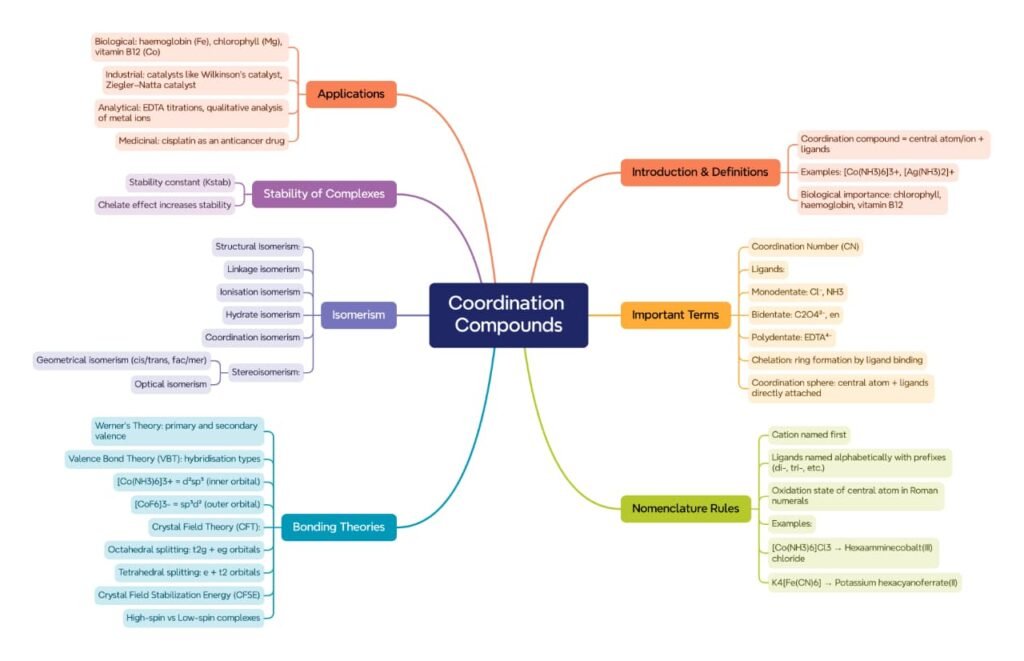
MIND MAPS
————————————————————————————————————————————————————————————————————————————