
Class 12 : Biology (English) – Lesson 9: Biotechnology: Principles and Processes

EXPLANATION & SUMMARY
🌟 Introduction
🧬 Biotechnology = application of biological organisms, systems, and processes for human welfare.
🔬 This chapter explains the principles (tools & techniques of genetic engineering) and processes (steps in recombinant DNA technology).
🔧 Principles of Biotechnology
Modern Definition
✔️ Biotechnology = genetic engineering + maintenance of sterile conditions + large-scale cultivation.
Core Techniques
🧪 Genetic Engineering — direct manipulation of DNA, e.g.:
Recombinant DNA technology
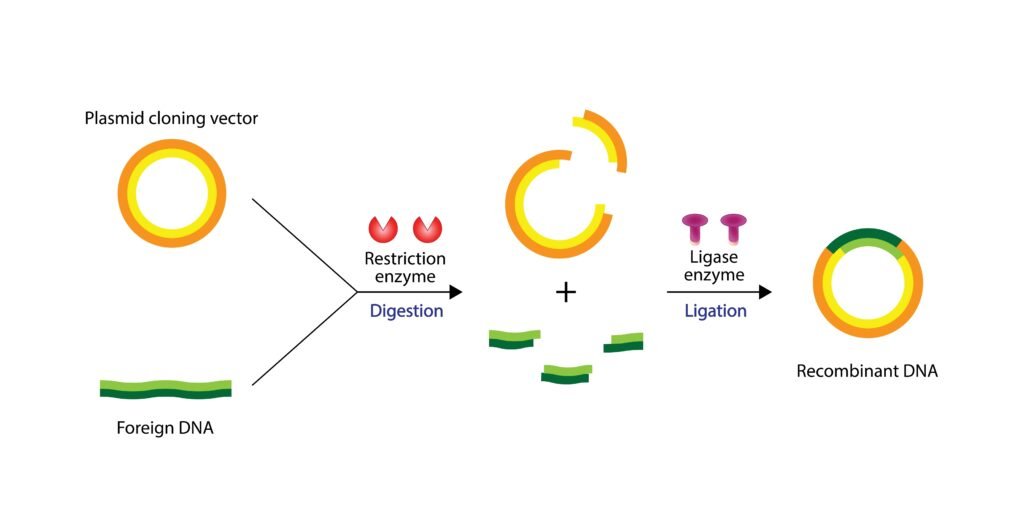
Gene transfer methods
Cloning
🧫 Tissue Culture — growth of isolated plant/animal cells under sterile, nutrient-rich conditions.
🛠️ Tools of Recombinant DNA Technology
Restriction Enzymes (Molecular Scissors ✂️)
Recognise specific DNA sequences (palindromes).
Types:
🔹 Exonucleases → cut ends of DNA.
🔹 Endonucleases → cut within DNA.
Example: EcoRI (cuts between G and A in GAATTC).
DNA Ligase (Molecular Glue 🧩)
Joins DNA fragments → seals “nicks”.
Vectors 🚚
DNA molecules used to carry foreign DNA into host.
Common vectors:

🟢 Plasmids (E. coli)
🔵 Bacteriophages (virus-based)
Good vector properties: origin of replication, selectable markers, cloning sites.
Competent Host Cells 🦠
E. coli often used.
DNA introduced via:
➡️ Transformation
➡️ Electroporation
➡️ Microinjection
➡️ Gene gun
🧪 Processes in Recombinant DNA Technology
Step 1: Isolation of DNA 🧬
Cells broken open → DNA separated from RNA, proteins, polysaccharides.
Step 2: Cutting DNA at Specific Sites ✂️
Restriction enzymes generate sticky ends.
Step 3: Amplification of Gene of Interest (GOI) 🔄
Polymerase Chain Reaction (PCR):

Denaturation (DNA strands separate).
Annealing (primers bind).
Extension (Taq polymerase synthesises DNA).
Step 4: Insertion of DNA into Vector 🧩
GOI ligated into plasmid/phage vector.
Step 5: Introduction of Recombinant DNA into Host Cell 🦠
Techniques: microinjection, electroporation, gene gun.
Step 6: Selection of Recombinants ✅
Markers used (antibiotic resistance, colour change).
Step 7: Downstream Processing 🏭
Large-scale production in bioreactors.
Purification of product → packaging.
🏭 Bioreactors (Large-Scale Production)
Fermenters for growth of cells and production of metabolites.
Types:
🔵 Stirred-tank bioreactor (mechanical stirrer).
🟢 Air-lift bioreactor.
Conditions controlled: pH, temperature, O₂, nutrients.
🌍 Applications
Production of insulin, interferons, growth hormones.
Transgenic plants (pest resistance, nutritional enhancement).
Gene therapy.

📝 Summary (~300 words)
Biotechnology integrates genetic engineering and bioprocess engineering. Its foundation lies in restriction enzymes, vectors, DNA ligases, and competent hosts.
The process involves isolation of DNA, cutting by restriction enzymes, amplification via PCR, ligation into vectors, and transfer into host cells. Recombinant organisms are screened with selectable markers.
At industrial level, bioreactors produce large-scale metabolites like antibiotics, hormones, enzymes, vaccines. Applications span medicine, agriculture, and industry, such as insulin production, biofortification, and transgenics.
🎯 Quick Recap
🧬 Principles: Genetic engineering + tissue culture.
✂️ Tools: Restriction enzymes, ligase, vectors, host cells.
🔄 Process: DNA isolation → cutting → PCR amplification → ligation → transformation → selection → large-scale production.
🏭 Bioreactors: Controlled vessels for industrial production.
💉 Applications: Medicines, vaccines, transgenics, therapy.
————————————————————————————————————————————————————————————————————————————
QUESTIONS FROM TEXTBOOK
🔹 Q1. Can you list 10 recombinant proteins which are used in medical practice? Find out where they are used as therapeutics.
✨ Answer:
🧬 Some important recombinant proteins used in therapy:
💉 Insulin → Diabetes mellitus treatment.
🧪 Human Growth Hormone (hGH) → Pituitary dwarfism.
🛡️ Interferons → Viral infections and cancer therapy.
🩸 Factor VIII → Treatment of Haemophilia A.
🩺 Erythropoietin (EPO) → Stimulates RBC formation in anaemia.
🧬 tPA (Tissue Plasminogen Activator) → Dissolves blood clots (thrombolysis).
🦠 Hepatitis B Vaccine → Prevention of hepatitis B infection.
🧩 Monoclonal antibodies (mAbs) → Cancer, autoimmune diseases (like trastuzumab).
💊 Interleukins → Stimulate immune response.
🧪 DNase enzyme → Cystic fibrosis treatment (clears mucus).
🔹 Q2. Make a chart (with diagrammatic representation) showing a restriction enzyme, the substrate DNA on which it acts, the site at which it cuts DNA and the product it produces.
✨ Answer:
✔️ Example: EcoRI (restriction endonuclease)
Recognition sequence: 5′-GAATTC-3′
Cuts between G and A → produces sticky ends.
📊 Representation:
5′—GAATTC—3′
3′—CTTAAG—5′
✂️ Cut →
5′—G AATTC—3′
3′—CTTAA G—5′
Product → sticky ends, useful for recombinant DNA formation.
🔹 Q3. From what you have learnt, can you tell whether enzymes are bigger or DNA is bigger in molecular size? How did you know?
✨ Answer:
DNA molecules are much larger compared to enzymes.
Example: Human DNA = billions of base pairs.
Enzymes = proteins of a few thousand amino acids.
➡️ Thus, DNA >> enzymes in size.
🔹 Q4. What would be the molar concentration of human DNA in a human cell?
✨ Answer:
Haploid human genome: ~3.3 × 10⁹ bp.
Diploid genome (in one somatic cell): 6.6 × 10⁹ bp.
Since DNA is present as two sets of chromosomes, molar concentration per cell ≈ 2.2 picograms of DNA per haploid genome.
Hence, a diploid cell has about 6.6 picograms DNA.
🔹 Q5. Do eukaryotic cells have restriction endonucleases? Justify your answer.
✨ Answer:
❌ No, eukaryotic cells do not have restriction endonucleases.
✔️ These enzymes are found in bacteria (where they act as a defence mechanism against bacteriophage DNA).
Eukaryotes lack such restriction-modification systems.
🔹 Q6. Besides better aeration and mixing properties, what other advantages do stirred-tank bioreactors have over shake flasks?
✨ Answer:
🏭 Advantages of Stirred-Tank Bioreactors:
✔️ Continuous monitoring of pH, oxygen, temperature, nutrients.
✔️ Better sterility maintenance.
✔️ Large-scale production possible.
✔️ More uniform distribution of cells, gases, and nutrients.
✔️ Downstream processing easier.
🔹 Q7. Collect 5 examples of palindromic DNA sequences.
✨ Answer:
✔️ Palindromic sequences read the same in both directions (5′→3′ and 3′→5′). Examples:
5′-GAATTC-3′ / 3′-CTTAAG-5′ (EcoRI)
5′-GGATCC-3′ / 3′-CCTAGG-5′ (BamHI)
5′-AAGCTT-3′ / 3′-TTCGAA-5′ (HindIII)
5′-GTCGAC-3′ / 3′-CAGCTG-5′ (SalI)
5′-CCCGGG-3′ / 3′-GGGCCC-5′ (SmaI)
🔹 Q8. Can you recall meiosis and indicate at what stage a recombinant DNA is made?
✨ Answer:
During meiosis, crossing over occurs in prophase I (pachytene stage).
Exchange of chromosomal segments between homologous chromosomes → recombinant DNA in gametes.
🔹 Q9. How can a reporter enzyme be used to monitor transformation of host cells by foreign DNA in addition to a selectable marker?
✨ Answer:
Reporter enzymes (e.g., β-galactosidase, luciferase, GFP) produce visible signals.
If host cells take up recombinant DNA:
Colonies show colour/fluorescence/light emission.
Example: lacZ reporter gene → blue/white colony selection in E. coli.
🔹 Q10. Describe briefly:
(a) Origin of replication
(b) Bioreactors
(c) Downstream processing
✨ Answer:
(a) Origin of replication (Ori): Specific DNA sequence where replication begins; ensures vector DNA multiplies inside host.
(b) Bioreactors: Large fermentation vessels with controlled conditions (pH, O₂, nutrients) for mass production of proteins/enzymes.
(c) Downstream processing: Purification and recovery of biotechnological products → includes separation, purification, formulation, and quality testing.
🔹 Q11. Explain briefly:
(a) PCR
(b) Restriction enzymes and DNA
(c) Chitinase
✨ Answer:
(a) PCR (Polymerase Chain Reaction): Technique to amplify DNA using denaturation, annealing, and extension steps.
(b) Restriction enzymes and DNA: Enzymes that cut DNA at palindromic sequences → generate sticky/blunt ends for cloning.
(c) Chitinase: Enzyme that digests chitin (present in fungal cell walls); used to isolate DNA from fungi.
🔹 Q12. Distinguish between:
(a) Plasmid DNA and Chromosomal DNA
(b) RNA and DNA
(c) Exonuclease and Endonuclease
✨ Answer:
(a) Plasmid DNA: Small, circular, extrachromosomal; Chromosomal DNA: large, linear, carries essential genes.
(b) RNA: Single-stranded, ribose sugar, uracil; DNA: double-stranded, deoxyribose, thymine.
(c) Exonuclease: Removes nucleotides from ends; Endonuclease: cuts within DNA.
————————————————————————————————————————————————————————————————————————————
OTHER IMPORTANT QUESTIONS FOR EXAMS
(CBSE MODEL QUESTION PAPER)
ESPECIALLY MADE FROM THIS CHAPTER ONLY
🟢 Section A — Very Short Answer / MCQs (Q1–Q6)
🔹 Q1. Which enzyme is called the “molecular scissors” in recombinant DNA technology?
🔵 (A) DNA ligase
🟢 (B) Restriction endonuclease
🟠 (C) RNA polymerase
🔴 (D) DNA polymerase
✅ Answer: (B) Restriction endonuclease
🔹 Q2. The function of DNA ligase is to:
🔵 (A) Cut DNA at palindromic sites
🟢 (B) Join DNA fragments
🟠 (C) Replicate DNA
🔴 (D) Denature DNA
✅ Answer: (B) Join DNA fragments
🔹 Q3. Which organism is widely used to produce insulin by recombinant DNA technology?
🔵 (A) Saccharomyces cerevisiae
🟢 (B) E. coli
🟠 (C) Rhizopus
🔴 (D) Penicillium
✅ Answer: (B) E. coli
🔹 Q4. PCR is used for:
🔵 (A) Protein purification
🟢 (B) DNA amplification
🟠 (C) RNA translation
🔴 (D) Gene silencing
✅ Answer: (B) DNA amplification
🔹 Q5. Name the specific site on plasmid DNA where replication begins.
✅ Answer: Origin of replication (Ori).
🔹 Q6. Which enzyme is required to digest fungal cell walls during DNA isolation?
✅ Answer: Chitinase.
🟡 Section B — Short Answer (Q7–Q12)
🔹 Q7. What are palindromic sequences? Give one example.
✅ Answer: Palindromic sequences are DNA sequences that read the same in 5′→3′ and 3′→5′ directions.
Example: 5′-GAATTC-3′ / 3′-CTTAAG-5′ (recognized by EcoRI).
🔹 Q8. Why are bioreactors preferred over shake flasks for large-scale production?
✅ Answer: Bioreactors maintain sterility, monitor pH, O₂, and temperature, allow better aeration, nutrient mixing, and large-scale production of recombinant proteins.
🔹 Q9. Differentiate between exonuclease and endonuclease.
✅ Answer:
Exonuclease: Removes nucleotides from DNA ends.
Endonuclease: Cuts DNA within the strand at specific sites.
🔹 Q10. What is downstream processing?
✅ Answer: Series of processes for purification and formulation of the recombinant product, including separation, quality control, and packaging.
🔹 Q11. Give two uses of recombinant human insulin.
✅ Answer:
Treatment of Type 1 diabetes.
Management of Type 2 diabetes in severe cases.
🔹 Q12. Mention the three steps of PCR in correct order.
✅ Answer:
Denaturation (DNA strands separate)
Annealing (primers attach)
Extension (Taq polymerase synthesises DNA)
🔴 Section C — Short Answer II (Q13–Q22)
🔹 Q13. How are selectable markers useful in rDNA technology?
✅ Answer: Selectable markers (e.g., antibiotic resistance genes) help distinguish recombinants from non-recombinants, as only recombinants grow on selective medium.
🔹 Q14. Explain the role of ori site in cloning vectors.
✅ Answer: Ori site initiates replication, controls copy number of plasmid, and ensures propagation of inserted gene.
🔹 Q15. Give one difference between plasmid DNA and chromosomal DNA.
✅ Answer: Plasmid: Small, circular, non-essential, extrachromosomal. Chromosomal: Large, linear, essential genes.
🔹 Q16. What is meant by competent host cells? How are E. coli cells made competent?
✅ Answer: Cells capable of taking up foreign DNA are competent. E. coli is made competent by treating with divalent cations (Ca²⁺) and heat shock.
🔹 Q17. Explain the principle of gel electrophoresis.
✅ Answer: DNA fragments migrate in an electric field through agarose gel; smaller fragments move faster towards the positive electrode.
🔹 Q18. What are cloning vectors? Mention two desirable features.
✅ Answer: DNA molecules that transfer foreign DNA into host. Features: Ori site, selectable markers, unique cloning sites, small size.
🔹 Q19. What is the use of biocontrol agents like Trichoderma in biotechnology?
✅ Answer: Trichoderma acts as a biocontrol fungus against plant pathogens, reducing chemical pesticide use.
🔹 Q20. Differentiate between RNA and DNA.
✅ Answer: RNA: Single-stranded, ribose sugar, uracil. DNA: Double-stranded, deoxyribose, thymine.
🔹 Q21. Why are sticky ends better than blunt ends in recombinant DNA technology?
✅ Answer: Sticky ends allow complementary base pairing, making ligation easier and more specific.
🔹 Q22. Write one application of recombinant DNA technology in agriculture.
✅ Answer: Development of pest-resistant Bt cotton.
🟣 Section D — Long Answer (Q23–Q30)
🔹 Q23. Explain the steps involved in recombinant DNA technology.
✅ Answer:
Isolation of DNA.
Cutting with restriction enzymes.
Amplification of gene (PCR).
Ligation of DNA fragment into vector.
Transfer into host (transformation).
Selection of recombinants using markers.
Large-scale production and downstream processing.
🔹 Q24. What is PCR? Explain its steps and applications.
✅ Answer:
Definition: Technique to amplify DNA.
Steps:
Denaturation (strand separation at ~95°C).
Annealing (primer binding at ~55°C).
Extension (DNA synthesis by Taq polymerase at ~72°C).
Applications: DNA fingerprinting, diagnosis, gene cloning, forensics.
🔹 Q25. Discuss the role of restriction enzymes in genetic engineering.
✅ Answer:
Cut DNA at specific palindromic sequences.
Produce sticky/blunt ends useful for cloning.
Essential for recombinant DNA technology.
Examples: EcoRI, BamHI, HindIII.
🔹 Q26. Describe bioreactors and their advantages in biotechnology.
✅ Answer:
Bioreactors: Vessels for large-scale cultivation of microbes/animal cells.
Types: Stirred-tank, air-lift.
Advantages: Controlled environment, large yield, continuous monitoring, sterile conditions, cost-efficient.
🔹 Q27. What is downstream processing? Mention its importance.
✅ Answer:
Series of steps for recovery and purification of recombinant products.
Includes: separation, purification, quality control, formulation, and packaging.
Importance: Ensures product safety, efficacy, and usability (e.g., insulin, vaccines).
🔹 Q28. Describe the process of producing recombinant human insulin.
✅ Answer:
Gene for insulin (A & B chains) inserted into E. coli plasmids.
Separate expression of A and B chains.
Chains purified and chemically combined to form functional insulin.
Marketed as Humulin.
🔹 Q29. Explain the principle and applications of gel electrophoresis.
✅ Answer:
DNA fragments separated based on size through agarose gel under electric field.
Smaller fragments move faster toward positive electrode.
Applications: DNA fingerprinting, gene cloning, genetic diagnosis, sequencing.
🔹 Q30. How are competent cells prepared and why are they important?
✅ Answer:
Preparation: Treating cells with Ca²⁺ ions and subjecting to heat shock to make cell walls permeable.
Importance: Allows uptake of foreign DNA → transformation → recombinant production.
🔵 Section E — Case Study Based Questions (Q31–Q33 with MCQs)
📌 Case Study: A scientist is working on producing recombinant human growth hormone (hGH). He uses E. coli as the host, a plasmid as the vector, restriction enzymes to cut the DNA, ligase to join the DNA, and selectable markers for screening.
🔹 Q31. Which enzyme is essential to cut the hGH gene and plasmid at the same site?
🔵 (A) DNA ligase
🟢 (B) Restriction endonuclease
🟠 (C) DNA polymerase
🔴 (D) RNA polymerase
✅ Answer: (B) Restriction endonuclease
🔹 Q32. Which selectable marker would best help in identifying recombinant colonies?
🔵 (A) Origin of replication
🟢 (B) Antibiotic resistance gene
🟠 (C) Promoter sequence
🔴 (D) Restriction site
✅ Answer: (B) Antibiotic resistance gene
🔹 Q33. Which step ensures large-scale production of hGH after transformation?
🔵 (A) Downstream processing
🟢 (B) Bioreactor cultivation
🟠 (C) Gel electrophoresis
🔴 (D) PCR amplification
✅ Answer: (B) Bioreactor cultivation
————————————————————————————————————————————————————————————————————————————