
Class 12 : Biology (English) – Lesson 4 Principles of Inheritance and Variation

EXPLANATION & SUMMARY
✨ Introduction
🔵 Inheritance → Passing of traits 🧬 from parents 👩👩👦 to offspring.
🟢 Variation → Differences 🌱 among individuals of the same species.
🟠 Genetics → Science of heredity & variation.
🔴 Importance → Explains continuity of life 🔗, origin of new traits 🌟, and basis of evolution 🌍.
🌿 Mendel and His Experiments
👨🔬 Gregor Johann Mendel (1822–1884) → Father of Genetics.
📖 Work: Experiments on Plant Hybridisation (1865).
🌱 Experimental plant: Pea plant (Pisum sativum).
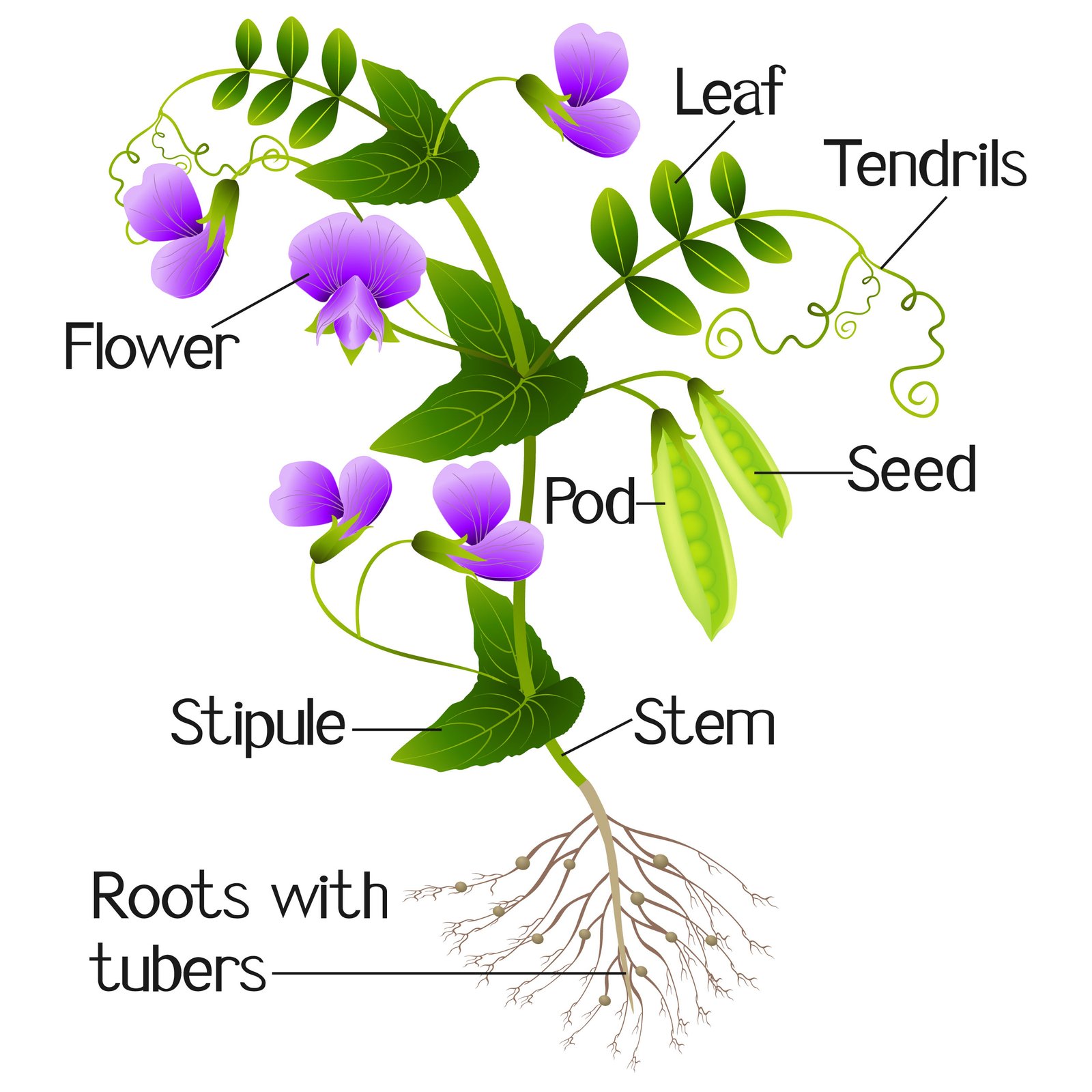
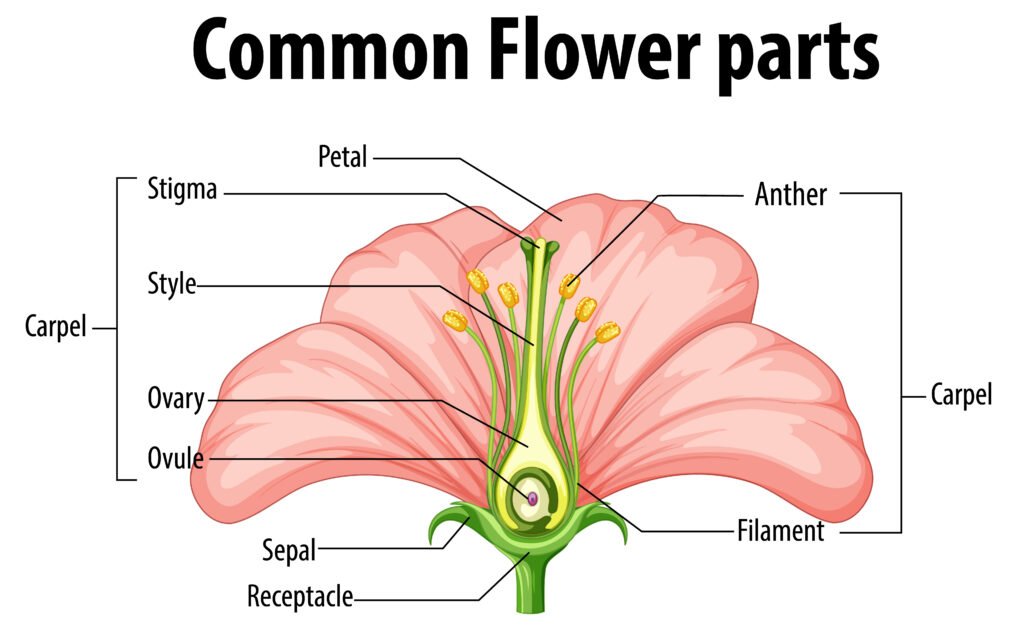
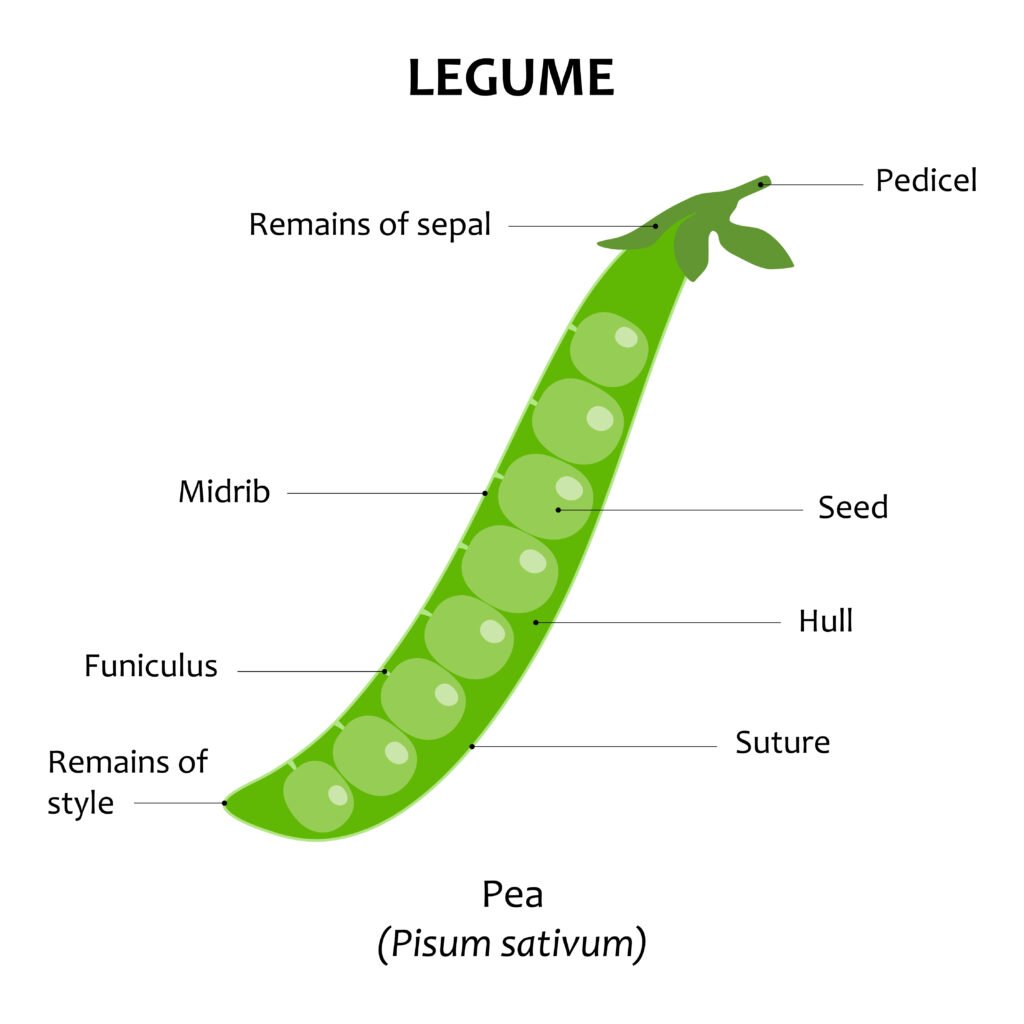
Why pea plant?
🌸 Clear contrasting traits (7 pairs).
⏱️ Short life cycle → quick results.
🌰 Produced large number of seeds.
🔀 Self-pollinating but cross-pollination possible.
Mendel’s Method
🧪 Maintained pure lines.
🎯 Studied one trait at a time.
📊 Counted large sample size.
🔢 Applied statistical analysis → accuracy.
🌱 Mendel’s Laws of Inheritance
⚡ Law of Dominance
In a hybrid (Aa), only the dominant allele shows its effect 💪, while the recessive remains hidden 👻.
Example: Tall (TT) × Dwarf (tt) → All Tall (Tt).
⚡ Law of Segregation (Purity of Gametes)
Allele pairs separate during gamete formation 🎲.
Each gamete gets only one allele.
Example: F2 of monohybrid cross = Phenotypic ratio 3 Tall : 1 Dwarf; Genotypic ratio 1:2:1.
⚡ Law of Independent Assortment
Alleles of different traits assort independently 🔄.
Example: Dihybrid cross (RRYY × rryy) → F2 ratio 9:3:3:1.
🧩 Mendel’s Crosses
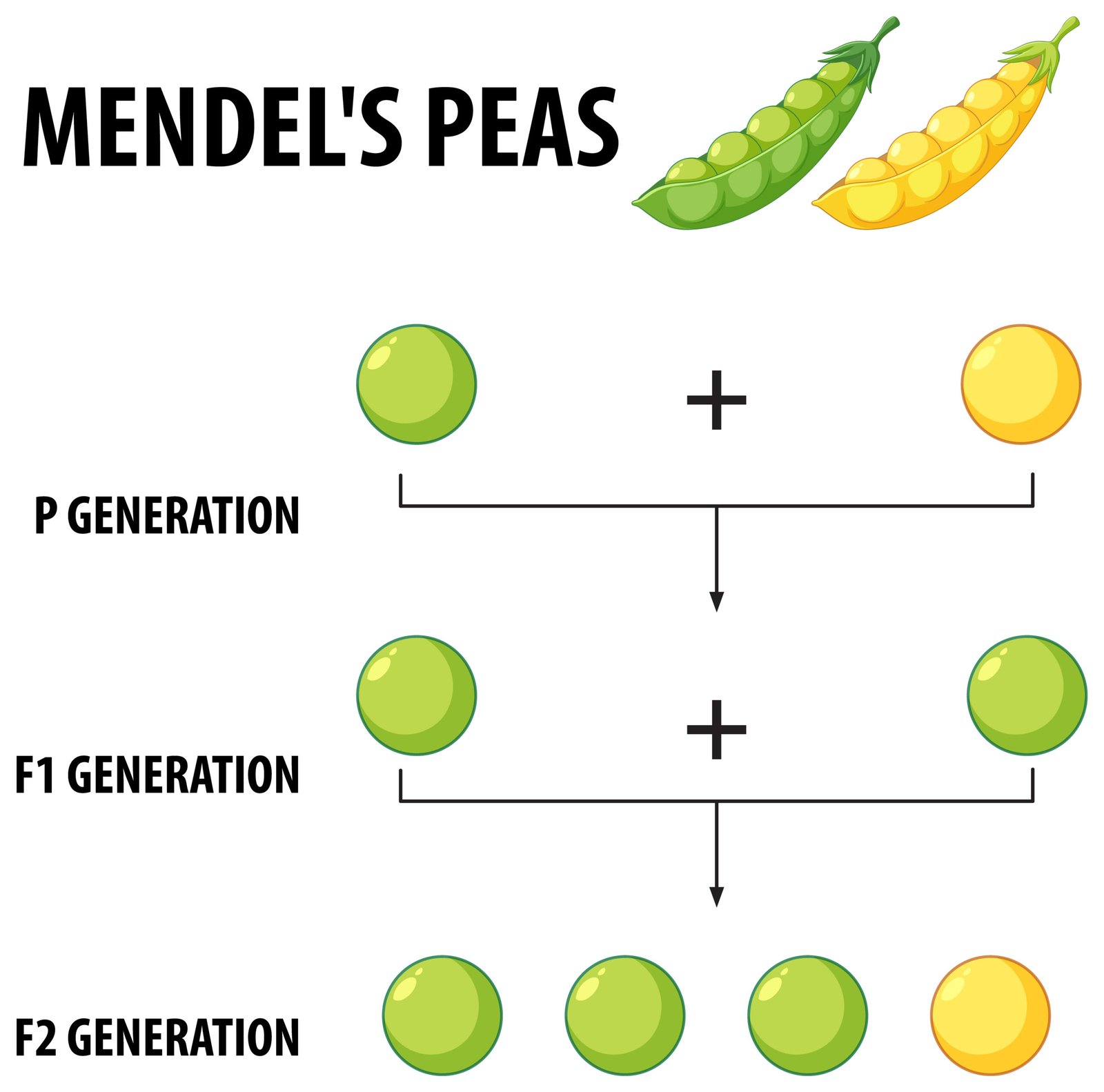
🥬 Monohybrid Cross
P: TT × tt
F1: All Tt (Tall 🌱)
F2: 3 Tall : 1 Dwarf
🌽 Dihybrid Cross
P: RRYY × rryy
F1: All RrYy (Round Yellow 🌽)
F2: 9 Round Yellow : 3 Round Green : 3 Wrinkled Yellow : 1 Wrinkled Green
🎯 Why Mendel Succeeded
⭐ Choice of clear contrasting traits.
📘 Careful controlled pollination.
📊 Large data collection → statistical approach.
🌱 Use of true-breeding pea plants.
🌸 Deviations from Mendel’s Ratios
🎨 Incomplete Dominance → Hybrid shows blended trait (e.g., Red × White Snapdragon 🌸 = Pink).
🩸 Codominance → Both alleles expressed equally (e.g., Human ABO blood group IA + IB = AB).
🔀 Multiple Alleles → More than two alleles for a gene (e.g., ABO system IA, IB, i).
🧬 Pleiotropy → One gene influences multiple traits (e.g., Sickle-cell anaemia).
👥 Polygenic Inheritance → Multiple genes control one trait (e.g., Skin colour 👩🏽👩🏻👩🏿).
🧬 Chromosomal Basis of Inheritance
📌 Proposed by Sutton & Boveri (1902).
⚛️ Genes are located on chromosomes.
🔄 Behaviour of chromosomes during meiosis mirrors Mendel’s laws.
🔗 Linkage and Recombination
🔗 Linkage → Genes close together on same chromosome are inherited together.
🔄 Recombination → New allele combinations due to crossing over.
🪰 Studied by T.H. Morgan in fruit fly (Drosophila).
🚹 Mechanisms of Sex Determination
👨 XY system → Humans, Drosophila.
🐦 ZW system → Birds (ZW = female, ZZ = male).
🐝 Haplodiploidy → Honeybees (male = haploid, female = diploid).
⚡ Mutation
⚡ Sudden change in DNA sequence.
Types:
🎯 Point mutation → Single base change (e.g., sickle-cell).
🧩 Chromosomal mutation → Deletion, duplication, inversion, translocation.
🧪 Genetic Disorders
Mendelian Disorders
🩸 Haemophilia (X-linked recessive).
🧠 Phenylketonuria (autosomal recessive).
🩺 Sickle-cell anaemia (autosomal recessive).
Chromosomal Disorders
👶 Down’s syndrome (Trisomy 21).
👩 Turner’s syndrome (XO).
👨 Klinefelter’s syndrome (XXY).
📊 Hardy–Weinberg Principle
🧩 Statement: In a stable population with random mating, large size, and no mutation, migration, selection, or drift, allele frequencies remain constant.
Formula:
p + q = 1
p² + 2pq + q² = 1
Where:
p² → Homozygous dominant (AA)
2pq → Heterozygous (Aa)
q² → Homozygous recessive (aa)
⚠️ Deviations → Indicate evolutionary forces at work.
🧩 Pedigree Analysis
📜 Diagram tracing inheritance of traits.
Symbols: ⬜ Male, ⚪ Female, ⬛ Affected.
Useful in genetic counseling & studying disorders.
📝 Concise Summary (~300 words)
This chapter explains the principles of inheritance and variation. Mendel’s pea plant experiments gave us the laws of dominance, segregation, and independent assortment, explained through monohybrid (3:1) and dihybrid (9:3:3:1) ratios.
Later research found deviations: incomplete dominance, codominance, multiple alleles, pleiotropy, and polygenic inheritance. Sutton and Boveri’s chromosomal theory linked inheritance to chromosomes, while Morgan’s work on Drosophila revealed linkage and recombination.
Sex determination varies in different organisms: XY in humans, ZW in birds, haplodiploidy in honeybees. Mutations introduce new variations, and disorders are classified as Mendelian (haemophilia, phenylketonuria, sickle-cell) or chromosomal (Down’s, Turner’s, Klinefelter’s).
Population genetics is explained by the Hardy–Weinberg principle, stating that allele frequencies remain constant unless acted upon by evolutionary forces. Pedigree analysis helps trace inheritance and identify genetic disorders.
Thus, this chapter connects Mendel’s experiments with molecular genetics and evolution.
🎯 Quick Recap
🟦 Mendel’s Laws → Dominance, Segregation, Independent Assortment.
🟩 Crosses → Monohybrid (3:1), Dihybrid (9:3:3:1).
🟨 Exceptions → Incomplete dominance, codominance, multiple alleles, pleiotropy, polygenic inheritance.
🟧 Chromosomal Theory → Sutton & Boveri; Morgan’s linkage & recombination.
🟪 Sex Determination → XY (humans), ZW (birds), haplodiploidy (bees).
🟫 Mutations → Point & chromosomal.
⬜ Disorders → Mendelian (sickle-cell, haemophilia), Chromosomal (Down’s, Turner’s, Klinefelter’s).
🔵 Hardy–Weinberg → p² + 2pq + q² = 1.
🔴 Pedigree → Family inheritance charts.
————————————————————————————————————————————————————————————————————————————
QUESTIONS FROM TEXTBOOK
Exercises Q&A
❓ Q1. Mention the advantages of selecting pea plant for experiment by Mendel.
✅ Answer:
🌱 Short life cycle → results obtained quickly.
🌸 Bisexual flowers → self-pollination, but cross-pollination possible.
🎨 Presence of 7 pairs of contrasting traits (e.g., tall/dwarf, round/wrinkled).
🌰 Large number of seeds produced → statistical accuracy.
🧪 Easy to cultivate & control pollination.
❓ Q2. Differentiate between the following –
(a) Dominance and Recessive
🌟 Dominant allele → Expressed in heterozygote (e.g., Tall in Tt).
🌑 Recessive allele → Masked in heterozygote, expressed only when homozygous (tt).
(b) Homozygous and Heterozygous
🟢 Homozygous → Both alleles identical (TT or tt).
🔵 Heterozygous → Two different alleles (Tt).
(c) Monohybrid and Dihybrid
🥬 Monohybrid → Cross involving a single trait (e.g., Tall × Dwarf).
🌽 Dihybrid → Cross involving two traits (e.g., Seed shape × Seed colour).
❓ Q3. A diploid organism is heterozygous for 4 loci, how many types of gametes can be produced?
✅ Answer (Stepwise):
🧮 Formula = , where n = number of heterozygous loci.
Here, n = 4.
Calculation: .
✅ Total gametes possible = 16.
❓ Q4. Explain the Law of Dominance using a monohybrid cross.
✅ Answer:
Law: In heterozygote (Aa), only one character (dominant) expresses, recessive remains hidden.
Example: Tall (TT) × Dwarf (tt)
🌱 P generation → TT × tt.
🌱 F1 → All Tt (Tall).
🌱 F2 → TT : Tt : tt = 1 : 2 : 1 (Genotypic).
Phenotypic ratio → 3 Tall : 1 Dwarf.
🎯 Conclusion: Dominant allele (T) masks recessive allele (t).
❓ Q5. Define and design a test-cross.
✅ Answer:
Definition: Crossing an individual with unknown genotype with a homozygous recessive to determine genotype.
Example: Tall plant of unknown genotype (T_) × dwarf plant (tt).
If all tall → parent = TT.
If 1 Tall : 1 Dwarf → parent = Tt.
❓ Q6. Using a Punnett Square, work out the distribution of phenotypic features in the first filial generation after a cross between a homozygous female and a heterozygous male for a single locus.
✅ Answer:
Let the trait = Tallness (T = tall, t = dwarf).
Parent: Homozygous female (TT) × Heterozygous male (Tt).
Gametes:
Female: T
Male: T, t
Punnett Square:T (♂) t (♂)
T (♀) TT Tt
Result: 50% TT, 50% Tt.
✅ All offspring Tall (100%).
❓ Q7. When a cross is made between tall plant with yellow seeds (TTyy) and tall plant with green seeds (Ttyy), what proportions of phenotype in the offspring could be expected to be –
(a) Tall and green
(b) Dwarf and green
✅ Answer (Stepwise):
Parents: TTyy × Ttyy.
Gametes:
TTyy → Ty.
Ttyy → Ty, ty.
Cross:
Ty × Ty = TTyy (Tall, Yellow).
Ty × ty = Ttyy (Tall, Yellow).
Result:
All offspring Tall, Yellow.
(a) Tall and Green = 0.
(b) Dwarf and Green = 0.
❓ Q8. Two heterozygous parents are crossed. If the two loci are linked, what would be the distribution of phenotypic features in F₁ generation for a dihybrid cross?
✅ Answer:
Parents: RrYy × RrYy (linked genes).
If completely linked, gametes formed will be RY, ry only.
Cross: RY × ry → Only Parental combinations.
Result: Only 2 phenotypes instead of 4 → 50% Round Yellow, 50% Wrinkled Green.
❓ Q9. Briefly mention the contribution of T.H. Morgan in genetics.
✅ Answer:
🪰 Worked on Drosophila melanogaster (fruit fly).
🔗 Discovered linkage of genes.
🔄 Studied recombination and crossing over.
📊 Introduced concept of gene mapping.
🏆 Awarded Nobel Prize (1933) for genetics research.
❓ Q10. What is pedigree analysis? Suggest how such an analysis can be useful.
✅ Answer:
Pedigree analysis → Diagrammatic record of inheritance across generations.
Usefulness:
🩺 Helps detect genetic disorders.
👨👩👧 Shows inheritance pattern (dominant, recessive, X-linked).
🧬 Useful in genetic counseling.
📚 Helps predict risk in future generations.
❓ Q11. How is sex determined in human beings?
✅ Answer:
Humans have 46 chromosomes (44 autosomes + XX/XY).
👩 Female → XX.
👨 Male → XY.
Egg always contributes X.
Sperm may contribute X or Y.
Fertilisation results:
X + X → Female child.
X + Y → Male child.
✅ Thus, male gamete determines the sex of the child.
❓ Q12. A child has blood group O. If the father has blood group A and mother blood group B, work out the genotypes of the parents and the possible genotypes of the other offspring.
✅ Answer (Stepwise):
Child with O = genotype ii.
Father has group A = possible genotype IAi.
Mother has group B = possible genotype IBi.
Cross: IAi × IBi
Gametes: IA, i (father) × IB, i (mother).
Punnett Square:
IAIB → AB group
IAi → A group
IBi → B group
ii → O group
✅ Possible offspring groups = A, B, AB, O.
❓ Q13. Explain the following terms with example:
(a) Codominance
Both alleles expressed equally in heterozygote.
Example: AB blood group (IA and IB).
(b) Incomplete dominance
Heterozygote shows intermediate phenotype.
Example: Snapdragon flower → Red × White = Pink.
❓ Q14. What is point mutation? Give one example.
✅ Answer:
A mutation affecting a single base pair.
Example: Sickle-cell anaemia (substitution of adenine → thymine in β-globin gene).
❓ Q15. Who had proposed the chromosomal theory of inheritance?
✅ Answer:
Sutton and Boveri (1902) proposed the Chromosomal Theory of Inheritance.
❓ Q16. Mention any two autosomal genetic disorders with their symptoms.
✅ Answer:
Sickle-cell anaemia (autosomal recessive)
Abnormal haemoglobin → sickle-shaped RBCs.
Symptoms: Anaemia, fatigue, joint pain.
Phenylketonuria (autosomal recessive)
Mutation in gene for phenylalanine metabolism.
Symptoms: Mental retardation, seizures, light skin/hair.
————————————————————————————————————————————————————————————————————————————
OTHER IMPORTANT QUESTIONS FOR EXAMS
(CBSE MODEL QUESTION PAPER)
ESPECIALLY MADE FROM THIS CHAPTER ONLY
Full Board Style Solved Paper (33 Questions, 70 Marks)
🌟 Section A (1 Mark × 16 = 16 Marks, MCQs with Options)
Q1. Which of the following is a contrasting character studied by Mendel in pea plant?
🟦 (A) Tall vs Dwarf
🟩 (B) White vs Black flowers
🟨 (C) Smooth vs Rough seeds
🟧 (D) Pink vs Red flowers
✅ Answer: (A) Tall vs Dwarf
Q2. The genotype of a pure tall pea plant is:
🟦 (A) TT
🟩 (B) Tt
🟨 (C) tt
🟧 (D) None of these
✅ Answer: (A) TT
Q3. Law of Segregation was proposed by:
🟦 (A) T.H. Morgan
🟩 (B) Darwin
🟨 (C) Mendel
🟧 (D) Lamarck
✅ Answer: (C) Mendel
Q4. Which one is a sex-linked disorder?
🟦 (A) Phenylketonuria
🟩 (B) Haemophilia
🟨 (C) Sickle-cell anaemia
🟧 (D) Down’s syndrome
✅ Answer: (B) Haemophilia
Q5. The phenotypic ratio of a monohybrid cross is:
🟦 (A) 9:3:3:1
🟩 (B) 1:2:1
🟨 (C) 3:1
🟧 (D) 2:1
✅ Answer: (C) 3:1
Q6. In incomplete dominance, F₂ phenotypic ratio is:
🟦 (A) 1:2:1
🟩 (B) 3:1
🟨 (C) 9:3:3:1
🟧 (D) 2:1:1
✅ Answer: (A) 1:2:1
Q7. Number of different gametes produced by AaBbCc is:
🟦 (A) 2
🟩 (B) 4
🟨 (C) 8
🟧 (D) 16
✅ Answer: (C) 8
Q8. Who proposed the chromosomal theory of inheritance?
🟦 (A) Mendel
🟩 (B) Sutton & Boveri
🟨 (C) Watson & Crick
🟧 (D) Morgan
✅ Answer: (B) Sutton & Boveri
Q9. If frequency of allele ‘a’ = 0.4, frequency of ‘A’ = ?
🟦 (A) 0.4
🟩 (B) 0.6
🟨 (C) 0.8
🟧 (D) 0.2
✅ Answer: (B) 0.6
Q10. A cross between IAi × IBi can produce a child with blood group:
🟦 (A) A only
🟩 (B) AB only
🟨 (C) A, B, AB, O
🟧 (D) O only
✅ Answer: (C) A, B, AB, O
Q11. Example of polygenic inheritance is:
🟦 (A) AB blood group
🟩 (B) Skin colour in humans
🟨 (C) Sickle-cell anaemia
🟧 (D) Haemophilia
✅ Answer: (B) Skin colour in humans
Q12. Which of the following is a trisomy?
🟦 (A) Turner’s syndrome
🟩 (B) Klinefelter’s syndrome
🟨 (C) Down’s syndrome
🟧 (D) None
✅ Answer: (C) Down’s syndrome
Q13. Sex of child is determined by:
🟦 (A) Ovum
🟩 (B) Male gamete (sperm)
🟨 (C) Both
🟧 (D) None
✅ Answer: (B) Male gamete (sperm)
Q14. Which one shows codominance?
🟦 (A) ABO blood group
🟩 (B) Snapdragon flower colour
🟨 (C) Skin colour in humans
🟧 (D) Eye colour in Drosophila
✅ Answer: (A) ABO blood group
Q15. Crossing over occurs in:
🟦 (A) Mitosis metaphase
🟩 (B) Meiosis I prophase
🟨 (C) Meiosis II telophase
🟧 (D) None
✅ Answer: (B) Meiosis I prophase
Q16. Which disorder is caused by substitution mutation in haemoglobin?
🟦 (A) Phenylketonuria
🟩 (B) Sickle-cell anaemia
🟨 (C) Haemophilia
🟧 (D) Down’s syndrome
✅ Answer: (B) Sickle-cell anaemia
✨ Section B (2 marks × 6 = 12 marks)
Q17. Differentiate between dominance and recessiveness with one example each.
Answer:
🌟 Dominance: Allele that expresses in heterozygote. Example: Tall (T) in pea.
🌑 Recessiveness: Allele masked in heterozygote, expressed only in homozygote. Example: Dwarf (t) in pea.
Q18. What is linkage? How does it affect recombination?
Answer:
🔗 Linkage: Tendency of genes on the same chromosome (close together) to be inherited together.
🔄 Effect: Decreases recombination → fewer new combinations, more parental types.
Q19. Show the outcome of a test cross Tt × tt using a Punnett square.
Answer:
🧬 Gametes: (T, t) from Tt; (t) from tt.
🧮 Cross:
T × t = Tt (Tall)
t × t = tt (Dwarf)
✅ Phenotype ratio: 1 Tall : 1 Dwarf.
Q20. Why does the father determine the sex of a human child?
Answer:
👩 Eggs always carry X.
👨 Sperms carry X or Y.
🧷 Fertilisation results:
X (egg) + X (sperm) = XX (female)
X (egg) + Y (sperm) = XY (male)
✅ Thus, sperm from father decides the sex.
Q21. Define mutation. Distinguish point vs chromosomal mutations.
Answer:
⚡ Mutation: Sudden heritable change in DNA sequence.
🎯 Point mutation: Single base change (e.g., sickle-cell anaemia).
🧩 Chromosomal mutation: Large-scale alteration (deletion, duplication, inversion, translocation).
Q22. What is pedigree analysis? Mention one importance.
Answer:
📜 Pedigree analysis: Diagram showing inheritance of a trait across generations.
🎯 Use: Helps identify mode of inheritance and detect genetic disorders.
🔬 Section C (3 marks × 6 = 18 marks)
Q23. Explain incomplete dominance in snapdragon with cross and ratio.
Answer:
🎨 Concept: Heterozygote shows intermediate phenotype.
🌸 Cross: Red (RR) × White (rr) → F₁: Rr (Pink).
🔁 F₂: Rr × Rr = 1 RR (Red) : 2 Rr (Pink) : 1 rr (White).
Q24. State the Law of Independent Assortment. Verify with a dihybrid cross.
Answer:
📘 Law: Alleles of different genes assort independently if not linked.
🌽 Cross: RRYY × rryy → F₁: RrYy (Round Yellow).
🔁 F₂: Produces phenotypic ratio 9:3:3:1.
Q25. Describe inheritance of haemophilia. Why is it more common in males?
Answer:
🩸 Type: X-linked recessive disorder.
👩 Female (XX): requires two defective Xs → rare.
👨 Male (XY): one defective X → disease expressed.
✅ Therefore, males are more commonly affected.
Q26. How many different gametes can an organism with genotype AaBbCc produce? Show steps.
Answer:
Rule: Number of gamete types = 2ⁿ, n = heterozygous loci.
1️⃣ n = 3 (A, B, C heterozygous).
2️⃣ 2³ = 8.
✅ Total gametes = 8.
Q27. Write any three reasons for Mendel’s success in his experiments.
Answer:
🌱 Chose contrasting traits.
🌸 Used pure lines & controlled pollination.
📊 Collected large data and applied statistics.
Q28. A child has O blood group. Father is A, mother is B. Work out possible parental genotypes and children’s blood groups.
Answer:
👶 Child O ⇒ genotype ii.
👨 Father A ⇒ must be Iᴬi.
👩 Mother B ⇒ must be Iᴮi.
🧮 Cross: Iᴬi × Iᴮi → offspring = A, B, AB, O.
✅ All four blood groups possible.
📚 Section D (Case-based, 4 marks × 2 = 8 marks)
Q29. Hardy–Weinberg Case: In a population, 36% individuals are recessive aa. Calculate q, p, heterozygotes, and list disturbing forces.
Answer:
1️⃣ q² = 0.36 → q = 0.6.
2️⃣ p = 1 − q = 0.4.
3️⃣ Heterozygotes = 2pq = 0.48 = 48%.
4️⃣ Disturbing forces: mutation, migration, natural selection, genetic drift, non-random mating, small population size.
Q30. Pedigree Case (Haemophilia):
Answer:
(a) Type = X-linked recessive.
(b) More common in males → they are hemizygous (XY).
(c) Carrier mother (XᴴXʰ) × normal father (XᴴY) → 50% sons haemophilic.
(d) Importance → predicts risk, useful in genetic counselling.
🧬 Section E (Long answer, 5 marks × 3 = 15 marks)
Q31. Explain Morgan’s linkage–recombination experiments in Drosophila.
Answer:
🪰 Used fruit fly → short life, many progeny.
🔗 Found some traits inherited together = linkage.
🔄 Crossing over produced recombinants.
📏 Calculated recombination % → mapped genes.
✅ Conclusion: Closer genes = stronger linkage, less recombination.
Q32. Describe Mendel’s monohybrid cross and compare ratios.
Answer:
🌱 P: TT × tt → F₁: Tt (all tall).
🌱 F₂: Tt × Tt = 1 TT : 2 Tt : 1 tt.
Genotypic ratio: 1:2:1.
Phenotypic ratio: 3 Tall : 1 Dwarf.
✅ Shows dominance + segregation.
Q33. Describe any two autosomal genetic disorders with causes and symptoms.
Answer:
Sickle-cell anaemia (autosomal recessive)
Cause: Point mutation in β-globin gene.
Effect: HbS polymerises → sickle-shaped RBCs.
Symptoms: Anaemia, pain, fatigue.
Phenylketonuria (autosomal recessive)
Cause: Defective enzyme for phenylalanine metabolism.
Effect: Toxic phenylalanine buildup.
Symptoms: Intellectual disability, seizures, fair skin.
————————————————————————————————————————————————————————————————————————————