
Class 12 : Biology (English) – Lesson 13: Biodiversity and Conservation

EXPLANATION & SUMMARY
🌿 Introduction to Biodiversity
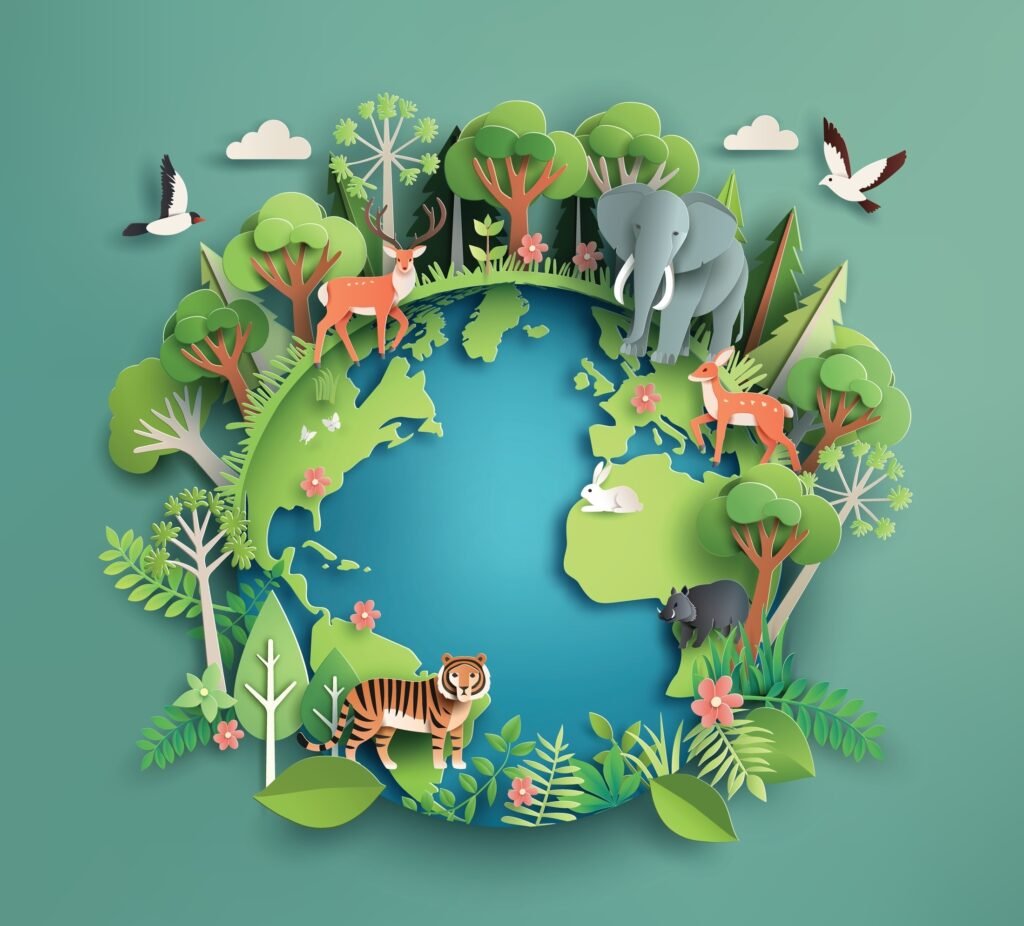
🔵 Definition:
Biodiversity = variety of life at all levels of biological organisation 🌱🦋🦜🐟.
🟢 Levels of Biodiversity:
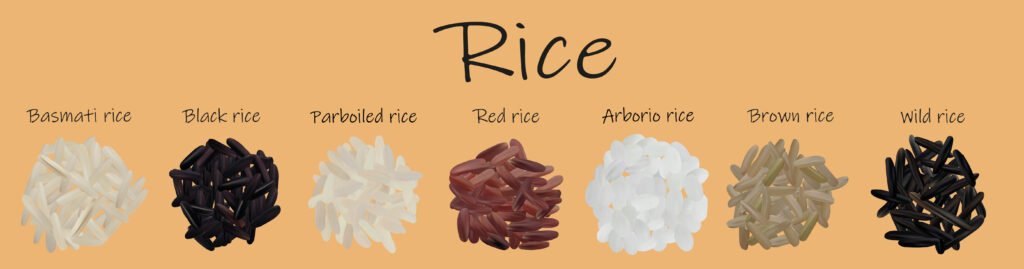
✨ Genetic diversity — variation of genes within species (e.g., rice varieties 🍚, mango varieties 🥭).
🌳 Species diversity — variety of species in an area (e.g., Western Ghats 🐸🌴 > Gangetic plains).
🌏 Ecological/Ecosystem diversity — variety of habitats, ecosystems, landscapes (forests 🌲, deserts 🏜️, wetlands 🐊).
🟠 Global Biodiversity:
Identified species ≈ 1.7–1.8 million 🌍.
India = megadiverse country (2.4% land area but 8.1% species 🌸🦚🐅).
🌍 Patterns of Biodiversity
🔹 Latitudinal gradients:
🌴 Species richness higher in tropics (Amazon rainforest = “lungs of the planet”).
🌡️ Stable climate + productivity → greater diversity.
🔹 Species–area relationship (SAR):
📈 Alexander von Humboldt → larger area = more species.
Formula: S = C·A^Z
S = species richness
A = area
Z = slope (0.1–0.2 generally, 0.6–1.2 for islands 🏝️).
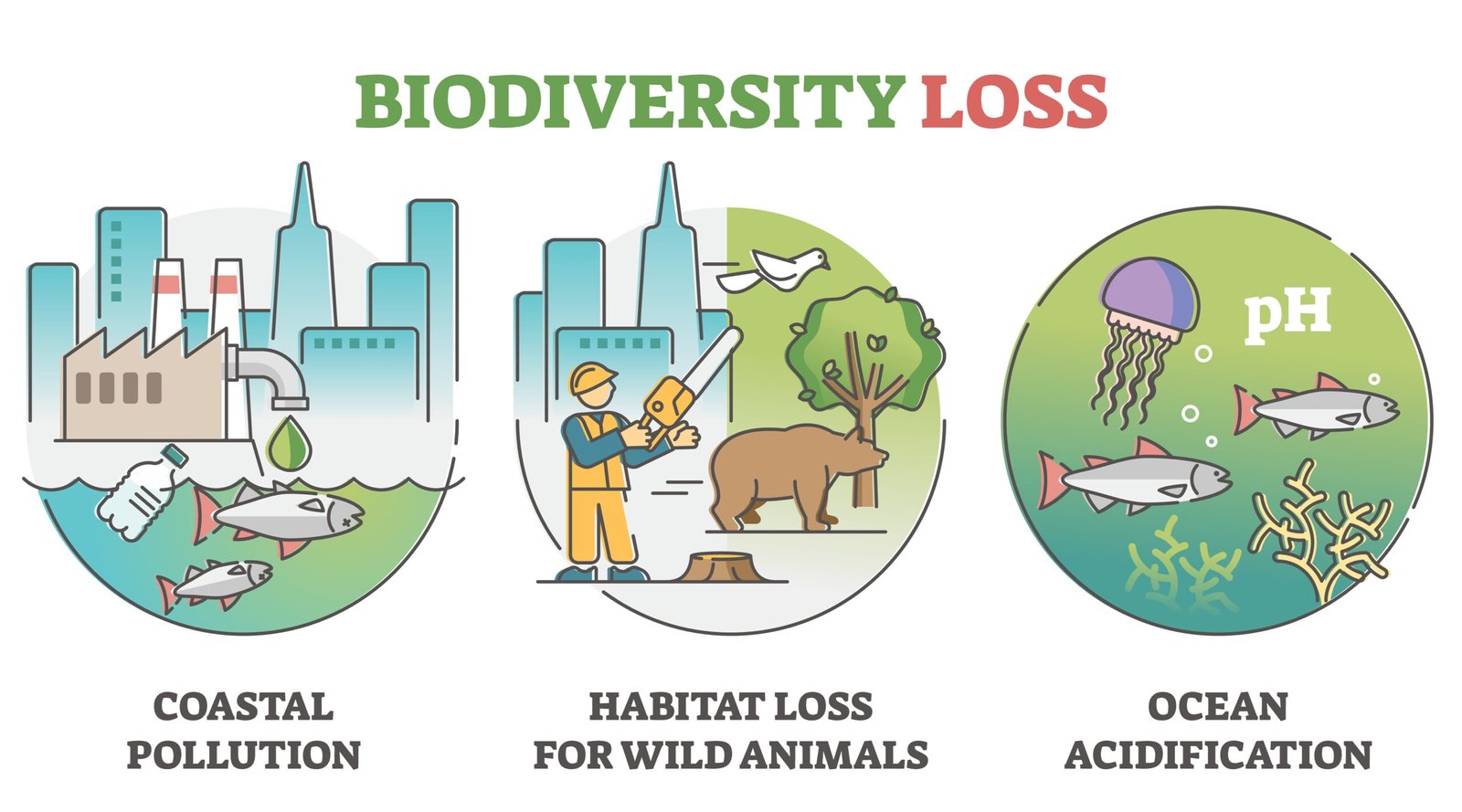
⚠️ Threats to Biodiversity
🔴 HIPPO mnemonic (E.O. Wilson):
H — Habitat loss & fragmentation (deforestation 🌳✂️, Amazon rainforest burning 🔥).
I — Invasive species (Lantana, Parthenium 🌿, African catfish 🐟).
P — Population explosion 👥 (resource overuse).
P — Pollution ☠️ (industrial effluents, biomagnification 🐟→🦅).
O — Overexploitation 🐅🐚 (hunting, poaching).
➡️ Global concern: 🌡️ Climate change, ozone depletion, acid rain.
💡 Importance of Biodiversity
🟡 Ecosystem services (R. Costanza study, 1997):
🌬️ Gas regulation (O₂–CO₂ balance).
💧 Water purification, soil formation, pollination 🐝.
🌾 Provision of food, fibres, medicines 💊.
💰 Estimated value = US $33 trillion/year.
🟢 Direct benefits:
Food crops 🍚, medicinal plants 🌿, fibre crops, fuelwood, rubber.
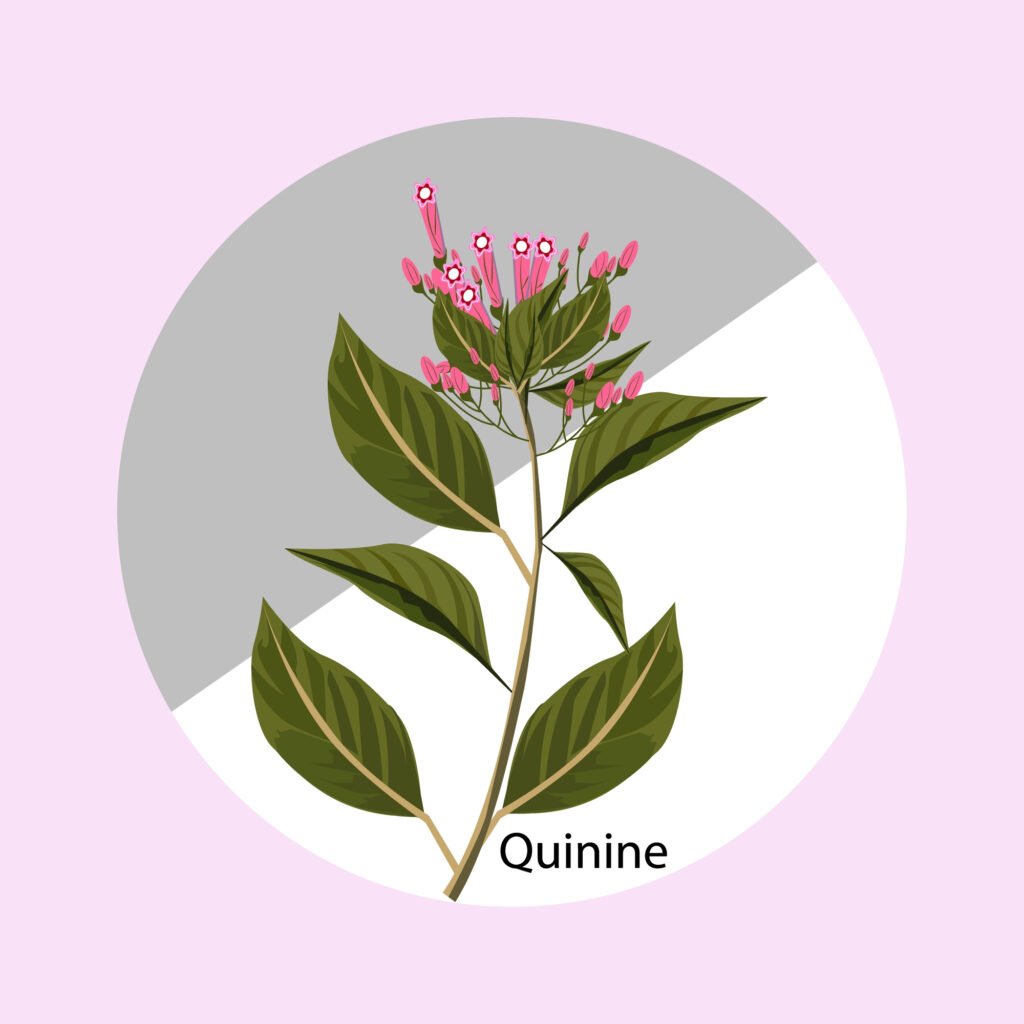
Drugs: morphine (Papaver), quinine (Cinchona), taxol (Taxus).
🛡️ Conservation of Biodiversity
In situ (on-site):
🌳 Protected areas:
Biosphere reserves (Nilgiri, Nanda Devi).
National parks (Kaziranga 🦏, Gir 🦁).
Wildlife sanctuaries (Keoladeo 🐦).
🌱 Sacred groves (Meghalaya, Western Ghats).
Ex situ (off-site):
🧬 Seed banks 🌾, cryopreservation ❄️, tissue culture.
🦓 Zoological parks, botanical gardens 🌼.
📊 India’s Biodiversity Profile
34 global biodiversity hotspots → India has 4 (Himalaya, Indo-Burma, Indo-Malayan, Western Ghats).
104 national parks, 566 wildlife sanctuaries 🦌, 18 biosphere reserves.
Endangered species: Lion-tailed macaque 🐒, Sangai deer 🦌, Great Indian bustard 🦅.
📝 Summary (≈300 words)
Biodiversity is the variety of life forms on Earth, expressed at three levels: genetic, species, and ecological diversity. It sustains life and maintains ecosystem balance. Global biodiversity counts about 1.7 million described species, with India ranked among the 17 megadiverse nations, harbouring 8.1% of global species.
Patterns of biodiversity include latitudinal gradients—tropical forests like Amazon having the highest richness—and species–area relationships, where larger areas support more species (S = C·A^Z).
Biodiversity faces serious threats due to HIPPO factors: habitat loss, invasive species, population growth, pollution, and overexploitation. Examples include deforestation, alien weeds like Parthenium, and poaching of tigers and elephants. Climate change and pollution worsen the crisis.
Biodiversity is vital for ecosystem services such as oxygen production, water purification, pollination, and nutrient cycling. R. Costanza’s 1997 study estimated its economic worth at US $33 trillion/year. Humans derive direct benefits as well: food, fibre, fuel, and medicines (e.g., quinine, morphine, taxol).
To conserve biodiversity, two strategies are adopted: in situ conservation (protecting species in natural habitats, e.g., biosphere reserves, national parks, sanctuaries, sacred groves) and ex situ conservation (protecting outside natural habitats, e.g., zoological parks, seed banks, cryopreservation). India has 4 biodiversity hotspots and extensive protected area networks.
Conservation of biodiversity is crucial to ensure sustainability of ecosystems, secure natural resources, and preserve heritage for future generations.
🎯 Quick Recap
🟢 Levels: Genetic, Species, Ecological.
🔵 Patterns: Latitudinal gradient, SAR (S = C·A^Z).
🔴 Threats: HIPPO (Habitat loss, Invasives, Population, Pollution, Overexploitation).
🟠 Values: Food, medicines, ecosystem services.
🟡 Conservation: In situ (parks, reserves, sacred groves) & Ex situ (zoos, seed banks).
————————————————————————————————————————————————————————————————————————————
QUESTIONS FROM TEXTBOOK
❓ Q1. Name the three important components of biodiversity.
✅ Answer:
🌱 Genetic diversity — variation of genes within species (e.g., rice varieties 🍚).
🦋 Species diversity — variety of species in a region (e.g., birds 🐦, mammals 🐘).
🌳 Ecosystem diversity — variety of ecosystems (forests 🌲, wetlands 🐊, deserts 🏜️).
❓ Q2. How do ecologists estimate the total number of species present in the world?
✅ Answer:
🔬 Ecologists use statistical models & extrapolations:
Known species described scientifically (~1.7 million).
Ratios between studied and unexplored groups (e.g., insects 🐞).
Sampling in small regions → extrapolated to global scale.
🌍 Thus, estimates suggest 8.1 million eukaryotic species globally.
❓ Q3. Give three hypotheses for explaining why tropics show greatest levels of species richness.
✅ Answer:
1️⃣ Stable climate — less seasonal variation → long periods for speciation 🌴.
2️⃣ High productivity due to more sunlight & rainfall 🌞🌧️.
3️⃣ Larger geographical area of tropics → promotes diversity.
❓ Q4. What is the significance of the slope of regression in a species–area relationship?
✅ Answer:
📈 The slope Z indicates rate of species richness with area.
Normal areas: Z = 0.1–0.2.
Islands & isolated habitats 🏝️: Z = 0.6–1.2 (steeper slope due to isolation).
❓ Q5. What are the major causes of species losses in a geographical region?
✅ Answer (HIPPO):
H — Habitat loss & fragmentation 🌳✂️.
I — Invasive species (Parthenium, Lantana 🌿).
P — Population pressure 👥.
P — Pollution ☠️.
O — Overexploitation (poaching 🦏, hunting 🐅).
❓ Q6. How is biodiversity important for ecosystem functioning?
✅ Answer:
Ensures stability & resilience of ecosystems.
Provides ecosystem services (pollination 🐝, nutrient cycling ♻️, soil fertility 🌱).
Experiments show plots with higher biodiversity have greater productivity & sustainability.
❓ Q7. What are sacred groves? What is their role in conservation?
✅ Answer:
🌿 Sacred groves = patches of forests protected due to cultural/religious beliefs (e.g., Meghalaya, Western Ghats).
🌳 Role:
Preserve rare & endemic species.
Act as biodiversity reservoirs.
Provide habitat for endangered flora & fauna.
❓ Q8. Among ecosystem services are control of floods and soil erosion. How is this achieved by the biotic components of the ecosystem?
✅ Answer:
🌱 Forests & vegetation cover:
Roots bind soil → prevent erosion.
Plants slow water flow → reduce floods.
Forests regulate water cycle 💧 → maintain groundwater.
❓ Q9. The species diversity of plants (22%) is less than animals (72%). What could be the explanations to how animals achieved greater diversification?
✅ Answer:
Animals show greater mobility → adapt to diverse habitats 🐒🐦.
Faster speciation & adaptation due to mobility and varied diets 🍃🍖.
Occupy wider ecological niches compared to plants.
❓ Q10. Can you think of a situation where we deliberately want to make a species extinct? How would you justify it?
✅ Answer:
⚠️ Yes — species harmful to humans/environment:
Example: Smallpox virus 🦠 — eradicated by vaccination.
Justification: Prevents disease spread, protects health, ensures survival of humans and livestock.
————————————————————————————————————————————————————————————————————————————
OTHER IMPORTANT QUESTIONS FOR EXAMS
(CBSE MODEL QUESTION PAPER)
ESPECIALLY MADE FROM THIS CHAPTER ONLY
🟢 Section A — MCQs (Q1–Q12)
🔸 Q1. 🌱 Which of the following is not a standard level of biodiversity?
🔵 (A) Genetic diversity
🟢 (B) Species diversity
🟠 (C) Ecosystem diversity
🔴 (D) Biochemical diversity
✅ Answer: (D) Biochemical diversity
🔸 Q2. 📈 In the species–area relationship S = C·A^Z, the slope Z for most continental habitats typically lies between
🔵 (A) 0.1–0.2
🟢 (B) 0.6–1.2
🟠 (C) 1.5–2.0
🔴 (D) 2.0–3.0
✅ Answer: (A) 0.1–0.2
🔸 Q3. 🏝️ Island communities commonly have a steeper species–area curve because
🔵 (A) Lower immigration and higher extinction
🟢 (B) Higher productivity always
🟠 (C) Absence of predators
🔴 (D) Only endemic plants occur
✅ Answer: (A) Lower immigration and higher extinction
🔸 Q4. 🌴 The tropics harbour higher species richness mainly due to
🔵 (A) High climatic stability over long periods
🟢 (B) Frequent glaciations
🟠 (C) Uniform day length at poles
🔴 (D) Lower productivity
✅ Answer: (A) High climatic stability over long periods
🔸 Q5. 🌿 Which is the correct in situ conservation measure?
🔵 (A) Seed bank
🟢 (B) Botanical garden
🟠 (C) National park
🔴 (D) Cryopreservation
✅ Answer: (C) National park
🔸 Q6. ❄️ Cryopreservation is best described as
🔵 (A) Storage of seeds at room temperature
🟢 (B) Storage at very low temperature in liquid nitrogen
🟠 (C) Drying of seeds by desiccation
🔴 (D) In vitro micropropagation at 25°C
✅ Answer: (B) Storage at very low temperature in liquid nitrogen
🔸 Q7. 🌾 Sacred groves primarily help in conserving
🔵 (A) Soil microbes only
🟢 (B) Rare and endemic plant species
🟠 (C) Only large mammals
🔴 (D) Marine algae
✅ Answer: (B) Rare and endemic plant species
🔸 Q8. 🚫 Which pair shows alien invasive species in India?
🔵 (A) Lantana camara and Parthenium
🟢 (B) Azadirachta and Mangifera
🟠 (C) Shorea and Dalbergia
🔴 (D) Ficus and Ficus religiosa
✅ Answer: (A) Lantana camara and Parthenium
🔸 Q9. 📕 The IUCN Red List provides
🔵 (A) Techniques of herbarium preparation
🟢 (B) Status of threatened species
🟠 (C) Keys for plant identification only
🔴 (D) Zoogeographical maps only
✅ Answer: (B) Status of threatened species
🔸 Q10. 🦊 Keystone species are those that
🔵 (A) Are always the most abundant
🟢 (B) Exert disproportionate influence on community stability
🟠 (C) Occupy the largest habitat area
🔴 (D) Are always producers
✅ Answer: (B) Exert disproportionate influence on community stability
🔸 Q11. ♻️ An ecosystem service that directly supports agriculture is
🔵 (A) Ozone formation
🟢 (B) Pollination
🟠 (C) Seafloor spreading
🔴 (D) Plate tectonics
✅ Answer: (B) Pollination
🔸 Q12. 🐟 Biomagnification is the
🔵 (A) Increase of nutrient concentration along food chain
🟢 (B) Decrease of pollutant concentration at higher trophic levels
🟠 (C) Increase of pollutant concentration at higher trophic levels
🔴 (D) Dilution of toxins in producers
✅ Answer: (C) Increase of pollutant concentration at higher trophic levels
🟠 Section B — Very Short Answer (Q13–Q15)
🔸 Q13. ✍️ Define biodiversity and list its three components with one example each.
✅ Answer: Biodiversity = variety of life at genetic, species, and ecosystem levels.
Genetic: rice varieties
Species: birds of Western Ghats
Ecosystem: forests, deserts, wetlands
🔸 Q14. 🧭 Give three causes for biodiversity loss (HIPPO).
✅ Answer: Habitat loss, Invasive species, Population pressure, Pollution, Overexploitation.
🔸 Q15. 🧪 Differentiate: In situ vs Ex situ conservation with one example each.
✅ Answer:
In situ: conservation in natural habitats (e.g., Kaziranga National Park).
Ex situ: conservation outside natural habitats (e.g., seed banks, zoos).
🔴 Section C — Short Answer (Q16–Q17)
🔸 Q16. 🔬 What does species richness measure? How is it different from evenness?
✅ Answer: Richness = number of species present.
Evenness = distribution of individuals across species.
🔸 Q17. Numerical — Species–Area relationship
A reserve of area A1 = 100 km² has S1 = 200 species. If Z = 0.2, predict species in a proposed reserve A2 = 400 km² (assume same C).
✅ Answer (step by step):
Step 1: Formula → S2 / S1 = (A2 / A1)^Z
Step 2: Substitute → S2 / 200 = (400 / 100)^0.2
Step 3: (400 / 100) = 4 → 4^0.2
Step 4: 4^0.2 = e^(0.2 × ln4) ≈ e^0.2773 ≈ 1.319
Step 5: S2 = 200 × 1.319 = 263.8
Final Answer: ≈ 264 species
🟢 Section D — Short Answer (Q18–Q24)
🔸 Q18. 🌍 Explain the role of biodiversity in providing ecosystem services.
✅ Answer:
Provisioning: food, fuel, fibre, medicine 🌾💊
Regulating: climate control, flood control 🌧️
Supporting: nutrient cycling, soil formation ♻️
Cultural: aesthetic, spiritual, recreation 🎨
🔸 Q19. 🧬 Define endemic species with an example.
✅ Answer: Species confined to a specific geographical area.
Example: Nicobar megapode bird 🐦 in Andaman & Nicobar Islands.
🔸 Q20. 🦏 Give two examples of Indian animals included in the Red Data Book.
✅ Answer: Indian rhinoceros, Lion-tailed macaque.
🔸 Q21. 🌳 How are biosphere reserves different from wildlife sanctuaries?
✅ Answer:
Biosphere reserve: large area, multiple levels of protection (core, buffer, transition).
Wildlife sanctuary: smaller area, only faunal protection.
🔸 Q22. 🚨 State two consequences of habitat loss and fragmentation.
✅ Answer:
Decline in population sizes.
Local extinction of species.
🔸 Q23. 🌲 Define hotspots of biodiversity and name two in India.
✅ Answer:
Hotspots = regions rich in endemic species but under threat.
India: Himalaya and Indo-Burma regions.
🔸 Q24. 🔬 Write a note on IUCN categories of threat.
✅ Answer:
Extinct (EX)
Critically Endangered (CR)
Endangered (EN)
Vulnerable (VU)
Near Threatened (NT)
Least Concern (LC)
🟠 Section E — Long Answer (Q25–Q29)
🔸 Q25. 📈 Explain the species–area relationship and its ecological importance.
✅ Answer:
Described by Alexander von Humboldt.
Larger areas harbour more species.
Expressed as S = C·A^Z (S = species, A = area, Z = slope, C = constant).
Important in reserve design and island biogeography.
🔸 Q26. 🧭 Discuss the HIPPO causes of biodiversity loss with suitable examples.
✅ Answer:
Habitat loss (deforestation 🌳).
Invasive alien species (Parthenium 🌿).
Population explosion 👥.
Pollution (DDT biomagnification 🐟).
Overexploitation (overfishing 🐠, poaching 🦏).
🔸 Q27. 🏞️ Explain in situ conservation strategies in India.
✅ Answer:
National Parks (e.g., Gir NP).
Wildlife Sanctuaries (e.g., Bharatpur).
Biosphere Reserves (e.g., Nilgiri).
Sacred groves (Meghalaya).
🔸 Q28. 🧪 Describe ex situ conservation with examples.
✅ Answer:
Seed banks, cryopreservation ❄️
Tissue culture labs
Zoological parks 🦁
Botanical gardens 🌱
🔸 Q29. 🌐 Explain the role of conventions and acts in biodiversity conservation.
✅ Answer:
CBD (Convention on Biological Diversity, 1992).
CITES (Convention on International Trade in Endangered Species).
Wildlife Protection Act, 1972 (India).
🔴 Section F — Case Study + Application (Q30–Q33)
🔸 Q30. MCQ Case Study 🦋
A lake ecosystem is polluted with pesticide residues. Zooplankton → Small fish → Large fish → Birds.
Which trophic level will have maximum pesticide concentration?
🔵 (A) Zooplankton
🟢 (B) Small fish
🟠 (C) Large fish
🔴 (D) Birds
✅ Answer: (D) Birds
🔸 Q31. MCQ Case Study 🌳
In an island of 500 km², researchers find 800 species. Using species–area curve with Z = 0.2, predict species richness if area increases to 2000 km².
🔵 (A) 1200
🟢 (B) 1320
🟠 (C) 1600
🔴 (D) 2000
✅ Answer: (B) 1320
🔸 Q32. 🧭 Justify why tropical rainforests are called “cradles of biodiversity.”
✅ Answer:
High productivity due to year-round warmth and moisture.
Stable climate over millions of years.
Greater opportunities for speciation.
🔸 Q33. 🦏 Write an essay on the importance of biodiversity conservation for sustainable development.
✅ Answer:
Provides food, medicine, fuel, fibre.
Maintains ecological balance.
Supports ecosystem services.
Ensures long-term sustainability of human society.
————————————————————————————————————————————————————————————————————————————