
Class 11 : Physics (In English) – Chapter 7: Gravitation

EXPLANATION & SUMMARY
🔵 1. Introduction
Every object in the universe attracts every other object with a force known as Gravitation.
This force acts between all masses, from tiny particles to massive celestial bodies.
💡 Concept: Gravitation is a universal, attractive, and long-range force.
It is one of the four fundamental forces of nature and plays a key role in maintaining planetary motion and cosmic structure.

🟢 2. Newton’s Law of Universal Gravitation
💡 Statement:
Every particle in the universe attracts every other particle with a force that
➡️ is directly proportional to the product of their masses, and
➡️ inversely proportional to the square of the distance between them.
✏️ Formula:
F = G (m₁m₂) / r²
where
F = force of attraction between two bodies
m₁, m₂ = masses of the two bodies
r = distance between their centers
G = universal gravitational constant
✔️ Unit of G: N·m²/kg²
✔️ Value: 6.67 × 10⁻¹¹ N·m²/kg²
💡 The force acts along the line joining the centers of the two bodies and is always attractive.
🔴 3. Universal Gravitational Constant (G)
Definition:
G is defined as the force of attraction between two unit masses separated by a unit distance.
✏️ Formula:
G = F·r² / (m₁m₂)
💡 Dimensional Formula: [M⁻¹L³T⁻²]
✔️ G is the same everywhere in the universe and independent of medium or substance.
🟡 4. Comparison between Gravitational and Electrostatic Forces
🔹 Gravitational force is always attractive, while electrostatic force can be attractive or repulsive.
🔹 Gravitational force depends on masses, while electrostatic force depends on charges.
🔹 Gravitational constant (G) is universal; electrostatic constant (k = 1/4πε₀) depends on medium.
🔹 Gravitational force is much weaker than electrostatic force.
💡 Even though weak, gravity dominates on large scales because it is always attractive and acts on all matter.
🔵 5. Acceleration Due to Gravity (g)
When an object falls freely near the Earth, it experiences an acceleration called acceleration due to gravity (g).
From Newton’s law,
F = G(Mₑm)/r²
From Newton’s second law, F = ma = mg
Equating both:
mg = G(Mₑm)/r²
Therefore,
g = GMₑ / r²
where
Mₑ = mass of Earth = 5.972 × 10²⁴ kg
r = radius of Earth = 6.371 × 10⁶ m
✔️ Value of g = 9.8 m/s² near Earth’s surface
🟢 6. Variation of g with Altitude, Depth, and Latitude
🔹 With Altitude:
At a height h above the surface,
g’ = g (R / (R + h))²
If h ≪ R, then
g’ ≈ g (1 − 2h/R)
💡 g decreases with height.
🔹 With Depth:
At depth d below the surface,
g’ = g (1 − d/R)
💡 g decreases linearly with depth and becomes zero at the center.
🔹 With Latitude:
Due to Earth’s rotation, effective gravity decreases from poles to equator.
💡 g is maximum at poles and minimum at equator.
🔴 7. Relation between g and G
G is a universal constant, but g varies from place to place.
✏️ Relation:
g = GMₑ / Rₑ²
✔️ G is constant for the universe; g changes with location on Earth.
🟡 8. Gravitational Field and Field Intensity
💡 Definition:
The region around a mass in which its gravitational influence can be felt is called its gravitational field.
The gravitational field intensity (E₉) at a point is the force experienced by a unit mass placed at that point.
✏️ Formula:
E₉ = F/m = GM / r²
✔️ Unit: N/kg
✔️ Direction: Always toward the mass (attractive).
🔵 9. Gravitational Potential and Potential Energy
🔹 Gravitational Potential (V):
Potential at a point is the work done per unit mass in bringing it from infinity to that point.
V = −GM / r
💡 Negative because gravity is attractive.
🔹 Gravitational Potential Energy (U):
Energy of interaction between two masses m₁ and m₂ separated by r:
U = −G(m₁m₂)/r
As r → ∞, U → 0.
🟢 10. Relation between g and V
g = −dV/dr
✔️ The field intensity equals the negative gradient of potential.
✔️ The negative sign indicates that potential decreases in the direction of g.
🔴 11. Escape Velocity (vₑ)
💡 Definition:
The minimum velocity required to escape Earth’s gravitational field without any further propulsion.
✏️ Derivation:
½mvₑ² = GMₑm / Rₑ
⟹ vₑ = √(2GMₑ / Rₑ)
✔️ On Earth, vₑ = 11.2 km/s
✔️ Independent of mass of the object.
🟡 12. Orbital Velocity (vₒ)
💡 Definition:
The velocity required to keep a body in a circular orbit around Earth.
✏️ Derivation:
Centripetal force = Gravitational force
mvₒ² / r = GMₑm / r²
⟹ vₒ = √(GMₑ / r)
✔️ For near-Earth orbit: vₒ = 7.9 km/s
✔️ Relation: vₑ = √2 × vₒ
🔵 13. Geostationary and Polar Satellites
🔹 Geostationary Satellite:
Appears stationary relative to Earth.
Revolves from west to east in equatorial plane.
Orbital period = 24 hours.
Height ≈ 36,000 km.
Used for communication, broadcasting, and weather observation.
🔹 Polar Satellite:
Revolves north–south around Earth.
Period ≈ 100 minutes.
Covers entire Earth as it rotates.
Used for mapping and remote sensing.
🟢 14. Energy of a Satellite in Orbit
Kinetic Energy = ½mvₒ² = GMₑm / 2r
Potential Energy = −GMₑm / r
Total Energy = −GMₑm / 2r
✔️ Negative total energy means satellite is bound to Earth’s gravitational field.
🔴 15. Energy Required to Move Satellite to Another Orbit
If satellite moves from radius r₁ to r₂,
Change in energy per unit mass:
ΔE = GMₑ / 2 (1/r₁ − 1/r₂)
✔️ To move to a higher orbit, ΔE must be supplied.
🟡 16. Weight and Weightlessness
🔹 Weight (W): Force by which Earth attracts a body:
W = mg
🔹 Weightlessness:
When no normal reaction acts on a body (N = 0).
💡 Examples:
Astronauts in orbit.
Freely falling elevator.
Even though gravity acts, apparent weight becomes zero because everything accelerates together.
🔵 17. Kepler’s Laws of Planetary Motion
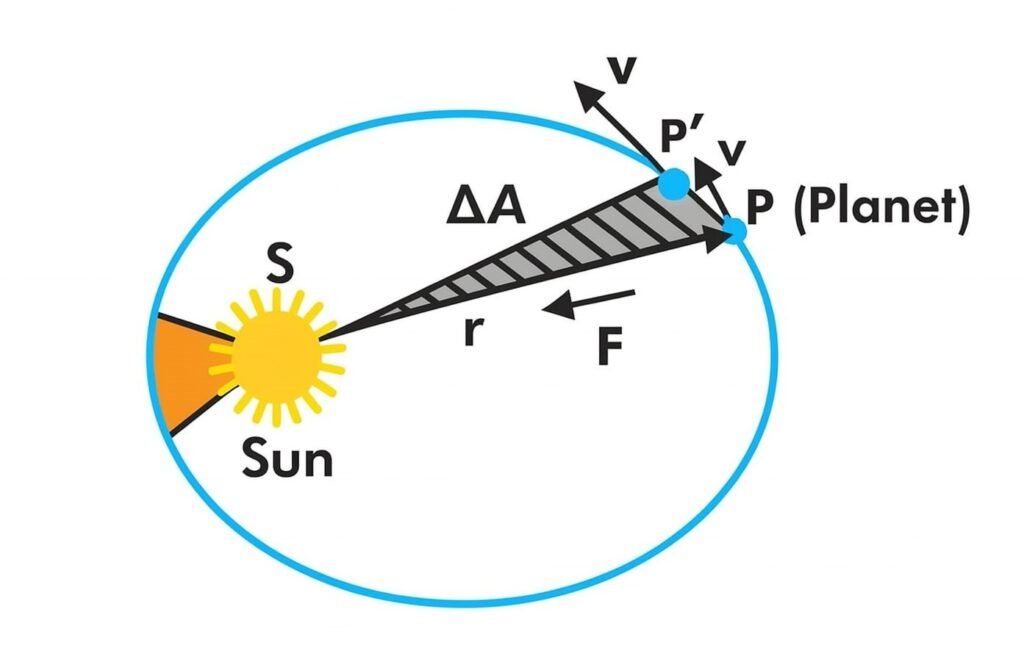
🔹 Law 1 (Orbits): Planets move in elliptical orbits with the Sun at one focus.
🔹 Law 2 (Areas): The line joining a planet and the Sun sweeps equal areas in equal times.
🔹 Law 3 (Periods): The square of the orbital period (T²) is proportional to the cube of the mean distance (r³):
T² ∝ r³
✏️ From Newton’s law:
T² = (4π²/GM) r³
✔️ This supports Kepler’s 3rd law.
🟢 18. Gravitational Potential Energy of a System of Particles
For two masses m₁, m₂ separated by r:
U = −Gm₁m₂ / r
For a system of many particles:
U_total = −G Σ (mᵢmⱼ / rᵢⱼ)
✔️ Total potential energy is the sum of all pairwise interactions.
🔴 19. Gravitational Field Lines
💡 Properties:
Always directed toward the mass.
Never intersect.
Denser lines indicate stronger field.
Field is strongest near the mass and weaker farther away.
🟡 20. Satellite Binding Energy
💡 Binding Energy: Work needed to remove satellite from orbit to infinity.
Binding energy per unit mass = GMₑ / 2r
✔️ Equal to the magnitude of total energy in orbit.
⚡ Summary (Approx. 300 words)
🔹 Gravitation is the universal attraction between all masses.
🔹 Newton’s Law: F = Gm₁m₂ / r², with G = 6.67×10⁻¹¹ N·m²/kg².
🔹 Acceleration due to gravity: g = GMₑ / Rₑ² = 9.8 m/s².
🔹 g decreases with altitude, depth, and from poles to equator.
🔹 Gravitational field intensity = GM / r²; potential = −GM / r; potential energy = −Gm₁m₂ / r.
🔹 Escape velocity = √(2GMₑ / Rₑ) = 11.2 km/s; orbital velocity = √(GMₑ / Rₑ) = 7.9 km/s.
🔹 Geostationary satellites orbit in equatorial plane with 24-hour period; polar satellites cover Earth pole-to-pole.
🔹 Satellite energy E = −GMₑm / 2r, negative for bound motion.
🔹 Kepler’s laws describe planetary motion: elliptical orbit, equal areas in equal times, and T² ∝ r³.
🔹 Weightlessness occurs when apparent weight becomes zero (as in satellites).
Gravitation explains falling bodies, planetary motion, tides, and satellite orbits — forming the foundation of celestial mechanics.
🧠 Quick Recap
🟢 Newton’s Law: F = Gm₁m₂ / r²
🔵 Acceleration due to gravity: g = GMₑ / Rₑ²
🟡 Escape velocity = 11.2 km/s
🔴 Orbital velocity = 7.9 km/s
💡 Kepler’s Third Law: T² ∝ r³
⚡ Energy of satellite = −GMₑm / 2r
————————————————————————————————————————————————————————————————————————————
QUESTIONS FROM TEXTBOOK
Question 7.1
Answer the following:
(a) You can shield a charge from electrical forces by putting it inside a hollow conductor. Can you shield a body from the gravitational influence of nearby matter by putting it inside a hollow sphere or by some other means?
(b) An astronaut inside a small space ship orbiting around the earth cannot detect gravity. If the space station orbiting around the earth has a large size, can he hope to detect gravity?
(c) If you compare the gravitational force on the earth due to the sun to that due to the moon, you would find that the Sun’s pull is greater than the Moon’s pull. However, the tidal effect of the Moon’s pull is greater than the tidal effect of the Sun. Why?
Answer:
(a) ✖️ No shielding of gravity is possible. Gravitational interaction cannot be screened; a hollow shell produces zero field only inside due to itself, but it does not block external gravitational fields.
(b) 🛰️ In a small spaceship, everything is in free fall → apparent weightlessness. In a very large station, tidal effects (small variation of g across the station) can be detected.
(c) 🌞 Sun’s force on Earth is larger, but tidal force ∝ M/r³. The Moon is much closer, so its field gradient at Earth is larger → stronger tides.
Question 7.2
Choose the correct alternative:
(a) Acceleration due to gravity increases/decreases with increasing altitude.
(b) Acceleration due to gravity increases/decreases with increasing depth (assume the earth to be a sphere of uniform density).
(c) Acceleration due to gravity is independent of mass of the earth/mass of the body.
(d) The formula −G M m (1/r₂ − 1/r₁) is more/less accurate than the formula m g (r₂ − r₁) for the difference of potential energy between two points r₁ and r₂ distant from the centre of the earth.
Answer:
(a) 🔽 Decreases with altitude.
(b) 🔽 Decreases with depth (for uniform density, g ∝ r inside; g → 0 at centre).
(c) ✅ Independent of mass of the body (depends on Earth’s mass and r).
(d) ✅ More accurate (exact), while m g Δr is a near-surface approximation where g ≈ constant.
Question 7.3
Suppose there existed a planet that went around the Sun twice as fast as the Earth. What would be its orbital size as compared to that of the Earth?
Answer:
💡 For circular orbits: v = √(GM⊙/r) ⇒ v ∝ r⁻¹/².
If v₂ = 2v⊕, then r₂ = r⊕/4.
✔️ Orbital radius = one-fourth of Earth’s.
(Consequently, T ∝ r³/² ⇒ T₂ = T⊕/8 ≈ 45.6 days.)
Question 7.4
Io, one of Jupiter’s satellites, has an orbital period of 1.769 days and the radius of the orbit is 4.22 × 10⁸ m. Show that the mass of Jupiter is about one-thousandth that of the Sun.
Answer:
Use M = 4π²r³ / (G T²).
➡️ r = 4.22×10⁸ m, T = 1.769 days = 1.769×86400 s.
➡️ M_J ≈ 1.90×10²⁷ kg.
Solar mass M⊙ ≈ 1.99×10³⁰ kg.
➡️ M_J/M⊙ ≈ 9.6×10⁻⁴ ≈ 10⁻³.
✔️ Jupiter’s mass ≈ one-thousandth of the Sun’s.
Question 7.5
Assume our galaxy consists of 2.5 × 10¹¹ stars each of one solar mass. How long will a star at a distance of 50,000 ly from the galactic centre take to complete one revolution? (Take the diameter of the Milky Way ≈ 10⁵ ly.)
Answer:
Let enclosed mass M ≈ 2.5×10¹¹ M⊙.
Radius r = 5.0×10⁴ ly = 5.0×10⁴×9.46×10¹⁵ m.
Orbital period T = 2π√(r³ / G M).
🔢 Substituting gives T ≈ 3.6×10⁸ years (order 10⁸ y).
✔️ So the star takes ~3 × 10⁸ years to go once around the Galaxy.
Question 7.6
Choose the correct alternative:
(a) If the zero of potential energy is at infinity, the total energy of an orbiting satellite is the negative of its kinetic energy/potential energy.
(b) The energy required to launch an orbiting satellite out of earth’s gravitational influence is more/less than that required to project a stationary object at the same height (as the satellite) out of earth’s influence.
Answer:
(a) ✅ Negative of its kinetic energy (E = K + U = −K = U/2).
(b) ✅ Less (the satellite already possesses orbital kinetic energy).
Question 7.7
Does the escape speed of a body from Earth depend on
(a) the mass of the body,
(b) the location from where it is projected (on Earth’s surface),
(c) the direction of projection,
(d) the height of the location from where it is launched?
Answer:
(a) ❌ No (independent of the body’s mass).
(b) ❌ No (ignoring Earth’s rotation and small radius variations).
(c) ❌ No.
(d) ✅ Yes (since v_esc = √(2GM/(R+h)) decreases with altitude).
Question 7.8
A comet orbits the Sun in a highly elliptical orbit. Does the comet have a constant
(a) linear speed, (b) angular speed, (c) angular momentum, (d) kinetic energy, (e) potential energy, (f) total energy throughout the orbit, (g) areal velocity over equal time intervals?
(h) Is the average speed of the comet the same when it is near the Sun and when it is far from the Sun?
(i) If there is a mass loss of the comet when it comes close to the Sun, what happens to its orbital period?
Answer:
(a) ❌ No (speed varies; fastest at perihelion).
(b) ❌ No (ω not constant in an ellipse).
(c) ✅ Yes (about the Sun; central force ⇒ L conserved).
(d) ❌ No (changes with speed).
(e) ❌ No (varies with distance r).
(f) ✅ Yes (constant, negative for bound orbit).
(g) ✅ Yes (areal velocity constant; Kepler’s 2nd law).
(h) ❌ No; the near-Sun half has greater average speed.
(i) ⚖️ Period remains essentially unchanged (two-body Keplerian period is independent of comet’s own mass; mass loss of the tiny comet hardly affects T, unless outgassing thrust changes the orbit).
🔵 Question 7.10
In the following two exercises, choose the correct answer from among the given ones:
The gravitational intensity at the centre of a hemispherical shell of uniform mass density has the direction indicated by the arrow (see Fig. 7.11):
(i) a, (ii) b, (iii) c, (iv) 0
🟢 Answer:
💡 The resultant field at the centre is along the axis of symmetry, directed toward the flat face of the hemisphere.
✔️ Correct option: (ii) b
🔵 Question 7.11
For the above problem, the direction of the gravitational intensity at an arbitrary point P is indicated by the arrow
(i) d, (ii) e, (iii) f, (iv) g
🟢 Answer:
💡 The gravitational field due to the hemisphere acts toward its mass distribution, i.e. inward toward the curved surface.
✔️ Correct option: (i) d
🔵 Question 7.12
A rocket is fired from the Earth towards the Sun. At what distance from the Earth’s centre is the gravitational force on the rocket zero?
Given:
☀️ Mass of the Sun = 2 × 10³⁰ kg
🌍 Mass of the Earth = 6 × 10²⁴ kg
🌌 Orbital radius = 1.5 × 10¹¹ m
🟢 Answer:
➡️ Let the distance from Earth where net force = 0 be x.
🧮 Formula:
G M_E / x² = G M_S / (R − x)²
Simplify:
√(M_E / M_S) = x / (R − x)
⇒ x = R / (1 + √(M_S/M_E))
Substitute values:
R = 1.5×10¹¹ m, M_S/M_E = 3.33×10⁵
√(M_S/M_E) ≈ 577
x = 1.5×10¹¹ / (1 + 577) = 2.6×10⁸ m
✔️ The point of zero net force lies about 2.6×10⁸ m from Earth toward the Sun.
🔵 Question 7.13
How will you “weigh the Sun,” that is, estimate its mass?
Mean orbital radius of the Earth around the Sun = 1.5 × 10⁸ km
🟢 Answer:
💡 Using Kepler’s 3rd Law (Newton’s form):
M_S = (4π²r³) / (G T²)
➡️ Substitution:
r = 1.5×10¹¹ m, T = 1 yr = 3.156×10⁷ s
M_S = (4π² × (1.5×10¹¹)³) / (6.67×10⁻¹¹ × (3.156×10⁷)²)
= 1.99×10³⁰ kg
✔️ Mass of the Sun = 2.0×10³⁰ kg
🔵 Question 7.14
A Saturn year is 29.5 times the Earth year. How far is Saturn from the Sun if the Earth is 1.5×10⁸ km away?
🟢 Answer:
💡 By Kepler’s 3rd Law:
T² ∝ r³
(T_S / T_E)² = (r_S / r_E)³
(r_S / r_E) = (T_S / T_E)^(2/3) = (29.5)^(2/3) = 14.3
r_S = 14.3 × 1.5×10⁸ = 2.15×10⁹ km
✔️ Saturn’s distance from Sun ≈ 2.15×10⁹ km
🔵 Question 7.15
A body weighs 63 N on the surface of the Earth. What is the gravitational force on it due to the Earth at a height equal to half the radius of the Earth?
🟢 Answer:
Given: W₀ = 63 N, h = R/2
💡 Formula: F = W₀ (R / (R + h))²
F = 63 × (R / 1.5R)² = 63 × (2/3)² = 63 × 4/9 = 28 N
✔️ Gravitational force = 28 N
🔵 Question 7.16
Assuming the Earth to be a sphere of uniform mass density, how much would a body weigh halfway down to the centre of the Earth if it weighed 250 N on the surface?
🟢 Answer:
Inside the Earth, g ∝ r
➡️ g’ = g/2 at r = R/2
Hence, W’ = W/2 = 250/2 = 125 N
✔️ Weight at halfway point = 125 N
🔵 Question 7.17
A rocket is fired vertically with a speed of 5 km/s from the Earth’s surface. How far from the Earth does the rocket go before returning to Earth?
Given: M = 6.0×10²⁴ kg, R = 6.4×10⁶ m, G = 6.67×10⁻¹¹
🟢 Answer:
💡 By energy conservation:
½v² − GM/R = −GM/(R + h)
Substitute:
v = 5000 m/s, GM = 3.986×10¹⁴
⇒ 1/(R + h) = 1/R − v²/(2GM)
= 1/(6.4×10⁶) − (25×10⁶)/(7.97×10¹⁴)
= 1.5625×10⁻⁷ − 3.14×10⁻⁸ = 1.248×10⁻⁷
Thus, R + h = 8.01×10⁶ m → h = 1.6×10⁶ m = 1600 km
✔️ Rocket reaches a maximum height ≈ 1600 km
🔵 Question 7.18
The escape speed of a projectile on Earth’s surface is 11.2 km/s. A body is projected with three times this speed. What is its speed far away from Earth?
🟢 Answer:
💡 Formula:
v∞ = √(v² − vₑ²)
vₑ = 11.2 km/s, v = 3vₑ = 33.6 km/s
v∞ = √(9vₑ² − vₑ²) = √8 × vₑ = 2.83 × 11.2 = 31.7 km/s
✔️ Speed far away = 31.7 km/s
🔵 Question 7.19
A satellite orbits Earth at a height of 400 km. How much energy must be expended to rocket it out of Earth’s gravitational influence?
Given: m = 200 kg, M = 6×10²⁴ kg, R = 6.4×10⁶ m, G = 6.67×10⁻¹¹
🟢 Answer:
💡 Total energy per unit mass in orbit = −GM/(2r)
At height 400 km → r = 6.8×10⁶ m
E = −(6.67×10⁻¹¹×6×10²⁴)/(2×6.8×10⁶) = −2.94×10⁷ J/kg
Energy to escape = +2.94×10⁷ J/kg
For 200 kg satellite:
ΔE = 200 × 2.94×10⁷ = 5.88×10⁹ J
✔️ Energy required = 5.9×10⁹ J
🔵 Question 7.20
Two stars, each of one solar mass (2×10³⁰ kg), approach each other for a head-on collision. When 10 km apart, their speeds are negligible. What is the speed when they collide?
Radius of each star = 10⁴ km.
🟢 Answer:
💡 Using energy conservation:
½(2M)v² = G M² / r_final
r_final = 2×10⁷ m
v = √(2GM / r_final)
= √(2×6.67×10⁻¹¹×2×10³⁰ / 2×10⁷)
= √(1.334×10¹³) = 3.65×10⁶ m/s
✔️ Collision speed = 3.65×10⁶ m/s (~3650 km/s)
🔵 Question 7.21
Two heavy spheres each of mass 100 kg and radius 0.10 m are placed 1.0 m apart on a horizontal table.
(a) What is the gravitational force and potential at the midpoint of the line joining the centres?
(b) Is a small object placed at that point in equilibrium? If so, is it stable or unstable?
🟢 Answer:
Given: m₁ = m₂ = 100 kg, distance = 1 m
Distance of midpoint from each = 0.5 m
➡️ Force by one sphere:
F = Gm / r² = 6.67×10⁻¹¹×100 / (0.5)² = 2.67×10⁻⁷ N
🟣 Forces cancel → Net F = 0
➡️ Potential at midpoint:
V = 2(−Gm / r) = −2×6.67×10⁻¹¹×100 / 0.5 = −2.67×10⁻⁷ J/kg
💡 Since net force = 0, equilibrium exists.
If displaced slightly → net force pulls away from centre → unstable equilibrium.
✔️ Equilibrium: Unstable
————————————————————————————————————————————————————————————————————————————
OTHER IMPORTANT QUESTIONS FOR EXAMS
(CBSE MODEL QUESTIONS PAPER)
ESPECIALLY MADE FROM THIS LESSON ONLY
⚙️ SECTION A: Multiple Choice Questions (Q1–Q18)
Question 1:
The universal law of gravitation states that the force between two masses is
🔵 (A) Directly proportional to the product of their masses
🟢 (B) Inversely proportional to the square of the distance between them
🟠 (C) Both (A) and (B)
🔴 (D) None of these
Answer: (C) Both (A) and (B)
Question 2:
The value of universal gravitational constant (G) is
🔵 (A) 9.8 m/s²
🟢 (B) 6.67 × 10⁻¹¹ N·m²/kg²
🟠 (C) 1.6 × 10⁻¹⁹ C
🔴 (D) 3 × 10⁸ m/s
Answer: (B) 6.67 × 10⁻¹¹ N·m²/kg²
Question 3:
Gravitational force is
🔵 (A) Always attractive
🟢 (B) Always repulsive
🟠 (C) Either attractive or repulsive
🔴 (D) Zero
Answer: (A) Always attractive
Question 4:
The dimensions of G are
🔵 (A) [M⁻¹L³T⁻²]
🟢 (B) [ML²T⁻²]
🟠 (C) [M⁰L⁰T⁰]
🔴 (D) [ML⁻¹T⁻²]
Answer: (A) [M⁻¹L³T⁻²]
Question 5:
Acceleration due to gravity on Earth’s surface is given by
🔵 (A) g = Gm/r²
🟢 (B) g = GMₑ/Rₑ²
🟠 (C) g = F/m
🔴 (D) g = GMₑm/r²
Answer: (B) g = GMₑ/Rₑ²
Question 6:
The value of g on Earth’s surface is approximately
🔵 (A) 6.67 × 10⁻¹¹ m/s²
🟢 (B) 10 m/s²
🟠 (C) 9.8 m/s²
🔴 (D) 7.9 m/s²
Answer: (C) 9.8 m/s²
Question 7:
At what location on Earth is the value of g maximum?
🔵 (A) Equator
🟢 (B) Poles
🟠 (C) Tropic of Cancer
🔴 (D) Tropic of Capricorn
Answer: (B) Poles
Question 8:
The acceleration due to gravity at a height h is given by
🔵 (A) g’ = g (R/(R+h))²
🟢 (B) g’ = g (R/(R+h))
🟠 (C) g’ = g (1+h/R)²
🔴 (D) g’ = g (1+h/R)
Answer: (A) g’ = g (R/(R+h))²
Question 9:
At the center of Earth, the value of g is
🔵 (A) Maximum
🟢 (B) Zero
🟠 (C) Half
🔴 (D) One-fourth
Answer: (B) Zero
Question 10:
The gravitational potential at distance r from a mass M is
🔵 (A) +GM/r
🟢 (B) −GM/r
🟠 (C) −GMr
🔴 (D) GM/r²
Answer: (B) −GM/r
Question 11:
Gravitational field intensity at a point is
🔵 (A) The potential per unit mass
🟢 (B) The force experienced by a unit mass
🟠 (C) The work done per unit distance
🔴 (D) The acceleration per unit charge
Answer: (B) The force experienced by a unit mass
Question 12:
Escape velocity from Earth’s surface is about
🔵 (A) 7.9 km/s
🟢 (B) 8.9 km/s
🟠 (C) 11.2 km/s
🔴 (D) 9.8 km/s
Answer: (C) 11.2 km/s
Question 13:
Orbital velocity of a satellite near Earth’s surface is
🔵 (A) 5.9 km/s
🟢 (B) 7.9 km/s
🟠 (C) 11.2 km/s
🔴 (D) 3.1 km/s
Answer: (B) 7.9 km/s
Question 14:
A geostationary satellite revolves around Earth once in
🔵 (A) 12 hours
🟢 (B) 24 hours
🟠 (C) 48 hours
🔴 (D) 6 hours
Answer: (B) 24 hours
Question 15:
Which of the following quantities has negative value for a satellite in orbit?
🔵 (A) Kinetic Energy
🟢 (B) Potential Energy
🟠 (C) Total Energy
🔴 (D) Both (B) and (C)
Answer: (D) Both (B) and (C)
Question 16:
The total energy of a satellite revolving in circular orbit is
🔵 (A) −GMₑm/r
🟢 (B) −GMₑm/2r
🟠 (C) GMₑm/2r
🔴 (D) Zero
Answer: (B) −GMₑm/2r
Question 17:
According to Kepler’s third law, T² is proportional to
🔵 (A) r
🟢 (B) r²
🟠 (C) r³
🔴 (D) r⁴
Answer: (C) r³
Question 18:
If the distance between two bodies is doubled, the gravitational force becomes
🔵 (A) 1/2 times
🟢 (B) 1/4 times
🟠 (C) 2 times
🔴 (D) 4 times
Answer: (B) 1/4 times
🧩 SECTION B: Very Short/Short Answer (Q19–Q23)
Question 19:
Define universal gravitational constant.
Answer:
💡 Universal gravitational constant (G) is the force of attraction between two unit masses separated by unit distance in vacuum.
✔️ G = 6.67 × 10⁻¹¹ N·m²/kg².
Question 20:
What is the difference between g and G?
Answer:
✔️ G is universal and constant everywhere; g is local and depends on the Earth’s mass and radius.
✔️ G = 6.67 × 10⁻¹¹ N·m²/kg²; g = 9.8 m/s².
✔️ g = GMₑ / Rₑ².
Question 21:
What happens to the value of g with increase in height from Earth’s surface?
Answer:
💡 As height increases, g decreases according to g’ = g (R / (R + h))².
Hence, at large heights, the gravitational pull weakens.
Question 22:
State Kepler’s second law of planetary motion.
Answer:
💡 The line joining a planet and the Sun sweeps out equal areas in equal intervals of time.
✔️ This means the planet moves faster when nearer to the Sun and slower when farther away.
Question 23:
Why do astronauts feel weightless in a spaceship orbiting Earth?
Answer:
✔️ Because both the astronaut and the spaceship are in free fall around the Earth, they experience no normal reaction.
Hence, apparent weight becomes zero — this is weightlessness.
⚡ SECTION C: Mid-Length Numerical/Theory (Q24–Q28)
Question 24:
Derive the expression for acceleration due to gravity on Earth’s surface.
Answer:
✏️ From Newton’s law: F = G(Mₑm)/Rₑ²
From Newton’s second law: F = ma = mg
Equating: mg = G(Mₑm)/Rₑ²
Cancel m: g = GMₑ / Rₑ²
✔️ Therefore, g depends on Earth’s mass and radius only.
Question 25:
Find the ratio of the acceleration due to gravity at height h = R/2 to that on Earth’s surface.
Answer:
✏️ Formula: g’ = g (R / (R + h))²
Substitute h = R/2:
g’ = g (R / (3R/2))² = g (2/3)² = (4/9)g
✔️ Therefore, g’ : g = 4 : 9.
Question 26:
Derive the expression for escape velocity from Earth.
Answer:
💡 Total energy required = Gain in potential energy + Kinetic energy
For escape, ½mvₑ² = GMₑm / Rₑ
vₑ = √(2GMₑ / Rₑ)
✔️ On Earth, vₑ = 11.2 km/s.
Question 27:
Calculate orbital velocity for a satellite near Earth’s surface.
Answer:
✏️ Centripetal force = Gravitational force
mvₒ² / R = GMₑm / R²
vₒ = √(GMₑ / R)
✔️ Substituting values gives vₒ = 7.9 km/s.
Question 28:
Derive the relation between orbital and escape velocities.
Answer:
vₑ = √(2GMₑ / Rₑ)
vₒ = √(GMₑ / Rₑ)
Divide both:
vₑ / vₒ = √2
✔️ Hence, vₑ = √2 × vₒ.
⚡ SECTION D: Long Answer Questions (Q29–Q31)
Question 29:
Derive the expression for variation of acceleration due to gravity (g) with altitude.
Answer:
💡 Concept:
The value of acceleration due to gravity decreases with increase in height above the Earth’s surface.
Let the value of g at height h be g’.
✏️ Step 1:
According to Newton’s law of gravitation,
F = G(Mₑm) / (Rₑ + h)²
Also, F = mg’
So, mg’ = G(Mₑm) / (Rₑ + h)²
✏️ Step 2:
At Earth’s surface,
g = G(Mₑ) / Rₑ²
Dividing both equations:
g’/g = (Rₑ² / (Rₑ + h)²)
Therefore,
➡️ g’ = g (Rₑ / (Rₑ + h))²
✏️ Step 3 (Approximation for small h):
If h ≪ Rₑ,
(Rₑ / (Rₑ + h))² ≈ (1 − 2h/Rₑ)
Thus,
➡️ g’ ≈ g (1 − 2h/Rₑ)
✔️ Hence, g decreases with height.
💡 Result:
g’ = g (Rₑ / (Rₑ + h))²
✔️ As h increases, g decreases.
Question 30:
Derive the expression for potential energy of a body in the gravitational field of Earth.
Answer:
💡 Concept:
Gravitational potential energy (U) is the work done in bringing a body from infinity to a point in the Earth’s gravitational field.
✏️ Step 1:
Work done in moving a mass m from infinity to distance r from Earth’s center is:
W = ∫∞ᵣ (−F) dr
F = G(Mₑm)/r²
So,
W = −∫∞ᵣ G(Mₑm)/r² dr
✏️ Step 2:
Integrating:
W = −G(Mₑm) [−1/r]∞ᵣ
= −G(Mₑm)(0 − (−1/r))
= −G(Mₑm)/r
✏️ Step 3:
This work is stored as potential energy, hence
➡️ U = −G(Mₑm)/r
💡 Interpretation:
✔️ Negative sign indicates that gravitational potential energy is less than zero (since gravity is attractive).
✔️ As r → ∞, U → 0.
Question 31:
Explain and derive Kepler’s third law of planetary motion using Newton’s law of gravitation.
Answer:
💡 Kepler’s Third Law:
The square of the time period (T²) of revolution of a planet around the Sun is directly proportional to the cube of the mean distance (r³) between them.
✏️ Step 1:
For a planet of mass m revolving around the Sun (mass Mₛ) in a circular orbit,
Centripetal force = Gravitational force
m v² / r = G(Mₛm)/r²
⟹ v² = G Mₛ / r
✏️ Step 2:
Orbital velocity v = 2πr / T
Substitute in above equation:
(4π²r² / T²) = G Mₛ / r
⟹ T² = (4π² / G Mₛ) r³
💡 Step 3:
Hence,
➡️ T² ∝ r³
✔️ The constant of proportionality (4π² / GMₛ) is same for all planets revolving around the Sun.
⚡ Result:
T² / r³ = constant
✔️ Thus, Kepler’s third law is derived from Newton’s law of gravitation.
🌍 SECTION E: Case/Application Based Questions (Q32–Q33)
Question 32:
A satellite is revolving around the Earth in a circular orbit of radius 7 × 10⁶ m.
Calculate its orbital velocity.
(Mₑ = 6 × 10²⁴ kg, G = 6.67 × 10⁻¹¹ N·m²/kg²)
Answer:
✏️ Step 1:
Formula for orbital velocity:
vₒ = √(GMₑ / r)
Substitute:
vₒ = √((6.67 × 10⁻¹¹ × 6 × 10²⁴) / (7 × 10⁶))
✏️ Step 2:
vₒ = √(4.002 × 10¹⁴ / 7 × 10⁶)
= √(5.717 × 10⁷)
= 7.56 × 10³ m/s
✔️ Result:
Orbital velocity = 7.56 km/s
💡 This value matches the typical orbital speed near Earth’s surface.
Question 33:
A rocket is fired vertically upward with a speed of 8 km/s.
Will it escape Earth’s gravity?
(Escape velocity from Earth = 11.2 km/s)
Answer:
✏️ Step 1:
Given:
v = 8 km/s, vₑ = 11.2 km/s
✏️ Step 2:
If v < vₑ, the object cannot escape Earth’s gravity.
It will rise up to some height and then fall back.
✔️ Result:
Since 8 km/s < 11.2 km/s,
💡 The rocket will not escape Earth’s gravitational pull.
It will move upward, slow down, and then return to Earth.
————————————————————————————————————————————————————————————————————————————