
Class 11 : Physics (In English) – Chapter 5: Work, Energy and Power

EXPLANATION & SUMMARY
🔵 Explanation
🌿 Introduction
The concepts of work, energy, and power are central to understanding motion and physical processes in nature. Every event involving motion — a falling ball, a running engine, or a stretching spring — involves energy transfer governed by the principles of work and power.
💡 Work connects force and displacement, energy measures the ability to do work, and power indicates the rate of doing work. These three are interlinked through the work–energy theorem and the law of conservation of energy.
🟢 Work
💡 Definition
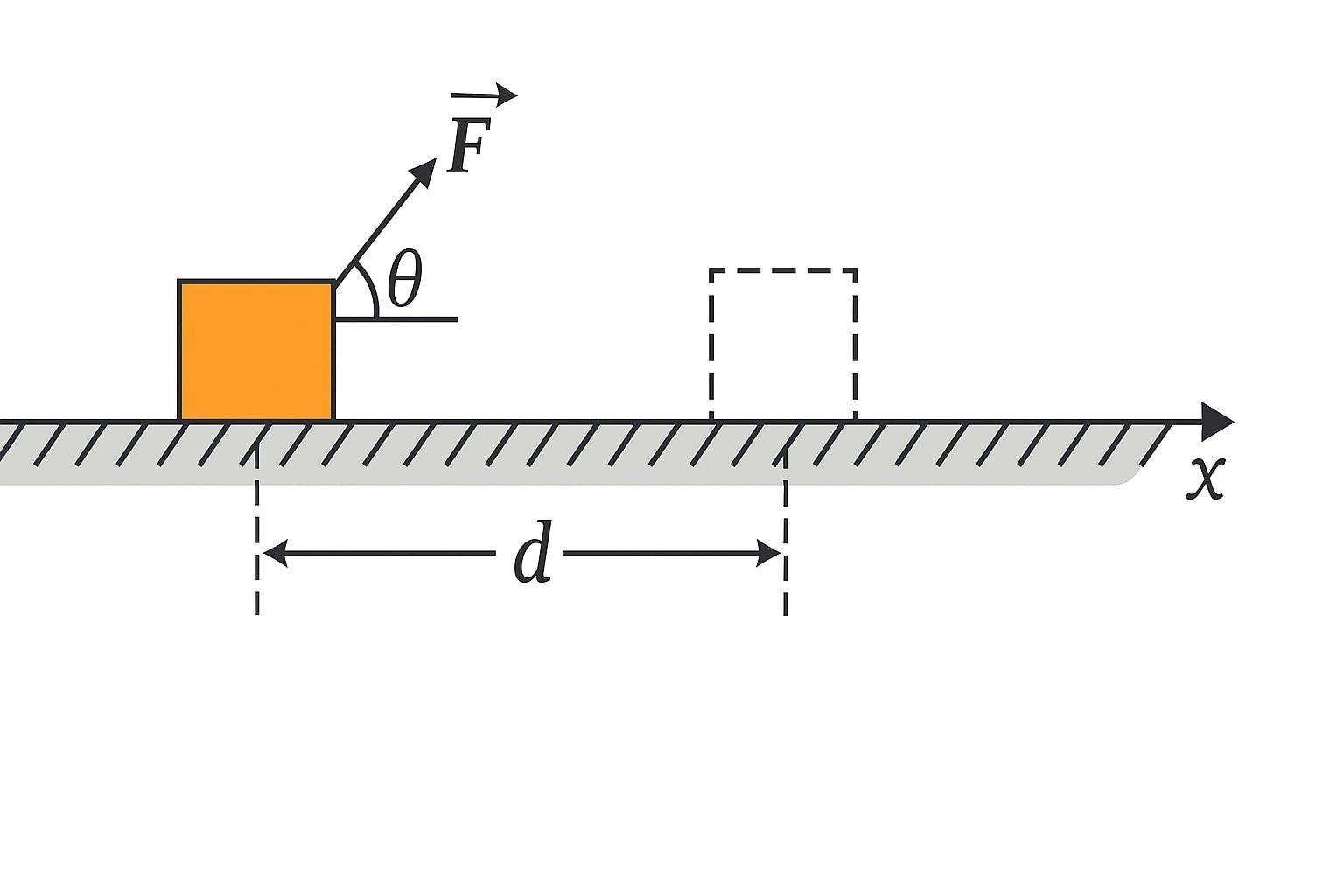
When a force acts on a body and displaces it in the direction of the force, work is said to be done.
➡️ Formula: W = F × s × cos θ
where
F = magnitude of applied force
s = displacement of the body
θ = angle between force and displacement
🧠 Key Points
✔️ Work is a scalar quantity.
✔️ SI Unit: joule (J), where 1 J = 1 N·m.
✔️ CGS Unit: erg, where 1 erg = 10⁻⁷ joule.
✔️ Work depends on both the magnitude and direction of the applied force.
🔵 Types of Work
🔹 Positive Work: When θ < 90°, force aids motion.
➡️ Example: Engine pulling a train.
🔹 Negative Work: When θ > 90°, force opposes motion.
➡️ Example: Work done by friction or gravity while throwing a ball upward.
🔹 Zero Work: When θ = 90°, force is perpendicular to displacement.
➡️ Example: Centripetal force in circular motion.
🟣 Work Done by Variable Force
When force changes with position, the total work is obtained by integration:
➡️ W = ∫ F·ds
Graphically, work done equals the area under the F–s graph.
🔴 Work Done by Constant Force
If the force is uniform and acts along displacement:
➡️ W = F × s
Example: Lifting a 10 kg body vertically by 2 m,
W = mgh = 10 × 9.8 × 2 = 196 J
🟡 Work Done by Gravitational Force
For a body of mass m moving vertically through height h,
➡️ W = mgh (if lifted)
✔️ Work done is positive when lifted upward by an external agent,
✔️ Negative when the body falls under gravity.
⚡ Power
💡 Definition
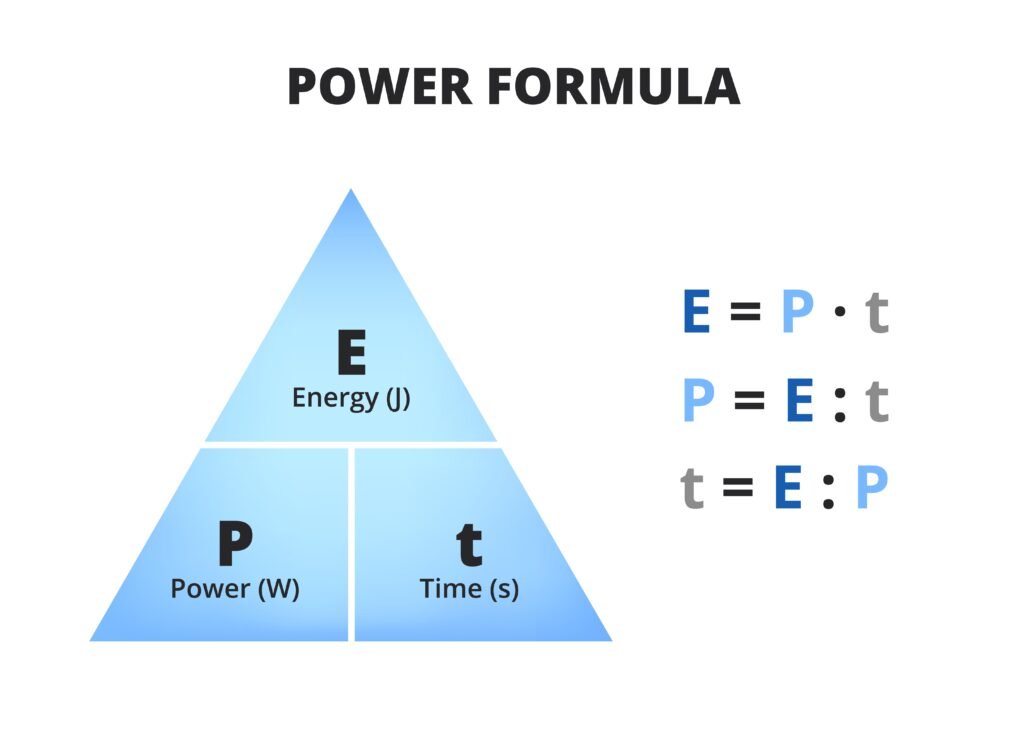
Power is the rate of doing work.
➡️ P = W / t = F·v
✔️ SI Unit: watt (W) → 1 W = 1 J/s
✔️ Larger units: kilowatt (kW), megawatt (MW).
💡 Average Power = Total work / Total time
💡 Instantaneous Power = dW/dt
🟢 Energy
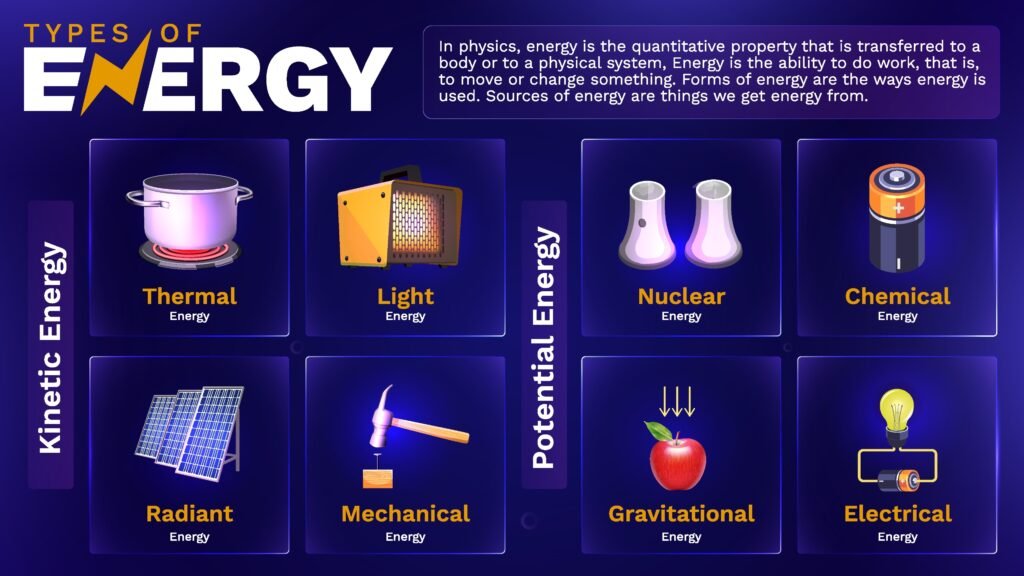
💡 Energy is the capacity of a body to do work.
✔️ Scalar quantity, unit: joule (J).
Forms of energy include mechanical (kinetic, potential), chemical, thermal, electrical, etc.
🟣 Kinetic Energy (K.E.)
💡 Energy possessed due to motion.
➡️ K.E. = (1/2)mv²
🧠 Derivation:
Work done by a force in accelerating a body from rest:
W = F × s = ma × s
Using v² − u² = 2as,
W = ½ m(v² − u²)
Thus, W = ΔK.E.
✔️ Work–Energy Theorem: Work done by the net force equals change in kinetic energy.
🔴 Potential Energy (P.E.)
💡 Energy possessed due to position or configuration.
➡️ P.E. = mgh
✔️ It depends on the reference point (zero level).
✔️ Unit: joule (J).
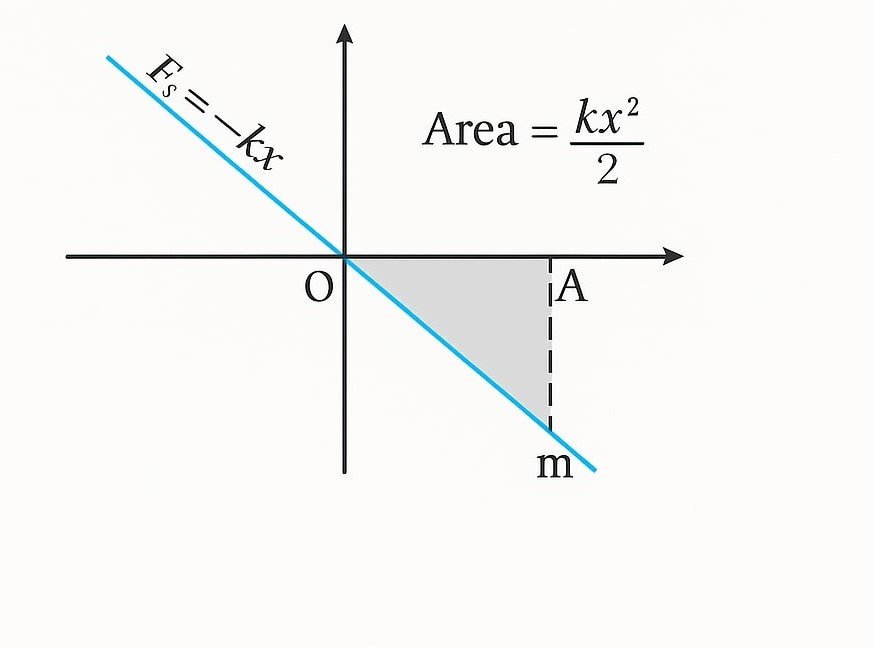
🟢 Elastic Potential Energy

For a stretched or compressed spring:
➡️ U = (1/2)kx²
where k = spring constant, x = deformation.
🧠 Derivation:
W = ∫₀ˣ kx·dx = ½kx²
🟣 Mechanical Energy
💡 Total mechanical energy = Kinetic + Potential energy
➡️ E = ½mv² + mgh
✔️ For conservative forces (like gravity), total mechanical energy remains constant.
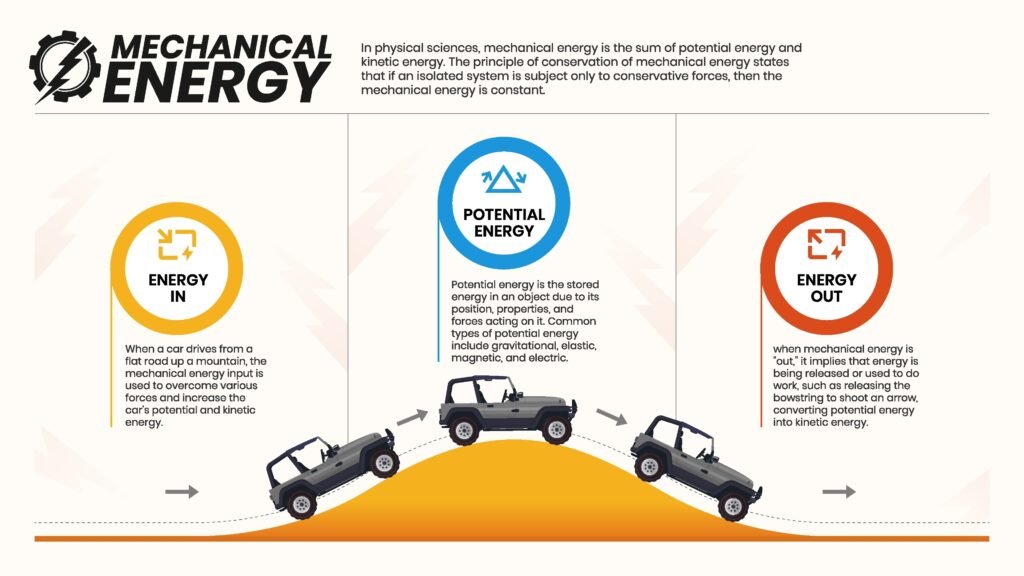
💡 Conservation of Mechanical Energy
✔️ Energy can neither be created nor destroyed; it only changes form.
Example (freely falling body):
At top → P.E. = mgh, K.E. = 0
At bottom → P.E. = 0, K.E. = mgh
Total E = constant = mgh
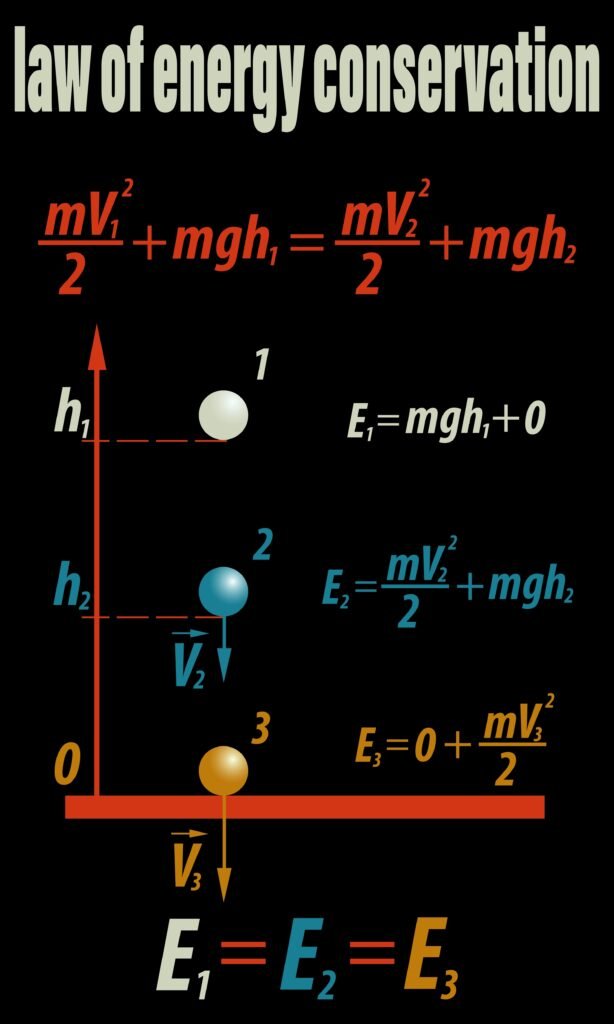
⚡ Power–Energy Relation
Since power = work/time and work = energy,
➡️ P = dE/dt
Example: A 100 W bulb converts 100 J of energy every second.
🔵 Conservative & Non-Conservative Forces
💡 Conservative Force
✔️ Work depends only on initial and final positions.
✔️ Work done in closed path = 0.
➡️ Examples: gravitational force, spring force.
💡 Non-Conservative Force
✔️ Work depends on path taken.
✔️ Energy lost as heat or sound.
➡️ Examples: friction, viscous drag.
🟢 Work Done by a Spring
Restoring force F = −kx
Work done from x = 0 to x = X:
➡️ W = ∫₀ˣ (−kx)dx = −½kX²
Negative sign shows work done against restoring force.
🟣 Potential Energy Curve
Graph of potential energy (U) vs position (x):
✔️ Equilibrium point → dU/dx = 0
✔️ Stable equilibrium → minimum U
✔️ Unstable equilibrium → maximum U
💡 Collisions and Energy
✔️ In elastic collisions → both momentum and kinetic energy conserved.
✔️ In inelastic collisions → momentum conserved, kinetic energy not conserved.
🟢 Work–Energy Theorem (General Form)
✔️ The total work done by all forces = change in kinetic energy.
➡️ ΣW = ΔK.E. = K₂ − K₁
🔴 Law of Conservation of Energy
💡 Total energy of an isolated system remains constant though forms change.
Examples:
✔️ Pendulum: Potential ↔ Kinetic energy.
✔️ Roller coaster: Conversion of potential and kinetic.
➡️ K₁ + U₁ = K₂ + U₂
⚡ Power in Rotational Motion
When torque (τ) acts with angular velocity (ω):
➡️ P = τ × ω
🟢 Efficiency
Efficiency η = (Useful output energy / Total input energy) × 100%
Example: If 1000 J input gives 800 J output,
η = 800/1000 × 100 = 80%
🔴 Dimensional Analysis (Without Table)
Work → joule (J), dimensions [M¹L²T⁻²]
Energy → joule (J), dimensions [M¹L²T⁻²]
Power → watt (W), dimensions [M¹L²T⁻³]
🟢 Numerical Example 1
A force of 50 N acts on a body moving 10 m at 60° to the force.
➡️ W = F·s·cosθ = 50×10×cos60° = 500×0.5 = 250 J
🟣 Numerical Example 2
Find kinetic energy of a 5 kg mass moving with 4 m/s.
➡️ K.E. = ½mv² = ½×5×16 = 40 J
🔴 Numerical Example 3
A spring with k = 200 N/m is stretched by 0.1 m.
➡️ U = ½kx² = ½×200×(0.1)² = 1 J
⚡ Energy Transformations (Examples)
✔️ Electric fan → electrical to mechanical
✔️ Solar cell → solar to electrical
✔️ Motor → electrical to mechanical
✔️ Pendulum → potential ↔ kinetic
✔️ Car engine → chemical to mechanical
🟢 Concept Flow Summary
Force → Work → Energy → Power
✔️ Work done changes kinetic energy
✔️ Energy interconverts but total remains constant
✔️ Power measures rate of energy use
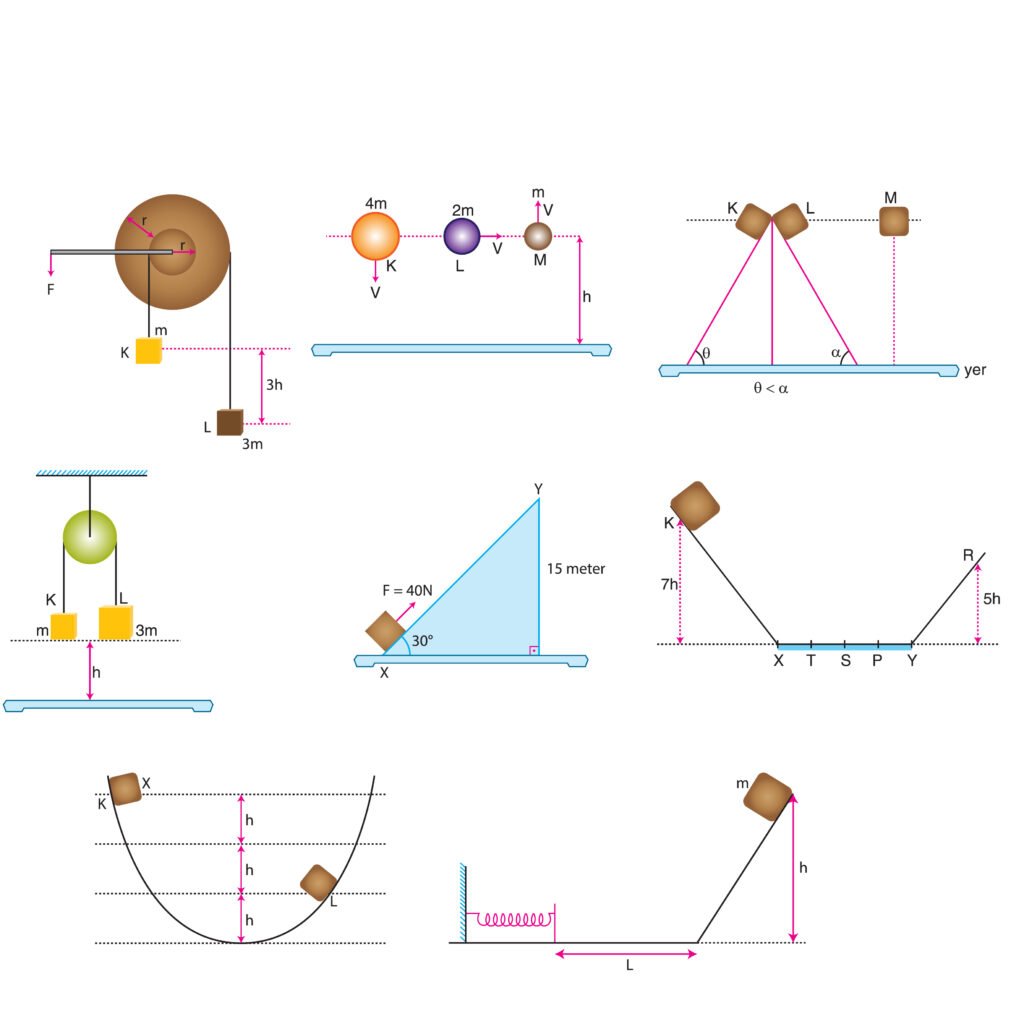
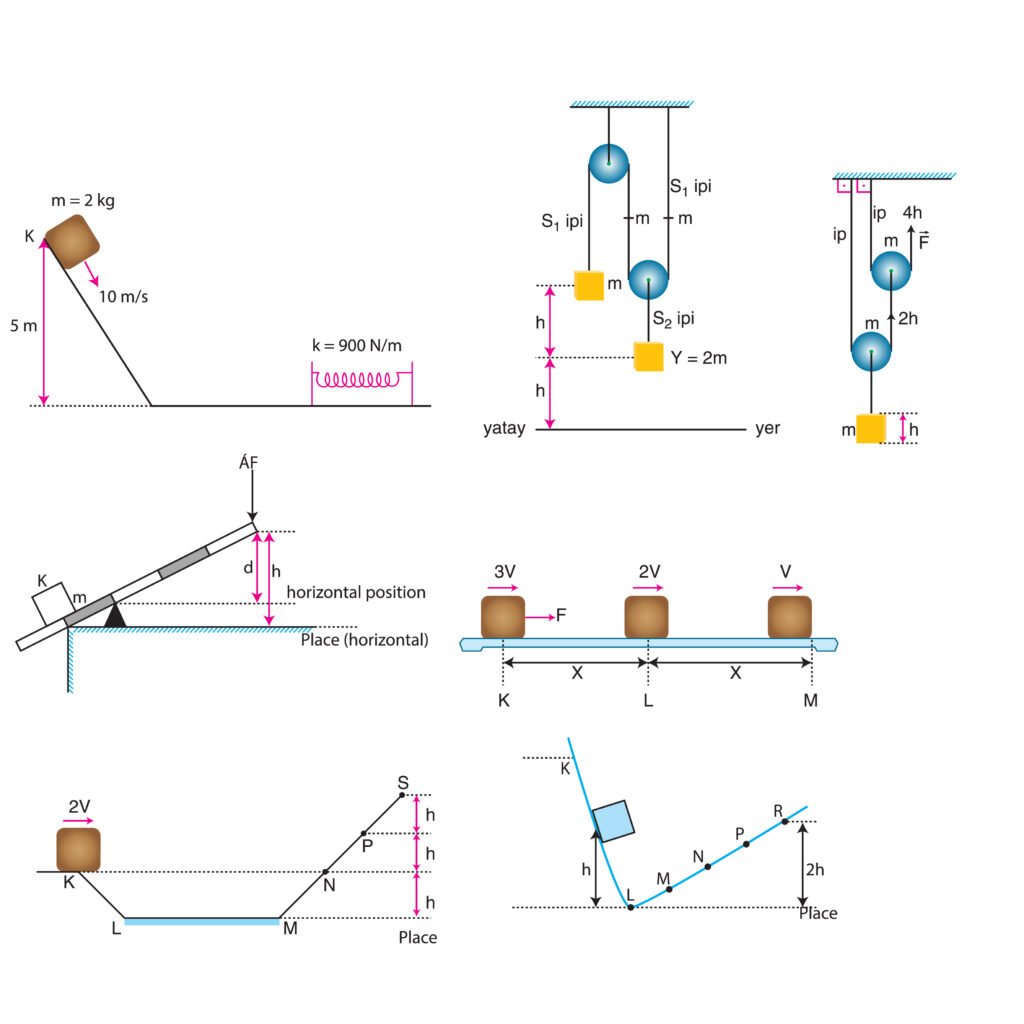
🟣 Summary
The chapter Work, Energy and Power explains how energy and motion relate through forces. Work (W = F·s·cosθ) is the measure of energy transfer by force. Positive work increases motion, negative work resists it.
Energy is the capacity to do work. Kinetic energy (½mv²) arises from motion, potential energy (mgh or ½kx²) from position or deformation. The work–energy theorem states: total work done equals change in kinetic energy.
Mechanical energy, the sum of kinetic and potential energies, remains constant when only conservative forces act. Power (P = W/t = F·v) quantifies how fast work is done.
The law of conservation of energy ensures total energy remains constant, transforming between different forms like heat, light, mechanical, or electrical. Friction and resistance are non-conservative forces converting mechanical energy into heat.
Practical applications include engines, motors, pendulums, and moving vehicles — all illustrating the same fundamental rules of energy conservation and transformation.
📝 Quick Recap
🔵 Work → W = F·s·cosθ
🟢 Kinetic Energy → K.E. = ½mv²
🟠 Potential Energy → P.E. = mgh or ½kx²
🔴 Power → P = W/t or F·v
💡 Work–Energy Theorem → Net work = ΔK.E.
⚡ Law of Conservation of Energy → Energy remains constant in isolated systems
————————————————————————————————————————————————————————————————————————————
QUESTIONS FROM TEXTBOOK
Question 5.1
The sign of work done by a force on a body is important to understand. State carefully if the following quantities are positive or negative:
(a) Work done by a man in lifting a bucket out of a well by means of a rope tied to the bucket.
(b) Work done by gravitational force in the above case.
(c) Work done by friction on a body sliding down an inclined plane.
(d) Work done by an applied force on a body moving on a rough horizontal plane with uniform velocity.
(e) Work done by the resistive force of air on a vibrating pendulum in bringing it to rest.
Answer
🔹 (a) Positive — The man applies an upward force, and the displacement of the bucket is also upward.
➡️ Work done (W = F·s cosθ), here θ = 0°, so W > 0.
🔹 (b) Negative — Gravitational force acts downward while displacement is upward, hence θ = 180°, so cosθ = −1 ⇒ W < 0.
🔹 (c) Negative — Frictional force opposes motion; displacement and force are in opposite directions.
🔹 (d) Positive — Applied force and displacement are in the same direction, though the magnitude of velocity is constant.
🔹 (e) Negative — Resistive force of air opposes the motion of the pendulum; thus work done is negative.
✔️ Hence,
(a) +ve (b) −ve (c) −ve (d) +ve (e) −ve
Question 5.2
A body of mass 2 kg initially at rest moves under the action of an applied horizontal force of 7 N on a table with a coefficient of kinetic friction μ = 0.1. Compute:
(a) work done by the applied force in 10 s,
(b) work done by friction in 10 s,
(c) work done by the net force on the body in 10 s,
(d) change in kinetic energy of the body in 10 s, and interpret your results.
Answer
Given:
m = 2 kg, F = 7 N, μ = 0.1, g = 10 m s⁻², u = 0, t = 10 s
➡️ Frictional force, f = μmg = 0.1 × 2 × 10 = 2 N
➡️ Net force, F_net = F − f = 7 − 2 = 5 N
➡️ Acceleration, a = F_net / m = 5 / 2 = 2.5 m s⁻²
➡️ Displacement, s = ut + (1/2) a t² = 0 + 0.5 × 2.5 × (10)² = 125 m
(a) Work done by applied force:
W₁ = F × s = 7 × 125 = 875 J
(b) Work done by friction:
W₂ = −f × s = −2 × 125 = −250 J
(c) Work done by net force:
W_net = F_net × s = 5 × 125 = 625 J
(d) Change in kinetic energy:
Using work–energy theorem, ΔK = W_net = 625 J
➡️ Final velocity, v² = u² + 2as = 0 + 2 × 2.5 × 125 = 625 ⇒ v = 25 m s⁻¹
⇒ K_f = ½ m v² = ½ × 2 × (25)² = 625 J ✅
✔️ Interpretation:
Work done by the net force equals the increase in kinetic energy — verifying the work–energy theorem.
Question 5.3
Given in Fig. 5.11 are examples of some potential energy functions in one dimension. The total energy of the particle is indicated by a cross on the ordinate axis. In each case, specify the regions, if any, in which the particle cannot be found for the given energy. Also, indicate the minimum total energy the particle must have in each case.
Answer
💡 Concept:
The particle can exist only where its total energy E ≥ potential energy V(x).
If E < V(x), the particle cannot exist in that region (classically forbidden).
Case (a):
Potential energy V(x) has a step-like pattern, V = 0 for x < 0, V = V₀ for x ≥ 0.
For total energy E < V₀, the particle cannot be found in the region x ≥ 0 (since E < V₀).
Minimum energy required to reach x ≥ 0 is E = V₀.
Case (b):
V(x) is piecewise constant with a well between x = a and x = b (V = −V₁) and V = 0 outside.
If total energy E = 0, the particle can exist in all regions (E ≥ V).
For E < 0, the particle is confined to the potential well region between a and b.
Minimum total energy = E = −V₁.
Case (c):
V(x) has a potential well of depth V₁ below the zero level and rises symmetrically.
The particle can exist only where E ≥ V(x).
The classically forbidden regions correspond to x-values where V(x) > E (outer slopes).
Minimum total energy for motion inside the well = E = V₁ (bottom of the well).
✔️ Thus, the particle’s motion is restricted to regions where total energy ≥ potential energy, and forbidden elsewhere.
Question 5.5
Answer the following:
(a) The casing of a rocket in flight burns up due to friction. At whose expense is the heat energy required for burning obtained — the rocket or the atmosphere?
Answer:
➡️ The heat energy is obtained at the expense of the rocket’s kinetic energy.
🌡️ As the rocket moves through air, friction between its surface and air molecules converts part of its kinetic energy into heat.
⚡ Therefore, the rocket slows down slightly as it loses energy to heating.
✔️ Source of heat: Rocket’s own kinetic energy (not the atmosphere).
(b) Comets move around the Sun in highly elliptical orbits. The gravitational force on the comet due to the Sun is not normal to the comet’s velocity in general. Yet, the work done by the gravitational force over every complete orbit of the comet is zero. Why?
Answer:
💡 Concept: Work done by a force = change in kinetic energy = change in total mechanical energy.
➡️ Gravitational force is conservative ⇒ work done over a closed path = 0.
🌀 After one full revolution, the comet returns to its starting position with same potential and kinetic energy.
✔️ Hence, total work done by gravity = 0 over one complete orbit.
(c) An artificial satellite orbiting the Earth in a very thin atmosphere loses its energy gradually due to atmospheric drag. However, as it comes closer to Earth, its speed increases progressively. Why?
Answer:
➡️ Due to drag, total mechanical energy decreases slowly (both potential and kinetic energy change).
➡️ As the satellite spirals inward, its potential energy decreases (becomes more negative).
➡️ To conserve total energy (E = K + U), kinetic energy increases, and thus its speed increases.
💡 Therefore:
As altitude ↓ ⇒ potential energy ↓ ⇒ kinetic energy ↑ ⇒ speed ↑.
(d) In Fig. 5.13:
A man walks 2 m carrying a mass of 15 kg in his hands. In (i) he walks horizontally holding the mass; in (ii) the mass is tied to a rope and hangs at rest while the man walks the same distance pulling the rope behind him.
In which case is the work done greater?
Answer:
Case (i):
🔵 The man lifts no mass vertically; the force (upward) and displacement (horizontal) are perpendicular.
➡️ W = F s cosθ = F s cos(90°) = 0.
✅ Work done = 0 J.
Case (ii):
🟢 The man exerts a tension T on the rope (angled backward).
➡️ The horizontal component of tension T cosθ acts along displacement.
Hence, work done = (T cosθ) × s ≠ 0.
✅ Therefore, work done in case (ii) is greater because a horizontal component of force acts in the direction of motion.
Question
5.6 Underline the correct alternative:
(a) When a conservative force does positive work on a body, the potential energy of the body increases/decreases/remains unaltered.
(b) Work done by a body against friction always results in a loss of its kinetic/potential energy.
(c) The rate of change of total momentum of a many-particle system is proportional to the external force/sum of the internal forces on the system.
(d) In an inelastic collision of two bodies, the quantities which do not change after the collision are the total kinetic energy/total linear momentum/total energy of the system of two bodies.
Answer
🔵 (a) decreases
➡️ For a conservative force: W_cons = −ΔU. If W_cons > 0 ⇒ ΔU < 0 ⇒ U decreases.
🟢 (b) kinetic energy
➡️ Friction does negative work on the moving body; its mechanical energy reduces, primarily as a loss of K to thermal energy.
🟠 (c) external force
➡️ d⃗P_total/dt = ⃗F_external (internal forces cancel in pairs by Newton’s third law).
🔴 (d) total linear momentum (always, for an isolated system) and total energy (always; kinetic + internal + other forms conserved).
➡️ Total kinetic energy is not conserved in an inelastic collision.
Question
5.7 State if each of the following statements is true or false. Give reasons for your answer.
(a) In an elastic collision of two bodies, the momentum and energy of each body is conserved.
(b) Total energy of a system is always conserved, no matter what internal and external forces are present.
(c) Work done in the motion of a body over a closed loop is zero for every force in nature.
(d) In an inelastic collision, the final kinetic energy is always less than the initial kinetic energy of the system.
Answer
🔵 (a) False. In an elastic collision, total linear momentum and total kinetic energy of the system are conserved; those of individual bodies generally change.
🟢 (b) False. The energy of a system can change if external work/heat crosses its boundary. (Energy is conserved only for the universe or for an isolated system; for a closed, isolated system E_total is constant.)
🟠 (c) False. Zero work over a closed path holds only for conservative forces (e.g., gravity, spring). Non-conservative forces (e.g., friction, drag) do non-zero negative work over a cycle.
🔴 (d) True. For an inelastic collision in an isolated system, some kinetic energy converts to internal/thermal energy; hence K_final < K_initial (strict inequality except perfectly elastic case).
Question
5.8 Answer carefully, with reasons:
(a) In an elastic collision of two billiard balls, is the total kinetic energy conserved during the short time of collision (when they are in contact)?
(b) Is the total linear momentum conserved during the short time of an elastic collision of two balls?
Answer
🔵 (a) No. During the brief contact, some kinetic energy is temporarily stored as elastic potential energy of deformation and then returned. Thus K(t) is not constant during contact; only before and after collision (long before/long after) the initial and final total K are equal.
🟢 (b) Yes (for an isolated pair). External forces (weight/normal) nearly cancel over the tiny interval, while mutual internal forces are equal and opposite. Hence ⃗P_total is conserved at every instant during the collision.
🔷 Question 5.8
Answer carefully, with reasons :
(a) In an elastic collision of two billiard balls, is the total kinetic energy conserved during the short time of collision of the balls (i.e. when they are in contact)?
(b) Is the total linear momentum conserved during the short time of an elastic collision of two balls?
(c) What are the answers to (a) and (b) for an inelastic collision?
(d) If the potential energy of two billiard balls depends only on the separation distance between their centres, is the collision elastic or inelastic?
🔶 Answer:
➡️ (a) During the short interval when the balls are in contact, part of kinetic energy is temporarily stored as elastic potential energy. Hence total kinetic energy is not conserved at that instant, though it is conserved before and after collision.
➡️ (b) Total linear momentum is conserved at all times during the collision, because internal forces act equally and oppositely on both balls (Newton’s 3rd law).
➡️ (c) For inelastic collision, total momentum remains conserved, but total kinetic energy decreases (partly converted to heat/sound/deformation).
➡️ (d) If potential energy depends only on the separation distance, the forces are conservative, so collision is elastic.
🔷 Question 5.9
A body is initially at rest. It undergoes one-dimensional motion with constant acceleration. The power delivered to it at time t is proportional to
(i) t¹ᐟ² (ii) t (iii) t³ᐟ² (iv) t²
🔶 Answer:
💡 Concept:
Power P = F·v = m·a·v and v = a·t
✏️ So, P = m·a²·t
Hence, P ∝ t
✔️ Correct option: (ii) t
🔷 Question 5.10
A body is moving unidirectionally under the influence of a source of constant power. Its displacement in time t is proportional to
(i) t¹ᐟ² (ii) t³ᐟ² (iii) t⁵ᐟ² (iv) t³
🔶 Answer:
💡 Concept: P = F·v = m·a·v and F = m·a
So a = P / (m·v)
Since a = dv/dt = P / (m·v)
➡️ v·dv = (P/m)·dt
Integrate from 0 to v and 0 to t:
½ v² = (P/m)·t
∴ v ∝ t¹ᐟ²
Now displacement s = ∫v dt ∝ ∫t¹ᐟ² dt ∝ t³ᐟ²
✔️ Correct option: (ii) t³ᐟ²
🔷 Question 5.11
A body constrained to move along the z-axis is subject to a constant force F = −î + 2ĵ + 3k̂ N.
What is the work done by this force in moving the body a distance of 4 m along the z-axis?
🔶 Answer:
➡️ Only the z-component (F_z = 3 N) does work.
Work done, W = F_z · s = 3 × 4 = 12 J
✔️ Work done = 12 J
🔷 Question 5.12
An electron and a proton are detected in a cosmic-ray experiment, the first with kinetic energy 10 keV and the second with 100 keV. Which is faster? Obtain the ratio of their speeds.
Given:
mₑ = 9.1×10⁻³¹ kg, m_p = 1.67×10⁻²⁷ kg, 1 eV = 1.6×10⁻¹⁹ J
🔶 Answer:
Convert energies to joules:
Eₑ = 10 × 10³ × 1.6×10⁻¹⁹ = 1.6×10⁻¹⁵ J
E_p = 100 × 10³ × 1.6×10⁻¹⁹ = 1.6×10⁻¹⁴ J
For non-relativistic speeds, v = √(2E/m)
➡️ vₑ = √(2×1.6×10⁻¹⁵ / 9.1×10⁻³¹) = 1.88×10⁷ m s⁻¹
➡️ v_p = √(2×1.6×10⁻¹⁴ / 1.67×10⁻²⁷) = 4.38×10⁶ m s⁻¹
Ratio vₑ : v_p ≈ 4.3 : 1
✔️ Electron is faster; vₑ/v_p ≈ 4.3
🔷 Question 5.13
A rain drop of radius 2 mm falls from a height of 500 m. At half the height (250 m), its velocity becomes terminal (10 m s⁻¹). Find
(a) work done by gravitational force in the whole fall, and
(b) work done by resistive force.
🔶 Answer:
✏️ (a) Work by gravity: W_g = m g h
Volume = (4/3) π r³ = (4/3) × 3.14 × (2×10⁻³)³ = 3.35×10⁻⁸ m³
Mass = ρ × Volume = 1000 × 3.35×10⁻⁸ = 3.35×10⁻⁵ kg
W_g = 3.35×10⁻⁵ × 9.8 × 500 = 0.164 J
✏️ (b) Work done by resistive force (W_r):
Net energy gained = ½ m v² = ½ × 3.35×10⁻⁵ × (10)² = 1.68×10⁻³ J
Therefore W_r = W_g − ΔK = 0.164 − 0.00168 ≈ 0.162 J (opposite in direction)
✔️ W_g = 0.164 J, W_r = −0.162 J
🔷 Question 5.14
A molecule in a gas container hits a horizontal wall with speed 200 m s⁻¹ and at an angle 30° with the normal, and rebounds with the same speed. Is momentum conserved in the collision? Is the collision elastic or inelastic?
🔶 Answer:
➡️ Component of momentum normal to wall reverses; tangential component remains unchanged.
Hence momentum of molecule alone not conserved — wall exerts impulse.
For molecule + wall system, total momentum is conserved.
➡️ Kinetic energy before = after, so collision is elastic.
✔️ Total momentum conserved (system), collision elastic.
🔷 Question 5.15
A pump on the ground floor of a building can pump up water to fill a tank of volume 30 m³ in 15 min. If the tank is 40 m above ground and efficiency of pump is 30%, find the electric power consumed.
🔶 Answer:
Volume = 30 m³ Density of water ρ = 1000 kg m⁻³
➡️ m = ρ V = 3 × 10⁴ kg
Work done = m g h = 3×10⁴ × 9.8 × 40 = 1.176×10⁷ J
Time = 15 min = 900 s
Useful power output = 1.176×10⁷ / 900 = 1.31×10⁴ W
Efficiency η = 30% = 0.3
Input power = P_out / η = 1.31×10⁴ / 0.3 = 4.37×10⁴ W
✔️ Electric power consumed = 43.7 kW
🔷 Question 5.16
Two identical ball bearings (1 and 2) rest in contact on a smooth table. A third identical ball (3) moving with speed V hits ball 1 head-on. Which of the following outcomes is possible for an elastic collision?
(i) 1 → V, 2 → 0, 3 → 0
(ii) 1 → V/2, 2 → V/2, 3 → 0
(iii) 1 → 0, 2 → V, 3 → 0
🔶 Answer:
💡 In a perfectly elastic head-on collision between identical spheres, the incoming ball transfers its velocity to the first and then to the next ball successively (as in Newton’s cradle).
➡️ Therefore, ball 3 stops, and ball 2 moves with velocity V.
✔️ Correct option: (iii)
🔷 Question 5.17
The bob A of a pendulum released from 30° to the vertical hits another bob B of the same mass at rest on a table (Fig. 5.15). How high does the bob B rise after the collision? Neglect the size of the bobs and assume the collision is elastic.
🔶 Answer:
💡 Concept:
In an elastic collision between equal masses:
➡️ The moving mass transfers its velocity completely to the stationary mass.
✏️ Step 1: Velocity of A just before impact
v = √(2gh) = √(2gL(1 − cos30°))
= √(2 × 9.8 × L × 0.134) = √(2.63L)
✏️ Step 2: After collision, A stops and B moves with velocity v.
✏️ Step 3: Maximum height of B = v² / (2g) = [2gL(1 − cos30°)] / (2g) = L(1 − cos30°)
✔️ Height attained by B = L(1 − cos30°)
🔷 Question 5.18
The bob of a pendulum is released from a horizontal position. The length of the pendulum is 1.5 m. What is the speed at the lowest point, given that it dissipated 5% of its initial energy against air resistance?
🔶 Answer:
💡 Concept:
Potential energy at top = m g L
Kinetic energy at bottom = 0.95 m g L
✏️ Step 1: v = √(2 × 0.95 g L)
= √(2 × 0.95 × 9.8 × 1.5)
= √(27.93) = 5.28 m s⁻¹
✔️ Speed = 5.3 m s⁻¹ (approx.)
🔷 Question 5.19
A trolley of mass 300 kg carrying a sandbag of 25 kg is moving uniformly with a speed of 27 km h⁻¹ on a frictionless track. After a while, sand starts leaking out at the rate of 0.05 kg s⁻¹. What is the speed of the trolley after the sandbag is empty?
🔶 Answer:
💡 Concept:
There is no external horizontal force, so total momentum remains conserved.
✏️ Step 1: v_final = v_initial = 27 km h⁻¹ = 7.5 m s⁻¹
✔️ Speed remains unchanged = 7.5 m s⁻¹
🔷 Question 5.20
A body of mass 0.5 kg travels in a straight line with velocity v = α x¹ᐟ², where α = 5 m¹ᐟ² s⁻¹. What is the work done by the net force during its displacement from x = 0 to x = 2 m?
🔶 Answer:
💡 Concept:
Work–energy theorem: W = ΔK = ½ m(v₂² − v₁²)
✏️ Step 1:
v₁ = α √x₁ = 0
v₂ = α √x₂ = 5 √2 = 7.07 m s⁻¹
✏️ Step 2:
W = ½ × 0.5 × (7.07² − 0) = 0.25 × 50 = 12.5 J
✔️ Work done = 12.5 J
🔷 Question 5.21
The blades of a windmill sweep out a circle of area A.
(a) If the wind flows at velocity v perpendicular to the circle, what is the mass of air passing through it in time t?
(b) What is the kinetic energy of the air?
(c) If the windmill converts 25% of this energy into electrical energy, find the power produced when A = 30 m², v = 36 km h⁻¹, ρ = 1.2 kg m⁻³.
🔶 Answer:
✏️ (a) Mass of air = ρ A v t
✏️ (b) K.E. of air = ½ (ρ A v t) v² = ½ ρ A v³ t
✏️ (c) Power output = (25 % of energy)/t = ¼ × ½ ρ A v³
= ⅛ ρ A v³
Convert v = 36 km h⁻¹ = 10 m s⁻¹
P = ⅛ × 1.2 × 30 × 10³ = 450 W
✔️ Power produced = 450 W
🔷 Question 5.22
A person trying to lose weight climbs a staircase of height 0.5 m each time.
(a) Determine the work done against gravity in each climb by a 100 kg mass.
(b) If fat supplies 3.8 × 10⁷ J kg⁻¹ energy and efficiency is 20%, how much mass is lost per climb?
🔶 Answer:
✏️ (a) W = m g h = 100 × 9.8 × 0.5 = 490 J
✏️ (b) Useful energy from fat = 0.2 × (3.8×10⁷) = 7.6×10⁶ J kg⁻¹
Mass lost = 490 / (7.6×10⁶) = 6.45×10⁻⁵ kg
✔️ Mass lost ≈ 6.5×10⁻⁵ kg per climb
🔷 Question 5.23
A solar panel uses 8 kW of solar energy incident on its horizontal surface at an average rate of 200 W m⁻².
(a) If 20 % of this energy can be converted into useful electrical energy, how large an area is needed to supply 8 kW?
(b) Compare this area to that of a typical house roof.
🔶 Answer:
✏️ (a) Power density = 200 × 0.2 = 40 W m⁻²
Required power = 8 × 10³ W
Area = Power / Power density = 8000 / 40 = 200 m²
✏️ (b) A typical house roof ≈ 100 m², so required area ≈ 2× roof area.
✔️ Required solar area = 200 m² ≈ twice a normal roof
————————————————————————————————————————————————————————————————————————————
OTHER IMPORTANT QUESTIONS FOR EXAMS
(CBSE MODEL QUESTIONS PAPER)
ESPECIALLY MADE FROM THIS LESSON ONLY
⚡ SECTION A – Multiple Choice Questions (Q1–Q18)
Question 1.
Work is said to be done when:
🔵 (A) A force acts on a body.
🟢 (B) A body moves without force.
🟠 (C) A force acts and the body is displaced.
🔴 (D) A force acts perpendicular to motion.
Answer: (C) A force acts and the body is displaced.
Question 2.
Which of the following quantities is scalar?
🔵 (A) Force
🟢 (B) Velocity
🟠 (C) Work
🔴 (D) Displacement
Answer: (C) Work
Question 3.
Work done is zero when:
🔵 (A) Force and displacement are parallel.
🟢 (B) Force and displacement are perpendicular.
🟠 (C) Force acts opposite to motion.
🔴 (D) Displacement is along force.
Answer: (B) Force and displacement are perpendicular.
Question 4.
If a body moves in a circular path, the work done by centripetal force is:
🔵 (A) Positive
🟢 (B) Negative
🟠 (C) Zero
🔴 (D) Constant
Answer: (C) Zero
Question 5.
Work done by a constant force is given by:
🔵 (A) W = F × s × cosθ
🟢 (B) W = F × s × sinθ
🟠 (C) W = F / s
🔴 (D) W = F² × s
Answer: (A) W = F × s × cosθ
Question 6.
The SI unit of work is:
🔵 (A) erg
🟢 (B) joule
🟠 (C) watt
🔴 (D) newton
Answer: (B) joule
Question 7.
Work done against gravity in lifting a body of mass m through height h is:
🔵 (A) mg/h
🟢 (B) mgh
🟠 (C) mh/g
🔴 (D) ½mgh
Answer: (B) mgh
Question 8.
A body of mass 4 kg moves with velocity 5 m/s. Its kinetic energy is:
🔵 (A) 25 J
🟢 (B) 50 J
🟠 (C) 100 J
🔴 (D) 10 J
Answer: (B) 50 J
Question 9.
Which one of the following has no unit?
🔵 (A) Work
🟢 (B) Energy
🟠 (C) Efficiency
🔴 (D) Power
Answer: (C) Efficiency
Question 10.
The rate of doing work is called:
🔵 (A) Force
🟢 (B) Energy
🟠 (C) Power
🔴 (D) Momentum
Answer: (C) Power
Question 11.
The SI unit of power is:
🔵 (A) joule
🟢 (B) watt
🟠 (C) newton
🔴 (D) erg
Answer: (B) watt
Question 12.
A 100 W bulb converts how much energy in 5 seconds?
🔵 (A) 100 J
🟢 (B) 500 J
🟠 (C) 50 J
🔴 (D) 1000 J
Answer: (B) 500 J
Question 13.
Kinetic energy depends upon:
🔵 (A) Velocity only
🟢 (B) Mass only
🟠 (C) Both mass and velocity
🔴 (D) Force
Answer: (C) Both mass and velocity
Question 14.
If velocity of a body becomes double, its kinetic energy becomes:
🔵 (A) Same
🟢 (B) Double
🟠 (C) Four times
🔴 (D) Half
Answer: (C) Four times
Question 15.
Potential energy of a spring is given by:
🔵 (A) mgh
🟢 (B) ½kx²
🟠 (C) ½mv²
🔴 (D) Fx
Answer: (B) ½kx²
Question 16.
Mechanical energy is conserved when:
🔵 (A) Friction acts
🟢 (B) Only conservative forces act
🟠 (C) External force acts
🔴 (D) None
Answer: (B) Only conservative forces act
Question 17.
The dimensional formula of work is:
🔵 (A) [M¹L²T⁻²]
🟢 (B) [M⁰L¹T⁻²]
🟠 (C) [M¹L¹T⁻¹]
🔴 (D) [M²L²T⁻³]
Answer: (A) [M¹L²T⁻²]
Question 18.
1 kilowatt-hour equals:
🔵 (A) 3.6 × 10⁵ J
🟢 (B) 36 × 10⁵ J
🟠 (C) 3.6 × 10⁶ J
🔴 (D) 36 × 10⁶ J
Answer: (C) 3.6 × 10⁶ J
🟢 SECTION B – Very Short and Short Answer Questions (Q19–Q23)
Question 19.
Define work and state its SI unit.
Answer:
💡 Definition: Work is said to be done when a force produces displacement in the direction of the force.
➡️ Mathematically, W = F·s·cosθ,
where F is the force, s is displacement, and θ is the angle between them.
✔️ SI Unit: Joule (J).
1 joule = work done when a force of 1 N displaces a body by 1 m in its direction.
Question 20.
A body moves in a circular path. What is the work done by centripetal force?
Answer:
💡 Centripetal force always acts perpendicular to the motion of the body.
➡️ Since θ = 90°, W = F·s·cos90° = 0.
✔️ Hence, the work done is zero, as the direction of displacement is tangential while force is radial.
Question 21.
State and prove the work–energy theorem for a constant force.
Answer:
💡 Statement: The net work done on a body by all forces equals the change in its kinetic energy.
🔵 Step 1: Let a force F act on a body of mass m, producing acceleration a.
🔵 Step 2: From Newton’s second law, F = ma.
🔵 Step 3: Work done, W = F·s = ma·s.
🔵 Step 4: Using v² − u² = 2as → as = (v² − u²)/2.
🔵 Step 5: Substitute in W = ma·s → W = ½m(v² − u²).
✔️ Hence proved:
W = ΔK.E. = K₂ − K₁
The total work done equals the change in kinetic energy.
Question 22.
What is the relation between kinetic energy and momentum?
Answer:
💡 We know p = mv and K.E. = ½mv².
Substituting v = p/m,
➡️ K.E. = p² / (2m)
✔️ Hence, kinetic energy of a body is proportional to the square of its momentum for constant mass.
Question 23.
State the law of conservation of mechanical energy for freely falling bodies.
Answer:
💡 Statement: The sum of potential and kinetic energies of a freely falling body remains constant if air resistance is neglected.
🔵 At height h:
P.E. = mgh, K.E. = 0 → Total E = mgh
🔵 At ground:
P.E. = 0, K.E. = mgh → Total E = mgh
✔️ Hence, P.E. + K.E. = Constant, proving mechanical energy is conserved.
🟣 SECTION C – Mid-Length Numerical and Theory Questions (Q24–Q28)
Question 24.
A 20 N force moves a body through 5 m at 60° to its direction. Find the work done.
Answer:
🔵 Given: F = 20 N, s = 5 m, θ = 60°
➡️ W = F·s·cosθ = 20 × 5 × cos60°
➡️ W = 100 × 0.5 = 50 J
✔️ Work done = 50 joules.
Question 25.
Derive an expression for potential energy of a spring.
Answer:
💡 For spring, restoring force F = −kx.
Work done in stretching the spring from 0 to x,
➡️ W = ∫₀ˣ F·dx = ∫₀ˣ (−kx)·dx
➡️ W = −½kx²
✔️ Hence, Potential Energy (U) = ½kx²
(negative sign indicates energy stored against restoring force).
Question 26.
A 2 kg body falls from height 10 m. Find its kinetic energy when it reaches the ground. (Take g = 9.8 m/s²)
Answer:
🔵 Given: m = 2 kg, h = 10 m
P.E. at top = mgh = 2 × 9.8 × 10 = 196 J
💡 By conservation of energy,
K.E. at ground = P.E. lost = 196 J
✔️ Kinetic Energy = 196 J.
Question 27.
State the conditions for conservation of mechanical energy.
Answer:
💡 Mechanical energy (E = K.E. + P.E.) remains constant when:
🟢 (1) Only conservative forces act (like gravity or spring).
🟢 (2) Non-conservative forces (like friction) are absent.
🟢 (3) The system is isolated (no external work input/output).
✔️ Under these conditions, total mechanical energy stays constant.
Question 28.
Define power and derive its relation with force and velocity.
Answer:
💡 Definition: Power is the rate of doing work.
➡️ P = dW/dt
For constant force, W = F·s·cosθ → differentiate:
➡️ P = F·v·cosθ
✔️ Instantaneous Power = Force × Velocity × cosθ.
🔴 SECTION D – Long Answer Questions (Q29–Q31)
Question 29.
State and explain the Law of Conservation of Energy with an example.
Answer:
💡 Statement:
Energy can neither be created nor destroyed; it can only be transformed from one form to another, but the total energy of an isolated system remains constant.
🟢 Step 1: Explanation
➡️ Consider a freely falling body of mass m falling from height h.
At the top:
Potential energy = mgh
Kinetic energy = 0
Total energy = mgh
When the body has fallen a distance x:
Potential energy = mg(h − x)
Kinetic energy = ½mv², where v² = 2gx
🟡 Step 2: Total energy during fall
➡️ E = mg(h − x) + ½m(2gx)
➡️ E = mgh − mgx + mgx = mgh
✔️ Hence, total energy remains constant throughout motion.
🔴 Step 3: Conclusion
The potential energy continuously converts into kinetic energy, but the sum of the two remains unchanged.
✅ Therefore, total mechanical energy is conserved.
Question 30.
Define potential energy. Derive an expression for gravitational potential energy near the Earth’s surface.
Answer:
💡 Definition:
Potential energy is the energy possessed by a body due to its position or configuration.
🟢 Step 1: Consideration
A body of mass m is lifted vertically through height h against gravity.
The constant force required to lift = weight of body = mg.
🟡 Step 2: Work done against gravity
➡️ Work done = Force × Displacement
➡️ W = mg × h = mgh
🔴 Step 3: Interpretation
✔️ Work done is stored as potential energy of the body.
✔️ Therefore, Potential Energy (U) = mgh
💡 Note: P.E. is measured with respect to a reference level where U = 0.
Question 31.
Explain the concept of Power. Derive its relation with force and velocity.
Answer:
💡 Definition:
Power is the rate at which work is done or energy is transferred.
🟢 Step 1: Basic formula
➡️ Power = Work / Time
➡️ P = W / t
🟡 Step 2: Substituting work (W = F·s·cosθ)
➡️ P = (F·s·cosθ)/t
Since s/t = v,
➡️ P = F·v·cosθ
🔴 Step 3: Types of Power
✔️ Average Power: total work done / total time
✔️ Instantaneous Power: rate of work at a particular instant = dW/dt
🧠 Example:
If a car engine exerts a force of 500 N to move at 10 m/s,
➡️ P = F·v = 500 × 10 = 5000 W = 5 kW
✅ Hence, Power = Force × Velocity × cosθ, giving the rate of work done by the applied force.
🟣 SECTION E – Case / Application-Based Questions (Q32–Q33)
Question 32.
A block of 10 kg is pulled by a horizontal force of 50 N on a rough surface (μ = 0.2). Find (a) work done by applied force, (b) work done against friction, (c) net work done, and (d) change in kinetic energy, if block moves 5 m. (Take g = 10 m/s²)
Answer:
🔵 Given:
m = 10 kg, F = 50 N, μ = 0.2, s = 5 m
🟢 Step 1: Frictional Force
f = μN = μmg = 0.2 × 10 × 10 = 20 N
🟡 Step 2: Work by Applied Force
W₁ = F × s = 50 × 5 = 250 J
🔴 Step 3: Work against Friction
W₂ = −f × s = −20 × 5 = −100 J
🟢 Step 4: Net Work Done
W = W₁ + W₂ = 250 − 100 = 150 J
🟡 Step 5: Change in Kinetic Energy (Work–Energy Theorem)
ΔK.E. = W = 150 J
✔️ Results:
(a) 250 J (b) −100 J (c) 150 J (d) K.E. increases by 150 J
Question 33.
A 5 kg block slides down a smooth incline of height 4 m. Find (a) velocity at the bottom, and (b) kinetic energy at that point. (Take g = 9.8 m/s²)
Answer:
🔵 Given:
m = 5 kg, h = 4 m, smooth surface (no friction).
🟢 Step 1: Using Conservation of Energy
At top: P.E. = mgh = 5 × 9.8 × 4 = 196 J, K.E. = 0.
At bottom: P.E. = 0, K.E. = 196 J.
🟡 Step 2: Using K.E. = ½mv²
196 = ½ × 5 × v²
v² = (196 × 2) / 5 = 78.4
v = 8.86 m/s
✔️ Final Answers:
(a) Velocity = 8.86 m/s
(b) Kinetic Energy = 196 J
————————————————————————————————————————————————————————————————————————————