
Class 11 : Physics (In English) – Chapter 13: Oscillations

EXPLANATION & SUMMARY
🔷 EXPLANATION
🌟 1. Introduction
🔵 Many physical systems in nature repeat their motion in a regular time interval — such repetitive motions are called oscillations or vibrations.
🟢 Examples: motion of a pendulum, vibration of a stretched spring, sound waves, or an alternating electric current.
🔴 The study of oscillations helps in understanding wave motion, resonance, alternating current circuits, and molecular vibrations.
💡 2. Periodic and Oscillatory Motion
✏️ Periodic motion: A motion which repeats itself after equal intervals of time.
➡️ Example: Earth’s rotation, motion of a fan blade.
✏️ Oscillatory motion: A type of periodic motion in which a body moves to and fro about a fixed equilibrium position.
➡️ Example: Simple pendulum, spring-mass system.
✔️ Every oscillatory motion is periodic, but not every periodic motion is oscillatory.
🔹 3. Displacement, Amplitude, Frequency, and Phase
Let the equilibrium position of an oscillating particle be O.
When displaced, its position at time t is measured by its displacement (x).
Amplitude (A): Maximum displacement from the mean position.
Time period (T): Time taken for one complete oscillation.
Frequency (ν): Number of oscillations per second → ν = 1/T.
Angular frequency (ω): ω = 2πν = 2π/T.
Phase (ϕ): Quantity that determines the state (position and direction) of motion at any instant.
🧠 Relation of displacement in simple harmonic motion (SHM):
x = A sin(ωt + ϕ) or x = A cos(ωt + ϕ)
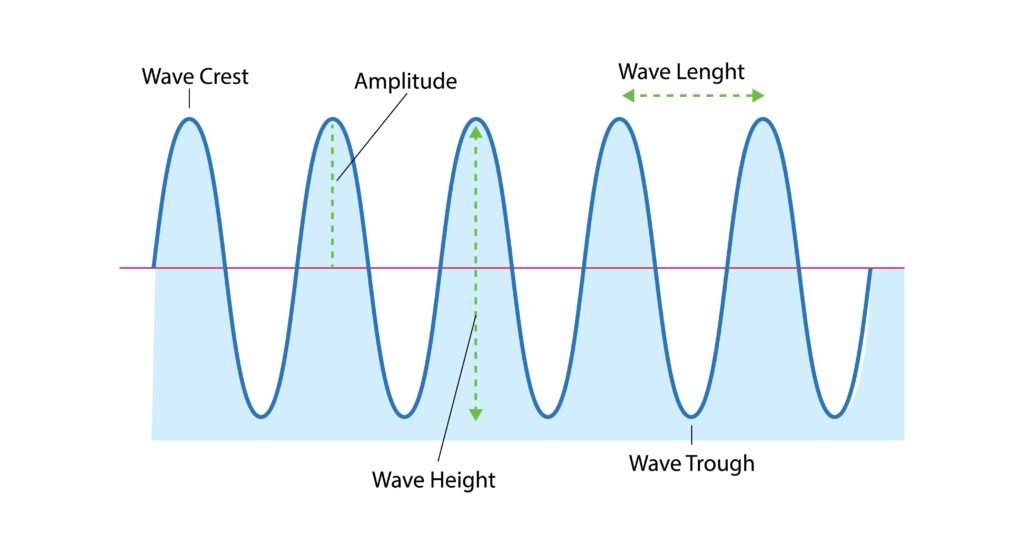
🔹 4. Simple Harmonic Motion (SHM)
💡 Definition: Motion of a particle in which its acceleration is directly proportional to its displacement from the mean position and is always directed towards it.
Mathematically,
a ∝ −x or a = −ω²x
➡️ The negative sign indicates that the acceleration is always directed opposite to displacement (restoring nature).
Here, ω is the angular frequency, given by ω = 2π/T.
✔️ Displacement equation: x = A sin(ωt + ϕ)
✔️ Velocity: v = dx/dt = Aω cos(ωt + ϕ)
✔️ Acceleration: a = −Aω² sin(ωt + ϕ) = −ω²x
🔹 5. Graphical Representation
✴️ Displacement–Time Graph: A sine or cosine curve between x and t.
✴️ Velocity–Time Graph: A cosine curve when x ∝ sin(ωt).
✴️ Acceleration–Time Graph: Same as displacement but with opposite sign.
✴️ Phase difference: Between x, v, a →
• Displacement and velocity differ by π/2
• Velocity and acceleration differ by π/2
• Displacement and acceleration differ by π
🔹 6. Energy in SHM
The oscillating body possesses potential energy (PE) and kinetic energy (KE) interchangeably.
Let displacement at any instant = x.
💡 Potential energy: U = (1/2) k x²
💡 Kinetic energy: K = (1/2) m ω² (A² − x²)
💡 Total energy: E = (1/2) m ω² A² = constant
✔️ Energy is maximum at the mean position (all kinetic).
✔️ Energy is potential at the extreme position (x = ±A).
🔹 7. Force in SHM
From Newton’s law, F = ma
⇒ F = −mω²x
💡 Hence, the restoring force is directly proportional to displacement and directed towards the mean position.
🔹 8. The Spring–Mass System (Linear SHM)
Consider a mass m attached to a light spring of force constant k, fixed at one end and lying on a smooth surface.
When the spring is stretched by x, restoring force is F = −kx.
By Newton’s second law:
m a = −k x ⇒ a = −(k/m) x
Comparing with a = −ω²x, we get
ω = √(k/m)
Hence,
T = 2π √(m/k)
✔️ Time period increases with mass and decreases with stiffness of the spring.
🔹 9. The Simple Pendulum
A small bob of mass m suspended by a light inextensible string of length l performs oscillations about its mean position under gravity.
Restoring torque = −m g sinθ × l
For small angles (sinθ ≈ θ):
Torque = −m g l θ
and angular acceleration α = −(g/l) θ
Comparing with SHM (α = −ω²θ):
ω = √(g/l)
Hence,
T = 2π √(l/g)
✔️ Time period depends only on length and acceleration due to gravity, not on mass or amplitude (for small oscillations).
🔹 10. Phase and Its Significance
At any instant, the argument (ωt + ϕ) is called phase.
When ωt + ϕ = 0 → motion starts from mean position.
When ωt + ϕ = π/2 → particle at extreme position.
Phase difference determines relative state of motion between two SHMs.
🔹 11. Superposition of Two SHMs
If two SHMs act simultaneously on a particle along the same line, their resultant displacement is the algebraic sum of individual displacements.
Let x₁ = A₁ sin(ωt), x₂ = A₂ sin(ωt + δ)
Then resultant displacement:
x = A sin(ωt + ϕ)
where
A = √(A₁² + A₂² + 2A₁A₂ cosδ)
💡 The resultant amplitude depends on phase difference δ.
🔹 12. Damped Oscillations
In practical systems, amplitude decreases with time due to friction or air resistance.
Such oscillations are called damped oscillations.
Equation:
x = A e^(−bt/2m) sin(ωt + ϕ)
where b = damping constant.
✔️ Energy decreases exponentially with time.
✔️ At large damping, oscillations cease — system becomes aperiodic.
🔹 13. Forced Oscillations
When an external periodic force acts on an oscillator, it performs forced oscillations.
Equation:
F = F₀ sin(ω_d t)
The body vibrates with the driving frequency ω_d (not its natural frequency).
When ω_d ≈ ω₀ (natural frequency), amplitude becomes large — this condition is resonance.
🔹 14. Resonance
💡 Resonance: The phenomenon of large amplitude oscillation when the frequency of the external periodic force equals the natural frequency of the oscillator.
➡️ Example: Tuning fork in resonance, vibrating bridges, radio tuning.
✔️ Resonance transfers maximum energy and may cause destruction (like Tacoma bridge collapse).
🔹 15. Energy of Damped and Forced Oscillations
In damped systems, mechanical energy decreases continuously.
In forced oscillations, energy is supplied periodically; hence steady-state amplitude is reached.
Power absorbed per cycle = (average work done by driving force).
At resonance, power absorbed is maximum.
🔹 16. Applications of SHM
🟢 Measurement of time (pendulum clocks).
🔵 Design of oscillatory circuits (LC circuits).
🔴 Understanding acoustic and seismic vibrations.
🟠 Design of suspension systems, building structures against vibrations.


🟢 SUMMARY (~300 words)
Oscillatory motion is a repetitive motion about a mean position. Simple Harmonic Motion (SHM) is a special type where acceleration is directly proportional to displacement and opposite in direction, given by a = −ω²x.
In SHM, displacement at any time is x = A sin(ωt + ϕ), where A is amplitude, ω angular frequency, and ϕ phase constant.
Velocity and acceleration vary sinusoidally, and total energy remains constant:
E = (1/2) m ω² A².
For a spring–mass system, restoring force F = −kx gives
T = 2π√(m/k).
For a simple pendulum, small-angle oscillations give
T = 2π√(l/g).
When two SHMs of same frequency combine, resultant amplitude depends on phase difference.
Real systems exhibit damped oscillations due to friction; amplitude decreases exponentially.
If an external periodic force acts, motion becomes forced oscillation.
At resonance, the external frequency equals the natural frequency, producing maximum amplitude.
Oscillations explain diverse phenomena — vibrations in mechanical systems, alternating current circuits, sound, and waves. Understanding SHM forms the basis for the study of wave motion and resonance phenomena.
🔻 QUICK RECAP (6 Key Points)
1️⃣ Equation of SHM: x = A sin(ωt + ϕ), a = −ω²x
2️⃣ Time Period:
• Spring: T = 2π√(m/k)
• Pendulum: T = 2π√(l/g)
3️⃣ Energy: E = (1/2) m ω² A² = constant
4️⃣ Relation: vₚ : vₐᵥg : vᵣₘₛ = 1 : 1.128 : 1.225 (for gases, analogy of oscillation speeds)
5️⃣ Damped Motion: x = A e^(−bt/2m) sin(ωt + ϕ)
6️⃣ Resonance: Occurs when driving frequency = natural frequency → maximum amplitude
————————————————————————————————————————————————————————————————————————————
QUESTIONS FROM TEXTBOOK
🔵 Question 13.1
Which of the following examples represent periodic motion?
(a) A swimmer completing one [return] trip from one bank of a river to the other and back.
(b) A freely suspended bar magnet displaced from its N–S direction and released.
(c) A hydrogen molecule rotating about its centre of mass.
(d) An arrow released from a bow.
Answer:
🟢 Step 1: Identify periodic nature
➡️ A periodic motion repeats itself after a fixed interval of time.
🟡 Step 2: Analyze each case
(a) The swimmer’s motion is not periodic, since the time taken for return trip depends on conditions like speed and flow; it doesn’t repeat in equal intervals ❌
(b) A freely suspended bar magnet oscillates to and fro about its mean position when displaced — this is periodic motion ✔️
(c) A hydrogen molecule rotating continuously about its centre of mass repeats its motion after a fixed time (rotation period) — periodic motion ✔️
(d) An arrow released from a bow moves in one direction only, not repeating its path — not periodic ❌
✔️ Final Answer: (b) and (c) represent periodic motion.
🔵 Question 13.2
Which of the following examples represent (nearly) simple harmonic motion and which represent periodic but not simple harmonic motion?
(a) The rotation of earth about its axis.
(b) Motion of an oscillating mercury column in a U-tube.
(c) Motion of a ball bearing inside a smooth curved bowl, when released from a point slightly above the lower most point.
(d) General vibrations of a polyatomic molecule about its equilibrium position.
Answer:
🟢 Step 1: Recall definition
➡️ In simple harmonic motion (S.H.M.), restoring force ∝ displacement and acts toward mean position.
🟡 Step 2: Analyze cases
(a) Rotation of Earth — uniform circular motion, not SHM but periodic ✔️ (Periodic only)
(b) Oscillating mercury column in U-tube — restoring force ∝ displacement of mercury level ⇒ SHM ✔️ (Nearly SHM)
(c) Ball in a smooth curved bowl — near the mean position restoring force ∝ displacement ⇒ SHM ✔️ (Nearly SHM)
(d) Vibrations of a polyatomic molecule — complex motion due to many coupled oscillations; periodic but not simple harmonic ✔️ (Periodic only)
✔️ Final Answer:
Nearly SHM → (b), (c)
Periodic but not SHM → (a), (d)
🔵 Question 13.3
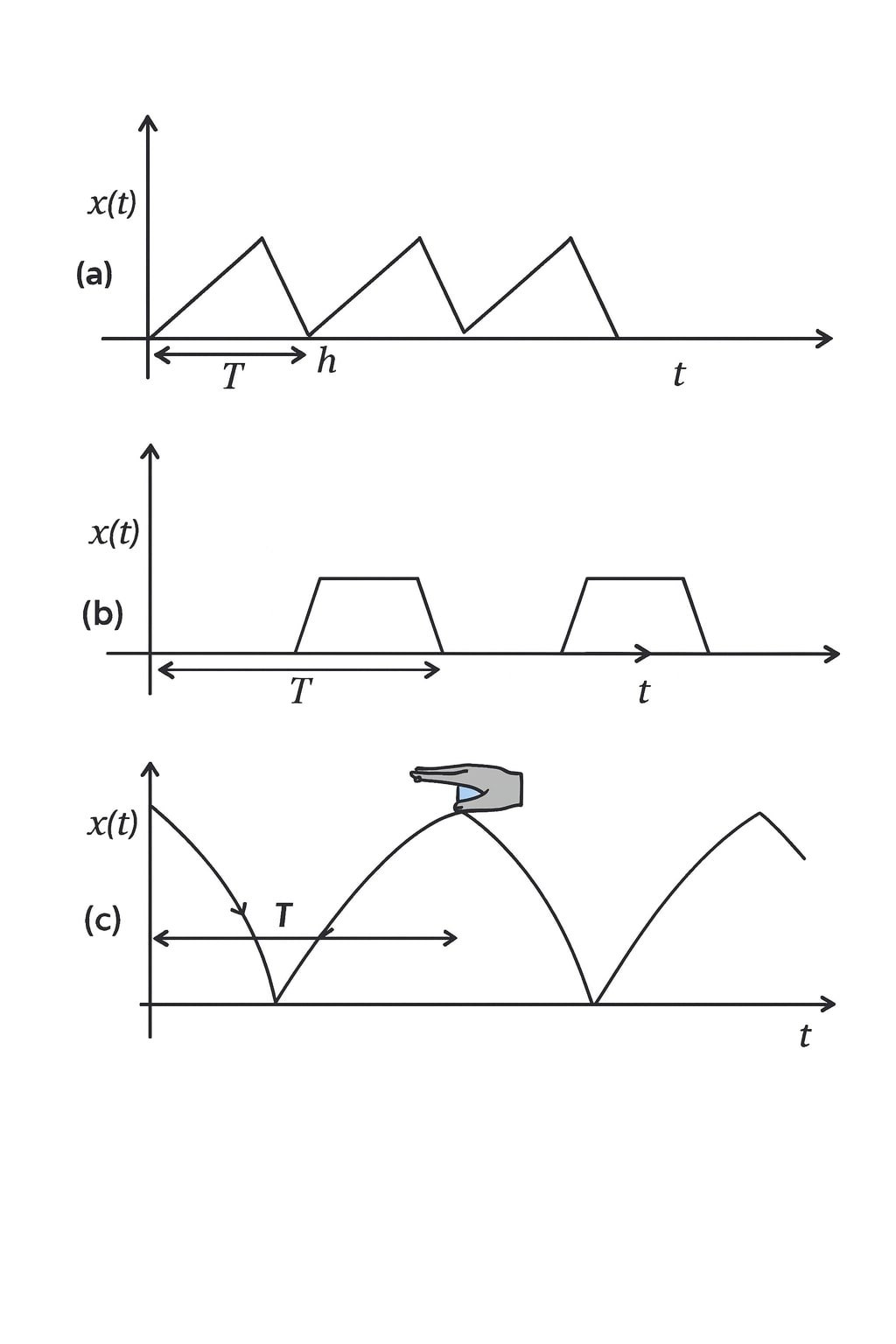
Fig. 13.18 depicts four x–t plots for linear motion of a particle.
Which of the plots represent periodic motion?
What is the period of motion (in case of periodic motion)?
Answer:
🟢 Step 1: Analyze the four plots
(a) Straight line graph:
x increases continuously with t, does not repeat — ❌ not periodic.
(b) Irregular wave:
Pattern not repeating uniformly — ❌ not periodic.
(c) Uneven oscillations:
Amplitude and period not constant — ❌ not periodic.
(d) Regular sine-type wave:
Repeats after equal intervals — ✔️ periodic motion.
🟡 Step 2: Determine period (T)
From graph (d), one full cycle occurs from t = –2 to t = +2 s.
➡️ Period T = 4 s
✔️ Final Answer:
Only plot (d) represents periodic motion.
✅ Period = 4 seconds.
🔵 Question 13.4
Which of the following functions of time represent
(a) simple harmonic,
(b) periodic but not simple harmonic, and
(c) non-periodic motion?
Give the period for each case of periodic motion (ω is any positive constant):
(a) sin ωt – cos ωt
(b) sin² ωt
(c) 3 cos (π/4 – 2ωt)
(d) cos ωt + cos 3ωt + cos 5ωt
(e) exp(–ω²t²)
(f) 1 + ωt + ω²t²
Answer:
🟢 (a) sin ωt – cos ωt
➡️ Rewrite as √2 sin(ωt – π/4)
✔️ Represents simple harmonic motion (SHM)
➡️ Period T = 2π/ω
🟡 (b) sin² ωt
➡️ sin² ωt = (1 – cos 2ωt)/2
✔️ Periodic but not SHM (does not change sign)
➡️ Period T = π/ω
🟢 (c) 3 cos(π/4 – 2ωt)
➡️ Same as 3 cos(2ωt – π/4)
✔️ Represents SHM
➡️ Period T = π/ω
🟡 (d) cos ωt + cos 3ωt + cos 5ωt
➡️ Superposition of several harmonic motions
✔️ Periodic but not SHM
➡️ Period T = 2π/ω
🔴 (e) exp(–ω²t²)
➡️ Exponential decay, does not repeat
❌ Non-periodic
🔴 (f) 1 + ωt + ω²t²
➡️ Increases continuously with time
❌ Non-periodic
✔️ Summary:
(a) SHM (b) Periodic (c) SHM (d) Periodic (e) Non-periodic (f) Non-periodic
🔵 Question 13.5
A particle is in linear SHM between two points A and B, 10 cm apart.
Take A → B as the positive direction.
Find the signs of velocity, acceleration, and force when it is:
(a) at A (b) at B (c) at mid-point going towards A (d) 2 cm from B going towards A (e) 3 cm from A going towards B (f) 4 cm from B going towards A
Answer:
🟢 Amplitude A = 5 cm (since total AB = 10 cm)
Restoring force and acceleration always act toward the mean position (O).
(a) At end A (x = –A):
➡️ Velocity = 0 Acceleration = +ve Force = +ve
(b) At end B (x = + A):
➡️ Velocity = 0 Acceleration = –ve Force = –ve
(c) At mid-point (x = 0, going to A):
➡️ Velocity = –ve Acceleration = 0 Force = 0
(d) 2 cm from B (x = +3 cm, going to A):
➡️ Velocity = –ve Acceleration = –ve Force = –ve
(e) 3 cm from A (x = –2 cm, going to B):
➡️ Velocity = +ve Acceleration = +ve Force = +ve
(f) 4 cm from B (x = +1 cm, going to A):
➡️ Velocity = –ve Acceleration = –ve Force = –ve
✔️ Positive sign means towards B, negative towards A.
🔵 Question 13.6
Which of the following relations between acceleration a and displacement x represent SHM?
(a) a = 0.7x (b) a = –200x² (c) a = –10x (d) a = 100x³
Answer:
💡 In SHM, acceleration ∝ –x (directed toward mean position).
(a) a = 0.7x → same direction as displacement ❌ Not SHM
(b) a = –200x² → non-linear ❌ Not SHM
(c) a = –10x → linear and opposite to x ✔️ SHM
(d) a = 100x³ → non-linear ❌ Not SHM
✔️ Final Answer: (c) a = –10x
🔵 Question 13.7
The SHM is given by x = A cos(ωt + ϕ).
At t = 0, x = 1 cm and v = ω cm/s.
Find amplitude and initial phase angle (ω = π s⁻¹).
Also find amplitude and initial phase if x = B sin(ωt + α).
Answer:
🟢 Given:
x₀ = 1 cm, v₀ = ω cm/s = π cm/s
For x = A cos(ωt + ϕ):
➡️ x₀ = A cos ϕ = 1
➡️ v₀ = –A ω sin ϕ = π
🟡 Step 1: tan ϕ = – (v₀ / ωx₀) = – 1 ⇒ ϕ = – π/4
🟡 Step 2: A = √(x₀² + (v₀/ω)²) = √(1 + 1) = √2 cm
🟢 For sine form: x = B sin(ωt + α)
➡️ x₀ = B sin α = 1
➡️ v₀ = B ω cos α = π
⇒ cot α = (v₀ / ωx₀) = 1 ⇒ α = π/4
➡️ B = √2 cm
✔️ Final Answers:
Amplitude = √2 cm
ϕ = –π/4 (in cosine form)
α = π/4 (in sine form)
🔵 Question 13.8
A spring balance of length 20 cm reads 0–50 kg.
When displaced and released, it oscillates with a period T = 0.6 s.
Find the weight of the body.
Answer:
🟢 Total load = 50 kg ⇒ F = 50×9.8 = 490 N
Extension = 0.2 m
➡️ Spring constant k = F/x = 490/0.2 = 2450 N/m
🟡 Using T = 2π√(m/k):
0.6 = 2π√(m/2450)
⇒ m = (2450 / 4π²) × (0.6)² = 8.03 kg
🟢 Weight W = m g = 8.03×9.8 = 78.7 N
✔️ Final Answer: Weight ≈ 79 N
🔵 Question 13.9
A horizontal spring (k = 1200 N m⁻¹) has a mass 3 kg attached to it.
Pulled sideways by 2.0 cm and released.
Find: (i) frequency of oscillation, (ii) maximum acceleration, (iii) maximum speed.
Answer:
🟢 Given: k = 1200 N/m, m = 3 kg, A = 0.02 m
🟡 Angular frequency ω = √(k/m) = √(1200/3) = 20 rad/s
(i) Frequency f = ω/2π = 20/(2×3.14) = 3.18 Hz
(ii) aₘₐₓ = ω²A = 400×0.02 = 8 m/s²
(iii) vₘₐₓ = ωA = 20×0.02 = 0.4 m/s
✔️ Final Answers:
➡️ f = 3.18 Hz
➡️ aₘₐₓ = 8 m/s²
➡️ vₘₐₓ = 0.4 m/s
🔵 Question 13.10
In Exercise 13.9, let us take the position of the mass when the spring is unstretched as x = 0 and the direction from left to right as the positive x-axis.
Give x as a function of time t for the oscillating mass if, at the moment we start the stopwatch (t = 0), the mass is
(a) at the mean position,
(b) at the maximum stretched position, and
(c) at the maximum compressed position.
In what way do these functions for SHM differ from each other—in frequency, in amplitude, or in the initial phase?
Answer:
🟢 The general equation of SHM is:
➡️ x = A sin(ωt + ϕ) or x = A cos(ωt + ϕ)
Here, A = amplitude, ω = angular frequency, and ϕ = initial phase.
Given: the motion starts at different initial positions.
(a) At the mean position:
At t = 0, x = 0, and the particle moves in the positive direction.
➡️ Hence, x = A sin(ωt)
✔️ Initial phase ϕ = 0
(b) At maximum stretched position:
At t = 0, x = +A.
➡️ Hence, x = A cos(ωt)
✔️ Initial phase ϕ = 0
(c) At maximum compressed position:
At t = 0, x = –A.
➡️ Hence, x = –A cos(ωt) = A cos(ωt + π)
✔️ Initial phase ϕ = π
🟡 Difference among them:
➡️ All have the same frequency and amplitude, but differ in initial phase (ϕ) only.
🔵 Question 13.11
Figures 13.20 (a) and (b) correspond to two circular motions.
The radius of the circle, the period of revolution, the initial position, and the sense of revolution (clockwise or anticlockwise) are indicated.
Obtain the corresponding simple harmonic motions of the x-projection of the radius vector of the revolving particle P in each case.
Answer:
🟢 (a) From Fig. 13.20 (a):
➡️ Radius = 3 cm, Period T = 2 s
➡️ Angular velocity, ω = 2π/T = π rad/s
➡️ Initial position P(t = 0) at the bottom of the circle (–y direction).
Hence, x = A cos(ωt + ϕ)
At t = 0, x = 0 (since P is on y-axis), and motion starts toward the right (positive x).
➡️ Therefore, x = 3 sin(πt) cm
🟢 (b) From Fig. 13.20 (b):
➡️ Radius = 2 m, T = 4 s
➡️ ω = 2π/T = π/2 rad/s
➡️ Particle at rightmost position on x-axis, motion clockwise.
Hence, x = A cos(ωt)
➡️ x = 2 cos((π/2)t) m
✔️ Final Answers:
(a) x = 3 sin(πt) cm
(b) x = 2 cos((π/2)t) m
🔵 Question 13.12
Plot the reference circle for each of the following SHMs. Indicate initial (t = 0) position, radius, and angular speed. Assume anticlockwise rotation.
(a) x = –2 sin(3t + π/3)
(b) x = cos(π/6 – t)
(c) x = 3 sin(2πt + π/4)
(d) x = 2 cos(πt)
Answer:
💡 For a reference circle, the SHM can be expressed as the x-projection of uniform circular motion.
🟢 (a) x = –2 sin(3t + π/3)
➡️ Amplitude A = 2 cm
➡️ Angular frequency ω = 3 rad/s
➡️ Initial phase ϕ = π/3 + π (due to negative sign)
✔️ Radius of circle = 2 cm
🟢 (b) x = cos(π/6 – t)
➡️ Rewrite as cos(–t + π/6) = cos(t – π/6) (since cos(–θ) = cos θ)
➡️ A = 1, ω = 1 rad/s, ϕ = –π/6
✔️ Starts from x = cos(π/6) = 0.866
🟢 (c) x = 3 sin(2πt + π/4)
➡️ A = 3 cm, ω = 2π rad/s, ϕ = π/4
✔️ Period T = 2π/ω = 1 s
🟢 (d) x = 2 cos(πt)
➡️ A = 2 cm, ω = π rad/s, ϕ = 0
✔️ Period T = 2 s
✅ Each represents SHM as x-projection of circular motion with the above parameters.
🔵 Question 13.13
A spring of constant k is clamped at one end, and a force F stretches it by x.
(a) What is the maximum extension of the spring in the two cases shown below?
(b) If released, what is the period of oscillation in each case?
(Fig. 13.21a): One mass m attached to one end, other end fixed.
(Fig. 13.21b): Two equal masses m attached at both ends, spring stretched by same force F.
Answer:
🟢 Case (a): One mass attached
➡️ Force balance: F = kx
➡️ Extension when static: x = F/k
✔️ Maximum extension = F/k
When released, the time period is given by
T₁ = 2π√(m/k)
🟢 Case (b): Two equal masses attached
➡️ The effective mass in oscillation = m/2 (since both ends move symmetrically).
➡️ Static extension remains x = F/k
✔️ Maximum extension = F/k
Time period,
T₂ = 2π√(m/2k) = T₁ / √2
🟡 Comparison:
➡️ Both have same extension (F/k)
➡️ Period in (b) is smaller by √2 factor.
✔️ Final Answers:
(i) Maximum extension = F/k (for both)
(ii) T₁ = 2π√(m/k), T₂ = 2π√(m/2k)
🔵 Question 13.14
The piston in the cylinder head of a locomotive has a stroke (twice the amplitude) of 1.0 m. If the piston moves with simple harmonic motion with an angular frequency of 200 rad/min, what is its maximum speed?
Answer:
🟢 Step 1: Given
Stroke = 2A = 1.0 m → A = 0.5 m
Angular frequency = 200 rad/min = 200 ÷ 60 = 3.33 rad/s
🟢 Step 2: Formula
Maximum speed, vₘₐₓ = ωA
🟢 Step 3: Substitution
vₘₐₓ = 3.33 × 0.5 = 1.67 m/s
✔️ Final Answer: vₘₐₓ = 1.67 m/s
🔵 Question 13.15
The acceleration due to gravity on the surface of the moon is 1.7 m/s². What is the time period of a simple pendulum on the surface of the moon if its time period on the surface of earth is 3.5 s? (gₑ = 9.8 m/s²)
Answer:
🟢 Step 1: Relation between periods
T ∝ 1/√g
⇒ Tₘ = Tₑ √(gₑ / gₘ)
🟢 Step 2: Substitution
Tₘ = 3.5 √(9.8 / 1.7) = 3.5 × 2.40 = 8.4 s
✔️ Final Answer: Tₘ = 8.4 s
🔵 Question 13.16
A simple pendulum of length l with bob of mass M is suspended in a car moving on a circular track of radius R with uniform speed v. If the pendulum makes small oscillations in a radial direction about its equilibrium position, what will be its time period?
Answer:
🟢 Step 1: Effective acceleration
Centrifugal acceleration = v²/R
Effective gravity = √(g² + (v²/R)²)
🟢 Step 2: Time period formula
T = 2π √(l / g′)
= 2π √[ l / √(g² + (v²/R)²) ]
✔️ Final Answer:
T = 2π √[ l / √(g² + (v²/R)²) ]
🔵 Question 13.17
A cylindrical piece of cork of density ρ, base area A, and height h floats in a liquid of density ρf. The cork is depressed slightly and released. Show that the cork oscillates up and down with SHM of period
T = 2π √(hρ / ρf g)
Answer:
🟢 Step 1: At equilibrium
ρf g A y₀ = ρ g A h
⇒ y₀ = (ρ / ρf) h
🟢 Step 2: Displace downward by x
Extra upthrust = ρf g A x (restoring upward force)
🟢 Step 3: Equation of motion
mẍ = –ρf g A x
(ρ A h)ẍ + ρf g A x = 0
⇒ ẍ + (ρf g / ρh) x = 0
🟢 Step 4: Angular frequency
ω² = ρf g / ρh
T = 2π √(hρ / ρf g)
✔️ Final Answer: T = 2π √(hρ / ρf g)
🔵 Question 13.18
One end of a U-tube containing mercury is connected to a suction pump and the other end to atmosphere. A small pressure difference is maintained between the two columns. When suction is removed, show that the mercury column executes SHM and find its period.
Answer:
🟢 Step 1: Let total length of oscillating column = l, cross-section = A
When one limb rises by y, the other falls by y ⇒ height difference = 2y
🟢 Step 2: Pressure difference
Δp = ρ g (2y)
Restoring force, F = Δp × A = 2ρ g A y
🟢 Step 3: Mass of liquid
m = ρ A l
🟢 Step 4: Equation of motion
mẍ + 2ρ g A y = 0
⇒ ẍ + (2g/l) y = 0
🟢 Step 5: Time period
T = 2π √(l / 2g)
✔️ Final Answer: T = 2π √(l / 2g)
————————————————————————————————————————————————————————————————————————————
OTHER IMPORTANT QUESTIONS FOR EXAMS
(CBSE MODEL QUESTIONS PAPER)
ESPECIALLY MADE FROM THIS LESSON ONLY
Section A (Q1–Q18): Multiple Choice Questions
Q1. Which of the following is not an example of oscillatory motion?
🔵(A) Motion of a spring
🟢(B) Motion of a clock pendulum
🟠(C) Motion of Earth around Sun
🔴(D) Motion of a stretched string
Answer: (C) Motion of Earth around Sun
💡 Earth’s motion is periodic but not about a mean position, so not oscillatory.
Q2. The motion of a particle is simple harmonic when acceleration is
🔵(A) Proportional to velocity
🟢(B) Proportional to displacement and directed away from mean position
🟠(C) Proportional to displacement and directed towards mean position
🔴(D) Constant
Answer: (C) Proportional to displacement and directed towards mean position
Q3. The displacement in SHM is given by x = A sin(ωt + ϕ). The amplitude is
🔵(A) ω
🟢(B) ϕ
🟠(C) A
🔴(D) x
Answer: (C) A
Q4. The time period of a simple pendulum depends on
🔵(A) Length and mass
🟢(B) Length and g
🟠(C) Mass and amplitude
🔴(D) Only amplitude
Answer: (B) Length and g
Q5. For small oscillations, a simple pendulum executes
🔵(A) Uniform motion
🟢(B) SHM
🟠(C) Non-periodic motion
🔴(D) Circular motion
Answer: (B) SHM
Q6. The velocity in SHM is maximum when
🔵(A) Displacement is zero
🟢(B) Displacement is maximum
🟠(C) Acceleration is zero
🔴(D) Both (A) and (C)
Answer: (D) Both (A) and (C)
Q7. The potential energy of an oscillator is maximum when
🔵(A) At mean position
🟢(B) At extreme position
🟠(C) At half amplitude
🔴(D) Zero displacement
Answer: (B) At extreme position
Q8. In SHM, total energy of a particle is proportional to
🔵(A) Amplitude
🟢(B) Amplitude²
🟠(C) Frequency
🔴(D) Velocity
Answer: (B) Amplitude²
Q9. The restoring force in SHM is given by
🔵(A) F = −kx
🟢(B) F = +kx
🟠(C) F = kx²
🔴(D) F = −kx²
Answer: (A) F = −kx
Q10. The time period of a spring–mass system is
🔵(A) 2π√(k/m)
🟢(B) 2π√(m/k)
🟠(C) 2π√(m·k)
🔴(D) 2πm/k
Answer: (B) 2π√(m/k)
Q11. The acceleration of a particle in SHM at extreme position is
🔵(A) Zero
🟢(B) Maximum
🟠(C) Minimum
🔴(D) Infinite
Answer: (B) Maximum
Q12. The total energy of a simple harmonic oscillator is
🔵(A) Zero
🟢(B) Constant
🟠(C) Variable
🔴(D) Negative
Answer: (B) Constant
Q13. The time period of a simple pendulum is independent of
🔵(A) Length
🟢(B) Amplitude (for small θ)
🟠(C) Acceleration due to gravity
🔴(D) String material
Answer: (B) Amplitude (for small θ)
Q14. A particle executing SHM crosses mean position with speed 10 cm/s. If amplitude is 5 cm, find ω.
🔵(A) 1 rad/s
🟢(B) 2 rad/s
🟠(C) √2 rad/s
🔴(D) 3 rad/s
Answer: (B) 2 rad/s
💡 vₘₐₓ = Aω ⇒ 10 = 5×ω ⇒ ω = 2 rad/s
Q15. The maximum kinetic energy of a simple harmonic oscillator is
🔵(A) (1/2) mω²A²
🟢(B) (1/2) kA²
🟠(C) mA²
🔴(D) kA
Answer: (A) (1/2) mω²A²
Q16. The frequency of a simple pendulum increases if
🔵(A) Length increases
🟢(B) g decreases
🟠(C) Length decreases
🔴(D) Both (A) and (B)
Answer: (C) Length decreases
Q17. The angular frequency of a mass–spring system is
🔵(A) √(k/m)
🟢(B) √(m/k)
🟠(C) k/m
🔴(D) m/k
Answer: (A) √(k/m)
Q18. The phase difference between displacement and acceleration in SHM is
🔵(A) 0
🟢(B) π/2
🟠(C) π
🔴(D) 3π/2
Answer: (C) π
⚡ SECTION B — Very Short & Short Answer Questions (Q19–Q23)
⚡ SECTION C — Mid-length Questions (Q24–Q27)
Q19. What is meant by oscillatory motion? Give one example.
Answer:
🟢 An oscillatory motion is a type of periodic motion in which a body moves to and fro about a fixed mean or equilibrium position.
💡 Example: Motion of a simple pendulum or a spring–mass system.
✔️ In this motion, displacement, velocity, and acceleration all repeat after equal intervals of time.
Q20. Define amplitude, frequency, and time period of SHM.
Answer:
🔹 Amplitude (A): The maximum displacement of the particle from its mean position.
🔹 Time period (T): The time taken by the particle to complete one full oscillation.
🔹 Frequency (ν): The number of oscillations per second, ν = 1/T.
💡 The relation between angular frequency (ω) and time period is ω = 2π/T.
Q21. Write the equation for displacement of a particle executing SHM and explain the meaning of each term.
Answer:
✏️ The displacement of a particle performing SHM is given by
x = A sin(ωt + ϕ)
where,
A → Amplitude of oscillation
ω → Angular frequency
t → Time
ϕ → Phase constant
✔️ This equation describes the instantaneous position of the oscillating particle at any time t.
Q22. Show that the acceleration in SHM is directly proportional to displacement and opposite in direction.
Answer:
💡 Let the displacement of a particle performing SHM be x = A sin(ωt).
Then velocity, v = dx/dt = Aω cos(ωt).
Acceleration, a = dv/dt = −Aω² sin(ωt) = −ω²x.
✅ Hence, acceleration (a) is directly proportional to displacement (x) and directed towards the mean position (negative sign).
Q23. What is the total energy of a particle in SHM?
Answer:
The total mechanical energy of a particle performing SHM is the sum of its kinetic and potential energies.
💡 E = (1/2) m ω² A²
✔️ Total energy remains constant throughout the motion.
✔️ Kinetic energy is maximum at the mean position, while potential energy is maximum at the extreme positions.
⚙️ SECTION C — Mid-length Questions
Q24. Derive the expression for the time period of a mass attached to a spring executing SHM.
Answer:
Let a mass m be attached to a spring of force constant k.
When the mass is displaced by x, restoring force = −kx.
By Newton’s second law:
m a = −k x
⇒ a = −(k/m)x
Comparing with SHM equation (a = −ω²x),
we get, ω = √(k/m)
Now, T = 2π/ω = 2π√(m/k)
✅ Therefore, time period of a spring–mass system:
T = 2π√(m/k)
✔️ It depends on the mass and spring stiffness only.
Q25. A spring has a force constant of 100 N/m. What is the time period when a 0.1 kg mass is attached to it?
Answer:
Formula: T = 2π√(m/k)
Substitute: m = 0.1 kg, k = 100 N/m
T = 2π√(0.1 / 100)
= 2π√(0.001)
= 2π × 0.0316
✅ T = 0.198 s (approximately)
Hence, the time period = 0.2 seconds.
Q26. Derive the expression for potential energy and total energy in SHM.
Answer:
Let displacement at any instant = x.
Potential energy, U = (1/2) k x²
Kinetic energy, K = (1/2) m (v²)
But, v² = ω²(A² − x²)
Therefore, K = (1/2) m ω² (A² − x²)
Total energy,
E = K + U
E = (1/2) m ω² (A² − x²) + (1/2) k x²
Since k = mω²,
E = (1/2) m ω² A²
✅ Hence, total energy is constant and proportional to amplitude².
Q27. Derive the expression for the time period of a simple pendulum for small oscillations.
Answer:
Let a pendulum of length l and mass m make an angle θ with the vertical.
Restoring force = −mg sinθ
For small angles, sinθ ≈ θ, so
F = −mgθ = −mg (x/l), where x = lθ
Then, F = −(mg/l) x
By Newton’s law: m a = −(mg/l)x
⇒ a = −(g/l)x
Comparing with a = −ω²x,
we get, ω = √(g/l)
Therefore, T = 2π√(l/g)
✅ Hence, for small oscillations, a simple pendulum executes SHM.
⚡ SECTION D — Long Answer Questions (Q28–Q31)
⚡ SECTION E — Case Study / Application-Based Questions (Q32–Q33)
Q28. Derive the equation of motion for a particle performing simple harmonic motion and obtain expressions for its velocity and acceleration.
Answer:
💡 Step 1: Consider a particle of mass m displaced by x from the mean position.
🟢 Restoring Force:
F = −kx
🔵 Newton’s 2nd Law:
m a = −k x
🟠 Acceleration:
a = −(k/m) x
💡 Step 2: Comparing with standard SHM form,
a = −ω²x where ω² = k/m
Hence, a = −ω²x
🔴 Step 3: The differential equation of motion becomes:
d²x/dt² = −ω²x
🟢 Step 4: The solution is of the form:
x = A sin(ωt + ϕ)
🔵 Velocity:
v = dx/dt = Aω cos(ωt + ϕ)
🟠 Acceleration:
a = dv/dt = −Aω² sin(ωt + ϕ) = −ω²x
✅ Final Results:
Displacement: x = A sin(ωt + ϕ)
Velocity: v = Aω cos(ωt + ϕ)
Acceleration: a = −ω²x
✔️ Thus, acceleration is always directed towards the mean position, confirming SHM.
Q29. Derive expressions for kinetic energy, potential energy, and total energy of a particle executing SHM.
Answer:
💡 Given: Displacement at any instant = x, amplitude = A
🟢 Step 1: Kinetic Energy (K)
Velocity, v = ω√(A² − x²)
K = (1/2)m v²
➡️ K = (1/2)m ω² (A² − x²)
🔵 Step 2: Potential Energy (U)
Restoring force, F = −kx
Work done to move from 0 to x = (1/2)k x²
➡️ U = (1/2)k x² = (1/2)m ω² x²
🟠 Step 3: Total Energy (E)
E = K + U
E = (1/2)m ω² (A² − x²) + (1/2)m ω² x²
➡️ E = (1/2)m ω² A² (constant)
🔴 Step 4: Energy Transformations
✔️ At mean position → K maximum, U = 0
✔️ At extreme position → U maximum, K = 0
✔️ Total energy remains constant during oscillation.
Q30. Explain the motion of a simple pendulum and derive the expression for its time period for small oscillations.
Answer:
💡 Step 1: Consider a pendulum of length l and mass m, displaced through an angle θ.
🟢 Restoring Force:
F = −mg sinθ
🔵 Step 2: For small angles (sinθ ≈ θ):
F = −mgθ = −mg (x/l)
🟠 Step 3: Using Newton’s law,
m a = −(mg/l)x
➡️ a = −(g/l)x
🔴 Step 4: Comparing with SHM form a = −ω²x, we get
ω = √(g/l)
🟢 Step 5: Time period,
T = 2π/ω = 2π√(l/g)
✅ Final Expression:
T = 2π√(l/g)
✔️ Thus, a simple pendulum performs SHM for small oscillations, with T depending only on l and g.
Q31. What is meant by damping? Derive the equation for a damped harmonic oscillator.
Answer:
💡 Step 1: When an oscillating body loses energy due to friction or air resistance, its amplitude decreases — this is called damping.
🟢 Step 2: If the damping force is proportional to velocity,
Damping force = −b (dx/dt)
🔵 Step 3: Equation of motion:
m (d²x/dt²) + b (dx/dt) + kx = 0
🟠 Step 4: Divide by m,
d²x/dt² + (b/m) (dx/dt) + (k/m)x = 0
Let (b/2m) = γ and (k/m) = ω₀², then
d²x/dt² + 2γ (dx/dt) + ω₀²x = 0
🔴 Step 5: Solution of equation:
x = A e^(−γt) sin(ωt + ϕ)
where ω = √(ω₀² − γ²)
✅ Final Result:
✔️ Amplitude decreases exponentially with time.
✔️ Energy ∝ e^(−2γt) — decreases exponentially due to damping.
⚙️ SECTION E — Case Study / Application-Based Questions
Q32. A 100 g mass is attached to a spring of force constant 50 N/m and is displaced by 0.05 m. Find (a) the time period, (b) maximum speed, and (c) total energy of oscillation.
Answer:
📘 Given:
m = 0.1 kg, k = 50 N/m, A = 0.05 m
🟢 (a) Time Period:
T = 2π√(m/k)
➡️ T = 2π√(0.1/50) = 2π√(0.002)
➡️ T = 2π × 0.0447 = 0.281 s
🔵 (b) Maximum Speed:
vₘₐₓ = Aω = A√(k/m)
➡️ vₘₐₓ = 0.05√(50/0.1) = 0.05√500
➡️ vₘₐₓ = 0.05 × 22.36 = 1.12 m/s
🟠 (c) Total Energy:
E = (1/2)kA²
➡️ E = (1/2)×50×(0.05)²
➡️ E = 25 × 0.0025 = 0.0625 J
✅ Final Answers:
Time period (T) = 0.281 s
Maximum speed (vₘₐₓ) = 1.12 m/s
Total energy (E) = 0.0625 J
✔️ The system obeys SHM with constant total energy and alternating kinetic/potential energy.
Q33. Explain resonance with one real-life example.
Answer:
💡 Step 1: Definition:
Resonance is the phenomenon of maximum amplitude when the frequency of an external periodic force equals the natural frequency of the system.
🟢 Step 2: Explanation:
In forced oscillations, the external driving frequency (ω_d) tries to control the oscillator.
When ω_d = ω₀, energy transfer per cycle is maximum, giving large amplitude.
🔵 Step 3: Mathematical Form:
x = A sin(ω_d t)
Maximum amplitude → when ω_d = ω₀
🟠 Step 4: Example:
When one tuning fork (256 Hz) is struck near another of the same frequency, the second fork starts vibrating — resonance.
Bridges and buildings can oscillate dangerously when wind or earthquake frequency matches their natural frequency.
🔴 Step 5: Conclusion:
✔️ Resonance produces large amplitude oscillations.
✔️ It is useful in radio tuning and musical instruments, but harmful in mechanical structures.
————————————————————————————————————————————————————————————————————————————