
Class 11 : Biology (In English) – Lesson 14: Breathing and Exchange of Gases

EXPLANATION & SUMMARY
🌱✨ Introduction
🫁 Breathing is the physical process of taking in oxygen (O₂) and giving out carbon dioxide (CO₂).
🧠 Respiration is the biochemical process of oxidizing food to release energy (ATP).
🌿 Both are interlinked — breathing ensures gas exchange for respiration.
💡 Concept:
➡️ Breathing = Ventilation (mechanical)
➡️ Respiration = Cellular oxidation (chemical)
🌍 In humans and other higher organisms, respiration involves multiple steps:
1️⃣ Breathing
2️⃣ External respiration (gas exchange between lungs and blood)
3️⃣ Transport of gases
4️⃣ Internal respiration (exchange between blood and tissues)
5️⃣ Cellular respiration
🫁 Respiratory Organs
🧬 Organisms possess different respiratory structures adapted to habitats:
Group Example Respiratory Organ
🌾 Simple diffusion Amoeba Body surface
🪱 Cutaneous Earthworm Skin
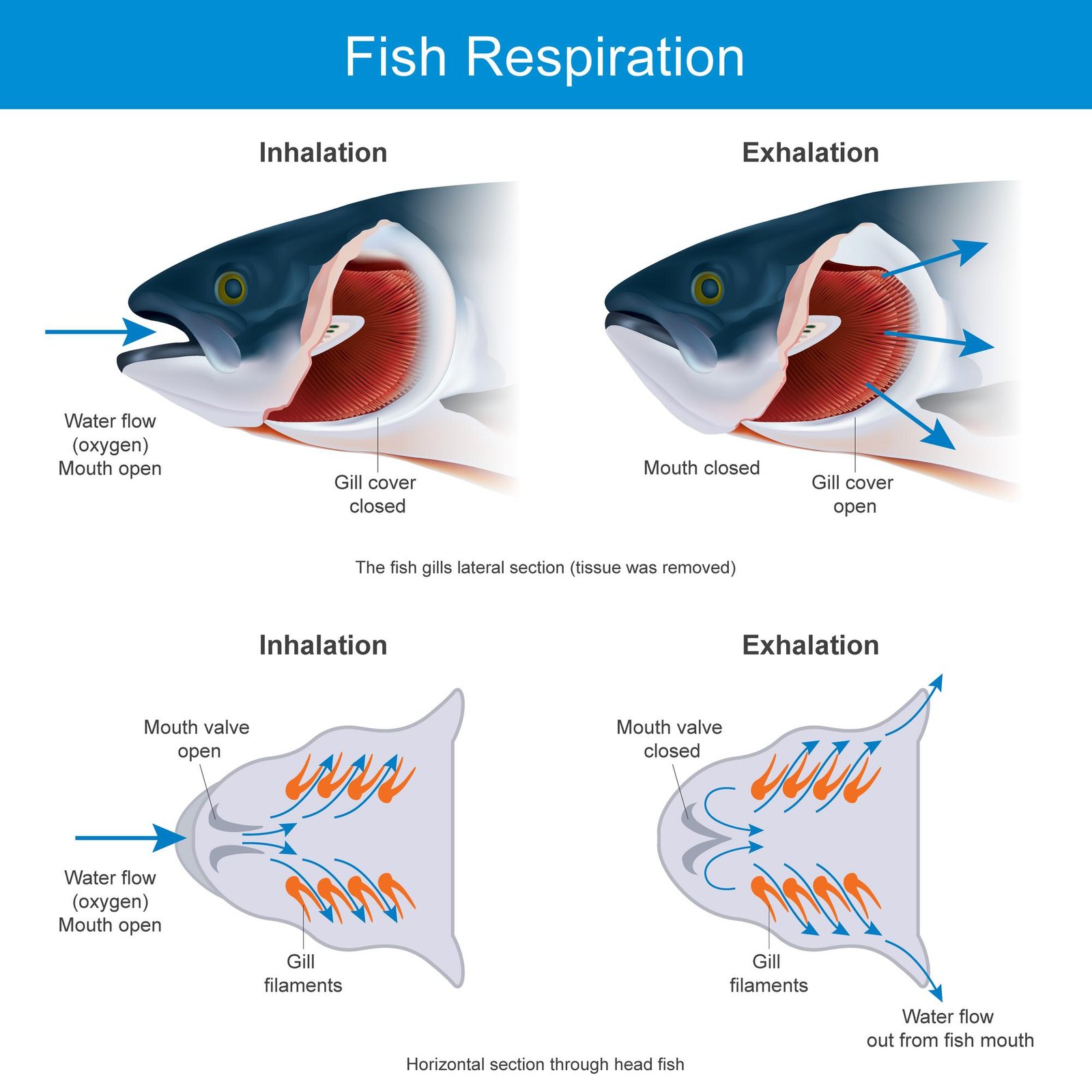
🐠 Gills Fish Gills
🐸 Skin + Lungs Frog Both
🧍♂️ Lungs Humans, mammals Lungs
💡 Concept: Terrestrial organisms → lungs; aquatic → gills.
🫁 Human Respiratory System
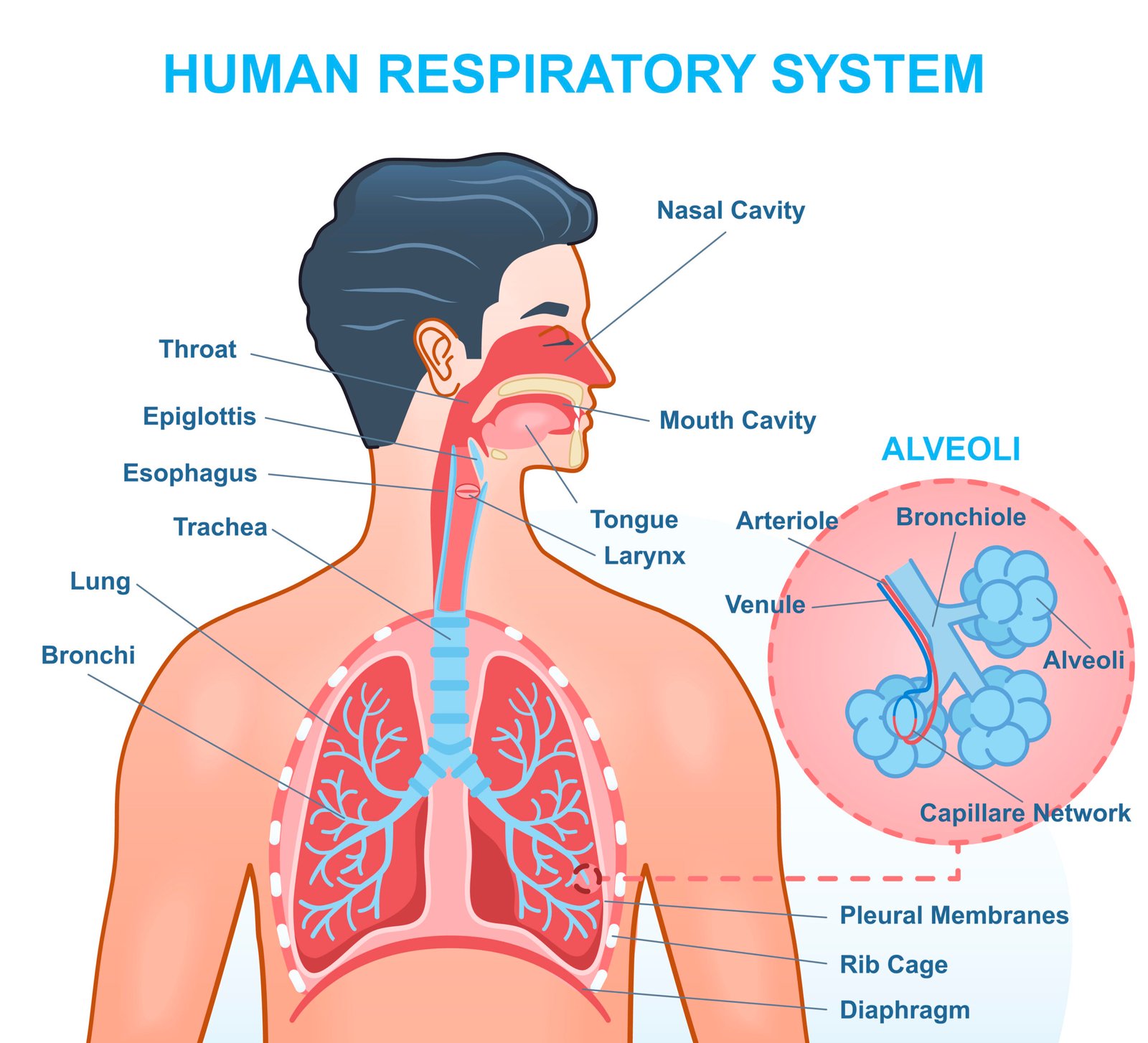
📘 Major organs (in air pathway):
1️⃣ Nostrils ➡️ filters air
2️⃣ Nasal cavity ➡️ warms, moistens air
3️⃣ Pharynx ➡️ common passage
4️⃣ Larynx (voice box) ➡️ sound production
5️⃣ Trachea ➡️ windpipe with cartilaginous rings
6️⃣ Bronchi ➡️ two main branches
7️⃣ Bronchioles ➡️ finer divisions
8️⃣ Alveoli ➡️ tiny sacs for gas exchange
🫁 Lungs:
Right: 3 lobes
Left: 2 lobes
Surrounded by double pleura and pleural fluid
💡 Gas exchange occurs only at alveoli, rich in capillaries.
🌬️ Mechanism of Breathing
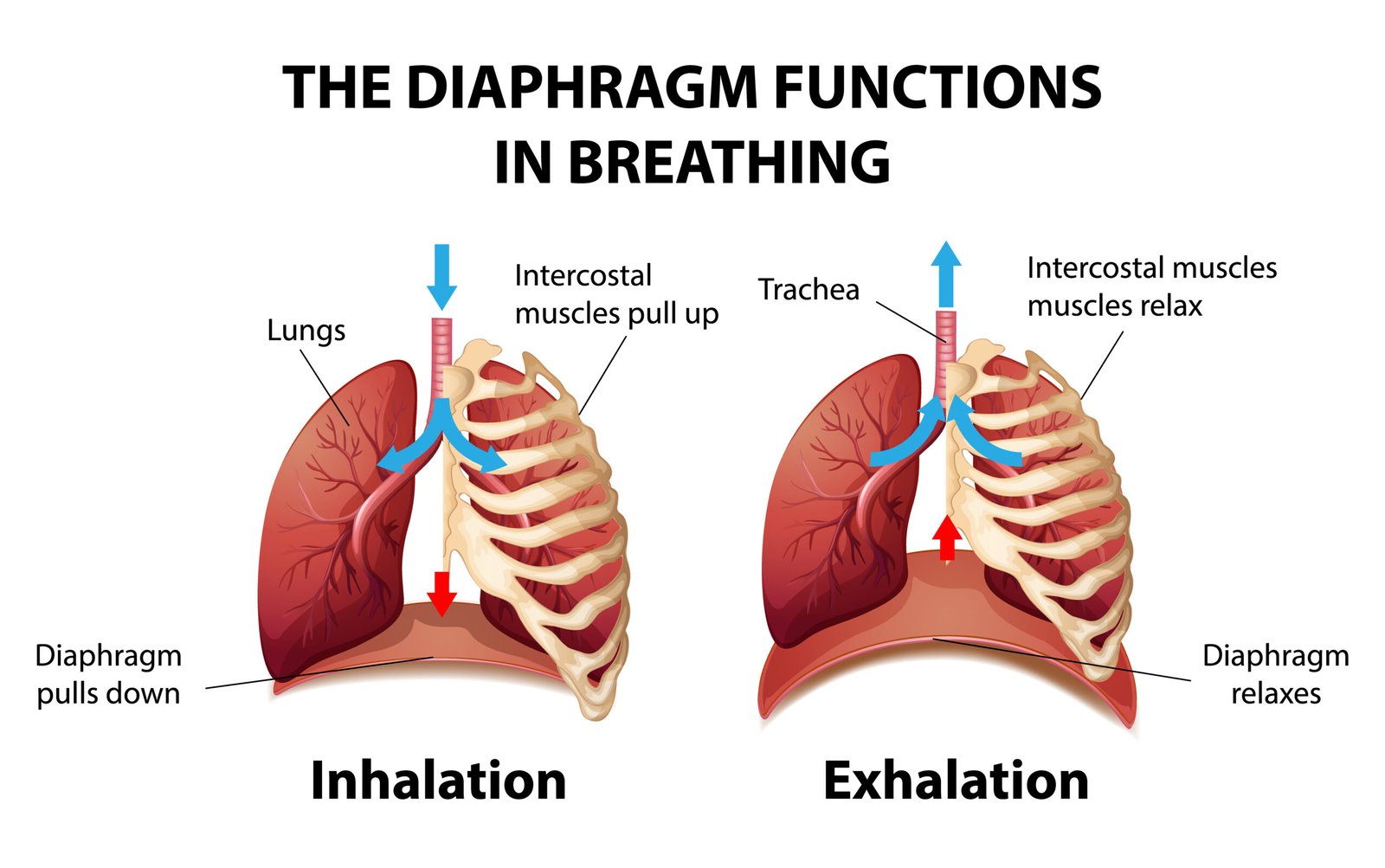
Breathing = Inspiration + Expiration
🌿 1️⃣ Inspiration (Inhalation)
Diaphragm contracts → moves downward
External intercostal muscles lift ribs
Thoracic volume ↑ → pressure ↓
➡️ Air flows into lungs
🍃 2️⃣ Expiration (Exhalation)
Diaphragm relaxes → moves upward
Ribs fall, thoracic volume ↓ → pressure ↑
➡️ Air flows out of lungs
💡 Concept: Breathing is pressure-driven (Boyle’s Law).
📈 Normal breathing rate: ~12–16/min (adult)
🫁 Respiratory Volumes and Capacities
🧪 Measured using spirometer
Parameter Description Value
Tidal Volume (TV) Air in one normal breath ~500 mL
Inspiratory Reserve Volume (IRV) Extra air inhaled forcibly ~2500 mL
Expiratory Reserve Volume (ERV) Extra air exhaled forcibly ~1000 mL
Residual Volume (RV) Air remaining after forceful exhalation ~1100 mL
🌾 Respiratory Capacities
Capacity Formula Value
Vital Capacity (VC) TV + IRV + ERV ~4600 mL
Total Lung Capacity (TLC) VC + RV ~5800 mL
Inspiratory Capacity (IC) TV + IRV ~3000 mL
Functional Residual Capacity (FRC) ERV + RV ~2100 mL
💡 Concept: These values indicate lung efficiency and ventilation capacity.
🌬️ Exchange of Gases
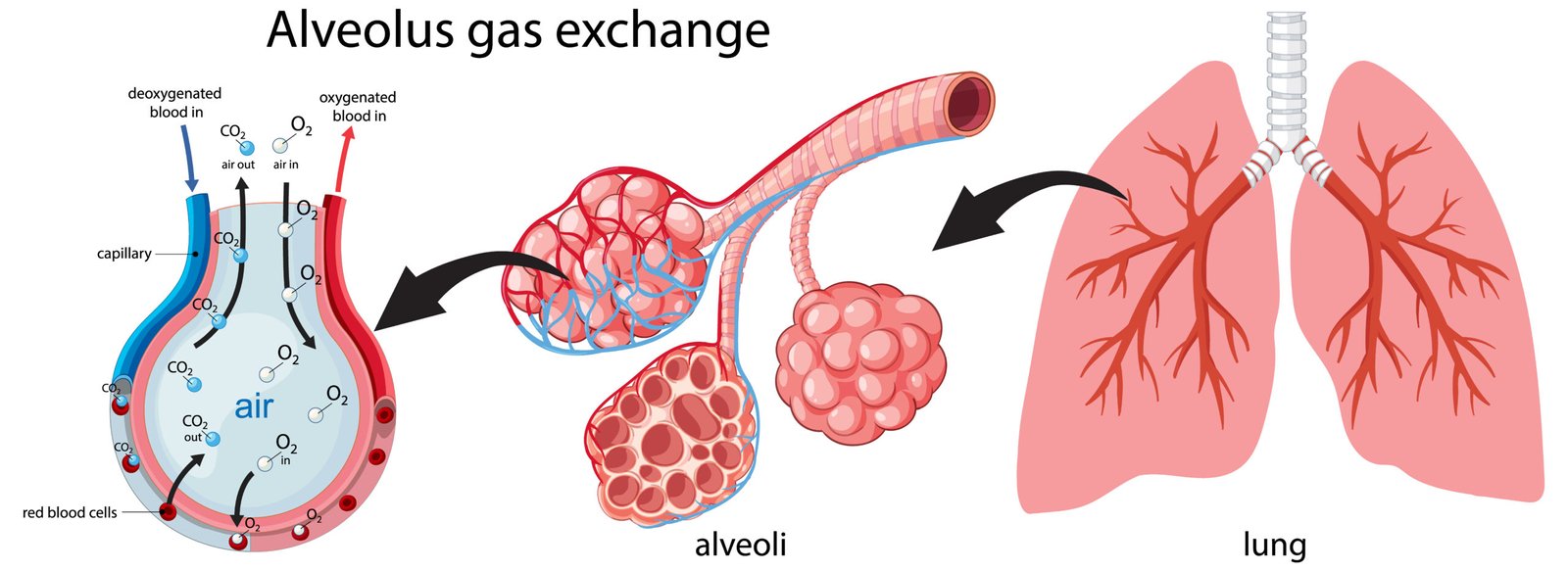
Occurs by simple diffusion across alveolar membrane due to pressure gradients.
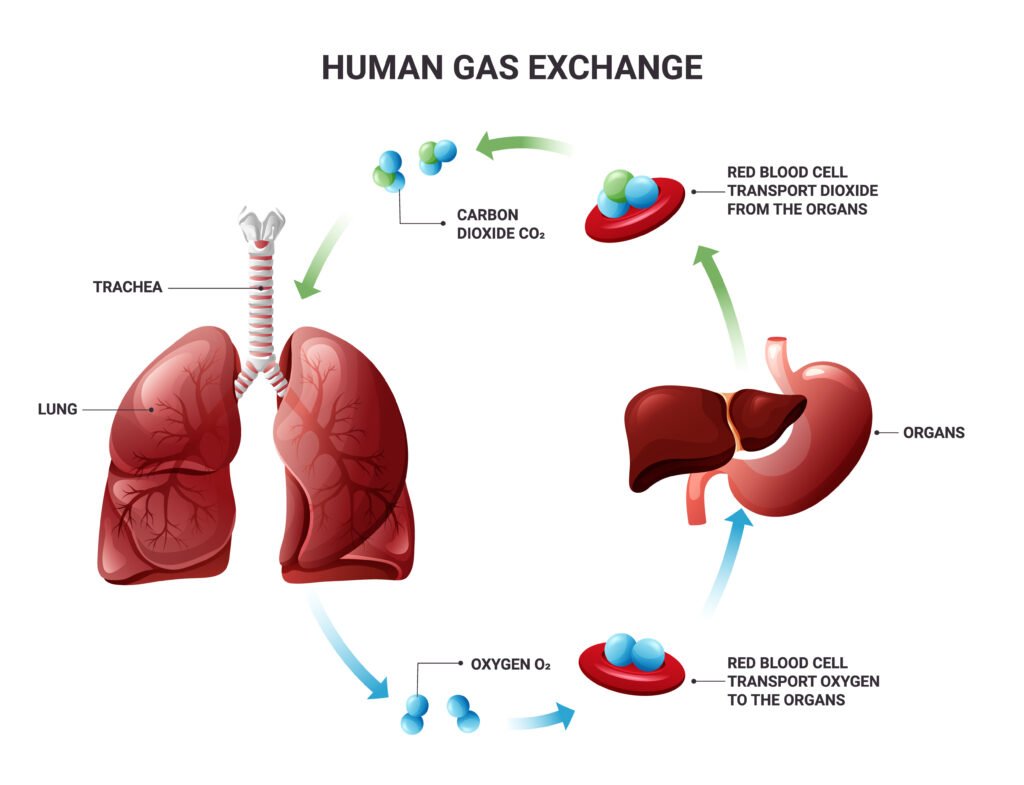
🧪 1️⃣ Exchange at Alveoli (External Respiration)
pO₂ alveoli (104 mm Hg) > pO₂ blood (40 mm Hg)
➡️ O₂ diffuses into blood
pCO₂ blood (45 mm Hg) > pCO₂ alveoli (40 mm Hg)
➡️ CO₂ diffuses into alveoli
🧬 2️⃣ Exchange at Tissues (Internal Respiration)
pO₂ blood (95 mm Hg) > pO₂ tissues (40 mm Hg)
➡️ O₂ diffuses into cells
pCO₂ tissues (46 mm Hg) > pCO₂ blood (40 mm Hg)
➡️ CO₂ diffuses into blood
💡 Concept: Diffusion depends on partial pressure gradient and solubility.
🧠 Transport of Gases
🫀 Oxygen Transport
🧪 98.5% → bound to hemoglobin (oxyhemoglobin)
🫧 1.5% → dissolved in plasma
🧬 Reaction: Hb + O₂ ⇌ HbO₂
🌡️ Influenced by pO₂, pCO₂, pH, temperature
📈 Oxyhemoglobin dissociation curve = sigmoid shape
Right shift (↓ affinity): ↑ CO₂, ↑ temp, ↓ pH (Bohr effect)
Left shift: ↓ CO₂, ↓ temp, ↑ pH
💡 Ensures O₂ loading in lungs, unloading in tissues.
💨 Carbon Dioxide Transport
🧠 70% → as bicarbonate ions (HCO₃⁻)
💧 23% → as carbamino-hemoglobin (HbCO₂)
🌬️ 7% → dissolved in plasma
🧪 In RBC:
CO₂ + H₂O ⇌ H₂CO₃ ⇌ H⁺ + HCO₃⁻
(Enzyme: Carbonic anhydrase)
⚡ Chloride shift: Cl⁻ enters RBC to balance charge during HCO₃⁻ exit.
💡 Facilitates efficient CO₂ transport from tissues to lungs.
🧠 Regulation of Respiration
📍 Controlled by respiratory centers in medulla oblongata and pons.
🧪 Chemoreceptors respond to CO₂, H⁺, and O₂ levels.
💨 High CO₂/H⁺ → stimulates faster breathing;
Low CO₂ → slows down rate.
✏️ Note: CO₂ is main regulator, not O₂.
🧬 Disorders of Respiratory System
1️⃣ Asthma: Bronchi inflammation → breathing difficulty
2️⃣ Emphysema: Damage of alveoli → reduced surface area
3️⃣ Occupational diseases: Dust inhalation (silicosis, asbestosis)
4️⃣ Pneumonia: Infection in alveoli
5️⃣ Chronic bronchitis: Excess mucus → airflow obstruction
💡 Prevention: Avoid allergens, pollution; maintain hygiene and exercise.
🌿 Differences: Breathing vs Respiration
Feature Breathing Respiration
Nature Physical Biochemical
Site Lungs Cells
Energy No release ATP formed
Function Gas exchange Oxidation of food
🌍 Significance
🧠 Ensures continuous oxygen supply for metabolism
💨 Removes toxic CO₂
⚡ Maintains acid-base balance
🌿 Supports energy release for vital functions
🌍 Why This Lesson Matters
🌬️ Explains mechanics of life-supporting gas exchange
🫁 Foundation for human physiology, medicine, and sports science
🧠 Helps understand respiratory disorders and environmental impacts (pollution, smoking)
⚙️ Vital for analyzing body’s energy economy
📝 Quick Recap
🫁 Breathing: Inhalation + exhalation
🌿 Organs: Nose → alveoli
⚙️ Mechanism: Pressure-driven ventilation
🧪 Gases exchanged by diffusion (based on pO₂, pCO₂)
🫀 O₂ transport: Hb → oxyhemoglobin
💨 CO₂ transport: Bicarbonate, carbamino, dissolved
🧠 Regulation: Medulla centers, CO₂ level
🧬 Disorders: Asthma, emphysema, pneumonia
🌍 Maintains O₂ supply, CO₂ removal, energy balance
📘 Summary
Breathing and respiration ensure oxygen intake and carbon dioxide removal through the lungs. Air enters via nasal passages into alveoli, where diffusion occurs across membranes. Oxygen binds to hemoglobin forming oxyhemoglobin, while carbon dioxide travels as bicarbonate ions. The process is regulated by medullary centers responding to CO₂ and pH levels. Disorders such as asthma and emphysema highlight the importance of healthy respiratory function. Overall, respiration sustains life by enabling cellular oxidation and energy production.
————————————————————————————————————————————————————————————————————————————
QUESTIONS FROM TEXTBOOK
🔵 Question 1. Define vital capacity. What is its significance?
🟢 Answer:
🌿 Vital Capacity (VC):
Maximum volume of air that can be expelled from the lungs after a maximum inspiration.
📏 VC = Tidal Volume (TV) + Inspiratory Reserve Volume (IRV) + Expiratory Reserve Volume (ERV)
💡 Significance:
Indicates strength of respiratory muscles.
Represents pulmonary health.
Provides reserve air for aerobic metabolism during exercise.
🔵 Question 2. State the volume of air remaining in the lungs after a normal breathing.
🟢 Answer:
🌸 After normal expiration, air left = Functional Residual Capacity (FRC)
📏 FRC = ERV + Residual Volume (RV)
= 1000 mL + 1200 mL = 2200 mL
✔️ Prevents collapse of lungs and facilitates continuous gas exchange.
🔵 Question 3. Exchange of gases takes place in the alveoli. Name the primary factors responsible for diffusion of gases.
🟢 Answer:
🧬 Factors responsible:
🌿 Pressure/Concentration gradient (O₂, CO₂)
🌸 Solubility of gases in blood
⚗️ Thickness of membrane (thin for rapid diffusion)
🌬️ Surface area of alveoli
✔️ O₂ diffuses from alveoli → blood; CO₂ diffuses from blood → alveoli.
🔵 Question 4. Diffusion of gases occurs in the alveolar region only and not in other parts of respiratory system. Why?
🟢 Answer:
🌱 Alveoli have:
Extremely thin epithelium
Rich capillary network
Large surface area
➡️ Ensures efficient diffusion
Other parts (bronchi, trachea) have thicker walls, no exchange surface → unsuitable for diffusion.
🔵 Question 5. What are the major transport mechanisms for O₂ and CO₂? Explain.
🟢 Answer:
🧬 O₂ transport:
🌿 98.5% as oxyhaemoglobin (Hb + O₂ ⇌ HbO₂)
🌬️ 1.5% dissolved in plasma
🧠 CO₂ transport:
⚗️ 70% as bicarbonates (HCO₃⁻)
🌸 23% as carbamino-haemoglobin (HbCO₂)
💧 7% dissolved in plasma
✔️ Exchange is reversible and governed by partial pressure.
🔵 Question 6. What will be the pO₂ and pCO₂ in the atmospheric air compared to alveolar air?
🟢 Answer:
Air Type pO₂ (mm Hg) pCO₂ (mm Hg)
Atmospheric air ~159 ~0.3
Alveolar air ~104 ~40
💡 Due to:
Humidification
Mixing of fresh and residual air
Continuous gas exchange
✔️ Alveolar air = lower O₂, higher CO₂.
🔵 Question 7. How is the respiratory centre regulated?
🟢 Answer:
🧠 Respiratory centres in medulla oblongata and pons control rhythm.
💡 Chemoreceptors in carotid and aortic bodies detect CO₂ and H⁺ levels.
➡️ High CO₂/H⁺ → stimulates inspiratory centre → increases breathing rate
➡️ Low CO₂ → inhibits centre → reduces breathing rate
✔️ Regulation is automatic, maintaining homeostasis.
🔵 Question 8. What is the effect of pCO₂ on oxygen transport?
🟢 Answer:
🌿 High pCO₂ → ↓ Hb affinity for O₂ → promotes O₂ release (Bohr’s effect)
🌸 Low pCO₂ → ↑ Hb affinity for O₂ → enhances O₂ uptake
✔️ Ensures O₂ is released in tissues (high CO₂) and loaded in lungs (low CO₂).
🔵 Question 9. What happens to the respiratory process in man going up a hill?
🟢 Answer:
⛰️ At high altitude:
Low atmospheric pO₂ → less O₂ diffusion
Causes hypoxia (O₂ deficiency)
Stimulates faster breathing (hyperventilation)
RBC count increases (acclimatization)
✔️ Body adapts to low O₂ environment.
🔵 Question 10. What is the site of gaseous exchange in an insect?
🟢 Answer:
🐞 Insects → gaseous exchange via tracheal system.
💨 Air enters through spiracles → tracheae → tracheoles → directly to tissues.
✔️ No blood involvement; diffusion through moist surface.
🔵 Question 11. Define oxygen dissociation curve. Can you suggest any reason for its sigmoidal pattern?
🟢 Answer:
🧬 Oxygen dissociation curve: Graph showing % Hb saturation vs pO₂.
📈 Sigmoidal shape due to cooperative binding of O₂:
First O₂ binding increases affinity for next → sequential loading
✔️ Reflects efficiency of Hb in O₂ transport.
🔵 Question 12. Have you heard about hypoxia? Write a brief note on its types.
🟢 Answer:
🌿 Hypoxia: Condition of inadequate O₂ supply to tissues.
💡 Types:
Hypoxic hypoxia: Low O₂ in blood (high altitude)
Anaemic hypoxia: Low Hb
Stagnant hypoxia: Poor blood flow
Histotoxic hypoxia: Tissues unable to use O₂ (e.g. cyanide poisoning)
✔️ Leads to fatigue, unconsciousness, death if severe.
🔵 Question 13. What are the adverse effects of smoking on the respiratory system?
🟢 Answer:
🚭 Smoking harms lungs by:
🌬️ Irritation of airways → inflammation
⚫ Deposition of tar → blocks alveoli
🧬 CO binds Hb → less O₂ transport
💨 Causes chronic bronchitis, emphysema, lung cancer
✔️ Reduces gas exchange and lung efficiency.
————————————————————————————————————————————————————————————————————————————
OTHER IMPORTANT QUESTIONS FOR EXAMS
(CBSE MODEL QUESTIONS PAPER)
ESPECIALLY MADE FROM THIS LESSON ONLY
🔴 Question 1:
Primary site of gaseous exchange in humans is —
🔴1️⃣ Trachea
🟢2️⃣ Alveoli
🟡3️⃣ Bronchi
🔵4️⃣ Larynx
🟢 Answer: 2️⃣ Alveoli
🔴 Question 2:
Inspiration begins when —
🔴1️⃣ Diaphragm relaxes
🟢2️⃣ Diaphragm contracts
🟡3️⃣ Intrapulmonary pressure rises
🔵4️⃣ Thoracic volume decreases
🟢 Answer: 2️⃣ Diaphragm contracts
🔴 Question 3:
Tidal volume (at rest) is approximately —
🔴1️⃣ 150 mL
🟢2️⃣ 500 mL
🟡3️⃣ 1100 mL
🔵4️⃣ 3000 mL
🟢 Answer: 2️⃣ 500 mL
🔴 Question 4:
Vital capacity equals —
🔴1️⃣ TV + IRV + ERV
🟢2️⃣ TLC − RV
🟡3️⃣ TV + FRC
🔵4️⃣ RV + IRV + ERV
🟢 Answer: 1️⃣ TV + IRV + ERV
🔴 Question 5:
Rapid conversion of CO₂ + H₂O ↔ H₂CO₃ in RBCs is catalysed by —
🔴1️⃣ Dehydrogenase
🟢2️⃣ Carbonic anhydrase
🟡3️⃣ Oxidase
🔵4️⃣ Transferase
🟢 Answer: 2️⃣ Carbonic anhydrase
🔴 Question 6:
Major fraction of CO₂ is transported in blood as —
🔴1️⃣ Dissolved CO₂ in plasma
🟢2️⃣ Bicarbonate ions (HCO₃⁻)
🟡3️⃣ Carbamino-Hb
🔵4️⃣ Carbonic acid (H₂CO₃)
🟢 Answer: 2️⃣ Bicarbonate ions (HCO₃⁻)
🔴 Question 7:
Gas with the highest affinity for haemoglobin is —
🔴1️⃣ O₂
🟢2️⃣ CO
🟡3️⃣ CO₂
🔵4️⃣ N₂
🟢 Answer: 2️⃣ CO
🔴 Question 8:
Pulmonary surfactant is secreted by —
🔴1️⃣ Type I pneumocytes
🟢2️⃣ Type II pneumocytes
🟡3️⃣ Alveolar macrophages
🔵4️⃣ Goblet cells
🟢 Answer: 2️⃣ Type II pneumocytes
🔴 Question 9:
Respiratory rhythm is primarily regulated by centres in the —
🔴1️⃣ Cerebellum
🟢2️⃣ Medulla oblongata
🟡3️⃣ Hypothalamus
🔵4️⃣ Thalamus
🟢 Answer: 2️⃣ Medulla oblongata
🔴 Question 10:
Bohr effect refers to —
🔴1️⃣ Effect of O₂ on CO₂ transport
🟢2️⃣ Effect of CO₂/H⁺ on Hb–O₂ affinity (right shift)
🟡3️⃣ Effect of temperature on ventilation rate
🔵4️⃣ Effect of surfactant on lung compliance
🟢 Answer: 2️⃣ Effect of CO₂/H⁺ on Hb–O₂ affinity (right shift)
🔴 Question 11:
Define residual volume (RV).
🟢 Answer: Air remaining in lungs after maximal expiration (≈ 1100–1200 mL).
🔴 Question 12:
Name the respiratory pigment in human blood.
🟢 Answer: Haemoglobin (Hb).
🔴 Question 13:
Define breathing and respiration. Differentiate between them.
🟢 Answer:
Breathing: Physical process of taking in O₂ and releasing CO₂.
Respiration: Biochemical process of oxidation of food to release energy (ATP).
Feature Breathing Respiration
Nature Physical Biochemical
Site Respiratory organs All cells
Energy No energy release ATP produced ⚡
Enzymes Not involved Enzymes involved
💡 Both are essential for supplying oxygen and releasing energy.
🔴 Question 14:
Describe the steps involved in respiration in humans.
🟢 Answer:
1️⃣ Pulmonary ventilation (Breathing): Inspiration & expiration through lungs.
2️⃣ External respiration: Exchange of gases between alveoli & blood.
3️⃣ Gas transport: O₂ and CO₂ carried by blood.
4️⃣ Internal respiration: Exchange between blood & body tissues.
5️⃣ Cellular respiration: Oxidation of glucose → ATP in mitochondria. ⚡
🔴 Question 15:
What are the different respiratory volumes?
🟢 Answer:
1️⃣ Tidal Volume (TV): Air inhaled/exhaled per breath (~500 mL).
2️⃣ Inspiratory Reserve Volume (IRV): Extra air inhaled after normal inspiration (~2500 mL).
3️⃣ Expiratory Reserve Volume (ERV): Extra air exhaled after normal expiration (~1000 mL).
4️⃣ Residual Volume (RV): Air left after forceful exhalation (~1100 mL).
✅ Used to calculate lung capacities.
🔴 Question 16:
Explain lung capacities with formulae.
🟢 Answer:
1️⃣ Inspiratory Capacity (IC): TV + IRV
2️⃣ Functional Residual Capacity (FRC): ERV + RV
3️⃣ Vital Capacity (VC): TV + IRV + ERV
4️⃣ Total Lung Capacity (TLC): VC + RV
💡 TLC ≈ 6000 mL in adult humans.
🔴 Question 17:
Explain the mechanism of inspiration.
🟢 Answer:
1️⃣ Diaphragm contracts → moves downward.
2️⃣ External intercostal muscles contract → ribs move upward/outward.
3️⃣ Thoracic volume increases → intrapulmonary pressure decreases.
4️⃣ Air rushes into lungs from outside.
✅ Active process requiring energy.
🔴 Question 18:
Explain the mechanism of expiration.
🟢 Answer:
1️⃣ Diaphragm relaxes, returns to dome shape.
2️⃣ Ribs move downward and inward.
3️⃣ Thoracic volume decreases, pressure increases.
4️⃣ Air forced out of lungs.
💡 Passive process at rest; active during forced expiration.
🔴 Question 19:
How is oxygen transported in blood?
🟢 Answer:
97% by haemoglobin as oxyhaemoglobin (HbO₂):
Hb + O₂ ⇌ HbO₂
3% dissolved in plasma.
Affected by partial pressure of O₂, CO₂, temperature, pH.
💡 Represented by oxygen dissociation curve (sigmoid-shaped).
🔴 Question 20:
How is carbon dioxide transported in blood?
🟢 Answer:
1️⃣ 70% as bicarbonate ions (HCO₃⁻) in plasma.
2️⃣ 23% as carbamino-haemoglobin (HbCO₂).
3️⃣ 7% dissolved in plasma.
💡 Enzyme carbonic anhydrase catalyzes reversible reaction in RBCs.
🔴 Question 21:
Explain the Bohr effect.
🟢 Answer:
At high CO₂ or low pH, haemoglobin releases more O₂.
Reaction: HbO₂ + H⁺ → Hb + O₂.
Occurs in tissues for efficient oxygen delivery.
💡 Facilitates O₂ unloading in tissues with high CO₂.
🔴 Question 22:
What are the factors affecting oxygen dissociation curve?
🟢 Answer:
1️⃣ Partial pressure of O₂ (↑ = more HbO₂).
2️⃣ Partial pressure of CO₂ (↑ = less HbO₂).
3️⃣ pH (↓ pH = more O₂ release).
4️⃣ Temperature (↑ = more O₂ release).
✅ Right shift = greater O₂ unloading (Bohr effect).
🔴 Question 23:
Explain the mechanism of breathing in humans.
🟢 Answer:
Inspiration (Inhalation):
1️⃣ Diaphragm contracts → flattens downward.
2️⃣ External intercostal muscles contract → ribs move upward/outward.
3️⃣ Thoracic cavity expands → pressure decreases.
4️⃣ Air rushes into lungs.
Expiration (Exhalation):
1️⃣ Diaphragm relaxes → dome-shaped.
2️⃣ Ribs move downward/inward.
3️⃣ Thoracic cavity reduces → pressure increases.
4️⃣ Air expelled from lungs.
💡 Inspiration = active process, Expiration = passive process (at rest).
🔴 Question 24:
Describe the structure of human respiratory system.
🟢 Answer:
1️⃣ Nostrils & Nasal cavity: Filter, moisten and warm air.
2️⃣ Pharynx & Larynx: Common passage; larynx = voice box.
3️⃣ Trachea: Cartilaginous tube conducting air to lungs.
4️⃣ Bronchi & Bronchioles: Branches distributing air inside lungs.
5️⃣ Alveoli: Thin-walled air sacs for gas exchange; surrounded by capillaries.
💡 Total alveolar surface area ≈ 70 m², enabling efficient diffusion of gases.
🔴 Question 25:
Explain the process of gaseous exchange in alveoli.
🟢 Answer:
External respiration:
1️⃣ O₂ diffusion: From alveolar air (high PO₂) → pulmonary blood (low PO₂).
2️⃣ CO₂ diffusion: From blood (high PCO₂) → alveolar air (low PCO₂).
Principle: Simple diffusion along concentration gradient.
Factors: Partial pressures, solubility, thickness of membrane.
💡 Exchange completed in 0.25 seconds due to thin respiratory membrane (~0.5 µm).
🔴 Question 26:
Describe the oxygen–haemoglobin dissociation curve.
🟢 Answer:
Shape: Sigmoid (S-shaped).
X-axis: PO₂; Y-axis: % saturation of Hb.
At lungs: High PO₂, low PCO₂ → Hb fully saturated (HbO₂).
At tissues: Low PO₂, high PCO₂ → O₂ released from Hb.
💡 Bohr effect: High CO₂ or low pH shifts curve to right → facilitates O₂ unloading.
🔴 Question 27:
Explain the transport of CO₂ in blood.
🟢 Answer:
1️⃣ As Bicarbonate (HCO₃⁻): 70% formed in RBCs via carbonic anhydrase.
2️⃣ As Carbamino-Hb: 23% combines with Hb (HbCO₂).
3️⃣ Dissolved in Plasma: 7%.
💡 In lungs, reactions reversed to release CO₂ for expiration.
🔴 Question 28:
Discuss regulation of respiration.
🟢 Answer:
Respiratory centre: In medulla oblongata and pons 🧠.
Chemosensitive area: Detects CO₂/H⁺ levels.
High CO₂ / low pH: Stimulates inspiration.
Stretch receptors: Prevent overinflation.
Voluntary control: By cerebral cortex (e.g., speech, singing).
✅ CO₂ is main regulator of breathing.
🔴 Question 29:
Explain the effect of high altitude on respiration.
🟢 Answer:
Low PO₂: Reduces O₂ availability → hypoxia.
Immediate response: Faster breathing (hyperventilation).
Long-term: More RBCs produced (polycythemia), ↑ haemoglobin.
Symptoms: Fatigue, headache, breathlessness.
💡 Acclimatization helps adapt to low oxygen.
🔴 Question 30:
Write short notes on respiratory disorders.
🟢 Answer:
1️⃣ Asthma: Inflammation and constriction of bronchi; causes breathlessness.
2️⃣ Emphysema: Alveolar walls damaged due to smoking → reduced surface area.
3️⃣ Occupational lung diseases: e.g., Silicosis, Asbestosis due to dust inhalation.
4️⃣ Pneumonia: Alveoli filled with fluid due to infection.
✅ Proper ventilation & avoiding pollutants prevent respiratory diseases.
————————————————————————————————————————————————————————————————————————————