
Class 10 : Science (In English) – Lesson 9. Light: Reflection and Refraction

EXPLANATION & SUMMARY
🌟 Introduction: What light does
🔵 Light travels in straight lines (rays) and lets us see objects.
🟢 When light meets a surface or a new medium, two key effects occur: reflection (bouncing back) and refraction (bending).
✨ These ideas power mirrors, lenses, spectacles, cameras and many scientific instruments.
🪞 Reflection of Light (plane mirrors and basics)
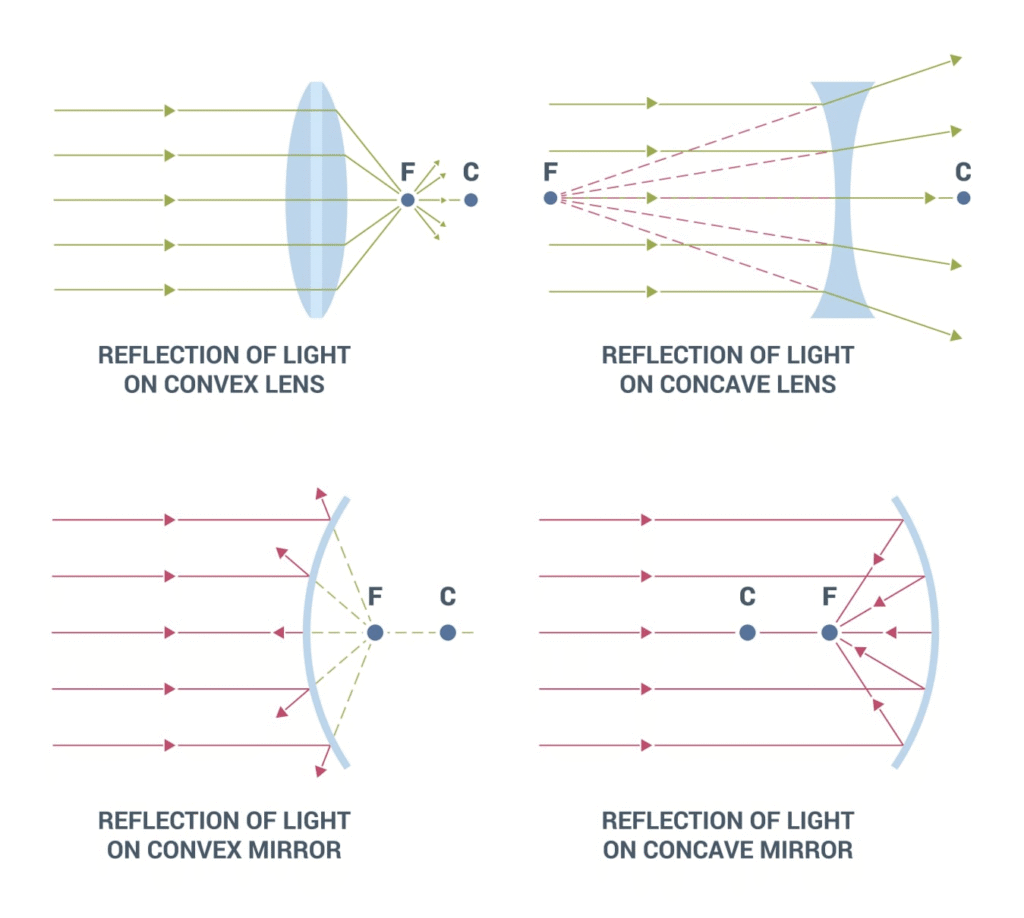
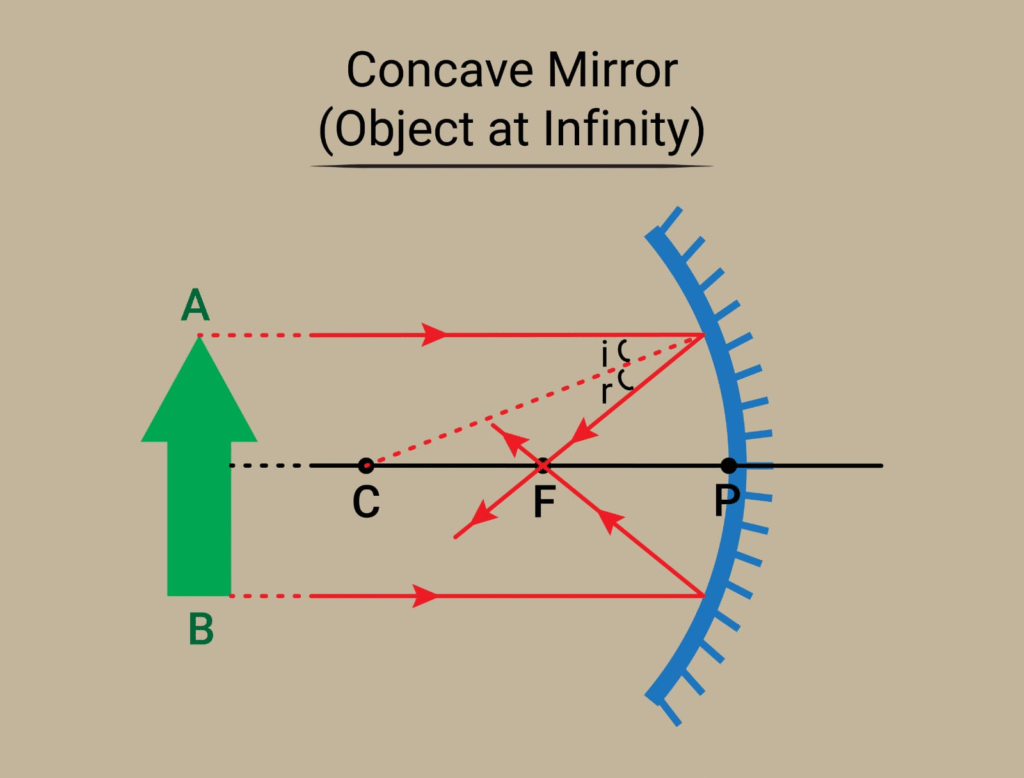
🔴 Law 1: Incident ray, reflected ray and the normal at the point of incidence lie in one plane.
🟡 Law 2: Angle of incidence i = angle of reflection r.
🌿 Regular reflection (smooth surface) gives clear images; diffuse reflection (rough surface) scatters light.
✏️ Note: The image in a plane mirror is virtual, erect, same size as the object, and laterally inverted.
🟣 Spherical Mirrors (concave and convex)
🟠 Concave mirror (converging): focuses parallel rays at a point.
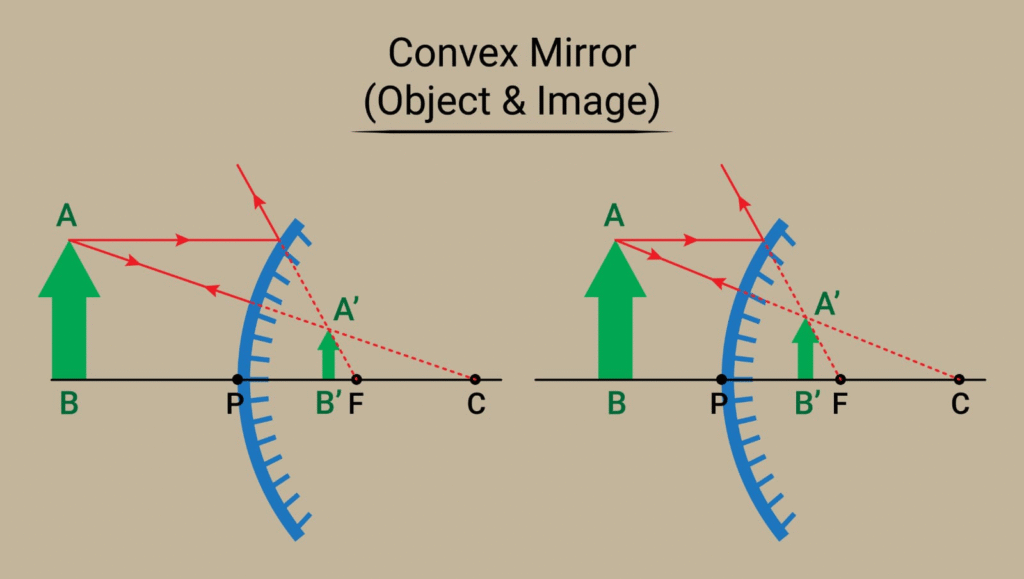
🟤 Convex mirror (diverging): spreads rays; appears to focus behind the mirror.
Key terms :
🧠 Pole (P): centre of mirror surface.
🌍 Principal axis: line through P and centre of curvature.
🎯 Centre of curvature (C): centre of the sphere of which the mirror is a part.
⭐ Focus (F): point where parallel rays meet (concave) or appear to meet (convex).
📏 Focal length (f): PF (distance from pole to focus).
Sign convention (Cartesian):
Take the pole P as origin on the principal axis.
Distances measured towards the incident light (usually to the left) are negative.
Heights above principal axis are positive; below are negative.
Mirror formula:
1/f = 1/v + 1/u
(u = object distance, v = image distance, f = focal length)
Magnification for mirrors:
m = h_i / h_o = − v / u
(h_i = image height, h_o = object height)
Concave mirror image summary (textual ray guide):
🔵 Object beyond C → image between C and F (real, inverted, diminished).
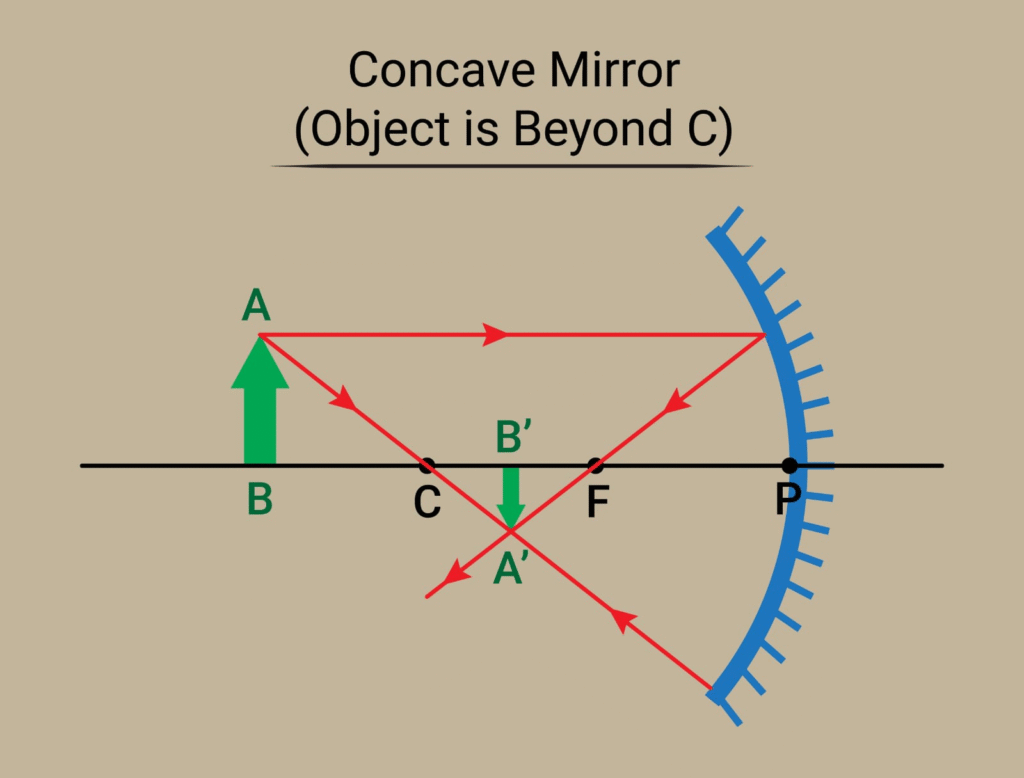
🟢 Object at C → image at C (real, inverted, same size).
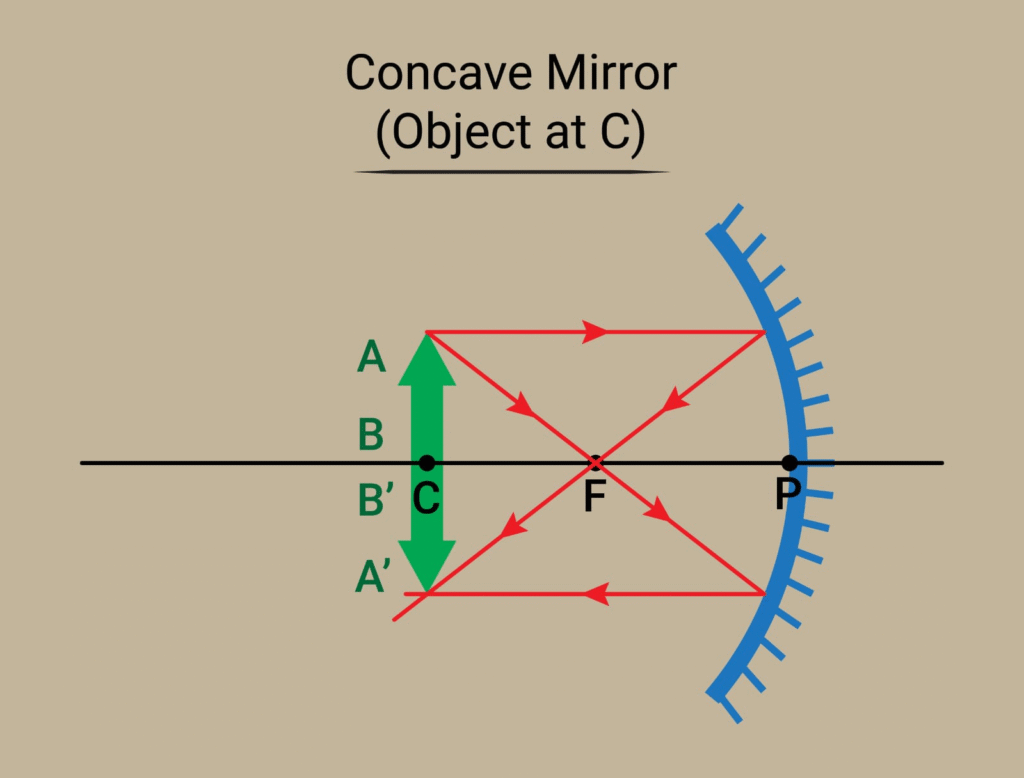
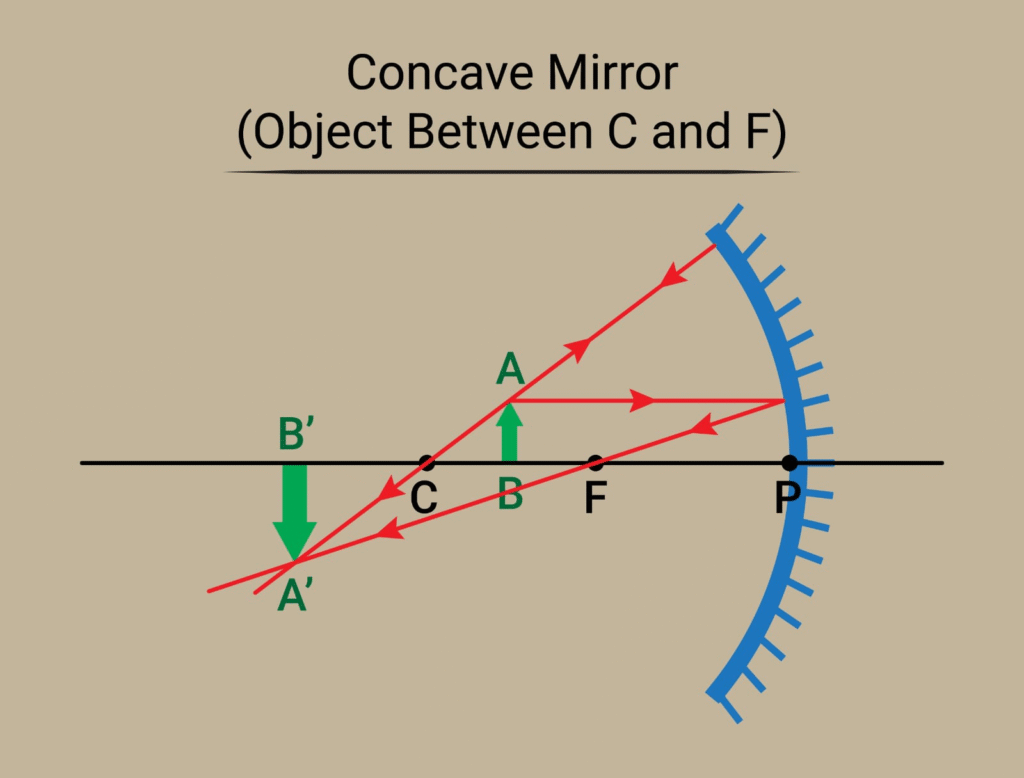
🟡 Object between C and F → image beyond C (real, inverted, magnified).
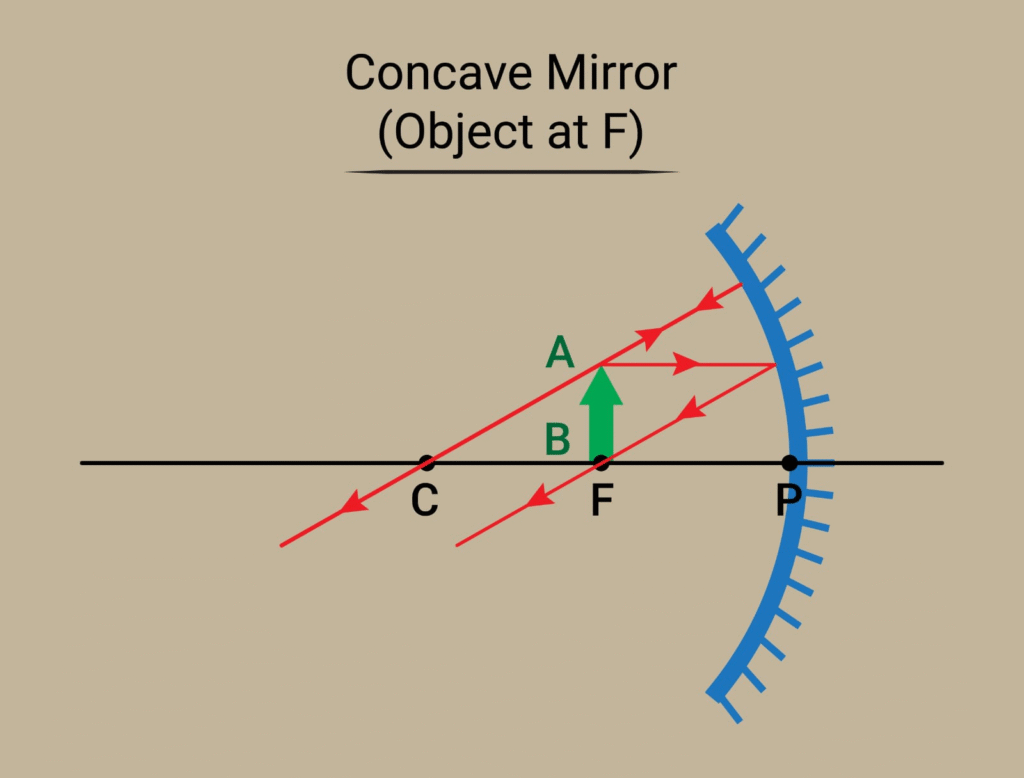
🔴 Object at F → image at infinity (highly enlarged).
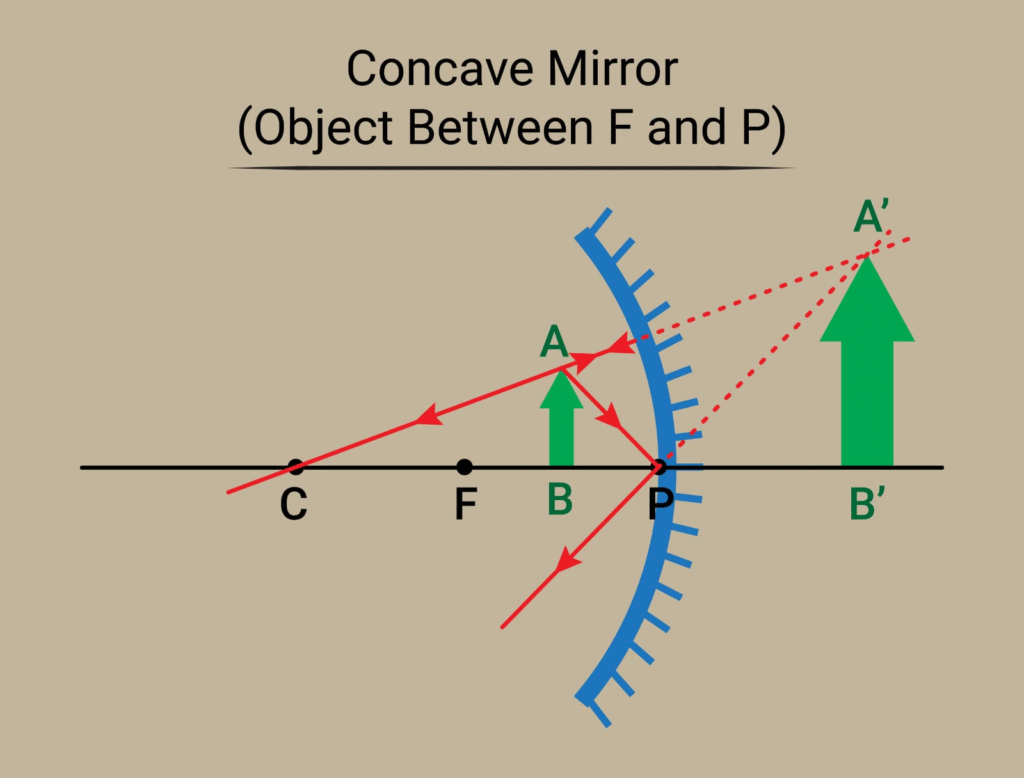
🟣 Object between F and P → image behind mirror (virtual, erect, magnified).
Convex mirror image:
🧠 For any object position, image forms between P and F, virtual, erect, diminished.
Applications:
⚡ Concave: headlights, shaving/dentist mirrors, solar furnaces.
🚗 Convex: vehicle rear-view (wide field of view).
💧 Refraction of Light (bending across media)
🔵 Refraction is bending of light due to change in speed when it enters a different medium (air → glass or water → air).
🟢 Rays bend towards the normal when entering an optically denser medium; away from the normal when entering a rarer medium.
Snell’s law (copy-safe):
n = sin i / sin r
(i = angle of incidence, r = angle of refraction, n = refractive index of second medium w.r.t. first)
Absolute refractive index:
n = (speed of light in vacuum) / (speed of light in medium)
💡 Concept: Higher n means light slows more and bends more towards the normal.
✔️ Everyday effects: A pencil in water looks bent; the bottom of a pool looks raised; stars appear to twinkle (atmospheric refraction).
🔎 Refraction through a rectangular glass slab (what to expect)
🌿 The emergent ray is parallel to the incident ray, but laterally displaced (shifted sideways).
✏️ Note: The two refractions (air→glass, glass→air) bend in opposite directions, cancelling the angle but not the path shift.
👓 Spherical Lenses (convex and concave)
🔵 Convex lens (converging): thicker at centre; brings parallel rays to a focus.
🔴 Concave lens (diverging): thinner at centre; makes rays diverge as if from a focus.
Key lens terms:
Optical centre (O), principal axis, focal points F on both sides, focal length f (OF).
Sign convention for lenses (Cartesian):
Object kept on the left of lens → u is negative.
Real image on the right → v positive; virtual image on the left → v negative.
Convex lens has positive f; concave lens has negative f (by convention).
Lens formula (copy-safe):
1/f = 1/v − 1/u
Magnification for lenses:
m = h_i / h_o = v / u
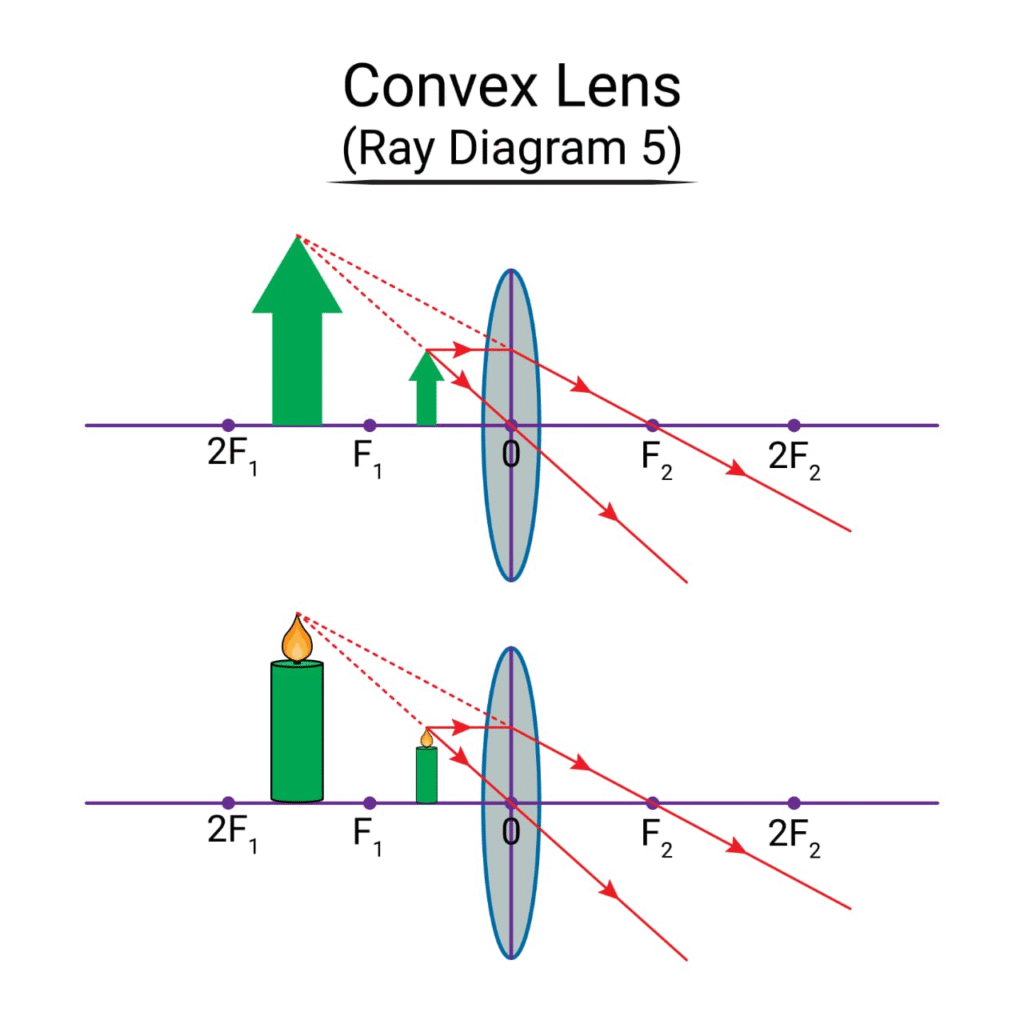
Convex lens image guide:
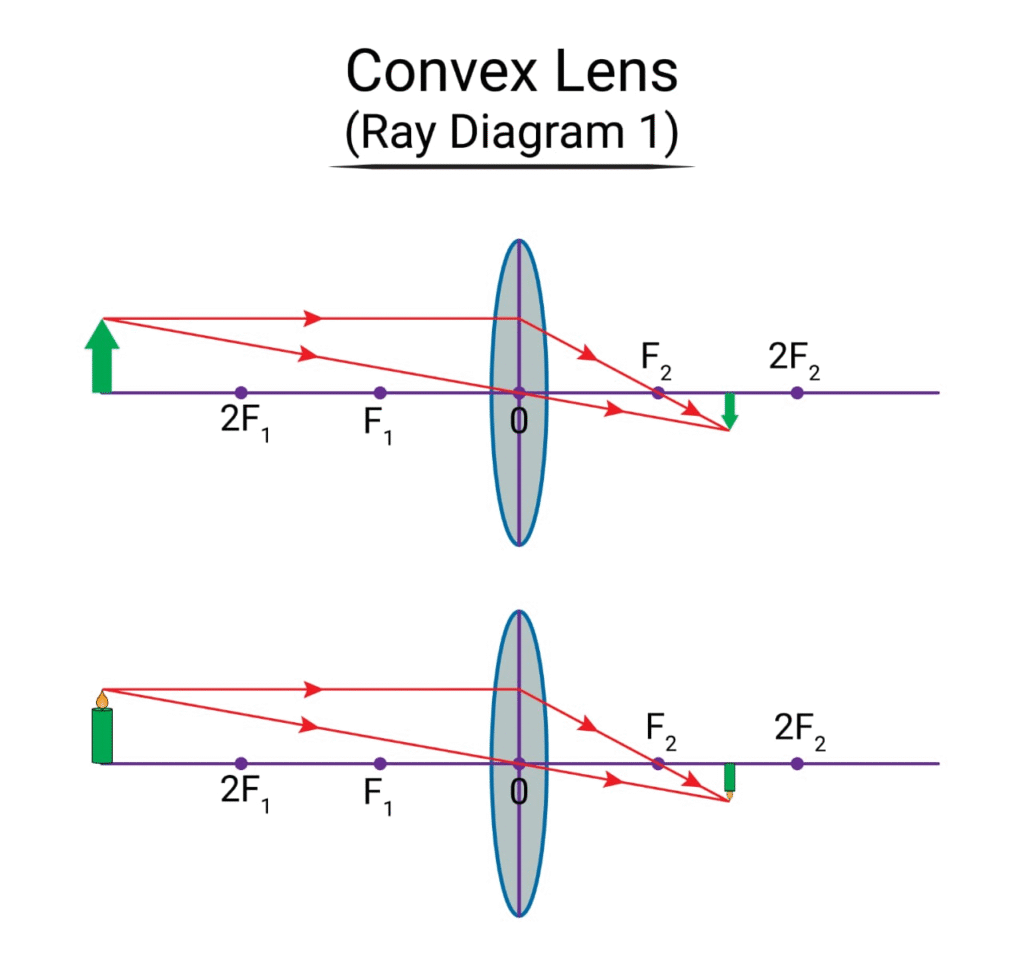
🌟 Object at infinity → image at F (real, inverted, highly diminished).
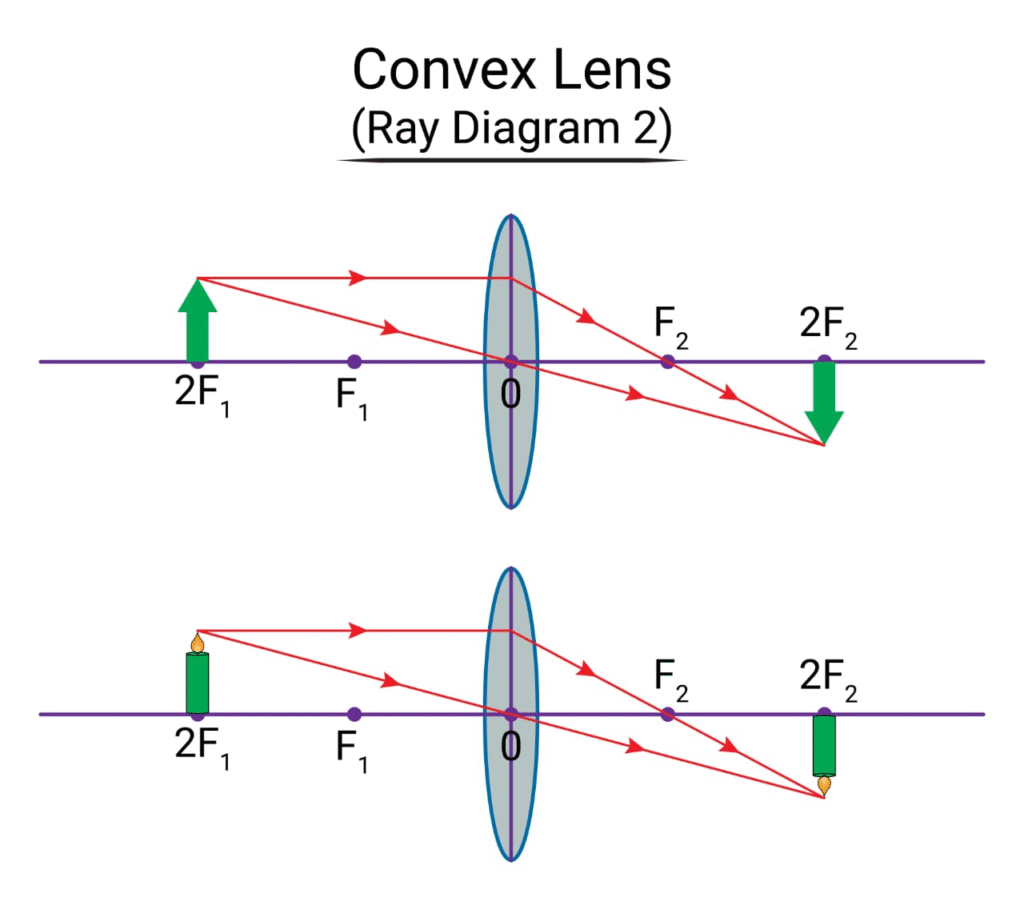
🟣 Object at 2F → image at 2F (real, inverted, same size).
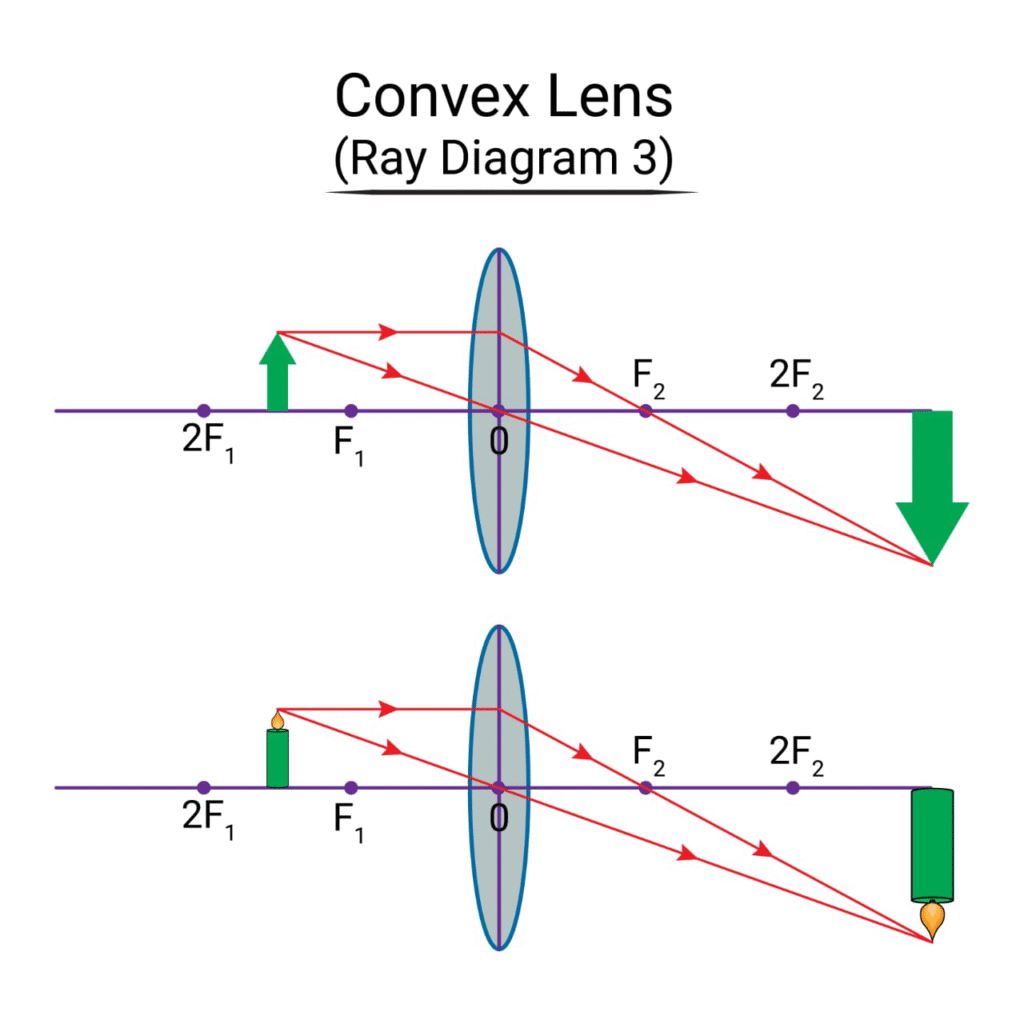
🟠 Object between F and 2F → image beyond 2F (real, inverted, magnified).
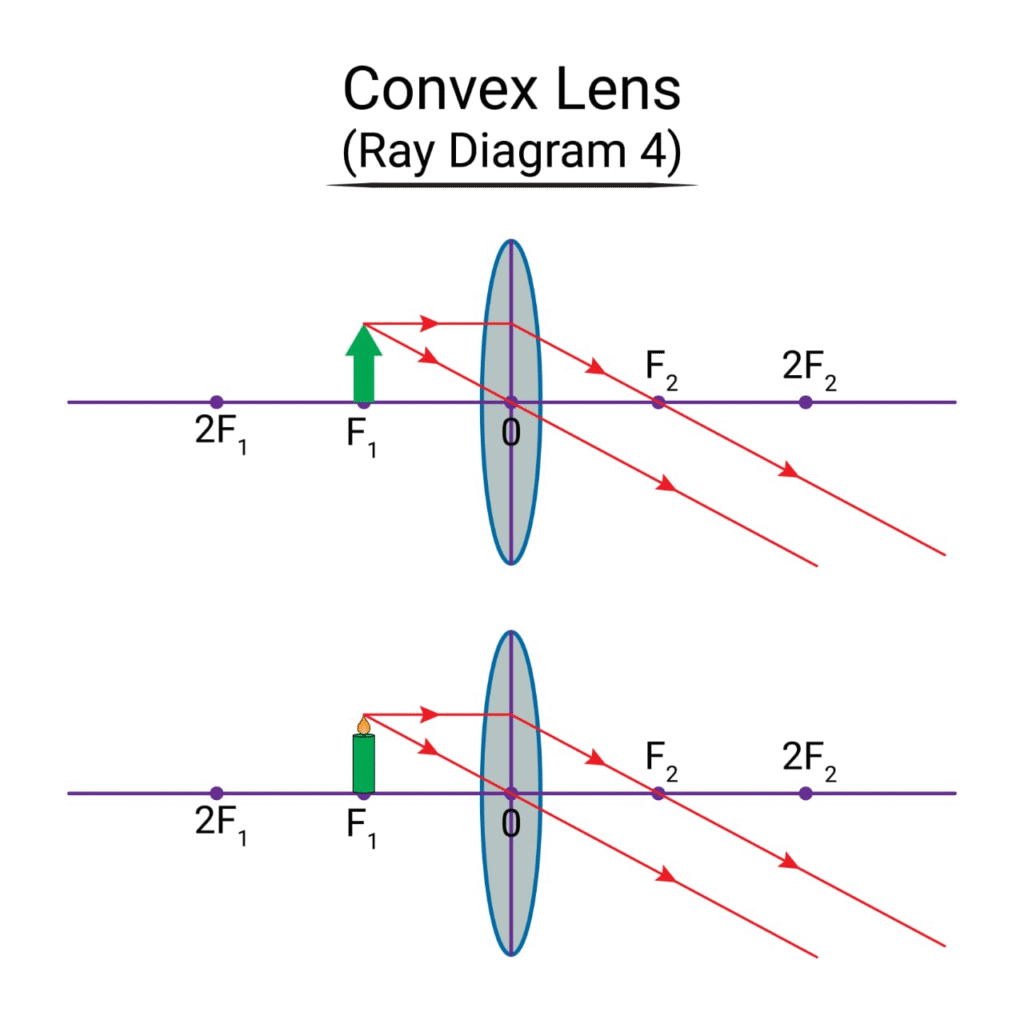
🟤 Object at F → image at infinity (highly enlarged).
🟡 Object between F and O → image on same side as object (virtual, erect, magnified) → magnifying glass.
Concave lens image:
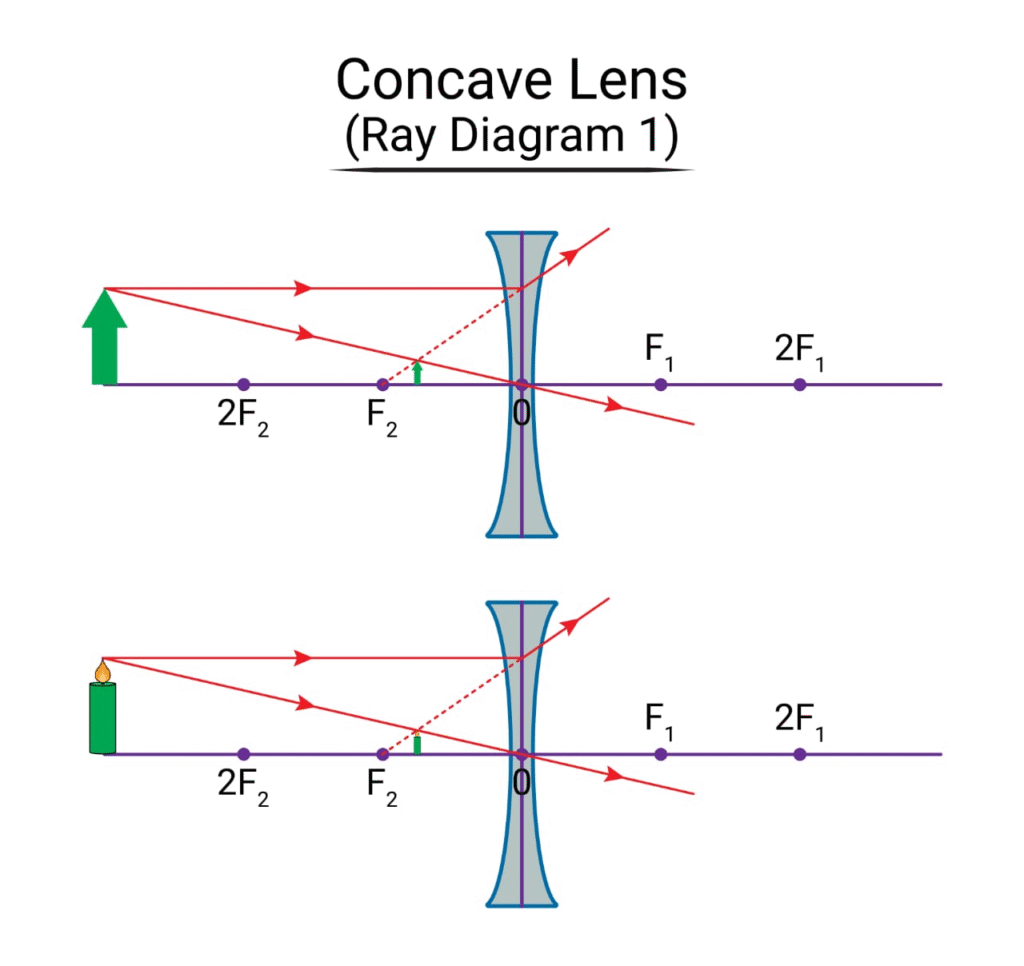
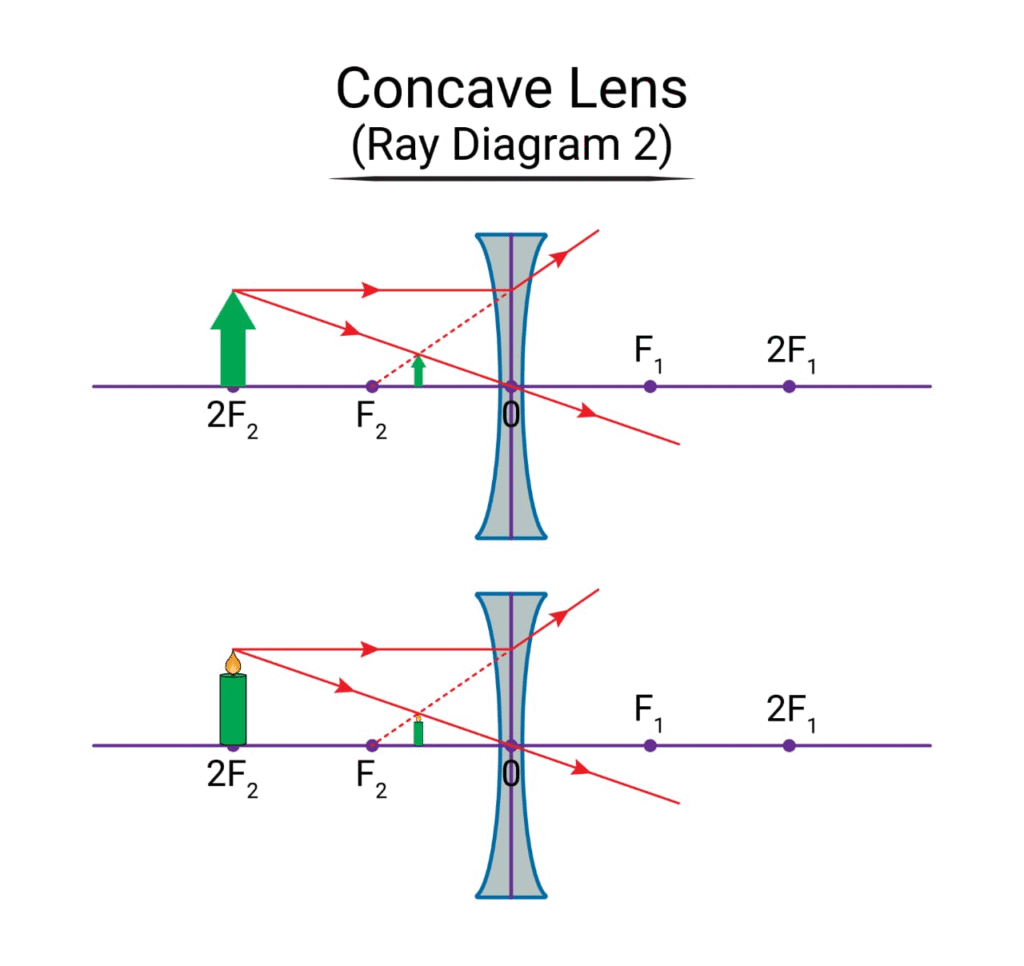
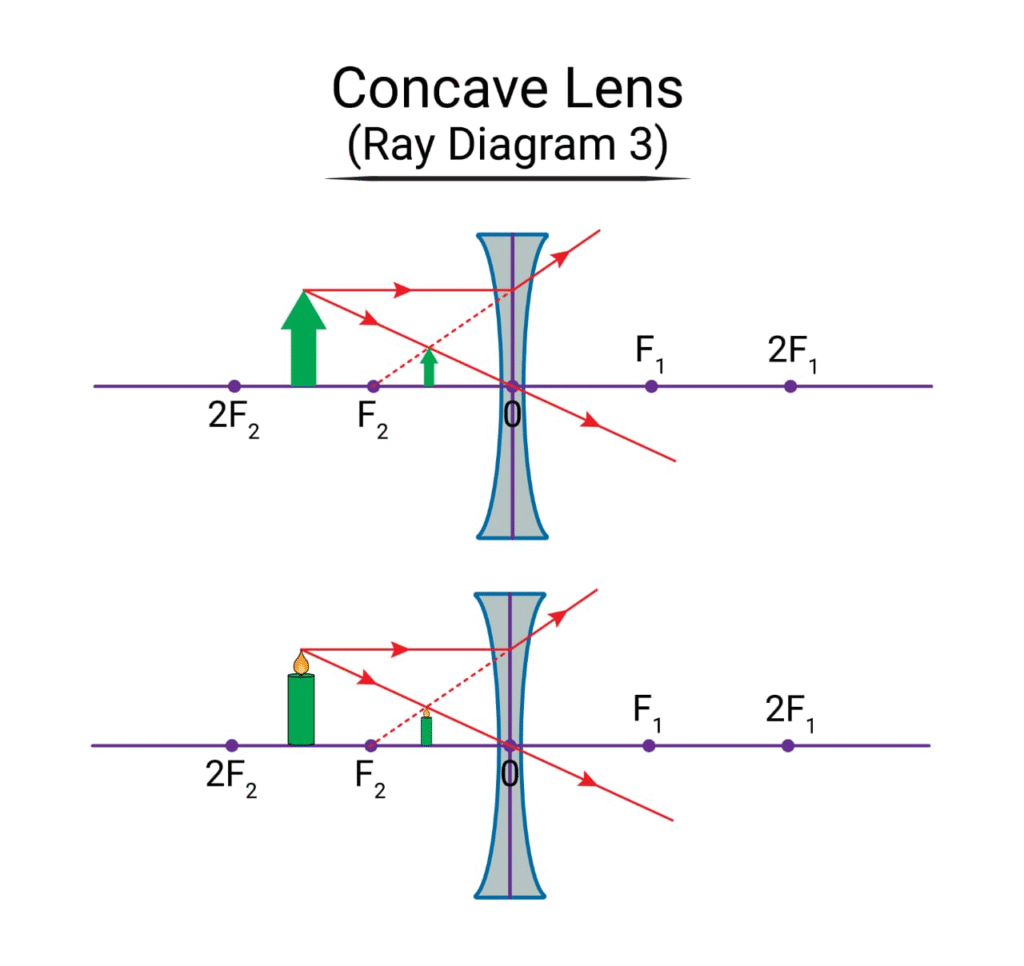
🧠 For any object position, image forms between O and F on the same side as object (virtual, erect, diminished).
📐 Power of a Lens (for spectacle numbers)
Power P measures how strongly a lens converges or diverges light.
Formula (copy-safe): P = 1/f (when f is in metres; P in dioptre, symbol D)
🔵 Convex lens → positive power; 🔴 Concave lens → negative power.
✨ Combination: P_total = P1 + P2 + … (useful for lens systems).
🧠 Problem-solving essentials (safe equations)
Mirror: 1/f = 1/v + 1/u ; m = − v / u.
Lens: 1/f = 1/v − 1/u ; m = v / u.
Keep units consistent (metre for f in power).
Apply sign convention carefully to avoid mistakes.
🌍 Real-life applications
🚗 Convex mirrors as rear-view mirrors (wide field, smaller image).
🔦 Concave mirrors in torches and headlights (focus a strong beam).
🔍 Convex lenses in magnifiers, cameras, projectors, eye (image formation on retina).
🕳️ Concave lenses in spectacles for myopia (diverge rays to help focus).
✏️ Study tip: When you cannot draw, describe the ray diagram—state object position and resulting image position, nature (real/virtual), orientation (inverted/erect), and size (diminished/same/magnified).
🟢 Summary (quick revision)
🔵 Reflection: i = r; plane mirrors give virtual, erect, same-size images.
🟣 Spherical mirrors: Concave (converging), Convex (diverging); 1/f = 1/v + 1/u; m = − v/u.
💧 Refraction: bending due to speed change; n = sin i / sin r; higher n → more bending.
🔎 Glass slab: emergent ray parallel, but laterally shifted.
👓 Lenses: Convex (converging), Concave (diverging); 1/f = 1/v − 1/u; m = v/u; P = 1/f (m).
🌟 Applications: mirrors in vehicles/torches; lenses in spectacles/cameras.
📝 Quick Recap
✨ Laws of reflection hold for all reflecting surfaces.
🌿 Concave mirror: can give real or virtual images; convex mirror: always virtual, erect, diminished.
💧 Refraction follows n = sin i / sin r; denser medium → bend towards normal.
🔍 Convex lens can magnify (object between F and O); concave lens always shrinks the image.
✔️ Power in dioptres helps choose spectacle lenses.
————————————————————————————————————————————————————————————————————————————
QUESTIONS FROM TEXTBOOK
Question 1
Which one of the following materials cannot be used to make a lens?
(a) Water
(b) Glass
(c) Plastic
(d) Clay
Answer
🔵 Lenses must be transparent so that light can pass through.
🟢 Water, glass and plastic are transparent.
🔴 Clay is opaque → cannot form a lens.
✔️ Correct option: (d) Clay
Question 2
The image formed by a concave mirror is observed to be virtual, erect and larger than the object. Where should be the position of the object?
(a) Between the principal focus and the centre of curvature
(b) At the centre of curvature
(c) Beyond the centre of curvature
(d) Between the pole of the mirror and its principal focus
Answer
🌿 Concave mirror gives a virtual, erect, magnified image only when object is between P (pole) and F (focus).
✔️ Correct option: (d)
Question 3
Where should an object be placed in front of a convex lens to get a real image of the same size as the object?
(a) At the principal focus of the lens
(b) At twice the focal length
(c) At infinity
(d) Between the optical centre of the lens and its principal focus
Answer
🧠 A convex lens forms a real, inverted, same size image when object is placed at 2F.
✔️ Correct option: (b)
Question 4
A spherical mirror and a thin spherical lens have each a focal length of –15 cm. The mirror and the lens are likely to be
(a) both concave
(b) both convex
(c) the mirror is concave and the lens is convex
(d) the mirror is convex but the lens is concave
Answer
🔵 Negative focal length means:
Concave mirror has f < 0.
Concave lens has f < 0.
✔️ Correct option: (a) both concave
Question 5
No matter how far you stand from a mirror, your image appears erect. The mirror is likely to be
(a) only plane
(b) only concave
(c) only convex
(d) either plane or convex
Answer
🌸 Plane mirror → erect, virtual image always.
🌍 Convex mirror → erect, diminished, virtual image always.
Concave mirror → erect only when object within F (not always).
✔️ Correct option: (d) either plane or convex
Question 6
Which of the following lenses would you prefer to use while reading small letters in a dictionary?
(a) A convex lens of focal length 50 cm
(b) A concave lens of focal length 50 cm
(c) A convex lens of focal length 5 cm
(d) A concave lens of focal length 5 cm
Answer
🔎 To magnify small letters, a convex lens with short focal length is required.
✔️ Correct option: (c) A convex lens of focal length 5 cm
Question 7
We wish to obtain an erect image of an object, using a concave mirror of focal length 15 cm. What should be the range of distance of the object from the mirror? What is the nature of the image? Is the image larger or smaller than the object? Draw a ray diagram to show the image formation in this case.
Answer
🌿 For concave mirror, erect image occurs only when object is placed between P (pole) and F (focus).
🟢 Distance range: 0 to < 15 cm.
🟡 Nature: Virtual, erect, magnified.
✏️ In diagram (to be drawn in exam): object between P and F → image behind the mirror, larger than object.
Question 8
Name the type of mirror used in the following situations. Support your answer with reason.
(a) Headlights of a car
(b) Side/rear-view mirror of a vehicle
(c) Solar furnace
Answer
(a) 🔦 Concave mirror → produces powerful parallel beam.
(b) 🚗 Convex mirror → gives wide field of view, erect and diminished image.
(c) ☀️ Concave mirror → focuses sunlight at one point to produce heat.
Question 9
One-half of a convex lens is covered with a black paper. Will this lens produce a complete image of the object? Verify your answer experimentally. Explain your observations.
Answer
🌿 Yes, the lens will form a complete image but with reduced brightness.
🟢 Rays from the uncovered part still converge to form image.
🟡 Experiment: Cover half of lens, place object → image appears, but less bright.
Question 10
An object 5 cm in length is held 25 cm away from a converging lens of focal length 10 cm. Draw the ray diagram and find the position, size and the nature of the image formed.
Answer
🔵 Lens formula: 1/f = 1/v – 1/u
f = 10 cm, u = –25 cm (sign convention)
1/v = 1/10 + 1/25 = (2.5 + 1)/25 = 3.5/25
v = 25/3.5 ≈ 7.14 cm (positive → image on right side).
🟢 Magnification: m = v/u = 7.14 / –25 ≈ –0.29 → image inverted and diminished.
🟡 Image size: h_i = m × h_o = –0.29 × 5 ≈ –1.45 cm (negative → inverted).
✔️ Nature: Real, inverted, diminished.
Question 11
A concave lens of focal length 15 cm forms an image 10 cm from the lens. How far is the object placed from the lens? Draw the ray diagram.
Answer
🔵 Lens formula: 1/f = 1/v – 1/u
f = –15 cm, v = –10 cm
1/–15 = 1/–10 – 1/u
–1/15 = –1/10 – 1/u
1/u = –1/10 + 1/15 = (–3 + 2)/30 = –1/30
u = –30 cm.
✔️ Object distance = 30 cm (in front of lens).
✔️ Nature: Virtual, erect, diminished.
Question 12
An object is placed at a distance of 10 cm from a convex mirror of focal length 15 cm. Find the position and nature of the image.
Answer
🔵 Mirror formula: 1/f = 1/v + 1/u
f = +15 cm (convex mirror), u = –10 cm
1/v = 1/15 – 1/10 = (2 – 3)/30 = –1/30
v = –30 cm (negative → image behind mirror).
✔️ Nature: Virtual, erect, diminished.
Question 13
The magnification produced by a plane mirror is +1. What does this mean?
Answer
🌸 Magnification = h_i / h_o = +1.
🟢 Means image is of same size as object.
🟡 Positive sign → image is virtual and erect.
Question 14
An object 5.0 cm in length is placed at a distance of 20 cm in front of a convex mirror of radius of curvature 30 cm. Find the position of the image, its nature and size.
Answer
🔵 Focal length f = R/2 = 30/2 = 15 cm (convex mirror → +15 cm).
u = –20 cm.
1/v = 1/f – 1/u = 1/15 – (–1/20) = 1/15 + 1/20 = (4 + 3)/60 = 7/60.
v = 60/7 ≈ 8.57 cm (behind mirror).
🟢 Magnification: m = –v/u = –8.57/–20 ≈ +0.43.
🟡 Image size: h_i = m × h_o = 0.43 × 5 ≈ 2.15 cm.
✔️ Image: Virtual, erect, diminished.
Question 15
An object of size 7.0 cm is placed at 27 cm in front of a concave mirror of focal length 18 cm. At what distance from the mirror should a screen be placed, so that a sharp focussed image can be obtained? Find the size and the nature of the image.
Answer
🔵 Mirror formula: 1/f = 1/v + 1/u
f = –18 cm, u = –27 cm
1/v = 1/–18 – 1/–27 = –1/18 + 1/27 = (–3 + 2)/54 = –1/54
v = –54 cm (real image).
🟢 Magnification: m = –v/u = –(–54)/(–27) = –2.
🟡 Image size: h_i = m × h_o = –2 × 7 = –14 cm (negative → inverted).
✔️ Screen at 54 cm. Image is real, inverted, magnified (14 cm).
Question 16
Find the focal length of a lens of power –2.0 D. What type of lens is this?
Answer
🔵 Formula: P = 100/f (f in cm).
f = 100/P = 100 / –2 = –50 cm.
🟢 Negative focal length → lens is concave.
✔️ Focal length = –50 cm, concave lens.
Question 17
A doctor has prescribed a corrective lens of power +1.5 D. Find the focal length of the lens. Is the prescribed lens diverging or converging?
Answer
🔵 f = 100 / P = 100 / +1.5 ≈ 66.7 cm.
🟢 Positive focal length → convex (converging) lens.
✔️ Focal length = +66.7 cm, convex lens.
————————————————————————————————————————————————————————————————————————————
OTHER IMPORTANT QUESTIONS FOR EXAMS
(CBSE MODEL QUESTION PAPER)
ESPECIALLY MADE FROM THIS CHAPTER ONLY
⚙️ Section A: Q1–6 (1 Mark Each – MCQ Type)
🔵 Question 1: The image formed by a plane mirror is —
🔵 (A) Real and inverted
🟢 (B) Virtual and erect
🔴 (C) Real and erect
🟡 (D) Virtual and inverted
✔️ Answer: (B) Virtual and erect
💡 Plane mirrors always produce virtual, erect, and laterally inverted images of the same size as the object.
🔵 Question 2: The focal length of a concave mirror is 20 cm. What is its radius of curvature?
🔵 (A) 10 cm
🟢 (B) 20 cm
🔴 (C) 30 cm
🟡 (D) 40 cm
✔️ Answer: (D) 40 cm
💡 Formula: R = 2f ⇒ R = 2 × 20 = 40 cm.
🔵 Question 3: A concave mirror forms a virtual image only when the object is placed —
🔵 (A) Beyond centre of curvature
🟢 (B) Between focus and pole
🔴 (C) At centre of curvature
🟡 (D) At infinity
✔️ Answer: (B) Between focus and pole
💡 Only in this position, a concave mirror forms a virtual, erect, and magnified image.
🔵 Question 4: The refractive index of water is 1.33. It means —
🔵 (A) Speed of light in water is 1.33 times that in air
🟢 (B) Speed of light in water is less than that in air
🔴 (C) Light travels faster in water than in air
🟡 (D) None of these
✔️ Answer: (B) Speed of light in water is less than that in air.
💡 Refractive index = speed in vacuum / speed in medium ⇒ greater the value, lesser the speed.
🔵 Question 5: Which type of lens can form both real and virtual images?
🔵 (A) Convex lens
🟢 (B) Concave lens
🔴 (C) Plane glass slab
🟡 (D) None of these
✔️ Answer: (A) Convex lens
💡 Convex lens acts as a converging lens and can produce real or virtual images depending on object position.
🔵 Question 6: The mirror formula is —
🔵 (A) 1/f = 1/v + 1/u
🟢 (B) 1/f = 1/v − 1/u
🔴 (C) f = u + v
🟡 (D) f = u − v
✔️ Answer: (A) 1/f = 1/v + 1/u
💡 This formula relates focal length (f), image distance (v), and object distance (u) for mirrors.
⚡ Section B: Q7–12 (2 Marks Each – Short Answers)
🔵 Question 7: Define focal length and centre of curvature of a spherical mirror.
✔️ Answer:
➡️ Focal length (f): The distance between the pole and the focus of the mirror.
➡️ Centre of curvature (C): The centre of the sphere of which the mirror is a part.
🟢 Question 8: State the laws of reflection of light.
✔️ Answer:
1️⃣ The angle of incidence = the angle of reflection.
2️⃣ The incident ray, reflected ray, and normal all lie in the same plane.
🔴 Question 9: Define refractive index.
✔️ Answer:
It is the ratio of the speed of light in vacuum to the speed of light in the given medium.
Formula: n = c / v
🟡 Question 10: What is the relationship between focal length and radius of curvature of a mirror?
✔️ Answer:
For all spherical mirrors,
➡️ R = 2f
where R = radius of curvature and f = focal length.
🔵 Question 11: Why does a pencil partly immersed in water appear bent?
✔️ Answer:
Light rays from the submerged part bend at the surface due to refraction, making the pencil appear bent or displaced.
🟢 Question 12: What is the difference between real and virtual images?
✔️ Answer:
➡️ Real image: Formed when light rays actually meet; can be obtained on a screen (e.g., by concave mirror).
➡️ Virtual image: Formed when rays appear to meet; cannot be obtained on a screen (e.g., plane mirror).
⚙️ Section C: Q13–22 (3 Marks Each – Mid-Length Answers)
🔵 Question 13: Explain image formation by a concave mirror when the object is placed —
(a) Beyond centre of curvature, (b) At focus, (c) Between focus and pole.
✔️ Answer:
(a) Beyond C: Image formed between F and C, real, inverted, smaller.
(b) At F: Rays become parallel; image at infinity, highly enlarged.
(c) Between F and P: Image behind the mirror, virtual, erect, and magnified.
🟢 Question 14: Draw ray diagrams for a convex mirror and state its image characteristics.
✔️ Answer:
➡️ Always forms a virtual, erect, and diminished image behind the mirror between focus and pole.
💡 Used in rear-view mirrors of vehicles.
🔴 Question 15: What is refraction? State the laws of refraction.
✔️ Answer:
Refraction is the bending of light when it passes from one medium to another.
Laws:
1️⃣ The incident ray, refracted ray, and normal lie in the same plane.
2️⃣ Ratio of sin i / sin r = constant (Snell’s Law).
🟡 Question 16: State the sign conventions for spherical mirrors.
✔️ Answer:
According to the New Cartesian Sign Convention:
1️⃣ All distances measured from the pole.
2️⃣ Distances measured in the direction of incident light are positive.
3️⃣ Distances measured opposite to the incident light are negative.
4️⃣ Heights measured upward are positive; downward are negative.
🔵 Question 17: Derive the mirror formula.
✔️ Answer:
From similar triangles formed by incident and reflected rays:
1/f = 1/v + 1/u
💡 This relation holds for both concave and convex mirrors under sign conventions.
🟢 Question 18: State the lens formula and derive the magnification relation.
✔️ Answer:
Lens formula: 1/f = 1/v − 1/u
Magnification (m) = h₂/h₁ = v/u
💡 Positive for erect images, negative for inverted.
🔴 Question 19: What is total internal reflection? Give two conditions for it.
✔️ Answer:
When light passes from a denser to a rarer medium and the angle of incidence exceeds the critical angle, it gets completely reflected inside the medium.
➡️ Conditions:
1️⃣ Light travels from denser to rarer medium.
2️⃣ Angle of incidence > critical angle.
🟡 Question 20: What is the refractive index of a medium if light travels in it at a speed of 2 × 10⁸ m/s? (Speed of light in vacuum = 3 × 10⁸ m/s)
✔️ Answer:
n = c / v = (3 × 10⁸) / (2 × 10⁸) = 1.5
🔵 Question 21: An object is placed 30 cm in front of a concave mirror of focal length 15 cm. Find the position of image.
✔️ Answer:
1/f = 1/v + 1/u
⇒ 1/15 = 1/v + 1/(-30)
⇒ 1/v = 1/15 + 1/30 = 1/10
✅ v = 10 cm (real and inverted)
🟢 Question 22: State two uses each of concave and convex mirrors.
✔️ Answer:
Concave mirror: Used in shaving mirrors, headlights of vehicles.
Convex mirror: Used in rear-view mirrors, road safety mirrors.
🧠 Section D: Q23–30 (4 Marks Each – Long and Case-Based Answers)
🔵 Question 23: Explain refraction of light through a rectangular glass slab with ray diagram.
✔️ Answer:
When a ray enters the glass slab obliquely, it bends towards the normal; on leaving, it bends away.
💡 The emergent ray is parallel to the incident ray but laterally displaced.
🟢 Question 24: Describe the formation of image by a convex lens for different object positions.
✔️ Answer:
1️⃣ At infinity: Image at focus, real and highly diminished.
2️⃣ Beyond 2F: Image between F and 2F, real and smaller.
3️⃣ At 2F: Image at 2F, same size, real and inverted.
4️⃣ Between F and 2F: Image beyond 2F, real, enlarged, inverted.
5️⃣ At F: Image at infinity.
6️⃣ Between F and O: Image virtual, erect, and enlarged.
🔴 Question 25: Explain refraction through a concave lens with diagram.
✔️ Answer:
A concave lens diverges light rays. The refracted rays appear to come from a point on the same side of the lens, forming a virtual, erect, and diminished image.
🟡 Question 26: Derive the relation between object distance, image distance, and focal length for a convex lens.
✔️ Answer:
Using geometry of two similar triangles formed by refracted rays and principal axis,
➡️ 1/f = 1/v − 1/u
This is the lens formula.
🔵 Question 27: Case Study — A student positions an object 25 cm in front of a convex lens of focal length 10 cm. Find the image distance and nature of image.
✔️ Answer:
1/f = 1/v − 1/u
⇒ 1/10 = 1/v − 1/(-25)
⇒ 1/v = 1/10 + 1/25 = (5 + 2)/50 = 7/50
✅ v = 7.14 cm (real and inverted)
🟢 Question 28: What happens to the path of light when it travels from air to water and back to air?
✔️ Answer:
When it enters water, it bends towards the normal (speed decreases).
On re-entering air, it bends away from the normal (speed increases).
🔴 Question 29: Explain the sign convention and mirror formula with an example numerical.
✔️ Answer:
Formula: 1/f = 1/v + 1/u
Example: A concave mirror has f = 12 cm, object at 18 cm.
1/12 = 1/v + 1/(-18)
1/v = 1/12 + 1/18 = (3 + 2)/36 = 5/36
✅ v = 7.2 cm (real and inverted)
🟡 Question 30: Describe an experiment to find the focal length of a concave mirror using sunlight.
✔️ Answer:
➡️ Hold a concave mirror facing the Sun.
➡️ Adjust a white screen in front of it until a sharp, bright image of the Sun is obtained.
➡️ Measure the distance between the mirror and screen — this distance is the focal length.
————————————————————————————————————————————————————————————————————————————