
Class 10 : Science (In English) – Lesson 10. The Human Eye and the Colourful World

EXPLANATION & SUMMARY
🔵 Detailed Explanation
🌟 Introduction
🔵 The human eye is a natural optical instrument that allows us to see objects by receiving light.
🟢 It works on the principle of refraction of light through a lens system.
🟡 The colourful world we perceive is due to dispersion, scattering and atmospheric phenomena involving sunlight.
👁️ Structure of the Human Eye
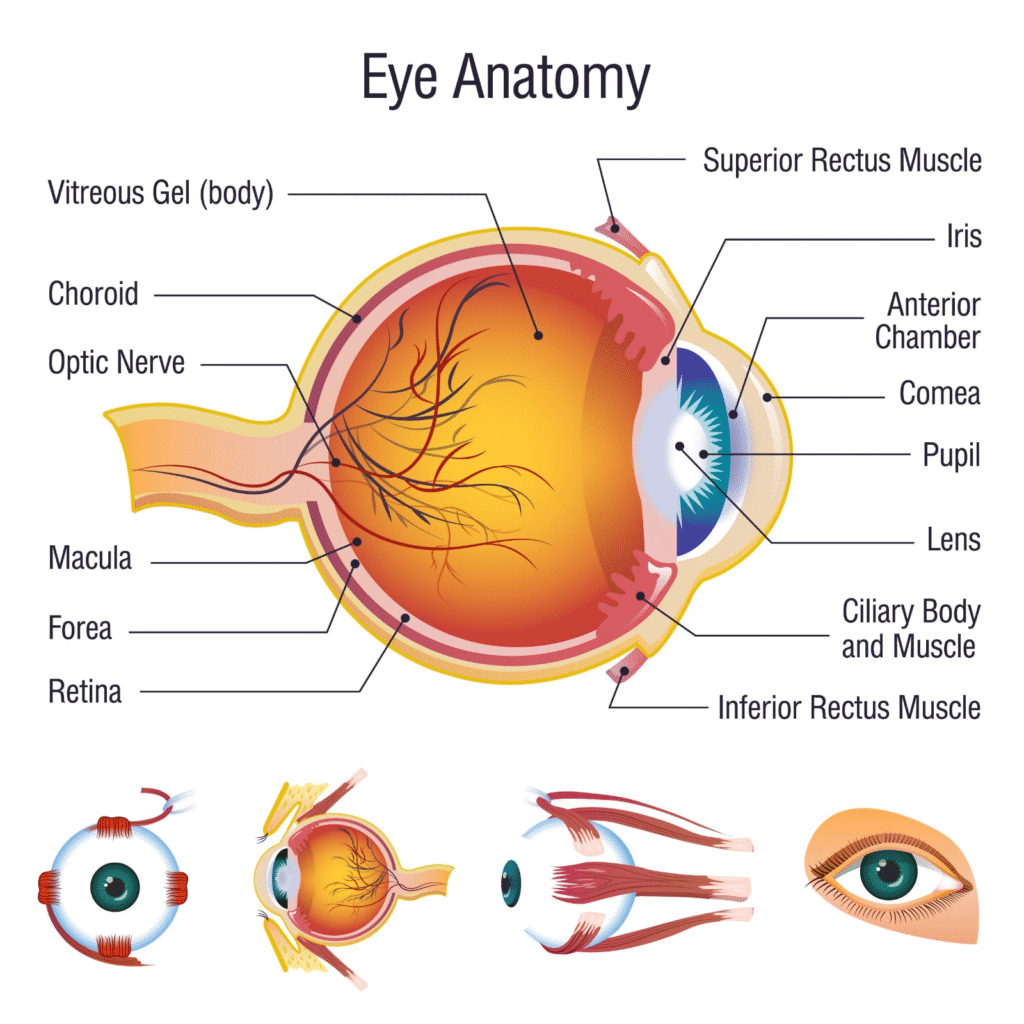
🌿 Cornea: Transparent, curved front surface; refracts most of the light entering the eye.
💧 Aqueous humour: Fluid-filled chamber between cornea and lens; maintains pressure.
🔵 Iris: Coloured diaphragm controlling size of pupil.
🌟 Pupil: Opening that regulates the amount of light entering.
🟣 Eye lens: Transparent, convex lens; refracts light to form image on retina.
🧠 Ciliary muscles: Adjust curvature of lens to change focal length (accommodation).
🟢 Vitreous humour: Transparent jelly filling eye behind lens; maintains shape.
🟡 Retina: Light-sensitive screen; rods (low light) and cones (colour).
🔴 Optic nerve: Carries visual information to brain.
🟠 Functioning of Eye
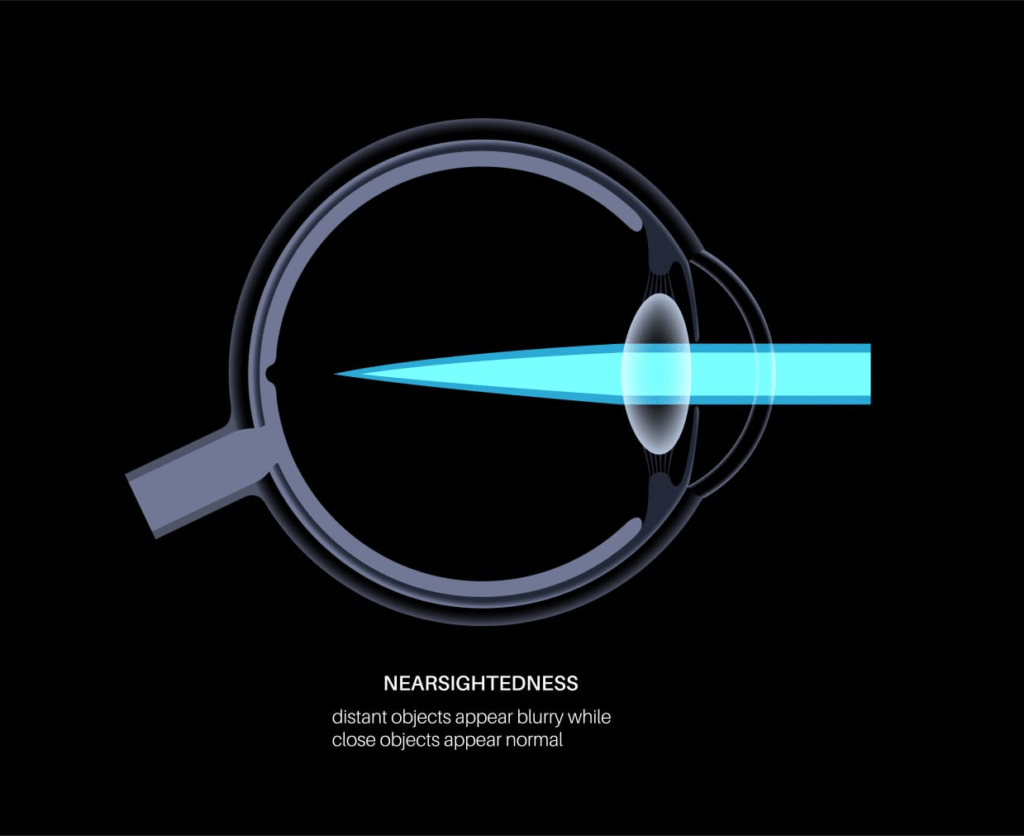
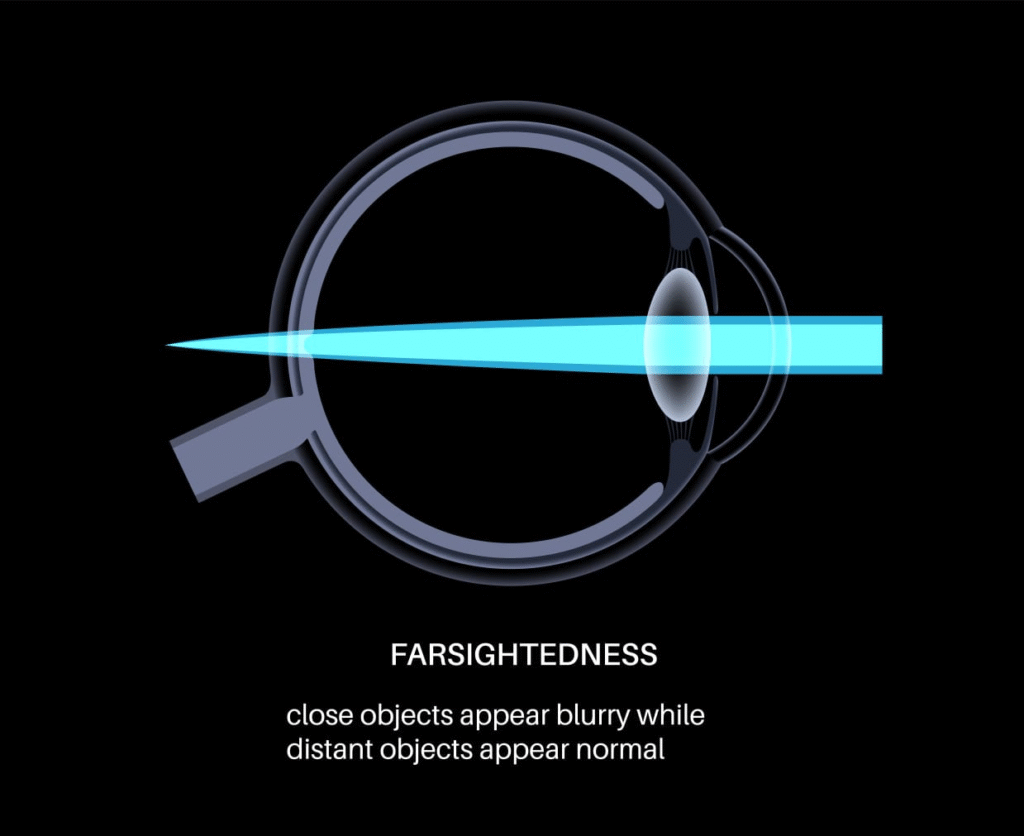
🔵 Light rays enter through cornea → refracted.
🟢 Pass through aqueous humour, pupil, and lens.
🟡 Lens focuses rays to form real, inverted image on retina.
🧠 Retina converts into electrical signals → brain interprets as upright image.
🔴 Power of Accommodation
🌿 Eye lens can change focal length from about 2.27 cm to 2.72 cm.
🟢 Enables us to see both nearby and distant objects clearly.
💧 Near point (least distance of distinct vision) = 25 cm (for a normal eye).
🌍 Far point = Infinity (for a normal eye).
👓 Defects of Vision and their Correction
Myopia (Near-sightedness)
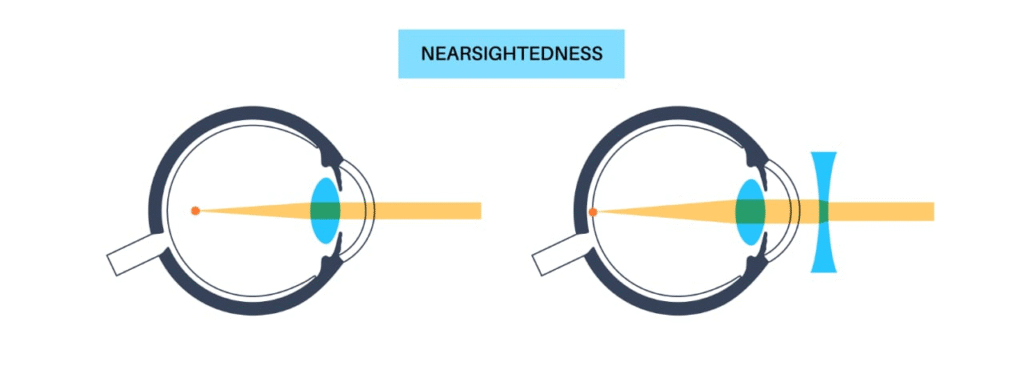
🔵 Cannot see distant objects clearly.
Cause: Elongated eyeball / lens too curved.
Image forms before retina.
Correction: Concave lens (diverges rays).
Hypermetropia (Far-sightedness)
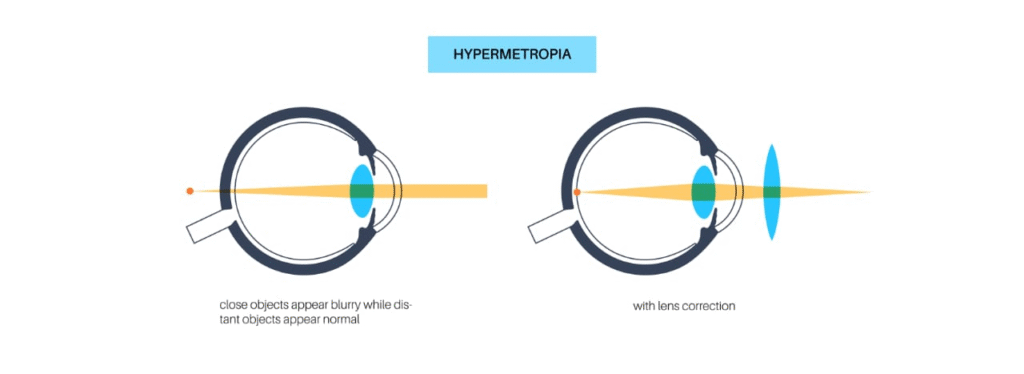
🟢 Cannot see nearby objects clearly.
Cause: Short eyeball / lens less curved.
Image forms behind retina.
Correction: Convex lens (converges rays).
Presbyopia
🟡 Age-related weakening of ciliary muscles.
Both near and far vision problems.
Correction: Bifocal lenses.
Astigmatism (not always in NCERT but relevant)
Blurred vision due to irregular curvature of cornea/lens.
Correction: Cylindrical lenses.
🌈 Refraction of Light through Atmosphere
🔵 Stars appear to twinkle because starlight refracts continuously due to changing air density in atmosphere.
🟢 Planets do not twinkle significantly (appear larger, closer).
🟡 Apparent shift in star position also due to atmospheric refraction.
🌍 Dispersion of Light by Prism
🔵 White light splits into seven colours (VIBGYOR).
🟢 Cause: Different refractive indices for different wavelengths.
🌈 Violet deviates most, red deviates least.
✨ Newton’s experiment proved sunlight is a mixture of colours.
🌞 Phenomena of Colourful World
Rainbow
🌿 Due to dispersion, refraction and reflection in water droplets.
Sunlight splits → forms concentric arcs.
Scattering of Light
🔵 Small particles scatter shorter wavelengths (blue).
🟢 Sky appears blue.
🟡 At sunrise/sunset, sunlight travels longer path → blue scattered away, red remains → reddish sun.
Tyndall Effect
🌟 Scattering of light by colloidal particles.
Example: Sunlight entering a dark room through a hole appears as visible beam.
🧮 Formulae / Key Values (copy-safe)
Power of lens: P = 100 / f (f in cm).
Near point (normal eye): 25 cm.
Far point (normal eye): Infinity.
Range of accommodation: From 25 cm to ∞.
🟢 Summary (for quick revision)
🔵 Eye lens adjusts focal length → accommodation.
🟢 Defects: Myopia (concave lens), Hypermetropia (convex lens), Presbyopia (bifocals).
🟡 Twinkling of stars = atmospheric refraction.
🔴 Rainbow = dispersion, refraction, reflection in droplets.
🌍 Sky blue = scattering of short wavelengths; sunrise/sunset red = scattering of longer path.
📝 Quick Recap
👁️ Human eye is a natural lens system forming real images on retina.
🌟 Near point = 25 cm; far point = ∞.
👓 Myopia → concave lens; Hypermetropia → convex lens; Presbyopia → bifocal.
🌈 White light disperses into VIBGYOR by prism.
🔵 Sky blue, 🌞 red sunrise/sunset due to scattering.
🌦️ Rainbow by dispersion, reflection, refraction in droplets.
————————————————————————————————————————————————————————————————————————————
QUESTIONS FROM TEXTBOOK
💡Question 1
The human eye can focus on objects at different distances by adjusting the focal length of the eye lens. This is due to
(a) presbyopia
(b) accommodation
(c) near-sightedness
(d) far-sightedness
Answer
🔵 This ability of the eye lens to adjust its focal length is called accommodation.
✔️ Correct option: (b) accommodation
💡Question 2
The human eye forms the image of an object at its
(a) cornea
(b) iris
(c) pupil
(d) retina
Answer
🟢 The retina is the light-sensitive screen where real, inverted image is formed.
✔️ Correct option: (d) retina
💡Question 3
The least distance of distinct vision for a young adult with normal vision is about
(a) 25 m
(b) 2.5 cm
(c) 25 cm
(d) 2.5 m
Answer
🌟 For a normal healthy eye, least distance of distinct vision = 25 cm.
✔️ Correct option: (c) 25 cm
💡Question 4
The change in focal length of an eye lens is caused by the action of the
(a) pupil
(b) retina
(c) ciliary muscles
(d) iris
Answer
💧 Ciliary muscles alter curvature of the eye lens to change focal length.
✔️ Correct option: (c) ciliary muscles
💡Question 5
A person needs a lens of power –5.5 dioptres for correcting his distant vision. For correcting his near vision he needs a lens of power +1.5 dioptre. What is the focal length of the lens required for correcting (i) distant vision, and (ii) near vision?
Answer
🔵 Formula: f = 100 / P (f in cm, P in dioptres)
(i) For P = –5.5 D → f = 100 / –5.5 ≈ –18.18 cm → concave lens.
(ii) For P = +1.5 D → f = 100 / 1.5 ≈ +66.7 cm → convex lens.
✔️ Correction: Distant vision → concave lens of f ≈ –18 cm; Near vision → convex lens of f ≈ +67 cm.
💡Question 6
The far point of a myopic person is 80 cm in front of the eye. What is the nature and power of the lens required to correct the problem?
Answer
🌿 For myopia, far point < ∞.
Far point = 80 cm → object at infinity should form image at 80 cm.
Lens formula: 1/f = 1/v – 1/u
u = ∞, v = –80 cm → f = –80 cm.
Power = 100 / f = 100 / –80 = –1.25 D.
✔️ Correction: Concave lens of power –1.25 D.
💡Question 7
Make a diagram to show how hypermetropia is corrected. The near point of a hypermetropic eye is 1 m. What is the power of the lens required to correct this defect? Assume that the near point of the normal eye is 25 cm.
Answer
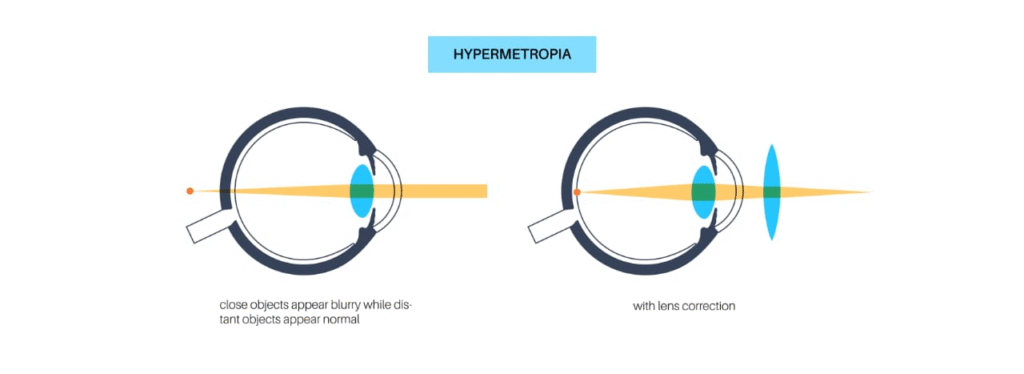
🔵 For hypermetropia: object at 25 cm should appear at 100 cm.
Lens formula: 1/f = 1/v – 1/u
u = –25 cm, v = –100 cm
1/f = (–1/100) – (–1/25) = –0.01 + 0.04 = 0.03 → f = 33.3 cm.
Power = 100 / f = 100 / 33.3 ≈ +3 D.
✔️ Correction: Convex lens of +3 D.
✏️ Diagram (to be drawn in exam): Convex lens placed in front of hypermetropic eye, converging rays onto retina.
💡Question 8
Why is a normal eye not able to see clearly the objects placed closer than 25 cm?
Answer
🟢 The ciliary muscles cannot increase curvature of lens beyond a limit.
🔵 Hence focal length cannot be shortened further.
✔️ So rays from objects closer than 25 cm are not focused on retina → blurred vision.
💡Question 9
What happens to the image distance in the eye when we increase the distance of an object from the eye?
Answer
🌟 The image distance (lens to retina) is fixed.
🟡 Eye lens changes focal length by accommodation.
✔️ Image distance remains constant; only focal length varies.
💡Question 10
Why do stars twinkle?
Answer
🔵 Starlight passes through Earth’s atmosphere, layers of varying refractive index.
🟢 Light undergoes continuous atmospheric refraction.
🟡 Apparent brightness changes → star appears to twinkle.
💡Question 11
Explain why the planets do not twinkle.
Answer
🌍 Planets are much closer; they appear as extended sources of light.
🔵 The effects of atmospheric refraction from different parts average out.
✔️ Thus planets shine steadily without noticeable twinkling.
💡Question 12
Why does the sky appear dark instead of blue to an astronaut?
Answer
💧 Scattering of light requires atmosphere.
🌌 Space has no atmosphere → no scattering.
✔️ Hence sky appears dark/black to astronauts.
————————————————————————————————————————————————————————————————————————————
OTHER IMPORTANT QUESTIONS FOR EXAMS
(CBSE MODEL QUESTION PAPER)
ESPECIALLY MADE FROM THIS CHAPTER ONLY
⚙️ Section A: Q1–6 (1 Mark Each – MCQ Type)
🔵 Question 1: Which part of the human eye controls the amount of light entering it?
🔵 (A) Cornea
🟢 (B) Iris
🔴 (C) Pupil
🟡 (D) Retina
✔️ Answer: (B) Iris
💡 The iris adjusts the size of the pupil to regulate the amount of light entering the eye.
🔵 Question 2: The image formed on the retina of the human eye is —
🔵 (A) Real and inverted
🟢 (B) Virtual and erect
🔴 (C) Real and erect
🟡 (D) Virtual and inverted
✔️ Answer: (A) Real and inverted
💡 The eye lens forms a real, inverted image on the retina.
🔵 Question 3: The change in the focal length of the eye lens is caused by —
🔵 (A) Retina
🟢 (B) Pupil
🔴 (C) Ciliary muscles
🟡 (D) Iris
✔️ Answer: (C) Ciliary muscles
💡 These muscles adjust the curvature of the lens for focusing near or distant objects (accommodation).
🔵 Question 4: The defect of vision due to elongation of eyeball is —
🔵 (A) Myopia
🟢 (B) Hypermetropia
🔴 (C) Presbyopia
🟡 (D) Astigmatism
✔️ Answer: (A) Myopia
💡 Myopia or short-sightedness occurs when the eyeball becomes too long.
🔵 Question 5: The splitting of white light into seven colours is called —
🔵 (A) Reflection
🟢 (B) Refraction
🔴 (C) Dispersion
🟡 (D) Scattering
✔️ Answer: (C) Dispersion
💡 Dispersion occurs when white light splits into its constituent colours (VIBGYOR).
🔵 Question 6: Which colour of light is scattered the most in the atmosphere?
🔵 (A) Red
🟢 (B) Blue
🔴 (C) Yellow
🟡 (D) Green
✔️ Answer: (B) Blue
💡 Blue light has the shortest wavelength and is scattered most by air molecules.
⚡ Section B: Q7–12 (2 Marks Each – Short Answers)
🔵 Question 7: Define the power of accommodation of the human eye.
✔️ Answer:
The ability of the eye lens to adjust its focal length to focus near and distant objects clearly on the retina is called power of accommodation.
🟢 Question 8: What causes presbyopia?
✔️ Answer:
Presbyopia occurs due to the weakening of ciliary muscles and loss of flexibility of the eye lens with age, making it difficult to see nearby objects.
🔴 Question 9: Why do stars twinkle?
✔️ Answer:
Light from stars undergoes refraction through different layers of air having varying densities. The apparent position of the star keeps changing slightly, causing twinkling.
🟡 Question 10: What is the function of the retina in the human eye?
✔️ Answer:
Retina acts as a screen where the image is formed. It contains light-sensitive cells (rods and cones) which convert light into electrical signals sent to the brain via the optic nerve.
🔵 Question 11: What type of lens is used to correct hypermetropia?
✔️ Answer:
A convex lens is used to correct hypermetropia (far-sightedness).
🟢 Question 12: State two causes of dispersion of light.
✔️ Answer:
➡️ Different colours of light travel at different speeds in glass.
➡️ Each colour bends by a different angle due to varying refractive indices.
⚙️ Section C: Q13–22 (3 Marks Each – Mid-Length Answers)
🔵 Question 13: Explain the structure of the human eye.
✔️ Answer:
Main parts:
• Cornea: Transparent front part that refracts light.
• Iris: Coloured part controlling pupil size.
• Pupil: Opening through which light enters.
• Lens: Focuses light on retina.
• Retina: Contains rods and cones for vision.
• Optic nerve: Carries signals to the brain.
🟢 Question 14: Differentiate between myopia and hypermetropia.
✔️ Answer:
• Myopia: Near objects seen clearly, distant appear blurred; corrected by concave lens.
• Hypermetropia: Distant objects seen clearly, near appear blurred; corrected by convex lens.
🔴 Question 15: What is the dispersion of light? Explain with an example.
✔️ Answer:
Dispersion is the splitting of white light into its constituent colours when it passes through a prism.
💡 Example: Formation of a rainbow or prism experiment showing VIBGYOR.
🟡 Question 16: Explain the formation of a rainbow.
✔️ Answer:
Sunlight enters raindrops, gets refracted and dispersed, internally reflected, and finally refracted again to form a spectrum of seven colours — forming a rainbow opposite the Sun.
🔵 Question 17: What is atmospheric refraction? Give two examples.
✔️ Answer:
Atmospheric refraction is bending of light by the Earth’s atmosphere due to change in air density.
Examples:
1️⃣ Twinkling of stars.
2️⃣ Apparent rise of the Sun before actual sunrise.
🟢 Question 18: Why does the Sun appear reddish during sunrise and sunset?
✔️ Answer:
At sunrise/sunset, sunlight travels longer through the atmosphere; blue light is scattered away and only red light reaches the observer’s eyes.
🔴 Question 19: What is the role of ciliary muscles in eye vision?
✔️ Answer:
Ciliary muscles change the curvature of the lens, altering its focal length.
➡️ For near objects: lens becomes thicker.
➡️ For distant objects: lens becomes thinner.
🟡 Question 20: What is the function of rods and cones in the retina?
✔️ Answer:
• Rods: Sensitive to dim light (night vision).
• Cones: Sensitive to bright light and colour (day vision).
🔵 Question 21: Define scattering of light and give one application.
✔️ Answer:
Scattering is the phenomenon of spreading of light in all directions by particles of medium.
💡 Application: Blue colour of sky or red colour of Sun at sunset.
🟢 Question 22: What are the causes of colour of sky and colour of the Sun?
✔️ Answer:
• Sky appears blue due to scattering of shorter wavelength (blue).
• Sun appears reddish at sunrise/sunset due to longer path and scattering of shorter wavelengths.
🧠 Section D: Q23–30 (4 Marks Each – Long and Case-Based Answers)
🔵 Question 23: Explain the process of accommodation in the human eye with diagrammatic description.
✔️ Answer:
Accommodation is the ability of the eye lens to adjust its focal length.
• For near objects — ciliary muscles contract, lens becomes thicker.
• For distant objects — muscles relax, lens becomes thinner.
💡 This keeps the image focused on retina.
🟢 Question 24: Describe defects of vision and their correction.
✔️ Answer:
1️⃣ Myopia (short-sightedness): Image forms in front of retina; corrected with concave lens.
2️⃣ Hypermetropia (long-sightedness): Image forms behind retina; corrected with convex lens.
3️⃣ Presbyopia: Due to age; corrected with bifocal lenses.
🔴 Question 25: What is refraction through the atmosphere? Explain the apparent position of stars.
✔️ Answer:
Atmosphere has layers with varying densities; light bends continuously as it passes through them.
This makes stars appear slightly higher and their light flicker — apparent twinkling.
🟡 Question 26: Explain the formation of rainbow in the sky after rain.
✔️ Answer:
Raindrops act like tiny prisms:
➡️ Refraction and dispersion of sunlight inside the drop.
➡️ Internal reflection from back surface.
➡️ Refraction again while coming out.
💡 This results in seven-colour spectrum arranged as VIBGYOR.
🔵 Question 27: Case Study — A person can see distant objects clearly but not near objects.
✔️ Answer:
➡️ The defect is hypermetropia.
➡️ The image forms behind retina.
➡️ Corrected by using a convex lens that converges the rays before entering the eye.
🟢 Question 28: Explain why danger signals are red in colour.
✔️ Answer:
Red light has the longest wavelength, hence scattered the least.
It can travel long distances through dust, fog, or smoke — visible clearly even in poor weather.
🔴 Question 29: Why do planets not twinkle like stars?
✔️ Answer:
Planets are much closer and appear as extended sources of light.
Variations in refractive index are averaged out over their larger image, so they do not twinkle.
🟡 Question 30: Describe an experiment to show the dispersion of white light by a glass prism.
✔️ Answer:
➡️ Pass a narrow beam of sunlight through a glass prism onto a white screen.
➡️ The light splits into seven colours forming a spectrum (VIBGYOR).
💡 This proves that white light is composed of multiple colours.
————————————————————————————————————————————————————————————————————————————