
Class 10 : English – Lesson 31. Grammar 1

—————————–
DETERMINERS
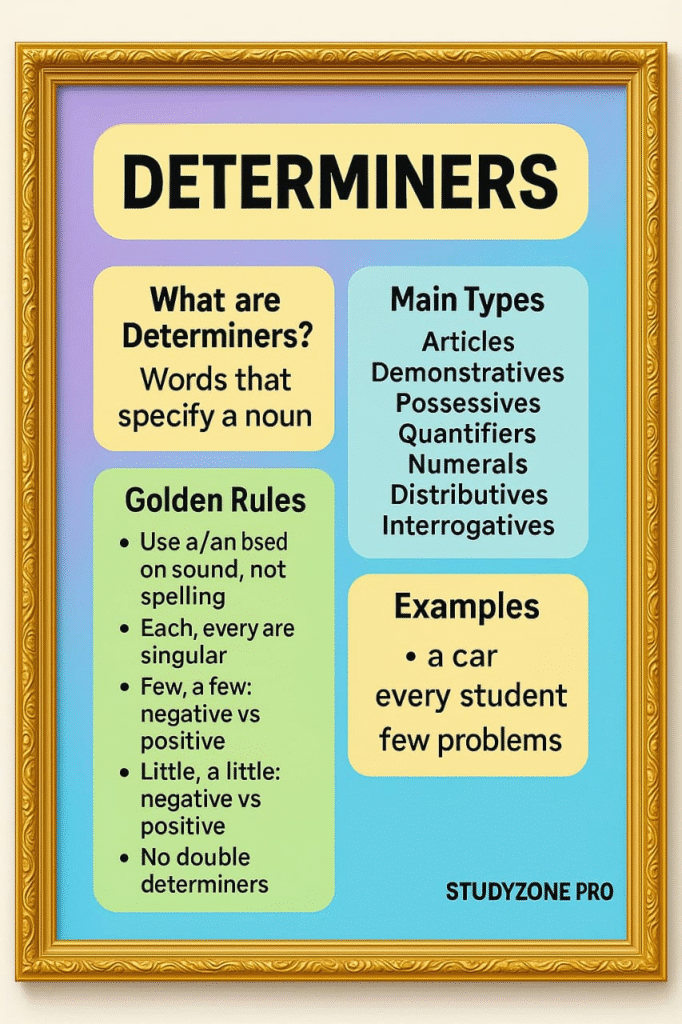
🔵💠 What are Determiners?
🌈 Definition: Words placed before nouns to limit / specify them.
🎯 They answer: Which one? Whose? How many? What amount?
✨ Examples: this book, my brother, two pens, little water
🟢💠 Order in a Noun Phrase
👉 Predeterminer ➝ Central Determiner ➝ Post-determiner ➝ Adjective ➝ Noun
🔹 Predeterminers: all, both, half
🔹 Central: the, a, an, this, my, any, each, no
🔹 Post-determiners: two, first, several, many, little
💡 Example: all my three close friends
🟣💠 Types of Determiners (with Rules + Examples)
1️⃣ 📝 Articles (a, an, the)
🟨 a → consonant sound (a book, a one-rupee coin)
🟨 an → vowel sound (an hour, an MA, an honest man)
🟨 the → unique / specific (the sun, the Himalayas, the Gita)
🚫 Omission (zero article): go to school, play cricket, at breakfast
2️⃣ 👆 Demonstratives (this, that, these, those)
🟧 Near vs Far: this pen / that pen, these stars / those stars
🔔 Agree with number: this kind / these kinds
3️⃣ 👑 Possessives (my, your, his, her, its, our, their, noun+’s)
🟦 Show ownership: my car, their ideas
🚫 Don’t pair with articles (❌ the my book → ✅ my book)
✅ Use of with inanimates: roof of the house
4️⃣ 📊 Quantifiers
🔸 Countable → many, few, several, a few, the few
🔸 Uncountable → much, little, a little, the little
🔸 Both → some, any, a lot of, plenty of, enough
✨ Contrast:
🌑 few = hardly any (negative)
🌟 a few = some (positive)
🌑 little = hardly any (negative)
🌟 a little = some (positive)
5️⃣ ❓ Interrogatives (which, what, whose)
🔹 what → general: What subject do you teach?
🔹 which → choice: Which bus goes there?
🔹 whose → possession: Whose notebook is this?
🔴💠 Precautions & Common Errors
⚠️ Singular countable noun needs a determiner.
❌ Book is useful.
✅ A book is useful.
⚠️ Don’t use double determiners:
❌ the my pen → ✅ my pen
⚠️ Sound not spelling:
✅ an hour, an MA, an honest act
✅ a university, a European
⚠️ Fewer vs Less
✅ fewer students (countable)
✅ less sugar (uncountable)
⚠️ Each / Every → singular verb
⚠️ Both → plural verb
⚠️ Either / Neither → singular verb
🟡💠 Rapid Recall Tables
📌 Articles Quick Use
🟢 a + consonant sound → a European
🟢 an + vowel sound → an hour
🟢 the + unique/superlative → the best, the Himalayas
🟢 zero article → at school, at breakfast
📌 Quantifier Chooser
🌟 Countable (positive small no.) → a few
🌑 Countable (almost none) → few
🌟 Uncountable (positive small amt.) → a little
🌑 Uncountable (almost none) → little
📝 PRACTICE SECTION (Exam Pattern)
🟢 Set A — Gap Filling (12 Q)
1.There is _ sugar in the bowl.
2.He met _ honest man on the road.
3._ sun rises in the east.
4.We saw _ Himalayas from the plane.
5.She bought _ oranges and _ bananas.
6.There are not _ students present today.
7.He worked for _ hour.
8._ of the two is guilty.
9._ Ganga is a holy river.
10.I have read _ Ramayana.
11.There is _ hope left.
12._ student must carry ID.
✔ Answers: some, an, The, the, some, any, an, Either, The, the, little, Every
🔵 Set B — Error Correction (10 Q)
1.She has much friends. → many friends
2.I met an European. → a European
3.He has less problems now. → fewer problems
4.Each of the players were given a prize. → was given
5.The Mount Everest is the highest peak. → Mount Everest
6.These kind of mistakes are common. → This kind / These kinds
7.Neither of the answers are correct. → is correct
8.He gave me an one-rupee coin. → a one-rupee coin
9.A gold is precious. → Gold
10.She read a Gita. → the Gita
🟣 Set C — MCQs (6 Q)
1.There are not _ apples left.
(A) much (B) any (C) little (D) some
✔ Ans → B
2.I have read _ Mahabharata.
(A) a (B) an (C) the (D) no article
✔ Ans → C
3._ of you will go first.
(A) Either (B) Neither (C) Both (D) None
✔ Ans → A
4.She bought _ milk.
(A) many (B) a few (C) much (D) several
✔ Ans → C
5.There are _ reasons to be hopeful.
(A) much (B) many (C) less (D) few
✔ Ans → B
6._ of the information was wrong.
(A) Few (B) A few (C) Little (D) A little
✔ Ans → C
🔴 Set D — Sentence Transformation (6 Q)
1.❌ Few friends came. (negative)
✅ A few friends came. (positive)
2.❌ Little knowledge is dangerous.
✅ A little knowledge is useful.
3.❌ These kind of problems is common.
✅ This kind of problem is common.
4.❌ Neither of the two answers are correct.
✅ Neither of the two answers is correct.
5.❌ He solved last two questions.
✅ He solved the last two questions.
6.❌ She gave me an useful idea.
✅ She gave me a useful idea.
🌟 Final Summary (Quick Memory Box)
✨ Singular countable nouns always need a determiner.
✨ a/an depend on sound not spelling.
✨ Few/Little = negative, A few/A little = positive.
✨ Each/Every → singular verb, Both → plural, Either/Neither → singular.
✨ Use the with rivers, seas, deserts, ranges, unique things.
———————————————————————————————————————————————————————————————————————————-
TENSES
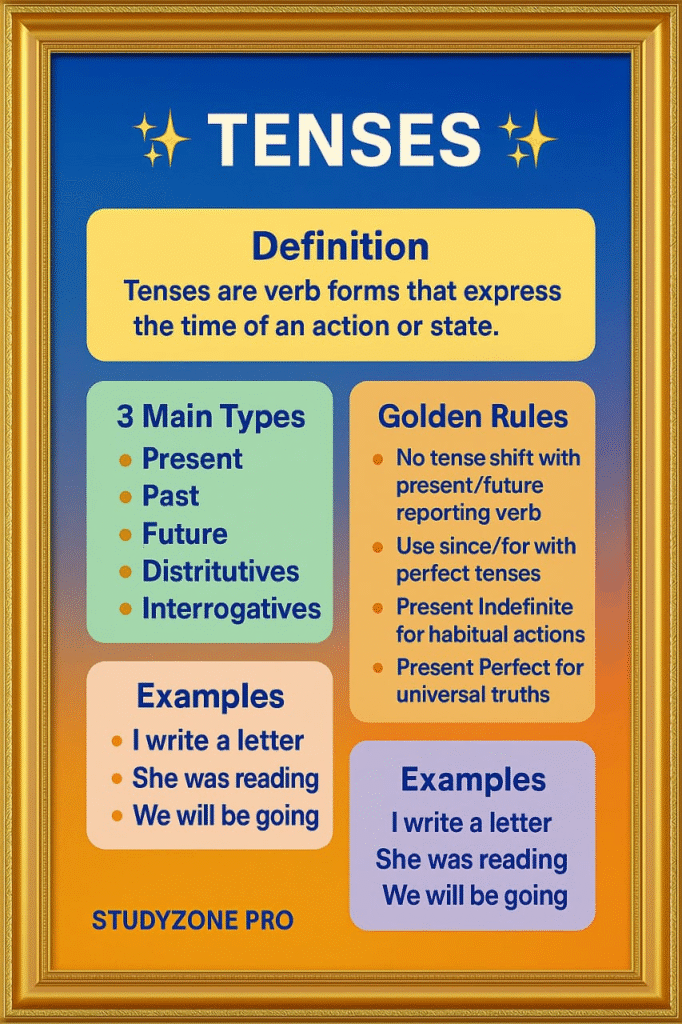
🔵💠 What are Tenses?
🌈 Definition: Tense shows the time of an action and the state of verb.
🎯 It indicates when an action happens (past, present, future) and what kind of action it is (completed, continuing, habitual, planned).
✨ Example: She writes a letter (present),
She wrote a letter (past),
She will write a letter (future).
🟢💠 Division of Tenses
Tenses are divided into 3 main types, each with 4 aspects.
🔷 Present
1️⃣ Present Indefinite (Simple Present)
2️⃣ Present Continuous
3️⃣ Present Perfect
4️⃣ Present Perfect Continuous
🔷 Past
1️⃣ Past Indefinite (Simple Past)
2️⃣ Past Continuous
3️⃣ Past Perfect
4️⃣ Past Perfect Continuous
🔷 Future
1️⃣ Future Indefinite (Simple Future)
2️⃣ Future Continuous
3️⃣ Future Perfect
4️⃣ Future Perfect Continuous
🟣💠 Detailed Rules + Examples
🔹 1. Present Tenses
✅ Simple Present
Habitual / universal truths.
Structure: S + V1 / V1+s/es
Example: She plays cricket. The sun rises in the east.
✅ Present Continuous
Action happening now / temporary.
Structure: S + is/are/am + V1+ing
Example: She is playing cricket now.
✅ Present Perfect
Completed action with effect in present.
Structure: S + has/have + V3
Example: She has written a letter.
✅ Present Perfect Continuous
Action started in past and still continuing.
Structure: S + has/have been + V1+ing + since/for
Example: She has been studying since morning.
——
🔹 2. Past Tenses
✅ Simple Past
Completed action in past.
Structure: S + V2
Example: She wrote a letter yesterday.
✅ Past Continuous
Action continuing at a past moment.
Structure: S + was/were + V1+ing
Example: She was reading when I came.
✅ Past Perfect
Action completed before another past action.
Structure: S + had + V3
Example: She had finished work before he arrived.
✅ Past Perfect Continuous
Action continuing up to a point in past.
Structure: S + had been + V1+ing + since/for
Example: She had been waiting for two hours before the bus came.
——–
🔹 3. Future Tenses
✅ Simple Future
Action that will happen.
Structure: S + will/shall + V1
Example: She will sing a song.
✅ Future Continuous
Action continuing at a future moment.
Structure: S + will be + V1+ing
Example: She will be studying at 8 p.m.
✅ Future Perfect
Action completed before a future time.
Structure: S + will have + V3
Example: She will have finished her project by tomorrow.
✅ Future Perfect Continuous
Action continuing for some time in future.
Structure: S + will have been + V1+ing + since/for
Example: She will have been studying for 2 hours by evening.
——–
🔴💠 Precautions + Common Errors
⚠️ Don’t mix tenses:
❌ She is coming yesterday.
✅ She came yesterday.
⚠️ Since vs For
Since → point of time (since 2010)
For → duration (for 5 years)
⚠️ Do/Does in Simple Present
Negative/Question: He does not play, Does he play?
⚠️ Had vs Has/Have
Past → had
Present → has/have
⚠️ Will vs Shall
Modern usage: will for all subjects
Old rule: shall with I/we, will with others
🟡💠 Rapid Recall Table
📌 Simple Present → Habit / Truth → V1 (+s/es)
📌 Present Continuous → Now → is/are/am + V+ing
📌 Present Perfect → Completed / effect now → has/have + V3
📌 Present Perfect Continuous → Ongoing since past → has/have been + V+ing
📌 Simple Past → Past completed → V2
📌 Past Continuous → Ongoing past → was/were + V+ing
📌 Past Perfect → Earlier past action → had + V3
📌 Past Perfect Continuous → Ongoing till past → had been + V+ing
📌 Simple Future → Will happen → will/shall + V1
📌 Future Continuous → Ongoing in future → will be + V+ing
📌 Future Perfect → Done before future point → will have + V3
📌 Future Perfect Continuous → Ongoing till future point → will have been + V+ing
📝 PRACTICE SECTION (Exam-Oriented)
🟢 Set A — Gap Filling (12 Q)
1.She _ (go) to school every day.
2.The train _ (leave) at 5 yesterday.
3.They _ (play) cricket now.
4.By next week, he _ (finish) the project.
5.When I called, she _ (sleep).
6.He _ (work) here since 2010.
7.The sun _ (rise) in the east.
8.They _ (study) for 2 hours before the teacher came.
9.At this time tomorrow, I _ (travel) to Delhi.
10.She _ (be) absent yesterday.
11.He _ (read) a novel since morning.
12.By evening, she _ (wait) for two hours.
✔ Answers: goes, left, are playing, will have finished, was sleeping, has been working, rises, had been studying, will be travelling, was, has been reading, will have been waiting
🔵 Set B — Error Correction (10 Q)
1.He go to school daily. → goes
2.They has completed homework. → have
3.She did not went to market. → go
4.She is knowing him for years. → has known
5.He will comes tomorrow. → come
6.They was playing football. → were
7.The train leave at 8 every day. → leaves
8.By 2020, he has completed studies. → had
9.She is go to market. → is going
10.Neither boys was guilty. → were
🟣 Set C — MCQs (6 Q)
1.By next year, she _ her course.
(A) completes (B) will complete (C) will have completed (D) is completing
✔ Ans → C
2.She _ TV when I came.
(A) watches (B) was watching (C) is watching (D) watched
✔ Ans → B
3.He _ English for 5 years.
(A) learnt (B) has learnt (C) has been learning (D) was learning
✔ Ans → C
4.At 9 p.m. tomorrow, I _ my dinner.
(A) will eat (B) will be eating (C) eat (D) eating
✔ Ans → B
5.She _ a letter yesterday.
(A) write (B) wrote (C) writes (D) written
✔ Ans → B
6.The sun _ in the east.
(A) rise (B) rises (C) rose (D) rising
✔ Ans → B
🔴 Set D — Transformation (6 Q)
1.She is reading now. (Simple Present) → She reads now.
2.He goes to school daily. (Present Continuous) → He is going to school daily.
3.She sang a song. (Past Perfect) → She had sung a song.
4.They will complete work. (Future Perfect) → They will have completed work.
5.I was playing. (Simple Past) → I played.
6.He will study since morning. (Correct) → He has been studying since morning.
🌟 Final Quick Memory
⏰ Simple = fact/habit/past/future plan.
⏰ Continuous = ongoing.
⏰ Perfect = completed action with reference.
⏰ Perfect Continuous = action continuing till a point.
———————————————————————————————————————————————————————————————————————————
MODELS

🔵💠 What are Modals?
🌈 Definition: Modals are helping verbs (auxiliary verbs) that express ability, possibility, permission, necessity, obligation, certainty, probability, etc.
🎯 They always appear with a main verb (bare infinitive V1), never alone.
✨ Examples: can, could, may, might, shall, should, will, would, must, ought to, need, dare, used to.
🟢💠 General Features of Modals
🔹 No -s / -es with 3rd person singular:
✅ She can sing.
❌ She cans sing
.
🔹 Followed by V1 (main verb base form):
✅ He will go.
❌ He will goes.
🔹 Same form for all subjects: I can, You can, He can, They can.
🔹 Negative → add not after modal: cannot / can’t, should not / shouldn’t, must not / mustn’t.
🟣💠 Common Modals with Meanings & Uses
1️⃣ Can / Could
🌟 Ability: I can swim.
🌟 Possibility: It can rain today.
🌟 Permission (informal): You can leave now.
🌟 Could → past ability / polite request: I could ride a cycle when I was 6. Could you help me?
2️⃣ May / Might
🌟 Permission (formal): May I come in?
🌟 Possibility: It may rain tomorrow.
🌟 Might → weaker possibility: He might be late.
3️⃣ Shall / Should
🌟 Shall → future (traditional with I / we): I shall return.
🌟 Should → advice / duty / expectation: You should study well.
4️⃣ Will / Would
🌟 Will → strong future: She will win the race.
🌟 Would → past habit / polite request: When I was a child, I would play all day.
5️⃣ Must
🌟 Strong obligation / necessity: You must wear a helmet.
🌟 Logical certainty: This must be the place.
6️⃣ Ought to
🌟 Moral duty: We ought to respect elders.
🌟 Strong advice: You ought to work harder.
7️⃣ Need / Dare
🌟 Need (modal): necessity in negative / interrogative.
Need you go now? / You need not worry.
🌟 Dare (modal): courage in negative / interrogative.
Dare he oppose me?
8️⃣ Used to
🌟 Past habit / state: I used to play football in school.
🔴💠 Precautions & Errors
⚠️ Don’t use double modals:
❌ He will can go.
✅ He will be able to go.
⚠️ Use bare infinitive after modals:
❌ He can goes.
✅ He can go.
⚠️ Must vs Should
Must = strong necessity (You must wear helmet).
Should = mild advice (You should eat fruits).
⚠️ May vs Can
Can = ability / informal permission.
May = formal permission / possibility.
🟡💠 Rapid Recall (Table of Modals)
🔹 Modal 🔹 Function / Use 🔹 Example
Can Ability, possibility, permission She can swim.
Could Past ability, polite request Could you lend me a pen?
May Permission, possibility May I come in?
Might Weaker possibility It might rain.
Shall Future (I/we), determination I shall succeed.
Should Advice, duty You should respect parents.
Will Future, certainty He will arrive soon.
Would Past habit, polite request Would you help me?
Must Necessity, obligation You must follow rules.
Ought to Moral duty We ought to save trees.
Need Necessity (negative/interrogative) Need you go now?
Dare Courage (negative/interrogative) Dare he oppose me?
Used to Past habit/state He used to live here.
📝 PRACTICE SECTION (Exam-Style)
🟢 Set A — Gap Filling (12 Q)
1. You _ (must / should) fasten your seat belt while driving.
2. She _ (can / may) speak three languages.
3. _ I use your phone, please?
4. He said it _ (might / can) rain today.
5. We _ (ought / must) to protect our environment.
6. When I was young, I _ (used to / must) climb trees.
7. She is not answering; she _ (must / should) be asleep.
8. You _ (need / dare) not worry about this issue.
9. _ you please pass the salt?
10.They _ (will / would) go for a picnic tomorrow.
11. Nobody _ (dare / ought) to question the judge.
12.Students _ (shall / should) complete their work on time.
✔ Answers: must, can, May, might, ought, used to, must, need, Could, will, dare, should,
🔵 Set B — Error Correction (10 Q)
1.He can sings well. → He can sing well.
2.You must to follow rules. → You must follow rules.
3.I used play cricket daily. → I used to play cricket daily.
4. Need he goes now? → Need he go now?
5. She may can solve this. → She may solve this.
6. He dare to oppose me. → He dare oppose me.
7. You should goes to school. → You should go to school.
8. I will be able can finish it. → I will be able to finish it.
9. Ought we respect elders? → Ought we to respect elders?
10. She must not to leave early. → She must not leave early.
🟣 Set C — MCQs (6 Q)
1. You _ respect your parents.
(A) may (B) ought to (C) can (D) might
✔ Ans → B
2. He _ be at the station; I just saw him there.
(A) must (B) should (C) may (D) might
✔ Ans → A
3. When I was young, I _ play for hours.
(A) must (B) used to (C) dare (D) should
✔ Ans → B
4. _ you like some tea?
(A) Should (B) Could (C) Ought (D) Need
✔ Ans → B
5. You _ not park here; it is prohibited.
(A) may (B) must (C) must not (D) ought
✔ Ans → C
6. He said it _ rain today.
(A) may (B) must (C) shall (D) will
✔ Ans → A
🔴 Set D — Transformation (6 Q)
1.❌ He cans swim. → ✅ He can swim.
2.❌ You should to obey teachers. → ✅ You should obey teachers.
3.❌ She used play cricket. → ✅ She used to play cricket.
4.❌ He dare to tell me. → ✅ He dare tell me.
5.❌ He will can sing tomorrow. → ✅ He will be able to sing tomorrow.
6.❌ May I can sit here? → ✅ May I sit here?
🌟 Final Quick Memory
✨ Ability → can/could
✨ Possibility → may/might
✨ Duty/Advice → should/ought to
✨ Strong necessity → must
✨ Future → will/shall
✨ Past habit → used to
✨ Negative necessity → need not
✨ Courage (challenge) → dare
———————————————————————————————————————————————————————————————————————————
SUBJECT VERB AGREEMENT

🔵💠 What is Subject–Verb Concord?
🌈 Definition: Subject–Verb Concord means the verb must agree with the subject in number and person.
🎯 Singular subject → Singular verb; Plural subject → Plural verb.
✨ Example:
✅ She writes well.
✅ They write well.
🟢💠 Golden Rules of Subject–Verb Agreement
1️⃣ Singular vs Plural Subjects
🔹 Singular subject → Singular verb (is, was, has, goes)
🔹 Plural subject → Plural verb (are, were, have, go)
✔ Example: The boy is playing. / The boys are playing.
2️⃣ Two Subjects Joined by and
Usually plural → take plural verb.
✔ Ram and Shyam are friends.
Exception: when both refer to one thing/person.
✔ Bread and butter is my breakfast.
✔ Time and tide wait for none.
3️⃣ Subjects Joined by or / either…or / neither…nor
Verb agrees with subject closest to it.
✔ Either Ram or his friends are guilty.
✔ Neither the students nor the teacher was present.
4️⃣ Indefinite Pronouns
Singular: each, every, either, neither, one, anyone, everyone, somebody, nobody → take singular verb.
✔ Each student is honest.
✔ Nobody was there.
Plural: few, many, several, both → take plural verb.
✔ Few students were late.
Either singular/plural: some, all, most, any → depend on noun.
✔ Some water is left. (uncountable)
✔ Some students are absent. (countable)
5️⃣ Collective Nouns
As a whole group → Singular verb.
✔ The team is playing well.
As individuals → Plural verb.
✔ The team are quarreling among themselves.
6️⃣ Amounts, Time, Distance, Weight, Money
Singular verb (considered as a unit).
✔ Five kilometers is a long walk.
✔ Fifty thousand rupees is a big sum.
7️⃣ Words with with, together with, along with, as well as
Verb agrees with first subject.
✔ The principal, along with the teachers, was present.
8️⃣ Titles of Books, Films, Subjects
Singular verb.
✔ “The Arabian Nights” is famous.
✔ Mathematics is my favorite subject.
9️⃣ Nouns Plural in Form but Singular in Meaning
Singular verb.
✔ Physics is tough.
✔ Measles is dangerous.
🔟 Relative Pronoun who/which/that
Verb agrees with the antecedent (the noun it refers to).
✔ She is one of the students who work hard.
✔ She is the only one of the students who works hard.
🔴💠 Precautions
⚠️ Don’t confuse plural form with plural meaning:
✅ News is important. (not “are”)
⚠️ Fractions and percentages:
Verb depends on noun.
✔ 50% of the water is wasted.
✔ 50% of the students are absent.
⚠️ One of always takes singular verb.
✔ One of my friends is a doctor.
🟡💠 Quick Memory Box
🟢 Singular subject = Singular verb
🟢 Plural subject = Plural verb
🟢 Either/or, neither/nor → verb with nearest subject
🟢 Collective noun → singular/plural by sense
🟢 Amount/Time/Distance → singular
🟢 Plural nouns with singular meaning (Mathematics, Politics) → singular verb
📝 PRACTICE SECTION (Exam-Style)
🟢 Set A — Gap Filling (12 Q)
1.Neither the teacher nor the students _ (be) in the class.
2.Everyone _ (like) honesty.
3.The quality of these mangoes _ (be) good.
4.Each boy and girl _ (be) present.
5.The team _ (play) well today.
6.Fifty rupees _ (be) too much for this.
7.Ten kilometers _ (be) a long distance.
8.Either my brother or I _ (be) to blame.
9.A bouquet of roses _ (smell) fresh.
10.Measles _ (be) a dangerous disease.
11.The furniture _ (be) new.
12.Some of the students _ (be) absent.
✔ Answers: were, likes, is, is, is, is, is, am, smells, is, is, are
🔵 Set B — Error Correction (10 Q)
1.Neither of the boys are guilty. → is
2.The scissors is on the table. → are
3.Mathematics are my favorite subject. → is
4.One of my friends are a singer. → is
5.Fifty kilometers are a long distance. → is
6.The team are playing as one unit. → is
7.These kind of mistakes is common. → are
8.Everyone know the truth. → knows
9.Either Ravi or his friends is coming. → are
10.The Arabian Nights are famous. → is
🟣 Set C — MCQs (6 Q)
1.Neither of the answers _ correct.
(A) is (B) are (C) were (D) have
✔ Ans → A
2.Ten kilometers _ a short distance for him.
(A) is (B) are (C) were (D) have
✔ Ans → A
3.One of the girls _ absent today.
(A) are (B) is (C) have (D) were
✔ Ans → B
4.The jury _ divided in their opinion.
(A) was (B) were (C) is (D) has
✔ Ans → B
5.Neither Ramesh nor his friends _ guilty.
(A) is (B) are (C) was (D) has
✔ Ans → B
6.The news _ true.
(A) is (B) are (C) were (D) have
✔ Ans → A
🔴 Set D — Transformation (6 Q)
1.❌ Everyone know the answer.
✅ Everyone knows the answer.
2.❌ The jury was divided in their opinion.
✅ The jury were divided in their opinion.
3.❌ Neither the students nor the teacher were present.
✅ Neither the students nor the teacher was present.
4.❌ Fifty rupees are too much.
✅ Fifty rupees is too much.
5.❌ One of the players are hurt.
✅ One of the players is hurt.
6.❌ The furniture are costly.
✅ The furniture is costly.
🌟 Final Quick Recap
✅ Verb matches subject in number and person.
✅ Either/or, neither/nor → nearest subject rule.
✅ Collective nouns → singular/plural by meaning.
✅ Distances, amounts, time → singular.
✅ Plural in form, singular in meaning → singular.
✅ One of → singular verb.
———————————————————————————————————————————————————————————————————————————
REPORTED SPEECHES

🔵💠 What is Reported Speech?
🌈 Definition: Reported speech is the way of reporting someone’s words without quoting them exactly.
🎯 It has two forms:
1.Direct Speech → Exact words inside quotes (“…”).
2.Indirect / Reported Speech → Meaning conveyed without quotes.
✨ Example:
Direct: He said, “I am tired.”
Indirect: He said that he was tired.
🟢💠 Rules of Transformation
1️⃣ 🔹 Change of Pronouns
Pronouns change according to sense.
I → he/she
We → they
My → his/her
Our → their
✔ Example: She said, “I love my mother.” → She said that she loved her mother.
2️⃣ 🔹 Change of Tense (when reporting verb is in past)
Simple Present → Simple Past
He said, “I play cricket.” → He said that he played cricket.
Present Continuous → Past Continuous
He said, “I am playing.” → He said that he was playing.
Present Perfect → Past Perfect
He said, “I have finished.” → He said that he had finished.
Past Indefinite → Past Perfect
He said, “I wrote a letter.” → He said that he had written a letter.
Past Continuous → Past Perfect Continuous
He said, “I was reading.” → He said that he had been reading.
Past Perfect / Past Perfect Continuous → No change.
🚫 Exception: If reporting verb is in present/future OR statement is a universal truth → No tense change.
✔ She says, “The sun rises in the east.” → She says that the sun rises in the east.
3️⃣ 🔹 Change of Time & Place Words
now → then
today → that day
tomorrow → the next day
yesterday → the previous day
here → there
this → that
these → those
✔ Example: He said, “I will go tomorrow.” → He said that he would go the next day.
4️⃣ 🔹 Change of Sentence Types
A. Statements
Reporting verbs: said / told.
Direct: She said, “I am happy.”
Indirect: She said that she was happy.
B. Questions
Yes/No type → use if / whether.
Wh-type → use same wh-word.
✔ He said, “Are you ready?” → He asked if I was ready.
✔ She said, “Where are you going?” → She asked where I was going.
C. Commands / Requests / Advice
Reporting verbs: ordered, requested, advised, suggested, etc.
Structure: reporting verb + object + to-infinitive.
✔ He said to me, “Open the door.” → He ordered me to open the door.
✔ She said to me, “Please help me.” → She requested me to help her.
D. Exclamations / Wishes
Reporting verbs: exclaimed, wished, prayed, etc.
✔ He said, “Alas! I am ruined.” → He exclaimed with sorrow that he was ruined.
✔ She said, “Hurrah! We have won.” → She exclaimed with joy that they had won.
🔴💠 Precautions
⚠️ Avoid using “that” with questions → use “if/whether” or wh-word.
⚠️ Do not change universal truths.
⚠️ Match pronouns carefully with context.
⚠️ Imperatives always change to infinitives.
⚠️ In exclamations, replace words like alas, hurrah with suitable expressions.
🟡💠 Quick Memory Box
Statements → said/told + that + clause.
Questions → asked + if/wh-word + clause.
Commands/Requests → ordered/requested/advised + object + to-infinitive.
Exclamations → exclaimed/wished/prayed + clause.
Tense shift only if reporting verb in past.
Universal truths remain unchanged.
📝 PRACTICE SECTION (Exam-Style)
🟢 Set A — Change into Reported Speech (12 Q)
1.He said, “I am busy now.”
2.She said, “I have completed my work.”
3.They said, “We shall play tomorrow.”
4.He said, “I was sleeping when you called.”
5.She said, “I had finished my homework.”
6.He said, “The earth moves round the sun.”
7.She said, “I can solve this sum.”
8.He said, “I may go to Delhi.”
9.She said, “I must complete this project.”
10.He said, “I will help you.”
11.They said, “We are studying English.”
12.She said, “I was waiting for you yesterday.”
✔ Answers:
1.He said that he was busy then.
2.She said that she had completed her work.
3.They said that they would play the next day.
4.He said that he had been sleeping when I had called.
5.She said that she had finished her homework.
6.He said that the earth moves round the sun.
7.She said that she could solve that sum.
8.He said that he might go to Delhi.
9.She said that she must complete that project.
10.He said that he would help me.
11.They said that they were studying English.
12.She said that she had been waiting for me the previous day.
🔵 Set B — Questions (10 Q)
1.He said, “Are you happy?”
2.She said, “Do you like music?”
3.He said, “Where do you live?”
4.She said, “Why are you late?”
5.He said, “Who is your teacher?”
6.She said, “Have you finished your work?”
7.He said, “Will you help me?”
8.She said, “When will you arrive?”
9.He said, “Is he playing cricket?”
10.She said, “How are you feeling now?”
✔ Answers:
1.He asked if I was happy.
2.She asked if I liked music.
3. He asked where I lived.
4.She asked why I was late.
5.He asked who my teacher was.
6.She asked if I had finished my work.
7.He asked if I would help him.
8.She asked when I would arrive.
9.He asked if he was playing cricket.
10.She asked how I was feeling then.
🟣 Set C — Commands / Requests (6 Q)
1.He said to me, “Open the door.”
→ He ordered me to open the door
2.She said to him, “Please sit down.”
→ She requested him to sit down.
3.He said to them, “Don’t make a noise.”
→ He ordered them not to make a noise.
4.She said to me, “Help the poor.”
→ She advised me to help the poor.
5.He said to her, “Never tell a lie.”
→ He advised her never to tell a lie.
6.The teacher said to the students, “Work hard.”
→ The teacher advised the students to work hard.
🔴 Set D — Exclamations (6 Q)
1.He said, “Alas! I failed.”
→ He exclaimed with sorrow that he had failed.
2.She said, “Hurrah! We have won.”
→ She exclaimed with joy that they had won.
3.He said, “What a beautiful sight!”
→ He exclaimed with wonder that it was a very beautiful sight.
4.She said, “How foolish I am!”
→ She exclaimed with regret that she was very foolish.
5.He said, “Would that I were rich!”
→ He wished that he were rich.
6.She said, “May you succeed!”
→ She prayed that I might succeed.
🌟 Final Recap
✅ Statements → that + clause.
✅ Yes/No Questions → if/whether.
✅ Wh-Questions → wh-word + clause.
✅ Commands/Requests → to-infinitive.
✅ Exclamations → exclaimed/wished/prayed.
✅ Pronoun & tense changes are crucial.
———————————————————————————————————————————————————————————————————————————