Class : 9 – Science (English) : Lesson 3. Atoms and Molecules

EXPLANATION & SUMMARY
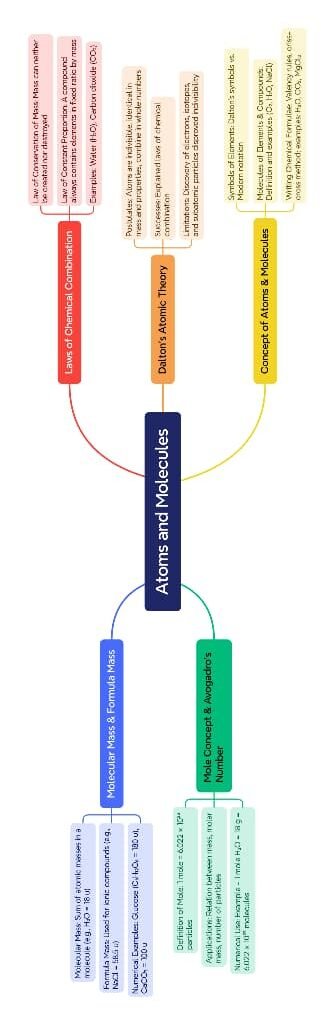
The chapter Atoms and Molecules from Class 9 NCERT Science builds a strong foundation in basic chemistry by exploring how matter is composed at the atomic and molecular level. It connects earlier concepts of matter with chemical combination and explains how atoms and molecules form the basis of all substances.
The lesson begins with the historical development of atomic theory. The idea that matter is made up of tiny indivisible particles dates back to ancient times, with thinkers like Maharishi Kanad in India and Democritus in Greece proposing early ideas about atoms. This was later formalized by John Dalton, who proposed the Dalton’s Atomic Theory. His key postulates include:
All matter is made of indivisible atoms.
Atoms of an element are identical in mass and properties.
Atoms combine in whole-number ratios to form compounds.
Atoms are neither created nor destroyed in chemical reactions.
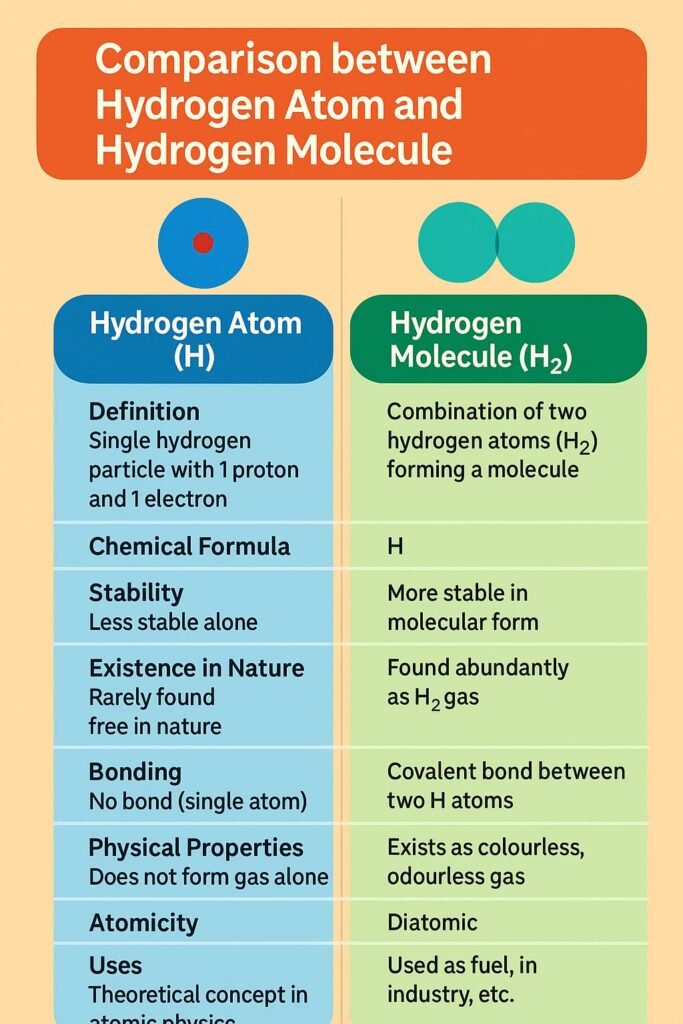
The chapter then discusses the concept of atoms, the smallest unit of an element. Each atom is represented by a symbol, mostly based on English or Latin names (e.g., O for oxygen, Fe for iron from Latin “ferrum”). These symbols are universally accepted and form the language of chemistry.
Atoms rarely exist alone in nature. They combine to form molecules, which are groups of two or more atoms bonded together. Molecules may consist of the same kind of atoms (e.g., O₂, N₂) or different kinds (e.g., H₂O, CO₂). The molecule of an element contains only one type of atom, while the molecule of a compound contains two or more different atoms chemically bonded.
The chapter introduces the concept of the atomic mass unit (amu), where 1 amu is defined as one-twelfth the mass of a carbon-12 atom. The molecular mass of a compound is calculated by adding the atomic masses of the atoms present in the molecule.
Next, the concept of ions is explained. Ions are charged particles formed when atoms gain or lose electrons. Cations are positively charged ions (e.g., Na⁺), and anions are negatively charged ions (e.g., Cl⁻). Compounds formed by the combination of cations and anions are called ionic compounds (e.g., NaCl).
A key part of the chapter is chemical formulae—representations of compounds using symbols and numerical subscripts. For example, H₂O means a molecule contains two hydrogen atoms and one oxygen atom. To write a chemical formula, one must know the valency (combining capacity) of each atom.
The chapter introduces the mole concept, which is essential for quantifying matter. One mole contains 6.022 × 10²³ particles (Avogadro’s number). The molar mass of a substance is the mass of one mole of its particles, numerically equal to its molecular mass in grams.
In conclusion, the lesson emphasizes that understanding atoms and molecules helps explain the behavior and interaction of matter. It prepares students for deeper chemical concepts, such as chemical reactions and equations, by giving them tools to visualize and calculate the smallest units of matter in physical and chemical processes.
———————————————————————————————————————————————————————————————————————————-
TEXTBOOK QUESTIONS
Question 1
A 0.24 g sample of compound of oxygen and boron was found by analysis to contain 0.096 g of boron and 0.144 g of oxygen. Calculate the percentage composition of the compound by weight.
Answer:
Given data:
Total mass of the compound = 0.24 g
Mass of boron in the compound = 0.096 g
Mass of oxygen in the compound = 0.144 g
The percentage composition formula is:
Percentage of an element = (Mass of element / Total mass of compound) × 100
Percentage of Boron:
Percentage of Boron = (0.096 g / 0.24 g) × 100 = 40%
Percentage of Oxygen:
Percentage of Oxygen = (0.144 g / 0.24 g) × 100 = 60%
Therefore, the compound contains 40% boron and 60% oxygen by weight.
Question 2
When 3.0 g of carbon is burnt in 8.00 g oxygen, 11.00 g of carbon dioxide is produced. What mass of carbon dioxide will be formed when 3.00 g of carbon is burnt in 50.00 g of oxygen? Which law of chemical combination will govern your answer?
Answer:
According to the given data:
3.0 g of carbon combines with 8.0 g of oxygen to produce 11.0 g of carbon dioxide
When 3.00 g of carbon is burnt in 50.00 g of oxygen, the reaction will still follow the Law of Definite Proportions (Law of Constant Proportions). This law states that in a pure chemical compound, elements are always present in definite proportions by mass.
Since carbon and oxygen always combine in a fixed ratio of 3:8 by mass, only 8.00 g of oxygen will be used to react with 3.00 g of carbon. The remaining 42.00 g of oxygen will remain unreacted.
Therefore, 11.00 g of carbon dioxide will be formed, and the Law of Definite Proportions governs this answer.
Question 3
What are polyatomic ions? Give examples.
Answer:
Polyatomic ions are ions that contain more than one atom. These ions consist of a group of atoms that carry a net positive or negative charge and behave as a single unit in chemical reactions.
The atoms in polyatomic ions can be of the same type or different types, and they are held together by covalent bonds. These ions carry a fixed charge and participate in ionic compound formation.
Examples of polyatomic ions:
Ammonium ion (NH₄⁺) – carries a +1 charge
Hydroxide ion (OH⁻) – carries a -1 charge
Sulfate ion (SO₄²⁻) – carries a -2 charge
Sulfite ion (SO₃²⁻) – carries a -2 charge
Carbonate ion (CO₃²⁻) – carries a -2 charge
Nitrate ion (NO₃⁻) – carries a -1 charge
Question 4
Write the chemical formulae of the following:
(a) Magnesium chloride
(b) Calcium oxide
(c) Copper nitrate
(d) Aluminium chloride
(e) Calcium carbonate
Answer:
The chemical formulae are determined by balancing the charges of the constituent ions:
(a) Magnesium chloride: MgCl₂
Mg²⁺ (magnesium ion) + Cl⁻ (chloride ion)
To balance charges: one Mg²⁺ requires two Cl⁻ ions
(b) Calcium oxide: CaO
Ca²⁺ (calcium ion) + O²⁻ (oxide ion)
Charges are already balanced in 1:1 ratio
(c) Copper nitrate: Cu(NO₃)₂
Cu²⁺ (copper ion) + NO₃⁻ (nitrate ion)
To balance charges: one Cu²⁺ requires two NO₃⁻ ions
(d) Aluminium chloride: AlCl₃
Al³⁺ (aluminium ion) + Cl⁻ (chloride ion)
To balance charges: one Al³⁺ requires three Cl⁻ ions
(e) Calcium carbonate: CaCO₃
Ca²⁺ (calcium ion) + CO₃²⁻ (carbonate ion)
Charges are already balanced in 1:1 ratio
Question 5
Give the names of the elements present in the following compounds:
(a) Quick lime
(b) Hydrogen bromide
(c) Baking powder
(d) Potassium sulphate
Answer:
(a) Quick lime (CaO):
Calcium and Oxygen
(b) Hydrogen bromide (HBr):
Hydrogen and Bromine
(c) Baking powder (NaHCO₃):
Sodium, Hydrogen, Carbon, and Oxygen
(d) Potassium sulphate (K₂SO₄):
Potassium, Sulfur, and Oxygen
Question 6
Calculate the molar mass of the following substances:
(a) Ethyne, C₂H₂
(b) Sulphur molecule, S₈
(c) Phosphorus molecule, P₄ (Atomic mass of phosphorus = 31)
(d) Hydrochloric acid, HCl
(e) Nitric acid, HNO₃
Answer:
The molar mass is calculated by adding the atomic masses of all atoms in the molecular formula:
(a) Ethyne (C₂H₂):
Molar mass = (2 × 12) + (2 × 1) = 24 + 2 = 26 u
(b) Sulphur molecule (S₈):
Molar mass = 8 × 32 = 256 u
(c) Phosphorus molecule (P₄):
Molar mass = 4 × 31 = 124 u
(d) Hydrochloric acid (HCl):
Molar mass = 1 + 35.5 = 36.5 u
(e) Nitric acid (HNO₃):
Molar mass = 1 + 14 + (3 × 16) = 1 + 14 + 48 = 63 u
————————————————————————————————————————————————————————————————————————————
OTHER IMPORTANT QUESTIONS FOR EXAMS
(MCQs)
🔒 ❓ Q1. According to the law of conservation of mass:
🟢 1️⃣ Mass can neither be created nor destroyed in a chemical reaction
🔵 2️⃣ Mass increases during a reaction
🟡 3️⃣ Mass decreases during a reaction
🟣 4️⃣ Mass is converted into energy
✔ Answer: 🟢1️⃣ Mass can neither be created nor destroyed in a chemical reaction
🔒 ❓ Q2. The law which states that elements combine in fixed proportions by mass to form a compound is called:
🟢 1️⃣ Law of conservation of mass
🔵 2️⃣ Law of constant proportions
🟡 3️⃣ Law of multiple proportions
🟣 4️⃣ Avogadro’s law
✔ Answer: 🔵2️⃣ Law of constant proportions
🔒 ❓ Q3. The smallest particle of an element that can take part in a chemical reaction is:
🟢 1️⃣ Atom
🔵 2️⃣ Molecule
🟡 3️⃣ Ion
🟣 4️⃣ Electron
✔ Answer: 🟢1️⃣ Atom
🔒 ❓ Q4. A molecule of oxygen contains:
🟢 1️⃣ One atom
🔵 2️⃣ Two atoms
🟡 3️⃣ Three atoms
🟣 4️⃣ Four atoms
✔ Answer: 🔵2️⃣ Two atoms
🔒 ❓ Q5. Which of the following represents a triatomic molecule?
🟢 1️⃣ O₂
🔵 2️⃣ H₂
🟡 3️⃣ O₃
🟣 4️⃣ N₂
✔ Answer: 🟡3️⃣ O₃
🔒 ❓ Q6. The atomicity of nitrogen (N₂) molecule is:
🟢 1️⃣ One
🔵 2️⃣ Two
🟡 3️⃣ Three
🟣 4️⃣ Four
✔ Answer: 🔵2️⃣ Two
🔒 ❓ Q7. The SI unit of amount of substance is:
🟢 1️⃣ Mole
🔵 2️⃣ Gram
🟡 3️⃣ Kilogram
🟣 4️⃣ Litre
✔ Answer: 🟢1️⃣ Mole
🔒 ❓ Q8. One mole of any substance contains:
🟢 1️⃣ 6.022 × 10²² particles
🔵 2️⃣ 6.022 × 10²³ particles
🟡 3️⃣ 6.022 × 10²⁴ particles
🟣 4️⃣ 6.022 × 10²¹ particles
✔ Answer: 🔵2️⃣ 6.022 × 10²³ particles
🔒 ❓ Q9. The formula of carbon dioxide is:
🟢 1️⃣ CO
🔵 2️⃣ CO₂
🟡 3️⃣ C₂O
🟣 4️⃣ C₂O₂
✔ Answer: 🔵2️⃣ CO₂
🔒 ❓ Q10. The molecular mass of water (H₂O) is:
🟢 1️⃣ 16 u
🔵 2️⃣ 18 u
🟡 3️⃣ 20 u
🟣 4️⃣ 14 u
✔ Answer: 🔵2️⃣ 18 u
————————————————————————————————————————————————————————————————————————————
MNEMONICS

————————————————————————————————————————————————————————————————————————————
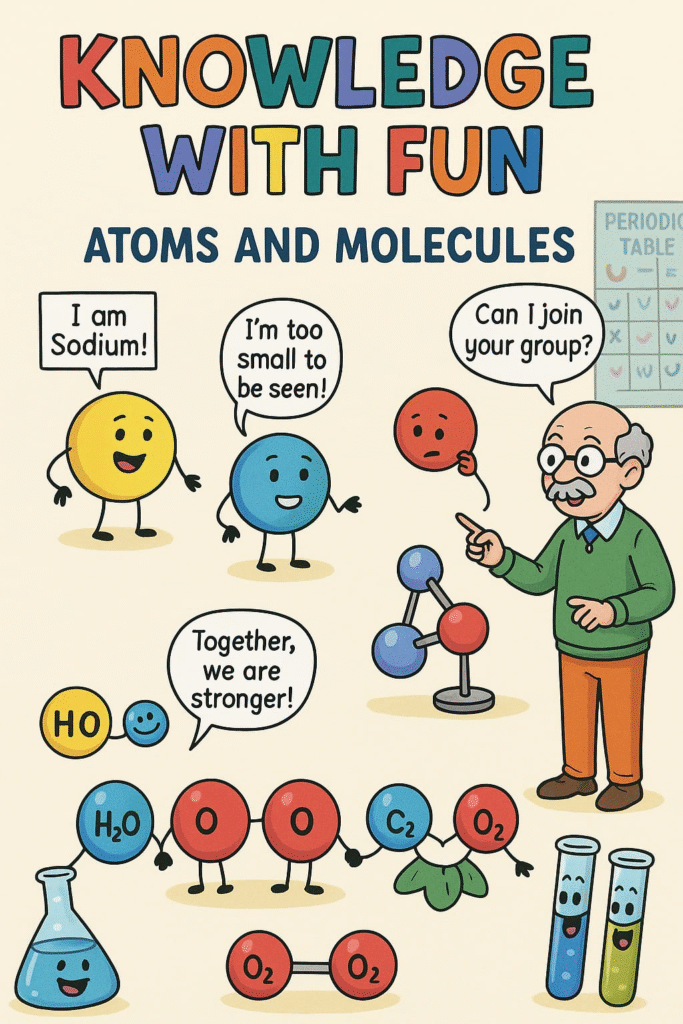
KNOWLEDGE WITH FUN
————————————————————————————————————————————————————————————————————————————