
Class : 9 – Lesson (19) The Adventures of Toto

EXPLANATION AND SUMMARY
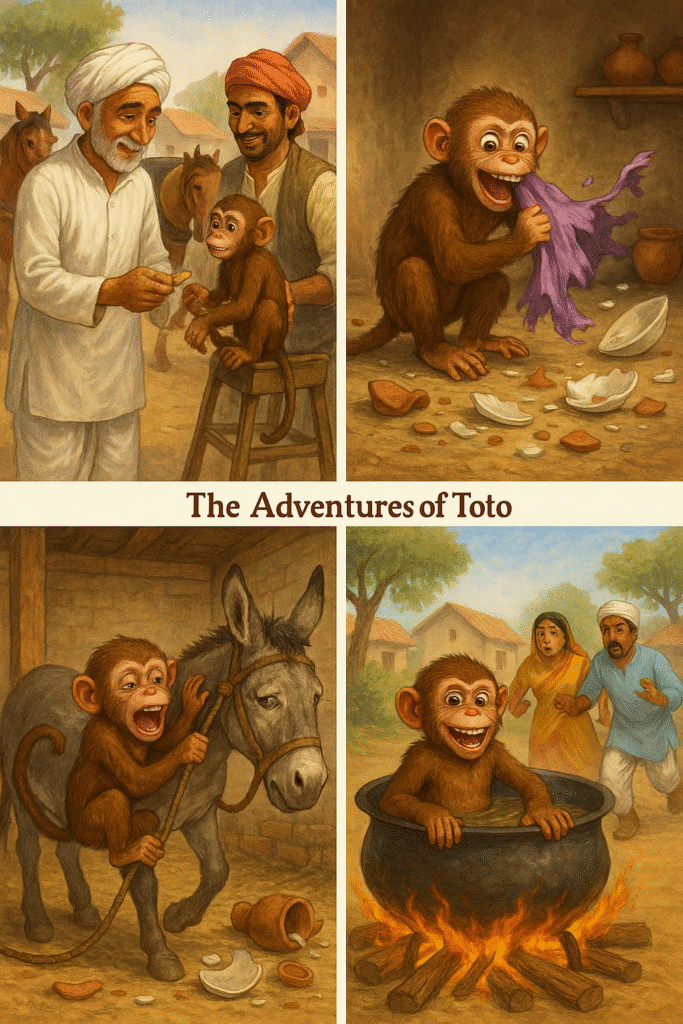
“The Adventure of Toto” is a humorous and engaging short story written by Ruskin Bond, which narrates the mischievous antics of a pet monkey named Toto. The story is a recollection by the narrator about how his grandfather brought Toto into their home and the trouble that followed.
The narrator’s grandfather was fond of animals and often brought home different kinds of pets. One day, he bought a young monkey named Toto from a tonga-driver for five rupees. Toto looked adorable with bright eyes, pearly white teeth, and a long tail. His looks were deceptive, however, because he was full of mischief and soon began to create chaos.
Since the narrator’s grandmother did not like animals in the house, Toto was kept secretly in a closet. That very night, Toto tore off the wallpaper, pulled down the peg on which his swing was tied, and destroyed his sleeping mat. He was then transferred to the servant’s quarters, where he did not get along with the other pets, especially the family donkey, Nana. Toto would constantly tease Nana and bite him, causing a lot of trouble.
Things got worse when Grandfather had to travel to Saharanpur and decided to take Toto with him. He carried him in a strong canvas bag with a lock, but Toto managed to tear through it and frighten other passengers at the railway station. He even created a scene on the train, pulling the ticket-collector’s cap. The grandfather had to buy a ticket for Toto, treating him like any other passenger, which added to the humor.
Once back home, Toto continued his mischief. One of the funniest incidents occurred when Toto tried to take a bath in the warm water tub in the bathroom. He enjoyed it like a human, testing the temperature first and then soaking himself in it. However, once the water got cold, he ran into the kitchen and nearly burned himself by sitting on a boiling kettle. He threw the kettle and scattered everything.
Toto’s appetite was also extraordinary. He would eat anything and everything. Once, he ate a whole dish of pulao meant for lunch and then flung the empty dish down from a tree, shattering it to pieces. These constant disturbances eventually made the narrator’s family realize that Toto was more trouble than delight.
Despite all these misadventures, Grandfather had a soft corner for Toto. But after much chaos, destruction, and concern from Grandmother, he finally decided to return Toto to the tonga-driver for three rupees—two rupees less than what he had paid. The family learned that wild animals, no matter how amusing or charming, are not suitable domestic pets.
✅ Conclusion
“The Adventure of Toto” is a delightful story that captures the playful yet troublesome nature of animals and the challenges of domesticating wild creatures. Through light humor and vivid storytelling, Ruskin Bond presents the idea that love for animals should be accompanied by responsibility and understanding. The story ultimately reminds us that not all animals are meant to live in human households.
____________________________________________________________________________________________________________________________________________________________
PASSAGE
📜 Passage from “The Adventure of Toto”
Toto was finally accepted in the house and given a place in the stable, where he had Nana, the family donkey, for company. But Toto wouldn’t let Nana rest. He kept pulling at her long ears with his sharp teeth. Even when tied, Toto would somehow reach her, causing such commotion that Grandfather had to shift him back to his earlier place — the servant’s quarters.
Questions and Answers
🔒 ❓ Q1. Fill in the blank (1 mark)
Identify the word from the passage that conveys a state of continuous noisy disturbance and disorder, created by Toto’s mischievous behaviour.
📌 ✅ Answer: commotion
✅ Q2. Multiple Choice Question (1 mark)
Choose the correct antonym of the word “accepted” as used in the passage:
A) permitted
B) rejected
C) welcomed
D) included
Answer: rejected
✅ Q3. Answer in 15 words (1 mark)
Why was Toto removed from the stable and sent back to the servant’s quarters?
Answer:
Because he constantly disturbed Nana by biting her ears and creating a loud, chaotic disturbance.
✅ Q4. Answer in 40 words (2 marks)
What does this passage reveal about Toto’s behavior with other animals?
Answer:
The passage shows that Toto was mischievous and aggressive towards other animals. Despite having company in the stable, he disturbed Nana continuously. His inability to behave calmly or peacefully made him unfit for shared spaces, highlighting his wild, uncontrollable nature.
———————————————————————————————————————————————————————————————————————————————-
OTHER IMPORTANT QUESTIONS
Questions 1–4 are 3 marks each (60 words)
Questions 5–6 are 6 marks each (120 words)
✅ Q1. Why was Toto bought, and how did he look when he first arrived? (3 marks – 60 words)
Answer:
Grandfather bought Toto from a tonga-driver for five rupees because he loved collecting unusual pets. Toto was a pretty monkey with sparkling eyes, white teeth, and a tail that acted like a third hand. His mischievous expression and appearance made him seem both clever and amusing, though he soon proved to be more trouble than expected.
✅ Q2. What damage did Toto cause on his first night in the closet? (3 marks – 60 words)
Answer:
On his first night, Toto tore off the ornamental wallpaper, pulled out the peg of his swing, and shredded the author’s school blazer into pieces. He proved to be a destructive force, clearly unsuitable for confinement. This incident gave the family an early glimpse of Toto’s mischievous and uncontrollable nature, which would continue throughout the story.
✅ Q3. Describe Toto’s behaviour on the train to Saharanpur. (3 marks – 60 words)
Answer:
During the train journey, Toto tore a hole in the canvas bag he was carried in and popped his head out, frightening fellow passengers. He snatched the ticket-collector’s cap and created a scene, forcing Grandfather to pay for his fare. The incident highlighted Toto’s wild energy and the challenges of keeping a monkey as a pet.
✅ Q4. How did Toto take a bath, and what was unusual about it? (3 marks – 60 words)
Answer:
Toto enjoyed warm baths and imitated the narrator. He tested the water temperature with his hand, stepped in slowly, soaked himself, and used soap generously. However, once the water turned cold, he jumped out and ran straight to the kitchen fire to warm up. His almost human-like bathing style amused the family and showcased his cleverness.
✅ Q5. Do you think animals like Toto should be kept as pets? Give reasons for your answer. (6 marks – 120 words)
Answer:
Animals like Toto, especially wild ones, should not be kept as pets. While Toto was intelligent and entertaining, his wild instincts made him destructive and difficult to manage. He damaged property, disturbed other animals, and created chaos wherever he went. Such animals require a natural environment and proper care that cannot be provided in a household setting. Keeping them for personal amusement can harm both the animal and the family. Also, domesticating wild animals is unfair to them as it limits their freedom and natural behaviour. The story shows that love for animals must come with responsibility. Pets should be chosen thoughtfully, considering their nature, needs, and suitability for a home.
✅ Q6. Imagine you are the narrator. Write a diary entry after Toto was finally returned to the tonga-driver. (6 marks – 120 words)
Answer:
Diary Entry –
Today, Grandfather finally returned Toto to the tonga-driver. I must admit, I felt a strange mix of relief and sadness. Toto was wild and always up to some mischief — tearing clothes, breaking dishes, and biting Nana’s ears! He never fit in, yet the house feels quieter now. I’ll miss his energy and the way he bathed like a gentleman. But I also know we couldn’t give him the space he needed. He belonged to the wild, not in our home. Grandmother is pleased, of course, and so are the other pets. I hope Toto finds peace wherever he is. One thing’s sure — his adventures will always be unforgettable.