
Class 7 : English – Lesson 1. The Day The River Spoke

EXPLANATION AND ANALYSIS
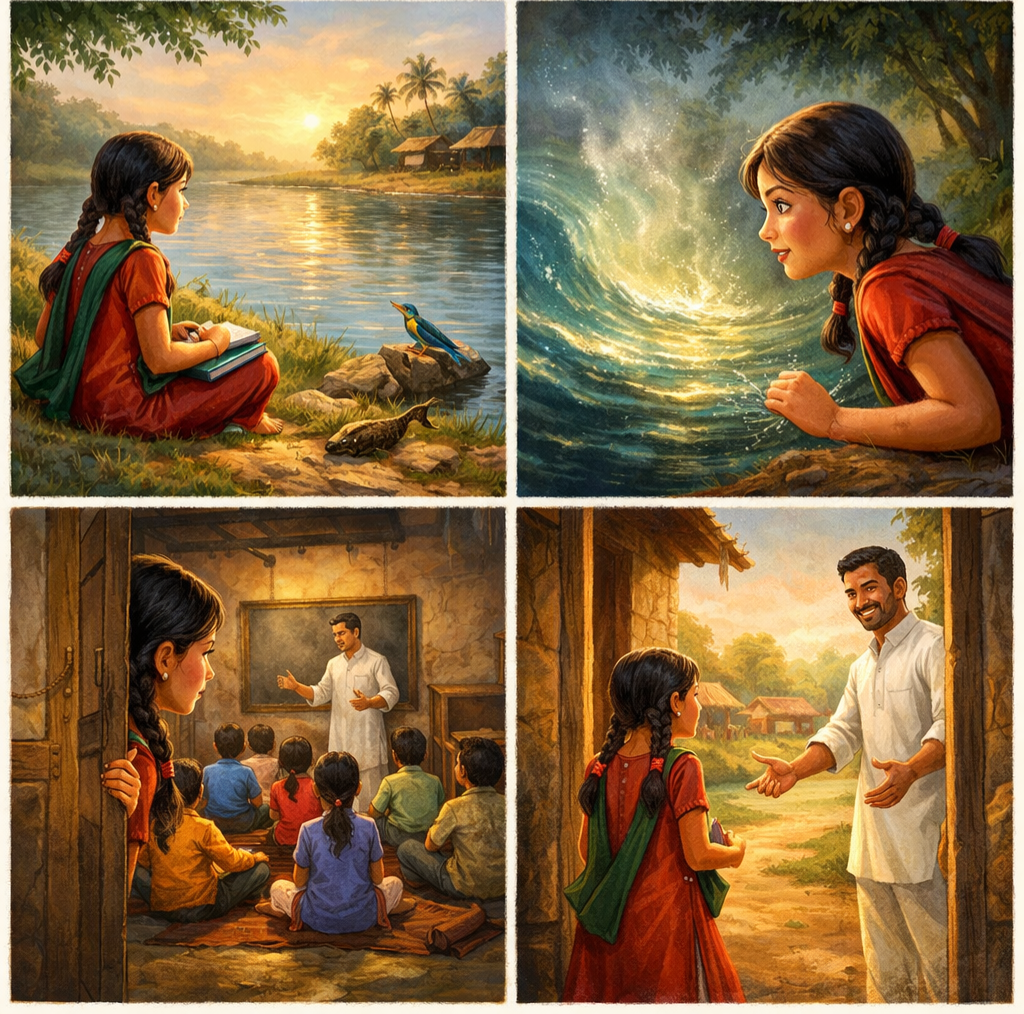
🪶 INTRODUCTORY IDEA AND CENTRAL THEME 🪶
🌊 The Day the River Spoke is a powerful narrative that gives voice to nature and reminds readers that rivers are living entities not lifeless resources The lesson highlights the deep relationship between humans and the natural world It shows how ignoring nature leads to imbalance while listening to it brings understanding responsibility and respect The story urges readers to reflect on human actions and their long term impact on the environment
🌳 SETTING AND THE LIVING RIVER 🌳
🏞️ The river flows through villages fields and daily life supporting people animals and plants It is not presented as a background element but as a central presence The setting shows how human life depends on the river for water farming and survival By placing the river at the heart of the story the lesson establishes nature as an active participant in human history
🗣️ THE RIVER AS A SPEAKING VOICE 🗣️
💬 The most striking feature of the lesson is that the river speaks This voice represents truth memory and warning The river remembers how it once flowed freely and how people respected it Over time neglect pollution and misuse increased By speaking the river exposes human carelessness and reminds readers that nature observes and responds
🏗️ HUMAN ACTIONS AND THEIR CONSEQUENCES 🏗️
⚠️ The lesson describes how construction waste pollution and thoughtless use harm the river These actions reduce water quality disturb life and weaken natural balance The story does not accuse harshly but presents consequences clearly It teaches that environmental damage is not sudden but gradual caused by repeated neglect
🧠 REALISATION AND AWAKENING 🧠
🌱 When people hear the river they begin to reflect on their behaviour Awareness replaces ignorance This shift shows that change begins with understanding The lesson emphasises that listening is the first step toward responsibility Once people understand the rivers pain they feel a moral duty to protect it
🤝 COLLECTIVE RESPONSIBILITY AND HOPE 🤝
🌈 The story stresses that saving the river is not the task of one person but of the whole community Cooperation respect and shared effort become essential The lesson offers hope by showing that damage can be reduced when people act together This message encourages students to believe in positive change
🌍 ENVIRONMENTAL MESSAGE AND VALUES 🌍
🌿 The lesson strongly promotes environmental ethics It teaches respect care gratitude and restraint Rivers are shown as lifelines deserving protection The story builds awareness about sustainable living and responsible development It prepares students to think beyond personal benefit
🧭 RELEVANCE IN MODERN LIFE 🧭
🏙️ In today’s world rivers face pollution scarcity and exploitation The lesson feels highly relevant as many water bodies suffer silently It encourages readers to observe their surroundings and question harmful practices The message applies not only to rivers but to all natural resources
🌟 CORE MESSAGE AND VALUE EDUCATION 🌟
📘 The Day the River Spoke teaches that nature communicates through change loss and imbalance Humans must learn to listen act wisely and protect what sustains life The lesson builds empathy environmental responsibility and moral awareness making it deeply meaningful for young readers
📗 SUMMARY 📗
🌸 The Day the River Spoke is a lesson where a river speaks about its suffering caused by human neglect The story shows how pollution and misuse harm nature When people listen they realise their responsibility The lesson teaches respect for rivers collective action and environmental care It reminds readers that protecting nature is essential for life
——————————————————————————————————————————————————————————————————————————–
TEXTBOOK QUESTIONS
🌿 Let us think and reflect
🔒 ❓ I. Read the extracts given below and answer the questions that follow.
🔒 ❓ 1.
“You shouldn’t cry, you know,” the voice went on. “And you really shouldn’t be scared, when you have been coming here to see me every day, well, almost every day.” She was puzzled. It was such a voice, like the river. It couldn’t be the river! “Well, tell me all about it,” said the River, for it was the River. “I’ve got to hurry to reach the sea, you know.”
🔒 ❓ (i) Complete the sentence with the correct option from those given in the brackets.
The tone of the River in the given extract is _.
(assuring / sympathising)
📌 ✅ Answer:
🔹 assuring
🔒 ❓ (ii) Select a phrase from the extract which shows that Jahnavi was a frequent visitor to the spot.
📌 ✅ Answer:
🔹 “you have been coming here to see me every day, well, almost every day”
🔒 ❓ (iii) Choose the correct option to complete the sentence.
The use of an exclamation mark at the end of the line, ‘It couldn’t be the river!’ expresses _.
A. excitement
B. hesitation
C. irritation
D. disbelief
📌 ✅ Answer:
🔹 D. disbelief
🔒 ❓ (iv) Choose three qualities of the River highlighted in the extract from the words in the box given below.
affectionate forgiving thoughtful impatient kind-hearted
📌 ✅ Answer:
🔹 affectionate
🔹 thoughtful
🔹 kind-hearted
🔒 ❓ 2.
“Can I do something?” asked Jahnavi. “Well, it’s up to you,” said the River. “Seems to me little girls can do as much as little boys—they swim as fast as little boys. You just slip along one morning and sit there in the school and listen to what’s going on, and maybe the teacher will let you stay.”
“I couldn’t,” gasped Jahnavi. “I couldn’t! They’d scare me! They’d chase me out.”
🔒 ❓ (i) Complete the sentence with an appropriate reason.
According to the River, there was no difference between girls and boys because _.
📌 ✅ Answer:
🔹 girls can do as much as boys and they swim as fast as boys
🔒 ❓ (ii) Identify whether the following statement is true or false.
The River encourages Jahnavi to have faith in herself and fulfil her desire to go to school.
📌 ✅ Answer:
🔹 True
🔒 ❓ (iii) Choose the correct option to complete the sentence.
When the River suggests that Jahnavi should ‘slip along’, it means that she should move _.
A. quickly
B. casually
C. quietly
D. confidently
📌 ✅ Answer:
🔹 C. quietly
🔒 ❓ (iv) What does the repetition of the phrase I couldn’t, tell us?
📌 ✅ Answer:
🔹 It shows Jahnavi’s fear, lack of confidence, and anxiety about going to school
🔒 ❓ II. Answer the following questions.
🔒 ❓ 1. Why does the writer describe different aspects of nature in great detail at the beginning of the story? Why do you think the writer does this?
📌 ✅ Answer:
🔹 To set the scene and mood of the story
🔹 To make nature an important presence in the narrative
🔹 To prepare the reader for the River becoming a speaking character
🔒 ❓ 2. How did the River know so much about Jahnavi?
📌 ✅ Answer:
🔹 Jahnavi visited the river almost every day
🔹 The River observed her closely and listened to her
🔒 ❓ 3. Jahnavi says, “And I’m so old now, they’ll never let me go.” What can you infer about Jahnavi and the school from this line?
📌 ✅ Answer:
🔹 Jahnavi feels she is too old to start school
🔹 She believes school is meant only for younger children
🔒 ❓ 4. Why did the River laugh when Jahnavi said she would be scared at school?
📌 ✅ Answer:
🔹 Because the River knew her fears were unnecessary
🔹 It wanted to reassure and encourage her
🔒 ❓ 5. Why should Jahnavi follow the River’s advice?
📌 ✅ Answer:
🔹 The River gives wise and caring advice
🔹 Going to school would help Jahnavi gain confidence and knowledge
🔒 ❓ 6. How does the conversation between Jahnavi and the River make the story more appealing?
📌 ✅ Answer:
🔹 It adds imagination and warmth
🔹 It makes the message more engaging and friendly
🔒 ❓ 7. What is the main message that the writer intends to convey?
📌 ✅ Answer:
🔹 Everyone has the right to education
🔹 One should overcome fear and believe in oneself
📘 Let us learn
🔒 ❓ I.
You have learnt that naming words are called nouns and only proper nouns begin with a capital letter. Why has the author used a capital letter for the ‘River’ even when it is a common noun?
(Clue: Has the River been given qualities of a human being?)
📌 ✅ Answer:
🔹 The River is personified and given human qualities
🔹 Hence it is treated like a proper noun
🔒 ❓ II. There are a few words related to sound in the text. Pick the words from the text and write them next to the correct definition.
📌 ✅ Answers:
made a high-pitched piercing sound — shrieked
to cause liquid to strike or fall on something — splashed
a low continuous background noise — murmur
cry with loud uncontrollable gasps — sobbed
to make a soft dry sound, like paper or leaves moving — rustled
took a short quick breath through the mouth due to surprise, pain or shock — gasped
shaking rapidly to make continuous short, sharp sounds — rattled
making a lot of noise — clamour
made a long, high cry, usually because of pain or sadness — wailed
🔒 ❓ Now, fill in the blanks with suitable sound words from exercise (II).
📌 ✅ Answer:
(i) clamorous
(ii) rustle
(iii) murmured
(iv) sobbed
(v) clamour
(vi) gasped
🔒 ❓ III.
The word ‘catamaran’ is used in the text. The word originates from Tamil language ‘kattu maram’ meaning ‘tied wood’.
Find out the meanings of these words. From which Indian language these words were borrowed. An example has been given.
📌 ✅ Answer:
karma — Sanskrit
sahib — Arabic
chutney — Hindi
guru — Sanskrit
verandah — Hindi
jungle — Sanskrit
areca — Malayalam
palanquin — Sanskrit
🔒 ❓ IV.
Chandu, the fisherman, has a catamaran that the River preferred to a ship.
Given below are some boats that are used in different parts of our country.
🔒 ❓ (i) Which one would you like to travel in?
📌 ✅ Answer:
🔹 I would like to travel in a shikara.
🔒 ❓ (ii) Make a colourful drawing of a boat that you would like to travel in.
📌 ✅ Answer:
🔹 Activity to be done by the student.
🔒 ❓ V. Solve the crossword puzzle based on words related to water transport.
📌 ✅ Answer:
Across
ship
boat
raft
steamer
Down
canoe
tugboat
yacht
🔒 ❓ VI. Read the highlighted words in the following lines from the text.
“She goes down towards the sea. I’ve seen her; she always takes the same way—over the mountains and down to the sea, like me!”
📌 ✅ Answer:
🔹 towards, over, down are prepositions showing direction
🔒 ❓ Now, fill in the blanks with suitable prepositions given within the brackets.
📌 ✅ Answer:
at
outside
through
between
about
for
🔒 ❓ VII. Fill in the blanks with prepositions or adverbs.
📌 ✅ Answer:
on
on
through
above
along
inside
around
on.
——————————————————————————————————————————————————————————————————————————–
OTHER IMPORTANT QUESTIONS
📖 Passage
For years the river flowed silently beside the town giving water nourishment and livelihood. Gradually people began treating it as a dumping space for waste forgetting its importance. Though the river continued to serve it grew weaker each day. Its silent suffering carried a warning that neglecting nature eventually harms human life itself.
🔒 ❓ Q1. The word livelihood in the passage most nearly refers to
🟢 1️⃣ decoration
🔵 2️⃣ means of living
🟡 3️⃣ natural beauty
🟣 4️⃣ temporary shelter
✔️ Answer: 🔵 2️⃣ means of living
🔒 ❓ Q2. Which word best captures the river’s behaviour before people realised their mistake
🟢 1️⃣ aggressive
🔵 2️⃣ enduring
🟡 3️⃣ careless
🟣 4️⃣ demanding
✔️ Answer: 🔵 2️⃣ enduring
🔒 ❓ Q3. The river’s condition reflects human __ toward resources that appear endlessly available.
📌 ✅ Answer: complacency
🔒 ❓ Q4. Why does the passage describe the river as serving despite harm
📌 ✅ Answer: To show its patience and the imbalance in human behaviour.
🔒 ❓ Q5. What warning is implied through the river’s silent suffering
📌 ✅ Answer: That harming nature ultimately harms human survival.
🔒 ❓ Q6. Explain how the passage uses the river to convey a moral lesson about human responsibility.
📌 ✅ Answer: The river is presented as a life-giver that continues to support humans even when mistreated. Its weakening condition symbolises the consequences of careless exploitation. Through this image the passage teaches that ignoring responsibility toward nature leads to long-term damage for humanity itself.
——————————————————————————————————————————————————————————————————————————–