
Class 6 : Maths ( English ) – Lesson 1. Patterns in Mathematics

EXPLANATION AND ANALYSIS
🌿 1. Introduction: Why Patterns Matter in Mathematics
When we look closely at the world around us, we notice repetition everywhere. The rising and setting of the Sun, the days of the week, tiles on a floor, beats in music, designs on clothes, and even the way numbers increase in counting—all follow some form of pattern. Mathematics helps us understand these regularities clearly and logically.
🔵 A pattern is not just decoration; it is a rule-based arrangement
🟢 Patterns help us predict what comes next
🟡 They train our brain to think logically and systematically
🔴 This chapter introduces the idea that mathematics is about finding order in repetition
Patterns form the foundation of algebra, sequences, and higher mathematical thinking, so learning them carefully is very important.
🧠 2. What Is a Pattern?
A pattern is an arrangement of numbers, shapes, objects, or symbols that follows a specific rule.
🔹 The rule decides how the pattern grows or repeats
🔹 Once the rule is known, future terms can be predicted
🔹 Patterns can be simple or complex
💡 Concept:
Pattern = repetition + rule
✏️ Note:
In mathematics, identifying the rule is more important than just writing the next term.
🟢🔵 Patterns Using Shapes and Designs
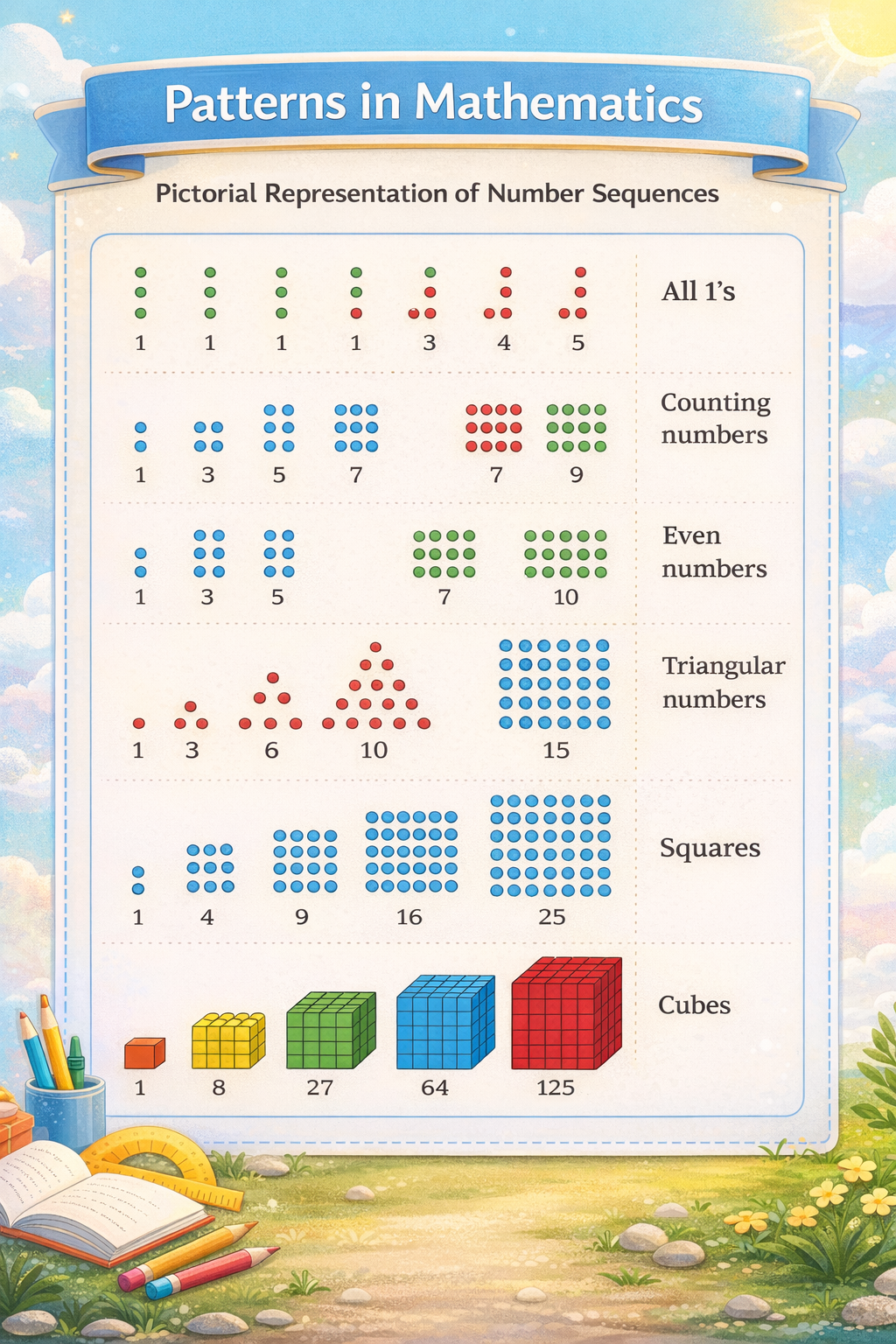
🌱 3. Number Patterns
Number patterns are sequences of numbers arranged according to a fixed rule.
🔵 Increasing number patterns
🔹 Numbers increase by adding a fixed number
🔹 Example: 2, 4, 6, 8, … (add 2 each time)
🟢 Decreasing number patterns
🔹 Numbers decrease by subtracting a fixed number
🔹 Example: 50, 45, 40, 35, … (subtract 5 each time)
🟡 These patterns help students understand addition and subtraction deeply
💡 Concept:
If the difference between terms is constant, the pattern is arithmetic.
🧠 4. Patterns Using Multiplication
Some patterns grow faster because numbers are multiplied instead of added.
🔵 Example: 2, 4, 8, 16, 32
🔹 Each term is multiplied by 2
🔹 Such patterns increase rapidly
🟢 These patterns help prepare students for powers and exponential ideas later
🔴 They are commonly seen in population growth or doubling situations
✏️ Note:
Always check whether numbers are added, subtracted, multiplied, or divided.
🌿 5. Square Number Patterns
Square numbers form a very important number pattern.
🔵 Square numbers are obtained by multiplying a number by itself
🔹 1 = 1 × 1
🔹 4 = 2 × 2
🔹 9 = 3 × 3
🔹 16 = 4 × 4
🟢 Pattern: 1, 4, 9, 16, 25, …
🟡 These patterns appear in area calculations and geometry
💡 Concept:
The nth square number is n².
🧠 6. Cube Number Patterns
Cube numbers are formed by multiplying a number three times.
🔵 1 = 1 × 1 × 1
🔵 8 = 2 × 2 × 2
🔵 27 = 3 × 3 × 3
🟢 Pattern: 1, 8, 27, 64, …
🔴 Cube patterns help in understanding volume later
✏️ Note:
Square patterns relate to area, cube patterns relate to volume.
🌱 7. Shape Patterns
Patterns are not limited to numbers; shapes also follow patterns.
🔵 Shapes may repeat in a fixed order
🟢 Shapes may grow step by step
🟡 Shapes may rotate or alternate
🔹 Example: ▲ ● ▲ ● ▲ ●
🔹 Rule: triangle and circle repeat alternately
💡 Concept:
Look at colour, shape, size, and position while identifying shape patterns.
🧠 8. Letter Patterns
Letters can also form patterns based on alphabetical order.
🔵 Example: A, C, E, G, …
🔹 Letters skip one alphabet each time
🟢 Example: Z, X, V, T, …
🔹 Letters move backward, skipping one letter
✏️ Note:
Letter patterns strengthen understanding of order and sequence.
🌿 9. Patterns in Matchstick Arrangements
Matchstick patterns are very important in this chapter.
🔵 Matchsticks are used to form squares, triangles, or other shapes
🟢 Each new figure follows a rule based on the previous one
🔹 Example: squares in a row sharing sides
🔹 First square needs 4 matchsticks
🔹 Each new square adds 3 matchsticks
💡 Concept:
Matchstick patterns help in forming algebraic expressions later.
🧠 10. Growing Patterns
Some patterns grow step by step.
🔵 Number of objects increases regularly
🟢 Difference between terms increases gradually
🔹 Example: 1, 3, 6, 10, 15
🔹 Differences are 2, 3, 4, 5
💡 Concept:
Such patterns are called triangular number patterns.
🌍 11. Patterns in Daily Life
Patterns are part of everyday life.
🔵 Days of the week repeat after 7 days
🟢 Traffic signals follow a colour pattern
🟡 Floor tiles show repeating designs
🔴 Rhythms in music follow patterns
✏️ Note:
Observing daily-life patterns improves mathematical thinking.
🧠 12. Importance of Studying Patterns
Patterns help us think logically and predict outcomes.
🔹 They help in understanding sequences
🔹 They prepare us for algebra
🔹 They improve problem-solving skills
💡 Concept:
Mathematics is the study of patterns and relationships.
📘 Summary
The chapter Patterns in Mathematics introduces students to the idea that repetition in numbers, shapes, letters, and objects follows logical rules. Number patterns can increase or decrease by addition, subtraction, multiplication, or division. Special patterns like square numbers and cube numbers play an important role in geometry and measurement. Shape patterns, letter patterns, and matchstick patterns help students understand structure and growth.
Patterns are also seen in daily life, such as calendars, traffic signals, and designs. Studying patterns develops logical thinking, prediction skills, and mathematical reasoning. This chapter lays the foundation for algebra and higher mathematics by teaching students how to identify rules and apply them correctly.
📝 Quick Recap
🟢 A pattern is an arrangement following a rule
🟡 Number patterns may use addition, subtraction, or multiplication
🔵 Square and cube patterns are special number patterns
🔴 Shapes, letters, and matchsticks also form patterns
⚡ Patterns help in prediction and logical thinking
🧠 Patterns are the foundation of higher mathematics
——————————————————————————————————————————————————————————————————————————–
TEXTBOOK QUESTIONS
Section: Figure it Out
🔒 ❓ Question 1
Count the number of sides in each shape in the sequence of Regular Polygons. Which number sequence do you get? What about the number of corners in each shape in the sequence of Regular Polygons? Do you get the same number sequence? Can you explain why this happens?
📌 ✅ Answer (Step-by-step, teacher style):
🔹 Let us first recall what regular polygons are.
🔹 A regular polygon has all sides equal and all corners (vertices) equal.
🔹 Now, we count the number of sides in the sequence of regular polygons:
➡️ Triangle → 3 sides
➡️ Square → 4 sides
➡️ Pentagon → 5 sides
➡️ Hexagon → 6 sides
🔹 So, the number sequence of sides is:
➡️ 3, 4, 5, 6, …
🔹 Now, let us count the number of corners (vertices) in the same shapes:
➡️ Triangle → 3 corners
➡️ Square → 4 corners
➡️ Pentagon → 5 corners
➡️ Hexagon → 6 corners
🔹 The number sequence of corners is also:
➡️ 3, 4, 5, 6, …
🔹 Yes, we get the same number sequence.
🔹 Explanation (Why this happens):
➡️ Every side of a polygon meets another side at a corner.
➡️ So, each side corresponds to exactly one corner.
➡️ Therefore, in any polygon, number of sides = number of corners.
🔒 ❓ Question 2
Count the number of lines in each shape in the sequence of Complete Graphs. Which number sequence do you get? Can you explain why?
📌 ✅ Answer (Step-by-step, teacher style):
🔹 A complete graph is a figure in which every point is joined to every other point by a line.
🔹 Let us count the number of lines step by step:
➡️ For 2 points:
🔹 Only 1 line can be drawn.
➡️ For 3 points:
🔹 Each point joins with the other two.
🔹 Total lines = 3
➡️ For 4 points:
🔹 Each point joins with the other three.
🔹 Total lines = 6
➡️ For 5 points:
🔹 Each point joins with the other four.
🔹 Total lines = 10
🔹 So, the number sequence of lines is:
➡️ 1, 3, 6, 10, …
🔹 Explanation (Why this happens):
➡️ Every new point connects with all the previous points.
➡️ So, the number of lines increases more each time.
➡️ This creates a growing pattern where lines are added systematically.
🔒 ❓ Question 3
How many little squares are there in each shape of the sequence of Stacked Squares? Which number sequence does this give? Can you explain why?
📌 ✅ Answer (Step-by-step, teacher style):
🔹 In stacked squares, small squares are arranged layer by layer.
🔹 Let us count the number of little squares in each shape:
➡️ First shape → 1 little square
➡️ Second shape → 4 little squares
➡️ Third shape → 9 little squares
➡️ Fourth shape → 16 little squares
🔹 So, the number sequence is:
➡️ 1, 4, 9, 16, …
🔹 Explanation (Why this happens):
➡️ Each new shape forms a bigger square.
➡️ The side length increases by 1 each time.
➡️ The total number of little squares = side × side.
➡️ That is why we get square numbers.
🔒 ❓ Question 4
How many little triangles are there in each shape of the sequence of Stacked Triangles? Which number sequence does this give? Can you explain why?
(Hint: In each shape in the sequence, how many triangles are there in each row?)
📌 ✅ Answer (Step-by-step, teacher style):
🔹 Let us count row by row using the hint.
➡️ First shape:
🔹 1 triangle
➡️ Second shape:
🔹 1 triangle in first row
🔹 2 triangles in second row
🔹 Total = 1 + 2 = 3
➡️ Third shape:
🔹 1 triangle in first row
🔹 2 triangles in second row
🔹 3 triangles in third row
🔹 Total = 1 + 2 + 3 = 6
➡️ Fourth shape:
🔹 1 + 2 + 3 + 4 = 10
🔹 So, the number sequence is:
➡️ 1, 3, 6, 10, …
🔹 Explanation (Why this happens):
➡️ Each new row has one more triangle than the previous row.
➡️ The total is found by adding triangles row by row.
➡️ This creates a growing pattern.
🔒 ❓ Question 5
To get from one shape to the next shape in the Koch Snowflake sequence, one replaces each line segment ‘—’ by a ‘speed bump’ ^. As one does this more and more times, the changes become tinier and tinier with very very small line segments. How many total line segments are there in each shape of the Koch Snowflake? What is the corresponding number sequence?
(The answer is 3, 12, 48, …, i.e. 3 times Powers of 4; this sequence is not shown in Table 1.)
📌 ✅ Answer (Step-by-step, teacher style):
🔹 Let us start from the first shape.
➡️ First shape:
🔹 It is a triangle.
🔹 Number of line segments = 3
➡️ Second shape:
🔹 Each line is replaced by 4 smaller lines.
🔹 Total = 3 × 4 = 12
➡️ Third shape:
🔹 Each of the 12 lines becomes 4 lines.
🔹 Total = 12 × 4 = 48
➡️ Fourth shape:
🔹 48 × 4 = 192
🔹 So, the number sequence is:
➡️ 3, 12, 48, 192, …
🔹 Explanation (Why this happens):
➡️ Every step replaces one line with 4 new lines.
➡️ So, the number of line segments becomes 4 times each time.
➡️ That is why the sequence follows 3 × powers of 4.
——————————————————————————————————————————————————————————————————————————–
OTHER IMPORTANT QUESTIONS
(CBSE MODEL QUESTION PAPER)
ESPECIALLY MADE FROM THIS CHAPTER ONLY
🔵 Section A — Very Short Answer (1 mark each)
🔒 ❓ Question 1
Identify the next number in the pattern:
2, 4, 6, 8, ___
📌 ✅ Answer:
🔹 The numbers increase by 2 each time
✔️ Final: 10
🔒 ❓ Question 2
Write the missing shape in the pattern:
▲, ●, ▲, ●, ___
📌 ✅ Answer:
🔹 The shapes repeat alternately
✔️ Final: ▲
🔒 ❓ Question 3
Find the next letter in the pattern:
A, C, E, G, ___
📌 ✅ Answer:
🔹 Letters are skipping one letter each time
✔️ Final: I
🔒 ❓ Question 4
Write the next term in the pattern:
1, 4, 9, 16, ___
📌 ✅ Answer:
🔹 These are square numbers
🔸 1², 2², 3², 4²
✔️ Final: 25
🔒 ❓ Question 5
How many matchsticks are needed to make one square?
📌 ✅ Answer:
🔹 A square has four equal sides
✔️ Final: 4 matchsticks
🔒 ❓ Question 6
True or False:
Patterns help us predict future terms
📌 ✅ Answer:
🔹 Patterns show regularity and repetition
✔️ Final: True
🟢 Section B — Short Answer I (2 marks each)
🔒 ❓ Question 7
Find the next two numbers in the pattern:
5, 10, 15, 20, ___, ___
📌 ✅ Answer:
🔹 Step 1: Common difference = 5
🔹 Step 2: Add 5 successively
✔️ Final: 25, 30
🔒 ❓ Question 8
Observe the pattern and write the rule:
3, 6, 12, 24
📌 ✅ Answer:
🔹 Each term is multiplied by 2
💡 Concept: Multiplicative number pattern
✔️ Final: Multiply by 2
🔒 ❓ Question 9
How many matchsticks are needed to make 3 squares in a row if they share sides?
📌 ✅ Answer:
🔹 Step 1: First square needs 4 matchsticks
🔹 Step 2: Each additional square adds 3 matchsticks
🔹 Step 3: Total = 4 + 3 + 3
✔️ Final: 10 matchsticks
🔒 ❓ Question 10
Find the missing number:
2, 6, 18, ___
📌 ✅ Answer:
🔹 Step 1: Each term is multiplied by 3
🔹 Step 2: 18 × 3 = 54
✔️ Final: 54
🔒 ❓ Question 11
Write one real-life example of a pattern
📌 ✅ Answer:
🔹 Days of the week repeat after every 7 days
✔️ Final: Weekly calendar pattern
🔒 ❓ Question 12
Find the next figure in the pattern:
⬜⬛⬜⬛ ___
📌 ✅ Answer:
🔹 The pattern alternates between white and black squares
✔️ Final: ⬜
🟡 Section C — Short Answer II (3 marks each)
🔒 ❓ Question 13
Find the next three numbers in the pattern:
1, 4, 9, 16, ___, ___, ___
📌 ✅ Answer:
🔹 These are square numbers
🔹 Step 1: 1 = 1²
🔹 Step 2: 4 = 2²
🔹 Step 3: 9 = 3²
🔹 Step 4: 16 = 4²
🔹 Step 5: Next are 5², 6², 7²
✔️ Final: 25, 36, 49
🔒 ❓ Question 14
Observe the pattern and write the rule:
2, 5, 10, 17, 26
📌 ✅ Answer:
🔹 Step 1: Differences are 3, 5, 7, 9
🔹 Step 2: Differences increase by 2
💡 Concept: Pattern based on increasing odd numbers
✔️ Final: Add consecutive odd numbers
🔒 ❓ Question 15
How many matchsticks are required to make 5 squares in a row if they share sides?
📌 ✅ Answer:
🔹 Step 1: First square needs 4 matchsticks
🔹 Step 2: Each new square adds 3 matchsticks
🔹 Step 3: For 5 squares → 4 + (4 × 3)
🔹 Step 4: 4 + 12 = 16
✔️ Final: 16 matchsticks
🔒 ❓ Question 16
Find the missing number in the pattern:
3, 6, 12, 24, ___
📌 ✅ Answer:
🔹 Step 1: Each term is multiplied by 2
🔹 Step 2: 24 × 2 = 48
✔️ Final: 48
🔒 ❓ Question 17
Write the next two terms and the rule for the pattern:
100, 90, 80, 70, ___, ___
📌 ✅ Answer:
🔹 Step 1: Difference between terms = −10
🔹 Step 2: Subtract 10 successively
✔️ Final: 60, 50
💡 Concept: Decreasing arithmetic pattern
🔒 ❓ Question 18
Find the next term in the pattern:
1, 3, 6, 10, 15, ___
📌 ✅ Answer:
🔹 Step 1: Differences are 2, 3, 4, 5
🔹 Step 2: Next difference = 6
🔹 Step 3: 15 + 6 = 21
✔️ Final: 21
🔒 ❓ Question 19
How many matchsticks are needed to make 6 triangles in a row if each new triangle shares one side?
📌 ✅ Answer:
🔹 Step 1: First triangle needs 3 matchsticks
🔹 Step 2: Each new triangle adds 2 matchsticks
🔹 Step 3: Total = 3 + (5 × 2)
🔹 Step 4: 3 + 10 = 13
✔️ Final: 13 matchsticks
🔒 ❓ Question 20
Write the rule for the letter pattern:
Z, X, V, T
📌 ✅ Answer:
🔹 Step 1: Letters move backward in the alphabet
🔹 Step 2: Each step skips one letter
✔️ Final: Move backward skipping one letter
🔒 ❓ Question 21
Find the missing number:
1, 8, 27, ___
📌 ✅ Answer:
🔹 Step 1: These are cube numbers
🔹 Step 2: 1 = 1³, 8 = 2³, 27 = 3³
🔹 Step 3: Next = 4³
✔️ Final: 64
🔒 ❓ Question 22
A pattern adds 4 every time. If the first term is 7, write the next three terms.
📌 ✅ Answer:
🔹 Step 1: Start with 7
🔹 Step 2: 7 + 4 = 11
🔹 Step 3: 11 + 4 = 15
🔹 Step 4: 15 + 4 = 19
✔️ Final: 11, 15, 19
🔴 Section D — Long Answer (4 marks each)
🔒 ❓ Question 23
A pattern is formed by adding consecutive odd numbers starting from 1:
1, 1+3, 1+3+5, 1+3+5+7, …
Write the first 5 terms of this pattern and identify what kind of numbers they are.
📌 ✅ Answer:
🔹 Step 1: Term 1 = 1
🔹 Step 2: Term 2 = 1 + 3 = 4
🔹 Step 3: Term 3 = 1 + 3 + 5 = 9
🔹 Step 4: Term 4 = 1 + 3 + 5 + 7 = 16
🔹 Step 5: Term 5 = 1 + 3 + 5 + 7 + 9 = 25
🔹 These results are perfect squares
💡 Concept: Sum of first n odd numbers = n²
✔️ Final: 1, 4, 9, 16, 25 (square numbers)
🔒 ❓ Question 24
Matchsticks are used to make squares in a row, where each new square shares one side with the previous square.
Find a rule (formula) to calculate the number of matchsticks needed for n squares.
📌 ✅ Answer:
🔹 Step 1: For 1 square, matchsticks = 4
🔹 Step 2: Each new square shares 1 side, so it adds 3 new matchsticks
🔹 Step 3: For n squares
🔹 First square contributes 4
🔹 Remaining (n − 1) squares contribute 3 each
🔹 Step 4: Total matchsticks = 4 + 3(n − 1)
🔹 Step 5: Simplify
🔹 4 + 3n − 3 = 3n + 1
✔️ Final: Matchsticks for n squares = 3n + 1
🔒 ❓ Question 25
A number pattern is:
2, 6, 12, 20, 30, …
(i) Write the next two terms
(ii) Describe the rule of the pattern clearly
📌 ✅ Answer:
🔹 Step 1: Find differences
🔹 6 − 2 = 4
🔹 12 − 6 = 6
🔹 20 − 12 = 8
🔹 30 − 20 = 10
🔹 Step 2: Differences are even numbers increasing by 2
🔹 Next differences = 12, 14
🔹 Step 3: Next term = 30 + 12 = 42
🔹 Step 4: Next term = 42 + 14 = 56
🔹 Rule: Add consecutive even numbers (4, 6, 8, 10, …)
✔️ Final: Next terms = 42, 56; Rule: add increasing even numbers
🔒 ❓ Question 26
A pattern of dots is formed like this:
Figure 1 has 1 dot
Figure 2 has 3 dots
Figure 3 has 6 dots
Figure 4 has 10 dots
(i) Find dots in Figure 5
(ii) Explain the pattern rule
📌 ✅ Answer:
🔹 Step 1: Observe differences
🔹 3 − 1 = 2
🔹 6 − 3 = 3
🔹 10 − 6 = 4
🔹 Step 2: Differences are 2, 3, 4 (increasing by 1)
🔹 Step 3: Next difference = 5
🔹 Step 4: Dots in Figure 5 = 10 + 5 = 15
🔹 Rule: Add consecutive natural numbers (2, 3, 4, 5, …)
💡 Concept: This is a triangular number pattern
✔️ Final: Figure 5 has 15 dots; Rule: add consecutive natural numbers
🔒 ❓ Question 27
OR
A staircase pattern is made using blocks.
Step 1 uses 1 block, Step 2 uses 3 blocks, Step 3 uses 6 blocks, Step 4 uses 10 blocks.
How many blocks will Step 6 use? Show steps and reasoning.
📌 ✅ Answer:
🔹 Step 1: The sequence is 1, 3, 6, 10, …
🔹 Step 2: Differences are
🔹 3 − 1 = 2
🔹 6 − 3 = 3
🔹 10 − 6 = 4
🔹 Step 3: Next differences will be 5, 6
🔹 Step 4: Step 5 = 10 + 5 = 15
🔹 Step 5: Step 6 = 15 + 6 = 21
✔️ Final: Step 6 uses 21 blocks
🔒 ❓ Question 28
A pattern is:
1, 2, 4, 7, 11, 16, …
(i) Find the next two terms
(ii) Explain the pattern rule
📌 ✅ Answer:
🔹 Step 1: Find differences
🔹 2 − 1 = 1
🔹 4 − 2 = 2
🔹 7 − 4 = 3
🔹 11 − 7 = 4
🔹 16 − 11 = 5
🔹 Step 2: Differences increase by 1 each time
🔹 Next differences = 6, 7
🔹 Step 3: Next term = 16 + 6 = 22
🔹 Step 4: Next term = 22 + 7 = 29
🔹 Rule: Add consecutive natural numbers (1, 2, 3, 4, 5, …)
✔️ Final: Next terms = 22, 29; Rule: add 1, 2, 3, 4, 5, …
🔒 ❓ Question 29
In a multiplication pattern, the nth term is n × (n + 1).
Write the first five terms and explain why it forms a pattern.
📌 ✅ Answer:
🔹 Step 1: For n = 1: 1 × 2 = 2
🔹 Step 2: For n = 2: 2 × 3 = 6
🔹 Step 3: For n = 3: 3 × 4 = 12
🔹 Step 4: For n = 4: 4 × 5 = 20
🔹 Step 5: For n = 5: 5 × 6 = 30
🔹 It forms a pattern because each term follows the same rule using n
💡 Concept: Rule-based (algebraic) pattern
✔️ Final: 2, 6, 12, 20, 30
🔒 ❓ Question 30
OR
A pattern is made from rectangles using matchsticks.
Each rectangle shares one side with the next rectangle in a row.
(i) Find matchsticks needed for 1, 2, 3 rectangles
(ii) Write a formula for n rectangles
📌 ✅ Answer:
🔹 Step 1: 1 rectangle needs 4 matchsticks
🔹 Step 2: When rectangles share one side, each new rectangle adds 3 matchsticks
🔹 Step 3: For 2 rectangles = 4 + 3 = 7
🔹 Step 4: For 3 rectangles = 7 + 3 = 10
🔹 Step 5: For n rectangles
🔹 Total = 4 + 3(n − 1)
🔹 Step 6: Simplify
🔹 4 + 3n − 3 = 3n + 1
✔️ Final:
🔹 For 1, 2, 3 rectangles: 4, 7, 10
🔹 Formula: 3n + 1
——————————————————————————————————————————————————————————————————————————–