
Class 12 : Poltical Science (English) – Lesson 5.Security in the Contemporary World

EXPLANATION & SUMMARY
🧭 Lesson Explanation
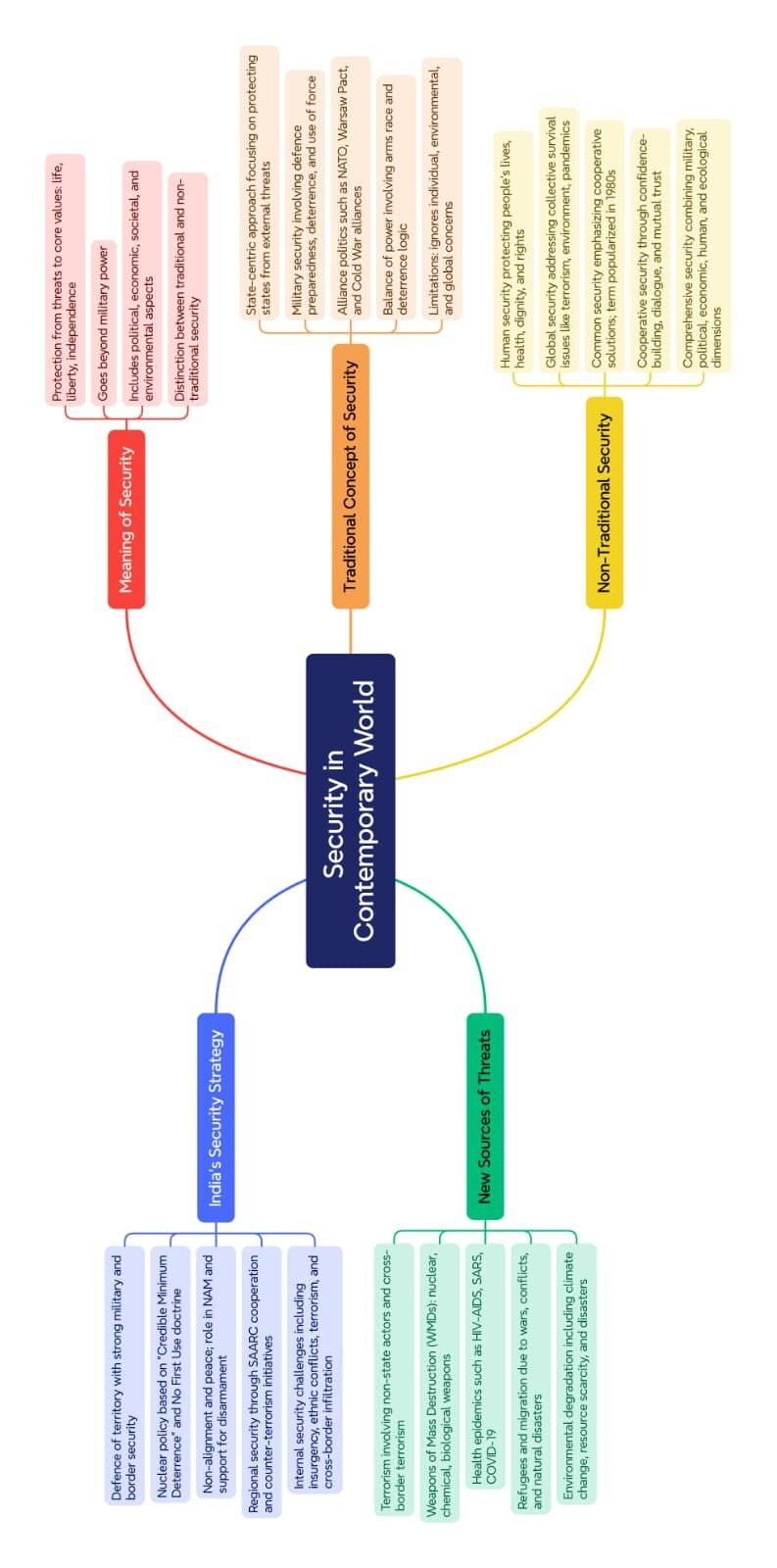
🔷 1. Meaning of Security
Security refers to the condition of being free from danger, fear, or threat.
In political science, security means protection of a country’s territory, people, and sovereignty from external and internal threats.
It is a basic goal of all nations, as without security, development and peace cannot be ensured.
Earlier, security = military protection, but in the modern world, it includes economic, political, human, and environmental aspects too.
💡 Key Idea: Security today is multidimensional, going beyond military defense.
🔷 2. Traditional Notion of Security
The traditional notion focuses on external military threats and protection of national boundaries.
🛡️ Main Features:
1️⃣ Emphasis on military power and defense preparedness.
2️⃣ Focus on sovereignty and territorial integrity.
3️⃣ Main actors: Nation-states.
4️⃣ Security threats mainly from other states.
5️⃣ Use of alliances (e.g., NATO, Warsaw Pact) for collective defense.
6️⃣ Importance of balance of power to avoid domination by any one state.
📍 Example:
During the Cold War, both USA and USSR built military alliances to protect their security interests — NATO (1949) and Warsaw Pact (1955).
⚔️ Approaches within Traditional Security:
Deterrence: Build large military capability to discourage attacks.
Defense: Strengthening military to protect from aggression.
Alliance System: Join with other states for collective protection.
💡 Key Focus: National security = Protection from military threats.
🔷 3. Limitations of Traditional Security
Ignores non-military threats (like poverty, pandemics, climate change).
Creates arms race and increases tensions.
Fails to ensure human welfare and sustainable peace.
Thus, a broader view of security became necessary.
🔷 4. Non-Traditional Notions of Security
Emerging after the Cold War, this approach broadens security to include economic, environmental, human, and global issues.
🌐 Main Features:
1️⃣ Security is not only about states, but also about people.
2️⃣ Focus on sustainable development, human rights, and well-being.
3️⃣ Threats are non-military and transnational.
4️⃣ Requires international cooperation.
💡 Key Idea: Non-traditional security seeks comprehensive safety for all humans.
🔷 5. Types of Non-Traditional Security
🔹 a. Human Security
Protection of individuals rather than the state.
Ensures freedom from fear (violence, war) and freedom from want (poverty, hunger).
Includes health, education, shelter, livelihood.
Promoted by UNDP Human Development Reports.
🔹 b. Global Security
Focuses on issues affecting entire planet.
Includes climate change, terrorism, nuclear proliferation, pandemics.
Requires collective global action.
🔹 c. Environmental Security
Protection from environmental degradation, global warming, resource depletion.
Recognises that natural disasters and climate change threaten survival.
🔹 d. Economic Security
Ensures access to basic resources, stable economic growth, and employment.
Prevents poverty and inequality that lead to instability.
🔹 e. Political Security
Guarantees human rights, political participation, and freedom.
🔷 6. Cooperation in Security
Modern security challenges require international cooperation.
🤝 Examples:
🌍 Climate Change: Global agreements like Paris Agreement (2015).
⚕️ Health: Cooperation through WHO during COVID-19.
☮️ Peacekeeping: UN missions in conflict zones.
💰 Economic Stability: Institutions like IMF, World Bank.
💡 Lesson: No nation can ensure security alone.
🔷 7. Disarmament and Arms Control
🔹 Arms Race:
Countries build up huge weapons stockpiles, leading to tension and wastage of resources.
🔹 Arms Control:
Agreements to limit certain weapons.
🧾 Examples:
SALT I (1972) and SALT II (1979) – USA & USSR
START (1991) – Strategic arms reduction treaty.
🔹 Disarmament:
Complete elimination of certain weapons.
🧾 Example:
Chemical Weapons Convention (1993) bans production and use of chemical arms.
💡 Goal: Global peace through reducing armaments.
🔷 8. Common Security (Cooperative Security)
Concept introduced by Palme Commission (1982).
Emphasises that security cannot be achieved against others, but with others.
Promotes mutual trust, dialogue, and collective efforts.
💡 Key Principle: “No one is secure until all are secure.”
🔷 9. Security Challenges in Contemporary World
🔸 a. Terrorism:
Transnational terrorist networks pose global threat (e.g., 9/11 attacks).
Needs coordinated international response.
🔸 b. Nuclear Proliferation:
Spread of nuclear weapons to more states/non-state actors increases danger.
Treaties like NPT (1968) and CTBT (1996) aim to control this.
🔸 c. Cyber Threats:
Hacking, cyber warfare, misinformation threaten digital infrastructure.
🔸 d. Climate Change:
Rising temperatures, floods, droughts threaten survival and stability.
🔸 e. Health Pandemics:
COVID-19 showed global vulnerability; cooperation through WHO essential.
🔸 f. Migration and Refugees:
Wars and disasters cause displacement; creates humanitarian crises.
🔷 10. India’s Security Strategy
India adopts a comprehensive security approach:
🔹 a. Military Security:
Strong armed forces.
Nuclear deterrence (since 1998).
Defence cooperation with friendly countries.
🔹 b. Territorial Integrity:
Vigilant borders, strong navy, air force.
🔹 c. Economic Development:
Promotes growth to reduce internal instability.
🔹 d. Diplomacy:
Participates in UN peacekeeping, SAARC, NAM.
Advocates for global disarmament.
🔹 e. Human and Environmental Security:
Poverty eradication, climate action, social justice.
💡 India believes: true security = human welfare + peace + cooperation.
🔷 11. Role of International Organisations in Security
🕊️ United Nations (UN):
Maintains peace via Security Council and peacekeeping missions.
Promotes human development, human rights, and global dialogue.
🌐 Regional Organisations:
NATO, ASEAN, African Union, SAARC – promote regional stability.
🧾 Global Treaties:
NPT, CTBT, Paris Agreement, Kyoto Protocol for cooperative security.
🔷 12. Human Security and Development
Security is not just absence of war, but presence of justice and opportunity.
Focus on:
Education
Health
Food
Employment
Equality
Environment
UNDP’s Human Development Index (HDI) links development with security.
💡 Without addressing basic needs, lasting peace is impossible.
🔷 13. Comprehensive Security Approach
A comprehensive approach combines traditional and non-traditional aspects:
🔹 Traditional 🔸 Non-Traditional
Military strength Human welfare
Territorial defense Economic stability
Alliances Global cooperation
Deterrence Sustainable development
🧭 Conclusion: Modern security = holistic, cooperative, human-centric.
🧾 Summary (≈200 words)
Security in the contemporary world means freedom from fear and want. Earlier, traditional security focused only on military defense and protection of national sovereignty. But after the Cold War, non-traditional threats like terrorism, poverty, pandemics, and environmental degradation became significant.
The new approach includes human security (safety of individuals), economic security (access to resources), and environmental security (protection of nature). Global cooperation through international organisations like the UN is essential to handle these challenges.
Agreements like NPT, CTBT, and Paris Climate Accord show global efforts for peace.
India adopts a comprehensive security policy, combining strong defense with development, diplomacy, and human welfare.
In today’s world, security is interdependent — no country can be safe in isolation. True security comes from justice, cooperation, and sustainable development.
📝 Quick Recap (≈100 words)
✔️ Security = protection from threats.
✔️ Traditional = military-based, state-centric.
✔️ Non-traditional = human-centric, includes environment, economy, health.
✔️ Types: human, global, environmental, economic.
✔️ Approaches: disarmament, arms control, cooperative security.
✔️ Challenges: terrorism, nuclear proliferation, climate change, pandemics.
✔️ India’s strategy: military strength + diplomacy + development.
✔️ Goal: holistic and sustainable peace.
🧭 Conclusion: Modern world needs collective, inclusive, and comprehensive security.
————————————————————————————————————————————————————————————————————————————
QUESTIONS FROM TEXTBOOK
🔵 Question 1:
Match the terms with their meaning:
Terms Meaning
i. Confidence Building Measures (CBMs) b. A process of exchanging information on defence matters between nations on a regular basis
ii. Arms Control d. Regulates the acquisition or development of weapons
iii. Alliance c. A coalition of nations meant to deter or defend against military attacks
iv. Disarmament a. Giving up certain types of weapons
🟢 Answer:
i – b, ii – d, iii – c, iv – a
🔵 Question 2:
Which among the following would you consider as a traditional security concern / non-traditional security concern / not a threat?
a. The spread of chikungunya / dengue fever → 🟡 Non-traditional
b. Inflow of workers from a neighbouring nation → 🟡 Non-traditional
c. Emergence of a group demanding nationhood for their region → 🔵 Traditional
d. Emergence of a group demanding autonomy for their region → 🔵 Traditional
e. A newspaper that is critical of the armed forces → 🟣 Not a threat
🔵 Question 3:
What is the difference between traditional and non-traditional security? Which category would the creation and sustenance of alliances belong to?
🟢 Answer:
✔️ Traditional security focuses on protection of state’s territorial integrity, sovereignty, and political independence from external military threats.
✔️ Non-traditional security focuses on human welfare, addressing issues like poverty, health, environment, and terrorism.
✔️ Alliances belong to traditional security, as they are formed to deter or defend against military attacks.
🔵 Question 4:
What are the differences in the threats that people in the Third World face and those living in the First World face?
🟢 Answer:
✔️ Third World countries face internal threats like poverty, ethnic conflicts, political instability, and underdevelopment.
✔️ First World countries face external threats like terrorism, cyberattacks, and nuclear proliferation.
🧭 Hence, Third World focuses on human security, while First World emphasises military and global security.
🔵 Question 5:
Is terrorism a traditional or non-traditional threat to security?
🟢 Answer:
✔️ Terrorism is a non-traditional threat, as it arises from non-state actors and targets civilians to create fear.
✔️ It crosses borders, affects economic stability, and needs global cooperation to counter.
🔵 Question 6:
What are the choices available to a state when its security is threatened, according to the traditional security perspective?
🟢 Answer:
✔️ Surrender – accept the threat and give up sovereignty.
✔️ Alliance – join other states for collective defense.
✔️ Balance of Power – build military strength to match rival.
✔️ Armament – increase weapons to deter attack.
🧭 These ensure protection against military aggression.
🔵 Question 7:
What is ‘Balance of Power’? How could a state achieve this?
🟢 Answer:
✔️ Balance of Power means a situation where no single state dominates over others.
✔️ A state achieves it by:
1️⃣ Increasing military capacity.
2️⃣ Forming alliances.
3️⃣ Strengthening economy and technology.
🧭 Goal: prevent hegemony and maintain stability.
🔵 Question 8:
What are the objectives of military alliances? Give an example of a functioning military alliance with its specific objectives.
🟢 Answer:
✔️ Objectives:
1️⃣ Collective defense against aggression.
2️⃣ Mutual military cooperation.
3️⃣ Strategic balance of power.
🧭 Example: NATO (1949) – objective to protect members through collective defense under Article 5.
🔵 Question 9:
Rapid environmental degradation is causing a serious threat to security. Do you agree with the statement? Substantiate your arguments.
🟢 Answer:
✔️ Yes, environmental degradation causes scarcity of resources, climate change, and displacement.
✔️ Leads to conflicts over water, food, and land.
✔️ Natural disasters weaken economies and threaten livelihoods.
🧭 Thus, environment is a non-traditional threat needing global cooperation.
🔵 Question 10:
Nuclear weapons as deterrence or defence have limited usage against contemporary security threats to states. Explain the statement.
🟢 Answer:
✔️ Nuclear weapons deter large wars but cannot tackle non-traditional threats like terrorism or climate change.
✔️ They are ineffective against internal conflicts, pandemics, or poverty.
🧭 Hence, security requires comprehensive approach, not just nuclear deterrence.
🔵 Question 11:
Looking at the Indian scenario, what type of security has been given priority in India, traditional or non-traditional? What examples can you cite?
🟢 Answer:
✔️ India adopts comprehensive security, but emphasis is on traditional due to border issues with Pakistan and China.
✔️ Also focuses on non-traditional like poverty eradication, health, climate action.
🧾 Examples: Nuclear deterrence, SAARC cooperation, UN peacekeeping, climate policies.
🔵 Question 12:
Read the cartoon below and write a short note in favour or against the connection between war and terrorism depicted in this cartoon.
🟢 Answer:
✔️ The cartoon shows war feeding terrorism, suggesting violence breeds more violence.
✔️ Wars create instability, grievances, and extremism.
✔️ Hence, war is not a solution; peace and justice reduce terrorism.
🧭 Promotes idea of human security and cooperative peace.
————————————————————————————————————————————————————————————————————————————
OTHER IMPORTANT QUESTIONS FOR EXAMS
🔵 Question 1:
Which of the following is the main objective of security?
🟢 1. To expand territory
🟡 2. To maintain peace and avoid threats
🔴 3. To dominate neighbours
🟣 4. To build more weapons
✅ Answer: 2. To maintain peace and avoid threats
🔵 Question 2:
Which of the following is a traditional security concern?
🟢 1. Military invasion
🟡 2. Climate change
🔴 3. Poverty
🟣 4. Epidemics
✅ Answer: 1. Military invasion
🔵 Question 3:
Which one is a non-traditional security concern?
🟢 1. Territorial disputes
🟡 2. Global warming
🔴 3. Border conflicts
🟣 4. Nuclear rivalry
✅ Answer: 2. Global warming
🔵 Question 4:
Which of the following refers to disarmament?
🟢 1. Building more arms
🟡 2. Giving up certain types of weapons
🔴 3. Regulating arms
🟣 4. Strengthening alliances
✅ Answer: 2. Giving up certain types of weapons
🔵 Question 5:
Which organisation is associated with nuclear safety and peaceful use of energy?
🟢 1. IAEA
🟡 2. WHO
🔴 3. IMF
🟣 4. WTO
✅ Answer: 1. IAEA
🔵 Question 6:
Human security focuses on—
🟢 1. Protection of territory
🟡 2. Welfare and safety of individuals
🔴 3. Economic growth only
🟣 4. Military strength
✅ Answer: 2. Welfare and safety of individuals
🔵 Question 7:
The Balance of Power aims to—
🟢 1. Increase dominance of one nation
🟡 2. Maintain equilibrium among states
🔴 3. End all alliances
🟣 4. Create one superpower
✅ Answer: 2. Maintain equilibrium among states
🔵 Question 8:
Which of the following is an example of a military alliance?
🟢 1. NATO
🟡 2. WHO
🔴 3. SAARC
🟣 4. UNESCO
✅ Answer: 1. NATO
🔵 Question 9:
The Palme Commission (1982) proposed the idea of—
🟢 1. Comprehensive security
🟡 2. Common security
🔴 3. Military security
🟣 4. National security
✅ Answer: 2. Common security
🔵 Question 10:
Which one of the following is not a component of non-traditional security?
🟢 1. Human rights
🟡 2. Poverty alleviation
🔴 3. Nuclear deterrence
🟣 4. Health care
✅ Answer: 3. Nuclear deterrence
🔵 Question 11:
Which statement is true regarding nuclear deterrence?
🟢 1. It prevents all wars
🟡 2. It only prevents large-scale wars
🔴 3. It solves all security issues
🟣 4. It ensures human security
✅ Answer: 2. It only prevents large-scale wars
🔵 Question 12:
Which of the following threats is global in nature?
🟢 1. Border conflicts
🟡 2. Terrorism
🔴 3. Regional disputes
🟣 4. Political instability
✅ Answer: 2. Terrorism
🧭 Section B – Short Answer Questions (2 marks each)
Answer each question in 50–60 words.
🔵 Question 13:
What is meant by security?
🟢 Answer:
Security means protection from threats to a country’s sovereignty, territorial integrity, and people. It includes freedom from fear and want, and today it covers military, economic, environmental, and human dimensions.
🔵 Question 14:
Differentiate between traditional and non-traditional security.
🟢 Answer:
✔️ Traditional security focuses on military defense and protection of the state from external threats.
✔️ Non-traditional security deals with issues like poverty, environment, health, and terrorism that affect human life.
🧭 Modern security combines both aspects.
🔵 Question 15:
What is human security?
🟢 Answer:
Human security emphasises the safety and well-being of individuals. It includes freedom from fear (violence, war) and freedom from want (poverty, hunger), focusing on health, education, and dignity.
🔵 Question 16:
State two components of non-traditional security.
🟢 Answer:
1️⃣ Human security – focuses on individual welfare and rights.
2️⃣ Environmental security – addresses climate change, resource depletion, and disasters threatening survival.
🔵 Question 17:
Explain the term balance of power.
🟢 Answer:
Balance of power means maintaining equilibrium among nations so that no single state becomes too powerful. It prevents domination and ensures stability through alliances and deterrence.
🔵 Question 18:
Mention two measures to strengthen security in today’s world.
🟢 Answer:
✔️ Cooperative security through dialogue and alliances.
✔️ Arms control and disarmament to reduce weapons and promote peace.
🧭 Section C – Long Answer Type I (4 marks each)
Answer each question in 100–120 words.
🔵 Question 19:
What is the difference between traditional and non-traditional security?
🟢 Answer:
✔️ Traditional Security:
Focuses on protection of the state from external military threats.
Emphasises territorial integrity and sovereignty.
Uses military alliances, arms build-up, and deterrence.
✔️ Non-Traditional Security:
Concerns human welfare (poverty, environment, health).
Aims for freedom from fear and want.
Requires international cooperation rather than war.
🧭 Conclusion:
Modern security includes both aspects, as global peace depends on military strength + human well-being.
🔵 Question 20:
What are the differences in the threats faced by people in the Third World and First World countries?
🟢 Answer:
✔️ Third World:
Threats from internal conflicts, poverty, ethnic strife, political instability, and developmental challenges.
✔️ First World:
Face external threats like terrorism, cyberattacks, nuclear weapons, and economic crises.
🧭 Conclusion:
Third World prioritises human security, while First World stresses global and strategic security.
🔵 Question 21:
Is terrorism a traditional or non-traditional threat? Explain.
🟢 Answer:
✔️ Terrorism is a non-traditional threat because it arises from non-state actors.
✔️ Targets civilians to spread fear and instability.
✔️ Crosses borders, disrupts economies, and causes mass casualties.
🧭 Needs global cooperation and intelligence sharing, not just military defense.
🔵 Question 22:
Explain the concept of Balance of Power and how it can be achieved.
🟢 Answer:
✔️ Meaning: Balance of Power refers to equilibrium among states so that no single state dominates.
✔️ Ways to achieve:
1️⃣ Building military capability.
2️⃣ Forming alliances.
3️⃣ Strengthening economic and technological power.
🧭 Ensures stability and prevents hegemony.
🧭 Section D – Source / Cartoon / Map-based Questions (4 marks each)
🔵 Question 23:
“Nuclear weapons as deterrence or defence have limited usage against contemporary security threats.” Explain.
🟢 Answer:
✔️ Nuclear weapons prevent major wars, but cannot stop terrorism, climate change, pandemics, or poverty.
✔️ Modern threats are non-military and global.
✔️ Hence, comprehensive security is needed — military + human + environmental approaches.
🔵 Question 24:
Looking at the Indian scenario, what type of security has been prioritised?
🟢 Answer:
✔️ India adopts a comprehensive security policy.
✔️ Priority to traditional security due to border tensions with Pakistan and China.
✔️ Also emphasises non-traditional aspects — poverty removal, disaster management, and environment.
🧾 Examples:
Nuclear deterrence, defence modernization, climate initiatives, health missions.
🔵 Question 25:
Interpret the cartoon showing war feeding terrorism.
🟢 Answer:
✔️ The cartoon suggests war breeds terrorism.
✔️ Violence leads to anger, radicalisation, and cycle of revenge.
✔️ Military actions without justice worsen instability.
🧭 Promotes idea of peaceful resolution and human security.
🧭 Section E – Long Answer Type II (6 marks each)
Answer each in 170–180 words.
🔵 Question 26:
Explain India’s security strategy in the contemporary world.
🟢 Answer:
✔️ Traditional Security:
Strong armed forces.
Nuclear deterrence since 1998.
Vigilant borders with Pakistan and China.
✔️ Non-Traditional Security:
Focus on economic growth, poverty eradication, environmental protection, disaster relief.
✔️ Diplomacy:
Member of UN, SAARC, BRICS, G20.
✔️ Global cooperation:
Participates in peacekeeping missions and climate agreements.
🧭 India believes in comprehensive, cooperative, and human-centered security.
🔵 Question 27:
What are the objectives of military alliances? Give an example.
🟢 Answer:
✔️ Objectives:
1️⃣ Collective defence against aggression.
2️⃣ Promote mutual security and strategy.
3️⃣ Maintain balance of power.
4️⃣ Enhance technological cooperation.
🧾 Example: NATO (1949) — aims at collective defence; an attack on one is treated as an attack on all.
🧭 Alliances ensure deterrence and stability.
🔵 Question 28:
Do you agree that rapid environmental degradation is a serious security threat? Substantiate.
🟢 Answer:
✔️ Yes, environmental degradation causes climate change, resource scarcity, disasters, and conflicts.
✔️ Threatens livelihoods, food security, and health.
✔️ Causes migration and instability in vulnerable regions.
🧭 Hence, it is a non-traditional global threat, requiring collective action.
🔵 Question 29:
Discuss the choices available to a state when its security is threatened (traditional view).
🟢 Answer:
✔️ Surrender: Accept domination to avoid war.
✔️ Alliance: Join other states for protection.
✔️ Balance of Power: Build strength to deter rivals.
✔️ Armament: Increase weapons to defend sovereignty.
🧭 Aim: Protect territorial integrity and sovereignty.
🔵 Question 30:
Explain cooperative security and its relevance today.
🟢 Answer:
✔️ Meaning: Security achieved through dialogue, trust, and cooperation, not confrontation.
✔️ Proposed by: Palme Commission (1982).
✔️ Relevance:
Global issues (terrorism, climate, pandemics) need joint response.
Promotes collective peace and reduces arms race.
🧭 Today, cooperative security is key to global stability.
————————————————————————————————————————————————————————————————————————————
MIND MAPS
————————————————————————————————————————————————————————————————————————————