
Class 12 : History (English) – Lesson 12. Framing the Constitution

EXPLANATION & SUMMARY
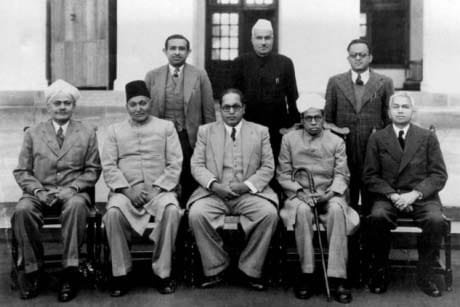
Constitution drafting committee
📜✨ Explanation
🏛️🌟 Context: Setting the Stage
🔵 By the mid-1940s, India’s freedom struggle was at its peak. The British, weakened by World War II, prepared to leave.
🟢 The challenge was to frame a Constitution for a diverse, unequal, multi-religious society.
📜 The Constituent Assembly was created in 1946 to draft an independent India’s supreme law.
📚⚔️ Formation of the Constituent Assembly
🌾 • Members were elected indirectly by Provincial Legislative Assemblies.
🏛️ • It had representation from Congress, Muslim League (initially), Scheduled Castes, Sikhs, Parsis, Christians, and women.
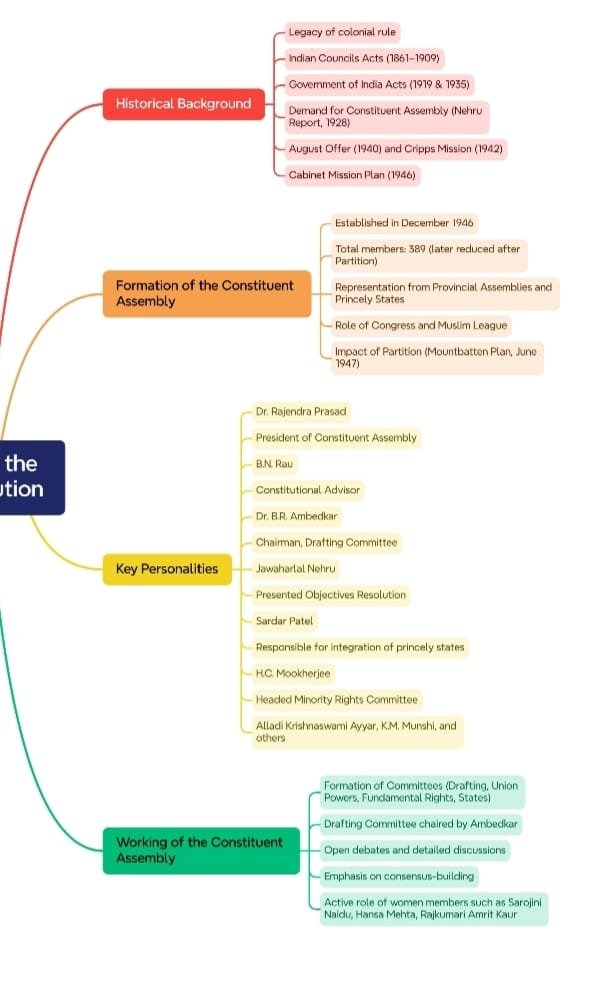
📜 • Dr. Rajendra Prasad served as President; B.N. Rau assisted as constitutional advisor.
🧭 • Committees like the Drafting Committee (chaired by Dr. B.R. Ambedkar) handled specific subjects.
🌾🗺️ Objectives Resolution and Debates
📜 Objectives Resolution (1946) — moved by Jawaharlal Nehru:
🔹 Declared India to be an independent, sovereign republic.
🔸 Promised justice—social, economic, and political—equality and fundamental freedoms.
🔹 Guaranteed safeguarding minorities and weaker sections.
🌿 Debates reflected diverse views: some wanted strong Centre, others state autonomy; some demanded socio-economic revolution, others gradual reform.
🏛️📜 Key Themes in the Constitution
⚖️ Fundamental Rights:
🌾 • Inspired by global charters—secured equality, freedom of speech, religion, and safeguards for minorities.
📚 Directive Principles of State Policy:
🧭 • Guided future governments to promote welfare, reduce inequality, and protect the environment.
🏺 Federal Structure with Strong Centre:
📜 • Balanced unity and diversity—states retained powers, but Centre had overriding authority in crises.
🌾 Secularism:
🏛️ • No state religion; equal respect for all faiths.
📚 Social Justice:
🌿 • Abolition of untouchability, reservations for Scheduled Castes/Tribes.
📜🌟 Challenges and Compromises
🔵 Partition violence created urgency—ensuring minority rights was critical.
🟢 Princely states had to be integrated.
📚 Land reforms, language policy, and reservation debates revealed deep divides.
🧭 Leaders compromised to maintain unity:
🌾 • Hindi accepted as official language but English retained temporarily.
🏛️ • Uniform civil code postponed to respect religious sentiments.
🧭⚡ Role of Key Figures
📜 B.R. Ambedkar: Principal architect—championed equality and fundamental rights.
🌾 Jawaharlal Nehru: Advocated democracy and secularism.
🏛️ Sardar Patel: Integrated princely states and supported strong Centre.
📚 Mahatma Gandhi: Though not in the Assembly, his ideals shaped debates on village self-rule, non-violence, and equality.
📉📜 Adoption and Legacy
⚔️ The Constitution was finalised on 26 November 1949, adopted 26 January 1950.
🌿 It blended Western democratic ideals with Indian realities.
📚 It ensured parliamentary democracy, independent judiciary, and fundamental rights.
🏛️ It became a living document—flexible for amendments yet firm on basic principles.
🧭🌿 Representations and Sources
🔵 Assembly debates, committee reports, letters, and newspapers reveal tensions and hopes.
🟢 Visuals—photographs of signing ceremony, stamps, and posters—symbolise a new India.
📜 The Constitution remains a source of pride, guiding modern India through challenges.
🟡 Summary (~300 words)
🔷 The framing of India’s Constitution (1946–49) occurred amid partition, violence, and diversity. The Constituent Assembly, indirectly elected, reflected multiple communities and ideologies. Under President Rajendra Prasad and Drafting Committee Chairman B.R. Ambedkar, it produced a unique document blending global democratic principles with Indian conditions.
🟢 Nehru’s Objectives Resolution outlined sovereignty, justice, equality, and safeguarding of minorities. Debates tackled federalism, secularism, reservations, economic reform, and individual freedoms. Fundamental Rights assured liberty and equality; Directive Principles guided welfare policies. Compromises—Hindi as official language with English for transition, postponing uniform civil code—kept unity.
🔴 Partition urgency shaped minority protections and princely state integration. Leaders like Ambedkar, Nehru, Patel, and Gandhi’s ideals ensured social justice, democracy, and secular values.
🟣 On 26 November 1949, the Constitution was finalised; on 26 January 1950, it came into force, inaugurating the Republic. Its flexibility allows amendments while preserving core values.
🧭 The Constitution symbolises India’s democratic spirit, ensuring participation, rights, and justice for all citizens.
📝 Quick Recap
📜 Constituent Assembly formed in 1946 to draft independent India’s Constitution.
🌾 Objectives Resolution declared sovereignty, justice, equality, and rights.
🏛️ Key features: Fundamental Rights, Directive Principles, federalism with strong Centre, secularism, social justice.
🧭 Compromises on language, reservations, and civil code ensured unity.
📚 Adopted 26 Nov 1949, enforced 26 Jan 1950—guiding India’s democratic journey.
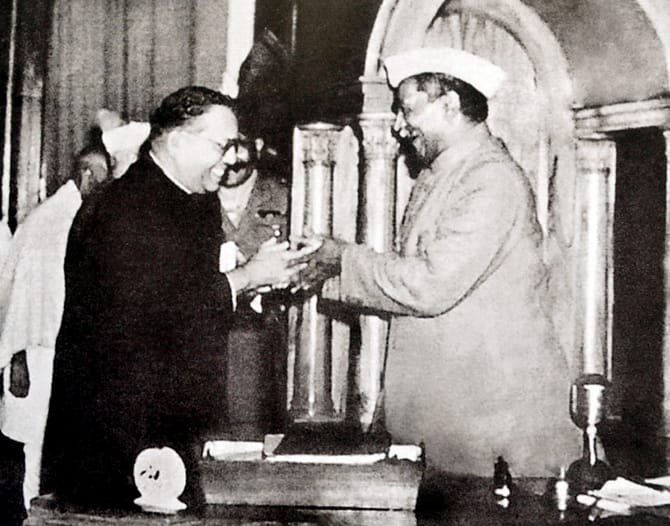
Dr. B.R. Ambedkar presenting the final draft of constitution to Dr. Rajendra prasad at 25 november 1949 .At 26 November 1949 the Assembly adopted the constitution.
————————————————————————————————————————————————————————————————————————————
QUESTIONS FROM TEXTBOOK
📜 Short Answer (100–150 words each)
📜 Q1. What ideals were expressed in the Objectives Resolution?
🧭 Answer:
🌾 • Declared India a sovereign, independent republic.
🏛️ • Promised justice—social, economic, political—and equality of status and opportunity.
📚 • Guaranteed fundamental freedoms—speech, religion, association.
🗺️ • Ensured safeguarding of minorities, backward classes, and tribal groups.
🌿 • Set the moral foundation for the Constitution.
📜 Q2. How did various groups define “minority”?
🧭 Answer:
🌾 • Religious communities like Muslims, Sikhs, and Christians sought cultural and political safeguards.
🏛️ • Depressed classes (Scheduled Castes) emphasised social and economic uplift.
📚 • Some linguistic groups argued for recognition of language rights.
🗺️ • Definitions reflected differing experiences of marginalisation.
📜 Q3. What arguments supported greater provincial power?
🧭 Answer:
🌾 • Provinces could better address local needs and cultures.
🏛️ • Fear of an overly strong Centre undermining autonomy.
📚 • Advocates felt decentralisation strengthened democracy and accountability.
🗺️ • States’ diversity required flexible governance to preserve unity.
📜 Q4. Why did Gandhi prefer Hindustani as national language?
🧭 Answer:
🌾 • Hindustani combined Hindi and Urdu—understood by many Indians.
🏛️ • Reflected cultural pluralism and inclusivity.
📚 • Gandhi believed it could unite communities without privileging one group.
🗺️ • Choosing Hindustani symbolised respect for India’s composite heritage.
⚔️ Long Answer (250–300 words each)
📜 Q5. What historical forces shaped the Constitution’s vision?
🧭 Answer:
🌾 • Freedom struggle values—democracy, equality, secularism—inspired its principles.
🏛️ • Experiences under British colonialism revealed dangers of authoritarian rule and racial discrimination.
📚 • Global events like WWII and rise of human rights shaped fundamental rights emphasis.
🗺️ • The trauma of Partition highlighted safeguarding minorities and maintaining unity.
🌿 • Socio-economic inequalities demanded Directive Principles for welfare and reform.
⚔️ • Leaders drew lessons from constitutions of USA, Ireland, Canada, and Weimar Germany—adopting parliamentary democracy, federalism, and fundamental rights tailored to Indian realities.
📜 Q6. Discuss arguments supporting the protection of oppressed groups.
🧭 Answer:
🌾 • Scheduled Castes/Tribes faced centuries of discrimination—special safeguards were moral necessity.
🏛️ • Reservation in legislatures, services, and education aimed to correct historical injustices.
📚 • Some argued empowerment prevents social unrest and strengthens democracy.
🗺️ • Critics feared excessive division, but supporters stressed temporary measures to ensure equality.
🌿 • Protection of culture and political voice promoted inclusive nation-building.
📜 Q7. How did Assembly members connect political realities with need for strong Centre?
🧭 Answer:
🌾 • Partition violence and communal tensions showed risks of fragmentation.
🏛️ • Integration of princely states required firm central authority.
📚 • Economic planning, defence, and foreign affairs needed unified decision-making.
🗺️ • Balancing autonomy with stability, they favoured a robust Centre to preserve unity without crushing diversity.
📜 Q8. How was the language controversy resolved?
🧭 Answer:
🌾 • Hindi accepted as the official language but English retained for a transition period.
🏛️ • Hindustani advocates stressed inclusivity, while non-Hindi speakers feared domination.
📚 • A “Munshi–Ayyangar compromise” balanced regional sensitivities—states could use their own languages.
🗺️ • The approach maintained national unity while respecting linguistic diversity.
————————————————————————————————————————————————————————————————————————————
OTHER IMPORTANT QUESTIONS FOR EXAMS
🏛️ SECTION A – MCQs (Q1–Q21)
📜 Q1. The Constituent Assembly of India was created in:
🔹 A. 📜 1945 Wavell Plan
🔸 B. 🌾 Cabinet Mission Plan 1946
🔹 C. 🏛️ Cripps Proposal 1942
🔸 D. 🗺️ Simon Commission 1927
🧭 Answer: B
📜 Q2. President of the Constituent Assembly was:
🔹 A. 🌾 Jawaharlal Nehru
🔸 B. 🏛️ Dr. Rajendra Prasad
🔹 C. 📜 Sardar Patel
🔸 D. 🗺️ B.R. Ambedkar
🧭 Answer: B
📜 Q3. The chairman of the Drafting Committee was:
🔹 A. 📜 K.M. Munshi
🔸 B. 🌾 B.N. Rau
🔹 C. 🏛️ B.R. Ambedkar
🔸 D. 🗺️ Jawaharlal Nehru
🧭 Answer: C
📜 Q4. Nehru’s Objectives Resolution proclaimed India as:
🔹 A. 🏛️ Dominion under Britain
🔸 B. 🌾 Independent Sovereign Republic
🔹 C. 📜 Federal State under Crown
🔸 D. 🗺️ Absolute Monarchy
🧭 Answer: B
📜 Q5. Fundamental Rights in the Constitution were influenced by:
🔹 A. 🌾 Irish Constitution
🔸 B. 📜 U.S. Bill of Rights
🔹 C. 🏛️ Both A & B
🔸 D. 🗺️ British Parliament Acts
🧭 Answer: C
📜 Q6. Directive Principles guide:
🔹 A. 📜 State policy for welfare
🔸 B. 🌾 Private corporations
🔹 C. 🏛️ Foreign embassies
🔸 D. 🗺️ Judiciary verdicts directly
🧭 Answer: A
📜 Q7. Language compromise accepted:
🔹 A. 🏛️ Only Hindi permanent
🔸 B. 📜 Only English permanent
🔹 C. 🌾 Hindi official with English transitional
🔸 D. 🗺️ Provincial languages only
🧭 Answer: C
📜 Q8. The Constitution was adopted on:
🔹 A. 📜 15 August 1947
🔸 B. 🌾 26 November 1949
🔹 C. 🏛️ 26 January 1950
🔸 D. 🗺️ 2 October 1948
🧭 Answer: B
📜 Q9. Federalism in India is:
🔹 A. 🌾 Loose confederation of states
🔸 B. 🏛️ Unitary with federal features
🔹 C. 📜 Rigid U.S. model
🔸 D. 🗺️ Purely provincial autonomy
🧭 Answer: B
📜 Q10. Who integrated most princely states into India?
🔹 A. 📜 Rajendra Prasad
🔸 B. 🌾 Sardar Patel
🔹 C. 🏛️ C. Rajagopalachari
🔸 D. 🗺️ Jawaharlal Nehru
🧭 Answer: B
📜 Q11. Assertion–Reason
A: Minority safeguards were included.
R: Partition violence and fears of domination shaped debates.
🔹 A. Both A & R true, R explains A
🔸 B. Both true, R does not explain
🔹 C. A true, R false
🔸 D. A false, R true
🧭 Answer: A
📜 Q12. Assertion–Reason
A: Ambedkar championed abolition of untouchability.
R: Social equality was vital for democratic citizenship.
🔹 A. Both A & R true, R explains A
🔸 B. Both true, R does not explain
🔹 C. A true, R false
🔸 D. A false, R true
🧭 Answer: A
📜 Q13. Match:
(i) Objectives Resolution – Nehru
(ii) Drafting Committee Chair – Ambedkar
(iii) Constitutional Advisor – B.N. Rau
(iv) First President of India – Rajendra Prasad
🔹 A. i-Nehru, ii-Ambedkar, iii-Rau, iv-Prasad
🔸 B. i-Ambedkar, ii-Nehru, iii-Rau, iv-Patel
🔹 C. i-Rau, ii-Prasad, iii-Ambedkar, iv-Nehru
🔸 D. i-Patel, ii-Rau, iii-Ambedkar, iv-Nehru
🧭 Answer: A
📜 Q14. Secularism in the Constitution means:
🔹 A. 🌾 No state religion, equal respect to all faiths
🔸 B. 🏛️ Promotion of majority religion
🔹 C. 📜 Religion banned entirely
🔸 D. 🗺️ British Church control
🧭 Answer: A
📜 Q15. Emergency provisions show:
🔹 A. 📜 Complete decentralisation
🔸 B. 🌾 Unitary tilt for national security
🔹 C. 🏛️ Absolute monarchy
🔸 D. 🗺️ Judicial supremacy
🧭 Answer: B
📜 Q16. Which borrowed feature came from Ireland?
🔹 A. 🏛️ Fundamental Rights
🔸 B. 🌾 Directive Principles of State Policy
🔹 C. 📜 Judicial Review
🔸 D. 🗺️ Impeachment procedure
🧭 Answer: B
📜 Q17. The Constitution is called a “living document” because:
🔹 A. 📜 It can be amended to meet new needs
🔸 B. 🌾 It never changes
🔹 C. 🏛️ It is handwritten only
🔸 D. 🗺️ It expires periodically
🧭 Answer: A
📜 Q18. The Advisory Committee on Fundamental Rights was headed by:
🔹 A. 🌾 Sardar Patel
🔸 B. 📜 B.R. Ambedkar
🔹 C. 🏛️ Rajendra Prasad
🔸 D. 🗺️ Jawaharlal Nehru
🧭 Answer: A
📜 Q19. Provincial elections influencing Assembly composition occurred in:
🔹 A. 📜 1935
🔸 B. 🌾 1945–46
🔹 C. 🏛️ 1927
🔸 D. 🗺️ 1951–52
🧭 Answer: B
📜 Q20. The Constitution came into force on:
🔹 A. 🏛️ 26 January 1950
🔸 B. 🌾 26 November 1949
🔹 C. 📜 15 August 1947
🔸 D. 🗺️ 2 October 1948
🧭 Answer: A
📜 Q21. Picture/ID: Identify the leader called “Father of the Indian Constitution.”
🔹 A. 📜 Rajendra Prasad
🔸 B. 🌾 B.R. Ambedkar
🔹 C. 🏛️ Sardar Patel
🔸 D. 🗺️ Jawaharlal Nehru
🧭 Answer: B
🏺 SECTION B – Short Answer (Q22–Q25)
📜 Q22. State two main ideals of the Objectives Resolution and one reason it was significant.
🧭 Answer:
🌾 • Declared India a sovereign republic committed to justice, equality, and freedom.
🏛️ • Guaranteed safeguards for minorities and weaker sections.
📚 • Significance: Set the philosophical framework guiding all constitutional debates.
📜 Q23. Explain two arguments for a strong Centre and one opposing view.
🧭 Answer:
🌾 • Partition violence and princely state integration needed firm central power.
🏛️ • Economic planning and defence required national coordination.
📚 • Opposing view: Excessive central power could weaken provincial autonomy and democracy.
📜 Q24A (choice). Mention two compromises made on language and one reason for compromise.
🧭 Answer:
🌾 • Hindi accepted as official; English retained for transition.
🏛️ • States free to use regional languages.
📚 • Reason: Prevent disunity among non-Hindi speakers and maintain administrative continuity.
📜 Q24B (choice). List two methods through which oppressed castes’ interests were protected and one purpose behind them.
🧭 Answer:
🌾 • Reserved seats in legislatures and public services.
🏛️ • Abolition of untouchability enshrined in Fundamental Rights.
📚 • Purpose: Ensure social justice and integrate marginalised groups into democracy.
📜 Q25. Describe two global influences on India’s Constitution and one way they were adapted.
🧭 Answer:
🌾 • Fundamental Rights inspired by U.S. Bill of Rights.
🏛️ • Directive Principles borrowed from Irish Constitution.
📚 • Adapted by blending with Indian realities—social justice focus and flexible amendments.
🏺 SECTION B (cont.) – Short Answer II
📜 Q26A (choice): State three ways the Partition influenced the framing of the Constitution.
🧭 Answer:
🌾 • Urgency to protect minorities and prevent communal violence.
🏛️ • Strengthened arguments for a strong Centre to preserve unity.
📚 • Encouraged inclusion of safeguards for displaced persons and vulnerable groups.
📜 Q26B (choice): List three criticisms voiced against the Constituent Assembly.
🧭 Answer:
🌾 • Members were indirectly elected—not fully representative of common people.
🏛️ • Dominance of Congress reduced diversity of opinions.
📚 • Debates sometimes overlooked grassroots voices, focusing on elites.
📜 Q27: Explain two ways princely state integration shaped constitutional debates and one measure taken.
🧭 Answer:
🌾 • Need for uniform laws pushed for strong Centre.
🏛️ • Raised questions on autonomy versus unity.
📚 • Measure: Sardar Patel’s efforts and Article 370 arrangements balanced integration and local identity.
⚔️ SECTION C – Long Answer (300–350 words)
📜 Q28A (choice): Analyse how social and economic justice were addressed in the Constitution.
🧭 Answer:
🌾 • Fundamental Rights outlawed untouchability, ensured equality before law.
🏛️ • Reservations for Scheduled Castes/Tribes in legislatures and jobs aimed to uplift marginalised groups.
📚 • Directive Principles urged land reforms, fair wages, and welfare measures to reduce inequality.
🗺️ • Right to freedom of association empowered workers to organise.
🌿 • Though not immediately enforceable, these provisions set direction for democratic reforms.
⚔️ • By combining enforceable rights with guiding principles, the Constitution balanced idealism with practical governance.
📜 Q28B (choice): Evaluate debates over federalism and central authority.
🧭 Answer:
🌾 • Some members feared excessive centralisation could ignore regional diversity.
🏛️ • Supporters of strong Centre cited Partition violence, integration challenges, and defence needs.
📚 • Compromise: Federal structure with unitary bias during emergencies, ensuring unity without fragmenting authority.
🗺️ • This model allowed flexibility—India could remain one nation yet respect state identities.
📜 Q29A (choice): Discuss the language question and how it was resolved.
🧭 Answer:
🌾 • Hindi supporters wanted national identity; others feared marginalisation.
🏛️ • Gandhi’s idea of Hindustani aimed at inclusivity.
📚 • Munshi–Ayyangar compromise: Hindi as official language, English retained temporarily, states free to choose regional languages.
🗺️ • This prevented linguistic conflict while enabling administrative continuity.
📜 Q29B (choice): Explain the influence of world events on India’s Constitution.
🧭 Answer:
🌾 • U.S. Bill of Rights inspired Fundamental Rights.
🏛️ • Irish Directive Principles shaped welfare goals.
📚 • WWII and the UN Charter influenced emphasis on human rights.
🗺️ • Lessons from Weimar instability and British parliamentary practices informed safeguards and democratic procedures.
📜 Q30: Assess the importance of Constituent Assembly debates for understanding Indian democracy.
🧭 Answer:
🌾 • Provide insight into diverse visions—secularism, social justice, federalism.
🏛️ • Show compromises balancing unity and diversity.
📚 • Reveal fears shaped by Partition and colonialism.
🗺️ • Historians use them to trace democratic values and evolving political culture.
🏛️ SECTION D – Source/Case-Based (1+1+2)
📜 Q31:
Source: “The Assembly must represent all voices, or it will not represent India.”
🧭 Answer:
🌾 (a) Stresses inclusive representation.
🏛️ (b) Reflects concerns of smaller groups.
📚 (c) Reminds us democracy thrives on diversity of participation.
📜 Q32:
Source: “A strong Centre is vital to hold India together after Partition.”
🧭 Answer:
🌾 (a) Highlights fear of fragmentation.
🏛️ (b) Justifies central powers in emergencies.
📚 (c) Shows balancing autonomy with stability was key.
📜 Q33:
Source: “The Constitution must abolish untouchability to ensure equality.”
🧭 Answer:
🌾 (a) Shows commitment to social justice.
🏛️ (b) Influenced drafting of Article 17.
📚 (c) Demonstrates moral urgency for ending discrimination.
🗺️ SECTION E – Map Work (5 marks)
📜 Q34.1: Mark Delhi—venue of Constituent Assembly meetings.
📜 Q34.2: Mark Patiala—a princely state integrated into Indian Union.
📜 Q34.3: Mark Hyderabad—its accession challenged central authority.
📜 Q34.4: Identify two centres marked and state their significance.
🧭 Answer:
🌾 • Delhi—seat of debates that framed independent India’s future.
🏛️ • Hyderabad—its eventual integration demonstrated Centre’s decisive role.
💬 VI Alternative: List three marked sites and explain any two as above.
————————————————————————————————————————————————————————————————————————————
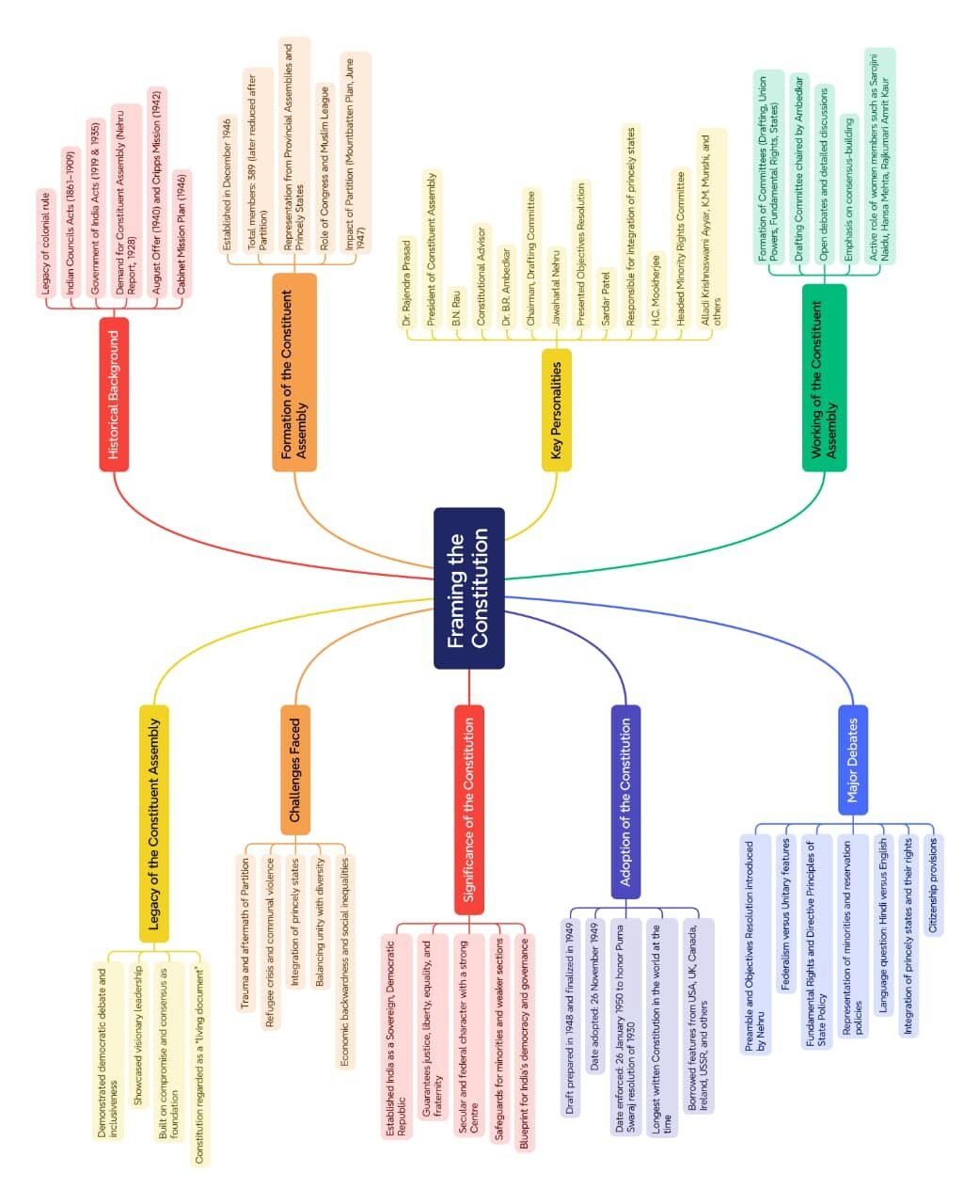
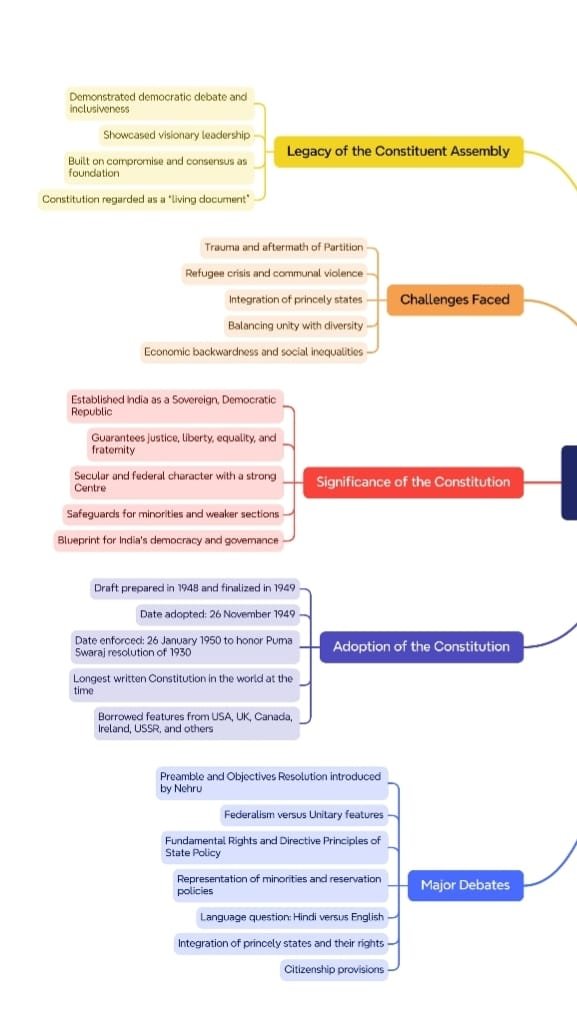
MIND MAPS
————————————————————————————————————————————————————————————————————————————