
Class 12 : English (core) Compulsory – Lesson 1. The Last Lesson

EXPLANATION & SUMMARY
“The Last Lesson” is a poignant short story set during the Franco-Prussian War (1870–71), written by French author Alphonse Daudet. It explores themes of linguistic identity, patriotism, loss, and the value of one’s language through the lens of a young boy named Franz, who narrates the story.
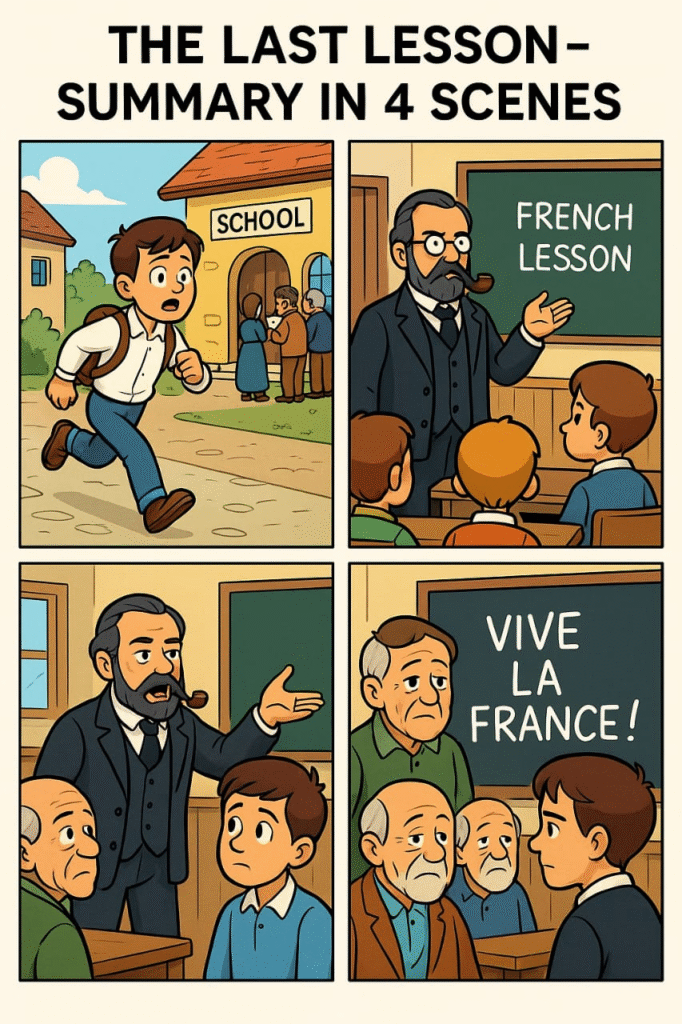
The plot unfolds in the small town of Alsace, which has recently come under Prussian control after France’s defeat. The Prussian authorities have issued an order that only German will be taught in the schools of Alsace and Lorraine, effectively banning French. The story takes place on the day this order comes into effect—when Mr. Hamel, the French teacher at Franz’s school, is delivering his last lesson in French.
Franz, a lazy and carefree boy, begins the day reluctant to go to school because he hasn’t prepared his grammar lesson on participles. On his way, he notices a crowd gathered around the bulletin board near the town hall—a place that had recently been the source of all the bad news. He wonders what now could be happening. Trying to avoid school, he initially thinks of running away, but ultimately goes in.
To his surprise, the atmosphere at school is strangely solemn. Students are unusually quiet, and Mr. Hamel, instead of scolding Franz, speaks kindly to him. Even the villagers, including old Hauser, are present in the classroom, seated at the back. Their presence shows respect and remorse—a silent tribute to Mr. Hamel and to the French language that they had long neglected.
Mr. Hamel, dressed in his ceremonial green coat and frilled shirt—attire he reserved for special occasions—announces that this is his last French lesson. The news shocks Franz. He suddenly realizes how precious his language is and regrets not having taken his studies seriously. He reflects on how everyone, including his parents and Mr. Hamel, is responsible for this loss—parents for prioritizing work over education, and the teacher himself for giving students holidays and tasks unrelated to studies.
With deep emotion, Mr. Hamel addresses the class about the importance of preserving one’s language. He calls French “the most beautiful language in the world”, and says that as long as people hold on to their language, it is like holding the key to their freedom. The story thus underlines how language is linked to national identity and pride.
As the class ends, Mr. Hamel is overcome with emotion. He tries to write “Vive La France!” (“Long Live France!”) on the blackboard but is choked with tears. He gestures the class to leave, as he cannot speak anymore.
Conclusion
“The Last Lesson” is a subtle reminder that we often realize the value of things only when they are about to be taken away. It is a tribute to linguistic heritage, and a call to respect one’s mother tongue, which forms the backbone of culture and freedom. Through Franz’s transformation and Mr. Hamel’s passionate farewell, Daudet presents a timeless message about the power of language and the regret that follows neglect.
——————————————————————————————————————————————————————————————————————————————–
PASSAGE
“I had counted on the commotion to get to my desk without being seen; but of course that day everything had to be as quiet as Sunday morning. Through the window I saw my classmates, already in their places, and Mr. Hamel walking up and down with his terrible iron ruler under his arm. I had to open the door and go in before everybody. You can imagine how I blushed and how frightened I was. But nothing happened. Mr. Hamel saw me and said very kindly, ‘Go to your place quickly, little Franz. We were beginning without you.’ I jumped over the bench and sat down at my desk. Not till then, when I had got a little over my fright, did I see that our teacher had on his beautiful green coat…”
(Short Answer – 30 words)
1. How does the subdued atmosphere described in the paragraph contrast with Franz’s expectations, and what deeper significance does this contrast carry?
Answer:
Franz expected chaos, but found solemn silence, reflecting the seriousness of the final French lesson and symbolizing a collective mourning for lost linguistic and cultural identity under foreign domination.
(Multiple Choice – Advanced)
2. Which literary device is most prominently used in the phrase “as quiet as Sunday morning”?
A. Hyperbole
B. Metaphor
C. Simile
D. Irony
Answer:
C. Simile
(Fill in the blank – Advanced)
3. Franz’s initial plan to slip into class unnoticed was disrupted by the unusually __ ambience, which starkly contrasted the typical classroom setting.
Answer:
solemn
(Fill in the blank – Advanced)
4. Mr. Hamel’s reaction to Franz’s tardiness was marked by an unexpected __, indicative of his emotional restraint and awareness of the moment’s gravity.
Answer:
gentleness
(Assertion and Reason – Advanced)
5. Assertion (A): Mr. Hamel’s choice of attire reflected personal vanity.
Reason (R): He wanted to appear dignified as he conducted the final lesson of his career and paid homage to the language he cherished.
A. A is false, but R is true.
B. Both A and R are true, and R is the correct explanation of A.
C. A is true, but R is false.
D. Both A and R are false.
Answer:
A. A is false, but R is true.
(Short Answer – 30 words)
6. In what way does Mr. Hamel’s calm demeanor subvert Franz’s expectations of discipline, and how does this moment deepen the emotional resonance of the narrative?
Answer:
Mr. Hamel’s unexpected kindness highlights his grief and helplessness. This subdued response deepens the emotional tone, marking a shift from disciplinary authority to dignified farewell amid cultural subjugation.
————————————————————————————————————————————————————————————————————————————
OTHER IMPORTANT QUESTIONS FOR EXAMS
1. Why does Franz feel embarrassed and guilty when Mr. Hamel announces the last French lesson?
Answer:
Franz feels embarrassed for arriving late and guilty for neglecting his language. The announcement forces him to realize the importance of French and his carelessness in learning it, evoking a deep sense of regret and loss he hadn’t anticipated before.
2. How does the presence of the village elders in the classroom enrich the story’s message?
Answer:
The elders’ presence symbolizes a collective remorse and recognition of cultural loss. They come not only to support Mr. Hamel but also to show respect for the language they had long taken for granted, underlining language as a shared national identity.
3. What does the silence in the classroom signify in contrast to ordinary school days?
Answer:
The silence marks reverence and reflection, replacing the usual indifference and noise. It signifies collective mourning and awareness that they are witnessing the end of an era—the symbolic burial of their mother tongue under foreign imposition.
4. Why does the author emphasize Mr. Hamel’s attire on the last day?
Answer:
Mr. Hamel’s ceremonial dress reflects dignity, self-respect, and solemnity. It’s a mark of honor for his profession and the language he’s devoted his life to. His attire contrasts the grief of loss with a proud, dignified farewell to his duty.
5. What is the symbolic value of the phrase “We were beginning without you” spoken by Mr. Hamel?
Answer:
The phrase is subtly layered—it shows acceptance without punishment, but also signifies that life, history, and consequences move forward regardless of individual readiness. It highlights how Franz, like others, has been late in valuing his own heritage.
6. How does Mr. Hamel critique society’s neglect of the French language?
Answer:
He accuses both parents and students of prioritizing livelihood and leisure over education, including himself for being lenient. His speech is a reflection on collective failure, portraying language as a pillar of freedom that was passively surrendered.
7. Why is the blackboard described so prominently in the closing scene?
Answer:
The blackboard becomes a silent monument. Mr. Hamel writes “Vive La France!” as an act of resistance and love. It’s a final expression of identity, contrasting the suppression of language with an indelible statement of cultural pride.
8. Explain the irony embedded in the title “The Last Lesson.”
Answer:
The title is ironic because it is only during the last lesson that the value of the language is fully realized. What had been neglected daily now becomes irretrievable, emphasizing the tragedy of appreciating something only when it’s gone.
9. How does Daudet use Franz’s perspective to intensify the emotional impact of the story?
Answer:
Franz’s childlike innocence and evolving realization act as a lens for the reader. His guilt, confusion, and transformation mirror the awakening of a people, making the personal experience resonate on a collective and emotional level.
10. How does the story reflect the connection between language and freedom?
Answer:
Language is portrayed not just as communication but as a vessel of culture and identity. Mr. Hamel calls it a key to freedom. Losing French represents more than a policy change—it symbolizes domination and cultural erasure under Prussian rule.
3 Questions (150-word answers)
1. Discuss the transformation in Franz’s attitude from the beginning to the end of “The Last Lesson.”
Answer:
Franz begins as a reluctant, careless student who fears a scolding for not learning participles. He tries to avoid school, distracted by nature and townspeople. However, the solemn mood, presence of villagers, and Mr. Hamel’s unexpected kindness gradually shift his mindset. The announcement that this will be the last French lesson awakens his conscience. He suddenly sees value in what he had taken for granted. The grammar lesson, the writing exercise, and even the teacher’s voice—all seem meaningful now. By the end, Franz is deeply moved, filled with guilt, regret, and patriotism. His yearning to hold on to the French language intensifies as he realizes its loss reflects a deeper loss of identity. This transformation illustrates the central theme: the tragic realization of value only when something is about to be lost forever.
2. Analyze how Daudet uses the setting and atmosphere to reinforce the theme of cultural loss in “The Last Lesson.”
Answer:
The setting—an Alsatian classroom in a village under Prussian control—anchors the story’s emotional and political weight. The morning quiet, the presence of town elders, and the subdued classroom environment sharply contrast with typical school days. These elements symbolize mourning. The stillness of “a Sunday morning” evokes the gravity of a funeral, not a class. Even Mr. Hamel’s green coat, worn only on inspection days, adds formality and finality. The visual of villagers quietly sitting, listening like students, suggests communal recognition of the impending cultural extinction. The blackboard and the French text on it become silent witnesses to identity being erased. This carefully constructed atmosphere reinforces Daudet’s central theme: that language is not merely functional but an emotional and cultural anchor—and losing it is akin to losing a part of the self.
3. Evaluate Mr. Hamel’s role as a patriot and how his character embodies resistance in the face of defeat.
Answer:
Mr. Hamel represents quiet yet profound resistance against cultural domination. Though a schoolteacher, he symbolizes the soul of Alsace. On the day of the last lesson, he doesn’t react with anger or protest. Instead, he teaches with dignity, dressing in his ceremonial clothes, making every word count. His lecture on the importance of the French language is not just academic—it is political and emotional. He critiques the negligence of both parents and students, but also honors the language as “the most beautiful” and “the clearest.” His final act—writing “Vive La France!” on the blackboard—is silent yet powerful defiance. He teaches not just grammar but pride, regret, and resistance. In the face of political defeat, he holds firm to his cultural identity, showing that true patriotism lies in preserving one’s heritage, even in silence. Mr. Hamel’s calm integrity leaves an indelible mark on both Franz and the reader.
————————————————————————————————————————————————————————————————————————————