
Class 12 : Biology (English) – Lesson 3: Reproductive Health

EXPLANATION & SUMMARY
🟢 Introduction to Reproductive Health
Reproductive health refers to a state of complete physical, emotional, behavioral, and social well-being in all aspects of reproduction. It does not merely indicate the absence of disease or disorder of the reproductive system but also implies that individuals have a safe and satisfying sex life, the ability to reproduce, and the freedom to decide if, when, and how often to do so. The term gained momentum after the 1994 UN Conference on Population and Development held in Cairo.
To ensure this, India initiated various programs under the umbrella of Family Planning and later expanded it to Reproductive and Child Health (RCH) programs.
✨ Key Objectives of Reproductive Health Programs:
🔹 Awareness and information dissemination
🔹 Access to contraceptives and medical assistance
🔹 Maternal and child care
🔹 Infertility and STD management
─────────────────────────────────────────────
🔴 1. Importance of Reproductive Health in Society
A society with healthy reproductive practices ensures:
✅ Lower infant and maternal mortality
✅ Controlled population growth
✅ Prevention of sexually transmitted diseases (STDs)
✅ Educated and aware youth
✅ Healthier future generations
Awareness about safe sexual practices, timely intervention in STDs, infertility treatments, contraceptive choices, and institutional deliveries is vital.
─────────────────────────────────────────────
🟣 2. Population Explosion and Its Causes
Population explosion refers to the rapid and unchecked increase in human population. India witnessed a sharp rise post-independence due to:
🔸 Decline in death rates due to improved healthcare
🔸 Better nutrition and medical facilities
🔸 Lack of awareness about contraceptives
🔸 Desire for male child in many families
🔸 Early marriages and limited education, especially in rural areas
💠 Such growth puts pressure on natural resources, employment, food, and infrastructure. Hence, it is crucial to control population through awareness and the use of contraceptive methods.
─────────────────────────────────────────────
🔵 3. Birth Control and Contraceptive Methods
Contraception is the prevention of pregnancy by interfering with the normal process of fertilisation, ovulation, or implantation.
✨ Ideal Characteristics of a Good Contraceptive:
✔️ User-friendly
✔️ Easily available
✔️ Effective and reversible
✔️ Economical
✔️ No or minimal side effects
🟩 Types of Contraceptive Methods:
🔹 Natural Methods
Prevent meeting of sperm and ovum.
Examples:
▪️ Periodic abstinence – avoiding intercourse during ovulation
▪️ Coitus interruptus – withdrawal before ejaculation
▪️ Lactational amenorrhea – during full lactation (first 6 months post-birth)
🔹 Barrier Methods
Block sperm from reaching the egg.
Examples:
▪️ Condoms (both male & female)
▪️ Diaphragms, Cervical caps, Spermicidal jellies
🔹 Intra-Uterine Devices (IUDs)
Inserted into uterus by medical professionals.
Types:
▪️ Non-medicated IUDs (e.g., Lippes loop)
▪️ Copper-releasing IUDs (e.g., CuT, Cu7) – inhibit sperm motility
▪️ Hormone-releasing IUDs (e.g., LNG-20) – thicken cervical mucus
🔹 Oral Contraceptives
Taken in pill form (e.g., Mala-D, Mala-N)
Contain synthetic hormones that inhibit ovulation.
🔹 Implants and Injections
Hormonal methods (e.g., Norplant) – longer-term contraception.
🔹 Surgical Methods (Sterilisation)
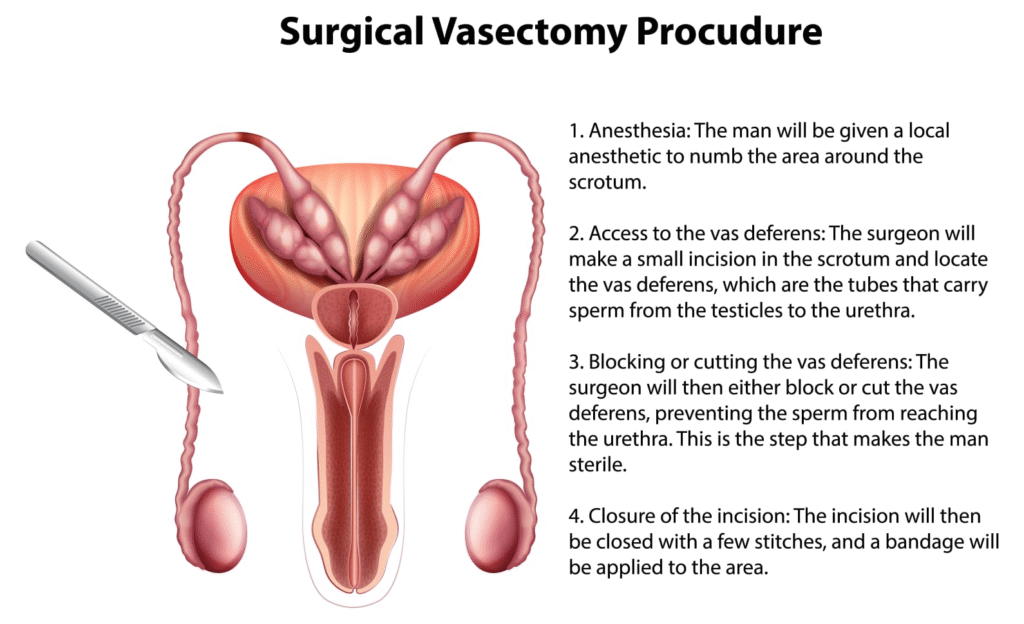
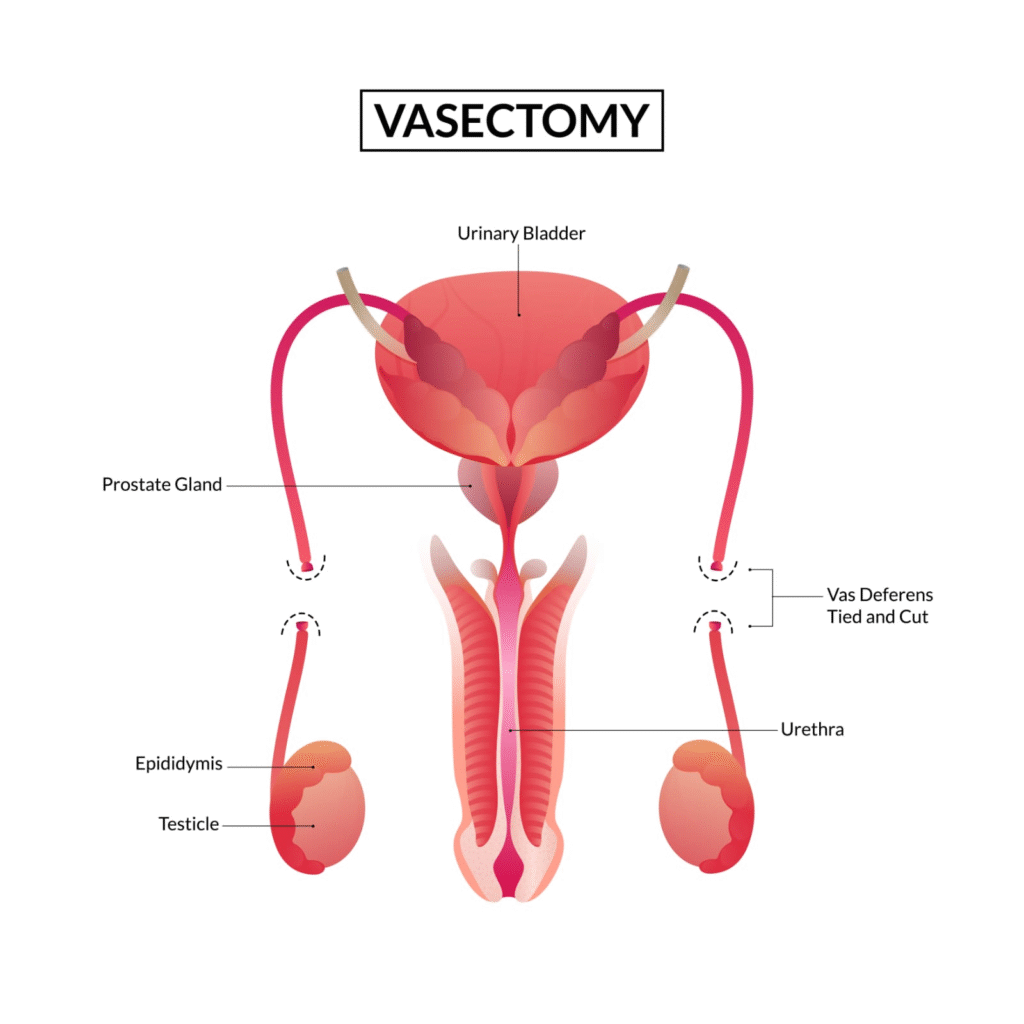
🔸 Vasectomy – removal/blocking of vas deferens in males
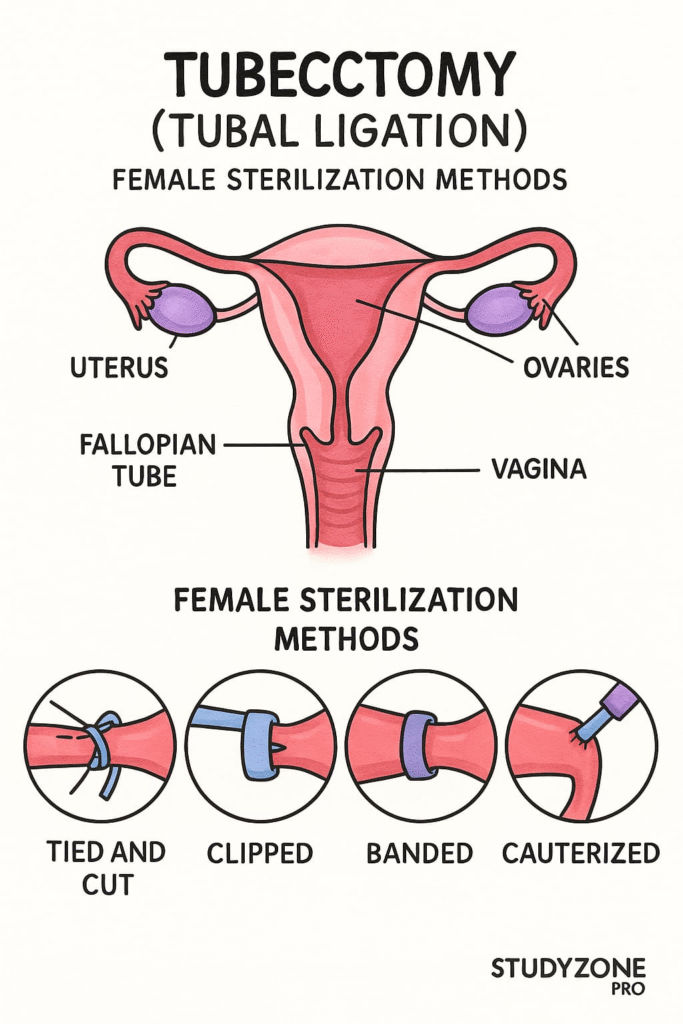
🔸 Tubectomy – removal/blocking of fallopian tubes in females
✅ These are permanent and highly effective
─────────────────────────────────────────────
🟠 4. Medical Termination of Pregnancy (MTP)
Also called abortion, MTP is the voluntary termination of pregnancy before full term. It was legalized in India in 1971 to regulate unsafe abortions.
✅ Done under safe conditions, preferably before 20 weeks.
⚠️ Frequent or unsafe MTPs can lead to complications or infertility.
🔸 Ethical concerns: Misuse for female foeticide
🔸 Solution: Strict legal ban on sex-determination tests
─────────────────────────────────────────────
🟡 5. Sexually Transmitted Diseases (STDs)
Diseases transmitted through sexual contact with an infected person.
Also called Venereal Diseases (VDs) or Reproductive Tract Infections (RTIs).
🧪 Examples of STDs:
▪️ Bacterial: Gonorrhoea, Syphilis
▪️ Viral: HIV-AIDS, Genital Herpes, Hepatitis-B
▪️ Fungal: Candidiasis
▪️ Protozoan: Trichomoniasis
🧩 Symptoms (May vary):
▪️ Painful urination
▪️ Discharge from genitals
▪️ Genital ulcers or itching
▪️ Fever or body pain
✅ Most STDs are curable if detected early, but viral infections like HIV are incurable.
🛡️ Prevention is better than cure: monogamous relationships, use of condoms, awareness, and regular check-ups are vital.
─────────────────────────────────────────────
🟢 6. Infertility and Its Management
Infertility is the inability to conceive or produce offspring after 1 year of regular, unprotected intercourse.
📌 Causes in Males:
▪️ Low sperm count, hormonal imbalance, infections, stress
📌 Causes in Females:
▪️ Hormonal disorders, blocked fallopian tubes, ovulation failure
✨ Assisted Reproductive Technologies (ARTs):
🔸 In Vitro Fertilisation (IVF) – Fertilisation outside body, embryo implanted in uterus
🔸 Zygote Intra Fallopian Transfer (ZIFT) – Zygote transferred into fallopian tube
🔸 Intra Cytoplasmic Sperm Injection (ICSI) – Sperm injected directly into egg
🔸 Gamete Intra Fallopian Transfer (GIFT) – Gametes placed in fallopian tube
🔸 Artificial Insemination (AI) – Semen introduced into vagina or uterus
🔸 Surrogacy – Another woman carries the baby for the couple
✔️ ARTs offer hope to infertile couples but are expensive and emotionally demanding
─────────────────────────────────────────────
🔴 7. Reproductive Health and Sex Education
Sex education is crucial for adolescents. It helps:
🧠 Understand body changes
🧠 Prevent unwanted pregnancies and STDs
🧠 Promote responsible behavior
🧠 Remove myths and taboos
💡 Reproductive health is not just about physical well-being but includes mental, social, and emotional aspects.
Programs like RCH, health camps, NGO support, and public education campaigns are essential.
─────────────────────────────────────────────
🌈 Conclusion
India has made progress through policies, awareness, and access to medical resources.
Still, challenges like population growth, gender discrimination, lack of access in rural areas, and social taboos remain.
Through education, government schemes, and public cooperation, we can create a healthy and responsible society.
🌿🌸🌿🌸🌿🌸🌿🌸🌿🌸🌿🌸🌿🌸🌿🌸🌿🌸🌿
─────────────────────────────────────────────
✍️ SUMMARY (~300 Words)
─────────────────────────────────────────────
🔹 Reproductive health refers to complete well-being in all aspects of reproduction, not just absence of diseases.
🔹 India initiated Family Planning programs, later expanded to Reproductive and Child Health (RCH).
🔹 Population explosion is controlled using awareness and contraceptive methods like:
▪️ Natural
▪️ Barrier
▪️ IUDs
▪️ Oral pills
▪️ Surgical methods
🔹 Contraceptives should be safe, effective, affordable, and reversible. Sterilisation (vasectomy and tubectomy) is permanent.
🔹 MTP (Medical Termination of Pregnancy) is legal under specific conditions. But misuse for sex-selective abortion is banned.
🔹 STDs include infections like HIV, Gonorrhoea, and Syphilis.
Preventive measures: monogamy, condom use, awareness, early diagnosis.
🔹 Infertility may affect males or females. Assisted Reproductive Technologies (ARTs) like IVF, ZIFT, GIFT, and surrogacy help such couples.
🔹 Sex education in schools empowers students with correct information about puberty, hygiene, STDs, and safe practices.
🔹 Reproductive health is key to social well-being and economic development.
Better awareness, healthcare, and education ensure a healthy future generation.
🌟 Reproductive health = Awareness + Access + Responsibility
————————————————————————————————————————————————————————————————————————————
QUESTIONS FROM TEXTBOOK
Q1. What do you think is the significance of reproductive health in a society?
🟢 Answer:
Reproductive health is essential for the overall well-being of individuals and society. It ensures: ✔️ Physical and emotional health of individuals
✔️ Prevention of sexually transmitted diseases (STDs)
✔️ Reduced maternal and infant mortality
✔️ Proper family planning and population control
✔️ Socio-economic development through informed reproductive choices
Q2. Suggest the aspects of reproductive health which need to be given special attention in the present scenario.
🟢 Answer:
Some crucial aspects include
🔹 Creating awareness about reproductive hygiene
🔹 Promoting safe sex practices and use of contraceptives
🔹 Preventing STDs and HIV
🔹 Providing education on sex and sexuality
🔹 Ensuring availability of reproductive health services
🔹 Encouraging medical check-ups and infertility treatment
Q3. Is sex education necessary in schools? Why?
🟢 Answer:
Yes, it is essential. Sex education helps students:
📘 Understand physical and emotional changes during puberty
🚫 Prevent myths and misconceptions
🛡️ Avoid unwanted pregnancies and STDs
🧠 Make informed decisions about reproductive health
👥 Develop respect for others and avoid exploitation
Q4. Do you think that reproductive health in our country has improved in the past 50 years? If yes, mention some such areas of improvement.
🟢 Answer:
Yes, reproductive health has improved significantly due to:
✅ Increased awareness about family planning
✅ Government initiatives like RCH (Reproductive and Child Health) programs
✅ Availability of contraceptives and MTP services
✅ Better maternal healthcare and reduced infant mortality
✅ Advances in infertility treatment (IVF, IUI, etc.)
Q5. What are the suggested reasons for population explosion?
🟢 Answer:
Key reasons include:
🔸 Decline in death rate due to better healthcare
🔸 High birth rate due to lack of awareness
🔸 Early marriages and large family preferences
🔸 Lack of access to contraceptives and education
Q6. Is the use of contraceptives justified? Give reasons.
🟢 Answer:
Yes, contraceptives are justified because:
✔️ They prevent unwanted pregnancies
✔️ Help maintain proper birth spacing
✔️ Control population growth
✔️ Reduce maternal health risks
✔️ Prevent transmission of STDs (in case of condoms)
Q7. Removal of gonads cannot be considered as a contraceptive option. Why?
🟢 Answer:
Gonad removal (castration) is a permanent and irreversible surgical procedure that leads to loss of secondary sexual characters and hormonal imbalance. It is medically unethical as a contraceptive and meant only for medical conditions like cancer.
Q8. Amniocentesis for sex determination is banned in our country. Is this ban necessary? Comment.
🟢 Answer:
Yes, the ban is absolutely necessary. Amniocentesis was misused for female foeticide due to gender bias. This led to a decline in female sex ratio. To promote gender equality and protect unborn girls, this ban is legally and ethically essential.
Q9. Suggest some methods to assist infertile couples to have children.
🟢 Answer:
Infertile couples can be helped using Assisted Reproductive Technologies (ARTs) such as:
🔹 IVF (In Vitro Fertilisation)
🔹 ZIFT (Zygote Intra-Fallopian Transfer)
🔹 ICSI (Intra Cytoplasmic Sperm Injection)
🔹 AI (Artificial Insemination)
🔹 GIFT (Gamete Intra-Fallopian Transfer)
🔹 Surrogacy
Q10. What are the measures one has to take to prevent from contracting STDs?
🟢 Answer:
To prevent STDs, one should:
🛡️ Avoid sex with multiple or unknown partners
🛡️ Use condoms during sexual intercourse
🛡️ Maintain personal hygiene
🛡️ Ensure regular medical check-ups
🛡️ Avoid sharing needles or razors
🛡️ Get prompt treatment if any symptoms appear
Q11. State True/False with explanation:
(a) Abortions could happen spontaneously too.
✅ True – These are called miscarriages and occur naturally.
(b) Infertility is defined as the inability to produce a viable offspring and is always due to abnormalities/defects in the female partner.
❌ False – Infertility may occur in either partner, not just the female.
(c) Complete lactation could help as a natural method of contraception.
✅ True – Lactational Amenorrhea Method (LAM) is effective for the first 6 months post-delivery.
(d) Creating awareness about sex related aspects is an effective method to improve reproductive health of the people.
✅ True – Awareness empowers people to make informed decisions and leads to better health outcomes.
Q12. Correct the following statements
(a) Surgical methods of contraception prevent gamete formation.
❌ Correction: They prevent fertilization, not gamete formation.
(b) All sexually transmitted diseases are completely curable.
❌ Correction: Some STDs like HIV/AIDS are incurable, others like syphilis are curable.
(c) Oral pills are very popular contraceptives among the rural women.
❌ Correction: Oral pills are less popular in rural areas due to lack of awareness; condoms or sterilization are more common.
(d) In E.T. techniques, embryos are always transferred into the uterus.
❌ Correction: Embryos can also be transferred into the Fallopian tubes (e.g., ZIFT).
————————————————————————————————————————————————————————————————————————————
OTHER IMPORTANT QUESTIONS FOR EXAMS
(CBSE MODEL QUESTIONS PAPER)
ESPECIALLY MADE FROM THIS LESSON ONLY
Q1. Which of the following is a natural method of contraception?
(A) Condom
(B) Coitus interruptus
(C) Oral pill
(D) Copper-T
Answer: (B) Coitus interruptus
Q2. Which of the following is a symptom of a sexually transmitted disease (STD)?
(A) Skin pigmentation
(B) Genital ulcers and discharge
(C) Blurred vision
(D) Persistent cough
Answer: (B) Genital ulcers and discharge
Q3. Assertion (A): Oral contraceptive pills inhibit ovulation.
Reason (R): They increase FSH and LH levels.
(A) Both A and R are true, and R is the correct explanation of A.
(B) Both A and R are true, but R is not the correct explanation of A.
(C) A is true, but R is false.
(D) A is false, but R is true.
Answer: (C) A is true, but R is false.
Q4. Which of the following sexually transmitted diseases is caused by a virus?
(A) Gonorrhoea
(B) Syphilis
(C) Genital herpes
(D) Chlamydia
Answer: (C) Genital herpes
Q5. Which hormone is commonly present in oral contraceptive pills?
(A) Oxytocin
(B) Testosterone
(C) Estrogen and Progesterone
(D) Thyroxine
Answer: (C) Estrogen and Progesterone
Q6. What is the full form of IUD in the context of contraception?
(A) Internal Uterine Device
(B) Intra-Uterine Device
(C) Immediate Use Device
(D) Injected Uterine Drug
Answer: (B) Intra-Uterine Device
Q7. Which surgical method is used in females for permanent contraception?
(A) Vasectomy
(B) Tubectomy
(C) Hysterectomy
(D) Coitus interruptus
Answer: (B) Tubectomy
Q8. Which among the following is a copper-releasing IUD?
(A) LNG-20
(B) CuT
(C) Mala-N
(D) Norplant
Answer: (B) CuT
Q9. Which of the following is a common cause of male infertility?
(A) Hyperthyroidism
(B) Low sperm count
(C) Ovulation failure
(D) Endometriosis
Answer: (B) Low sperm count
Q10. Which of the following is an assisted reproductive technology (ART)?
(A) Coitus interruptus
(B) Condom use
(C) In Vitro Fertilisation
(D) Tubectomy
Answer: (C) In Vitro Fertilisation
Q11. Assertion (A): Lactational amenorrhea is a temporary method of contraception.
Reason (R): It is effective only up to 6 months after childbirth, if the mother is fully breastfeeding.
(A) Both A and R are true, and R is the correct explanation of A.
(B) Both A and R are true, but R is not the correct explanation of A.
(C) A is true, but R is false.
(D) A is false, but R is true.
Answer: (A) Both A and R are true, and R is the correct explanation of A.
Q12. Which of the following STDs is caused by a retrovirus?
(A) Hepatitis-B
(B) Gonorrhoea
(C) AIDS
(D) Syphilis
Answer: (C) AIDS
Q13. In which ART are gametes directly introduced into the fallopian tube?
(A) ZIFT
(B) ICSI
(C) GIFT
(D) IVF
Answer: (C) GIFT
Q14. Which of the following is an objective of the RCH Programme in India?
(A) Increasing surgical methods
(B) Banning contraceptives
(C) Reducing maternal and infant mortality
(D) Promoting female foeticide
Answer: (C) Reducing maternal and infant mortality
Q15. Which of the following is a temporary, reversible method of contraception?
(A) Tubectomy
(B) Vasectomy
(C) Condom
(D) Hysterectomy
Answer: (C) Condom
Q16. What does ZIFT stand for in assisted reproductive techniques?
(A) Zygote Intra-Follicular Technique
(B) Zygote Implantation for Fertility Treatment
(C) Zygote Intra-Fallopian Transfer
(D) Zonal Infusion for Tubal Fertility
Answer: (C) Zygote Intra-Fallopian Transfer
Q17. In which ART technique is a sperm directly injected into the ovum?
(A) IVF
(B) ZIFT
(C) ICSI
(D) AI
Answer: (C) ICSI
Q18. Which of the following contraceptive methods can also prevent STDs?
(A) Oral pills
(B) Copper-T
(C) Condom
(D) Tubectomy
Answer: (C) Condom
Q19. Explain how the use of IUDs helps in preventing conception.
Answer:
IUDs (Intra-Uterine Devices), such as Copper-T, prevent conception by:
Releasing copper ions that suppress sperm motility and viability.
Causing changes in the uterine lining that prevent implantation.
Acting as a physical barrier to the movement of sperms.
They are highly effective, long-lasting, and reversible methods of contraception.
Q20. Why is the use of condoms considered a dual protection method?
Answer:
Condoms are considered dual protection because:
They prevent unwanted pregnancies by blocking sperm entry into the female reproductive tract.
They reduce the risk of transmission of sexually transmitted diseases (STDs) like HIV/AIDS, syphilis, gonorrhoea, etc.
Q21. A couple is unable to have a child. The medical reports suggest low sperm count in the male partner. Name a suitable ART for them and explain how it works.
Answer:
Suitable ART: Artificial Insemination (AI)
Working:
Semen collected from the male partner (or donor if needed) is processed and introduced into the female’s vagina or uterus around the time of ovulation to enhance chances of fertilisation.
Q22. What is MTP? Under what condition is it considered legal and justified in India?
Answer:
MTP stands for Medical Termination of Pregnancy.
It is legally permitted in India under the following conditions:
If the pregnancy poses a threat to the life or health (physical/mental) of the mother.
If the fetus shows severe abnormalities.
In cases of contraceptive failure or rape.
It is allowed only up to 20–24 weeks under medical supervision.
Q23. List any four steps to prevent sexually transmitted diseases.
Answer:
Avoid unprotected sex and maintain monogamous relationships.
Use condoms during every sexual encounter.
Avoid sharing needles, razors, or syringes.
Seek prompt medical attention in case of suspected infection.
Q24. Write any three differences between natural and barrier methods of contraception.
Answer:
Natural Method Barrier Method
Based on avoiding intercourse during fertile period Involves use of physical devices to block sperm
No cost or device required Requires external devices (e.g., condom)
Less reliable More reliable and effective
Examples: Coitus interruptus, lactational amenorrhea (natural); condoms, diaphragms (barrier)
Q25. Differentiate between tubectomy and vasectomy. Name the structures cut and tied in each case.
Answer:
Feature Tubectomy Vasectomy
Gender Female Male
Structure blocked Fallopian tubes Vas deferens
Effect Prevents egg transport Prevents sperm transport
Reversibility Usually irreversible Usually irreversible
Both are surgical and permanent contraceptive methods.
Q26. A woman wants to delay her pregnancy for a few years but prefers a temporary hormonal method. Suggest a suitable method and explain its working.
Answer:
Suggested Method: Oral contraceptive pills
Working:
Pills contain synthetic hormones (estrogen and progesterone).
These inhibit ovulation by suppressing FSH and LH release from the pituitary.
Also cause thickening of cervical mucus and change in endometrial lining to prevent implantation.
Q27. What are the ethical issues associated with amniocentesis? Why is it banned for sex determination?
Answer:
Ethical Issues:
Amniocentesis was misused for sex determination followed by female foeticide.
This led to a declining female sex ratio in many parts of India.
Ban Justification:
To prevent gender-based discrimination before birth.
It is now legally banned for sex determination but allowed for detecting genetic abnormalities.
Q28. Explain any three Assisted Reproductive Technologies (ARTs) with their key steps.
Answer:
IVF (In Vitro Fertilisation):
Fertilisation outside the body; zygote transferred to uterus.
ZIFT (Zygote Intra-Fallopian Transfer):
Fertilised zygote is transferred into fallopian tube.
ICSI (Intra Cytoplasmic Sperm Injection):
Sperm directly injected into ovum; used in male infertility.
Each technique helps infertile couples overcome conception difficulties.
Q29. Read the following passage and answer the questions:
India has witnessed a rapid rise in population since independence. The government has introduced family planning programs and campaigns to educate people about contraception and reproductive health. However, challenges such as lack of awareness, social taboos, and cultural factors still hinder progress in many rural areas.
(a) Mention any two reasons for population explosion in India.
(b) How does contraceptive use help in reproductive health?
(c) Name two commonly used temporary contraceptive methods.
Answer:
(a)
Decline in death rate due to improved medical care.
Lack of education and early marriages.
(b)
Contraceptives help in controlling unwanted pregnancies, ensuring proper birth spacing, and maintaining maternal health. This supports better family and community health.
(c)
Condoms
Oral contraceptive pills
Q30. Read the following case study and answer the questions:
A 32-year-old woman and her husband have been trying to conceive for over 2 years. Medical examination reveals that the woman’s fallopian tubes are blocked, and ovulation is irregular. The couple is advised to try ART.
(a) Name two ARTs that can help this couple.
(b) Which hormones are essential to induce ovulation in such patients?
(c) Name one ART that involves fertilisation outside the body.
Answer:
(a) IVF (In Vitro Fertilisation) and ICSI (Intra Cytoplasmic Sperm Injection)
(b) FSH (Follicle-Stimulating Hormone) and LH (Luteinising Hormone)
(c) IVF (In Vitro Fertilisation)
Q31. Read the passage and answer the following:
Sexually transmitted diseases (STDs) are rising among sexually active adolescents due to lack of awareness and unprotected sex. These infections can cause infertility, complications during pregnancy, and in severe cases, even death.
(a) Name any two STDs caused by bacteria.
(b) Suggest two ways to prevent transmission of STDs.
(c) Why is early diagnosis important in the case of STDs?
Answer:
(a) Gonorrhoea and Syphilis
(b)
Using condoms
Avoiding multiple sexual partners
(c)
Early diagnosis helps in effective treatment, prevents complications like infertility, and stops further spread of infection.
Q32. Describe in detail the types of contraceptive methods used to control birth. Mention one merit and one demerit of each.
Answer:
Natural Methods:
Examples: Coitus interruptus, periodic abstinence, lactational amenorrhea
Merit: No side effects
Demerit: Unreliable if timing is miscalculated
Barrier Methods:
Examples: Condoms, diaphragms, cervical caps
Merit: Prevent STDs and pregnancy
Demerit: Risk of rupture or improper use
Intra-Uterine Devices (IUDs):
Examples: Copper-T, LNG-20
Merit: Long-term and effective
Demerit: May cause uterine cramps or bleeding
Oral Contraceptives:
Examples: Mala-D, Mala-N
Merit: Regulates menstrual cycle
Demerit: May cause hormonal side effects
Surgical Methods:
Examples: Vasectomy, Tubectomy
Merit: Permanent solution
Demerit: Irreversible and requires surgery
Q33. What is infertility? Discuss the causes and any four ART techniques used to treat infertile couples.
Answer:
Infertility:
The inability of a couple to conceive even after one year of unprotected sexual intercourse.
Causes:
In males: Low sperm count, poor sperm motility, blockages, hormonal issues
In females: Ovulation failure, blocked fallopian tubes, uterine disorders
ART Techniques:
IVF (In Vitro Fertilisation): Fertilisation outside the body; embryo transferred to uterus.
ZIFT (Zygote Intra-Fallopian Transfer): Zygote transferred into fallopian tube.
ICSI (Intra Cytoplasmic Sperm Injection): Single sperm injected directly into ovum.
GIFT (Gamete Intra-Fallopian Transfer): Gametes introduced into fallopian tube for fertilisation.
These techniques have helped many couples achieve parenthood.
Q34. What are sexually transmitted diseases (STDs)? Write symptoms, transmission modes, and control/prevention measures for STDs.
Answer:
Definition:
STDs are infections transmitted from one person to another through sexual contact with an infected individual.
Examples: Gonorrhoea, Syphilis, AIDS, Genital herpes
Symptoms:
Painful urination
Genital ulcers
Discharge from genitals
Pelvic pain and rashes
Transmission Modes:
Unprotected sex
Sharing infected needles or razors
Transfusions of infected blood
From mother to child during childbirth
Prevention and Control:
Avoid multiple sexual partners
Use of condoms
Regular checkups and early treatment
Avoid sharing personal items like razors
Q35. Describe the role and objectives of the Reproductive and Child Health (RCH) Programme introduced by the Government of India.
Answer:
Role:
The RCH Programme was launched to improve reproductive health care, maternal health, and child survival through accessible and affordable medical services.
Objectives:
Provide reproductive health education
Control population growth
Reduce maternal and infant mortality
Prevent and treat STDs
Offer infertility treatments and contraceptive services
Ensure institutional deliveries and immunization
Empower women with health-related choices
Through public awareness, medical facilities, and family welfare programs, RCH promotes a healthier and informed society.
————————————————————————————————————————————————————————————————————————————
NEET QUESTIONS FROM THIS LESSON
Q1. Which of the following is a hormonal contraceptive?
(A) Copper-T
(B) Condom
(C) Mala-N
(D) Diaphragm
Answer: (C) Mala-N
Year: 2025 | Set: Z
Q2. Which IUD is known to release hormones?
(A) CuT
(B) LNG-20
(C) Lippes Loop
(D) Multiload 375
Answer: (B) LNG-20
Year: 2024 | Set: 2
Q3. Which of the following is a surgical method of contraception?
(A) Oral pill
(B) Tubectomy
(C) Condom
(D) IUD
Answer: (B) Tubectomy
Year: 2024 | Set: Q
Q4. Which one of the following is not a sexually transmitted disease?
(A) AIDS
(B) Gonorrhoea
(C) Syphilis
(D) Encephalitis
Answer: (D) Encephalitis
Year: 2023 | Set: R
Q5. Which one of the following is most effective for preventing pregnancy and protecting against STDs?
(A) IUD
(B) Oral pill
(C) Condom
(D) Vasectomy
Answer: (C) Condom
Year: 2023 | Set: Z
Q6. Which part is cut and tied during vasectomy?
(A) Ureter
(B) Vas deferens
(C) Fallopian tube
(D) Urethra
Answer: (B) Vas deferens
Year: 2022 | Set: M
Q7. Which of the following is a temporary method of contraception?
(A) Vasectomy
(B) Tubectomy
(C) Condom
(D) Hysterectomy
Answer: (C) Condom
Year: 2022 | Set: W
Q8. Which of the following methods does not prevent gamete formation?
(A) Vasectomy
(B) Oral pill
(C) Copper-T
(D) Lactational amenorrhea
Answer: (C) Copper-T
Year: 2021 | Set: 1
Q9. What is the function of copper ions released by IUDs?
(A) Increase egg motility
(B) Suppress sperm motility
(C) Inhibit LH surge
(D) Stimulate ovulation
Answer: (B) Suppress sperm motility
Year: 2021 | Set: S3
Q10. Which one is a non-medicated IUD?
(A) CuT
(B) LNG-20
(C) Lippes Loop
(D) Multiload 375
Answer: (C) Lippes Loop
Year: 2020 | Set: Z
Q11. Which of the following statements is true about oral contraceptive pills?
(A) They inhibit ovulation and implantation
(B) They block fallopian tubes
(C) They kill sperms
(D) They suppress menstruation
Answer: (A) They inhibit ovulation and implantation
Year: 2020 | Set: Q
Q12. Which of the following contraceptives changes the uterine lining to prevent implantation?
(A) Condom
(B) Oral pill
(C) Diaphragm
(D) Vasectomy
Answer: (B) Oral pill
Year: 2019 | Set: 2
Q13. Lactational amenorrhea is effective as a contraceptive method only up to:
(A) 1 year
(B) 2 years
(C) 6 months
(D) 3 months
Answer: (C) 6 months
Year: 2019 | Set: M
Q14. Which of the following is not a feature of a good contraceptive?
(A) User-friendly
(B) Irreversible
(C) Effective
(D) Easily available
Answer: (B) Irreversible
Year: 2018 | Set: W
Q15. Which one of the following is not an ART?
(A) ZIFT
(B) GIFT
(C) ICSI
(D) MTP
Answer: (D) MTP
Year: 2018 | Set: Z
Q16. Which of the following STD is not caused by a bacterium?
(A) Gonorrhoea
(B) Syphilis
(C) Chlamydia
(D) Genital herpes
Answer: (D) Genital herpes
Year: 2017 | Set: Q
Q17. Which of the following methods is considered a natural contraceptive?
(A) Condom
(B) Copper-T
(C) Coitus interruptus
(D) Oral pill
Answer: (C) Coitus interruptus
Year: 2017 | Set: R
Q18. Which of the following methods does not protect against STDs?
(A) Condom
(B) Oral contraceptive
(C) Abstinence
(D) Monogamy
Answer: (B) Oral contraceptive
Year: 2016 | Set: Z
Q19. Which of the following STDs can be caused by a protozoan?
(A) Gonorrhoea
(B) Trichomoniasis
(C) Syphilis
(D) Genital warts
Answer: (B) Trichomoniasis
Year: 2016 | Set: P
Q20. Which contraceptive is a hormone-releasing IUD?
(A) CuT
(B) Multiload
(C) Lippes Loop
(D) LNG-20
Answer: (D) LNG-20
Year: 2015 | Set: Q
Q21. Which statement is incorrect regarding STDs?
(A) Gonorrhoea is caused by bacteria
(B) AIDS is caused by virus
(C) Syphilis is caused by protozoa
(D) Genital herpes is viral
Answer: (C) Syphilis is caused by protozoa
Year: 2015 | Set: S
Q22. A woman has blocked fallopian tubes. Which ART can help her?
(A) ICSI
(B) ZIFT
(C) GIFT
(D) AI
Answer: (B) ZIFT
Year: 2014 | Set: 1
Q23. What is the full form of ICSI?
(A) Intra-cervical sperm injection
(B) Intra cytoplasmic sperm injection
(C) Intra-cellular sperm implantation
(D) Internal cervix sperm insemination
Answer: (B) Intra cytoplasmic sperm injection
Year: 2014 | Set: W
Q24. Condoms are effective in preventing:
(A) Pregnancy only
(B) STDs only
(C) Both pregnancy and STDs
(D) None
Answer: (C) Both pregnancy and STDs
Year: 2013 | Set: Z
Q25. Oral contraceptive pills are:
(A) Anabolic steroids
(B) Combination of estrogen and progesterone
(C) Combination of LH and FSH
(D) None of these
Answer: (B) Combination of estrogen and progesterone
Year: 2013 | Set: R
Q26. The function of copper ions in CuT is to:
(A) Prevent egg implantation
(B) Make uterus acidic
(C) Increase ovum lifespan
(D) Suppress sperm motility
Answer: (D) Suppress sperm motility
Year: 2012 | Set: 2
Q27. The contraceptive method involving no chemical or barrier is:
(A) Condom
(B) Withdrawal
(C) Diaphragm
(D) CuT
Answer: (B) Withdrawal
Year: 2012 | Set: Q
Q28. Which of the following is permanent and surgical?
(A) Condom
(B) IUD
(C) Oral pills
(D) Vasectomy
Answer: (D) Vasectomy
Year: 2011 | Set: P
Q29. Which is not a feature of condoms?
(A) Disposable
(B) Prevent ovulation
(C) Easy to use
(D) No side effects
Answer: (B) Prevent ovulation
Year: 2011 | Set: M
Q30. Which of these is not used in male contraception?
(A) Condom
(B) Vasectomy
(C) Withdrawal
(D) Copper-T
Answer: (D) Copper-T
Year: 2010 | Set: 1
Q31. Which hormone prevents ovulation in oral pills?
(A) LH
(B) Estrogen
(C) Progesterone
(D) FSH
Answer: (C) Progesterone
Year: 2010 | Set: Z
Q32. RCH programme does not include:
(A) Birth control
(B) STD prevention
(C) Cancer therapy
(D) Maternal health care
Answer: (C) Cancer therapy
Year: 2009 | Set: R
Q33. Which of these is not an STD?
(A) AIDS
(B) Cancer
(C) Gonorrhoea
(D) Syphilis
Answer: (B) Cancer
Year: 2009 | Set: P
Q34. Which of the following IUDs acts by increasing phagocytosis of sperms?
(A) CuT
(B) Oral pill
(C) Condom
(D) Diaphragm
Answer: (A) CuT
Year: 2008 | Set: W
Q35. Which among the following is not an IUD?
(A) Lippes Loop
(B) Multiload 375
(C) LNG-20
(D) Mala-D
Answer: (D) Mala-D
Year: 2008 | Set: Q
Q36. Which is not a barrier method of contraception?
(A) Condom
(B) Diaphragm
(C) IUD
(D) Cervical cap
Answer: (C) IUD
Year: 2007 | Set: Z
Q37. Which of the following ART techniques involves transfer of embryo into fallopian tube?
(A) ICSI
(B) GIFT
(C) ZIFT
(D) IVF
Answer: (C) ZIFT
Year: 2007 | Set: R
Q38. Medical termination of pregnancy is considered safe up to how many weeks?
(A) 6 weeks
(B) 12 weeks
(C) 20 weeks
(D) 26 weeks
Answer: (C) 20 weeks
Year: 2006 | Set: 2
Q39. What is the function of GIFT technique?
(A) Fertilised egg is transferred to uterus
(B) Zygote is transferred into fallopian tube
(C) Gametes are transferred to fallopian tube
(D) Sperms are injected into ovum
Answer: (C) Gametes are transferred to fallopian tube
Year: 2006 | Set: P
Q40. Which of the following STDs is not curable?
(A) Syphilis
(B) Gonorrhoea
(C) HIV/AIDS
(D) Trichomoniasis
Answer: (C) HIV/AIDS
Year: 2005 | Set: M
Q41. Which hormone is suppressed by oral contraceptive pills?
(A) Estrogen
(B) FSH
(C) Oxytocin
(D) ACTH
Answer: (B) FSH
Year: 2005 | Set: Q
Q42. In ARTs, embryos with more than 8 blastomeres are transferred into:
(A) Fallopian tube
(B) Uterus
(C) Ovary
(D) Cervix
Answer: (B) Uterus
Year: 2004 | Set: Z
Q43. Which method is not associated with preventing fertilisation?
(A) Condom
(B) Coitus interruptus
(C) Tubectomy
(D) Oral pill
Answer: (D) Oral pill
Year: 2004 | Set: R
Q44. Which STD causes genital warts?
(A) Herpes simplex virus
(B) Human papillomavirus (HPV)
(C) HIV
(D) Trichomonas vaginalis
Answer: (B) Human papillomavirus (HPV)
Year: 2003 | Set: Q
Q45. Which one of the following is not a sexually transmitted infection?
(A) Hepatitis-B
(B) Chlamydiasis
(C) Typhoid
(D) Gonorrhoea
Answer: (C) Typhoid
Year: 2003 | Set: Z
Q46. GIFT is recommended in cases where:
(A) Male partner has low sperm count
(B) Female has blocked fallopian tubes
(C) Female produces healthy ovum but unable to conceive
(D) Male has erectile dysfunction
Answer: (C) Female produces healthy ovum but unable to conceive
Year: 2002 | Set: W
Q47. The contraceptive method involving no physical or chemical barriers is:
(A) Coitus interruptus
(B) Diaphragm
(C) Condom
(D) IUD
Answer: (A) Coitus interruptus
Year: 2002 | Set: R
Q48. A combination of estrogen and progesterone used as contraceptive is found in:
(A) Norplant
(B) LNG-20
(C) Copper-T
(D) Mala-N
Answer: (D) Mala-N
Year: 2001 | Set: Q
Q49. Which of the following methods can help infertile couples but is not contraceptive?
(A) IUD
(B) MTP
(C) IVF
(D) Oral pills
Answer: (C) IVF
Year: 2001 | Set: S
Q50. Vasectomy is a surgical procedure in which:
(A) Fallopian tubes are tied
(B) Vas deferens are cut and tied
(C) Urethra is cut
(D) Prostate gland is removed
Answer: (B) Vas deferens are cut and tied
Year: 2001 | Set: P
Q51. In tubectomy, which structure is blocked?
(A) Fallopian tube
(B) Ureter
(C) Ovary
(D) Vagina
Answer: (A) Fallopian tube
Year: 2001 | Set: Z
Q52. Which IUD is effective for 10 years or more?
(A) CuT
(B) Cu7
(C) Lippes Loop
(D) LNG-20
Answer: (D) LNG-20
Year: 2001 | Set: M
Q53. Which method prevents the fertilisation process?
(A) Oral pills
(B) IUD
(C) Condom
(D) All of these
Answer: (D) All of these
Year: 2001 | Set: N
Q54. Which STD is caused by a protozoan?
(A) Syphilis
(B) Trichomoniasis
(C) Herpes
(D) AIDS
Answer: (B) Trichomoniasis
Year: 2001 | Set: Z
Q55. Condom is:
(A) Used by female
(B) Used by both partners
(C) Used by male
(D) Implanted surgically
Answer: (C) Used by male
Year: 2001 | Set: Q
Q56. Which method helps both spacing of children and STD prevention?
(A) Copper-T
(B) Condom
(C) Oral pill
(D) Tubectomy
Answer: (B) Condom
Year: 2001 | Set: P
Q57. Which STD is bacterial in origin?
(A) AIDS
(B) Herpes
(C) Gonorrhoea
(D) Hepatitis-B
Answer: (C) Gonorrhoea
Year: 2001 | Set: M
Q58. Which is an emergency contraceptive?
(A) IUD
(B) Progesterone-only pill
(C) Estrogen implants
(D) Diaphragm
Answer: (B) Progesterone-only pill
Year: 2001 | Set: W
Q59. The primary cause of infertility in females can be:
(A) Blocked fallopian tubes
(B) Prostate enlargement
(C) Erectile dysfunction
(D) Low sperm motility
Answer: (A) Blocked fallopian tubes
Year: 2001 | Set: R
Q60. Identify the method that can be used both as a contraceptive and to prevent STDs.
(A) Oral pill
(B) Vasectomy
(C) Condom
(D) Copper-T
Answer: (C) Condom
Year: 2001 | Set: Q
Q61. A permanent contraceptive method used in males is:
(A) Condom
(B) Oral pills
(C) Vasectomy
(D) Withdrawal
Answer: (C) Vasectomy
Year: 2001 | Set: Z
Q62. Which method is used by females for permanent contraception?
(A) Condom
(B) Oral pills
(C) Tubectomy
(D) Diaphragm
Answer: (C) Tubectomy
Year: 2001 | Set: N
Q63. Name the ART in which a sperm is directly injected into the ovum.
(A) ZIFT
(B) ICSI
(C) GIFT
(D) IVF
Answer: (B) ICSI
Year: 2001 | Set: S
Q64. Which contraceptive is inserted into the uterus?
(A) Oral pill
(B) Condom
(C) IUD
(D) Diaphragm
Answer: (C) IUD
Year: 2001 | Set: W
Q65. Which of these STDs is caused by a virus?
(A) Syphilis
(B) Gonorrhoea
(C) Herpes
(D) Chlamydia
Answer: (C) Herpes
Year: 2001 | Set: R
Q66. Which technique involves zygote formation outside the body and transfer into uterus?
(A) IVF
(B) GIFT
(C) ZIFT
(D) AI
Answer: (C) ZIFT
Year: 2001 | Set: P
Q67. Which of the following is not a feature of oral contraceptives?
(A) Inhibits ovulation
(B) Prevents fertilisation
(C) Alters uterine lining
(D) Surgically inserted
Answer: (D) Surgically inserted
Year: 2001 | Set: M
Q68. Which contraceptive works by changing cervical mucus consistency?
(A) Copper-T
(B) Hormonal pills
(C) Condoms
(D) Diaphragm
Answer: (B) Hormonal pills
Year: 2001 | Set: Z
Q69. Which is not an advantage of condom use?
(A) Protection from STDs
(B) Easy availability
(C) Permanent contraception
(D) No side effects
Answer: (C) Permanent contraception
Year: 2001 | Set: Q
Q70. Which contraceptive device causes inflammation of the uterus lining to prevent implantation?
(A) Condom
(B) Diaphragm
(C) Copper-T
(D) Oral pill
Answer: (C) Copper-T
Year: 2001 | Set: P
Q71. Which of the following is a non-barrier contraceptive method?
(A) Diaphragm
(B) IUD
(C) Condom
(D) Cervical cap
Answer: (B) IUD
Year: 2001 | Set: W
Q72. Which STD is caused by a flagellated protozoan?
(A) Gonorrhoea
(B) Syphilis
(C) Trichomoniasis
(D) AIDS
Answer: (C) Trichomoniasis
Year: 2001 | Set: R
Q73. Identify the method that completely prevents ovulation:
(A) Condom
(B) Oral contraceptive
(C) Withdrawal
(D) IUD
Answer: (B) Oral contraceptive
Year: 2001 | Set: S
Q74. Choose the correct statement regarding MTP:
(A) MTP is always unsafe
(B) MTP is banned in India
(C) MTP is allowed up to 20 weeks under medical supervision
(D) MTP is a permanent method
Answer: (C) MTP is allowed up to 20 weeks under medical supervision
Year: 2001 | Set: N
Q75. Which ART technique is recommended when male has very low sperm count?
(A) IVF
(B) ZIFT
(C) ICSI
(D) GIFT
Answer: (C) ICSI
Year: 2001 | Set: M
Q76. Which contraceptive method also serves as a protection against STDs?
(A) IUD
(B) Tubectomy
(C) Oral pill
(D) Condom
Answer: (D) Condom
Year: 2001 | Set: Z
Q77. Identify the barrier contraceptive from the following:
(A) Copper-T
(B) Mala-N
(C) Condom
(D) Norplant
Answer: (C) Condom
Year: 2001 | Set: P
Q78. In which ART is the sperm artificially introduced into the female reproductive tract?
(A) IVF
(B) ZIFT
(C) AI
(D) ICSI
Answer: (C) AI
Year: 2001 | Set: Q
Q79. Which method of contraception is irreversible in nature?
(A) Oral pills
(B) Condom
(C) Vasectomy
(D) IUD
Answer: (C) Vasectomy
Year: 2001 | Set: S
Q80. Which of the following infections is caused by a virus and affects the liver, but also transmitted sexually?
(A) AIDS
(B) Hepatitis-B
(C) Gonorrhoea
(D) Herpes
Answer: (B) Hepatitis-B
Year: 2001 | Set: M
Q81. Which of these is not an objective of RCH program?
(A) Child immunization
(B) Safe delivery
(C) Family planning
(D) Cancer treatment
Answer: (D) Cancer treatment
Year: 2001 | Set: N
Q82. Which STD can also be transmitted from infected mother to child during childbirth?
(A) Syphilis
(B) Gonorrhoea
(C) HIV
(D) All of the above
Answer: (D) All of the above
Year: 2001 | Set: R
Q83. Which method prevents sperm entry into the female reproductive tract?
(A) IUD
(B) Condom
(C) Oral pill
(D) Hormonal injection
Answer: (B) Condom
Year: 2001 | Set: Z
Q84. In which method are the fertilised embryos directly transferred to the uterus?
(A) ZIFT
(B) GIFT
(C) IVF-ET
(D) ICSI
Answer: (C) IVF-ET
Year: 2001 | Set: M
Q85. Which of the following contraceptives is user-controlled and disposable?
(A) Copper-T
(B) Oral pills
(C) Condom
(D) Diaphragm
Answer: (C) Condom
Year: 2001 | Set: S
Q86. Which disease is characterized by reduced immunity and weight loss?
(A) Gonorrhoea
(B) AIDS
(C) Syphilis
(D) Trichomoniasis
Answer: (B) AIDS
Year: 2001 | Set: P
Q87. What is the role of progesterone in oral pills?
(A) Stimulates ovulation
(B) Blocks FSH and LH
(C) Inhibits fertilisation
(D) Enhances menstruation
Answer: (B) Blocks FSH and LH
Year: 2001 | Set: Q
Q88. Oral pills act mainly by:
(A) Destroying ovum
(B) Inhibiting ovulation
(C) Killing sperms
(D) Blocking uterus
Answer: (B) Inhibiting ovulation
Year: 2001 | Set: W
Q89. Which method involves surgical intervention in females?
(A) Vasectomy
(B) Condom
(C) Tubectomy
(D) Diaphragm
Answer: (C) Tubectomy
Year: 2001 | Set: N
Q90. Which of these is not used in Assisted Reproductive Technology?
(A) IVF
(B) GIFT
(C) ICSI
(D) Condom
Answer: (D) Condom
Year: 2001 | Set: Q
Q91. Which of the following is effective for birth spacing?
(A) Hysterectomy
(B) IUD
(C) Vasectomy
(D) Tubectomy
Answer: (B) IUD
Year: 2001 | Set: S
Q92. Which statement is incorrect regarding condoms?
(A) Protects against STDs
(B) Can be reused
(C) Easy to use
(D) No side effects
Answer: (B) Can be reused
Year: 2001 | Set: R
Q93. Which hormone does not promote ovulation?
(A) FSH
(B) LH
(C) Progesterone
(D) Estrogen
Answer: (C) Progesterone
Year: 2001 | Set: W
Q94. Which of the following is a surgical method of contraception in females?
(A) Oral pill
(B) Tubectomy
(C) Copper-T
(D) Condom
Answer: (B) Tubectomy
Year: 2001 | Set: Q
Q95. Which is the most suitable contraceptive for a newly married couple?
(A) Vasectomy
(B) IUD
(C) Condom
(D) Tubectomy
Answer: (C) Condom
Year: 2001 | Set: Z
Q96. Which ART can be used when fallopian tubes are damaged?
(A) GIFT
(B) IUI
(C) IVF
(D) ZIFT
Answer: (C) IVF
Year: 2001 | Set: N
Q97. Which contraceptive method alters the uterine lining?
(A) Condom
(B) Oral pill
(C) Diaphragm
(D) Vasectomy
Answer: (B) Oral pill
Year: 2001 | Set: P
Q98. Which of the following is not a hormonal method of contraception?
(A) Oral pill
(B) Norplant
(C) LNG-20
(D) Copper-T
Answer: (D) Copper-T
Year: 2001 | Set: R
Q99. Which of the following techniques is not part of ART?
(A) ICSI
(B) IVF
(C) GIFT
(D) MTP
Answer: (D) MTP
Year: 2001 | Set: W
Q100. Which contraceptive can cause copper ion release in the uterus?
(A) IUD
(B) Condom
(C) Oral pill
(D) Diaphragm
Answer: (A) IUD
Year: 2001 | Set: Q
————————————————————————————————————————————————————————————————————————————
PRACTICE SETS FROM THIS LESSON
Q1. Which of the following methods is categorized as a natural contraceptive method?
(A) Condom
(B) Tubectomy
(C) Periodic abstinence
(D) IUD
Answer: (C) Periodic abstinence
Q2. What does the Copper-T primarily prevent?
(A) Ovum maturation
(B) Sperm motility
(C) Implantation
(D) Fertilisation
Answer: (D) Fertilisation
Q3. Which hormone is used in combination with estrogen in oral contraceptive pills?
(A) Testosterone
(B) Progesterone
(C) LH
(D) FSH
Answer: (B) Progesterone
Q4. Which of the following STDs is caused by a virus?
(A) Syphilis
(B) Gonorrhoea
(C) Chlamydia
(D) Genital herpes
Answer: (D) Genital herpes
Q5. The term “lactational amenorrhea” refers to:
(A) Absence of lactation
(B) Suppressed ovulation during breastfeeding
(C) Failure to implant embryo
(D) Disruption of fertilisation
Answer: (B) Suppressed ovulation during breastfeeding
Q6. Which of the following contraceptive methods offers protection against both pregnancy and STDs?
(A) Copper-T
(B) Condom
(C) Oral pill
(D) Vasectomy
Answer: (B) Condom
Q7. Which IUD releases hormones?
(A) CuT
(B) Lippes Loop
(C) LNG-20
(D) Multiload 375
Answer: (C) LNG-20
Q8. Surgical contraception in males involves the cutting of:
(A) Urethra
(B) Vas deferens
(C) Seminiferous tubule
(D) Epididymis
Answer: (B) Vas deferens
Q9. Which ART involves placing zygote directly into the fallopian tube?
(A) GIFT
(B) ICSI
(C) ZIFT
(D) AI
Answer: (C) ZIFT
Q10. Which contraceptive method works by thickening cervical mucus and preventing sperm entry?
(A) IUD
(B) Diaphragm
(C) Hormonal pill
(D) Copper loop
Answer: (C) Hormonal pill
Q11. The main cause of infertility in males can be:
(A) Blocked fallopian tubes
(B) Ovulation failure
(C) Low sperm count
(D) Endometriosis
Answer: (C) Low sperm count
Q12. Amniocentesis is banned for sex determination because it:
(A) Is unreliable
(B) Increases fertilisation chances
(C) Encourages female foeticide
(D) Causes infertility
Answer: (C) Encourages female foeticide
Q13. Identify a non-barrier method of contraception.
(A) Condom
(B) Diaphragm
(C) Oral pill
(D) Cervical cap
Answer: (C) Oral pill
Q14. RCH stands for:
(A) Reproductive and Cellular Health
(B) Reproductive and Child Health
(C) Reproduction of Children and Health
(D) Reproductive and Cervical Health
Answer: (B) Reproductive and Child Health
Q15. Which of the following is a permanent contraceptive method?
(A) Oral pills
(B) Copper-T
(C) Vasectomy
(D) Diaphragm
Answer: (C) Vasectomy
Q16. Which protozoan causes an STD?
(A) Trichomonas vaginalis
(B) Neisseria gonorrhoeae
(C) Herpes simplex
(D) Treponema pallidum
Answer: (A) Trichomonas vaginalis
Q17. The role of the Government’s family planning programme is to:
(A) Promote birth control and reproductive health
(B) Prevent menstruation
(C) Delay puberty
(D) Promote early marriage
Answer: (A) Promote birth control and reproductive health
Q18. Which method of contraception does not involve the use of hormones?
(A) Oral pills
(B) IUD (LNG-20)
(C) Copper-T
(D) Implant
Answer: (C) Copper-T
Q19. Which of the following ARTs is used when both gametes are normal but fertilisation fails naturally?
(A) ICSI
(B) IVF
(C) AI
(D) GIFT
Answer: (B) IVF
Q20. The MTP Act in India was passed in:
(A) 1971
(B) 1981
(C) 1991
(D) 2001
Answer: (A) 1971
Q21. Which of the following STDs is not curable?
(A) Gonorrhoea
(B) Chlamydia
(C) Genital herpes
(D) Syphilis
Answer: (C) Genital herpes
Q22. Which one of the following is a barrier contraceptive for females?
(A) Condom
(B) Cervical cap
(C) Copper-T
(D) Vasectomy
Answer: (B) Cervical cap
Q23. The success rate of lactational amenorrhea is high only when:
(A) Supplementary food is given
(B) Ovulation is induced
(C) The baby is fully breastfed
(D) Oral pills are used
Answer: (C) The baby is fully breastfed
Q24. Which of the following methods prevents implantation?
(A) Condom
(B) IUD (CuT)
(C) Oral pill
(D) Withdrawal
Answer: (C) Oral pill
Q25. Infertility may be due to:
(A) Excessive exercise
(B) Hormonal disorders
(C) Both A and B
(D) None of the above
Answer: (C) Both A and B
Q26. Which one of these is not an objective of RCH programme?
(A) Maternal care
(B) Birth control
(C) Genetic counselling
(D) Cancer therapy
Answer: (D) Cancer therapy
Q27. Which among the following can prevent sexually transmitted infections?
(A) Oral pills
(B) Condoms
(C) Copper-T
(D) Diaphragms
Answer: (B) Condoms
Q28. Oral pills primarily act by:
(A) Destroying ovum
(B) Blocking sperm entry
(C) Inhibiting ovulation
(D) Dissolving embryo
Answer: (C) Inhibiting ovulation
Q29. Which contraceptive method is preferred by males for permanent sterilization?
(A) Tubectomy
(B) Copper-T
(C) Vasectomy
(D) Condom
Answer: (C) Vasectomy
Q30. Which of the following is a hormone-releasing IUD?
(A) Lippes Loop
(B) CuT
(C) Multiload
(D) LNG-20
Answer: (D) LNG-20
Q31. The ART in which gametes are transferred into fallopian tube is:
(A) GIFT
(B) ZIFT
(C) ICSI
(D) IVF
Answer: (A) GIFT
Q32. Which of these is not an STD?
(A) Syphilis
(B) Trichomoniasis
(C) AIDS
(D) Typhoid
Answer: (D) Typhoid
Q33. Condom use prevents:
(A) Pregnancy only
(B) STDs only
(C) Both pregnancy and STDs
(D) Neither
Answer: (C) Both pregnancy and STDs
Q34. Which statement is correct about vasectomy?
(A) Prevents ovulation
(B) Blocks vas deferens
(C) Blocks oviduct
(D) Inhibits LH
Answer: (B) Blocks vas deferens
Q35. A woman has a healthy uterus but blocked fallopian tubes. Which ART is most appropriate for her?
(A) GIFT
(B) ZIFT
(C) ICSI
(D) IUD
Answer: (B) ZIFT
Q36. A contraceptive method inhibits LH surge. What would be its most likely mechanism?
(A) Prevent implantation
(B) Prevent fertilisation
(C) Prevent ovulation
(D) Prevent sperm motility
Answer: (C) Prevent ovulation
Q37. The absence of menstruation in lactating women is mainly due to:
(A) High estrogen levels
(B) Prolactin-induced suppression of GnRH
(C) Oxytocin stimulation
(D) Inhibition of LH directly by oxytocin
Answer: (B) Prolactin-induced suppression of GnRH
Q38. In ART, if a sperm is unable to penetrate the ovum naturally, which method should be used?
(A) IVF
(B) ZIFT
(C) ICSI
(D) GIFT
Answer: (C) ICSI
Q39. Which of the following would directly prevent gamete fusion?
(A) Condom
(B) Oral pill
(C) Copper-T
(D) Diaphragm
Answer: (A) Condom
Q40. The removal of vas deferens and fallopian tubes as contraceptive measures result in:
(A) Prevention of fertilisation
(B) Prevention of ovulation
(C) Hormonal imbalance
(D) Endocrine dysfunction
Answer: (A) Prevention of fertilisation
Q41. Which of the following changes would be observed if LNG-20 is inserted in a female?
(A) Increased ovulation
(B) Thicker cervical mucus and hostile endometrium
(C) Enhanced fertilisation
(D) Uterine contraction
Answer: (B) Thicker cervical mucus and hostile endometrium
Q42. Which of the following is NOT a correct match?
(A) CuT – Prevents sperm motility
(B) Oral pills – Inhibits ovulation
(C) Condom – Prevents implantation
(D) Diaphragm – Blocks sperm entry
Answer: (C) Condom – Prevents implantation
Q43. A couple is unable to have children due to very low sperm motility. Which technique would you recommend?
(A) ICSI
(B) IVF
(C) GIFT
(D) Tubectomy
Answer: (A) ICSI
Q44. An embryo with more than 8 blastomeres is best transferred into the:
(A) Fallopian tube
(B) Uterus
(C) Ovary
(D) Cervix
Answer: (B) Uterus
Q45. Which is true regarding hormonal contraceptives?
(A) They increase FSH levels
(B) They inhibit implantation only
(C) They mimic pregnancy hormone patterns
(D) They prevent sperm motility
Answer: (C) They mimic pregnancy hormone patterns
Q46. Identify the statement which explains why amniocentesis is restricted in India.
(A) It enhances maternal immunity
(B) It causes hormonal imbalance
(C) It was misused for sex determination
(D) It lowers fertility
Answer: (C) It was misused for sex determination
Q47. In lactational amenorrhea, which hormone is primarily involved in suppression of ovulation?
(A) LH
(B) Estrogen
(C) Prolactin
(D) Oxytocin
Answer: (C) Prolactin
Q48. Why is coitus interruptus an unreliable contraceptive method?
(A) It causes hormonal changes
(B) Sperm may still be present in pre-ejaculate
(C) It blocks ovulation
(D) It leads to uterine cramps
Answer: (B) Sperm may still be present in pre-ejaculate
Q49. In which of the following ART techniques is fertilisation carried out inside the female body?
(A) GIFT
(B) IVF
(C) ICSI
(D) ZIFT
Answer: (A) GIFT
Q50. Which of these combinations provide dual protection (against both pregnancy and STDs)?
(A) Oral pills + IUD
(B) Condom + Abstinence
(C) Diaphragm + Oral pill
(D) Vasectomy + Condom
Answer: (B) Condom + Abstinence
Q51. If a male undergoes vasectomy, what is the immediate effect?
(A) Loss of libido
(B) Blockage of sperm transport
(C) Hormone imbalance
(D) Testis stops producing sperm
Answer: (B) Blockage of sperm transport
Q52. Which contraceptive method modifies uterine lining and cervical mucus simultaneously?
(A) Oral pills
(B) Diaphragm
(C) Copper-T
(D) Vasectomy
Answer: (A) Oral pills
Q53. A hormone-releasing IUD mainly acts by:
(A) Increasing ovulation
(B) Creating sperm-friendly cervical environment
(C) Thickening cervical mucus and endometrial thinning
(D) Increasing estrogen
Answer: (C) Thickening cervical mucus and endometrial thinning
Q54. Why is ART like ICSI chosen over IVF in some cases?
(A) Higher cost
(B) Failure of natural fertilisation due to sperm defects
(C) Easier to implant embryos
(D) Preferred for female infertility
Answer: (B) Failure of natural fertilisation due to sperm defects
Q55. Which of the following changes occurs in an ART clinic if embryo transfer is planned to uterus?
(A) Embryo must have less than 8 cells
(B) Embryo must have more than 8 blastomeres
(C) Ovum is inserted instead
(D) Fertilisation happens in vivo
Answer: (B) Embryo must have more than 8 blastomeres
Q56. A woman using oral contraceptive pills regularly misses her dose for 2 consecutive days. What may happen?
(A) Ovulation may resume
(B) LH level drops
(C) Endometrium thickens
(D) Sperm count decreases
Answer: (A) Ovulation may resume
Q57. In GIFT, which combination is correct?
(A) Ovum and sperm introduced into uterus
(B) Zygote introduced into uterus
(C) Gametes introduced into fallopian tube
(D) Sperm introduced into cervix
Answer: (C) Gametes introduced into fallopian tube
Q58. Which STD spreads through skin-to-skin contact without fluid transfer?
(A) Gonorrhoea
(B) Herpes
(C) Chlamydia
(D) Syphilis
Answer: (B) Herpes
Q59. Which is the most effective temporary method of contraception for rural use?
(A) Oral pills
(B) Condoms
(C) Copper-T
(D) Implants
Answer: (B) Condoms
Q60. Which contraceptive method works through both physical and chemical action?
(A) Diaphragm with spermicide
(B) Copper-T
(C) Condom
(D) Tubectomy
Answer: (A) Diaphragm with spermicide
Q61. In ART procedures, cryopreservation is used to:
(A) Transfer zygote
(B) Store gametes or embryos for future use
(C) Stimulate ovulation
(D) Prevent implantation
Answer: (B) Store gametes or embryos for future use
Q62. Which is a side effect of frequent MTPs?
(A) Ovarian cancer
(B) Secondary infertility
(C) Overproduction of estrogen
(D) Shorter menstrual cycle
Answer: (B) Secondary infertility
Q63. Which contraceptive technique requires the most precise timing?
(A) Oral pills
(B) Diaphragm
(C) Periodic abstinence
(D) IUD
Answer: (C) Periodic abstinence
Q64. A man who has undergone vasectomy still produces:
(A) Testosterone but not sperm
(B) Sperm but not testosterone
(C) Both testosterone and sperm
(D) Neither
Answer: (C) Both testosterone and sperm
Q65. Which contraceptive alters both endocrine and physical parameters?
(A) Oral pill
(B) Condom
(C) Copper-T
(D) Diaphragm
Answer: (A) Oral pill
Q66. In which method is fertilisation carried out outside the body and embryo transferred into uterus?
(A) GIFT
(B) ZIFT
(C) IVF
(D) ICSI
Answer: (C) IVF
Q67. RCH programme integrates all of the following except:
(A) Birth control
(B) HIV prevention
(C) Adolescent reproductive education
(D) Cancer chemotherapy
Answer: (D) Cancer chemotherapy
Q68. A woman with healthy ovulation but blocked fallopian tubes and a normal uterus is seeking ART. Which two sequential steps would be involved in her treatment?
(A) ICSI followed by tubectomy
(B) IVF followed by embryo transfer to uterus
(C) GIFT followed by IUD insertion
(D) Ovum donation followed by ICSI
Answer: (B) IVF followed by embryo transfer to uterus
Q69. Failure of oral contraceptives is most likely due to:
(A) Excessive estrogen
(B) Reduced blood circulation
(C) Missed doses or incorrect usage
(D) Increased cervical mucus
Answer: (C) Missed doses or incorrect usage
Q70. In the case of a couple where the male has low sperm count and the female has healthy ovulation and open fallopian tubes, the most suitable ART would be:
(A) ZIFT
(B) GIFT
(C) Artificial insemination
(D) IVF
Answer: (C) Artificial insemination
Q71. Which of the following correctly explains why progesterone-based contraceptives prevent pregnancy?
(A) Stimulates release of LH
(B) Suppresses endometrial shedding
(C) Inhibits ovulation and thickens cervical mucus
(D) Enhances corpus luteum survival
Answer: (C) Inhibits ovulation and thickens cervical mucus
Q72. A woman receives embryo transfer on Day 5 post-ovulation. The embryo most likely has:
(A) 4 cells
(B) 8 cells
(C) Morula stage
(D) Blastocyst stage
Answer: (D) Blastocyst stage
Q73. Why does CuT increase phagocytosis of sperms?
(A) Releases hormones
(B) Changes pH
(C) Acts as antigen
(D) Causes mild local inflammatory reaction in uterus
Answer: (D) Causes mild local inflammatory reaction in uterus
Q74. In a case of GIFT, if the oocyte fails to fertilise, the most probable reason is:
(A) Hormonal imbalance
(B) Failure of ovulation
(C) Sperm abnormality
(D) Uterine lining issue
Answer: (C) Sperm abnormality
Q75. Which condition will render coitus interruptus completely ineffective?
(A) Irregular ovulation
(B) Presence of sperm in pre-ejaculate
(C) Narrowed urethra
(D) Blocked vas deferens
Answer: (B) Presence of sperm in pre-ejaculate
Q76. The common reason for the failure of natural methods of contraception is:
(A) User negligence and biological variability in ovulation
(B) Hormonal imbalance
(C) Poor sperm quality
(D) Tubal block
Answer: (A) User negligence and biological variability in ovulation
Q77. Why is ICSI considered over IVF when sperm count is extremely low?
(A) Ensures fertilisation by mechanical injection
(B) Facilitates natural implantation
(C) Improves uterine contractions
(D) Bypasses ovulation
Answer: (A) Ensures fertilisation by mechanical injection
Q78. Which statement explains why IUDs are effective for years?
(A) They dissolve in blood slowly
(B) They create chronic inflammation
(C) They have long-lasting hormone or copper release
(D) They cause ovulation arrest
Answer: (C) They have long-lasting hormone or copper release
Q79. Which ART would be preferred if sperm motility is normal, fallopian tubes are open, but fertilisation fails repeatedly?
(A) AI
(B) GIFT
(C) IVF
(D) ICSI
Answer: (C) IVF
Q80. A woman experiences frequent MTPs. What is the likely physiological impact?
(A) Hormonal dominance of estrogen
(B) Formation of fibroids
(C) Scar formation in uterus, leading to infertility
(D) Increased cervical dilation
Answer: (C) Scar formation in uterus, leading to infertility
Q81. Which contraceptive fails if ovulation occurs before hormone builds up in body?
(A) Condom
(B) IUD
(C) Hormonal implant
(D) Emergency contraceptive pill
Answer: (D) Emergency contraceptive pill
Q82. Which method is LEAST dependent on user’s precision or compliance?
(A) Oral pills
(B) IUD
(C) Periodic abstinence
(D) Coitus interruptus
Answer: (B) IUD
Q83. RCH programmes aim to reduce maternal and infant mortality primarily by:
(A) Limiting childbirth to one
(B) Educating women and providing antenatal care
(C) Providing IUDs
(D) Promoting male sterilisation
Answer: (B) Educating women and providing antenatal care
Q84. In vasectomy, fertility remains unaffected until:
(A) 3–4 weeks post-surgery
(B) 6 months post-surgery
(C) Old sperms are flushed out
(D) FSH production ceases
Answer: (C) Old sperms are flushed out
Q85. Which hormonal event is directly inhibited by oral contraceptive pills?
(A) Progesterone release
(B) LH surge and ovulation
(C) Follicle maturation
(D) Endometrial degeneration
Answer: (B) LH surge and ovulation
Q86. HIV infection can be transmitted even without genital contact through:
(A) Cough
(B) Mosquito bite
(C) Blood transfusion
(D) Fecal route
Answer: (C) Blood transfusion
Q87. Which contraceptive method is contraindicated in a woman with heavy menstrual bleeding?
(A) Copper-T
(B) Oral pill
(C) Condom
(D) Diaphragm
Answer: (A) Copper-T
Q88. Which combination is LEAST likely to fail as contraception?
(A) Oral pill + IUD
(B) Condom + diaphragm
(C) Diaphragm + periodic abstinence
(D) Coitus interruptus + calendar method
Answer: (A) Oral pill + IUD
Q89. Which ART is used when only fertilisation is defective but gametes are normal?
(A) IVF
(B) GIFT
(C) AI
(D) ICSI
Answer: (D) ICSI
Q90. Which condition invalidates the use of periodic abstinence?
(A) Amenorrhea
(B) Hormonal contraceptive use
(C) Irregular ovulation cycles
(D) Normal menstrual cycles
Answer: (C) Irregular ovulation cycles
Q91. Why are barrier methods more accessible in rural populations?
(A) High cost
(B) Need for prescription
(C) Easy availability and no hormonal side effects
(D) Require medical supervision
Answer: (C) Easy availability and no hormonal side effects
Q92. In IVF, embryo transfer is done at:
(A) Zygote stage
(B) Morula or blastocyst stage
(C) Follicle stage
(D) Unfertilised ovum stage
Answer: (B) Morula or blastocyst stage
Q93. Which component of RCH directly deals with adolescent health issues?
(A) Immunization
(B) ART
(C) Sex education and counselling
(D) Maternal care
Answer: (C) Sex education and counselling
Q94. Which STD may remain asymptomatic for years but cause sterility if untreated?
(A) AIDS
(B) Chlamydia
(C) Syphilis
(D) Gonorrhoea
Answer: (B) Chlamydia
Q95. Repeated hormonal contraceptive use in teenage girls can lead to:
(A) Uterine rupture
(B) Hormonal imbalance and delayed puberty
(C) Diabetes
(D) Sterility from first use
Answer: (B) Hormonal imbalance and delayed puberty
Q96. A couple uses condoms and spermicide together. What is the purpose?
(A) Reduce sperm quality
(B) Maximise failure rate
(C) Dual action barrier and sperm destruction
(D) Induce uterine contraction
Answer: (C) Dual action barrier and sperm destruction
Q97. Which stage of development is suitable for freezing embryos in ART clinics?
(A) Zygote
(B) Blastocyst
(C) Ovum
(D) 2-cell stage
Answer: (B) Blastocyst
Q98. In an ART clinic, what might be a reason for embryo not implanting post-IVF?
(A) Lack of estrogen
(B) Thin endometrial lining
(C) Slow cell division
(D) Cervical mucus
Answer: (B) Thin endometrial lining
Q99. Why is syphilis dangerous during pregnancy?
(A) Causes preeclampsia
(B) Can be transmitted to fetus congenitally
(C) Causes hormonal imbalance
(D) Leads to infertility
Answer: (B) Can be transmitted to fetus congenitally
Q100. In RCH, why is spacing between children emphasized?
(A) To increase labor supply
(B) To reduce maternal exhaustion and improve child health
(C) To control gender ratio
(D) To prevent hormonal damage
Answer: (B) To reduce maternal exhaustion and improve child health
————————————————————————————————————————————————————————————————————————————
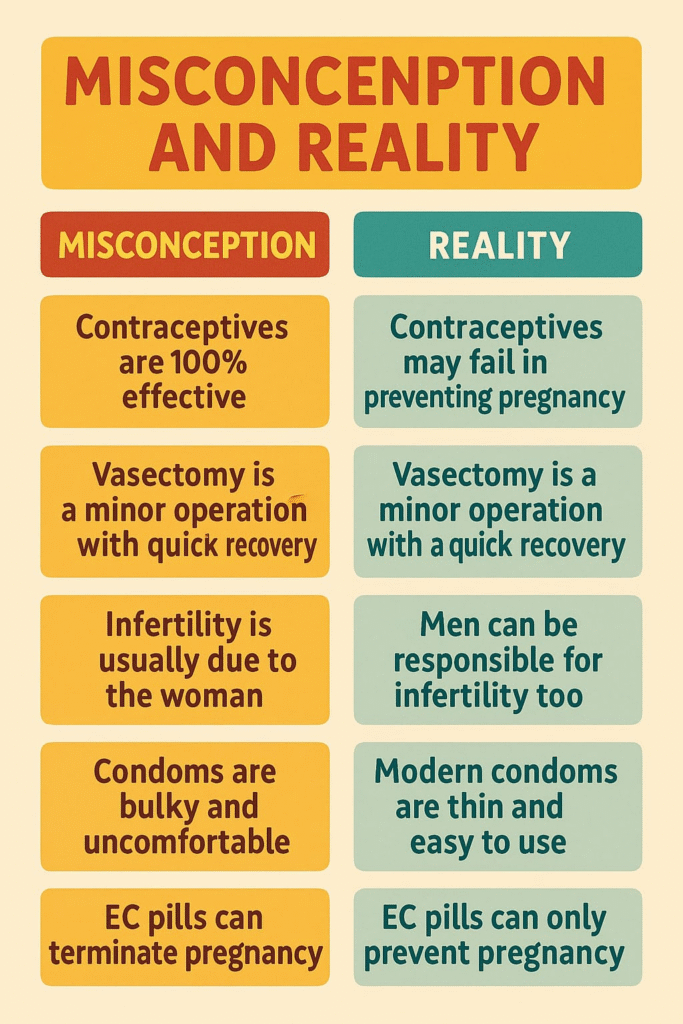
MISCONCEPTIONS “ALERTS”
————————————————————————————————————————————————————————————————————————————
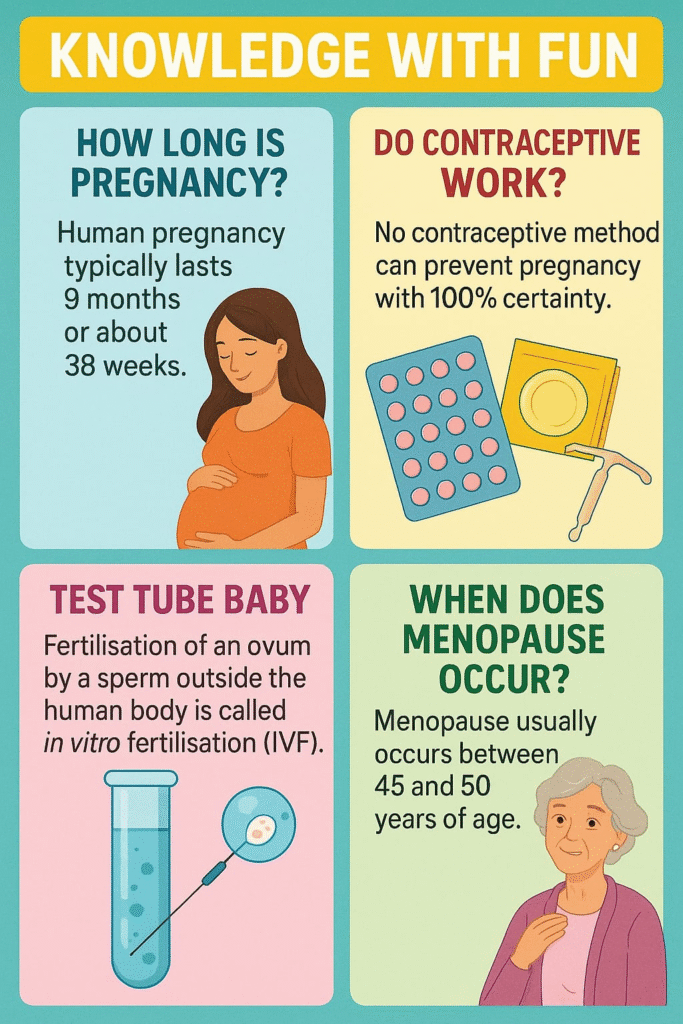
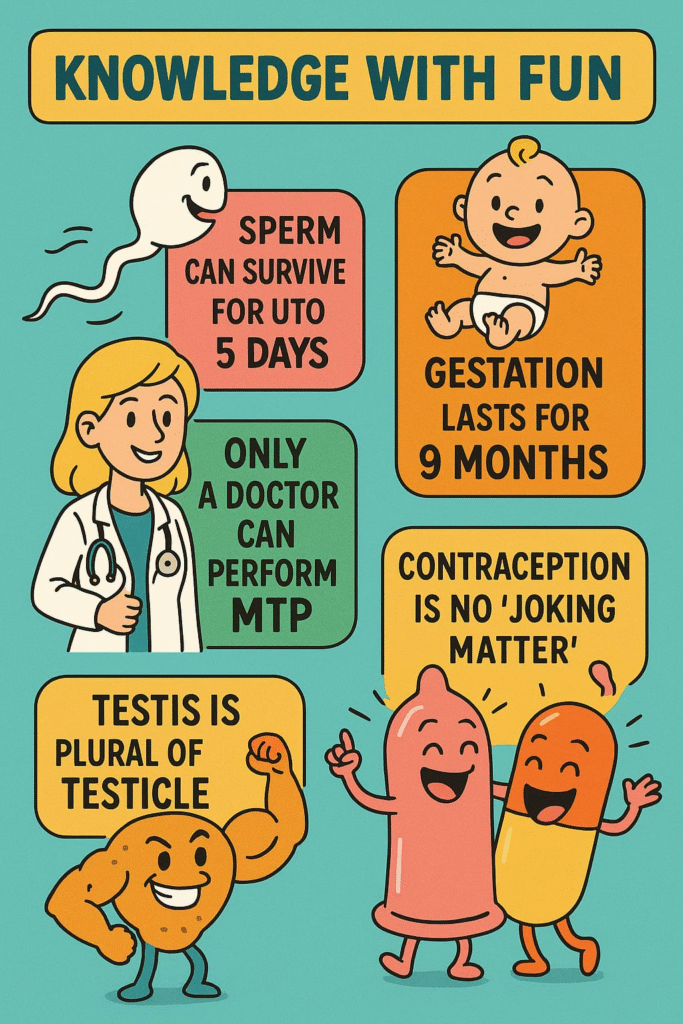
KNOWLEDGE WITH FUN
————————————————————————————————————————————————————————————————————————————
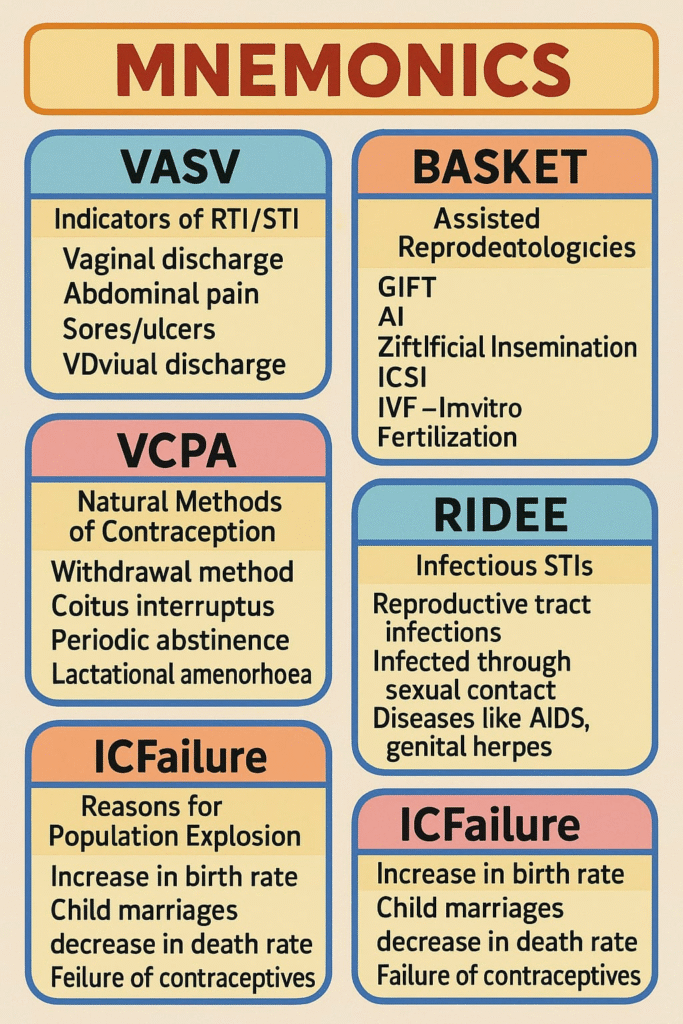
MNEMONICS
————————————————————————————————————————————————————————————————————————————
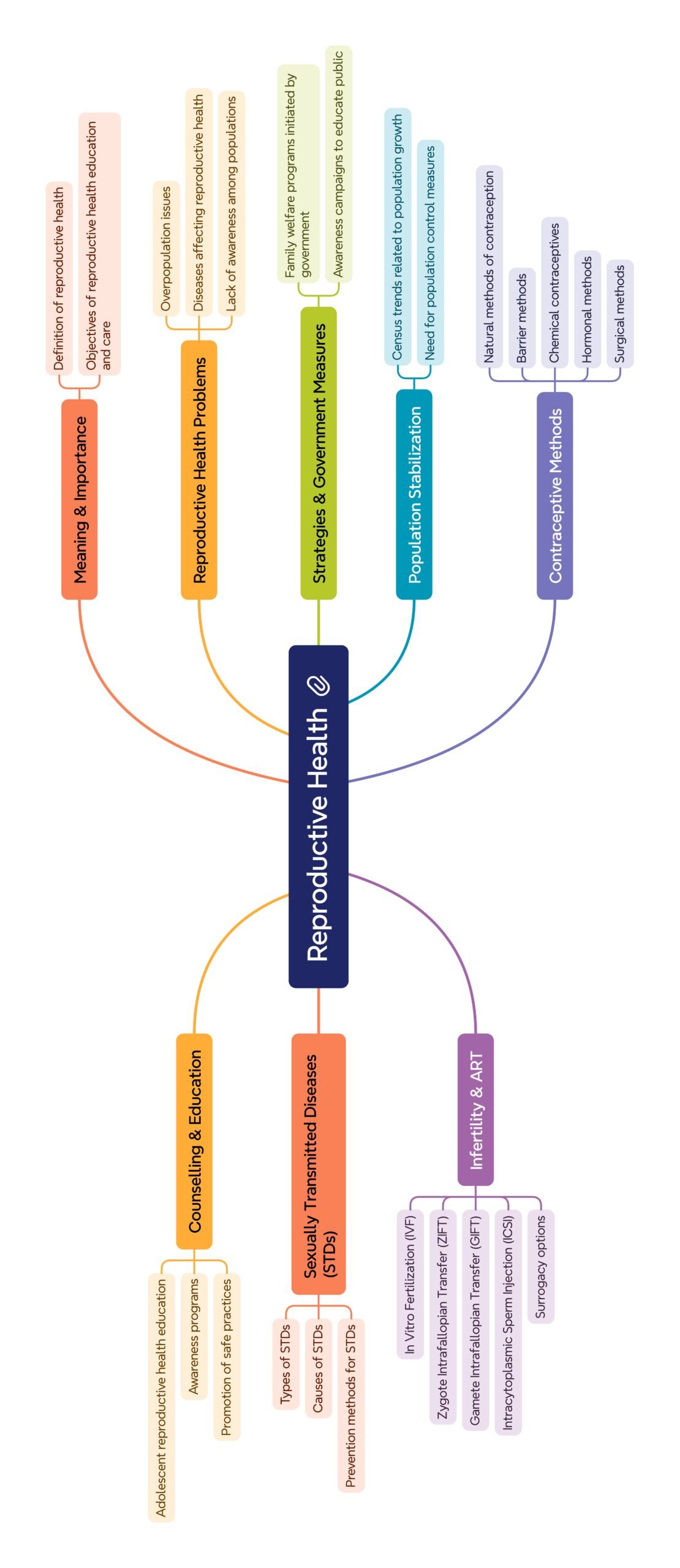
MIND MAP
—————————————————————————————————————————————————————————————————————————————————————————————