
Class 11 : Poltical Science (In English) – Lesson 6. Judiciary

EXPLANATION & SUMMARY
🔵 Introduction
The Judiciary is the third vital organ of government, alongside the Legislature and Executive. It acts as the guardian of the Constitution, protector of fundamental rights, and interpreter of laws. It ensures that all actions of the state are lawful and just, maintaining the rule of law and democracy.
🧭 1. Meaning and Role of Judiciary
🟢 The Judiciary refers to the system of courts that interpret, apply, and safeguard laws.
🟢 It provides justice to citizens in case of violation of rights or disputes.
🟢 It acts as a watchdog of the Constitution and ensures no organ exceeds its powers.
💡 Concept: Judiciary acts as the guardian of the Constitution and protector of fundamental rights.
⚖️ 2. Structure of Indian Judiciary
India has a unified judiciary with three tiers: 1️⃣ Supreme Court — Apex court at national level
2️⃣ High Courts — State-level courts
3️⃣ Subordinate Courts — District and lower-level courts
✔️ All courts follow a hierarchical order; decisions of higher courts are binding on lower ones.
🏛️ 3. Features of Indian Judiciary
🔹 Single integrated system — Unlike federal countries like the USA, India has one unified structure.
🔹 Independence of Judiciary — Judges function free from executive or legislative control.
🔹 Judicial Review — Judiciary can strike down unconstitutional laws/actions.
🔹 Rule of Law — All are equal before law.
🔹 Public Interest Litigation (PIL) — Any citizen can seek justice for public causes.
🔹 Supreme Court as Guardian of Fundamental Rights — Ensures protection under Article 32.
⚙️ 4. Independence of Judiciary
🟢 Judiciary must be independent to deliver impartial justice.
Provisions ensuring independence:
1️⃣ Judges have fixed tenure.
2️⃣ Judges can be removed only by impeachment.
3️⃣ Salaries and allowances are charged on Consolidated Fund.
4️⃣ Judiciary can punish for contempt of court.
5️⃣ Separation of judiciary from executive (Article 50).
🧠 Purpose: To ensure free and fair justice without fear or favor.
🧑⚖️ 5. Appointment and Removal of Judges
✔️ Supreme Court Judges appointed by the President in consultation with Chief Justice of India and senior judges.
✔️ Collegium system ensures independence.
✔️ Removal — by impeachment on grounds of proven misbehavior or incapacity (Article 124).
⚖️ 6. Jurisdiction of the Supreme Court
🔹 Original Jurisdiction — Disputes between Centre and State(s).
🔹 Appellate Jurisdiction — Hears appeals against High Court judgments.
🔹 Advisory Jurisdiction — President may seek advice under Article 143.
🔹 Writ Jurisdiction — Protection of Fundamental Rights.
🧭 7. Judicial Review
✔️ Judiciary can examine validity of legislative and executive actions.
✔️ If inconsistent with Constitution, it can be declared void.
💡 Introduced to uphold Constitutional supremacy.
🧑⚖️ 8. Judicial Activism
🔹 It refers to proactive role of judiciary in expanding scope of rights and justice.
🔹 Public Interest Litigation (PIL) is key tool.
🔹 Example: Environmental protection, women’s safety, food rights.
🔹 It bridges gap between law and social justice.
✏️ Note: Judicial activism must balance with judicial restraint to avoid encroachment on legislature.
⚖️ 9. Public Interest Litigation (PIL)
🔹 Introduced in 1980s to help marginalized sections.
🔹 Anyone can file case for public welfare.
🔹 Supreme Court and High Courts can entertain PILs directly.
🔹 Examples: Right to clean environment, free education, mid-day meals.
🏛️ 10. Judiciary as Guardian of the Constitution
🟢 Ensures all laws conform to Constitution.
🟢 Protects Fundamental Rights (Article 32 – Right to Constitutional Remedies).
🟢 Upholds democratic principles and federal balance.
📜 11. Judiciary and Parliament
✔️ Judicial Review ensures Parliament’s laws are constitutional.
✔️ Parliament can amend Constitution but cannot alter basic structure (Kesavananda Bharati Case, 1973).
✔️ Balance of power maintained through mutual respect.
📚 12. Landmark Judgments
1️⃣ Kesavananda Bharati Case (1973) — Basic structure doctrine.
2️⃣ Maneka Gandhi Case (1978) — Expanded scope of Article 21.
3️⃣ Indira Sawhney Case (1992) — Validated reservations within 50% limit.
4️⃣ Vishaka Case (1997) — Guidelines for workplace harassment.
🧠 13. Challenges Before Judiciary
🔴 Delay in justice — “Justice delayed is justice denied.”
🔴 Huge pendency of cases.
🔴 Accessibility — legal costs high for poor.
🔴 Judicial vacancies.
🔴 Need for transparency in appointments.
🧭 14. Judicial Reforms
✔️ More judges to reduce pendency.
✔️ Use of technology (e-Courts).
✔️ Legal aid for poor (Article 39A).
✔️ Simplify procedures.
✔️ Greater transparency through National Judicial Appointments Commission (debated).
⚖️ 15. Relationship with Executive and Legislature
🟢 Judiciary ensures other organs act within constitutional limits.
🟢 It can review laws and executive actions.
🟢 It is not superior but co-equal organ.
💡 Check and Balance: Judiciary maintains balance through review, Legislature through laws, and Executive through implementation.
🏛️ 16. High Courts
✔️ Each state (or group of states) has a High Court.
✔️ Functions include original, appellate, and supervisory jurisdiction.
✔️ Power to issue writs (Article 226).
✔️ Ensures rule of law at state level.
⚙️ 17. Subordinate Courts
✔️ District Courts and lower courts handle local disputes.
✔️ Work under High Court supervision.
✔️ Provide accessible justice at grassroots.
📖 18. Judiciary and Democracy
🟢 Judiciary is foundation of constitutional democracy.
🟢 Protects citizens against misuse of power.
🟢 Ensures equality before law and rule of law.
💬 19. Criticism
🔸 Judicial overreach — when courts interfere excessively in policy.
🔸 Lack of accountability.
🔸 Slow disposal.
✏️ Note: Balance needed between activism and restraint.
🌟 20. Conclusion
The Indian Judiciary is independent, powerful, and respected.
It plays a key role in:
Protecting rights
Upholding Constitution
Strengthening democracy
But reforms are needed for speed, efficiency, and accessibility.
📋 Summary (≈300 words)
🔹 The Judiciary is an independent organ responsible for interpreting and applying laws.
🔹 India has a unified judicial system headed by the Supreme Court, followed by High Courts and Subordinate Courts.
🔹 Its key functions include dispute resolution, judicial review, and protection of rights.
🔹 Independence is ensured through tenure, salary security, and removal process.
🔹 Judicial Review and PILs enhance accountability and accessibility.
🔹 Major doctrines like Basic Structure ensure Parliament’s powers are limited by the Constitution.
🔹 However, challenges like delays, pendency, and overreach exist.
🔹 Reforms like more judges, digitalization, and legal aid can enhance justice delivery.
✔️ Judiciary remains the guardian of democracy and the Constitution.
📝 Quick Recap
✔️ Unified Judiciary
✔️ Independence ensured
✔️ Judicial Review
✔️ PIL and Activism
✔️ Guardian of Constitution
✔️ Landmark cases
✔️ Challenges and Reforms
————————————————————————————————————————————————————————————————————————————
QUESTIONS FROM TEXTBOOK
🔵 Question 1:
What are the different ways in which the independence of the judiciary is ensured? Choose the odd ones out.
i. Chief Justice of the Supreme Court is consulted in the appointment of other judges of Supreme Court.
ii. Judges are generally not removed before the age of retirement.
iii. Judge of a High Court cannot be transferred to another High Court.
iv. Parliament has no say in the appointment of judges.
🟢 Answer:
✔️ Independence is ensured through:
Consultation with Chief Justice in appointments (i)
Security of tenure till retirement (ii)
Parliament having no say in appointments (iv)
🔴 Odd one out: (iii) — Because judges can be transferred to another High Court by the President.
🔵 Question 2:
Does independence of the judiciary mean that the judiciary is not accountable to anyone? Write your answer in not more than 100 words.
🟢 Answer:
No. Independence does not mean absence of accountability. Judiciary is accountable to:
✔️ The Constitution — judges must follow constitutional provisions.
✔️ The law — they must decide according to existing laws.
✔️ Judicial norms — they are bound by precedents and reasoning.
✔️ Public opinion — judgments are open to criticism.
Thus, judiciary is independent but responsible and transparent.
🔵 Question 3:
What are the different provisions in the constitution in order to maintain the independence of judiciary?
🟢 Answer:
✔️ Judges are appointed by the President in consultation with the judiciary.
✔️ Judges enjoy fixed tenure till retirement.
✔️ Removal only through impeachment by Parliament for proved misconduct.
✔️ Salaries and allowances charged on the Consolidated Fund.
✔️ Judiciary has the power of judicial review.
✔️ Separation of judiciary from executive is ensured.
🔵 Question 4:
Read the news report and identify:
(a) What is the case about?
(b) Who has been benefited by the case?
(c) Who is the petitioner?
(d) What were the arguments by the company?
(e) What arguments did the farmers have?
🟢 Answer:
(a) Case: Pollution caused by Reliance’s thermal power plant.
(b) Beneficiaries: Farmers of Dahanu region.
(c) Petitioner: Farmers and environmentalists.
(d) Company’s argument: Claimed difficulties in installing pollution control plant.
(e) Farmers’ argument: Pollution destroyed crops, fisheries, and forests; demanded compensation.
🔵 Question 5:
Read the news report and:
(a) Identify the governments at different levels.
(b) Identify the role of Supreme Court.
(c) What elements of the working of judiciary and executive can you identify?
(d) Identify the policy issue related to legislation, implementation, and interpretation.
🟢 Answer:
(a) Central and Delhi governments.
(b) Supreme Court gave directives on use of CNG for vehicles.
(c) Judiciary issuing orders; executive implementing.
(d) Policy issue: Environmental protection and fuel policy. Judiciary interpreting laws; executive implementing orders.
🔵 Question 6:
The statement about Ecuador says judges give inconsistent rulings. What similarities or differences do you find between this and India’s system?
🟢 Answer:
✔️ In India, consistency ensured by judicial precedent.
✔️ Higher courts’ rulings bind lower courts.
✔️ Written judgments give reasoning.
🔴 Difference: In Ecuador, judges not bound by precedent and may rule inconsistently.
India’s system ensures stability, transparency, and legal certainty.
🔵 Question 7:
Read the statements and match them with jurisdictions of Supreme Court – Original, Appellate, Advisory.
🟢 Answer:
Citizenship law query — Advisory Jurisdiction
River Cauvery dispute — Original Jurisdiction
Eviction appeal — Appellate Jurisdiction
🔵 Question 8:
In what way can Public Interest Litigation help the poor?
🟢 Answer:
✔️ Allows citizens to approach courts for others’ rights.
✔️ Removes cost barriers.
✔️ Helps poor gain access to justice in cases of exploitation, environment, wages, etc.
✔️ Courts can act on letters or media reports.
🔵 Question 9:
Do you think judicial activism can lead to conflict between judiciary and executive? Why?
🟢 Answer:
✔️ Yes, because judiciary may intervene in executive functions.
✔️ Judicial directions can appear as overreach.
✔️ However, activism ensures accountability when executive fails.
✔️ Both must work within constitutional limits.
🔵 Question 10:
How is judicial activism related to protection of fundamental rights? Has it helped in expanding the scope of fundamental rights?
🟢 Answer:
✔️ Judicial activism uses Article 32 and 226 to protect rights.
✔️ Expanded interpretation includes right to livelihood, environment, education.
✔️ PILs helped in enforcing socio-economic rights.
✔️ Thus, activism strengthened democracy and rights protection.
————————————————————————————————————————————————————————————————————————————
OTHER IMPORTANT QUESTIONS FOR EXAMS
🔷 Section A – Very Short Answer (1 mark each)
🔵 Question 1: Which Article of the Indian Constitution guarantees the independence of the judiciary?
🟢 Answer: Article 50 ensures the separation of the judiciary from the executive, guaranteeing independence.
🔵 Question 2: What is the tenure of a Supreme Court Judge?
🟢 Answer: Till the age of 65 years.
🔵 Question 3: Who appoints the Chief Justice of India?
🟢 Answer: The President of India.
🔵 Question 4: What is meant by Judicial Review?
🟢 Answer: The power of courts to examine laws and actions of the executive and legislature to ensure they conform to the Constitution.
🔵 Question 5: Name one case where Public Interest Litigation was used to protect the environment.
🟢 Answer: M.C. Mehta vs Union of India (Taj Trapezium Case).
🔵 Question 6: What is meant by Judicial Activism?
🟢 Answer: When the judiciary actively interprets laws to protect citizens’ rights and ensure justice beyond traditional limits.
🔶 Section B – Short Answer (2 marks each)
🔵 Question 7: Mention any two provisions ensuring the independence of the judiciary.
🟢 Answer:
✔️ Judges have fixed tenure till retirement.
✔️ They can only be removed by impeachment through Parliament.
🔵 Question 8: What do you understand by the term ‘Rule of Law’?
🟢 Answer:
✔️ It means everyone, including government, is subject to the law.
✔️ No person is above the law; all are equal before it.
🔵 Question 9: Differentiate between original and appellate jurisdiction.
🟢 Answer:
✔️ Original Jurisdiction – Cases which can be directly filed in the Supreme Court (e.g., disputes between states).
✔️ Appellate Jurisdiction – Court hears appeals from lower courts.
🔵 Question 10: What is the significance of the collegium system in judicial appointments?
🟢 Answer:
✔️ Ensures appointments are made through consultation among senior judges.
✔️ Protects judiciary from executive interference.
🔵 Question 11: State any two advantages of Public Interest Litigation.
🟢 Answer:
✔️ Enables access to justice for poor and marginalized.
✔️ Helps in enforcement of fundamental rights.
🔵 Question 12: How does the judiciary protect fundamental rights?
🟢 Answer:
✔️ Through writs under Article 32 and 226.
✔️ Declares any unconstitutional law void.
🔷 Section C – Short Answer II (3 marks each)
🔵 Question 13: Explain any three provisions in the Constitution that help maintain the independence of the judiciary.
🟢 Answer:
✔️ Security of Tenure: Judges can be removed only by impeachment.
✔️ Fixed Service Conditions: Their salaries and allowances cannot be changed to their disadvantage.
✔️ Separation of Powers: Article 50 separates judiciary from executive to prevent interference.
🔵 Question 14: What do you understand by Judicial Activism? Give examples.
🟢 Answer:
✔️ Judicial activism means proactive role of judiciary in protecting rights and ensuring justice.
✔️ It allows courts to interpret Constitution broadly to address contemporary issues.
✔️ Example: PILs on environment (e.g., Ganga Pollution Case), right to food, and rights of prisoners.
🔵 Question 15: Describe the difference between Judicial Review and Judicial Activism.
🟢 Answer:
✔️ Judicial Review: Courts examine validity of laws.
✔️ Judicial Activism: Courts go beyond review, take initiative to ensure justice.
✔️ Judicial review is constitutional power; activism is moral responsibility.
🔵 Question 16: What is Public Interest Litigation (PIL)? How has it helped people?
🟢 Answer:
✔️ PIL allows any citizen to approach court for public cause.
✔️ It has helped poor and marginalized access justice.
✔️ Many landmark rulings ensured environmental protection, prisoners’ rights, and right to education.
🔵 Question 17: How does the Supreme Court act as the guardian of the Constitution?
🟢 Answer:
✔️ It interprets the Constitution.
✔️ Reviews laws violating fundamental rights.
✔️ Ensures all institutions act within constitutional limits.
🔵 Question 18: Mention three types of jurisdictions of the Supreme Court.
🟢 Answer:
✔️ Original Jurisdiction: Disputes between Union and States.
✔️ Appellate Jurisdiction: Hears appeals from High Courts.
✔️ Advisory Jurisdiction: Gives advice to the President under Article 143.
🔵 Question 19: Why is accountability of judiciary essential?
🟢 Answer:
✔️ Prevents misuse of power.
✔️ Maintains public trust.
✔️ Ensures fairness and transparency in justice.
🔵 Question 20: Explain the concept of separation of powers with reference to judiciary.
🟢 Answer:
✔️ Judiciary is independent from legislative and executive.
✔️ It interprets laws made by legislature.
✔️ Prevents concentration of power and maintains balance.
🔵 Question 21: What is meant by judicial impartiality? How is it ensured?
🟢 Answer:
✔️ Judges decide cases without bias.
✔️ Ensured by fixed tenure, independent salary, and transparent procedure.
✔️ No external pressure allowed.
🔵 Question 22: Why is judicial review essential for democracy?
🟢 Answer:
✔️ It prevents violation of Constitution.
✔️ Acts as check on legislature and executive.
✔️ Protects citizens’ rights and maintains rule of law.
🔶 Section D – Long Answer (4 marks each)
🔵 Question 23: Discuss the role of judiciary in protecting fundamental rights.
🟢 Answer:
✔️ Judiciary acts as guardian of fundamental rights.
✔️ Uses writs like habeas corpus, mandamus, certiorari.
✔️ Strikes down unconstitutional laws.
✔️ Through PILs, ensures socio-economic rights (education, environment).
🔵 Question 24: Explain the importance and functions of the Supreme Court.
🟢 Answer:
✔️ Apex court under Article 124.
✔️ Interprets Constitution and laws.
✔️ Settles disputes between Union and States.
✔️ Protects fundamental rights.
✔️ Supervises lower courts.
🔵 Question 25: What are the main differences between Supreme Court and High Court?
🟢 Answer:
✔️ Jurisdiction: Supreme Court – national, High Court – state level.
✔️ Authority: Supreme Court decisions are binding.
✔️ Appeals: High Court’s decisions appealable to Supreme Court.
🔵 Question 26: Explain with examples how judicial activism has helped democracy.
🟢 Answer:
✔️ Expanded scope of rights – Right to life includes clean environment.
✔️ Brought accountability in governance.
✔️ Examples: Vishaka case (sexual harassment), Right to food, Pollution control orders.
🔵 Question 27: What are the limitations of judicial activism?
🟢 Answer:
✔️ May lead to encroachment on legislature/executive.
✔️ Judges not elected – democratic legitimacy questioned.
✔️ Can delay policy decisions.
🔵 Question 28: “Independence of judiciary is the backbone of democracy.” Explain.
🟢 Answer:
✔️ Prevents misuse of power by other organs.
✔️ Ensures rule of law.
✔️ Protects rights without fear or favour.
✔️ Builds trust in justice system.
🔵 Question 29: Explain the concept of Judicial Accountability.
🟢 Answer:
✔️ Judiciary must answer for performance and conduct.
✔️ Mechanisms: Impeachment, public scrutiny, transparent proceedings.
✔️ Ensures fairness, prevents misuse of power.
🔵 Question 30: Write a note on the contribution of PIL in strengthening judicial democracy.
🟢 Answer:
✔️ Opened doors of courts to all citizens.
✔️ Ensured justice for marginalized.
✔️ Promoted awareness of rights.
✔️ Strengthened participatory democracy.
————————————————————————————————————————————————————————————————————————————
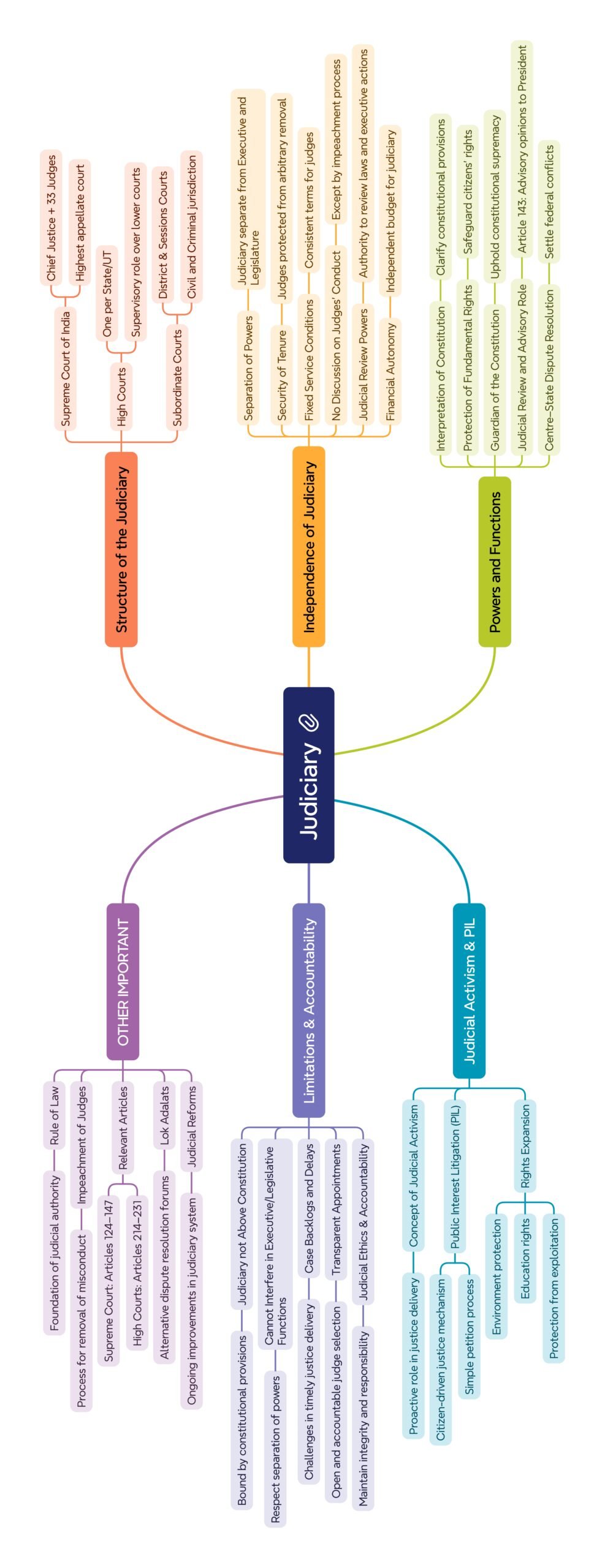
MIND MAPS
————————————————————————————————————————————————————————————————————————————