
Class 11 : Physics (In English) – Lesson Chapter 8: Mechanical Properties of Solids

EXPLANATION & SUMMARY
⚙️ EXPLANATION SECTION
🔵 1. Introduction
When external forces act on a solid, it may deform — changing shape or size. The study of how solids respond to such forces is called mechanical properties of solids. It explains how materials stretch, compress, bend, and resist deformation.
✔️ Elastic behavior helps engineers and scientists design safe structures, bridges, and machines.
🟢 2. Elasticity and Plasticity
💡 Elasticity: The ability of a body to regain its original shape and size after the deforming force is removed.
💡 Plasticity: The inability of a body to regain its original shape once the deforming force is removed.
✔️ Rubber is highly elastic.
✔️ Clay and wax are plastic.
🔴 3. Stress and Strain
When a force is applied on a body, internal restoring forces are developed to resist deformation. These are described through stress and strain.
✏️ Stress (σ):
The internal restoring force per unit area.
➡️ Formula: σ = F / A
Unit: N/m² (Pascal)
Dimension: [ML⁻¹T⁻²]
✏️ Types of Stress:
🔹 Tensile stress → due to stretching
🔹 Compressive stress → due to squeezing
🔹 Shearing stress → due to tangential forces
✏️ Strain (ε):
It is the fractional change in dimension produced by stress.
➡️ Formula: ε = ΔL / L
It is dimensionless (no unit).
✏️ Types of Strain:
🔹 Longitudinal strain → change in length / original length
🔹 Volumetric strain → change in volume / original volume
🔹 Shear strain → angular deformation
🟡 4. Hooke’s Law
💡 Within elastic limit, stress is directly proportional to strain.
➡️ σ ∝ ε
or, σ = E × ε
Here E is the modulus of elasticity (elastic constant).
✔️ Hooke’s law is valid only within the elastic limit.
Beyond that, deformation becomes permanent.
🔵 5. Elastic Moduli (Elastic Constants)
They measure how strongly a material resists deformation.
🟢 (a) Young’s Modulus (Y)
Ratio of tensile stress to longitudinal strain.
➡️ Y = (F × L) / (A × ΔL)
Unit: N/m² (Pa)
Dimension: [ML⁻¹T⁻²]
✔️ Higher Y means greater rigidity (steel > copper > rubber).
🔴 (b) Bulk Modulus (K)
Resistance to uniform compression.
➡️ K = −(Pressure change)/(Fractional change in volume)
or, K = −ΔP / (ΔV/V)
✔️ Negative sign shows that pressure increase reduces volume.
✔️ For solids, K is large; for liquids, smaller.
🟠 (c) Shear Modulus or Rigidity Modulus (η)
Resistance to change in shape (without volume change).
➡️ η = (Tangential stress)/(Shear strain)
✔️ Fluids have η = 0 since they cannot resist shape change.
🟣 6. Relation Between Elastic Moduli
For isotropic solids (same properties in all directions):
➡️ Y = 3K(1 − 2σ)
➡️ Y = 2η(1 + σ)
where σ = Poisson’s ratio.
💡 7. Poisson’s Ratio (σ)
When a wire is stretched, its length increases and diameter decreases.
➡️ σ = (Lateral strain) / (Longitudinal strain)
✔️ It has no unit.
✔️ For most solids: 0.25 ≤ σ ≤ 0.5
✔️ For incompressible material, σ = 0.5.
🧠 8. Stress–Strain Curve
As stress increases:
🔹 Proportional limit: Stress ∝ Strain (Hooke’s law valid).
🔹 Elastic limit or Yield point: Slight permanent deformation begins.
🔹 Plastic region: Large strain for small stress.
🔹 Breaking point: Fracture occurs.
✔️ Elastic limit marks the end of reversible deformation.
🟢 9. Elastic Fatigue and Elastic Limit
✔️ Elastic limit: Maximum stress without permanent deformation.
✔️ Elastic fatigue: Loss of elasticity after repeated loading and unloading (e.g., weakened springs).
🔴 10. Behavior of Common Materials
✔️ Steel: Very rigid, high Y, ideal for bridges.
✔️ Copper: Ductile, moderate Y, used in wires.
✔️ Rubber: Flexible, low Y, large strain range.
✔️ Glass: Brittle, high Y, breaks easily.
🧩 Steel is the most elastic material because it returns almost completely to its original shape.
💡 11. Applications of Elasticity
🔹 Designing bridges, buildings, and cranes (to avoid structural failure).
🔹 Manufacturing springs and shock absorbers.
🔹 Wire experiments for measuring Y.
🔹 Understanding pressure in hydraulic systems (bulk modulus).
🔹 Choosing materials based on required elasticity.
🔵 12. Determination of Young’s Modulus (Searle’s Method)
💡 Principle:
When a known weight is attached to a wire, elongation is measured.
➡️ Y = (mgL) / (πr²ΔL)
where
m = load mass,
L = wire length,
r = wire radius,
ΔL = elongation.
✔️ Micrometer screw gauge and spirit level are used for accurate measurement.
🟢 13. Elastic Potential Energy
When a wire is stretched, work done is stored as potential energy per unit volume.
➡️ U = ½ × stress × strain
or, U = ½ × (FΔL)/Volume
✔️ Maximum energy stored just before elastic limit.
🟠 14. Modulus of Resilience
💡 The energy stored per unit volume within the elastic limit.
➡️ Ur = ½ × (σ² / Y)
✔️ High modulus of resilience = better energy absorption before deformation.
🔴 15. Factors Affecting Elasticity
🔹 Temperature: Elasticity decreases with rise in temperature.
🔹 Impurities: May increase or decrease elasticity depending on impurity type.
🔹 Hammering and annealing: Hammering increases, annealing decreases elasticity.
💡 16. Comparison of Elastic Constants
For most solids:
Y > K > η
✔️ Resistance to length change > resistance to volume change > resistance to shape change.
⚡ 17. Compressibility
It is the reciprocal of bulk modulus.
➡️ β = 1 / K
✔️ Higher β means easier compression.
✔️ Gases have very high compressibility.
🟣 18. Importance in Engineering
Knowledge of elasticity ensures that stress never exceeds elastic limit.
✔️ Used in designing bridges, aircrafts, cranes, and cables.
✔️ Helps predict safe load and failure points.
🧩 19. Relation Between Stress, Strain, and Energy
The area under stress–strain curve = strain energy per unit volume.
➡️ U = ½ × σ × ε
✔️ Represents energy stored during elastic deformation.
🟢 20. Practical Examples
🔹 Steel wire stretches slightly but returns to original → highly elastic.
🔹 Rubber band stretches a lot but imperfectly → not truly elastic.
🔹 Building materials must have large Y and moderate σ to avoid breakage.

🌿 SUMMARY SECTION (~300 words)
✔️ Elasticity: Ability to regain shape after deforming force is removed.
✔️ Stress (σ): Restoring force per unit area.
✔️ Strain (ε): Fractional change in dimension.
✔️ Hooke’s Law: Stress ∝ Strain (within elastic limit).
✔️ Elastic Moduli:
🔸 Y (Young’s modulus): Measures rigidity.
🔸 K (Bulk modulus): Measures compressibility.
🔸 η (Shear modulus): Measures resistance to shape change.
✔️ Poisson’s Ratio (σ): Ratio of lateral to longitudinal strain.
✔️ Elastic Potential Energy: U = ½ σε.
✔️ Relation: Y = 3K(1 − 2σ) = 2η(1 + σ).
✔️ Stress–Strain Curve: Explains elastic, yield, plastic, and breaking regions.
✔️ Elastic Limit: Maximum stress without permanent deformation.
✔️ Elastic Fatigue: Reduction of elasticity after repeated use.
✔️ Steel: Most elastic; rubber: most flexible.
✔️ Applications: Bridge design, spring making, material selection, and stress analysis.
📝 QUICK RECAP
🔹 Stress = Force/Area
🔹 Strain = ΔL/L
🔹 Y = σ/ε, K = −ΔP/(ΔV/V), η = stress/shear strain
🔹 Hooke’s Law valid only within elastic limit
🔹 Poisson’s Ratio has no unit
🔹 Energy stored per unit volume = ½ σε
🔹 Steel → most elastic, Rubber → most stretchable
————————————————————————————————————————————————————————————————————————————
QUESTIONS FROM TEXTBOOK
🔷 Question 8.1
A steel wire of length 4.7 m and cross-sectional area 3.0 × 10⁻⁵ m² stretches by the same amount as a copper wire of length 3.5 m and cross-sectional area of 4.0 × 10⁻⁵ m² under a given load. What is the ratio of the Young’s modulus of steel to that of copper?
✅ Answer:
📘 For same elongation under same load:
Δl = (F × L)/(A × Y)
⇒ (L/A × Y) is constant
📘 So,
L₁ / (A₁Y₁) = L₂ / (A₂Y₂)
⇒ Y₁ / Y₂ = (L₁ / A₁) / (L₂ / A₂)
📌 L₁ = 4.7 m, A₁ = 3.0 × 10⁻⁵ m²
📌 L₂ = 3.5 m, A₂ = 4.0 × 10⁻⁵ m²
Y₁ / Y₂ = (4.7 / 3.0 × 10⁻⁵) / (3.5 / 4.0 × 10⁻⁵)
= (4.7 / 3.0) × (4.0 / 3.5) ≈ 1.5667 × 1.1429 ≈ 1.79
✅ Final Answer: 1.79
🔷 Question 8.2
Figure 8.9 shows the strain-stress curve for a given material. What are
(a) Young’s modulus and
(b) approximate yield strength for this material?
✅ Answer:
📘 From graph (read visually):
At point with stress = 300 × 10⁶ N/m², strain = 0.002
(a) Young’s modulus (Y) = Stress / Strain
= (300 × 10⁶) / 0.002 = 1.5 × 10¹¹ N/m²
(b) Yield strength ≈ maximum stress at elastic limit
= ~300 × 10⁶ N/m²
✅ Final Answers:
✔️ Young’s modulus = 1.5 × 10¹¹ N/m²
✔️ Yield strength ≈ 3.0 × 10⁸ N/m²
🔷 Question 8.3
The stress-strain graphs for materials A and B are shown in Fig. 8.10.
(a) Which of the materials has the greater Young’s modulus?
(b) Which of the two is the stronger material?
✅ Answer:
(a) Greater Young’s modulus → steeper slope
⇒ Material A has higher Young’s modulus
(b) Stronger material → can withstand more stress before breaking
⇒ Material B is stronger (higher ultimate stress)
✅ Final Answers:
✔️ Young’s modulus: A > B
✔️ Strength: B > A
🔷 Question 8.4
Read the following two statements below carefully and state, with reasons, if it is true or false.
(a) The Young’s modulus of rubber is greater than that of steel.
(b) The stretching of a coil is determined by its shear modulus.
✅ Answer:
(a) ❌ False – Rubber stretches more for same force, hence has lower Young’s modulus.
Steel resists elongation → higher Young’s modulus.
(b) ✅ True – Coils undergo deformation due to twisting (shearing), hence shear modulus is the relevant quantity.
🔷 Question 8.5
Two wires of diameter 0.25 cm, one made of steel and the other made of brass are loaded as shown in Fig. 8.11. The unloaded length of steel wire is 1.5 m and that of brass wire is 1.0 m. Compute the elongations of the steel and the brass wires.
✅ Answer:
📌 Given:
Diameter = 0.25 cm = 0.0025 m ⇒ A = πr² = π(0.00125)² ≈ 4.91 × 10⁻⁶ m²
g = 9.8 m/s²
Mass on steel = 4.0 kg → Force F = 4 × 9.8 = 39.2 N
Length L = 1.5 m, Y (steel) = 2 × 10¹¹ N/m²
Δl (steel) = (F × L) / (A × Y)
= (39.2 × 1.5) / (4.91 × 10⁻⁶ × 2 × 10¹¹)
≈ 6.0 × 10⁻⁴ m = 0.60 mm
Mass on brass = 6.0 kg → F = 6 × 9.8 = 58.8 N
Length L = 1.0 m, Y (brass) = 0.91 × 10¹¹ N/m²
Δl (brass) = (58.8 × 1.0) / (4.91 × 10⁻⁶ × 0.91 × 10¹¹)
≈ 1.33 × 10⁻³ m = 1.33 mm
✅ Final Answers:
✔️ Elongation of steel wire = 0.60 mm
✔️ Elongation of brass wire = 1.33 mm
🔷 Question 8.6
The edge of an aluminium cube is 10 cm long. One face of the cube is firmly fixed to a vertical wall. A mass of 100 kg is then attached to the opposite face of the cube. The shear modulus of aluminium is 25 GPa. What is the vertical deflection of this face?
✅ Answer:
📌 Given:
Edge length, L = 10 cm = 0.1 m
Force, F = mg = 100 × 9.8 = 980 N
Shear modulus, G = 25 GPa = 25 × 10⁹ N/m²
Area, A = (0.1 m)² = 0.01 m²
Shear strain = Δx / L = F / (A × G)
Δx = (F × L) / (A × G)
= (980 × 0.1) / (0.01 × 25 × 10⁹)
= 98 / (2.5 × 10⁸)
= 3.92 × 10⁻⁷ m = 0.392 µm
✅ Final Answer: 0.392 micrometres
🔷 Question 8.7
Four identical hollow cylindrical columns of mild steel support a big structure of mass 50,000 kg. The inner and outer radii of each column are 30 mm and 60 mm respectively. Assuming the load distribution to be uniform, calculate the compressional strain of each column.
✅ Answer:
📌 Given:
Mass = 50,000 kg → F = mg = 50,000 × 9.8 = 4.9 × 10⁵ N
Each column supports F/4 = 1.225 × 10⁵ N
Inner radius = 30 mm = 0.03 m
Outer radius = 60 mm = 0.06 m
Area, A = π(R² − r²)
= π[(0.06)² − (0.03)²] = π(0.0036 − 0.0009) = π(0.0027) ≈ 8.48 × 10⁻³ m²
Young’s modulus for steel, Y = 2 × 10¹¹ N/m²
Strain = Stress / Y
Stress = F / A = (1.225 × 10⁵) / (8.48 × 10⁻³) ≈ 1.44 × 10⁷ N/m²
Strain = (1.44 × 10⁷) / (2 × 10¹¹) = 7.2 × 10⁻⁵
✅ Final Answer: 7.2 × 10⁻⁵
🔷 Question 8.8
A piece of copper having a rectangular cross-section of 15.2 mm × 19.1 mm is pulled in tension with 44,500 N force, producing only elastic deformation. Calculate the resulting strain?
✅ Answer:
📌 Area = 15.2 mm × 19.1 mm = (15.2 × 10⁻³) × (19.1 × 10⁻³) = 2.9032 × 10⁻⁴ m²
Force = 44,500 N
Young’s modulus for copper, Y = 1.1 × 10¹¹ N/m²
Stress = F / A = 44500 / 2.9032 × 10⁻⁴ ≈ 1.53 × 10⁸ N/m²
Strain = Stress / Y = (1.53 × 10⁸) / (1.1 × 10¹¹) ≈ 1.39 × 10⁻³
✅ Final Answer: 1.39 × 10⁻³
🔷 Question 8.9
A steel cable with a radius of 1.5 cm supports a chairlift at a ski area. If the maximum stress is not to exceed 10⁸ N/m², what is the maximum load the cable can support?
✅ Answer:
📌 Radius = 1.5 cm = 0.015 m → A = πr² = π(0.015)² ≈ 7.07 × 10⁻⁴ m²
Maximum Stress = 10⁸ N/m²
Stress = Force / Area ⇒ F = Stress × Area
F = 10⁸ × 7.07 × 10⁻⁴ = 7.07 × 10⁴ N
✅ Final Answer: 70,700 N
🔷 Question 8.10
A rigid bar of mass 15 kg is supported symmetrically by three wires each 2.0 m long. Those at each end are of copper and the middle one is of iron. Determine the ratios of their diameters if each is to have the same tension.
✅ Answer:
📌 For same tension, extensions must be equal.
Δl = (F × L) / (A × Y) ⇒ Δl ∝ 1 / (A × Y)
Let diameters be d₁ (Cu), d₂ (Fe)
Since length and force are same,
1 / (πd₁²/4 × Y_Cu) = 1 / (πd₂²/4 × Y_Fe)
⇒ d₁² / Y_Cu = d₂² / Y_Fe
⇒ (d₁ / d₂)² = Y_Cu / Y_Fe
Y_Cu = 1.1 × 10¹¹ N/m²
Y_Fe = 2.0 × 10¹¹ N/m²
⇒ (d₁ / d₂)² = 1.1 / 2.0 = 0.55
⇒ d₁ / d₂ = √0.55 ≈ 0.741
✅ Final Answer: d_Cu / d_Fe ≈ 0.741
🔷 Question 8.11
A 14.5 kg mass, fastened to the end of a steel wire of unstretched length 1.0 m, is whirled in a vertical circle with angular velocity of 2 rev/s at the bottom of the circle. The cross-sectional area of the wire is 0.065 cm². Calculate the elongation of the wire when the mass is at the lowest point of its path.
✅ Answer:
📌 Mass = 14.5 kg, ω = 2 rev/s = 4π rad/s
L = 1.0 m
Area A = 0.065 cm² = 6.5 × 10⁻⁶ m²
Y = 2 × 10¹¹ N/m²
Centripetal Force at bottom:
T = mg + mω²R = 14.5 × 9.8 + 14.5 × (4π)² × 1
= 142.1 + 14.5 × 157.9 = 142.1 + 2299.6 ≈ 2441.7 N
Elongation = (F × L) / (A × Y)
= (2441.7 × 1) / (6.5 × 10⁻⁶ × 2 × 10¹¹)
= 2441.7 / (1.3 × 10⁶) ≈ 1.88 × 10⁻³ m = 1.88 mm
✅ Final Answer: 1.88 mm
🔷 Question 8.12
Compute the fractional change in volume of a glass slab, when subjected to a hydraulic pressure of 10⁶ Pa. Bulk modulus of glass = 5 × 10⁹ Pa.
✅ Answer:
📌 Fractional change in volume:
ΔV / V = – (P / B)
Where,
P = 10⁶ Pa
B = 5 × 10⁹ Pa
⇒ ΔV / V = – (10⁶ / 5 × 10⁹) = – 2 × 10⁻⁴
✅ Final Answer: –2 × 10⁻⁴
🔷 Question 8.13
Determine the volume contraction of a solid copper cube, 10 cm on an edge, when subjected to a hydraulic pressure of 7 × 10⁶ Pa. Bulk modulus of copper = 1.4 × 10¹¹ Pa.
✅ Answer:
📌 Volume of cube = (0.10 m)³ = 1.0 × 10⁻³ m³
Pressure, P = 7 × 10⁶ Pa
Bulk modulus, B = 1.4 × 10¹¹ Pa
Volume contraction:
ΔV = V × (P / B)
= 1.0 × 10⁻³ × (7 × 10⁶ / 1.4 × 10¹¹)
= 1.0 × 10⁻³ × 5 × 10⁻⁵ = 5.0 × 10⁻⁸ m³
✅ Final Answer: 5.0 × 10⁻⁸ m³
🔷 Question 8.14
A brass rod of length 50 cm and diameter 3.0 mm is joined to a steel rod of the same length and diameter. A force of 100 N is applied to this composite rod. Estimate the change in length of the composite rod.
(Y_brass = 0.9 × 10¹¹ Pa, Y_steel = 2.0 × 10¹¹ Pa)
✅ Answer:
📌 Length of each = 0.5 m
Diameter = 3.0 mm = 0.003 m
Area A = πr² = π × (0.0015)² ≈ 7.07 × 10⁻⁶ m²
Force F = 100 N
Change in length = Δl = (F × L) / (A × Y)
For brass:
Δl₁ = (100 × 0.5) / (7.07 × 10⁻⁶ × 0.9 × 10¹¹) ≈ 7.86 × 10⁻⁵ m
For steel:
Δl₂ = (100 × 0.5) / (7.07 × 10⁻⁶ × 2.0 × 10¹¹) ≈ 3.53 × 10⁻⁵ m
Total elongation = Δl₁ + Δl₂ = (7.86 + 3.53) × 10⁻⁵ = 1.139 × 10⁻⁴ m = 0.114 mm
✅ Final Answer: 0.114 mm
🔷 Question 8.15
A uniform wire of length 3 m and diameter 0.5 mm is stretched by a force of 100 N. Calculate the elongation produced. Young’s modulus of wire = 2 × 10¹¹ Pa.
✅ Answer:
📌 L = 3 m, d = 0.5 mm = 0.0005 m
r = 0.00025 m ⇒ A = πr² = π × (0.00025)² ≈ 1.96 × 10⁻⁷ m²
Y = 2 × 10¹¹ N/m², F = 100 N
Δl = (F × L) / (A × Y)
= (100 × 3) / (1.96 × 10⁻⁷ × 2 × 10¹¹)
= 300 / (3.92 × 10⁴) = 7.65 × 10⁻³ m = 7.65 mm
✅ Final Answer: 7.65 mm
🔷 Question 8.16
The Young’s modulus of steel is twice that of brass. Two wires of same length and same area of cross-section are suspended from a rigid support. One is of brass and the other is of steel. At the lower ends of the wires, a platform is suspended such that the platform remains horizontal when both wires are elongated. If the weight on the platform is 300 N, find the individual weights supported by the steel and brass wires.
✅ Answer:
📌 Y_steel = 2 × Y_brass
Let elongation = Δl (same for both)
⇒ F ∝ Y × A / L ⇒ Force ∝ Y (since A and L same)
Let force in brass = F_B, in steel = F_S
Then, F_S / F_B = Y_S / Y_B = 2
⇒ F_S = 2 × F_B
Also, total force = 300 N = F_B + F_S = F_B + 2F_B = 3F_B
⇒ F_B = 100 N, F_S = 200 N
✅ Final Answers:
✔️ Brass wire supports = 100 N
✔️ Steel wire supports = 200 N
🔷 Question 8.17
A steel cable with a radius of 1.5 cm supports a chairlift at a ski area. If the maximum stress is not to exceed 10⁸ N/m², what is the maximum load the cable can support?
✅ Answer:
📌 Radius, r = 1.5 cm = 0.015 m
Area, A = πr² = π × (0.015)² = π × 2.25 × 10⁻⁴ ≈ 7.07 × 10⁻⁴ m²
Maximum stress, σ = F / A
⇒ F = σ × A = 10⁸ × 7.07 × 10⁻⁴ = 7.07 × 10⁴ N
✅ Final Answer: Maximum load = 70,700 N
🔷 Question 8.18
A rigid bar of mass 15 kg is supported symmetrically by three wires each 2.0 m long. Those at each end are of copper and the middle one is of iron. Determine the ratios of their diameters if each is to have the same tension.
✅ Answer:
📌 Given: Length = same (L = 2.0 m), Tension = same
For equal tension, all wires must stretch by same amount
⇒ ΔL_copper = ΔL_iron
Using elongation formula:
ΔL = (F × L) / (A × Y) ⇒ ΔL ∝ 1 / (A × Y) ⇒ For same F and L:
1 / (πr² × Y) must be same ⇒ (1 / d²Y) same
Let diameters be d_C (copper) and d_I (iron):
⇒ (1 / d_C²Y_C) = (1 / d_I²Y_I)
Taking ratio:
d_C² / d_I² = Y_C / Y_I
Given:
Y_C = 1.1 × 10¹¹ Pa
Y_I = 2.0 × 10¹¹ Pa
⇒ d_C² / d_I² = 1.1 / 2.0 = 11 / 20
⇒ d_C / d_I = √(11/20) ≈ 0.7416
✅ Final Answer:
✔️ Ratio of diameters (d_C : d_I) ≈ 0.7416 : 1
————————————————————————————————————————————————————————————————————————————
OTHER IMPORTANT QUESTIONS FOR EXAMS
(CBSE MODEL QUESTIONS PAPER)
ESPECIALLY MADE FROM THIS LESSON ONLY
⚙️ SECTION A: Multiple Choice Questions (Q1–Q18)
Question 1:
Which of the following quantities is dimensionless?
🔵 (A) Stress
🟢 (B) Strain
🟠 (C) Modulus of elasticity
🔴 (D) Force
Answer: (B) Strain
Question 2:
The unit of Young’s modulus is
🔵 (A) N
🟢 (B) N/m
🟠 (C) N/m²
🔴 (D) m/N
Answer: (C) N/m²
Question 3:
If a wire is stretched and its length increases by 1%, the strain produced is
🔵 (A) 1
🟢 (B) 0.1
🟠 (C) 0.01
🔴 (D) 0.001
Answer: (C) 0.01
Question 4:
Hooke’s law is valid
🔵 (A) Beyond elastic limit
🟢 (B) Up to proportional limit
🟠 (C) For all values of stress
🔴 (D) Only for plastic materials
Answer: (B) Up to proportional limit
Question 5:
The ratio of lateral strain to longitudinal strain is
🔵 (A) Elastic limit
🟢 (B) Poisson’s ratio
🟠 (C) Stress
🔴 (D) Yield ratio
Answer: (B) Poisson’s ratio
Question 6:
If stress is doubled, within elastic limit strain will
🔵 (A) Double
🟢 (B) Halve
🟠 (C) Remain same
🔴 (D) Become four times
Answer: (A) Double
Question 7:
Which of the following is most elastic?
🔵 (A) Rubber
🟢 (B) Copper
🟠 (C) Steel
🔴 (D) Glass
Answer: (C) Steel
Question 8:
The bulk modulus of a fluid is
🔵 (A) Infinite
🟢 (B) Zero
🟠 (C) Finite
🔴 (D) Cannot be defined
Answer: (B) Zero
Question 9:
The SI unit of stress is
🔵 (A) J
🟢 (B) N/m²
🟠 (C) N·m
🔴 (D) W
Answer: (B) N/m²
Question 10:
The reciprocal of bulk modulus is called
🔵 (A) Rigidity
🟢 (B) Compressibility
🟠 (C) Flexibility
🔴 (D) Plasticity
Answer: (B) Compressibility
Question 11:
Which of the following has maximum Young’s modulus?
🔵 (A) Rubber
🟢 (B) Glass
🟠 (C) Copper
🔴 (D) Steel
Answer: (D) Steel
Question 12:
The dimensional formula of stress is
🔵 (A) [MLT⁻²]
🟢 (B) [ML⁻¹T⁻²]
🟠 (C) [M⁻¹L³T⁻²]
🔴 (D) [ML²T⁻²]
Answer: (B) [ML⁻¹T⁻²]
Question 13:
Which statement is correct about elastic limit?
🔵 (A) It is the maximum strain possible
🟢 (B) It is the maximum stress that can be applied without permanent deformation
🟠 (C) It depends on length only
🔴 (D) It is same for all materials
Answer: (B) It is the maximum stress that can be applied without permanent deformation
Question 14:
For an ideal solid, Poisson’s ratio can have a maximum value of
🔵 (A) 0.5
🟢 (B) 1
🟠 (C) 0
🔴 (D) ∞
Answer: (A) 0.5
Question 15:
Elastic potential energy per unit volume is
🔵 (A) σε
🟢 (B) ½ σε
🟠 (C) σ²ε
🔴 (D) σε²
Answer: (B) ½ σε
Question 16:
The wire elongates by 1 mm under a load of 100 N. If area = 2×10⁻⁶ m² and length = 2 m, find Young’s modulus.
🔵 (A) 1×10¹⁰ Pa
🟢 (B) 2×10¹⁰ Pa
🟠 (C) 5×10⁹ Pa
🔴 (D) 10¹¹ Pa
Answer: (A) 1×10¹⁰ Pa
Question 17:
The slope of the linear portion of stress–strain curve gives
🔵 (A) Bulk modulus
🟢 (B) Young’s modulus
🟠 (C) Rigidity modulus
🔴 (D) Poisson’s ratio
Answer: (B) Young’s modulus
Question 18:
If a steel wire and copper wire of same length and area are stretched by same load, which elongates more?
🔵 (A) Steel
🟢 (B) Copper
🟠 (C) Both equally
🔴 (D) None
Answer: (B) Copper
🌿 SECTION B: Very Short/Short Answers (Q19–Q23)
Question 19:
Define stress and strain.
Answer:
✔️ Stress: Force per unit area, σ = F/A.
✔️ Strain: Fractional change in length, ε = ΔL/L.
Both measure deformation effects under applied force.
Question 20:
State Hooke’s law.
Answer:
💡 Within elastic limit, stress is directly proportional to strain.
σ ∝ ε → σ = Yε.
Here Y = modulus of elasticity.
Question 21:
What is Poisson’s ratio?
Answer:
✔️ The ratio of lateral strain to longitudinal strain.
σ = lateral strain / longitudinal strain.
It has no unit and is less than 0.5 for solids.
Question 22:
Define elastic limit.
Answer:
💡 Elastic limit is the maximum stress up to which the material returns to its original shape on removal of force.
Beyond this, permanent deformation occurs.
Question 23:
What is meant by elastic fatigue?
Answer:
✔️ Elastic fatigue is the loss of elasticity due to repeated loading and unloading cycles.
Example: weakening of a spring after long use.
⚡ SECTION C: Mid-Length Numericals/Theory (Q24–Q28)
Question 24:
Derive the expression for Young’s modulus.
Answer:
✏️ Let a wire of length L and area A be stretched by force F.
Elongation = ΔL.
Stress = F/A, Strain = ΔL/L.
Therefore,
➡️ Y = Stress / Strain = (F/A)/(ΔL/L) = FL / (AΔL).
✔️ Hence, Y = (F×L)/(A×ΔL).
Question 25:
A wire 2 m long and 1 mm² cross-section is stretched by 1 mm under a load of 2 N. Find Young’s modulus.
Answer:
✏️ Given: L = 2 m, A = 1×10⁻⁶ m², F = 2 N, ΔL = 1×10⁻³ m.
Y = (F×L)/(A×ΔL)
= (2×2)/(1×10⁻⁶ × 1×10⁻³)
= 4 / 1×10⁻⁹ = 4×10⁹ Pa.
✔️ Y = 4 × 10⁹ Pa.
Question 26:
Derive the relation between Y, K and Poisson’s ratio (σ).
Answer:
💡 For isotropic material:
Y = 3K(1 − 2σ).
✔️ This is derived from the relation between longitudinal and volumetric strains under uniform stress.
Question 27:
Explain stress–strain curve for a typical ductile material.
Answer:
✔️ Proportional limit: Stress ∝ strain (Hooke’s law valid).
✔️ Elastic limit / yield point: Permanent deformation starts.
✔️ Plastic region: Large strain occurs with small increase in stress.
✔️ Breaking point: Material fractures.
💡 The area under curve = energy stored per unit volume.
Question 28:
What is elastic potential energy per unit volume? Derive expression.
Answer:
✏️ Work done = average stress × strain = (½σ) × ε.
Thus, energy per unit volume,
➡️ U = ½ σε.
✔️ It represents the energy stored in a body under deformation.
⚙️ SECTION D: Long Answer Questions (Q29–Q31)
Question 29:
Derive the relation between stress and strain for an elastic wire and hence explain Hooke’s Law.
Answer:
💡 Concept:
When a force acts on a solid, it produces deformation (strain). The ratio of stress to strain determines how elastic a material is.
✏️ Step 1: Definition of Stress
If a wire of cross-sectional area A is stretched by a force F,
then,
➡️ Stress (σ) = F / A
It represents internal restoring force per unit area.
✏️ Step 2: Definition of Strain
If the original length of the wire is L and its increase in length is ΔL,
➡️ Strain (ε) = ΔL / L
It is a dimensionless quantity (no unit).
✏️ Step 3: Hooke’s Law
Within elastic limit, the stress is directly proportional to strain.
➡️ σ ∝ ε
or, σ = Yε
where Y = Young’s Modulus (a constant for the material).
✏️ Step 4: Derivation of Y
From the above relation,
➡️ Y = σ / ε = (F/A) / (ΔL/L)
Therefore,
➡️ Y = (F × L) / (A × ΔL)
✔️ Interpretation:
Y measures the stiffness or rigidity of the material.
Higher Y → more elastic (e.g., steel).
Hooke’s law holds true only up to proportional limit.
💡 Result:
Y = (F × L) / (A × ΔL) and Stress ∝ Strain (Hooke’s Law).
Question 30:
Derive an expression for the energy stored per unit volume in a stretched wire.
Answer:
💡 Concept:
When a wire is stretched under a load, work is done on it, which is stored as elastic potential energy within the elastic limit.
✏️ Step 1:
Let the wire be stretched by a small length ΔL under force F.
Work done (W) = average force × extension
= ½ F × ΔL
✏️ Step 2:
Divide by the original volume of wire (A × L):
➡️ Energy per unit volume (U) = (½ F × ΔL) / (A × L)
✏️ Step 3:
From definitions,
F/A = σ (stress), ΔL/L = ε (strain)
Substitute:
➡️ U = ½ × σ × ε
✔️ Final Expression:
Elastic potential energy per unit volume:
➡️ U = ½ σε = ½ (Yε²) = ½ (σ²/Y)
💡 Interpretation:
The energy is proportional to both stress and strain.
The area under the linear portion of the stress–strain graph represents this energy.
Question 31:
Explain the Stress–Strain Curve for a ductile material (like mild steel).
Answer:
💡 Concept:
The stress–strain curve shows the behavior of a material under gradually increasing stress.
✏️ Step 1: Proportional Limit (O → A)
Stress ∝ strain (Hooke’s law valid).
The slope gives Young’s modulus (Y).
✏️ Step 2: Elastic Limit / Yield Point (A → B)
Beyond A, proportionality fails but material still returns to original shape.
Point B is elastic limit — end of perfect elasticity.
✏️ Step 3: Plastic Region (B → D)
Material deforms permanently.
Between B and C: plastic flow begins (yield point).
Between C and D: necking occurs (cross-section reduces).
✏️ Step 4: Breaking Point (D)
Material fractures; this is ultimate strength.
After D, wire breaks and stress falls to zero.
💡 Key Points from Curve:
✔️ Up to A → Elastic behavior (reversible).
✔️ Beyond A → Plastic behavior (irreversible).
✔️ Area under curve → Strain energy per unit volume.
🧠 Result:
Stress–strain curve clearly distinguishes elastic and plastic deformation, helping determine safe working stress of materials.
🌿 SECTION E: Case/Application Based Questions (Q32–Q33)
Question 32:
A brass wire of length 1.5 m and diameter 0.8 mm is subjected to a load of 2 kg.
Find the extension produced. (Y = 1×10¹¹ N/m², g = 9.8 m/s²)
Answer:
✏️ Step 1:
Given:
L = 1.5 m, r = 0.4×10⁻³ m, F = 2×9.8 = 19.6 N, Y = 1×10¹¹ N/m²
✏️ Step 2:
Formula: ΔL = (F × L) / (A × Y)
A = πr² = 3.14 × (0.4×10⁻³)² = 5.02×10⁻⁷ m²
✏️ Step 3:
ΔL = (19.6 × 1.5) / (5.02×10⁻⁷ × 1×10¹¹)
= 29.4 / 5.02×10⁴
= 5.86×10⁻⁴ m
✔️ Result:
Extension = 0.586 mm
Question 33:
A steel wire and a copper wire of same length and area are subjected to the same load.
If Yₛ = 2×10¹¹ N/m² and Y꜀ = 1.1×10¹¹ N/m², compare their extensions.
Answer:
✏️ Step 1:
For same L, A, and F:
ΔL ∝ 1/Y
✏️ Step 2:
ΔL꜀ / ΔLₛ = Yₛ / Y꜀ = (2×10¹¹)/(1.1×10¹¹) = 1.82
✔️ Result:
Extension in copper wire = 1.82 times that in steel wire.
💡 Hence, copper stretches more than steel (less rigid).
————————————————————————————————————————————————————————————————————————————
NEET QUESTIONS FROM THIS LESSON
Q1. A spring is stretched by a force. The work done is stored as:
(A) Kinetic energy
(B) Heat energy
(C) Elastic potential energy
(D) Sound energy
Answer: (C) Elastic potential energy
📅 NEET 2020 | Set S3
Q2. A wire of length L and radius r is stretched. The increase in its energy is proportional to:
(A) Lr²
(B) Lr
(C) L/r²
(D) L/r
Answer: (C) L/r²
📅 NEET 2017 | Set Q3
Q3. Two wires of same material have lengths in ratio 2:1 and radii 1:2. The ratio of their elongations under same force is:
(A) 8:1
(B) 1:8
(C) 4:1
(D) 1:4
Answer: (A) 8:1
📅 NEET 2023 | Set Q2
Q4. In an experiment, stress vs strain graph is a straight line. Then modulus of elasticity is:
(A) Strain
(B) Stress
(C) Area under the graph
(D) Slope of the graph
Answer: (D) Slope of the graph
📅 NEET 2016 | Set M2
Q5. A wire of area A and length L is stretched by force F. Strain energy per unit volume is:
(A) FL/A
(B) ½ FL/A
(C) ½ F/A × L
(D) ½ stress × strain
Answer: (D) ½ stress × strain
📅 NEET 2020 | Set R1
Q6. A metal wire of original length L is stretched by l. Work done is proportional to:
(A) l
(B) l²
(C) 1/l
(D) √l
Answer: (B) l²
📅 NEET 2021 | Set M2
Q7. A wire elongates by 0.5 cm under force. What is strain if length = 1 m?
(A) 0.005
(B) 0.05
(C) 0.5
(D) 5
Answer: (A) 0.005
📅 NEET 2019 | Set N2
Q8. Stress is defined as:
(A) Force × Area
(B) Force / Area
(C) Area / Force
(D) Force × Volume
Answer: (B) Force / Area
📅 NEET 2012 | Set R
Q9. For a material, stress is proportional to strain upto:
(A) Yield point
(B) Breaking point
(C) Elastic limit
(D) Proportional limit
Answer: (D) Proportional limit
📅 NEET 2023 | Set M3
Q10. If strain is constant, then stress is directly proportional to:
(A) Modulus
(B) Length
(C) Radius
(D) Thickness
Answer: (A) Modulus
📅 NEET 2018 | Set Q1
Q11. Poisson’s ratio for an ideal incompressible material is:
(A) 0
(B) 1
(C) 0.5
(D) ∞
Answer: (C) 0.5
📅 NEET 2016 | Set S2
Q12. Which material has highest bulk modulus?
(A) Air
(B) Rubber
(C) Steel
(D) Water
Answer: (C) Steel
📅 NEET 2022 | Set T1
Q13. Modulus of rigidity is also known as:
(A) Young’s modulus
(B) Shear modulus
(C) Bulk modulus
(D) Stress modulus
Answer: (B) Shear modulus
📅 NEET 2015 | Set Q
Q14. Dimensions of modulus of elasticity are same as:
(A) Pressure
(B) Force
(C) Work
(D) Energy
Answer: (A) Pressure
📅 NEET 2017 | Set Q2
Q15. Breaking point is defined as:
(A) Stress at elastic limit
(B) Strain at elastic limit
(C) Maximum stress before breaking
(D) Yielding stress
Answer: (C) Maximum stress before breaking
📅 NEET 2014 | Set M
Q16. A copper wire and a rubber wire of same length and area are stretched. Which is more elastic?
(A) Rubber
(B) Copper
(C) Both same
(D) Depends on force
Answer: (B) Copper
📅 NEET 2010 | Set Q
Q17. Bulk modulus is ratio of:
(A) Longitudinal stress/strain
(B) Shearing stress/strain
(C) Volume stress/strain
(D) Angular stress/strain
Answer: (C) Volume stress/strain
📅 NEET 2013 | Set R
Q18. Stress has units of:
(A) N
(B) Nm
(C) N/m
(D) N/m²
Answer: (D) N/m²
📅 NEET 2021 | Set Q3
Q19. In which region of stress-strain graph, Hooke’s law is valid?
(A) After yield point
(B) Up to elastic limit
(C) After fracture
(D) Beyond breaking
Answer: (B) Up to elastic limit
📅 NEET 2012 | Set M
Q20. Strain energy is maximum for:
(A) Rubber
(B) Iron
(C) Steel
(D) Copper
Answer: (A) Rubber
📅 NEET 2022 | Set R3
Q21. In stress-strain graph, elastic limit is point:
(A) After breaking
(B) After yielding
(C) Before permanent deformation
(D) With max strain
Answer: (C) Before permanent deformation
📅 NEET 2019 | Set Q1
Q22. Unit of Poisson’s ratio:
(A) m
(B) N/m²
(C) No unit
(D) m²
Answer: (C) No unit
📅 NEET 2011 | Set Q
Q23. A spring of force constant k is cut in half. Its new spring constant is:
(A) k
(B) 2k
(C) k/2
(D) 4k
Answer: (B) 2k
📅 NEET 2023 | Set P1
Q24. Tensile stress leads to:
(A) Volume change
(B) Shape change
(C) Length change
(D) Area change
Answer: (C) Length change
📅 NEET 2020 | Set Q3
Q25. Young’s modulus of ideal plastic body is:
(A) 0
(B) ∞
(C) 1
(D) Can’t be defined
Answer: (A) 0
📅 NEET 2016 | Set T3
Q26. A body shows no deformation up to a certain limit. That limit is:
(A) Elastic limit
(B) Plastic limit
(C) Breaking limit
(D) None
Answer: (A) Elastic limit
📅 NEET 2017 | Set Q4
Q27. A wire obeys Hooke’s law. If strain = 0.01 and Young’s modulus = 2×10¹¹ N/m², then stress is:
(A) 2×10⁷ N/m²
(B) 2×10⁹ N/m²
(C) 2×10¹³ N/m²
(D) 2×10⁶ N/m²
Answer: (B) 2×10⁹ N/m²
📅 NEET 2023 | Set S2
Q28. Which of the following shows elastic hysteresis?
(A) Rubber
(B) Steel
(C) Iron
(D) Copper
Answer: (A) Rubber
📅 NEET 2015 | Set R
Q29. A graph between stress and strain for a metal is:
(A) Curve
(B) Straight line
(C) Hyperbola
(D) Ellipse
Answer: (B) Straight line
📅 NEET 2020 | Set M2
Q30. If the strain in a wire is doubled, then the stress will:
(A) Halv
(B) Double
(C) Remain same
(D) Four times
Answer: (B) Double
📅 NEET 2016 | Set Q3
————————————————————————————————————————————————————————————————————————————
JEE MAINS QUESTIONS FROM THIS LESSON
Q1. A wire is stretched such that it elongates by 1 mm. What is the strain produced in the wire if the original length is 2 m?
(A) 0.0005
(B) 0.0001
(C) 0.001
(D) 0.005
Answer: (C)
Year: 2024 | Shift: 1 | Set: A
Q2. A wire of length L and radius r is stretched by a force F. The extension in the wire is proportional to:
(A) L²
(B) 1/L
(C) L
(D) 1/L²
Answer: (C)
Year: 2023 | Shift: 2 | Set: B
Q3. Young’s modulus is defined as:
(A) Stress × Strain
(B) Stress / Strain
(C) Strain / Stress
(D) 1 / (Stress × Strain)
Answer: (B)
Year: 2022 | Shift: 1 | Set: A
Q4. The work done in stretching a wire is proportional to:
(A) Square of extension
(B) Cube of extension
(C) Extension
(D) None of these
Answer: (A)
Year: 2022 | Shift: 2 | Set: C
Q5. If a metal wire has a Young’s modulus of 2 × 10¹¹ N/m² and stress applied is 4 × 10⁸ N/m², then the strain in the wire is:
(A) 2 × 10⁻²
(B) 4 × 10⁻³
(C) 2 × 10⁻³
(D) 4 × 10⁻²
Answer: (C)
Year: 2021 | Shift: 1 | Set: B
Q6. Which of the following has the highest Young’s modulus?
(A) Rubber
(B) Glass
(C) Steel
(D) Copper
Answer: (C)
Year: 2021 | Shift: 2 | Set: A
Q7. Bulk modulus is defined as:
(A) Stress / Volumetric strain
(B) Force / Area
(C) Strain / Stress
(D) Volume / Stress
Answer: (A)
Year: 2020 | Shift: 1 | Set: C
Q8. A spring of natural length 40 cm is stretched by 10 cm. If force constant is 100 N/m, the work done is:
(A) 0.25 J
(B) 0.5 J
(C) 1 J
(D) 2 J
Answer: (B)
Year: 2020 | Shift: 2 | Set: A
Q9. The breaking stress of a material is:
(A) Maximum stress a material can withstand
(B) Minimum stress applied
(C) Average of stress and strain
(D) None of these
Answer: (A)
Year: 2019 | Shift: 1 | Set: B
Q10. A wire is stretched such that it breaks. The stress at the breaking point is called:
(A) Yield stress
(B) Tensile stress
(C) Breaking stress
(D) Compressive stress
Answer: (C)
Year: 2019 | Shift: 2 | Set: C
Q11. A steel wire and copper wire of the same length and area of cross-section are stretched with the same force. Which one will elongate more?
(A) Steel
(B) Copper
(C) Both equally
(D) Depends on temperature
Answer: (B)
Year: 2018 | Shift: 1 | Set: A
Q12. The unit of modulus of elasticity in SI system is:
(A) N
(B) N/m
(C) N/m²
(D) N·m
Answer: (C)
Year: 2018 | Shift: 2 | Set: B
Q13. Poisson’s ratio is defined as:
(A) Longitudinal strain / Lateral strain
(B) Lateral strain / Longitudinal strain
(C) Stress / Strain
(D) Strain / Stress
Answer: (B)
Year: 2017 | Shift: 1 | Set: A
Q14. If the length of a wire is doubled, its extension (for the same force) becomes:
(A) Half
(B) Double
(C) Four times
(D) Same
Answer: (B)
Year: 2017 | Shift: 2 | Set: C
Q15. A material has Young’s modulus Y and Poisson’s ratio σ. The bulk modulus is given by:
(A) Y / [3(1 – 2σ)]
(B) Y / [3(1 – σ)]
(C) Y / [2(1 + σ)]
(D) 3Y / (1 + σ)
Answer: (A)
Year: 2016 | Shift: 1 | Set: B
Q16. Stress is defined as:
(A) Force × Area
(B) Force / Area
(C) Area / Force
(D) Force × Length
Answer: (B)
Year: 2016 | Shift: 2 | Set: A
Q17. What is the dimensional formula of Young’s modulus?
(A) ML⁻¹T⁻²
(B) MLT⁻²
(C) M⁻¹L⁻²T²
(D) ML⁻²T⁻²
Answer: (D)
Year: 2015 | Shift: 1 | Set: C
Q18. The stress-strain curve for a metal is:
(A) A straight line through origin
(B) Parabolic
(C) Elliptical
(D) Hyperbolic
Answer: (A)
Year: 2015 | Shift: 2 | Set: A
Q19. A wire is stretched by a force F producing strain ε. What is the energy stored per unit volume?
(A) ½ × Stress × Strain
(B) Stress / Strain
(C) Strain / Stress
(D) Force × Strain
Answer: (A)
Year: 2014 | Shift: 1 | Set: B
Q20. Which material has the least elasticity?
(A) Steel
(B) Glass
(C) Rubber
(D) Copper
Answer: (C)
Year: 2014 | Shift: 2 | Set: C
Q21. In an elastic material, stress is directly proportional to:
(A) Strain
(B) Square of strain
(C) Cube of strain
(D) None of these
Answer: (A)
Year: 2013 | Shift: 1 | Set: A
Q22. Hooke’s Law is valid up to:
(A) Limit of proportionality
(B) Elastic limit
(C) Yield point
(D) Breaking point
Answer: (A)
Year: 2013 | Shift: 2 | Set: B
Q23. The modulus of rigidity is also called:
(A) Shear modulus
(B) Bulk modulus
(C) Young’s modulus
(D) None of these
Answer: (A)
Year: 2012 | Shift: 1 | Set: A
Q24. What is the unit of strain?
(A) N/m²
(B) No unit
(C) m/s²
(D) N·m
Answer: (B)
Year: 2011 | Shift: 2 | Set: B
Q25. If a wire of length L and area A is stretched by force F, then the extension in the wire is:
(A) FL / AY
(B) FA / LY
(C) AY / FL
(D) FL / A²Y
Answer: (A)
Year: 2010 | Shift: 1 | Set: C
Q26. A cube is subjected to a uniform pressure from all sides. The change occurs in:
(A) Volume only
(B) Shape only
(C) Both volume and shape
(D) Neither volume nor shape
Answer: (A)
Year: 2009 | Shift: 2 | Set: A
Q27. Which of the following pairs has almost same Young’s modulus?
(A) Copper and Rubber
(B) Glass and Steel
(C) Steel and Copper
(D) Aluminium and Lead
Answer: (C)
Year: 2009 | Shift: 1 | Set: C
Q28. If stress is increased beyond elastic limit, the body:
(A) Returns to original shape
(B) Gets permanently deformed
(C) Oscillates
(D) Contracts
Answer: (B)
Year: 2008 | Shift: 1 | Set: A
Q29. What does area under the stress-strain curve represent?
(A) Power
(B) Energy stored per unit volume
(C) Force
(D) Strain
Answer: (B)
Year: 2008 | Shift: 2 | Set: C
Q30. If a rod is heated, which of the following increases?
(A) Young’s modulus
(B) Mass
(C) Length
(D) Density
Answer: (C)
Year: 2007 | Shift: 2 | Set: B
Q31. A material shows strain even when stress is zero. It is called:
(A) Elastic
(B) Plastic
(C) Brittle
(D) Hard
Answer: (B)
Year: 2006 | Shift: 1 | Set: A
Q32. Which type of modulus is involved in determining pressure on a submerged body?
(A) Young’s modulus
(B) Shear modulus
(C) Bulk modulus
(D) Rigidity modulus
Answer: (C)
Year: 2006 | Shift: 2 | Set: C
Q33. In Hooke’s Law, the proportionality constant is:
(A) Young’s modulus
(B) Bulk modulus
(C) Poisson’s ratio
(D) Stress
Answer: (A)
Year: 2005 | Shift: 1 | Set: B
Q34. A steel wire is stretched. The energy stored per unit volume in the wire is:
(A) (1/2) × Stress × Strain
(B) Stress / Strain
(C) Strain / Stress
(D) Force / Length
Answer: (A)
Year: 2005 | Shift: 2 | Set: A
Q35. The strain energy stored in a body due to elastic deformation depends on:
(A) Volume
(B) Mass
(C) Weight
(D) Density
Answer: (A)
Year: 2004 | Shift: 1 | Set: C
Q36. The dimensional formula of bulk modulus is same as that of:
(A) Stress
(B) Strain
(C) Energy
(D) Pressure
Answer: (D)
Year: 2004 | Shift: 2 | Set: A
Q37. The Poisson’s ratio of an ideal incompressible material is:
(A) 0
(B) 0.25
(C) 0.5
(D) 1
Answer: (C)
Year: 2003 | Shift: 1 | Set: B
Q38. A wire of original length L is stretched by a length l. The strain is:
(A) l/L
(B) L/l
(C) l²/L
(D) L²/l
Answer: (A)
Year: 2003 | Shift: 2 | Set: A
Q39. The relation between stress and strain is valid:
(A) Only in plastic region
(B) In both elastic and plastic regions
(C) Only in elastic region
(D) At breaking point
Answer: (C)
Year: 2002 | Shift: 1 | Set: C
Q40. The modulus of rigidity of a fluid is:
(A) Very high
(B) Zero
(C) One
(D) Infinite
Answer: (B)
Year: 2002 | Shift: 2 | Set: B
Q41. In a stress-strain curve, the yield point corresponds to:
(A) Ultimate strength
(B) Limit of elasticity
(C) Breaking point
(D) Elastic limit
Answer: (B)
Year: 2001 | Shift: 1 | Set: A
Q42. Strain has:
(A) No dimensions and no units
(B) Units only
(C) Dimensions only
(D) Neither
Answer: (A)
Year: 2001 | Shift: 2 | Set: C
Q43. A material which does not regain its original shape after the deforming force is removed is:
(A) Elastic
(B) Plastic
(C) Isotropic
(D) Ductile
Answer: (B)
Year: 2001 | Shift: 2 | Set: A
Q44. The ratio of lateral strain to longitudinal strain is called:
(A) Hooke’s constant
(B) Young’s modulus
(C) Poisson’s ratio
(D) Modulus of rigidity
Answer: (C)
Year: 2001 | Shift: 1 | Set: B
Q45. A perfectly rigid body has:
(A) Infinite modulus of elasticity
(B) Zero strain
(C) No deformation
(D) All of these
Answer: (D)
Year: 2001 | Shift: 2 | Set: C
Q46. Which is true about stress-strain graph?
(A) It starts from origin
(B) Area under it is always negative
(C) Always a straight line
(D) Parabolic throughout
Answer: (A)
Year: 2001 | Shift: 1 | Set: A
Q47. In Hookean materials, energy stored is:
(A) Fully recoverable
(B) Partly recoverable
(C) Not recoverable
(D) Negative
Answer: (A)
Year: 2001 | Shift: 2 | Set: B
Q48. The modulus of elasticity is large for:
(A) Ductile materials
(B) Soft materials
(C) Brittle materials
(D) Strong metals
Answer: (C)
Year: 2001 | Shift: 1 | Set: C
Q49. If a rod is under tensile stress and gets thinner, it exhibits:
(A) Young’s modulus
(B) Shear modulus
(C) Bulk modulus
(D) Poisson effect
Answer: (D)
Year: 2001 | Shift: 2 | Set: A
Q50. Which modulus is involved in compressibility of a material?
(A) Young’s modulus
(B) Shear modulus
(C) Bulk modulus
(D) Poisson ratio
Answer: (C)
Year: 2001 | Shift: 1 | Set: A
————————————————————————————————————————————————————————————————————————————
JEE ADVANCED QUESTIONS FROM THIS LESSON
🔹 Q1–Q17: JEE Advanced – Paper 1
Q1. Young’s modulus of a wire is defined as the ratio of:
(A) Stress and strain
(B) Strain and stress
(C) Force and area
(D) Pressure and strain
Answer: (A)
Year: 2025 | Paper: 1 | Set: 1
Q2. The SI unit of Young’s modulus is:
(A) N
(B) N/m
(C) N/m²
(D) N·m
Answer: (C)
Year: 2024 | Paper: 1 | Set: 2
Q3. A wire stretches by 1 mm under a force. If its length is doubled and diameter is halved, its extension under same force will be:
(A) 2 mm
(B) 4 mm
(C) 8 mm
(D) 16 mm
Answer: (D)
Year: 2024 | Paper: 1 | Set: 1
Q4. A metal wire is stretched with a force. If its radius is halved, the stress becomes:
(A) Four times
(B) Double
(C) Half
(D) One-fourth
Answer: (A)
Year: 2023 | Paper: 1 | Set: 2
Q5. Hooke’s law is valid up to:
(A) Limit of proportionality
(B) Elastic limit
(C) Breaking point
(D) Plastic limit
Answer: (A)
Year: 2023 | Paper: 1 | Set: 1
Q6. A metal wire of area A is stretched under a force F producing extension ΔL. Young’s modulus is:
(A) F/AΔL
(B) FΔL/A
(C) FΔL/L
(D) FL/AΔL
Answer: (D)
Year: 2022 | Paper: 1 | Set: 1
Q7. A stress of 10⁸ N/m² is applied to a wire. If Young’s modulus is 2×10¹¹ N/m², the strain produced is:
(A) 0.0005
(B) 0.0001
(C) 0.001
(D) 0.005
Answer: (C)
Year: 2022 | Paper: 1 | Set: 2
Q8. A wire of radius r and length l is stretched by a force F. The elongation is proportional to:
(A) F/l
(B) F/r²
(C) F·r²
(D) F·l
Answer: (B)
Year: 2021 | Paper: 1 | Set: 1
Q9. Which of the following has maximum Young’s modulus?
(A) Rubber
(B) Steel
(C) Copper
(D) Aluminium
Answer: (B)
Year: 2021 | Paper: 1 | Set: 2
Q10. The stress is defined as:
(A) Force/Area
(B) Force × Area
(C) Force × Length
(D) Pressure × Volume
Answer: (A)
Year: 2020 | Paper: 1 | Set: 1
Q11. The strain in a body is defined as:
(A) Change in length / Original length
(B) Force × Area
(C) Stress / Young’s modulus
(D) None of these
Answer: (A)
Year: 2020 | Paper: 1 | Set: 2
Q12. In which material is the breaking strain maximum?
(A) Rubber
(B) Copper
(C) Glass
(D) Iron
Answer: (A)
Year: 2019 | Paper: 1 | Set: 1
Q13. The modulus of rigidity is related to:
(A) Volume strain
(B) Shear strain
(C) Longitudinal strain
(D) Bulk strain
Answer: (B)
Year: 2019 | Paper: 1 | Set: 2
Q14. The bulk modulus of an ideal fluid is:
(A) Infinite
(B) Zero
(C) One
(D) Negative
Answer: (A)
Year: 2018 | Paper: 1 | Set: 1
Q15. A stress-strain graph for a ductile material is linear up to:
(A) Elastic limit
(B) Plastic limit
(C) Breaking point
(D) None
Answer: (A)
Year: 2017 | Paper: 1 | Set: 2
Q16. The slope of the stress-strain graph in elastic region gives:
(A) Strain
(B) Young’s modulus
(C) Bulk modulus
(D) Poisson’s ratio
Answer: (B)
Year: 2016 | Paper: 1 | Set: 1
Q17. A body returns to its original shape when deforming force is removed. This property is called:
(A) Elasticity
(B) Plasticity
(C) Malleability
(D) Rigidity
Answer: (A)
Year: 2015 | Paper: 1 | Set: 1
🔹 Q18–Q34: JEE Advanced – Paper 2
Q18. Poisson’s ratio is the ratio of:
(A) Lateral strain / Longitudinal strain
(B) Longitudinal strain / Lateral strain
(C) Stress / Strain
(D) Force / Area
Answer: (A)
Year: 2025 | Paper: 2 | Set: 1
Q19. Which of the following pairs has same units?
(A) Stress and pressure
(B) Strain and stress
(C) Force and strain
(D) Stress and strain
Answer: (A)
Year: 2024 | Paper: 2 | Set: 1
Q20. A steel wire is loaded by a weight W. The increase in length is proportional to:
(A) 1/W
(B) W
(C) √W
(D) W²
Answer: (B)
Year: 2024 | Paper: 2 | Set: 2
Q21. Young’s modulus depends on:
(A) Material
(B) Shape
(C) Length
(D) Radius
Answer: (A)
Year: 2023 | Paper: 2 | Set: 1
Q22. A force is applied on a rod. The rod changes length but not volume. Which modulus is relevant?
(A) Bulk modulus
(B) Young’s modulus
(C) Shear modulus
(D) Compressibility
Answer: (B)
Year: 2023 | Paper: 2 | Set: 2
Q23. The ratio of tensile stress to tensile strain is:
(A) Shear modulus
(B) Bulk modulus
(C) Young’s modulus
(D) Poisson’s ratio
Answer: (C)
Year: 2022 | Paper: 2 | Set: 1
Q24. The Young’s modulus of a wire is 2×10¹¹ N/m². If stress applied is 4×10⁸ N/m², strain is:
(A) 2×10⁻³
(B) 4×10⁻³
(C) 2×10⁻²
(D) 4×10⁻²
Answer: (A)
Year: 2022 | Paper: 2 | Set: 2
Q25. If the length of a wire is doubled, the extension becomes:
(A) Half
(B) Double
(C) Four times
(D) Same
Answer: (B)
Year: 2021 | Paper: 2 | Set: 1
Q26. The energy stored in a stretched wire is proportional to:
(A) Square of strain
(B) Strain
(C) Cube of strain
(D) Root of strain
Answer: (A)
Year: 2021 | Paper: 2 | Set: 2
Q27. Units of strain are:
(A) N/m²
(B) Unitless
(C) m/s
(D) kg/m³
Answer: (B)
Year: 2020 | Paper: 2 | Set: 1
Q28. Work done in stretching a wire is stored as:
(A) Thermal energy
(B) Elastic potential energy
(C) Kinetic energy
(D) Rotational energy
Answer: (B)
Year: 2020 | Paper: 2 | Set: 2
Q29. Breaking stress is:
(A) Maximum stress a material can withstand
(B) Average stress
(C) Yield stress
(D) Compressive stress
Answer: (A)
Year: 2019 | Paper: 2 | Set: 1
Q30. The elastic limit of a substance is the point where:
(A) Deformation is permanent
(B) Stress is zero
(C) Hooke’s law fails
(D) Strain is maximum
Answer: (C)
Year: 2018 | Paper: 2 | Set: 2
Q31. If a wire is doubled in length and diameter is doubled, its extension under same load is:
(A) Same
(B) Half
(C) Double
(D) One-fourth
Answer: (C)
Year: 2017 | Paper: 2 | Set: 1
Q32. Which quantity does not depend on the initial length of the wire?
(A) Stress
(B) Strain
(C) Elongation
(D) None
Answer: (A)
Year: 2016 | Paper: 2 | Set: 1
Q33. The dimensional formula of Young’s modulus is same as:
(A) Pressure
(B) Force
(C) Energy
(D) Work
Answer: (A)
Year: 2015 | Paper: 2 | Set: 1
Q34. A rubber band stretches and returns to its original shape. It is an example of:
(A) Elastic body
(B) Plastic body
(C) Rigid body
(D) None of these
Answer: (A)
Year: 2014 | Paper: 2 | Set: 1
————————————————————————————————————————————————————————————————————————————
PRACTICE SETS FROM THIS LESSON
⚡ Q1–Q20: NEET Level (Moderate)
Q1. The restoring force developed in a stretched wire is directly proportional to
🔵 (A) Stress
🟢 (B) Strain
🟠 (C) Modulus of elasticity
🔴 (D) None of these
Answer: (B) Strain
Q2. The ability of a material to regain its shape after deformation is called
🔵 (A) Ductility
🟢 (B) Elasticity
🟠 (C) Plasticity
🔴 (D) Malleability
Answer: (B) Elasticity
Q3. Hooke’s Law is valid up to
🔵 (A) Breaking point
🟢 (B) Elastic limit
🟠 (C) Yield point
🔴 (D) Plastic limit
Answer: (B) Elastic limit
Q4. The ratio of stress to strain is called
🔵 (A) Young’s modulus
🟢 (B) Poisson’s ratio
🟠 (C) Rigidity modulus
🔴 (D) Bulk modulus
Answer: (A) Young’s modulus
Q5. Stress has the same dimensions as
🔵 (A) Force
🟢 (B) Energy
🟠 (C) Pressure
🔴 (D) Power
Answer: (C) Pressure
Q6. Which of the following is most elastic?
🔵 (A) Copper
🟢 (B) Steel
🟠 (C) Rubber
🔴 (D) Glass
Answer: (B) Steel
Q7. A wire is said to obey Hooke’s law if
🔵 (A) It breaks when stretched
🟢 (B) Stress is proportional to strain
🟠 (C) Stress is inversely proportional to strain
🔴 (D) None of these
Answer: (B) Stress is proportional to strain
Q8. The unit of strain is
🔵 (A) m/s²
🟢 (B) N/m²
🟠 (C) Dimensionless
🔴 (D) J/m³
Answer: (C) Dimensionless
Q9. The slope of stress–strain curve in the elastic region gives
🔵 (A) Elastic limit
🟢 (B) Young’s modulus
🟠 (C) Breaking stress
🔴 (D) Yield point
Answer: (B) Young’s modulus
Q10. Poisson’s ratio is the ratio of
🔵 (A) Lateral strain to longitudinal strain
🟢 (B) Stress to strain
🟠 (C) Volume change to pressure
🔴 (D) Strain to stress
Answer: (A) Lateral strain to longitudinal strain
Q11. The negative sign in the formula K = −ΔP/(ΔV/V) indicates that
🔵 (A) Volume increases with pressure
🟢 (B) Volume decreases with pressure
🟠 (C) Pressure decreases with volume
🔴 (D) Both decrease together
Answer: (B) Volume decreases with pressure
Q12. The reciprocal of bulk modulus is
🔵 (A) Compressibility
🟢 (B) Rigidity
🟠 (C) Flexibility
🔴 (D) Ductility
Answer: (A) Compressibility
Q13. The dimensions of stress are
🔵 (A) [ML⁻¹T⁻²]
🟢 (B) [M⁻¹LT²]
🟠 (C) [MLT⁻²]
🔴 (D) [ML²T⁻²]
Answer: (A) [ML⁻¹T⁻²]
Q14. A material is more elastic if its
🔵 (A) Y is small
🟢 (B) Y is large
🟠 (C) Stress is small
🔴 (D) Strain is large
Answer: (B) Y is large
Q15. The energy stored per unit volume within the elastic limit is
🔵 (A) σε
🟢 (B) ½ σε
🟠 (C) σ²/Y
🔴 (D) Yε²
Answer: (B) ½ σε
Q16. The unit of Young’s modulus in SI system is
🔵 (A) N/m
🟢 (B) N/m²
🟠 (C) J/m³
🔴 (D) N·m
Answer: (B) N/m²
Q17. Elastic limit is the point beyond which
🔵 (A) Stress ∝ Strain
🟢 (B) Permanent deformation begins
🟠 (C) Wire breaks
🔴 (D) Strain becomes zero
Answer: (B) Permanent deformation begins
Q18. Which of the following is not a type of stress?
🔵 (A) Tensile
🟢 (B) Compressive
🟠 (C) Bending
🔴 (D) Shearing
Answer: (C) Bending
Q19. Which one of the following is not an elastic constant?
🔵 (A) Young’s modulus
🟢 (B) Rigidity modulus
🟠 (C) Bulk modulus
🔴 (D) Surface tension
Answer: (D) Surface tension
Q20. The strain energy stored per unit volume for stress σ and modulus Y is
🔵 (A) σ²/Y
🟢 (B) σ²/2Y
🟠 (C) σY/2
🔴 (D) Yσ²
Answer: (B) σ²/2Y
⚙️ Q21–Q40: JEE Main Level (Enhanced)
Q21. If stress is doubled and strain remains the same, the modulus of elasticity
🔵 (A) Doubles
🟢 (B) Halves
🟠 (C) Remains same
🔴 (D) Becomes zero
Answer: (A) Doubles
Q22. A steel wire and brass wire of same area are under same tension. The ratio of their extensions is
🔵 (A) Yₛ/Y_b
🟢 (B) Y_b/Yₛ
🟠 (C) √(Yₛ/Y_b)
🔴 (D) None
Answer: (B) Y_b/Yₛ
Q23. The relationship between Y, K, and σ is
🔵 (A) Y = 2K(1 − σ)
🟢 (B) Y = 3K(1 − 2σ)
🟠 (C) Y = 2K(1 + σ)
🔴 (D) Y = K(1 − 3σ)
Answer: (B) Y = 3K(1 − 2σ)
Q24. The strain produced in a wire due to applied stress depends on
🔵 (A) Material
🟢 (B) Length
🟠 (C) Area
🔴 (D) All of these
Answer: (D) All of these
Q25. For a cube under uniform pressure P, volumetric strain =
🔵 (A) P/K
🟢 (B) K/P
🟠 (C) P/Y
🔴 (D) Y/P
Answer: (A) P/K
Q26. The maximum energy per unit volume that a material can store elastically is called
🔵 (A) Elastic constant
🟢 (B) Modulus of resilience
🟠 (C) Elastic limit
🔴 (D) Plastic limit
Answer: (B) Modulus of resilience
Q27. When Poisson’s ratio = 0.5, the material is
🔵 (A) Perfectly elastic
🟢 (B) Incompressible
🟠 (C) Brittle
🔴 (D) Ductile
Answer: (B) Incompressible
Q28. For a small deformation, the potential energy per unit volume is
🔵 (A) σε
🟢 (B) σ²/Y
🟠 (C) ½ σε
🔴 (D) ½ σ²/Y
Answer: (C) ½ σε
Q29. A stress of 4×10⁷ N/m² produces strain 2×10⁻³. Find Y.
🔵 (A) 2×10¹⁰ Pa
🟢 (B) 4×10¹⁰ Pa
🟠 (C) 1×10¹⁰ Pa
🔴 (D) 8×10¹⁰ Pa
Answer: (A) 2×10¹⁰ Pa
Q30. The ratio of lateral strain to longitudinal strain is
🔵 (A) Bulk modulus
🟢 (B) Poisson’s ratio
🟠 (C) Shear strain
🔴 (D) Volume strain
Answer: (B) Poisson’s ratio
Q31. Which of the following has zero shear modulus?
🔵 (A) Solids
🟢 (B) Liquids
🟠 (C) Gases
🔴 (D) Both liquids and gases
Answer: (D) Both liquids and gases
Q32. The modulus of elasticity depends on
🔵 (A) Nature of material
🟢 (B) Shape of material
🟠 (C) Mass
🔴 (D) Density only
Answer: (A) Nature of material
Q33. The strain energy in a stretched wire per unit volume is given by
🔵 (A) σ²/2Y
🟢 (B) σ²/Y
🟠 (C) σY
🔴 (D) σ²/3Y
Answer: (A) σ²/2Y
Q34. When a wire is stretched, the volume change is mainly due to
🔵 (A) Longitudinal strain
🟢 (B) Lateral strain
🟠 (C) Both
🔴 (D) None
Answer: (B) Lateral strain
Q35. A solid sphere is under uniform pressure. Its shape
🔵 (A) Changes
🟢 (B) Does not change
🟠 (C) Becomes oval
🔴 (D) Breaks
Answer: (B) Does not change
Q36. Which modulus is involved when a body is compressed uniformly on all sides?
🔵 (A) Bulk modulus
🟢 (B) Young’s modulus
🟠 (C) Shear modulus
🔴 (D) None
Answer: (A) Bulk modulus
Q37. The stress at the breaking point is known as
🔵 (A) Limit stress
🟢 (B) Breaking stress
🟠 (C) Yield stress
🔴 (D) Ultimate stress
Answer: (B) Breaking stress
Q38. The unit of modulus of rigidity is
🔵 (A) N/m
🟢 (B) N/m²
🟠 (C) N·m
🔴 (D) J
Answer: (B) N/m²
Q39. Which of the following represents shear strain?
🔵 (A) ΔV/V
🟢 (B) θ (radian)
🟠 (C) ΔL/L
🔴 (D) ΔA/A
Answer: (B) θ (radian)
Q40. If the Poisson’s ratio is zero, then
🔵 (A) Material is incompressible
🟢 (B) No lateral strain occurs
🟠 (C) Both increase equally
🔴 (D) Material becomes brittle
Answer: (B) No lateral strain occurs
💡 Q41–Q50: JEE Advanced Level (High Difficulty)
Q41. A wire of length L and radius r is stretched. The fractional change in volume is given by
🔵 (A) (1 − 2σ)ε
🟢 (B) (1 − σ)ε
🟠 (C) (1 − 3σ)ε
🔴 (D) (1 + σ)ε
Answer: (A) (1 − 2σ)ε
Q42. If a rod is under both longitudinal and shear stress simultaneously, its total strain energy density equals
🔵 (A) Sum of individual energies
🟢 (B) Product of energies
🟠 (C) Difference of energies
🔴 (D) Zero
Answer: (A) Sum of individual energies
Q43. The volume strain under hydrostatic pressure p is
🔵 (A) p/K
🟢 (B) −p/K
🟠 (C) p/Y
🔴 (D) −p/Y
Answer: (B) −p/K
Q44. If Y and σ are known, the rigidity modulus η is given by
🔵 (A) Y = 2η(1 + σ)
🟢 (B) η = Y / [2(1 + σ)]
🟠 (C) η = Y / [3(1 − 2σ)]
🔴 (D) η = 3Y(1 − σ)
Answer: (B) η = Y / [2(1 + σ)]
Q45. A wire breaks when stress = 2×10⁸ N/m² and strain = 0.001. What is Y?
🔵 (A) 2×10¹¹ Pa
🟢 (B) 2×10⁵ Pa
🟠 (C) 2×10⁸ Pa
🔴 (D) 2×10⁴ Pa
Answer: (A) 2×10¹¹ Pa
Q46. A wire of steel (Y₁ = 2×10¹¹ Pa) and copper (Y₂ = 1×10¹¹ Pa) joined end to end under same tension — which elongates more?
🔵 (A) Steel
🟢 (B) Copper
🟠 (C) Both equal
🔴 (D) None
Answer: (B) Copper
Q47. The slope of the stress–strain curve gives
🔵 (A) Y
🟢 (B) σ
🟠 (C) ε
🔴 (D) K
Answer: (A) Y
Q48. The maximum strain energy per unit volume before fracture equals
🔵 (A) ½ σ²/Y
🟢 (B) σ²/Y
🟠 (C) σ²/2K
🔴 (D) σ²/3Y
Answer: (A) ½ σ²/Y
Q49. When two wires of same material and area but different lengths are stretched by the same load, the strain is
🔵 (A) Same
🟢 (B) Inversely proportional to length
🟠 (C) Directly proportional to length
🔴 (D) Independent of length
Answer: (C) Directly proportional to length
Q50. A material with Y = 2×10¹¹ N/m² and σ = 0.25 is subjected to a uniform pressure of 10⁸ N/m². The fractional change in volume is
🔵 (A) 1.5×10⁻³
🟢 (B) 2.0×10⁻³
🟠 (C) 5×10⁻⁴
🔴 (D) 7.5×10⁻⁴
Answer: (D) 7.5×10⁻⁴
————————————————————————————————————————————————————————————————————————————
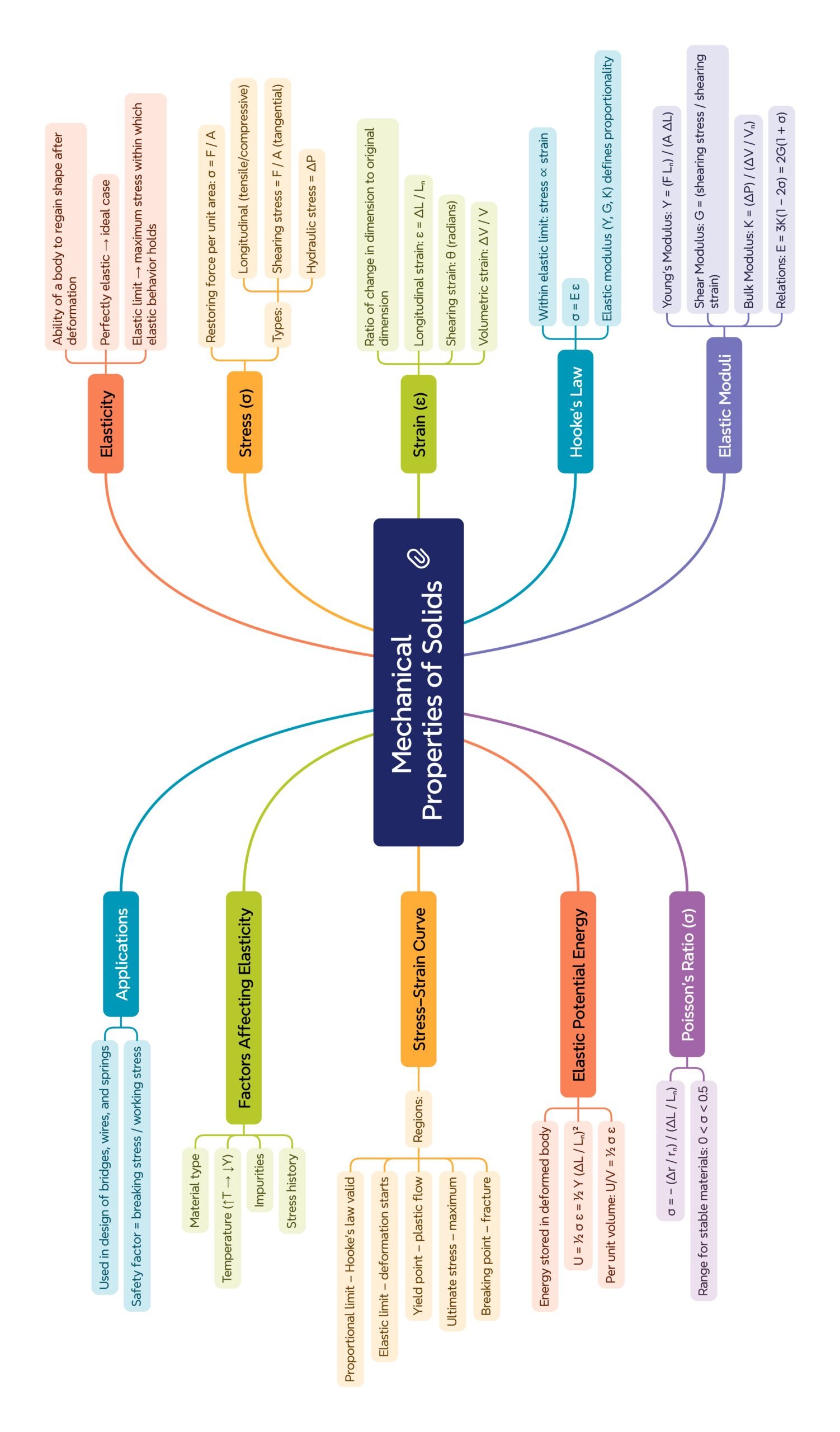
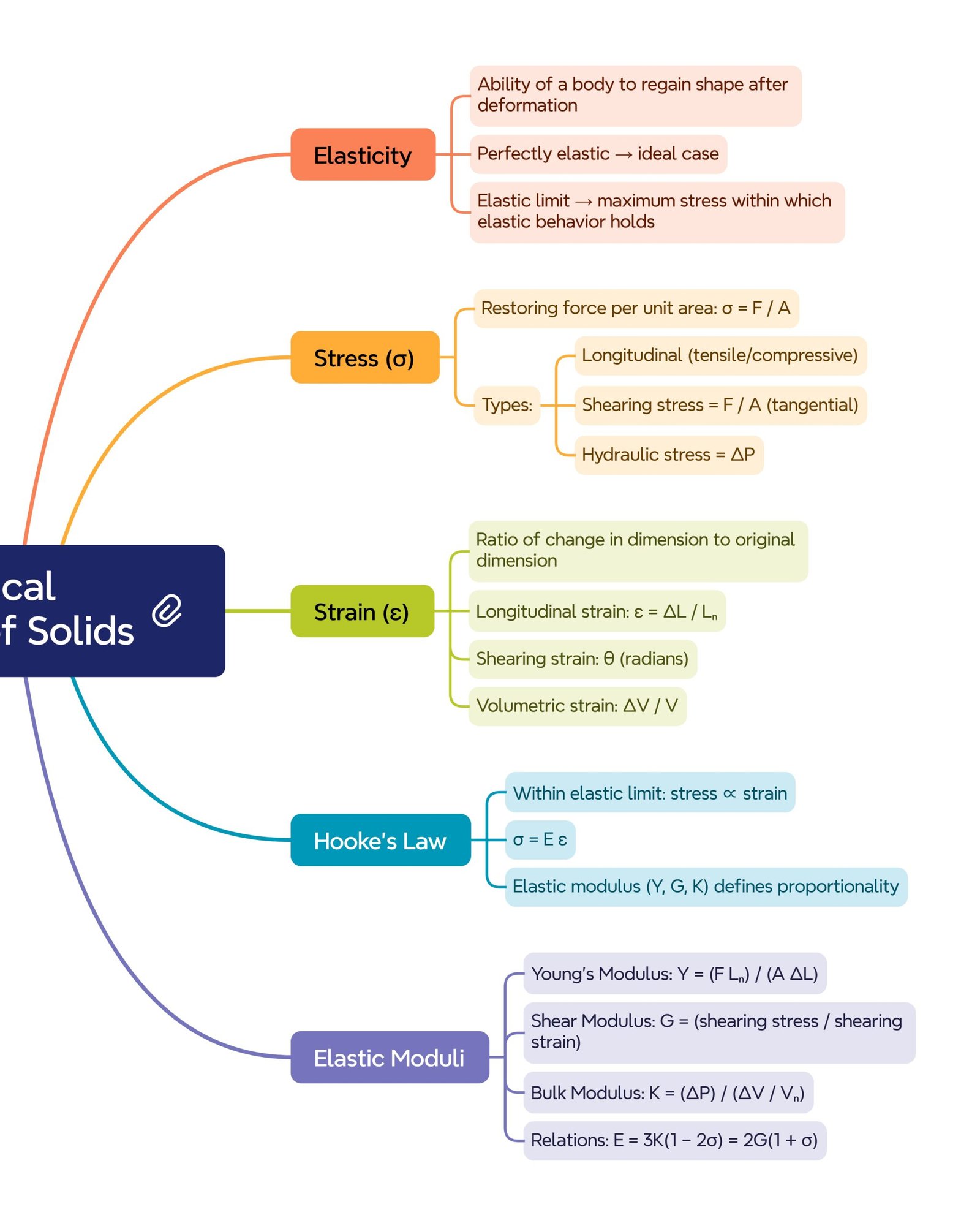
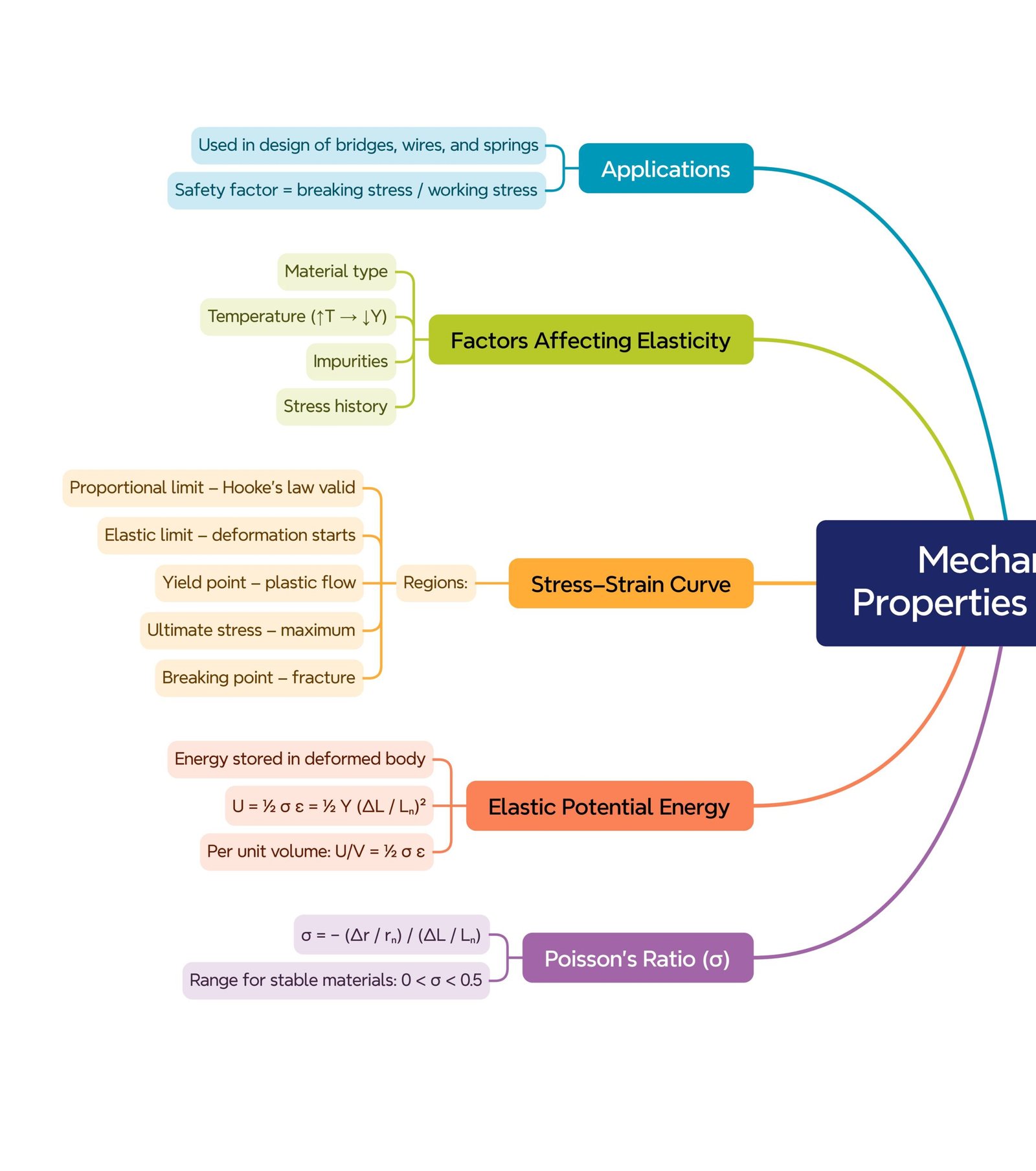
Mind MAP
————————————————————————————————————————————————————————————————————————————