Class 11 : Biology (In English) – Lesson 18: Neural Control and Coordination

EXPLANATION & SUMMARY
🌱✨ Introduction
🧠 Coordination ensures that all organs of the body work together harmoniously.
⚙️ The nervous system and endocrine system together regulate body functions through electrical and chemical signals.
🌿 This chapter focuses on the neural system, which works through neurons — specialized cells that transmit information via electrochemical impulses.
💡 Concept:
Neural control = rapid, short-term responses
Endocrine control = slower, long-term regulation
🧬 The Human Neural System
📘 Divided into:
1️⃣ Central Nervous System (CNS) — 🧠 Brain + 🧬 Spinal cord
2️⃣ Peripheral Nervous System (PNS) — cranial and spinal nerves
3️⃣ Autonomic Nervous System (ANS) — involuntary control (sympathetic & parasympathetic)
4️⃣ Somatic Nervous System — voluntary control of skeletal muscles
💡 The nervous system receives stimuli, processes them, and sends suitable responses.
🧠 Neuron: Structural and Functional Unit
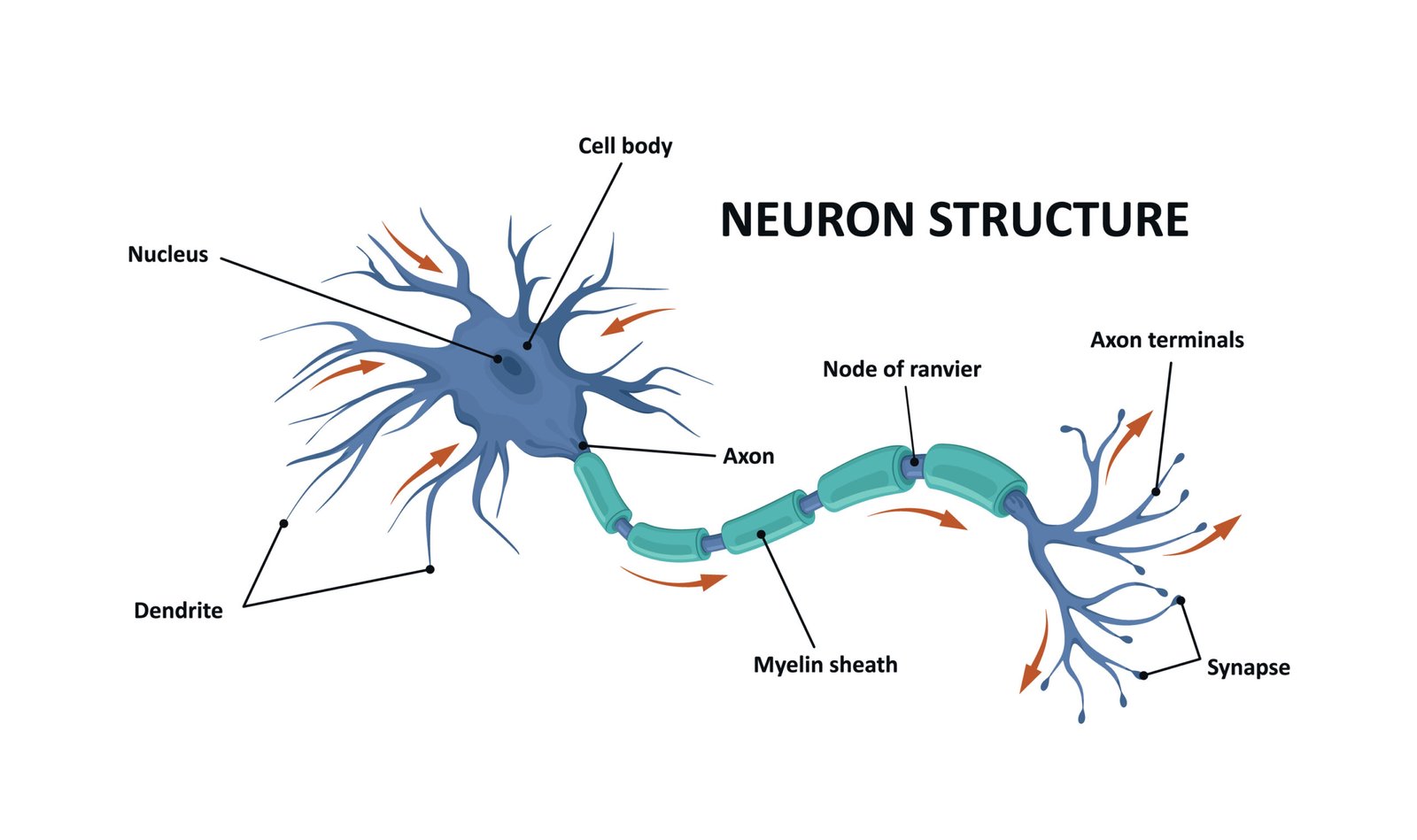
🧩 Neuron = nerve cell specialized to conduct impulses.
📘 Parts:
Cell body (Soma): contains nucleus, cytoplasm (Nissl bodies)
Dendrites: receive impulses
Axon: transmits impulse away from cell body
Axon terminals: form synapses with next cell
💡 Myelinated neurons have Schwann cells forming myelin sheath → faster conduction.
Unmyelinated neurons conduct slower.
🔹 Types of Neurons
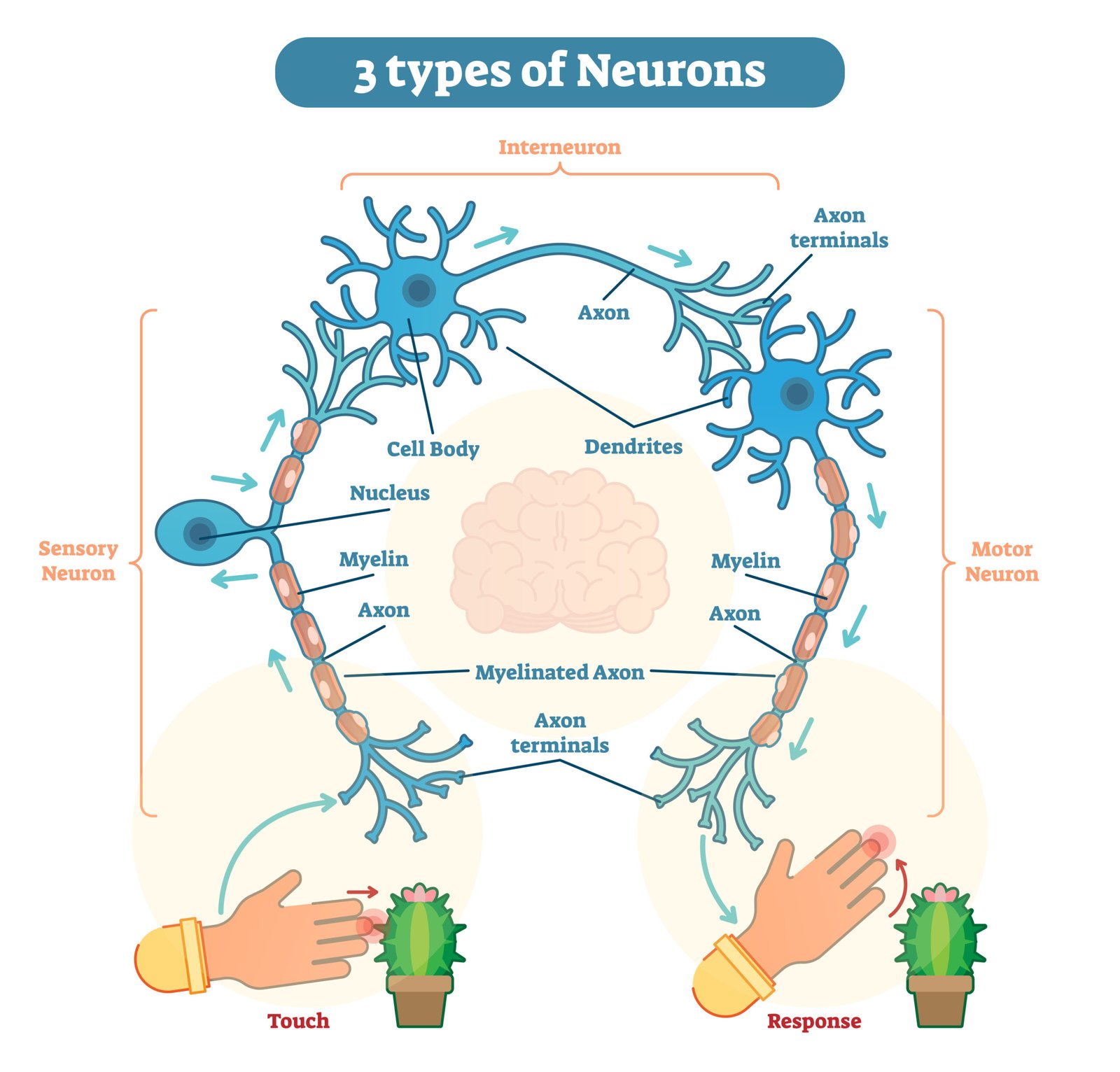
1️⃣ Sensory (Afferent): carry impulses from receptors to CNS
2️⃣ Motor (Efferent): carry impulses from CNS to effectors
3️⃣ Interneurons: connect sensory and motor neurons within CNS
⚡ Transmission of Nerve Impulse
🧠 Based on resting membrane potential and action potential.
1️⃣ Resting Potential
Inside neuron: negative (–70 mV)
Due to Na⁺/K⁺ pump (3 Na⁺ out, 2 K⁺ in)
Membrane is polarized
2️⃣ Action Potential (Depolarization)
Stimulus opens Na⁺ channels → Na⁺ influx → inside becomes positive
Membrane depolarized
3️⃣ Repolarization
K⁺ channels open → K⁺ efflux → negativity restored
Returns to resting state
💡 Impulse = wave of depolarization and repolarization
4️⃣ Conduction
Impulse travels along axon
In myelinated axons, jumps from node to node (saltatory conduction) → faster
🔄 Synapse
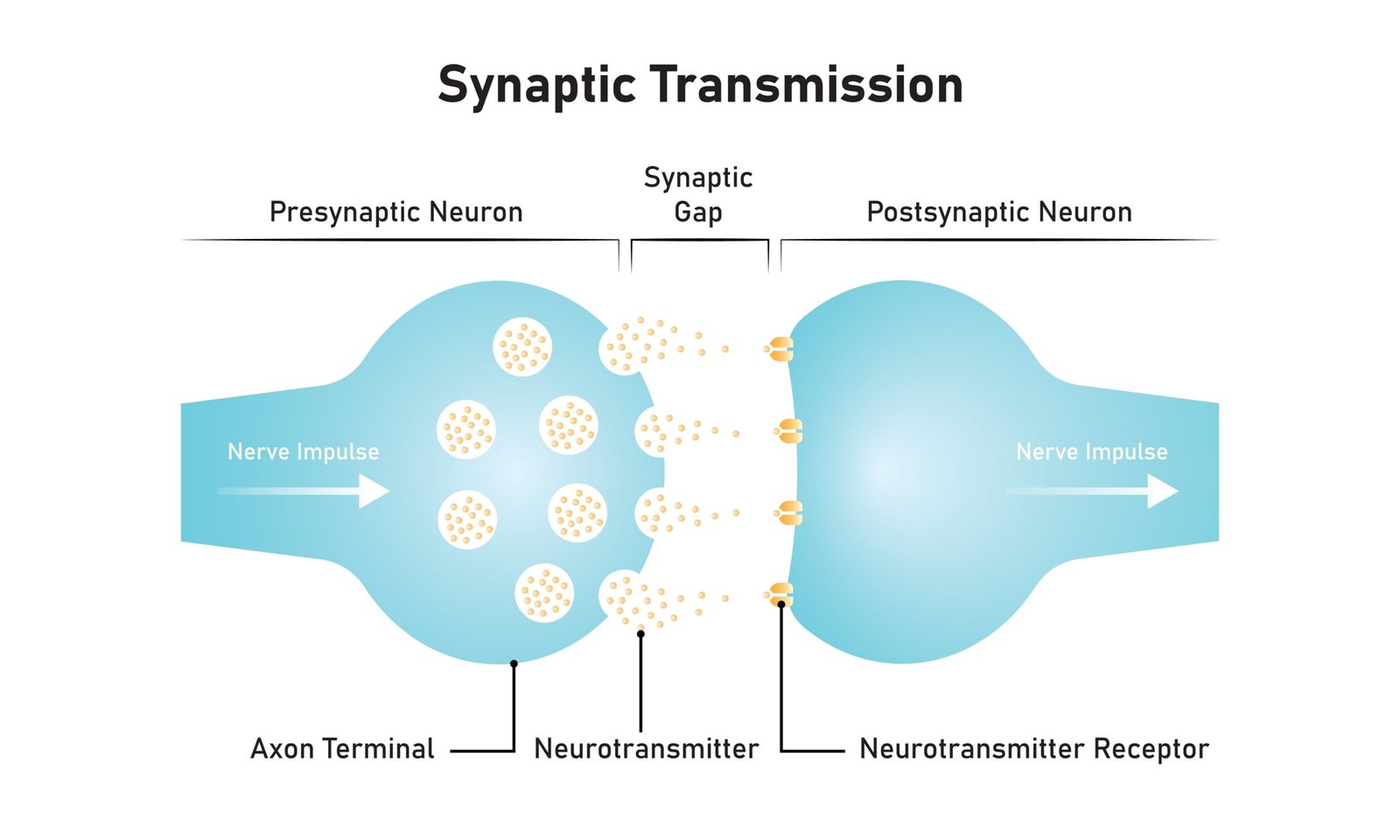
🧬 Junction between two neurons or neuron–effector.
Types:
1️⃣ Electrical synapse: direct ionic current; rare in humans
2️⃣ Chemical synapse: common; uses neurotransmitters (like acetylcholine)
🧠 Process:
Impulse → axon terminal → vesicle releases neurotransmitter → crosses synaptic cleft → binds receptor → new impulse in next neuron
✏️ Acetylcholinesterase destroys neurotransmitter to stop signal.
🧠 Central Nervous System (CNS)
🧩 1️⃣ Brain
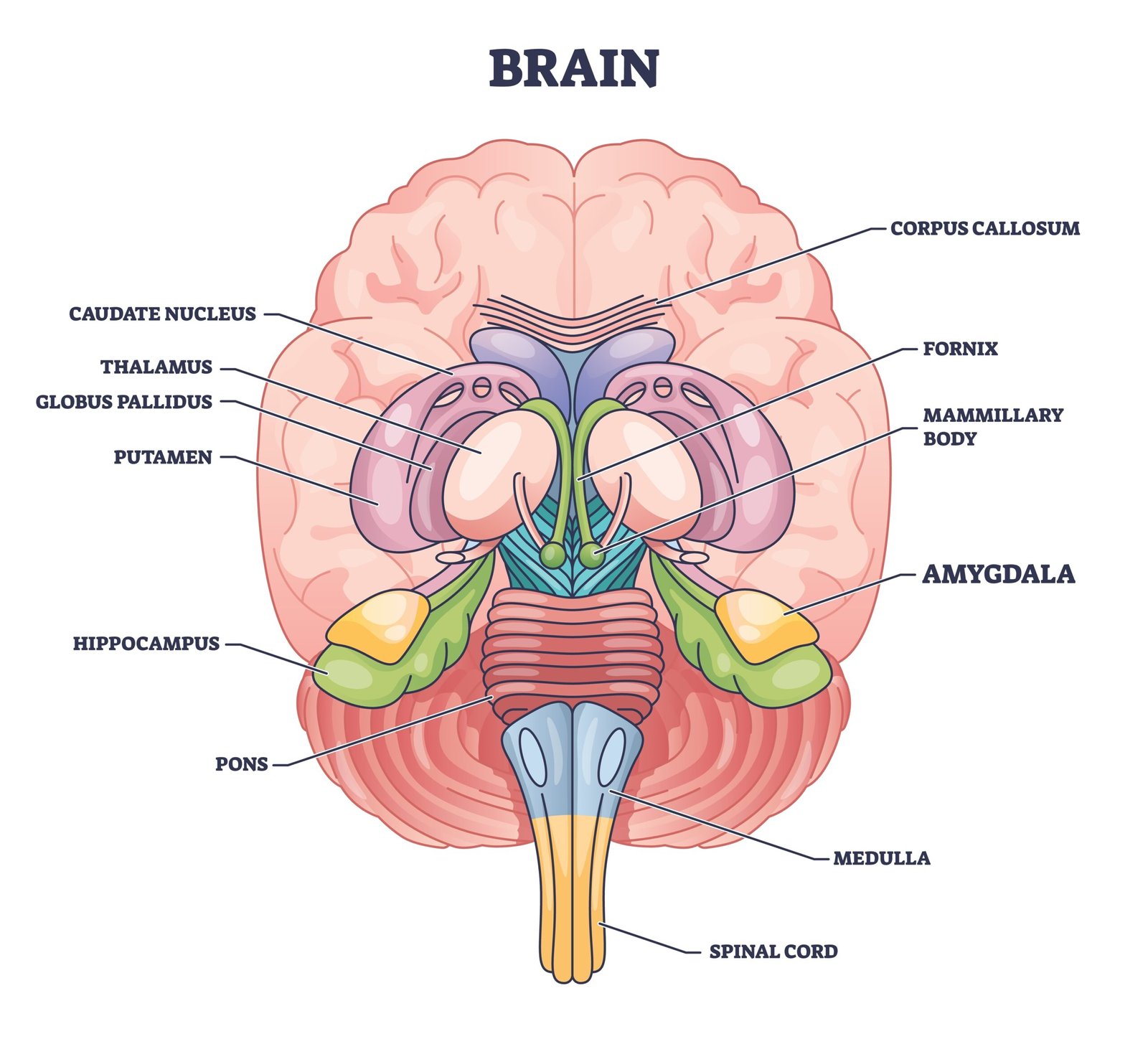
📍 Located in cranial cavity, protected by cranium, meninges (dura, arachnoid, pia), and cerebrospinal fluid (CSF).
💡 Divided into three main regions:
🧠 (a) Forebrain
Includes:
Cerebrum: largest part; divided into two hemispheres connected by corpus callosum
Frontal lobe: reasoning, movement
Parietal lobe: sensory processing
Temporal lobe: hearing, memory
Occipital lobe: vision
Thalamus: relay center
Hypothalamus: controls hunger, thirst, temperature, and links with endocrine system (pituitary)
🧠 (b) Midbrain
Connects forebrain & hindbrain
Contains optic and auditory reflex centers
🧠 (c) Hindbrain
Cerebellum: balance, posture, coordination
Pons: bridges forebrain & medulla
Medulla oblongata: controls involuntary actions (breathing, heartbeat)
💡 Brainstem: midbrain + pons + medulla
🧬 2️⃣ Spinal Cord
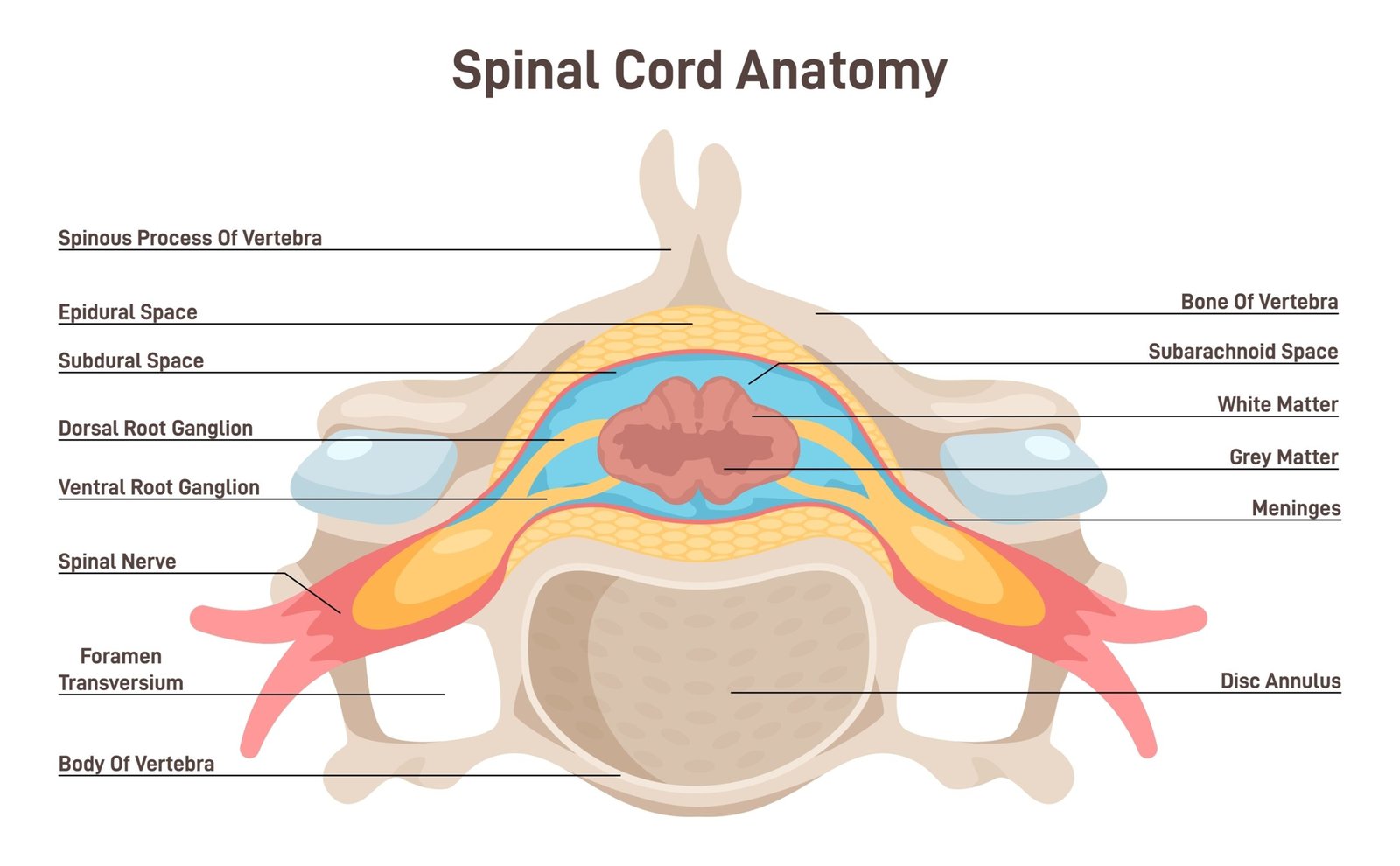
📘 Cylindrical structure extending from medulla down vertebral canal
🧠 Functions:
Reflex actions
Relay between brain and body
⚙️ Protected by vertebral column and CSF
🧩 Peripheral Nervous System (PNS)
Consists of cranial (12 pairs) and spinal nerves (31 pairs).
📘 Functions:
Connects CNS to limbs and organs
Carries impulses to and from CNS
⚙️ Autonomic Nervous System (ANS)
Controls involuntary functions (heart rate, digestion).
🧠 Two divisions:
1️⃣ Sympathetic (“fight or flight”)
Increases heart rate, BP, respiration
Dilates pupils
2️⃣ Parasympathetic (“rest and digest”)
Decreases heart rate, conserves energy
💡 Work in antagonistic coordination.
⚡ Reflex Action
🧠 Reflex = involuntary, instantaneous response to a stimulus.
🌀 Pathway:
Stimulus → receptor → sensory neuron → spinal cord → motor neuron → effector → response
📘 Reflex arc is the structural and functional unit of reflexes.
💡 Spinal cord acts as integration center for reflexes (e.g., knee-jerk)
✏️ Examples: Withdrawal of hand from hot object, blinking.
🧠 Sense Organs (Brief Overview)
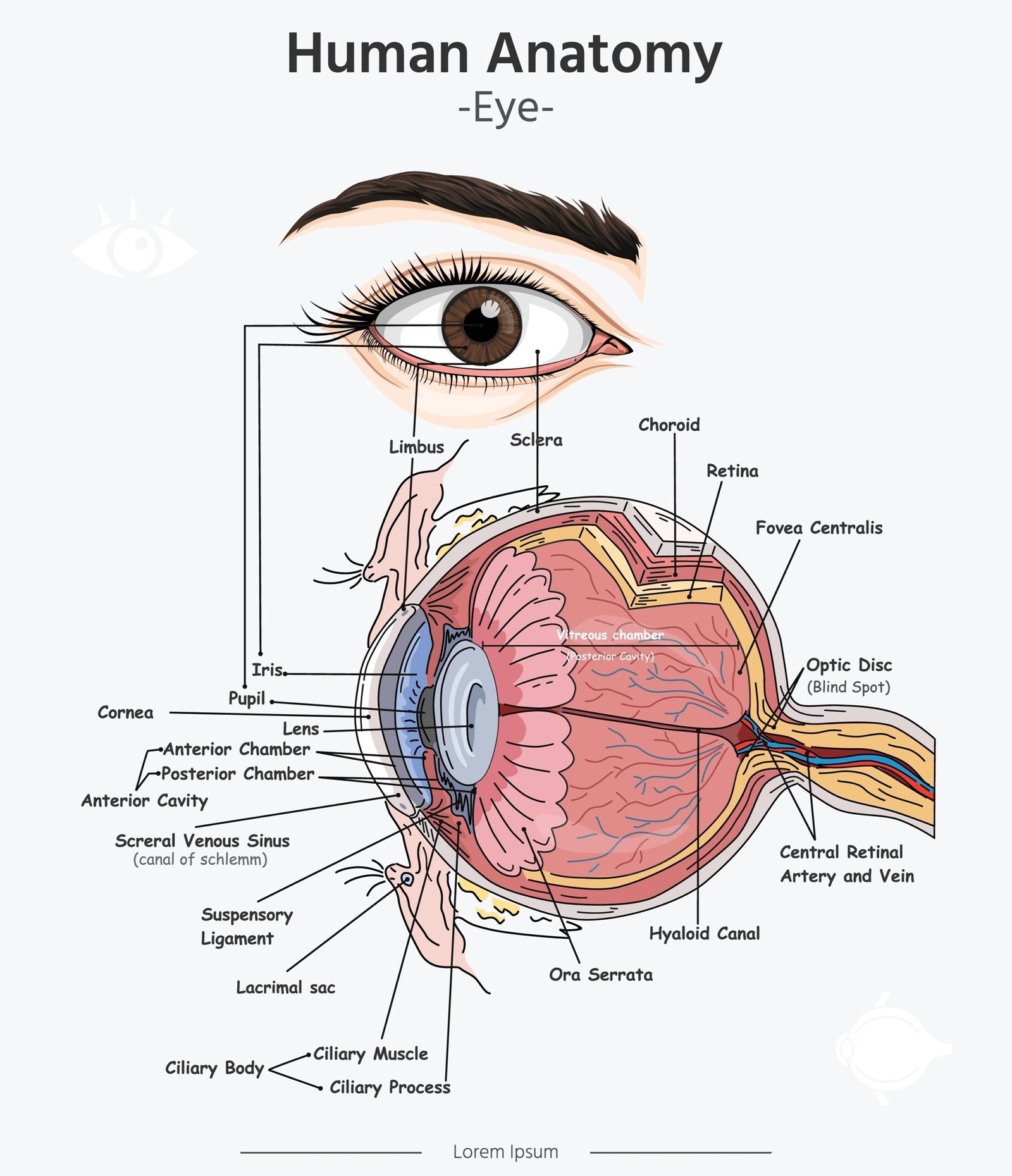
👁️ Eye
Sensory organ for vision
Composed of sclera, choroid, retina
Retina has rods (dim light) and cones (color)
Image formed is real, inverted
👂 Ear
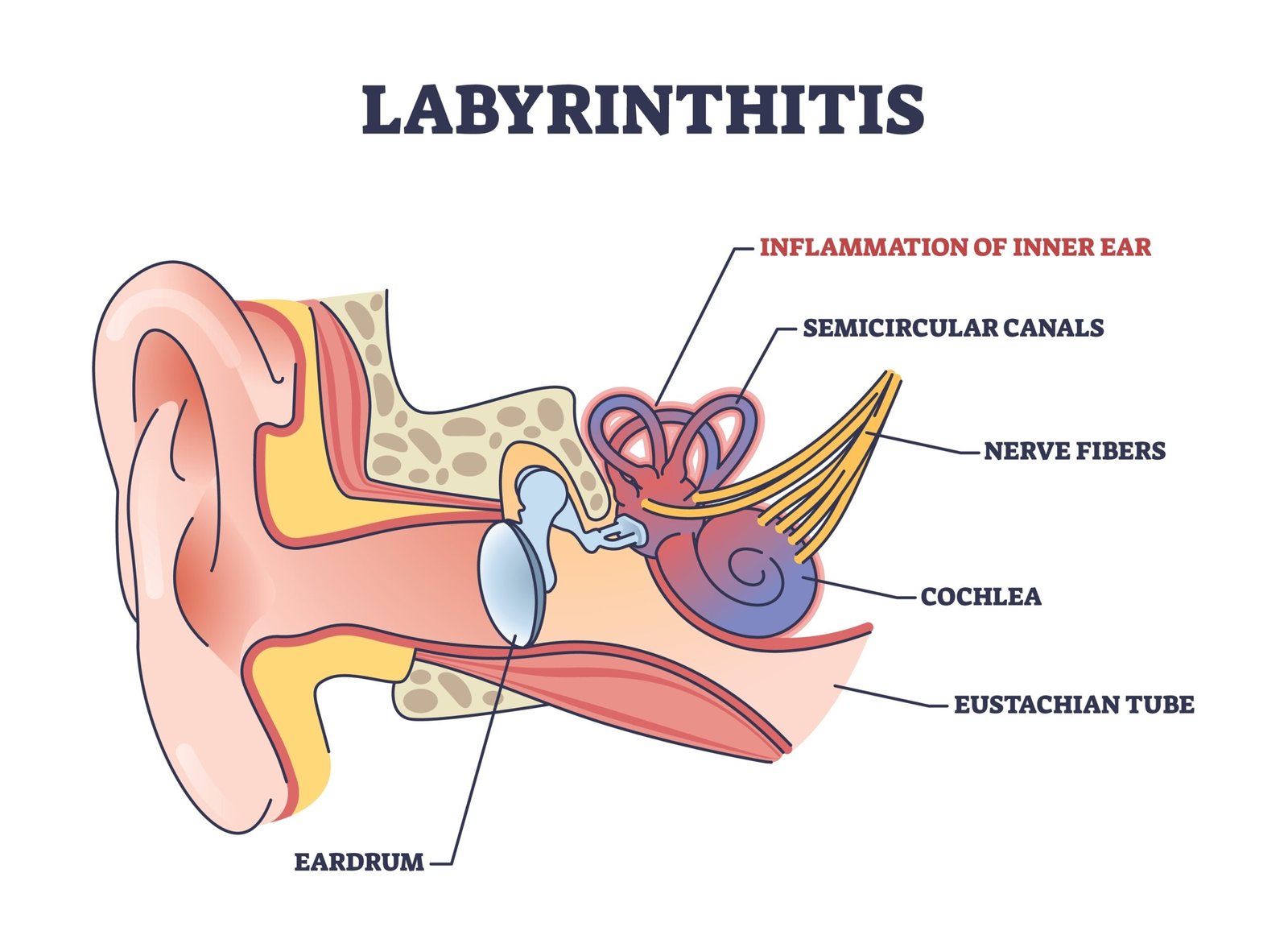
Organ for hearing and balance
Outer ear → Middle ear → Inner ear
Cochlea = hearing
Semicircular canals = balance
💡 Converts sound waves to nerve impulses.
🌍 Coordination with Endocrine System
📘 Hypothalamus connects nervous and endocrine systems
🧠 Regulates pituitary gland through releasing hormones
⚙️ Ensures homeostasis
⚠️ Disorders of Nervous System
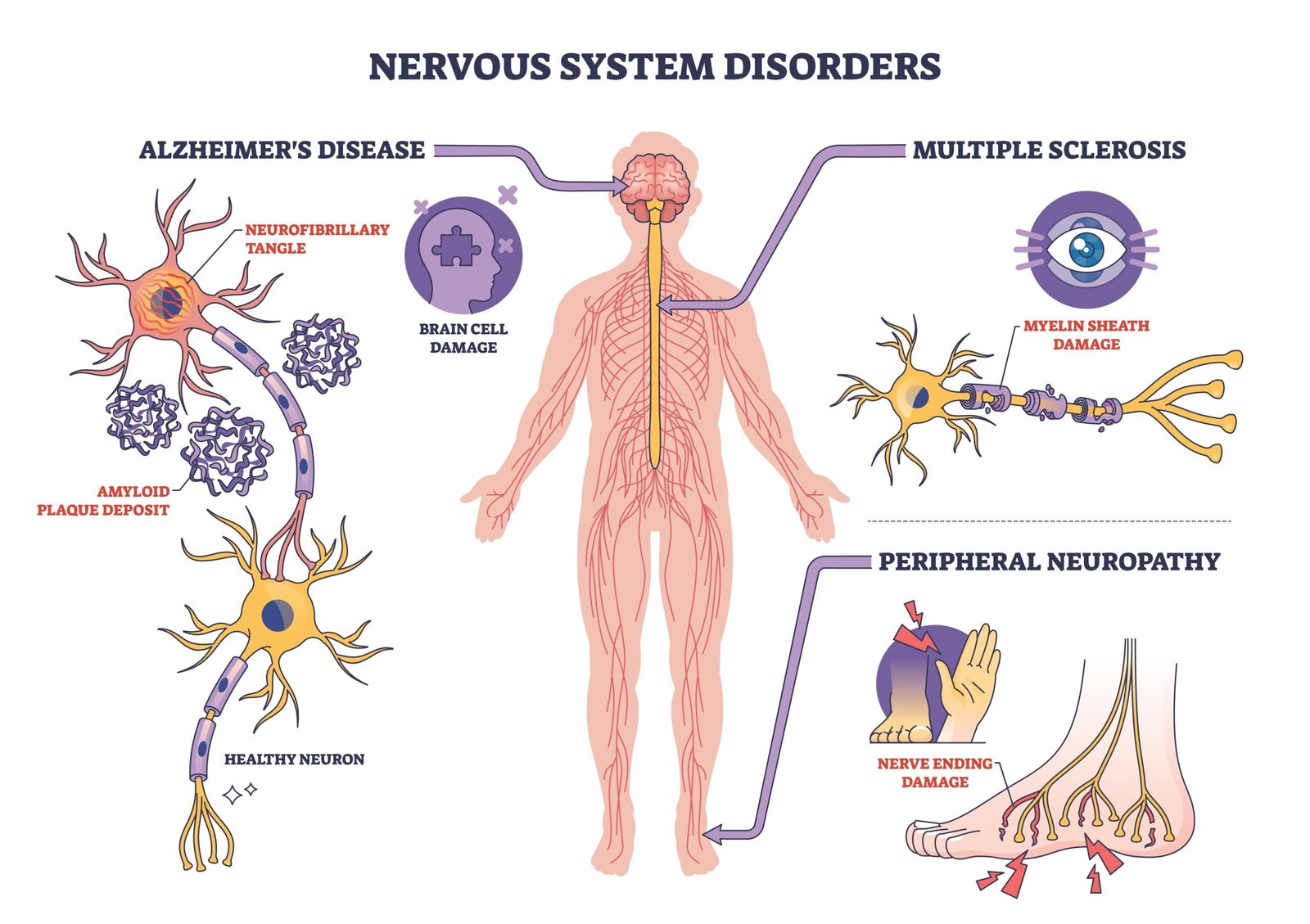
1️⃣ Epilepsy: recurrent seizures due to abnormal neural activity
2️⃣ Alzheimer’s disease: neurodegeneration → memory loss
3️⃣ Parkinson’s disease: dopamine deficiency → tremors
4️⃣ Stroke: brain damage due to disrupted blood supply
5️⃣ Depression: imbalance in neurotransmitters
💡 Healthy habits: balanced diet, rest, mental exercise.
🌍 Importance of Neural Control
🧠 Enables rapid communication across body
⚙️ Maintains coordination and reflexes
🌿 Integrates sensory input and motor output
💡 Essential for learning, memory, emotions
🌍 Why This Lesson Matters
💡 Provides foundation for understanding brain functions
🧠 Crucial for medicine, psychology, neuroscience
⚙️ Explains how body reacts and adapts
🌍 Helps understand disorders and mental health
📝 Quick Recap
🧠 Neuron = structural unit
⚡ Impulse = depolarization + repolarization
🔄 Synapse = chemical or electrical junction
🧬 Brain: forebrain, midbrain, hindbrain
🧩 Spinal cord = reflex center
⚙️ PNS: cranial + spinal nerves
🌀 ANS: sympathetic & parasympathetic
🧠 Reflex arc = receptor → effector
⚠️ Disorders: epilepsy, Parkinson’s, Alzheimer’s
📘 Summary
The nervous system regulates body functions via electrical impulses transmitted by neurons. Impulses travel through axons and synapses to coordinate actions. The CNS (brain and spinal cord) integrates information, while the PNS links the CNS to the body. The ANS controls involuntary processes through sympathetic and parasympathetic divisions. Reflex actions ensure rapid responses. Disorders like Alzheimer’s and Parkinson’s highlight its complexity. Neural control ensures coordination, perception, reaction, and adaptation — vital for survival.
————————————————————————————————————————————————————————————————————————————
QUESTIONS FROM TEXTBOOK
🔵 Question 1. Briefly describe the structure of the Brain.
🟢 Answer:
🧠 The human brain is divided into three main parts:
🌿 Forebrain:
Cerebrum: Largest part; divided into two hemispheres; controls intelligence, will, memory, voluntary actions.
Thalamus: Relay centre for sensory impulses.
Hypothalamus: Maintains homeostasis; regulates hunger, thirst, temperature, endocrine functions.
🌸 Midbrain:
Connects forebrain with hindbrain.
Contains corpora quadrigemina; controls reflexes of vision and hearing.
🌿 Hindbrain:
Cerebellum: Coordinates muscular activities and balance.
Pons: Connects parts of brain; helps in respiration.
Medulla oblongata: Controls involuntary actions like heartbeat, breathing, swallowing.
✔️ Protected by skull, meninges, and cerebrospinal fluid (CSF).
🔵 Question 2. Compare the following:
🟢 (a) Central Neural System (CNS) and Peripheral Neural System (PNS)
Feature CNS PNS
Components Brain and spinal cord Cranial and spinal nerves
Function Integration and control Transmission of impulses
Protection Protected by skull & vertebral column Not protected
🟢 (b) Resting potential and Action potential
Feature Resting Potential Action Potential
State Membrane at rest During impulse
Potential –70 mV +30 mV
Ion condition Na⁺ outside, K⁺ inside Na⁺ moves in, K⁺ out
Function Maintains polarity Generates impulse
🔵 Question 3. Explain the following processes:
🟢 (a) Polarisation of the membrane of a nerve fibre:
At rest, membrane is polarised:
Na⁺ outside, K⁺ inside, large negatively charged proteins inside.
Potential difference ≈ –70 mV (resting potential).
🟢 (b) Depolarisation of the membrane of a nerve fibre:
When stimulated, Na⁺ channels open → Na⁺ influx → inside becomes positive (+30 mV).
Depolarised state initiates action potential.
🟢 (c) Transmission of a nerve impulse across a chemical synapse:
Impulse reaches axon terminal.
Ca²⁺ enters → synaptic vesicles release neurotransmitter (acetylcholine).
Neurotransmitter binds to receptors on postsynaptic membrane.
Opens Na⁺ channels → new impulse.
Neurotransmitter degraded by enzyme (acetylcholinesterase).
✔️ Ensures one-way transmission.
🔵 Question 4. Draw labelled diagrams of the following:
🟢 (a) Neuron – Showing dendrites, cell body, axon, myelin sheath, nodes of Ranvier.
🟢 (b) Brain – Showing forebrain, midbrain, hindbrain, cerebrum, cerebellum, medulla oblongata.
✏️ (Draw in notebook with clear labels as per NCERT diagram)
🔵 Question 5. Write short notes on the following:
🧠 (a) Neural coordination:
Integration of sensory input and motor output through neurons, brain, and spinal cord.
🌿 (b) Forebrain:
Cerebrum, thalamus, hypothalamus; responsible for intelligence, emotions, and sensory perception.
🌸 (c) Midbrain:
Connects forebrain and hindbrain; controls visual and auditory reflexes.
🌿 (d) Hindbrain:
Includes cerebellum, pons, medulla; regulates balance, posture, and involuntary actions.
⚡ (e) Synapse:
Junction between two neurons; transmits impulses via neurotransmitters.
🔵 Question 6. Give a brief account of the mechanism of synaptic transmission.
🟢 Answer:
Impulse reaches axon terminal.
Ca²⁺ influx causes neurotransmitter release.
Neurotransmitter diffuses across synaptic cleft.
Binds to receptors on postsynaptic membrane.
Opens ion channels → new action potential generated.
✔️ Unidirectional transmission; neurotransmitter degraded thereafter.
🔵 Question 7. Explain the role of Na⁺ in the generation of action potential.
🟢 Answer:
Na⁺ influx causes depolarisation.
Rapid entry of Na⁺ reverses polarity (inside positive).
Triggers action potential.
Later, Na⁺/K⁺ pump restores resting potential.
✔️ Na⁺ essential for impulse initiation.
🔵 Question 8. Differentiate between:
(a) Myelinated Axons Non-myelinated Axons
Covering Myelin sheath No sheath
Conduction Saltatory, faster Continuous, slow
Location White matter Grey matter
(b) Dendrites Axons
Function Receive impulses Transmit impulses
Number Many One
Direction Towards cell body Away from cell body
(c) Thalamus Hypothalamus
Function Relay sensory impulses Regulates homeostasis
Position Above midbrain Below thalamus
(d) Cerebrum Cerebellum
Function Intelligence, thinking Balance, coordination
Structure Largest part Smaller, posterior
🔵 Question 9. Answer the following:
(a) 🌿 Which part of the human brain is the most developed?
➡️ Cerebrum – controls intelligence, memory, emotions.
(b) 🌸 Which part of our central neural system acts as a master clock?
➡️ Hypothalamus – regulates circadian rhythm and endocrine control.
🔵 Question 10. Distinguish between:
(a) Afferent Neurons Efferent Neurons
Function Carry impulses to CNS Carry impulses from CNS
Type Sensory Motor
(b) Myelinated vs Unmyelinated conduction
Myelinated: Saltatory (nodes of Ranvier), faster
Unmyelinated: Continuous, slower
(c) Cranial Nerves Spinal Nerves
Origin Brain Spinal cord
Number 12 pairs 31 pairs
Function Sensory, motor, mixed Sensory and motor
————————————————————————————————————————————————————————————————————————————
OTHER IMPORTANT QUESTIONS FOR EXAMS
(CBSE MODEL QUESTIONS PAPER)
ESPECIALLY MADE FROM THIS LESSON ONLY
🔴 Question 1:
Structural and functional unit of the nervous system is —
🔴1️⃣ Brain
🟢2️⃣ Neuron
🟡3️⃣ Spinal cord
🔵4️⃣ Nerve
🟢 Answer: 2️⃣ Neuron
🔴 Question 2:
Which part of the neuron receives impulses?
🔴1️⃣ Axon
🟢2️⃣ Dendrites
🟡3️⃣ Synapse
🔵4️⃣ Node of Ranvier
🟢 Answer: 2️⃣ Dendrites
🔴 Question 3:
Which division of the nervous system controls involuntary actions?
🔴1️⃣ Somatic
🟢2️⃣ Autonomic
🟡3️⃣ Central
🔵4️⃣ Peripheral
🟢 Answer: 2️⃣ Autonomic
🔴 Question 4:
Which part of the brain controls posture and balance?
🔴1️⃣ Cerebrum
🟢2️⃣ Cerebellum
🟡3️⃣ Medulla oblongata
🔵4️⃣ Pons
🟢 Answer: 2️⃣ Cerebellum
🔴 Question 5:
Which type of neuron carries impulses from sense organs to CNS?
🔴1️⃣ Motor neuron
🟢2️⃣ Sensory neuron
🟡3️⃣ Interneuron
🔵4️⃣ Mixed neuron
🟢 Answer: 2️⃣ Sensory neuron
🔴 Question 6:
Node of Ranvier is found in —
🔴1️⃣ Non-myelinated neurons
🟢2️⃣ Myelinated neurons
🟡3️⃣ Sensory neurons only
🔵4️⃣ Spinal nerves only
🟢 Answer: 2️⃣ Myelinated neurons
🔴 Question 7:
Which part of the brain controls respiration and heartbeat?
🔴1️⃣ Cerebrum
🟢2️⃣ Medulla oblongata
🟡3️⃣ Cerebellum
🔵4️⃣ Hypothalamus
🟢 Answer: 2️⃣ Medulla oblongata
🔴 Question 8:
The junction between two neurons is called —
🔴1️⃣ Axon terminal
🟢2️⃣ Synapse
🟡3️⃣ Dendrite
🔵4️⃣ Node
🟢 Answer: 2️⃣ Synapse
🔴 Question 9:
Which part of the brain is known as the “seat of intelligence”?
🔴1️⃣ Cerebellum
🟢2️⃣ Cerebrum
🟡3️⃣ Medulla
🔵4️⃣ Thalamus
🟢 Answer: 2️⃣ Cerebrum
🔴 Question 10:
Impulse transmission is fastest in —
🔴1️⃣ Non-myelinated neuron
🟢2️⃣ Myelinated neuron
🟡3️⃣ Synapse
🔵4️⃣ Spinal cord
🟢 Answer: 2️⃣ Myelinated neuron
🔴 Question 11:
Define a synapse.
🟢 Answer:
A synapse is the functional junction between two neurons or between a neuron and an effector where nerve impulses are transmitted via neurotransmitters.
🔴 Question 12:
Name the three main parts of the human brain.
🟢 Answer:
1️⃣ Forebrain (cerebrum, thalamus, hypothalamus)
2️⃣ Midbrain
3️⃣ Hindbrain (pons, cerebellum, medulla)
🔴 Question 13:
Describe the structure of a neuron.
🟢 Answer:
Cell body (Soma): Contains nucleus and cytoplasm with Nissl’s granules.
Dendrites: Short, branched processes that receive impulses.
Axon: Long fibre conducting impulses away from cell body; may be myelinated (with Schwann cells) or non-myelinated.
💡 Function: Neuron is the structural and functional unit of the nervous system.
🔴 Question 14:
Differentiate between myelinated and non-myelinated neurons.
🟢 Answer:
Feature Myelinated Neuron Non-Myelinated Neuron
Sheath Present Absent
Conduction Fast (saltatory) Slow
Nodes of Ranvier Present Absent
Location White matter, peripheral nerves Grey matter, ANS
💡 Myelin sheath insulates axon and increases speed.
🔴 Question 15:
Explain the generation and conduction of nerve impulse.
🟢 Answer:
1️⃣ Resting potential: Outer side +ve (Na⁺), inner side –ve (K⁺).
2️⃣ Depolarization: Stimulus → Na⁺ enters → inside becomes +ve.
3️⃣ Action potential: Electrical impulse generated.
4️⃣ Repolarization: K⁺ moves out → potential restored.
💡 Impulse travels unidirectionally along axon.
🔴 Question 16:
Describe the structure and function of synapse.
🟢 Answer:
Structure: Presynaptic membrane, synaptic cleft, postsynaptic membrane.
Process:
1️⃣ Impulse reaches axon terminal.
2️⃣ Vesicles release neurotransmitters (e.g., acetylcholine).
3️⃣ Neurotransmitters bind receptors → new impulse in next neuron.
💡 Allows one-way conduction of impulses.
🔴 Question 17:
Write short notes on reflex action and reflex arc.
🟢 Answer:
Reflex action: Automatic, involuntary response to stimulus.
Reflex arc: Pathway of reflex:
Receptor → Sensory neuron → Interneuron → Motor neuron → Effector
Example: Withdrawal of hand from hot object 🔥.
💡 Ensures quick protection from harmful stimuli.
🔴 Question 18:
Explain the parts of human central nervous system.
🟢 Answer:
1️⃣ Brain: Control centre with cerebrum, cerebellum, medulla.
2️⃣ Spinal cord: Extends from medulla; conducts impulses between brain and body; reflex centre.
💡 Protected by cranium and vertebral column; covered by meninges.
🔴 Question 19:
Describe the three meninges covering the brain.
🟢 Answer:
1️⃣ Dura mater: Outermost, tough fibrous layer.
2️⃣ Arachnoid: Middle delicate layer.
3️⃣ Pia mater: Innermost vascular layer; nourishes brain.
💡 Between arachnoid & pia = subarachnoid space filled with CSF.
🔴 Question 20:
Write the functions of cerebrospinal fluid (CSF).
🟢 Answer:
1️⃣ Acts as shock absorber.
2️⃣ Maintains constant pressure.
3️⃣ Provides nutrients and removes wastes.
4️⃣ Helps in exchange of materials between brain & blood.
💡 Present in ventricles, central canal, subarachnoid space.
🔴 Question 21:
Explain the structure and function of spinal cord.
🟢 Answer:
Structure: Cylindrical cord; grey matter inside, white matter outside.
Protected by: Vertebral column, meninges, CSF.
Functions:
1️⃣ Transmits impulses to/from brain.
2️⃣ Controls reflexes through reflex arcs.
💡 Extends from medulla to lumbar region.
🔴 Question 22:
Differentiate between sympathetic and parasympathetic nervous system.
🟢 Answer:
Feature Sympathetic Parasympathetic
Function Fight/flight Rest/digest
Effect on heart Increases rate ❤️ Decreases rate 💓
Effect on pupil Dilates 👁️ Constricts 👁️
Neurotransmitter Noradrenaline Acetylcholine
💡 Both form autonomic nervous system maintaining internal balance.
✅ End of Response 2 (Q13–Q22)
Proceed to Response 3 for Q23–Q30 (4-mark long answers).
all questions and answers belongs to this lesson……..only and all answers are rechecked and found correct.
📘 Lesson: Neural Control and Coordination — Code 3 — Response 3
(Class 11 Biology · NCERT 2025–26 Edition · Board-Style Paper Q23–Q30 · 4 Marks Each)
🔴 Question 23:
Explain the structure of the human brain.
🟢 Answer:
Main Parts:
1️⃣ Forebrain:
– Cerebrum: Largest part; controls intelligence, memory, reasoning.
– Thalamus: Relay centre for sensory impulses.
– Hypothalamus: Regulates hunger, thirst, temperature, endocrine control.
2️⃣ Midbrain: Connects forebrain and hindbrain; controls reflexes of eyes and ears.
3️⃣ Hindbrain:
– Cerebellum: Maintains posture and balance.
– Pons: Relays signals between cerebrum and cerebellum.
– Medulla oblongata: Controls heartbeat, respiration.
💡 Protected by cranium, meninges, and CSF.
🔴 Question 24:
Describe the parts and functions of the forebrain.
🟢 Answer:
1️⃣ Cerebrum:
– Two hemispheres, four lobes.
– Controls voluntary actions, intelligence, emotions, memory.
2️⃣ Thalamus:
– Relay centre for sensory impulses to cerebrum.
3️⃣ Hypothalamus:
– Maintains homeostasis (temperature, hunger, thirst).
– Controls pituitary gland; regulates sleep-wake cycle.
💡 Forebrain = seat of intelligence and sensory integration.
🔴 Question 25:
Explain the role of cerebellum and medulla oblongata.
🟢 Answer:
Cerebellum:
– Coordinates muscular movements.
– Maintains posture, equilibrium, balance.
– Ensures smooth voluntary movements.
Medulla oblongata:
– Controls involuntary activities: respiration, heartbeat, blood pressure.
– Reflex centres for coughing, sneezing, swallowing.
💡 Both belong to hindbrain, vital for survival.
🔴 Question 26:
Describe the transmission of nerve impulse across a synapse.
🟢 Answer:
1️⃣ Impulse reaches axon terminal of presynaptic neuron.
2️⃣ Synaptic vesicles release neurotransmitter (e.g., acetylcholine).
3️⃣ Neurotransmitter diffuses across synaptic cleft.
4️⃣ Binds to receptors on postsynaptic membrane, generating new impulse.
5️⃣ Neurotransmitter is degraded by enzyme (acetylcholinesterase).
💡 Ensures unidirectional transmission.
🔴 Question 27:
Explain the pathway of reflex action with an example.
🟢 Answer:
Reflex Arc Pathway:
Stimulus → Receptor → Sensory neuron → Interneuron (spinal cord) → Motor neuron → Effector
Example: Touching a hot object 🔥 → withdrawal of hand.
💡 Provides quick response to protect body without involving brain.
🔴 Question 28:
Differentiate between central and peripheral nervous system.
🟢 Answer:
Feature Central Nervous System (CNS) Peripheral Nervous System (PNS)
Components Brain & spinal cord Cranial & spinal nerves
Function Integration, control Transmission of impulses
Protection Cranium & vertebral column Not protected by bone
Example Brain 12 cranial nerves
💡 CNS = control centre; PNS = communication network.
🔴 Question 29:
Describe the autonomic nervous system and its divisions.
🟢 Answer:
Autonomic Nervous System (ANS): Controls involuntary actions of internal organs.
Divisions:
1️⃣ Sympathetic:
– Prepares body for emergency (“fight or flight”).
– Increases heart rate, dilates pupil, decreases digestion.
2️⃣ Parasympathetic:
– Restores normal state (“rest and digest”).
– Decreases heart rate, constricts pupil, promotes digestion.
💡 Both maintain homeostasis.
🔴 Question 30:
Write short notes on sense organs of humans.
🟢 Answer:
1️⃣ Eyes: Visual organ; image formed on retina; rods & cones for light and colour vision.
2️⃣ Ears: Hearing and balance; cochlea for sound, semicircular canals for equilibrium.
3️⃣ Nose: Olfactory receptors detect smell.
4️⃣ Tongue: Taste buds for sweet, sour, salty, bitter.
5️⃣ Skin: Receptors for touch, pain, temperature.
💡 Sense organs are receptors linking body with environment.
————————————————————————————————————————————————————————————————————————————
NEET QUESTIONS FROM THIS LESSON
🔵 Q1. The functional and structural unit of the nervous system is
🟡 A. Axon
🟡 B. Neuron
🟡 C. Synapse
🟡 D. Dendrite
🟢 Answer: B. Neuron
📅 NEET 2018
🔵 Q2. Nodes of Ranvier are found between
🟡 A. Dendrites
🟡 B. Myelin sheath gaps on axon
🟡 C. Axon terminals
🟡 D. Synaptic knobs
🟢 Answer: B. Myelin sheath gaps on axon
📅 AIPMT 2014
🔵 Q3. The neurotransmitter released at neuromuscular junction is
🟡 A. Dopamine
🟡 B. Serotonin
🟡 C. Acetylcholine
🟡 D. Noradrenaline
🟢 Answer: C. Acetylcholine
📅 NEET 2019
🔵 Q4. Resting membrane potential in neurons is about
🟡 A. +70 mV
🟡 B. −70 mV
🟡 C. 0 mV
🟡 D. +30 mV
🟢 Answer: B. −70 mV
📅 AIPMT 2012
🔵 Q5. Saltatory conduction occurs in
🟡 A. Unmyelinated axons
🟡 B. Myelinated axons
🟡 C. Dendrites only
🟡 D. Cell bodies
🟢 Answer: B. Myelinated axons
📅 NEET 2016
🔵 Q6. The hindbrain includes
🟡 A. Cerebrum, cerebellum, medulla
🟡 B. Medulla, pons, cerebellum
🟡 C. Cerebrum, pons, cerebellum
🟡 D. Midbrain, medulla, cerebellum
🟢 Answer: B. Medulla, pons, cerebellum
📅 AIPMT 2015
🔵 Q7. Myelin sheath in the central nervous system is formed by
🟡 A. Schwann cells
🟡 B. Oligodendrocytes
🟡 C. Astrocytes
🟡 D. Microglia
🟢 Answer: B. Oligodendrocytes
📅 NEET 2017
🔵 Q8. The part of the brain that maintains posture and equilibrium is
🟡 A. Cerebrum
🟡 B. Cerebellum
🟡 C. Medulla oblongata
🟡 D. Hypothalamus
🟢 Answer: B. Cerebellum
📅 AIPMT 2014
🔵 Q9. Which division of the autonomic nervous system prepares the body for emergencies?
🟡 A. Parasympathetic
🟡 B. Sympathetic
🟡 C. Somatic
🟡 D. Central
🟢 Answer: B. Sympathetic
📅 NEET 2015
🔵 Q10. The visual area of the human brain is located in
🟡 A. Parietal lobe
🟡 B. Temporal lobe
🟡 C. Frontal lobe
🟡 D. Occipital lobe
🟢 Answer: D. Occipital lobe
📅 AIPMT 2010
🔵 Q11. Transmission of a nerve impulse across a synapse is accomplished by
🟡 A. Electrical conduction
🟡 B. Neurotransmitters
🟡 C. Saltatory conduction
🟡 D. Osmosis
🟢 Answer: B. Neurotransmitters
📅 NEET 2019
🔵 Q12. The parasympathetic nervous system generally
🟡 A. Prepares the body for “fight or flight”
🟡 B. Promotes “rest and digest” responses
🟡 C. Increases heart rate and blood pressure
🟡 D. Inhibits digestive secretions
🟢 Answer: B. Promotes “rest and digest” responses
📅 AIPMT 2013
🔵 Q13. Which structure connects the two cerebral hemispheres?
🟡 A. Pons
🟡 B. Corpus callosum
🟡 C. Medulla
🟡 D. Midbrain
🟢 Answer: B. Corpus callosum
📅 NEET 2018
🔵 Q14. Which ion influx triggers neurotransmitter release at synaptic terminals?
🟡 A. Na⁺
🟡 B. K⁺
🟡 C. Ca²⁺
🟡 D. Cl⁻
🟢 Answer: C. Ca²⁺
📅 AIPMT 2015
🔵 Q15. The refractory period of a neuron is the time when
🟡 A. It cannot respond to a new stimulus
🟡 B. It fires continuously
🟡 C. It is at −70 mV resting potential
🟡 D. It releases acetylcholine
🟢 Answer: A. It cannot respond to a new stimulus
📅 NEET 2017
🔵 Q16. The auditory area of the brain is located in the
🟡 A. Occipital lobe
🟡 B. Temporal lobe
🟡 C. Parietal lobe
🟡 D. Frontal lobe
🟢 Answer: B. Temporal lobe
📅 AIPMT 2014
🔵 Q17. Which part of the human brain regulates body temperature and hunger?
🟡 A. Medulla oblongata
🟡 B. Hypothalamus
🟡 C. Cerebellum
🟡 D. Thalamus
🟢 Answer: B. Hypothalamus
📅 NEET 2016
🔵 Q18. The fluid that cushions and protects the brain and spinal cord is
🟡 A. Lymph
🟡 B. Plasma
🟡 C. Cerebrospinal fluid
🟡 D. Synovial fluid
🟢 Answer: C. Cerebrospinal fluid
📅 AIPMT 2012
🔵 Q19. Reflex actions are controlled by the
🟡 A. Cerebrum
🟡 B. Cerebellum
🟡 C. Spinal cord
🟡 D. Medulla
🟢 Answer: C. Spinal cord
📅 NEET 2014
🔵 Q20. The gap between two neurons is called
🟡 A. Synaptic cleft
🟡 B. Node of Ranvier
🟡 C. Neuromuscular junction
🟡 D. Axon hillock
🟢 Answer: A. Synaptic cleft
📅 AIPMT 2011
🔵 Q21. Which cranial nerves are purely sensory?
🟡 A. Olfactory and optic
🟡 B. Vagus and trigeminal
🟡 C. Facial and glossopharyngeal
🟡 D. Trochlear and abducens
🟢 Answer: A. Olfactory and optic
📅 NEET 2015
🔵 Q22. During depolarization of a neuron membrane
🟡 A. Na⁺ rushes into the neuron
🟡 B. K⁺ rushes into the neuron
🟡 C. K⁺ leaves the neuron
🟡 D. Ca²⁺ rushes into the neuron
🟢 Answer: A. Na⁺ rushes into the neuron
📅 AIPMT 2013
🔵 Q23. The central canal of the spinal cord is filled with
🟡 A. Blood plasma
🟡 B. Cerebrospinal fluid
🟡 C. Lymph
🟡 D. Myelin
🟢 Answer: B. Cerebrospinal fluid
📅 NEET 2018
🔵 Q24. Which part of the ear is responsible for hearing?
🟡 A. Utricle
🟡 B. Saccule
🟡 C. Cochlea
🟡 D. Semicircular canals
🟢 Answer: C. Cochlea
📅 AIPMT 2014
🔵 Q25. The dorsal root of a spinal nerve contains
🟡 A. Motor neurons
🟡 B. Sensory neurons
🟡 C. Mixed neurons
🟡 D. Association neurons
🟢 Answer: B. Sensory neurons
📅 NEET 2017
🔵 Q26. The parasympathetic nervous system uses which neurotransmitter at its effector organs?
🟡 A. Noradrenaline
🟡 B. Dopamine
🟡 C. Acetylcholine
🟡 D. Adrenaline
🟢 Answer: C. Acetylcholine
📅 AIPMT 2014
🔵 Q27. The part of the brain responsible for language and speech production is
🟡 A. Broca’s area
🟡 B. Wernicke’s area
🟡 C. Corpus callosum
🟡 D. Hippocampus
🟢 Answer: A. Broca’s area
📅 NEET 2017
🔵 Q28. Which of these is a mixed cranial nerve?
🟡 A. Optic
🟡 B. Vagus
🟡 C. Olfactory
🟡 D. Vestibulocochlear
🟢 Answer: B. Vagus
📅 AIPMT 2013
🔵 Q29. The medulla oblongata regulates
🟡 A. Vision and hearing
🟡 B. Heartbeat and respiration
🟡 C. Balance and posture
🟡 D. Emotions
🟢 Answer: B. Heartbeat and respiration
📅 NEET 2016
🔵 Q30. Which structure in the human brain acts as a relay centre for sensory signals to the cerebrum?
🟡 A. Hypothalamus
🟡 B. Medulla
🟡 C. Thalamus
🟡 D. Pons
🟢 Answer: C. Thalamus
📅 AIPMT 2012
🔵 Q31. The refractory period prevents
🟡 A. Depolarization
🟡 B. Repolarization
🟡 C. Backward propagation of action potential
🟡 D. Neurotransmitter release
🟢 Answer: C. Backward propagation of action potential
📅 NEET 2015
🔵 Q32. Which cranial nerve innervates the heart, lungs, and digestive tract?
🟡 A. Trigeminal
🟡 B. Vagus
🟡 C. Facial
🟡 D. Glossopharyngeal
🟢 Answer: B. Vagus
📅 AIPMT 2010
🔵 Q33. The sympathetic nervous system prepares the body for
🟡 A. Digestion and rest
🟡 B. Fight or flight
🟡 C. Relaxation and sleep
🟡 D. Memory storage
🟢 Answer: B. Fight or flight
📅 NEET 2018
🔵 Q34. Schwann cells are found in
🟡 A. Central nervous system
🟡 B. Peripheral nervous system
🟡 C. Brain ventricles
🟡 D. Spinal cord grey matter
🟢 Answer: B. Peripheral nervous system
📅 AIPMT 2014
🔵 Q35. Which part of the human brain is responsible for higher intellectual functions such as reasoning?
🟡 A. Medulla oblongata
🟡 B. Cerebellum
🟡 C. Cerebrum
🟡 D. Hypothalamus
🟢 Answer: C. Cerebrum
📅 NEET 2019
🔵 Q36. Wernicke’s area is associated with
🟡 A. Motor control of speech
🟡 B. Understanding spoken and written language
🟡 C. Balance and coordination
🟡 D. Regulation of heartbeat
🟢 Answer: B. Understanding spoken and written language
📅 AIPMT 2015
🔵 Q37. The part of the ear that maintains equilibrium is
🟡 A. Cochlea
🟡 B. Utricle and saccule
🟡 C. Eustachian tube
🟡 D. Tympanic membrane
🟢 Answer: B. Utricle and saccule
📅 NEET 2018
🔵 Q38. The refractory period in neurons ensures that
🟡 A. Action potentials travel in one direction
🟡 B. Depolarization is faster
🟡 C. Myelin is maintained
🟡 D. Na⁺ influx continues indefinitely
🟢 Answer: A. Action potentials travel in one direction
📅 AIPMT 2013
🔵 Q39. The corpus callosum connects
🟡 A. Cerebrum and cerebellum
🟡 B. Two cerebral hemispheres
🟡 C. Midbrain and hindbrain
🟡 D. Medulla and pons
🟢 Answer: B. Two cerebral hemispheres
📅 NEET 2017
🔵 Q40. Which sensory organ contains the organ of Corti?
🟡 A. Eye
🟡 B. Cochlea
🟡 C. Nose
🟡 D. Tongue
🟢 Answer: B. Cochlea
📅 AIPMT 2014
🔵 Q41. During repolarization of a neuron
🟡 A. Na⁺ rushes in
🟡 B. K⁺ moves out
🟡 C. Ca²⁺ enters
🟡 D. Na⁺ moves out
🟢 Answer: B. K⁺ moves out
📅 NEET 2016
🔵 Q42. The sensory receptors for balance are located in
🟡 A. Cochlea
🟡 B. Semicircular canals
🟡 C. Tympanic membrane
🟡 D. Oval window
🟢 Answer: B. Semicircular canals
📅 AIPMT 2010
🔵 Q43. The myelin sheath around axons in the peripheral nervous system is produced by
🟡 A. Oligodendrocytes
🟡 B. Schwann cells
🟡 C. Astrocytes
🟡 D. Microglia
🟢 Answer: B. Schwann cells
📅 NEET 2018
🔵 Q44. The fluid-filled structure in the inner ear responsible for hearing is
🟡 A. Utricle
🟡 B. Cochlea
🟡 C. Saccule
🟡 D. Semicircular canals
🟢 Answer: B. Cochlea
📅 AIPMT 2014
🔵 Q45. Which part of the brain regulates the pituitary gland?
🟡 A. Thalamus
🟡 B. Hypothalamus
🟡 C. Cerebellum
🟡 D. Medulla oblongata
🟢 Answer: B. Hypothalamus
📅 NEET 2015
🔵 Q46. The conduction of nerve impulses along a myelinated axon is
🟡 A. Continuous
🟡 B. Saltatory
🟡 C. Slow and uniform
🟡 D. Blocked at nodes of Ranvier
🟢 Answer: B. Saltatory
📅 AIPMT 2013
🔵 Q47. Which cranial nerve carries visual information?
🟡 A. Olfactory
🟡 B. Optic
🟡 C. Vagus
🟡 D. Trigeminal
🟢 Answer: B. Optic
📅 NEET 2019
🔵 Q48. The semicircular canals detect
🟡 A. Linear acceleration
🟡 B. Rotational movements of the head
🟡 C. Sound vibrations
🟡 D. Air pressure changes
🟢 Answer: B. Rotational movements of the head
📅 AIPMT 2015
🔵 Q49. Which glial cells act as phagocytes in the CNS?
🟡 A. Astrocytes
🟡 B. Microglia
🟡 C. Oligodendrocytes
🟡 D. Schwann cells
🟢 Answer: B. Microglia
📅 NEET 2017
🔵 Q50. The structure that equalizes air pressure on both sides of the tympanic membrane is
🟡 A. Cochlea
🟡 B. Oval window
🟡 C. Eustachian tube
🟡 D. Semicircular canal
🟢 Answer: C. Eustachian tube
📅 AIPMT 2012
————————————————————————————————————————————————————————————————————————————
PRACTICE SETS FROM THIS LESSON
🔵 Question 1:
Structural and functional unit of nervous system is:
🔴 1️⃣ Axon
🟢 2️⃣ Neuron
🟡 3️⃣ Dendrite
🔵 4️⃣ Brain
✔️ Answer: 2️⃣ Neuron
🔵 Question 2:
The part of neuron which carries impulse towards cell body is:
🔴 1️⃣ Axon
🟢 2️⃣ Dendrite
🟡 3️⃣ Synapse
🔵 4️⃣ Myelin
✔️ Answer: 2️⃣ Dendrite
🔵 Question 3:
The part which carries impulse away from cell body is:
🔴 1️⃣ Dendrite
🟢 2️⃣ Axon
🟡 3️⃣ Synapse
🔵 4️⃣ Soma
✔️ Answer: 2️⃣ Axon
🔵 Question 4:
Nerve impulse is:
🔴 1️⃣ Electrical
🟢 2️⃣ Chemical
🟡 3️⃣ Electrochemical
🔵 4️⃣ Physical
✔️ Answer: 3️⃣ Electrochemical
🔵 Question 5:
The gap between two neurons is called:
🔴 1️⃣ Synapse
🟢 2️⃣ Axolemma
🟡 3️⃣ Node of Ranvier
🔵 4️⃣ Axoplasm
✔️ Answer: 1️⃣ Synapse
🔵 Question 6:
At a synapse, impulse transmission is mostly:
🔴 1️⃣ Electrical
🟢 2️⃣ Chemical
🟡 3️⃣ Mechanical
🔵 4️⃣ Magnetic
✔️ Answer: 2️⃣ Chemical
🔵 Question 7:
Neurotransmitter released at synapse is:
🔴 1️⃣ Dopamine
🟢 2️⃣ Acetylcholine
🟡 3️⃣ Serotonin
🔵 4️⃣ Adrenaline
✔️ Answer: 2️⃣ Acetylcholine
🔵 Question 8:
Which part of brain controls voluntary actions?
🔴 1️⃣ Medulla
🟢 2️⃣ Cerebrum
🟡 3️⃣ Cerebellum
🔵 4️⃣ Pons
✔️ Answer: 2️⃣ Cerebrum
🔵 Question 9:
Which part of brain maintains posture and balance?
🔴 1️⃣ Cerebrum
🟢 2️⃣ Cerebellum
🟡 3️⃣ Pons
🔵 4️⃣ Midbrain
✔️ Answer: 2️⃣ Cerebellum
🔵 Question 10:
The centre for regulation of respiration is located in:
🔴 1️⃣ Cerebrum
🟢 2️⃣ Medulla oblongata
🟡 3️⃣ Cerebellum
🔵 4️⃣ Thalamus
✔️ Answer: 2️⃣ Medulla oblongata
🔵 Question 11:
The functional connection between two neurons is:
🔴 1️⃣ Synapse
🟢 2️⃣ Axon
🟡 3️⃣ Dendrite
🔵 4️⃣ Soma
✔️ Answer: 1️⃣ Synapse
🔵 Question 12:
Which part of neuron is covered by myelin sheath?
🔴 1️⃣ Dendrite
🟢 2️⃣ Axon
🟡 3️⃣ Soma
🔵 4️⃣ Synapse
✔️ Answer: 2️⃣ Axon
🔵 Question 13:
Nodes of Ranvier are found in:
🔴 1️⃣ Myelinated axons
🟢 2️⃣ Non-myelinated axons
🟡 3️⃣ Dendrites
🔵 4️⃣ Soma
✔️ Answer: 1️⃣ Myelinated axons
🔵 Question 14:
The transmission of nerve impulse across synapse occurs through:
🔴 1️⃣ Enzyme
🟢 2️⃣ Neurotransmitter
🟡 3️⃣ Ions
🔵 4️⃣ Hormones
✔️ Answer: 2️⃣ Neurotransmitter
🔵 Question 15:
Resting potential across neuron membrane is about:
🔴 1️⃣ +70 mV
🟢 2️⃣ –70 mV
🟡 3️⃣ 0 mV
🔵 4️⃣ +30 mV
✔️ Answer: 2️⃣ –70 mV
🔵 Question 16:
Action potential occurs due to:
🔴 1️⃣ Na⁺ inflow
🟢 2️⃣ K⁺ outflow
🟡 3️⃣ Cl⁻ inflow
🔵 4️⃣ Ca²⁺ inflow
✔️ Answer: 1️⃣ Na⁺ inflow
🔵 Question 17:
Resting potential is maintained by:
🔴 1️⃣ K⁺ pump
🟢 2️⃣ Na⁺/K⁺ pump
🟡 3️⃣ Ca²⁺ pump
🔵 4️⃣ Proton pump
✔️ Answer: 2️⃣ Na⁺/K⁺ pump
🔵 Question 18:
During depolarization, inside of neuron becomes:
🔴 1️⃣ Negative
🟢 2️⃣ Positive
🟡 3️⃣ Neutral
🔵 4️⃣ Unchanged
✔️ Answer: 2️⃣ Positive
🔵 Question 19:
Impulse transmission is faster in:
🔴 1️⃣ Myelinated fibre
🟢 2️⃣ Non-myelinated fibre
🟡 3️⃣ Both equal
🔵 4️⃣ None
✔️ Answer: 1️⃣ Myelinated fibre
🔵 Question 20:
Which part of brain acts as relay centre?
🔴 1️⃣ Medulla
🟢 2️⃣ Thalamus
🟡 3️⃣ Hypothalamus
🔵 4️⃣ Cerebellum
✔️ Answer: 2️⃣ Thalamus
🔵 Question 21:
Which part of brain regulates body temperature?
🔴 1️⃣ Thalamus
🟢 2️⃣ Hypothalamus
🟡 3️⃣ Cerebrum
🔵 4️⃣ Pons
✔️ Answer: 2️⃣ Hypothalamus
🔵 Question 22:
Spinal cord originates from:
🔴 1️⃣ Midbrain
🟢 2️⃣ Medulla
🟡 3️⃣ Cerebellum
🔵 4️⃣ Pons
✔️ Answer: 2️⃣ Medulla
🔵 Question 23:
The outermost covering of brain is:
🔴 1️⃣ Arachnoid
🟢 2️⃣ Dura mater
🟡 3️⃣ Pia mater
🔵 4️⃣ Pericardium
✔️ Answer: 2️⃣ Dura mater
🔵 Question 24:
Cerebrospinal fluid is filled in:
🔴 1️⃣ Dura mater
🟢 2️⃣ Subarachnoid space
🟡 3️⃣ Pia mater
🔵 4️⃣ Brain ventricles only
✔️ Answer: 2️⃣ Subarachnoid space
🔵 Question 25:
Reflex actions are controlled by:
🔴 1️⃣ Brain
🟢 2️⃣ Spinal cord
🟡 3️⃣ Medulla
🔵 4️⃣ Cerebellum
✔️ Answer: 2️⃣ Spinal cord
🔵 Question 26:
The simplest type of neural pathway is:
🔴 1️⃣ Sensory arc
🟢 2️⃣ Reflex arc
🟡 3️⃣ Motor arc
🔵 4️⃣ Relay arc
✔️ Answer: 2️⃣ Reflex arc
🔵 Question 27:
In reflex arc, afferent neuron carries impulse from:
🔴 1️⃣ Brain to effector
🟢 2️⃣ Receptor to CNS
🟡 3️⃣ Effector to CNS
🔵 4️⃣ CNS to effector
✔️ Answer: 2️⃣ Receptor to CNS
🔵 Question 28:
In reflex arc, efferent neuron carries impulse to:
🔴 1️⃣ Brain
🟢 2️⃣ Spinal cord
🟡 3️⃣ Effector organ
🔵 4️⃣ Receptor
✔️ Answer: 3️⃣ Effector organ
🔵 Question 29:
The part of neuron that receives impulse is:
🔴 1️⃣ Axon
🟢 2️⃣ Dendrite
🟡 3️⃣ Synapse
🔵 4️⃣ Soma
✔️ Answer: 2️⃣ Dendrite
🔵 Question 30:
Which ion is responsible for repolarization?
🔴 1️⃣ Na⁺ influx
🟢 2️⃣ K⁺ efflux
🟡 3️⃣ Cl⁻ influx
🔵 4️⃣ Ca²⁺ influx
✔️ Answer: 2️⃣ K⁺ efflux
🔵 Question 31:
Which structure regulates the release of pituitary hormones?
🔴 1️⃣ Thalamus
🟢 2️⃣ Hypothalamus
🟡 3️⃣ Cerebrum
🔵 4️⃣ Medulla
✔️ Answer: 2️⃣ Hypothalamus
🔵 Question 32:
The forebrain consists of:
🔴 1️⃣ Cerebrum only
🟢 2️⃣ Cerebrum, thalamus, hypothalamus
🟡 3️⃣ Cerebellum, pons
🔵 4️⃣ Midbrain, medulla
✔️ Answer: 2️⃣ Cerebrum, thalamus, hypothalamus
🔵 Question 33:
The midbrain contains:
🔴 1️⃣ Cerebrum
🟢 2️⃣ Corpora quadrigemina
🟡 3️⃣ Cerebellum
🔵 4️⃣ Thalamus
✔️ Answer: 2️⃣ Corpora quadrigemina
🔵 Question 34:
The hindbrain includes:
🔴 1️⃣ Pons, medulla, cerebellum
🟢 2️⃣ Pons, thalamus, cerebrum
🟡 3️⃣ Medulla, hypothalamus, cerebrum
🔵 4️⃣ Pons, midbrain, cerebrum
✔️ Answer: 1️⃣ Pons, medulla, cerebellum
🔵 Question 35:
Which part of brain is associated with vision?
🔴 1️⃣ Temporal lobe
🟢 2️⃣ Occipital lobe
🟡 3️⃣ Frontal lobe
🔵 4️⃣ Parietal lobe
✔️ Answer: 2️⃣ Occipital lobe
🔵 Question 36:
Which lobe controls hearing?
🔴 1️⃣ Occipital
🟢 2️⃣ Temporal
🟡 3️⃣ Frontal
🔵 4️⃣ Parietal
✔️ Answer: 2️⃣ Temporal
🔵 Question 37:
Which lobe is concerned with motor functions?
🔴 1️⃣ Frontal
🟢 2️⃣ Parietal
🟡 3️⃣ Temporal
🔵 4️⃣ Occipital
✔️ Answer: 1️⃣ Frontal
🔵 Question 38:
The peripheral nervous system includes:
🔴 1️⃣ Brain and spinal cord
🟢 2️⃣ Cranial and spinal nerves
🟡 3️⃣ Brain only
🔵 4️⃣ Spinal cord only
✔️ Answer: 2️⃣ Cranial and spinal nerves
🔵 Question 39:
Autonomic nervous system controls:
🔴 1️⃣ Voluntary activities
🟢 2️⃣ Involuntary activities
🟡 3️⃣ Reflexes
🔵 4️⃣ All of these
✔️ Answer: 2️⃣ Involuntary activities
🔵 Question 40:
Sympathetic nervous system prepares body for:
🔴 1️⃣ Rest
🟢 2️⃣ Fight or flight
🟡 3️⃣ Digestion
🔵 4️⃣ Sleep
✔️ Answer: 2️⃣ Fight or flight
🔵 Question 41:
Parasympathetic nervous system is active during:
🔴 1️⃣ Stress
🟢 2️⃣ Rest
🟡 3️⃣ Fear
🔵 4️⃣ Danger
✔️ Answer: 2️⃣ Rest
🔵 Question 42:
Cerebrospinal fluid is secreted by:
🔴 1️⃣ Pia mater
🟢 2️⃣ Choroid plexus
🟡 3️⃣ Dura mater
🔵 4️⃣ Arachnoid mater
✔️ Answer: 2️⃣ Choroid plexus
🔵 Question 43:
Meningitis is the inflammation of:
🔴 1️⃣ Brain
🟢 2️⃣ Meninges
🟡 3️⃣ Cerebrum
🔵 4️⃣ Spinal cord
✔️ Answer: 2️⃣ Meninges
🔵 Question 44:
Which part of brain controls vomiting reflex?
🔴 1️⃣ Cerebellum
🟢 2️⃣ Medulla
🟡 3️⃣ Thalamus
🔵 4️⃣ Pons
✔️ Answer: 2️⃣ Medulla
🔵 Question 45:
Which organ is known as seat of intelligence?
🔴 1️⃣ Cerebellum
🟢 2️⃣ Cerebrum
🟡 3️⃣ Medulla
🔵 4️⃣ Thalamus
✔️ Answer: 2️⃣ Cerebrum
🔵 Question 46:
Which part of brain regulates hunger and thirst?
🔴 1️⃣ Thalamus
🟢 2️⃣ Hypothalamus
🟡 3️⃣ Cerebrum
🔵 4️⃣ Medulla
✔️ Answer: 2️⃣ Hypothalamus
🔵 Question 47:
Which part of eye converts light into nerve impulse?
🔴 1️⃣ Cornea
🟢 2️⃣ Retina
🟡 3️⃣ Lens
🔵 4️⃣ Iris
✔️ Answer: 2️⃣ Retina
🔵 Question 48:
Rods in retina are sensitive to:
🔴 1️⃣ Colour
🟢 2️⃣ Dim light
🟡 3️⃣ Bright light
🔵 4️⃣ None
✔️ Answer: 2️⃣ Dim light
🔵 Question 49:
Cones in retina are sensitive to:
🔴 1️⃣ Dim light
🟢 2️⃣ Colour vision
🟡 3️⃣ Movement
🔵 4️⃣ Temperature
✔️ Answer: 2️⃣ Colour vision
🔵 Question 50:
The blind spot of eye lacks:
🔴 1️⃣ Lens
🟢 2️⃣ Photoreceptors
🟡 3️⃣ Retina
🔵 4️⃣ Cornea
✔️ Answer: 2️⃣ Photoreceptors
————————————————————————————————————————————————————————————————————————————
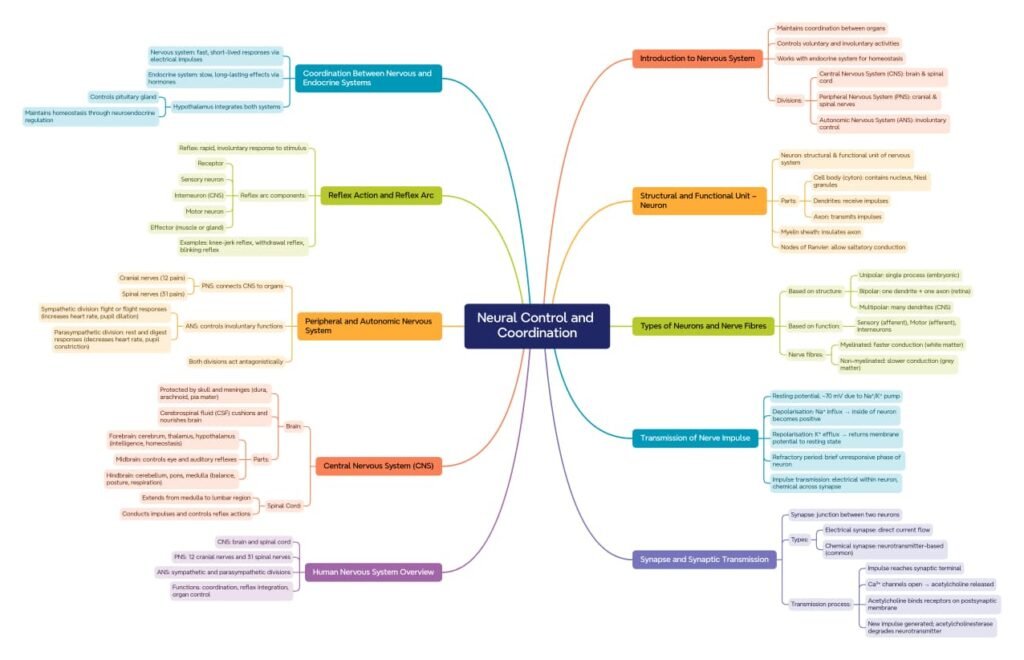
MIND MAPS
————————————————————————————————————————————————————————————————————————————