Class 11 : Biology (In English) – Lesson 10: Cell Cycle and Cell Division

EXPLANATION & SUMMARY
🌿✨ Introduction
🧠 All living organisms grow, repair, and reproduce by cell division.
Each new cell arises from a pre-existing cell (Virchow’s principle: Omnis cellula e cellula).
🌿 The cell cycle is a series of events a cell undergoes from its formation to the next division. It includes growth, DNA replication, and division.
💡 Concept:
Cell cycle = life span of a cell
Cell division = actual splitting to form new cells
Essential for growth, repair, reproduction, and continuity of life
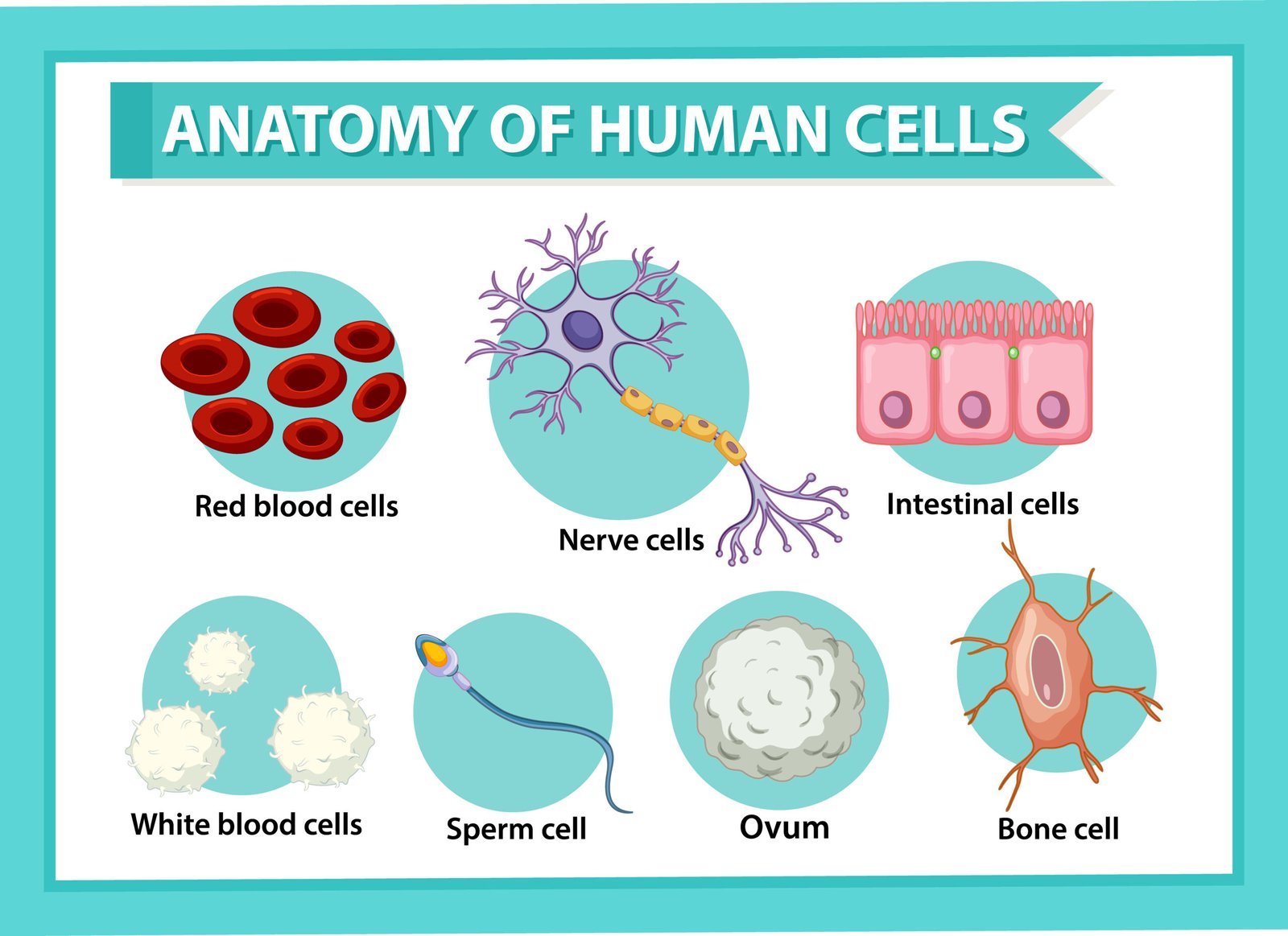
🧭 Phases of the Cell Cycle
🧬 Cell cycle = Interphase + M Phase (Mitotic phase)
🕓 Duration varies by cell type (e.g., human cell ≈ 24 hours)
🌱 1️⃣ Interphase — “Resting Phase” (but metabolically active)
🧠 Represents 95% of cycle; cell prepares for division.
Divided into three sub-phases:
🧪 (a) G₁ Phase (Gap 1)
🌿 Intense metabolic activity
⚙️ Synthesis of RNA, proteins, organelles
🧬 Cell grows; decides to divide or not
🧫 (b) S Phase (Synthesis Phase)
🧬 DNA replication occurs
📈 Chromosomes duplicate
💧 Amount of DNA doubles, chromosome number constant
⚙️ (c) G₂ Phase (Gap 2)
🧪 Synthesis of proteins for division
🧠 Cell checks DNA, prepares for mitosis
🌿 Centriole duplication completes (in animal cells)
✏️ Note: Some cells exit cycle after G₁ → enter G₀ (quiescent stage) — no division (e.g., neurons).
🌸 2️⃣ M Phase (Mitotic Phase)
🧠 Actual cell division: nucleus and cytoplasm divide.
Divided into:
1️⃣ Karyokinesis – division of nucleus
2️⃣ Cytokinesis – division of cytoplasm
💡 Two main types:
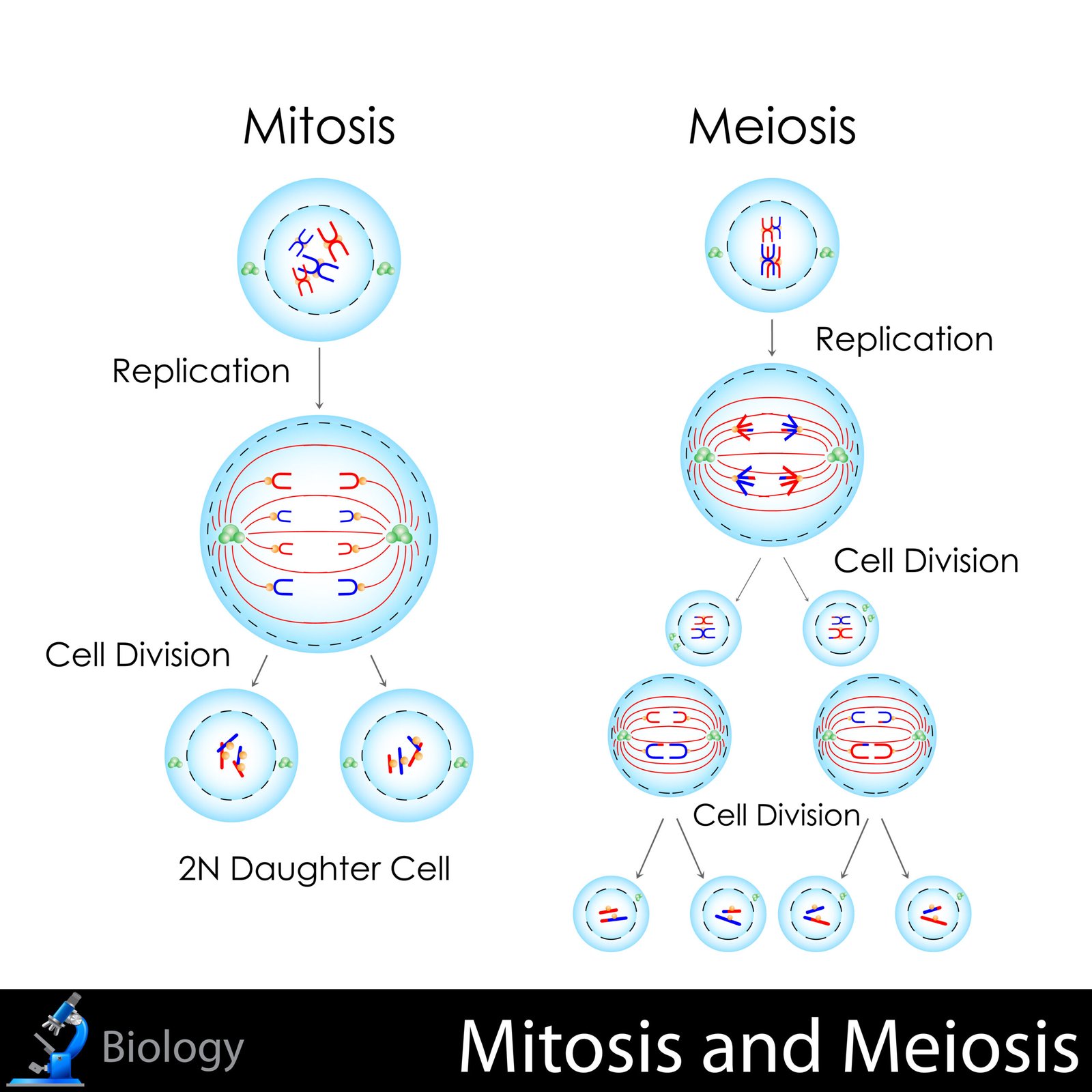
Mitosis – equational, growth
Meiosis – reductional, gamete formation
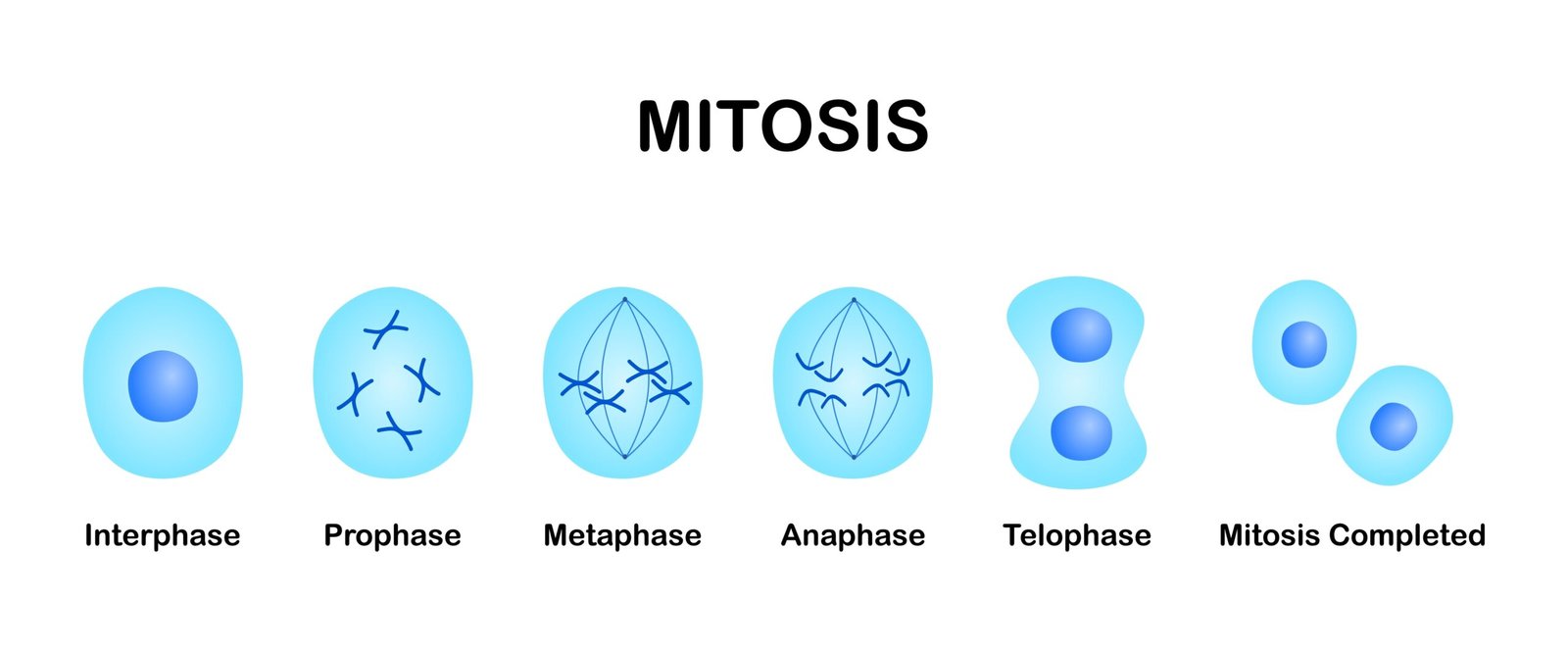
🌿 Mitosis — “Equational Division”
🧠 Occurs in somatic cells; daughter cells identical to parent (same chromosome number).
Ensures growth and repair.
🧪 Phases of Mitosis:
1️⃣ Prophase
🌸 Chromatin → chromosomes (visible)
🧠 Each chromosome = 2 sister chromatids joined at centromere
🧬 Nuclear membrane, nucleolus disappear
⚙️ Spindle fibres form from centrioles (in animals)
2️⃣ Metaphase
🌿 Chromosomes align at equatorial plane
🧪 Spindle attaches to centromeres
💡 Best stage for karyotype study
3️⃣ Anaphase
⚡ Centromeres split; chromatids move to opposite poles
🌾 Each chromatid = new chromosome
4️⃣ Telophase
🌸 Chromosomes uncoil → chromatin
🧠 Nuclear membrane & nucleolus reappear
🌿 Two nuclei formed
🌊 Cytokinesis
💧 Cytoplasm divides → 2 daughter cells
🌿 In animal cells – cleavage furrow
🌱 In plant cells – cell plate formation
💡 Significance of Mitosis:
Growth of organism
Cell replacement & repair
Asexual reproduction
Genetic stability
🌾 Meiosis — “Reductional Division”
🧬 Occurs in germ cells; chromosome number halved (2n → n).
Ensures genetic variation and gamete formation.
Divided into two stages:
1️⃣ Meiosis I – reductional
2️⃣ Meiosis II – equational
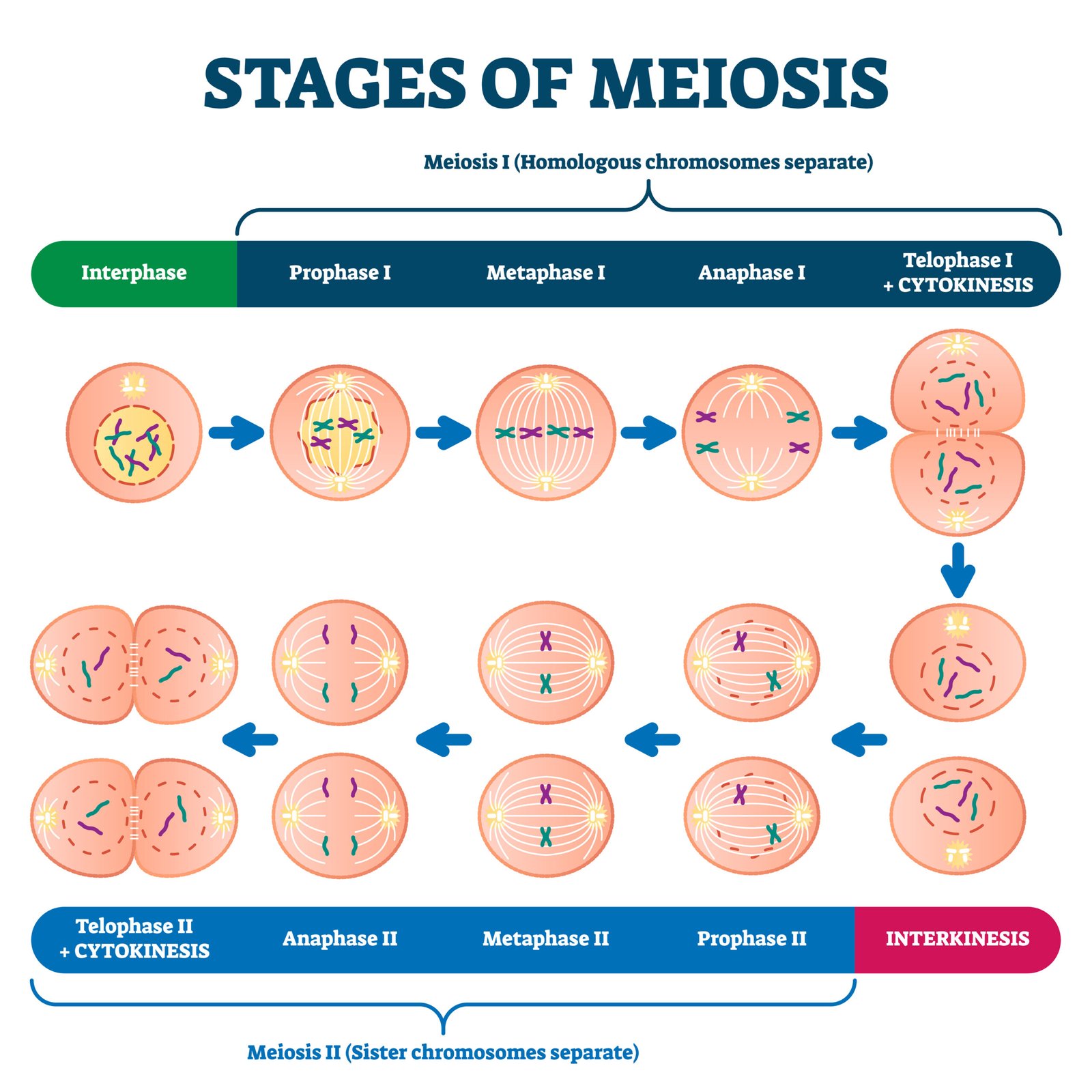
🌿 Meiosis I
🧠 Prophase I — longest, complex
Substages: Leptotene, Zygotene, Pachytene, Diplotene, Diakinesis
🌀 Leptotene – chromosomes condense
🌸 Zygotene – homologous chromosomes pair (synapsis) → bivalents
🧬 Pachytene – crossing over (exchange of genes)
💫 Diplotene – chiasmata visible
⚡ Diakinesis – terminalisation; spindle forms
🧭 Metaphase I
Bivalents align at equator; spindle attaches
⚙️ Anaphase I
Homologous chromosomes separate to opposite poles (chromatids remain joined)
🌾 Telophase I
Nucleus reforms; cytokinesis → 2 haploid cells
🌸 Meiosis II (Like Mitosis)
Prophase II – chromosomes condense again
Metaphase II – chromosomes align
Anaphase II – sister chromatids separate
Telophase II – nuclei reform
🌿 Final result: 4 haploid daughter cells (gametes)
💡 Significance of Meiosis:
Maintains chromosome number across generations
Introduces variation through crossing over
Essential for sexual reproduction
🧬 Control of Cell Cycle
⚙️ Regulated by cyclins and cyclin-dependent kinases (CDKs)
🧠 Checkpoints at G₁, G₂, and M phase ensure accuracy.
✏️ Note: Faulty control → cancer (uncontrolled division)
🧠 Comparison
Feature Mitosis Meiosis
Type Equational Reductional
Divisions One Two
Daughter cells 2 (diploid) 4 (haploid)
Similarity to parent Identical Genetically different
Function Growth, repair Gamete formation
🌍 Why This Lesson Matters
🌱 Explains how organisms grow and reproduce
🧬 Provides foundation for genetics and evolution
🧠 Essential for understanding cancer and fertility
⚡ Important for NEET and board exams
📝 Quick Recap
🧠 Cell cycle = Interphase + M Phase
🌿 Interphase: G₁ (growth), S (DNA replication), G₂ (preparation)
🧬 Mitosis: Prophase, Metaphase, Anaphase, Telophase → 2 identical cells
🌾 Meiosis: 2 divisions → 4 haploid gametes; introduces variation
⚙️ Checkpoints ensure accuracy; errors cause disease
📘 Summary
The cell cycle describes the sequence of events by which a cell grows, duplicates its DNA, and divides.
Interphase prepares the cell; M phase executes division.
Mitosis produces identical cells for growth and repair.
Meiosis halves chromosome number, forming gametes and ensuring variation.
Accurate regulation ensures organismal health; disruptions lead to disorders like cancer.
Understanding cell cycle and division connects molecular control, genetics, and development, forming a key pillar of biology 🌿.
————————————————————————————————————————————————————————————————————————————
QUESTIONS FROM TEXTBOOK
🔵 Question 1. What is the cell cycle?
🟢 Answer:
🧬 The cell cycle is the sequence of events by which a cell grows, prepares for division, and divides to form two daughter cells.
It consists of two main phases:
🌿 Interphase (period of growth)
G₁ phase: Cell growth and metabolism.
S phase: DNA replication.
G₂ phase: Preparation for mitosis.
🌸 M phase (Mitotic phase): Includes nuclear division (karyokinesis) and cytoplasmic division (cytokinesis).
✔️ Result: Formation of two genetically identical daughter cells.
🔵 Question 2. Describe the various phases of the cell cycle.
🟢 Answer:
🧫 Phases of the cell cycle:
G₁ phase (Gap 1):
➡️ Cell grows in size, synthesizes RNA and proteins.
S phase (Synthesis):
➡️ DNA replication takes place; amount of DNA doubles.
G₂ phase (Gap 2):
➡️ Further growth, preparation for division, duplication of organelles.
M phase (Mitotic):
➡️ Division of nucleus and cytoplasm → two daughter cells.
💡 Duration: Interphase occupies about 95% of total cycle time.
🔵 Question 3. Describe the events taking place during interphase.
🟢 Answer:
🌿 Interphase is the metabolically active phase between two successive cell divisions.
➡️ G₁ phase:
Cell grows
Synthesis of proteins and RNA
Cell decides to divide or not
➡️ S phase:
DNA replication occurs
Centrosome duplication
➡️ G₂ phase:
Cell prepares for mitosis
Synthesis of tubulin and mitotic proteins
✔️ Interphase ensures cell is ready for division.
🔵 Question 4. What is G₀ (quiescent phase)?
🟢 Answer:
🧠 Some cells exit the cell cycle after G₁ and enter a resting stage called G₀ phase.
💡 Features:
Cells are metabolically active but do not divide.
Remain in this phase for variable periods.
Seen in nerve cells and heart muscle cells.
✔️ Important for differentiation and maintenance.
🔵 Question 5. Why is mitosis called equational division?
🟢 Answer:
🧬 Mitosis produces two daughter cells with chromosome number identical to the parent cell.
➡️ DNA replicates once, and nucleus divides once.
➡️ Each daughter cell receives equal and identical set of chromosomes.
✔️ Hence, called equational division.
💡 Occurs in somatic cells for growth and repair.
🔵 Question 6. Name the stage of the cell cycle at which one of the following events occurs:
(a) Chromosomes are moved to spindle equator
(b) Centromere splits and chromatids separate
(c) Pairing between homologous chromosomes takes place
(d) Crossing over between homologous chromosomes takes place
🟢 Answer:
(a) 🌸 Metaphase — chromosomes align on equator
(b) 🌿 Anaphase — centromeres split, chromatids move apart
(c) 🧬 Zygotene (prophase I of meiosis) — homologous pairing (synapsis)
(d) ⚗️ Pachytene (prophase I of meiosis) — crossing over occurs
🔵 Question 7. Describe the following:
(a) Metaphase (b) Anaphase (c) Telophase
🟢 Answer:
(a) 🌸 Metaphase:
Chromosomes align on equatorial plate.
Spindle fibres attach to centromeres.
(b) 🌿 Anaphase:
Centromeres divide.
Sister chromatids move to opposite poles.
(c) 🧫 Telophase:
Chromatids reach poles, decondense into chromatin.
Nuclear envelope reforms; nucleolus reappears.
Cytokinesis begins.
✔️ Marks end of karyokinesis.
🔵 Question 8. Describe the significance of mitosis.
🟢 Answer:
🧬 Significance of mitosis:
🌱 Growth of multicellular organisms.
🧠 Maintenance and repair of tissues.
🌸 Asexual reproduction (in unicellular organisms).
⚖️ Genetic stability — identical daughter cells.
🧫 Cell replacement (e.g. skin cells, blood cells).
✔️ Maintains chromosome number constant.
🔵 Question 9. What are the main differences between mitosis and meiosis?
🟢 Answer:
Feature Mitosis Meiosis
Division One division Two divisions
Daughter cells Two Four
Chromosome number Same as parent Half of parent
Occurs in Somatic cells Reproductive cells
Crossing over Absent Present
Genetic composition Identical Different
✔️ Mitosis: Growth Meiosis: Gamete formation.
🔵 Question 10. What is meiosis? What are the stages of meiosis I?
🟢 Answer:
🧠 Meiosis is a type of cell division producing four haploid cells from one diploid cell.
➡️ Occurs in germ cells to form gametes.
➡️ Reduces chromosome number by half.
🌿 Meiosis I (Reductional division):
Prophase I: Longest phase, subdivided into:
Leptotene: Chromosomes condense.
Zygotene: Homologous chromosomes pair (synapsis).
Pachytene: Crossing over occurs.
Diplotene: Chiasmata visible.
Diakinesis: Terminalisation, spindle formation.
Metaphase I: Homologous pairs align on equator.
Anaphase I: Homologous chromosomes move to poles.
Telophase I: Nuclear membrane reforms, cytokinesis follows.
✔️ Result: Two haploid cells with half chromosome number.
🔵 Question 11. What is the significance of meiosis?
🟢 Answer:
🧬 Significance:
🌸 Formation of gametes (sperms and eggs).
⚖️ Maintains chromosome number constant across generations.
🌿 Genetic variation due to crossing over and independent assortment.
🧠 Basis of evolution and heredity.
✔️ Essential for sexual reproduction.
🔵 Question 12. Differentiate between cytokinesis in plant and animal cells.
🟢 Answer:
Feature Plant Cell Animal Cell
Method Formation of cell plate Formation of cleavage furrow
Location At centre At periphery
Involvement Golgi vesicles form plate Microfilaments constrict
Result New cell wall forms Two daughter cells formed
✔️ Both ensure division of cytoplasm equally.
————————————————————————————————————————————————————————————————————————————
OTHER IMPORTANT QUESTIONS FOR EXAMS
(CBSE MODEL QUESTIONS PAPER)
ESPECIALLY MADE FROM THIS LESSON ONLY
🔴 Question 1:
The sequence of events by which a cell duplicates its genome and divides is called:
🔴1️⃣ Cytokinesis
🟢2️⃣ Cell Cycle
🟡3️⃣ Karyokinesis
🔵4️⃣ Mitosis
🟢 Answer: 2️⃣ Cell Cycle
🔴 Question 2:
Which is the longest phase of the cell cycle?
🔴1️⃣ G₁ phase
🟢2️⃣ S phase
🟡3️⃣ G₂ phase
🔵4️⃣ M phase
🟢 Answer: 1️⃣ G₁ phase
🔴 Question 3:
During which phase does DNA replication occur?
🔴1️⃣ G₁ phase
🟢2️⃣ S phase
🟡3️⃣ G₂ phase
🔵4️⃣ M phase
🟢 Answer: 2️⃣ S phase
🔴 Question 4:
Karyokinesis refers to division of:
🔴1️⃣ Cytoplasm
🟢2️⃣ Nucleus
🟡3️⃣ Organelles
🔵4️⃣ Cell membrane
🟢 Answer: 2️⃣ Nucleus
🔴 Question 5:
Cytokinesis refers to division of:
🔴1️⃣ Nucleus
🟢2️⃣ Cytoplasm
🟡3️⃣ Chromosomes
🔵4️⃣ DNA
🟢 Answer: 2️⃣ Cytoplasm
🔴 Question 6:
Which phase is called the resting phase?
🔴1️⃣ G₀ phase
🟢2️⃣ G₁ phase
🟡3️⃣ G₂ phase
🔵4️⃣ S phase
🟢 Answer: 1️⃣ G₀ phase
🔴 Question 7:
In which phase of mitosis do chromosomes align on equator?
🔴1️⃣ Prophase
🟢2️⃣ Metaphase
🟡3️⃣ Anaphase
🔵4️⃣ Telophase
🟢 Answer: 2️⃣ Metaphase
🔴 Question 8:
During which phase do sister chromatids separate?
🔴1️⃣ Prophase
🟢2️⃣ Metaphase
🟡3️⃣ Anaphase
🔵4️⃣ Telophase
🟢 Answer: 3️⃣ Anaphase
🔴 Question 9:
In which phase do nuclear envelope and nucleolus reappear?
🔴1️⃣ Prophase
🟢2️⃣ Metaphase
🟡3️⃣ Anaphase
🔵4️⃣ Telophase
🟢 Answer: 4️⃣ Telophase
🔴 Question 10:
The number of chromosomes in daughter cells after mitosis is:
🔴1️⃣ Half of parent cell
🟢2️⃣ Double of parent cell
🟡3️⃣ Same as parent cell
🔵4️⃣ Variable
🟢 Answer: 3️⃣ Same as parent cell
🔴 Question 11:
Name the two main phases of cell cycle.
🟢 Answer:
1️⃣ Interphase – Period of growth and DNA replication.
2️⃣ M phase (Mitotic phase) – Period of division (karyokinesis + cytokinesis).
🔴 Question 12:
Define mitosis.
🟢 Answer:
Mitosis is an equational division in which one parent cell divides into two identical daughter cells with same chromosome number as parent cell.
🔴 Question 13:
What are the main phases of the cell cycle? Describe each briefly.
🟢 Answer:
The cell cycle has two main phases:
1️⃣ Interphase:
• Period of growth and preparation for division.
• Sub-phases:
🔹 G₁ phase: Cell grows, proteins and organelles synthesized.
🔹 S phase: DNA replication occurs; chromosome number constant.
🔹 G₂ phase: Final preparation, enzymes and energy produced.
2️⃣ M phase (Mitotic phase):
• Includes karyokinesis (nuclear division) and cytokinesis (cytoplasmic division).
💡 Result: Two genetically identical daughter cells.
🔴 Question 14:
Differentiate between G₁, S, and G₂ phases of interphase.
🟢 Answer:
Phase Events
G₁ phase Cell grows in size, RNA and proteins synthesized, organelles duplicated.
S phase DNA replication, each chromosome forms sister chromatids.
G₂ phase Preparation for mitosis, synthesis of mitotic proteins, spindle formation.
💡 Interphase = G₁ + S + G₂
🔴 Question 15:
Describe the stages of mitosis.
🟢 Answer:
1️⃣ Prophase:
• Chromatin condenses into chromosomes.
• Nuclear envelope and nucleolus disappear.
• Spindle fibres form.
2️⃣ Metaphase:
• Chromosomes align on equatorial plate.
• Spindle attaches to centromere.
3️⃣ Anaphase:
• Centromeres split.
• Sister chromatids move to opposite poles.
4️⃣ Telophase:
• Chromatids uncoil to chromatin.
• Nuclear envelope and nucleolus reappear.
💡 Followed by cytokinesis → two identical cells.
🔴 Question 16:
Define cytokinesis. Explain cytokinesis in plant and animal cells.
🟢 Answer:
Definition: Division of cytoplasm after karyokinesis.
In animal cells 🧫:
• Occurs by cleavage furrow formation from periphery to center.
In plant cells 🌿:
• Cell plate forms in center by fusion of Golgi vesicles, later becomes cell wall.
💡 Both produce two daughter cells with equal cytoplasm.
🔴 Question 17:
Write any three significance of mitosis.
🟢 Answer:
1️⃣ Maintains chromosome number constant.
2️⃣ Produces genetically identical cells.
3️⃣ Helps in growth, repair, and regeneration.
4️⃣ Maintains nucleus-cytoplasm ratio.
5️⃣ Basis of asexual reproduction.
🔴 Question 18:
What is meiosis? How is it different from mitosis?
🟢 Answer:
Definition: Division that reduces chromosome number by half, forming haploid cells.
Feature Mitosis Meiosis
Division One Two (I & II)
Chromosome number Same as parent Half of parent
Genetic composition Identical Different
Occurs in Somatic cells Germ cells
💡 Result: Four haploid cells.
🔴 Question 19:
What is synapsis? In which phase does it occur?
🟢 Answer:
Definition: Pairing of homologous chromosomes during meiosis.
Occurs in: Zygotene stage of Prophase I.
Feature:
• Homologous chromosomes form bivalents.
• Prepares for crossing over.
🔴 Question 20:
Explain crossing over and its significance.
🟢 Answer:
Definition: Exchange of genetic material between non-sister chromatids of homologous chromosomes.
Occurs in: Pachytene of Prophase I.
Significance:
1️⃣ Creates genetic variation.
2️⃣ Helps in evolution.
3️⃣ Maintains chromosomal integrity.
🔴 Question 21:
Name and describe the stages of Prophase I of meiosis.
🟢 Answer:
1️⃣ Leptotene: Chromosomes become visible.
2️⃣ Zygotene: Synapsis and bivalent formation.
3️⃣ Pachytene: Crossing over occurs.
4️⃣ Diplotene: Chiasmata appear.
5️⃣ Diakinesis: Terminalisation of chiasmata, spindle formation.
💡 Longest and most complex phase.
🔴 Question 22:
Differentiate between Meiosis I and Meiosis II.
🟢 Answer:
Feature Meiosis I Meiosis II
Type Reductional Equational
Chromosome number Reduced to half Remains same
Crossing over Occurs Absent
Homologous chromosomes Separate Sister chromatids separate
💡 End result: 4 haploid cells.
🔴 Question 23:
Explain the phases of mitosis in detail with labelled diagram description.
🟢 Answer:
Mitosis is an equational division producing two identical daughter cells. It includes:
1️⃣ Prophase:
• Chromatin condenses into visible chromosomes.
• Each chromosome has two sister chromatids joined at a centromere.
• Nuclear envelope and nucleolus disappear.
• Spindle fibres form from centrioles.
2️⃣ Metaphase:
• Chromosomes align on equatorial plate.
• Spindle fibres attach to centromeres.
3️⃣ Anaphase:
• Centromeres divide, sister chromatids separate.
• Move to opposite poles pulled by spindle fibres.
4️⃣ Telophase:
• Chromatids uncoil to form chromatin.
• Nuclear membrane and nucleolus reappear.
• Spindle fibres disappear.
5️⃣ Cytokinesis:
• Division of cytoplasm — cleavage furrow in animals 🧫; cell plate in plants 🌿.
💡 Result: Two diploid daughter cells identical to parent.
🔴 Question 24:
Describe the stages of meiosis I.
🟢 Answer:
1️⃣ Prophase I — Longest phase, subdivided into:
• Leptotene: Chromosomes condense.
• Zygotene: Synapsis → bivalent formation.
• Pachytene: Crossing over between non-sister chromatids.
• Diplotene: Chiasmata visible.
• Diakinesis: Terminalisation, spindle formed.
2️⃣ Metaphase I: Bivalents align on equator; spindle attaches to centromeres.
3️⃣ Anaphase I: Homologous chromosomes move to opposite poles; reduction in chromosome number.
4️⃣ Telophase I: Nuclear membrane reforms; cytokinesis → two haploid cells.
💡 Result: Two haploid daughter cells, chromosomes still duplicated.
🔴 Question 25:
Explain the stages of meiosis II.
🟢 Answer:
Similar to mitosis but starts with haploid cells:
1️⃣ Prophase II:
• Chromosomes condense, spindle forms, nuclear envelope disappears.
2️⃣ Metaphase II:
• Chromosomes align on equator.
3️⃣ Anaphase II:
• Centromeres split; sister chromatids separate and move to opposite poles.
4️⃣ Telophase II:
• Nuclear membrane reappears; cytokinesis occurs.
💡 Result: 4 haploid daughter cells genetically different.
🔴 Question 26:
Discuss the significance of mitosis and meiosis.
🟢 Answer:
Mitosis:
1️⃣ Maintains chromosome number.
2️⃣ Produces genetically identical cells.
3️⃣ Helps in growth, repair, regeneration.
4️⃣ Basis of asexual reproduction.
Meiosis:
1️⃣ Produces haploid gametes.
2️⃣ Introduces genetic variation via crossing over.
3️⃣ Maintains chromosome number across generations.
4️⃣ Essential for sexual reproduction.
🔴 Question 27:
Explain cell cycle checkpoints and their importance.
🟢 Answer:
Cell cycle checkpoints regulate orderly progression:
1️⃣ G₁ Checkpoint:
• Checks cell size, nutrients, DNA damage before S phase.
2️⃣ G₂ Checkpoint:
• Ensures complete DNA replication and repair before mitosis.
3️⃣ M Checkpoint:
• Verifies spindle attachment before anaphase.
💡 Importance: Prevents mutations, maintains genetic stability, controls uncontrolled cell division (cancer).
🔴 Question 28:
Describe Prophase I of meiosis in detail.
🟢 Answer:
Prophase I subdivided into five stages:
1️⃣ Leptotene: Chromosomes become visible.
2️⃣ Zygotene: Synapsis of homologous chromosomes → bivalents.
3️⃣ Pachytene: Crossing over at chiasmata.
4️⃣ Diplotene: Homologous chromosomes separate except at chiasmata.
5️⃣ Diakinesis: Terminalisation of chiasmata; spindle formed.
💡 Significance: Crossing over ensures genetic variation.
🔴 Question 29:
What is crossing over? Explain its steps and significance.
🟢 Answer:
Definition: Exchange of genetic material between non-sister chromatids of homologous chromosomes.
Occurs in: Pachytene of Prophase I.
Steps:
1️⃣ Synapsis → Bivalent formation.
2️⃣ Chiasma formation.
3️⃣ Exchange of DNA segments.
4️⃣ Recombination of genes.
Significance:
✔️ Genetic recombination.
✔️ Variation in offspring.
✔️ Evolutionary adaptation.
🔴 Question 30:
Compare mitosis and meiosis in tabular form.
🟢 Answer:
Feature Mitosis Meiosis
Number of divisions One Two
Chromosome number Maintained (2n → 2n) Halved (2n → n)
Daughter cells 2 4
Genetic composition Identical Different
Crossing over Absent Present
Occurs in Somatic cells Germ cells
Function Growth, repair Gamete formation
————————————————————————————————————————————————————————————————————————————
NEET QUESTIONS FROM THIS LESSON
🔵 Q1. The interphase stage of the cell cycle includes
🟡 A. G₁, S, G₂ phases
🟡 B. Prophase, Metaphase, Anaphase
🟡 C. Cytokinesis and Karyokinesis
🟡 D. G₀ and G₁ phases only
🟢 Answer: A. G₁, S, G₂ phases
📅 NEET 2019
🔵 Q2. DNA replication occurs during
🟡 A. G₁ phase
🟡 B. S phase
🟡 C. G₂ phase
🟡 D. M phase
🟢 Answer: B. S phase
📅 AIPMT 2013
🔵 Q3. Spindle fibres attach to chromosomes at
🟡 A. Centromere
🟡 B. Kinetochore
🟡 C. Centrosome
🟡 D. Chromatid arms
🟢 Answer: B. Kinetochore
📅 NEET 2020
🔵 Q4. The resting phase of a cell that is not dividing is
🟡 A. G₀ phase
🟡 B. G₁ phase
🟡 C. G₂ phase
🟡 D. S phase
🟢 Answer: A. G₀ phase
📅 AIPMT 2015
🔵 Q5. The synaptonemal complex is observed in
🟡 A. Leptotene
🟡 B. Pachytene
🟡 C. Zygotene
🟡 D. Diplotene
🟢 Answer: B. Pachytene
📅 NEET 2018
🔵 Q6. Crossing over occurs during
🟡 A. Prophase I of meiosis
🟡 B. Metaphase II of meiosis
🟡 C. Anaphase I of meiosis
🟡 D. Telophase I of meiosis
🟢 Answer: A. Prophase I of meiosis
📅 AIPMT 2011
🔵 Q7. Chromosomes arrange themselves on the equator in
🟡 A. Prophase
🟡 B. Metaphase
🟡 C. Anaphase
🟡 D. Telophase
🟢 Answer: B. Metaphase
📅 NEET 2017
🔵 Q8. Cytokinesis in plant cells occurs by
🟡 A. Cleavage furrow
🟡 B. Cell plate formation
🟡 C. Budding
🟡 D. Binary fission
🟢 Answer: B. Cell plate formation
📅 AIPMT 2010
🔵 Q9. The stage where homologous chromosomes separate is
🟡 A. Metaphase I
🟡 B. Anaphase I
🟡 C. Anaphase II
🟡 D. Telophase I
🟢 Answer: B. Anaphase I
📅 NEET 2016
🔵 Q10. Chiasmata are first visible during
🟡 A. Leptotene
🟡 B. Pachytene
🟡 C. Diplotene
🟡 D. Diakinesis
🟢 Answer: C. Diplotene
📅 AIPMT 2014
🔵 Q11. G₂ phase is characterized by
🟡 A. DNA synthesis
🟡 B. Organelle duplication and preparation for mitosis
🟡 C. Chromosome condensation
🟡 D. Nuclear envelope breakdown
🟢 Answer: B. Organelle duplication and preparation for mitosis
📅 NEET 2015
🔵 Q12. Synapsis occurs during
🟡 A. Leptotene
🟡 B. Zygotene
🟡 C. Pachytene
🟡 D. Diplotene
🟢 Answer: B. Zygotene
📅 AIPMT 2012
🔵 Q13. The number of chromosomes is reduced to half during
🟡 A. Mitosis
🟡 B. Meiosis I
🟡 C. Meiosis II
🟡 D. Cytokinesis
🟢 Answer: B. Meiosis I
📅 NEET 2014
🔵 Q14. Karyokinesis is the division of
🟡 A. Cytoplasm
🟡 B. Nucleus
🟡 C. Mitochondria
🟡 D. Chromatids only
🟢 Answer: B. Nucleus
📅 AIPMT 2013
🔵 Q15. The spindle apparatus begins to form in
🟡 A. G₁ phase
🟡 B. Prophase
🟡 C. Metaphase
🟡 D. Telophase
🟢 Answer: B. Prophase
📅 NEET 2018
🔵 Q16. Bivalent formation is a characteristic of
🟡 A. Mitosis
🟡 B. Meiosis I
🟡 C. Meiosis II
🟡 D. Cytokinesis
🟢 Answer: B. Meiosis I
📅 AIPMT 2015
🔵 Q17. The centrioles move to opposite poles during
🟡 A. Prophase
🟡 B. Metaphase
🟡 C. Anaphase
🟡 D. Telophase
🟢 Answer: A. Prophase
📅 NEET 2017
🔵 Q18. The phase of the cell cycle where DNA content doubles is
🟡 A. G₁ phase
🟡 B. S phase
🟡 C. G₂ phase
🟡 D. M phase
🟢 Answer: B. S phase
📅 AIPMT 2011
🔵 Q19. The stage of meiosis where terminalization of chiasmata occurs is
🟡 A. Diakinesis
🟡 B. Zygotene
🟡 C. Pachytene
🟡 D. Leptotene
🟢 Answer: A. Diakinesis
📅 NEET 2020
🔵 Q20. Cytokinesis in animal cells occurs by
🟡 A. Cell plate formation
🟡 B. Cleavage furrow
🟡 C. Budding
🟡 D. Binary fission
🟢 Answer: B. Cleavage furrow
📅 AIPMT 2012
🔵 Q21. The longest phase of the cell cycle is
🟡 A. M phase
🟡 B. G₁ phase
🟡 C. S phase
🟡 D. Interphase
🟢 Answer: D. Interphase
📅 NEET 2015
🔵 Q22. Reduction division is also known as
🟡 A. Mitosis
🟡 B. Meiosis I
🟡 C. Meiosis II
🟡 D. Cytokinesis
🟢 Answer: B. Meiosis I
📅 AIPMT 2014
🔵 Q23. The nuclear envelope reappears during
🟡 A. Metaphase
🟡 B. Prophase
🟡 C. Anaphase
🟡 D. Telophase
🟢 Answer: D. Telophase
📅 NEET 2016
🔵 Q24. Synaptonemal complex is made up of
🟡 A. DNA only
🟡 B. Protein
🟡 C. RNA
🟡 D. Lipids
🟢 Answer: B. Protein
📅 AIPMT 2013
🔵 Q25. The G₀ phase is
🟡 A. A permanent arrest of cell cycle
🟡 B. A phase of DNA synthesis
🟡 C. The mitotic phase
🟡 D. The cytokinetic phase
🟢 Answer: A. A permanent arrest of cell cycle
📅 NEET 2019
🔵 Q26. The stage of mitosis where sister chromatids separate is
🟡 A. Prophase
🟡 B. Metaphase
🟡 C. Anaphase
🟡 D. Telophase
🟢 Answer: C. Anaphase
📅 NEET 2018
🔵 Q27. Cytokinesis is absent after nuclear division in some fungi and algae, resulting in
🟡 A. Coenocytic cells
🟡 B. Polyploid cells
🟡 C. Haploid cells
🟡 D. Uninucleate cells
🟢 Answer: A. Coenocytic cells
📅 AIPMT 2014
🔵 Q28. The centromeres split and chromatids separate in
🟡 A. Anaphase of mitosis and Anaphase II of meiosis
🟡 B. Metaphase I of meiosis
🟡 C. Prophase I of meiosis
🟡 D. Telophase I of meiosis
🟢 Answer: A. Anaphase of mitosis and Anaphase II of meiosis
📅 NEET 2020
🔵 Q29. Crossing over leads to
🟡 A. Mutation
🟡 B. Recombination of genes
🟡 C. Formation of chiasmata only
🟡 D. Gene deletion
🟢 Answer: B. Recombination of genes
📅 AIPMT 2015
🔵 Q30. The equational division is
🟡 A. Meiosis I
🟡 B. Mitosis
🟡 C. Meiosis II
🟡 D. Both B and C
🟢 Answer: D. Both B and C
📅 NEET 2017
🔵 Q31. In mitosis, the number of chromosomes in daughter cells is
🟡 A. Halved
🟡 B. Doubled
🟡 C. Same as parent cell
🟡 D. Variable
🟢 Answer: C. Same as parent cell
📅 AIPMT 2012
🔵 Q32. The protein complex that holds sister chromatids together is
🟡 A. Separase
🟡 B. Cohesin
🟡 C. Condensin
🟡 D. Kinetochore
🟢 Answer: B. Cohesin
📅 NEET 2019
🔵 Q33. Synapsis is
🟡 A. Pairing of homologous chromosomes
🟡 B. Separation of chromatids
🟡 C. Cytoplasmic division
🟡 D. Spindle formation
🟢 Answer: A. Pairing of homologous chromosomes
📅 AIPMT 2013
🔵 Q34. The stage in which spindle fibres disappear and chromosomes decondense is
🟡 A. Metaphase
🟡 B. Prophase
🟡 C. Anaphase
🟡 D. Telophase
🟢 Answer: D. Telophase
📅 NEET 2016
🔵 Q35. Kinetochore is a
🟡 A. DNA sequence at telomere
🟡 B. Protein structure on centromere
🟡 C. Microtubule organizing centre
🟡 D. Chromatid arm
🟢 Answer: B. Protein structure on centromere
📅 AIPMT 2014
🔵 Q36. The mitotic spindle is formed by
🟡 A. Microtubules
🟡 B. Microfilaments
🟡 C. Intermediate filaments
🟡 D. Actin filaments
🟢 Answer: A. Microtubules
📅 NEET 2015
🔵 Q37. The stage of meiosis responsible for genetic variation is
🟡 A. Prophase I
🟡 B. Anaphase II
🟡 C. Telophase I
🟡 D. Metaphase II
🟢 Answer: A. Prophase I
📅 AIPMT 2011
🔵 Q38. Cytokinesis that leads to multinucleate condition is termed
🟡 A. Binary fission
🟡 B. Syncytium formation
🟡 C. Karyokinesis
🟡 D. Endomitosis
🟢 Answer: B. Syncytium formation
📅 NEET 2018
🔵 Q39. The chromosome number is reduced to half in
🟡 A. Anaphase of mitosis
🟡 B. Anaphase I of meiosis
🟡 C. Anaphase II of meiosis
🟡 D. Telophase II of meiosis
🟢 Answer: B. Anaphase I of meiosis
📅 AIPMT 2010
🔵 Q40. Terminalization of chiasmata occurs in
🟡 A. Diplotene
🟡 B. Diakinesis
🟡 C. Pachytene
🟡 D. Zygotene
🟢 Answer: B. Diakinesis
📅 NEET 2014
🔵 Q41. Cytokinesis in animal cells is achieved by
🟡 A. Formation of cell plate
🟡 B. Cleavage furrow formation
🟡 C. Constriction of spindle
🟡 D. Invagination of nuclear membrane
🟢 Answer: B. Cleavage furrow formation
📅 AIPMT 2012
🔵 Q42. The first step of mitosis is
🟡 A. Prophase
🟡 B. Metaphase
🟡 C. Anaphase
🟡 D. Telophase
🟢 Answer: A. Prophase
📅 NEET 2015
🔵 Q43. Bivalents are formed in
🟡 A. Metaphase I
🟡 B. Prophase I
🟡 C. Telophase II
🟡 D. Metaphase II
🟢 Answer: B. Prophase I
📅 AIPMT 2013
🔵 Q44. Spindle fibres are made of
🟡 A. Tubulin
🟡 B. Actin
🟡 C. Myosin
🟡 D. Keratin
🟢 Answer: A. Tubulin
📅 NEET 2016
🔵 Q45. The stage where nucleolus disappears is
🟡 A. Prophase
🟡 B. Metaphase
🟡 C. Anaphase
🟡 D. Telophase
🟢 Answer: A. Prophase
📅 AIPMT 2014
🔵 Q46. Equational division in meiosis is
🟡 A. Meiosis I
🟡 B. Meiosis II
🟡 C. Prophase I
🟡 D. Telophase II
🟢 Answer: B. Meiosis II
📅 NEET 2017
🔵 Q47. Crossing over occurs between
🟡 A. Non-homologous chromosomes
🟡 B. Sister chromatids
🟡 C. Homologous chromosomes
🟡 D. Centromeres
🟢 Answer: C. Homologous chromosomes
📅 AIPMT 2015
🔵 Q48. The main significance of mitosis is
🟡 A. Reduction of chromosome number
🟡 B. Genetic variation
🟡 C. Growth and repair
🟡 D. Formation of gametes
🟢 Answer: C. Growth and repair
📅 NEET 2018
🔵 Q49. The duration of the cell cycle is shortest in
🟡 A. Embryonic cells
🟡 B. Adult nerve cells
🟡 C. Muscle cells
🟡 D. Liver cells
🟢 Answer: A. Embryonic cells
📅 AIPMT 2013
🔵 Q50. The exchange of genetic material between homologous chromosomes is called
🟡 A. Terminalization
🟡 B. Chiasma formation
🟡 C. Crossing over
🟡 D. Synapsis
🟢 Answer: C. Crossing over
📅 NEET 2019
————————————————————————————————————————————————————————————————————————————
PRACTICE SETS FROM THIS LESSON
🔵 Question 1:
Cell cycle is the period between:
🔴 1️⃣ Two prophase stages
🟢 2️⃣ Two successive cell divisions
🟡 3️⃣ Two G₁ phases
🔵 4️⃣ Two telophase stages
✔️ Answer: 2️⃣ Two successive cell divisions
🔵 Question 2:
Interphase is also called:
🔴 1️⃣ Resting phase
🟢 2️⃣ Growth phase
🟡 3️⃣ Division phase
🔵 4️⃣ Chromosome phase
✔️ Answer: 2️⃣ Growth phase
🔵 Question 3:
Which phase of interphase shows DNA replication?
🔴 1️⃣ G₁
🟢 2️⃣ S
🟡 3️⃣ G₂
🔵 4️⃣ M
✔️ Answer: 2️⃣ S
🔵 Question 4:
G₁ phase is characterized by:
🔴 1️⃣ DNA replication
🟢 2️⃣ RNA and protein synthesis
🟡 3️⃣ Chromosome formation
🔵 4️⃣ Cytokinesis
✔️ Answer: 2️⃣ RNA and protein synthesis
🔵 Question 5:
G₂ phase is followed by:
🔴 1️⃣ G₁ phase
🟢 2️⃣ S phase
🟡 3️⃣ M phase
🔵 4️⃣ Cytokinesis
✔️ Answer: 3️⃣ M phase
🔵 Question 6:
Which phase is called mitotic phase?
🔴 1️⃣ G₁
🟢 2️⃣ G₂
🟡 3️⃣ M
🔵 4️⃣ S
✔️ Answer: 3️⃣ M
🔵 Question 7:
In which stage chromosomes become visible?
🔴 1️⃣ Prophase
🟢 2️⃣ Metaphase
🟡 3️⃣ Anaphase
🔵 4️⃣ Telophase
✔️ Answer: 1️⃣ Prophase
🔵 Question 8:
The alignment of chromosomes at equator occurs in:
🔴 1️⃣ Prophase
🟢 2️⃣ Metaphase
🟡 3️⃣ Anaphase
🔵 4️⃣ Telophase
✔️ Answer: 2️⃣ Metaphase
🔵 Question 9:
Chromatids move towards opposite poles in:
🔴 1️⃣ Prophase
🟢 2️⃣ Metaphase
🟡 3️⃣ Anaphase
🔵 4️⃣ Telophase
✔️ Answer: 3️⃣ Anaphase
🔵 Question 10:
Reformation of nuclear envelope occurs in:
🔴 1️⃣ Prophase
🟢 2️⃣ Metaphase
🟡 3️⃣ Anaphase
🔵 4️⃣ Telophase
✔️ Answer: 4️⃣ Telophase
🔵 Question 11:
Cytokinesis refers to:
🔴 1️⃣ Division of nucleus
🟢 2️⃣ Division of cytoplasm
🟡 3️⃣ DNA replication
🔵 4️⃣ Chromosome alignment
✔️ Answer: 2️⃣ Division of cytoplasm
🔵 Question 12:
In animal cells, cytokinesis occurs by:
🔴 1️⃣ Cell plate formation
🟢 2️⃣ Cleavage furrow
🟡 3️⃣ Constriction ring
🔵 4️⃣ Binary fission
✔️ Answer: 2️⃣ Cleavage furrow
🔵 Question 13:
In plant cells, cytokinesis occurs by:
🔴 1️⃣ Cleavage
🟢 2️⃣ Cell plate formation
🟡 3️⃣ Furrow method
🔵 4️⃣ Constriction
✔️ Answer: 2️⃣ Cell plate formation
🔵 Question 14:
In which phase does crossing over occur?
🔴 1️⃣ Zygotene
🟢 2️⃣ Pachytene
🟡 3️⃣ Diplotene
🔵 4️⃣ Diakinesis
✔️ Answer: 2️⃣ Pachytene
🔵 Question 15:
Synapsis occurs in:
🔴 1️⃣ Leptotene
🟢 2️⃣ Zygotene
🟡 3️⃣ Pachytene
🔵 4️⃣ Diplotene
✔️ Answer: 2️⃣ Zygotene
🔵 Question 16:
Chiasmata appear in:
🔴 1️⃣ Pachytene
🟢 2️⃣ Diplotene
🟡 3️⃣ Zygotene
🔵 4️⃣ Diakinesis
✔️ Answer: 2️⃣ Diplotene
🔵 Question 17:
Meiosis I is also called:
🔴 1️⃣ Reductional division
🟢 2️⃣ Equational division
🟡 3️⃣ Amitosis
🔵 4️⃣ Binary fission
✔️ Answer: 1️⃣ Reductional division
🔵 Question 18:
Meiosis II is also called:
🔴 1️⃣ Reductional division
🟢 2️⃣ Equational division
🟡 3️⃣ Amitosis
🔵 4️⃣ Cleavage
✔️ Answer: 2️⃣ Equational division
🔵 Question 19:
Which phase ensures equal distribution of chromosomes?
🔴 1️⃣ Prophase
🟢 2️⃣ Anaphase
🟡 3️⃣ Metaphase
🔵 4️⃣ Telophase
✔️ Answer: 2️⃣ Anaphase
🔵 Question 20:
In human beings, meiosis occurs in:
🔴 1️⃣ Somatic cells
🟢 2️⃣ Germ cells
🟡 3️⃣ Liver cells
🔵 4️⃣ Bone cells
✔️ Answer: 2️⃣ Germ cells
🔵 Question 21:
How many daughter cells are formed from one meiotic division?
🔴 1️⃣ 1
🟢 2️⃣ 2
🟡 3️⃣ 3
🔵 4️⃣ 4
✔️ Answer: 4️⃣ 4
🔵 Question 22:
Cell plate formation is guided by:
🔴 1️⃣ Spindle fibres
🟢 2️⃣ Golgi vesicles
🟡 3️⃣ Lysosomes
🔵 4️⃣ Ribosomes
✔️ Answer: 2️⃣ Golgi vesicles
🔵 Question 23:
Chromosome number is halved in:
🔴 1️⃣ Mitosis
🟢 2️⃣ Meiosis I
🟡 3️⃣ Meiosis II
🔵 4️⃣ Amitosis
✔️ Answer: 2️⃣ Meiosis I
🔵 Question 24:
Which phase occupies the longest duration in cell cycle?
🔴 1️⃣ M phase
🟢 2️⃣ Interphase
🟡 3️⃣ Cytokinesis
🔵 4️⃣ Prophase
✔️ Answer: 2️⃣ Interphase
🔵 Question 25:
Which stage of meiosis shows maximum recombination?
🔴 1️⃣ Zygotene
🟢 2️⃣ Pachytene
🟡 3️⃣ Diplotene
🔵 4️⃣ Metaphase I
✔️ Answer: 2️⃣ Pachytene
🔵 Question 26:
Which phase of mitosis is known as the longest phase?
🔴 1️⃣ Prophase
🟢 2️⃣ Metaphase
🟡 3️⃣ Anaphase
🔵 4️⃣ Telophase
✔️ Answer: 1️⃣ Prophase
🔵 Question 27:
Which phase of mitosis ensures equal distribution of chromosomes?
🔴 1️⃣ Prophase
🟢 2️⃣ Metaphase
🟡 3️⃣ Anaphase
🔵 4️⃣ Telophase
✔️ Answer: 3️⃣ Anaphase
🔵 Question 28:
The mitotic spindle is formed by:
🔴 1️⃣ Microtubules
🟢 2️⃣ Microfilaments
🟡 3️⃣ Golgi vesicles
🔵 4️⃣ Centromere
✔️ Answer: 1️⃣ Microtubules
🔵 Question 29:
In which phase of meiosis does pairing of homologous chromosomes occur?
🔴 1️⃣ Leptotene
🟢 2️⃣ Zygotene
🟡 3️⃣ Pachytene
🔵 4️⃣ Diplotene
✔️ Answer: 2️⃣ Zygotene
🔵 Question 30:
Bivalent formation occurs during:
🔴 1️⃣ Leptotene
🟢 2️⃣ Zygotene
🟡 3️⃣ Pachytene
🔵 4️⃣ Diplotene
✔️ Answer: 2️⃣ Zygotene
🔵 Question 31:
Synaptonemal complex is formed during:
🔴 1️⃣ Leptotene
🟢 2️⃣ Zygotene
🟡 3️⃣ Pachytene
🔵 4️⃣ Diplotene
✔️ Answer: 2️⃣ Zygotene
🔵 Question 32:
Crossing over leads to:
🔴 1️⃣ Mutation
🟢 2️⃣ Recombination
🟡 3️⃣ Segregation
🔵 4️⃣ Duplication
✔️ Answer: 2️⃣ Recombination
🔵 Question 33:
How many chromosomes are present in each daughter cell after mitosis if parent cell has 46?
🔴 1️⃣ 92
🟢 2️⃣ 23
🟡 3️⃣ 46
🔵 4️⃣ 69
✔️ Answer: 3️⃣ 46
🔵 Question 34:
How many chromosomes are present in each daughter cell after meiosis if parent cell has 46?
🔴 1️⃣ 92
🟢 2️⃣ 23
🟡 3️⃣ 46
🔵 4️⃣ 69
✔️ Answer: 2️⃣ 23
🔵 Question 35:
The G₀ phase is characterized by:
🔴 1️⃣ DNA replication
🟢 2️⃣ Metabolic activity but no division
🟡 3️⃣ Cell death
🔵 4️⃣ Rapid division
✔️ Answer: 2️⃣ Metabolic activity but no division
🔵 Question 36:
Which cell type remains permanently in G₀ phase?
🔴 1️⃣ Skin cells
🟢 2️⃣ Neurons
🟡 3️⃣ Bone marrow cells
🔵 4️⃣ Stem cells
✔️ Answer: 2️⃣ Neurons
🔵 Question 37:
Which event marks the end of prophase?
🔴 1️⃣ Disappearance of nucleolus
🟢 2️⃣ Disappearance of nuclear membrane
🟡 3️⃣ Chromosome alignment
🔵 4️⃣ Spindle formation
✔️ Answer: 2️⃣ Disappearance of nuclear membrane
🔵 Question 38:
The centromere splits during:
🔴 1️⃣ Metaphase
🟢 2️⃣ Anaphase of mitosis
🟡 3️⃣ Anaphase I
🔵 4️⃣ Prophase
✔️ Answer: 2️⃣ Anaphase of mitosis
🔵 Question 39:
Which phase of meiosis is similar to mitosis?
🔴 1️⃣ Meiosis I
🟢 2️⃣ Meiosis II
🟡 3️⃣ Pachytene
🔵 4️⃣ Diplotene
✔️ Answer: 2️⃣ Meiosis II
🔵 Question 40:
Mitosis occurs in:
🔴 1️⃣ Germ cells
🟢 2️⃣ Somatic cells
🟡 3️⃣ Both
🔵 4️⃣ None
✔️ Answer: 2️⃣ Somatic cells
🔵 Question 41:
Spindle fibres are made up of:
🔴 1️⃣ Actin
🟢 2️⃣ Tubulin
🟡 3️⃣ Myosin
🔵 4️⃣ Keratin
✔️ Answer: 2️⃣ Tubulin
🔵 Question 42:
Chromosome condensation begins in:
🔴 1️⃣ Prophase
🟢 2️⃣ Metaphase
🟡 3️⃣ Anaphase
🔵 4️⃣ Telophase
✔️ Answer: 1️⃣ Prophase
🔵 Question 43:
Which of the following is absent in prokaryotic cell cycle?
🔴 1️⃣ S phase
🟢 2️⃣ G₂ phase
🟡 3️⃣ M phase
🔵 4️⃣ Cytokinesis
✔️ Answer: 2️⃣ G₂ phase
🔵 Question 44:
Meiosis helps in:
🔴 1️⃣ Growth
🟢 2️⃣ Genetic stability
🟡 3️⃣ Genetic variation
🔵 4️⃣ Tissue repair
✔️ Answer: 3️⃣ Genetic variation
🔵 Question 45:
In meiosis, reduction in chromosome number occurs at:
🔴 1️⃣ Anaphase I
🟢 2️⃣ Telophase I
🟡 3️⃣ Anaphase II
🔵 4️⃣ Telophase II
✔️ Answer: 1️⃣ Anaphase I
🔵 Question 46:
The synaptonemal complex is composed of:
🔴 1️⃣ RNA
🟢 2️⃣ Protein
🟡 3️⃣ DNA
🔵 4️⃣ Chromatin
✔️ Answer: 2️⃣ Protein
🔵 Question 47:
Mitosis is also called:
🔴 1️⃣ Reduction division
🟢 2️⃣ Equational division
🟡 3️⃣ Amitosis
🔵 4️⃣ Multiple fission
✔️ Answer: 2️⃣ Equational division
🔵 Question 48:
Which structure attaches chromosomes to spindle fibres?
🔴 1️⃣ Centromere
🟢 2️⃣ Kinetochore
🟡 3️⃣ Centrosome
🔵 4️⃣ Centriole
✔️ Answer: 2️⃣ Kinetochore
🔵 Question 49:
The number of DNA molecules at G₂ stage is:
🔴 1️⃣ Double than in G₁
🟢 2️⃣ Half than in G₁
🟡 3️⃣ Same as G₁
🔵 4️⃣ None
✔️ Answer: 1️⃣ Double than in G₁
🔵 Question 50:
Meiosis occurs in:
🔴 1️⃣ Somatic cells
🟢 2️⃣ Reproductive cells
🟡 3️⃣ Embryonic cells
🔵 4️⃣ Stem cells
✔️ Answer: 2️⃣ Reproductive cells
————————————————————————————————————————————————————————————————————————————
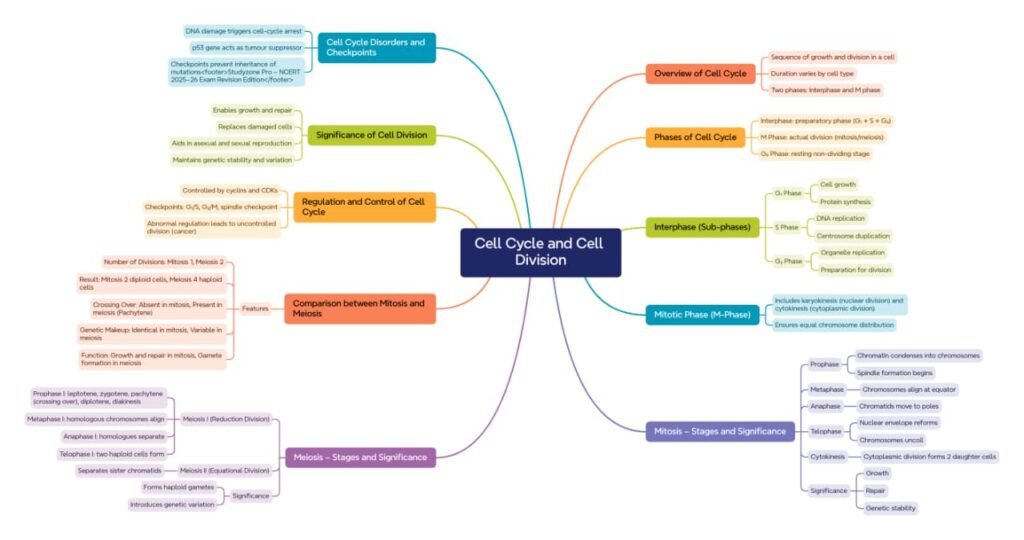
MIND MAPS
————————————————————————————————————————————————————————————————————————————