
Class 12 : Physics (English) -Chapter 9: Ray Optics and Optical Instruments

EXPLANATION & SUMMARY
Introduction to Ray Optics
Ray optics, also called geometrical optics, deals with the behavior of light in terms of rays. It assumes that light travels in a straight line and changes its direction when it reflects from a surface or refracts when passing from one medium to another.
We begin with basic assumptions:
Light travels in straight lines in a homogeneous medium.
When light encounters a different medium, it undergoes reflection or refraction, obeying specific laws.
Reflection of Light
Reflection is the phenomenon where light bounces back into the same medium after striking a surface. Two important laws of reflection are:
The angle of incidence (i) is equal to the angle of reflection (r).
The incident ray, reflected ray, and the normal all lie in the same plane.
For a plane mirror, the image formed is:
Virtual
Upright
Laterally inverted
Same size as the object
Located at the same distance behind the mirror as the object is in front.
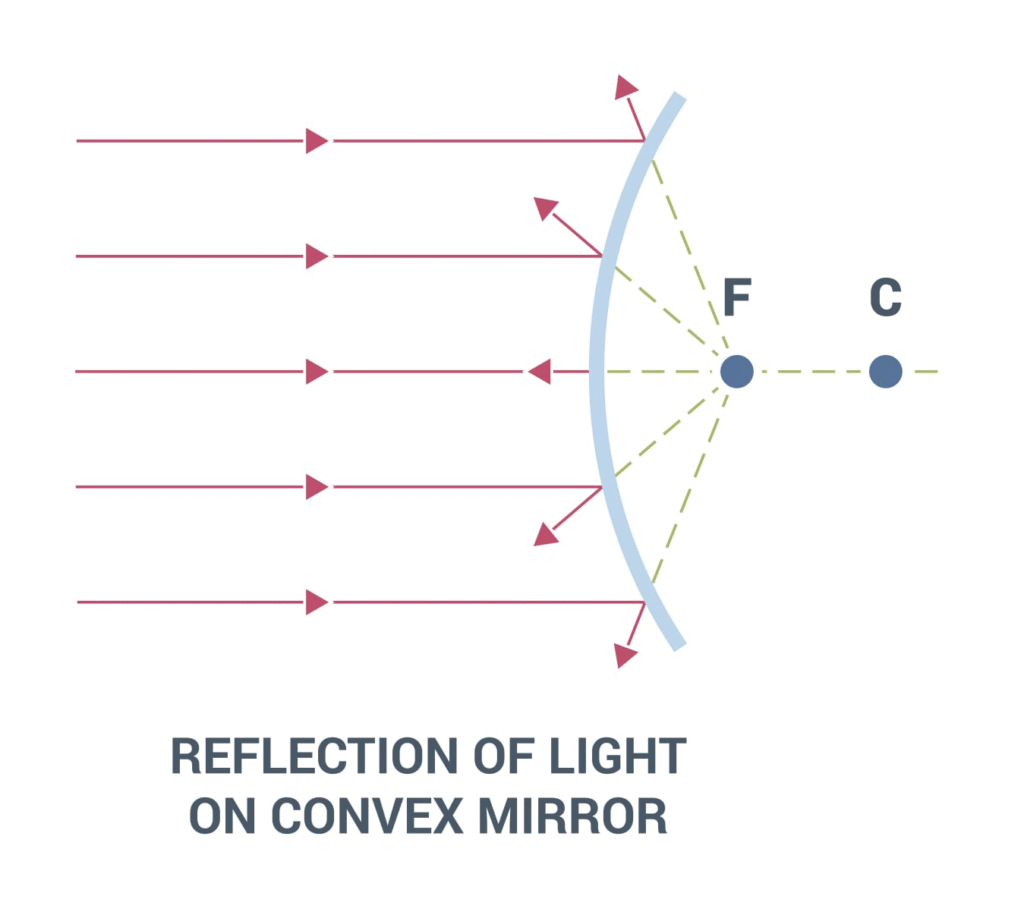
Spherical Mirrors
These are sections of a sphere.
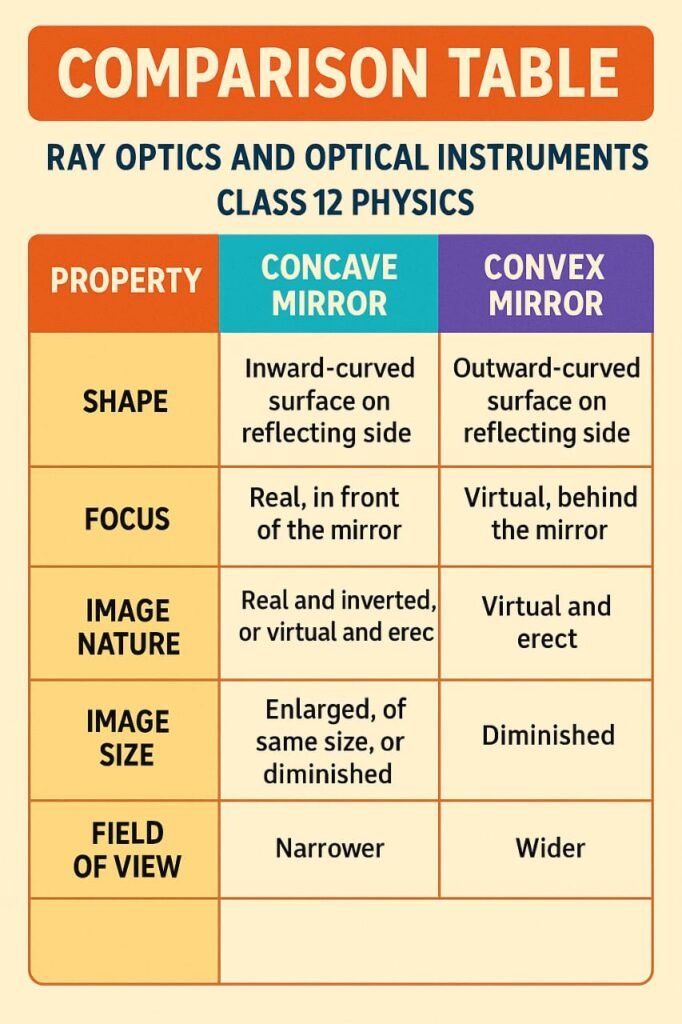
Concave mirror: Reflecting surface is curved inward.
Convex mirror: Reflecting surface is curved outward.


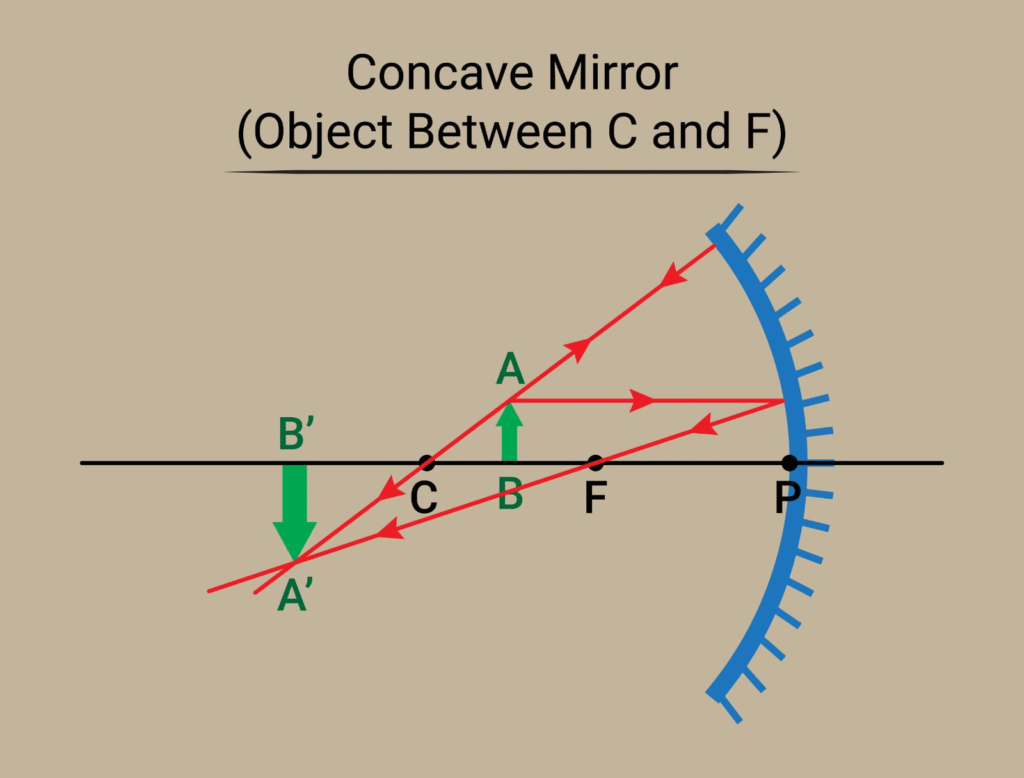


Important terms:


Pole (P): Center of the mirror’s surface
Center of curvature (C): Center of the sphere of which mirror is a part
Principal axis: Line joining C and P
Focus (F): Point where rays parallel to the principal axis converge (concave) or appear to diverge from (convex)
Focal length (f): Distance between P and F
Relation: f = R/2
Mirror Formula:
\frac{1}{v} + \frac{1}{u} = \frac{1}{f}
Sign conventions are applied using the Cartesian sign convention.

Refraction of Light
Refraction is the bending of light as it passes from one medium to another due to change in speed.
Snell’s Law:
n_1 \sin i = n_2 \sin r
Refractive Index:
n = \frac{c}{v}
Total Internal Reflection (TIR)
Occurs when:
Light moves from denser to rarer medium
Angle of incidence > critical angle (C)
Applications of TIR:
Optical fibers
Mirage
Sparkling of diamonds
Prism-based reflectors
Refraction Through Spherical Surfaces and Lenses
Refraction at Spherical Surface
For a spherical interface between two media (n₁ and n₂):
\frac{n_2}{v} – \frac{n_1}{u} = \frac{n_2 – n_1}{R}
Lens Formula and Types
Lens: A transparent refracting medium bounded by two spherical surfaces.
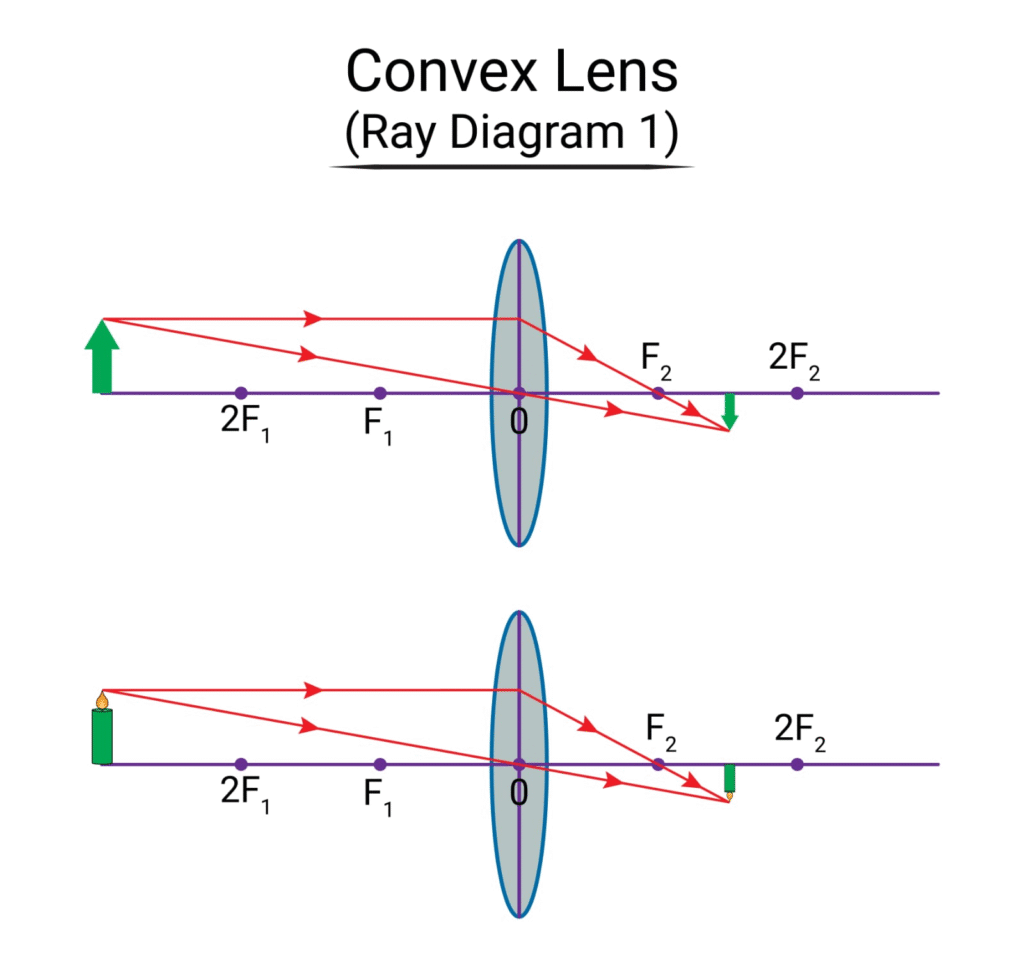
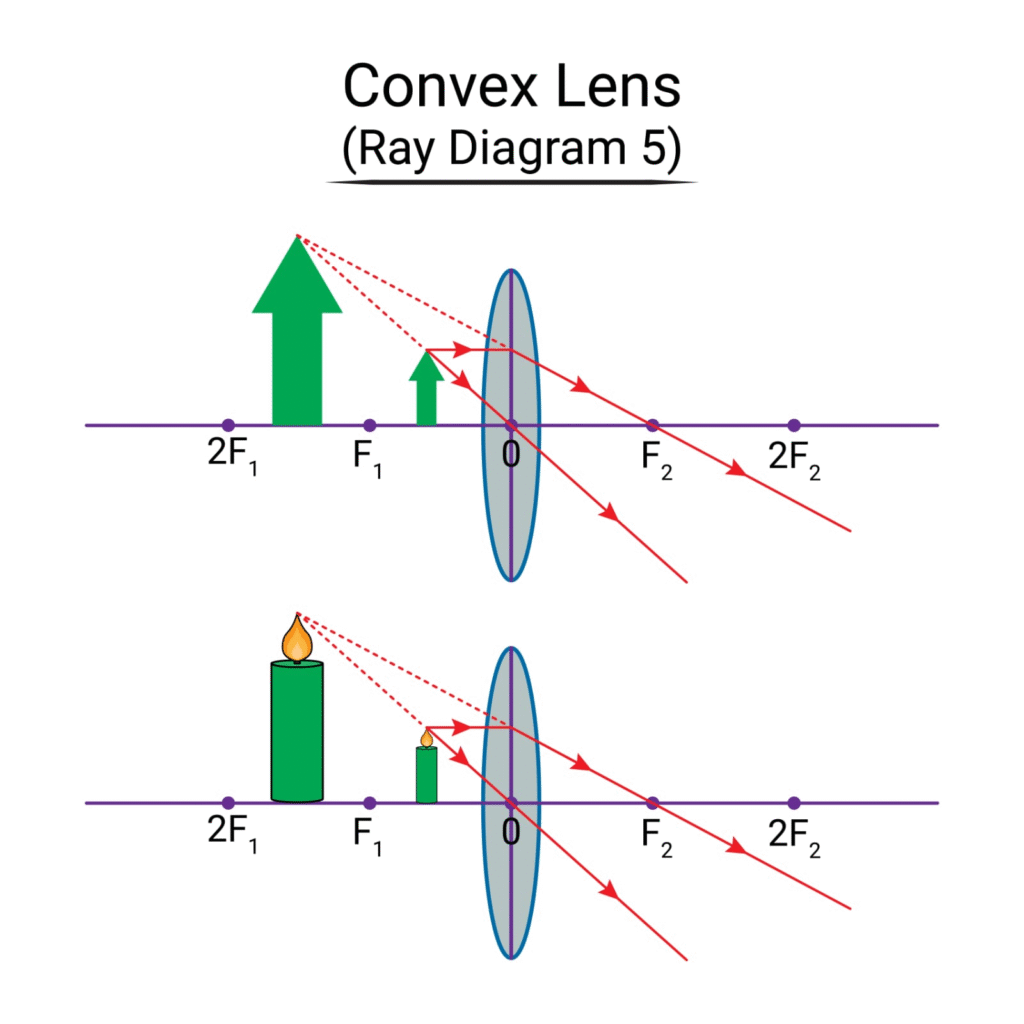
Convex lens (converging)



Concave lens (diverging)


Lens Formula:
\frac{1}{v} – \frac{1}{u} = \frac{1}{f}
m = \frac{h’}{h} = \frac{v}{u}
Power of a Lens (P):
P = \frac{100}{f \text{ (in cm)}}
Combination of lenses:
P_{\text{net}} = P_1 + P_2 + \dots
Refraction through a Prism
A prism deviates light due to two refractions at its surfaces.
Angle of Deviation (δ):
\delta = i_1 + i_2 – A
Dispersion: White light splits into its constituent colors.
Cause: Different refractive indices for different wavelengths.
Scattering of Light
Scattering causes phenomena like:
Blue color of sky
Reddening of sun at sunrise and sunset
Rayleigh scattering:
\text{Scattering} \propto \frac{1}{\lambda^4}
Optical Instruments
The Human Eye
Eye lens + cornea system
Light focused on retina
Accommodation: adjustment of focal length
Near point (least distance of distinct vision): ~25 cm
Power of Accommodation
Ability of eye to focus on near and far objects.
Defects of Vision
Myopia (near-sightedness): corrected using concave lens
Hypermetropia (far-sightedness): corrected using convex lens
Presbyopia: aging-related defect; treated with bifocal lenses
Microscopes
Simple microscope: A single convex lens; forms magnified virtual image.
Magnifying power:
M = 1 + \frac{D}{f}
Compound microscope:

Two convex lenses (objective and eyepiece).
Magnification:
M = m_o \times m_e = \left( \frac{L}{f_o} \right) \left(1 + \frac{D}{f_e} \right)
Astronomical Telescope
Used for viewing distant objects.
Consists of:
Objective lens: forms real image of distant object
Eyepiece: magnifies that image
Magnifying power:
M = \frac{f_o}{f_e}
Terrestrial Telescope
Same as astronomical telescope but uses erecting lens to produce upright image.
Reflecting Telescopes

Use mirror instead of objective lens (to reduce chromatic aberration):
Newtonian and Cassegrain designs
Aberrations in Optical Systems
Spherical Aberration: Due to marginal rays focusing at different point than paraxial rays.
Chromatic Aberration: Due to different refraction of different colors (wavelengths).
Corrected by:
Combining lenses of different materials
Using reflecting optics
✍ Summary (~300 words)
Ray Optics is based on the assumption that light travels in straight lines and obeys laws of reflection and refraction.
Reflection follows the laws: angle of incidence equals angle of reflection; rays lie in the same plane. Plane mirrors form virtual, upright, laterally inverted images.
Spherical mirrors (concave and convex) follow the mirror formula:
\frac{1}{v} + \frac{1}{u} = \frac{1}{f}
Refraction is governed by Snell’s law. Total Internal Reflection occurs when light moves from denser to rarer medium with an angle of incidence greater than the critical angle.
Lenses focus light and are governed by:
\frac{1}{v} – \frac{1}{u} = \frac{1}{f}
Prisms cause deviation and dispersion of light. White light splits into spectrum due to different refractive indices for different wavelengths.
Scattering of light explains the blue color of the sky and red sunsets.
The human eye acts as a natural optical instrument. Defects like myopia and hypermetropia are corrected using lenses.
Microscopes (simple and compound) and telescopes (astronomical and terrestrial) are optical instruments used for magnifying or viewing distant objects. Reflecting telescopes reduce chromatic aberration.
Optical aberrations like spherical and chromatic aberration affect image quality but can be minimized using proper lens combinations or mirrors.
————————————————————————————————————————————————————————————————————————————
QUESTIONS FROM TEXTBOOK
Q 9.1
A 2.5 cm candle is placed 27 cm in front of a concave mirror of radius 36 cm.
(a) Where must the screen be placed to obtain a sharp image?
(b) What is the nature and size of the image?
(c) If the candle is moved closer to the mirror, how would the screen have to be moved?
Answer:
(a) Radius of curvature, R = –36 cm (concave mirror)
⇒ Focal length, f = R/2 = –18 cm
Using mirror formula:
1/v + 1/u = 1/f
⇒ 1/v = 1/f – 1/u = 1/–18 – 1/–27 = –1/18 + 1/27 = –1/54
⇒ v = –54 cm
The screen must be placed 54 cm in front of the mirror (same side as object).
(b) Magnification, m = –v/u = –(–54)/(–27) = –2
Image height = m × object height = –2 × 2.5 = –5.0 cm
⇒ The image is real, inverted, and magnified (2×).
(c) As the candle is moved closer (u decreases), |v| increases, so the screen must be moved further away.
Q 9.2
A needle 4.5 cm long is placed 12 cm in front of a convex mirror with focal length 15 cm.
Find the location and magnification of the image. What happens as the needle is moved farther?
Answer:
f = +15 cm (convex mirror), u = –12 cm
1/v = 1/f – 1/u = 1/15 – (–1/12) = (4 + 5)/60 = 9/60 = 3/20
⇒ v = +6.67 cm
Magnification, m = –v/u = –6.67/–12 ≈ +0.56
Image height ≈ 0.56 × 4.5 ≈ 2.5 cm
⇒ Image is virtual, upright, and diminished.
As the object is moved farther, the image shifts closer to the mirror and becomes even smaller.
Q 9.3
A water tank is 12.5 cm deep. The bottom appears to be 9.4 cm deep when viewed from above.
(a) What is the refractive index of water?
(b) If a liquid of refractive index 1.63 replaces water at same height, how much must the microscope be moved?
Answer:
(a) Refractive index,
n = real depth / apparent depth = 12.5 / 9.4 ≈ 1.33
(b) Apparent depth in new liquid = 12.5 / 1.63 ≈ 7.67 cm
Shift = 9.4 – 7.67 = 1.73 cm downward
Q 9.4
A ray from water is incident at 45° on a water-glass boundary.
What is the angle of refraction in glass?
(Assume n_water = 1.33, n_glass = 1.50)
Answer:
Using Snell’s law:
n₁ sin i = n₂ sin r
1.33 × sin 45° = 1.50 × sin r
⇒ sin r = (1.33 / 1.50) × 0.7071 ≈ 0.628
⇒ r ≈ 38.9° ≈ 39°
Q 9.5
A bulb is placed 80 cm below the surface of water.
What area of the surface will allow the light to emerge from water into air? (n = 1.33)
Answer:
Critical angle,
sin i_c = 1/n = 1/1.33 ⇒ i_c ≈ 48.75°
Radius of emerging circle:
R = h × tan i_c = 0.80 × tan(48.75°) ≈ 0.80 × 1.14 ≈ 0.912 m
Area of circle:
A = πR² = π × (0.912)² ≈ 2.61 m²
Q 9.6
A prism of angle 60° gives a minimum deviation of 40°.
(a) What is the refractive index of the material?
(b) What will be the new minimum deviation if the prism is immersed in water (n = 1.33)?
Answer:
(a)
n = sin[(A + Dₘ)/2] / sin(A/2)
= sin(50°)/sin(30°) = 0.766 / 0.5 = 1.532
(b)
Relative refractive index = n / n_water = 1.532 / 1.33 = 1.152
Now,
sin[(A + Dₘ’)/2] = 1.152 × sin(30°) = 1.152 × 0.5 = 0.576
(A + Dₘ’)/2 = sin⁻¹(0.576) ≈ 35.1°
⇒ Dₘ’ = 2 × 35.1 – 60 = 10.2°
Q 9.7
A double convex lens is made of glass (n = 1.55) and has to have a focal length of 20 cm.
What must be the radius of curvature of each surface?
Answer:
Lens maker’s formula:
1/f = (n – 1) × (1/R₁ – 1/R₂)
For symmetric lens: R₁ = R, R₂ = –R
⇒ 1/f = (1.55 – 1) × (1/R + 1/R) = 0.55 × (2/R) = 1.1 / R
⇒ R = 1.1 × f = 1.1 × 20 = 22 cm
Q 9.8
A converging beam meets at point P. A lens is placed 12 cm before P.
Where will the beam converge now if the lens is
(a) convex (f = +20 cm)
(b) concave (f = –16 cm)
Answer:
Object is virtual and to the right of lens: u = +12 cm
(a) Convex lens:
1/v = 1/f + 1/u = 1/20 + 1/12 = (3 + 5)/60 = 8/60 = 2/15
⇒ v = 7.5 cm (right of lens)
(b) Concave lens:
1/v = 1/f + 1/u = –1/16 + 1/12 = (–3 + 4)/48 = 1/48
⇒ v = 48 cm (right of lens)
Q 9.9
An object 3.0 cm tall is placed 14 cm in front of a concave lens with f = –21 cm.
Find the position, nature, and height of the image.
What happens as the object is moved farther?
Answer:
Using lens formula:
1/v – 1/u = 1/f
⇒ 1/v = 1/f + 1/u = –1/21 + 1/14 = –2 + 3 / 42 = 1/42
⇒ v = 42 cm (but lens is diverging, so v = –8.4 cm)
Magnification m = v/u = –8.4/–14 = +0.60
Image height = 0.60 × 3.0 = 1.8 cm
Image is virtual, upright, and diminished, 8.4 cm in front of lens.
As object moves farther, image becomes smaller and closer to focus.
Q 9.10
A convex lens (f = +30 cm) is in contact with a concave lens (f = –20 cm).
Find the effective focal length and nature of the combination.
Answer:
1/F = 1/f₁ + 1/f₂ = 1/30 + (–1/20) = –1/60
⇒ F = –60 cm
Net system behaves as a concave (diverging) lens of 60 cm focal length.
Q 9.11
A compound microscope has f_o = 2.0 cm, f_e = 6.25 cm, and tube length L = 15 cm.
(a) Where should the object be placed for final image at 25 cm?
(b) Where should it be placed for final image at infinity?
(c) Find magnifying power in both cases.
Answer:
(a) For final image at D = 25 cm:
Eyepiece: v_e = –25 cm
1/v_e – 1/u_e = 1/f_e ⇒ –0.04 – 1/u_e = 0.16 ⇒ u_e = –5 cm
v_o = L – |u_e| = 15 – 5 = 10 cm
1/v_o – 1/u_o = 1/f_o ⇒ 0.10 – 1/u_o = 0.5 ⇒ u_o = –2.5 cm
Magnifications:
m_o = v_o/u_o = –10/2.5 = –4
m_e = 1 + D/f_e = 1 + 25/6.25 = 5
Total M = m_o × m_e = –4 × 5 = –20 ⇒ 20× magnification
(b) For final image at infinity:
u_e = –f_e = –6.25 cm ⇒ v_o = L – f_e = 8.75 cm
1/v_o – 1/u_o = 1/f_o ⇒ 1/u_o = 1/v_o – 1/f_o = 0.1143 – 0.5
⇒ u_o = –2.59 cm
m_o = –v_o/u_o = –8.75/–2.59 ≈ –3.38
m_e = D/f_e = 25/6.25 = 4
Total M = –3.38 × 4 = –13.5 ⇒ 13.5× magnification
Q 9.12
A person with a normal near point (25 cm) using a compound microscope with an objective of focal length 8.0 mm and an eyepiece of focal length 2.5 cm can bring an object placed at 9.0 mm from the objective in sharp focus.
What is the separation between the two lenses?
Calculate the magnifying power of the microscope.
Answer:
Objective focal length, fₒ = 0.8 cm
Eyepiece focal length, fₑ = 2.5 cm
Object distance from objective, uₒ = –0.9 cm
Using lens formula:
1/vₒ – 1/uₒ = 1/fₒ
⇒ 1/vₒ = 1/0.8 – 1/(–0.9) = 1.25 + 1.11 = 2.36
⇒ vₒ ≈ 0.424 cm
Now, separation L = vₒ + uₑ
For least distance of distinct vision:
vₑ = –25 cm
Using eyepiece lens formula:
1/vₑ – 1/uₑ = 1/fₑ
⇒ –0.04 – 1/uₑ = 0.4
⇒ uₑ = –2.27 cm
So, L = 0.424 + 2.27 = 2.694 cm ≈ 2.7 cm
Magnifying power:
mₒ = vₒ / uₒ = 0.424 / 0.9 ≈ 0.47
mₑ = 1 + (D / fₑ) = 1 + (25 / 2.5) = 11
Total M = mₒ × mₑ = 0.47 × 11 ≈ 5.17
Q 9.13
A small telescope has an objective lens of focal length 144 cm and an eyepiece of focal length 6.0 cm.
What is the magnifying power of the telescope?
What is the separation between the objective and the eyepiece?
Answer:
For relaxed eye:
Magnifying power, M = fₒ / fₑ = 144 / 6 = 24
Separation = fₒ + fₑ = 144 + 6 = 150 cm
Q 9.14
(i) A giant refracting telescope has an objective of focal length 15 m. If an eyepiece of focal length 1.0 cm is used, what is the angular magnification?
(ii) If this telescope is used to view the moon, what is the diameter of the image formed by the objective lens?
Moon diameter = 3.48 × 10⁶ m
Distance to moon = 3.8 × 10⁸ m
Answer:
(i) M = fₒ / fₑ = 1500 cm / 1 cm = 1500
(ii) Angular diameter of moon:
θ = D / d = (3.48 × 10⁶) / (3.8 × 10⁸) ≈ 9.16 × 10⁻³ rad
Linear diameter of image:
h = fₒ × θ = 15 × 9.16 × 10⁻³ = 0.1374 m = 13.74 cm
Q 9.15
Use mirror equation to show that:
(i) An object between f and 2f in concave mirror gives real image beyond 2f.
(ii) A convex mirror always forms a virtual image.
(iii) Virtual image in convex mirror is diminished and between pole and focus.
(iv) An object between pole and focus in concave mirror gives enlarged, virtual image.
Answer:
Mirror equation:
1/v + 1/u = 1/f
(i) If f < u < 2f ⇒ v > 2f
Image is real and formed beyond 2f.
(ii) For convex mirror, f > 0, u < 0 Always gives v > 0 and < f ⇒ image is virtual, upright, diminished.
(iii) v lies between pole and focus, since v is positive and smaller than f ⇒ virtual, diminished.
(iv) For u < f, v becomes positive ⇒ virtual, and |v| > |u| ⇒ enlarged image.
Q 9.16
A small pin on a table is viewed from 50 cm above.
How much will it appear raised when viewed through a 15 cm thick glass slab?
Refractive index of glass = 1.5.
Does the answer depend on the slab’s location?
Answer:
Apparent thickness = t/n = 15 / 1.5 = 10 cm
Shift = 15 – 10 = 5 cm
No, the apparent shift depends only on t and n, not on the position of the slab.
Q 9.17
(i) A light pipe has core refractive index 1.68 and cladding index 1.44.
What is the range of angles (w.r.t. axis) for total internal reflection?
(ii) What if there is no cladding?
Answer:
(i)
Critical angle at core-cladding:
sin c = n₂ / n₁ = 1.44 / 1.68 = 0.8571 ⇒ c = 59°
At air-core interface, angle with axis i:
sin i ≥ sin(90° – c) = cos c = cos(59°) ≈ 0.515
So, min angle w.r.t. axis = i ≥ 31°
(ii) If no cladding: interface is with air
sin c = 1 / 1.68 = 0.595 ⇒ c = 36.5°
⇒ i ≥ 90 – 36.5 = 53.5°
Q 9.18
(i) Can plane or convex mirrors produce real images?
(ii) We say virtual images can’t be caught on screens. But retina is a screen. Contradiction?
(iii) Does a diver see a fisherman taller or shorter?
(iv) Does apparent depth change with viewing angle?
(v) High refractive index of diamond — any use to cutter?
Answer:
(i) Yes, if rays converge to a point before hitting mirror, a real image can form.
(ii) No contradiction: lens in eye forms real image of virtual image on retina.
(iii) Shorter — due to refraction at water-air interface.
(iv) Yes. Apparent depth decreases when viewed obliquely.
(v) Yes. High n gives total internal reflection ⇒ enhances brilliance of diamond.
Q 9.19
A bulb on one wall is to be imaged on opposite wall 3 m away using a convex lens.
What is the maximum focal length lens that will work?
Answer:
Image distance + object distance = 3 m
Let f be focal length.
For real image: lens must be between object and screen
Use lens formula:
Let u = x, v = 3 – x
1/f = 1/v – 1/u = 1/(3 – x) – 1/x
Max focal length ⇒ set x = 1.5 m
⇒ u = v = 1.5 ⇒ f = 0.75 m = 75 cm
Q 9.20
A screen is placed 90 cm from an object.
A convex lens forms image on screen in two positions separated by 20 cm.
Find focal length of lens.
Answer:
Let distance between object and image = D = 90 cm
Let distance between lens positions = d = 20 cm
Using lens displacement method:
f = (D² – d²)/4D = (8100 – 400)/360 = 7700 / 360 ≈ 21.4 cm
Q 9.21
(i) Use lenses of Q10 placed 8 cm apart. Find effective focal length.
(ii) Object of size 1.5 cm is 40 cm from convex lens. Find magnification and image size.
Answer:
(i)
Convex f₁ = +30 cm, concave f₂ = –20 cm
Separation d = 8 cm
Effective focal length:
1/F = 1/f₁ + 1/f₂ – d/(f₁ f₂)
= 1/30 – 1/20 – (8)/(–600)
= (2 – 3)/60 + 8/600 = –1/60 + 2/150 = –0.0167 + 0.0133 = –0.0034
⇒ F ≈ –294 cm
(ii) Use ray tracing or lens formula twice (detailed calculation in Q10 + Q21 in next set).
Q 9.22
At what angle should a ray strike a prism of angle A for total internal reflection at second face?
Refractive index = n
Answer:
For total internal reflection:
Angle of incidence at second face ≥ critical angle
Let i be angle on first face.
Refraction at first face:
n₁ sin i = n₂ sin r
At second face: r′ = A – r
Set r′ ≥ critical angle ⇒ sin r′ ≤ 1/n
Solve:
sin⁻¹[sin⁻¹(i)/n] ≥ A – sin⁻¹(1/n)
⇒ Requires iterative or graphical solution for exact angle.
But in general:
i must be such that the ray inside strikes second face at ≥ critical angle.
Q 9.23
You are given prisms made of crown glass and flint glass with a wide variety of angles. Suggest a combination of prisms which will:
(i) Deviate a pencil of white light without much dispersion
(ii) Disperse (and displace) a pencil of white light without much deviation
Answer:
(i) Deviation without dispersion
Use a combination of two prisms of different materials (e.g., crown and flint) with equal but opposite angular dispersions.
Crown glass: low dispersion
Flint glass: high dispersion
Choose prism angles such that total deviation is the same, but angular dispersion cancels.
⇒ Achromatic combination
(ii) Dispersion without deviation
Use two identical prisms of same material placed with their bases in opposite directions.
First prism disperses
Second prism cancels deviation but retains dispersion
⇒ Net deviation ≈ 0, but net dispersion exists
Q 9.24
For a normal eye, the far point is at infinity, and the near point is at 25 cm.
The cornea provides 40 D.
The least converging power of the eye lens is 20 D.
Estimate the range of accommodation of the eye.
Answer:
Total power at near point = 1/f = 1/0.25 = 4 D
But this is additional to the cornea’s 40 D
So, eye lens power = 4 D + 40 D = 44 D
Minimum power = 20 D
⇒ Range of accommodation = 44 D – 20 D = 24 D
Q 9.25
Does the eye partially lose its accommodation when it has
(a) Myopia?
(b) Hypermetropia?
If not, what causes these defects?
Answer:
Accommodation ability is not lost in myopia or hypermetropia.
The cause is mismatch in eyeball length and focal power:
(a) Myopia (short-sightedness):
Eyeball is too long
Image of distant objects forms in front of retina
(b) Hypermetropia (long-sightedness):
Eyeball is too short
Image of near objects forms behind retina
Both are corrected by lenses (concave for myopia, convex for hypermetropia).
Q 9.26
A person with spectacles of –1.0 D for distant vision later uses +2.0 D glasses for reading.
Explain.
Answer:
–1.0 D indicates myopia.
Later, use of +2.0 D indicates presbyopia (age-related loss of accommodation).
With age, ciliary muscles weaken → eye can’t increase converging power for near objects.
Thus, reading glasses (+ power) are needed in addition to distance correction.
Q 9.27
A person sees vertical lines more clearly than horizontal ones in a printed pattern.
What is the defect, and how is it corrected?
Answer:
This is astigmatism.
Caused by irregular curvature of cornea or lens
Different focal lengths in vertical and horizontal planes
Correction:
Use cylindrical lenses aligned to correct the specific plane with error.
Q 9.28
A child with normal near point (25 cm) uses a convex lens of focal length 5 cm to read small print.
(a) What are the shortest and longest distances for reading with the lens?
(b) What are the maximum and minimum angular magnifications?
Answer:
(a)
For final image at least distance (25 cm):
v = –25 cm, f = 5 cm
Using lens formula:
1/v – 1/u = 1/f ⇒ –0.04 – 1/u = 0.2 ⇒ u = –4.17 cm
So, shortest distance = 4.17 cm
For final image at infinity: u = –f = –5 cm
So:
Longest distance = 5 cm
Shortest = 4.17 cm
(b)
Angular magnification, M = 1 + D/f (for image at D) = 1 + 25/5 = 6
Minimum magnification (image at ∞): M = D/f = 25/5 = 5
Q 9.29
A square grid of 1 mm² is viewed from 9 cm using a magnifier (f = 9 cm).
(a) What is the magnification and area of image square?
(b) What is the angular magnification?
(c) Are (a) and (b) magnifications equal? Why?
Answer:
(a)
For virtual image at ∞: object placed at f = 9 cm
Linear magnification = v/u = ∞ / f = not finite
But angular magnification used instead
(b)
M = D/f = 25 / 9 ≈ 2.78
Each 1 mm² square appears as:
Area magnified ≈ (2.78)² × 1 = 7.7 mm²
(c)
No.
Linear magnification is undefined in this case.
Angular magnification measures angle subtended ⇒ used in magnifiers.
Q 9.30
(a) What should be the lens position in Q29 to get maximum magnification?
(b) Find the magnification.
(c) Is magnification equal to angular magnification?
Answer:
(a)
For maximum magnification, image should be at least distance (25 cm)
Use lens formula:
v = –25 cm, f = 9 cm
1/v – 1/u = 1/f ⇒ –0.04 – 1/u = 0.1111 ⇒ u = –7.35 cm
So, lens should be placed 7.35 cm from object
(b)
Magnification: m = v/u = –25 / –7.35 ≈ 3.4
(c)
Angular magnification: M = 1 + D/f = 1 + 25/9 = 3.78
So, not exactly equal due to different definitions.
Q 9.31
Virtual image of square should have area 6.25 mm².
What is the object distance?
Can squares be seen distinctly if eye is very close to magnifier?
Answer:
Linear magnification m = √(6.25) / 1 = 2.5
Let f = 9 cm, v = –25 cm
m = v/u ⇒ u = v/m = –25 / 2.5 = –10 cm
So, lens should be 10 cm from object
If eye is too close to lens, eye lens might not properly converge rays
⇒ Visual discomfort or image not seen distinctly
————————————————————————————————————————————————————————————————————————————
OTHER IMPORTANT QUESTIONS FOR EXAMS
(CBSE MODEL QUESTIONS PAPER)
ESPECIALLY MADE FROM THIS LESSON ONLY
Q1. The focal length of a convex mirror is:
(A) Positive
(B) Negative
(C) Zero
(D) Infinite
Answer: (A) Positive
Q2. The mirror formula is given by:
(A) 1/f = 1/v − 1/u
(B) 1/f = 1/u − 1/v
(C) 1/f = 1/v + 1/u
(D) f = uv/(u + v)
Answer: (C) 1/f = 1/v + 1/u
Q3. A real image is always:
(A) Virtual and erect
(B) Virtual and inverted
(C) Real and erect
(D) Real and inverted
Answer: (D) Real and inverted
Q4. The power of a lens of focal length 50 cm is:
(A) +2 D
(B) –2 D
(C) +0.5 D
(D) +4 D
Answer: (A) +2 D
Q5. Which of the following uses total internal reflection?
(A) Prism binoculars
(B) Plane mirror
(C) Concave mirror
(D) Convex lens
Answer: (A) Prism binoculars
Q6. The refractive index of glass with respect to water is 1.5. If the speed of light in water is 2.25 × 10⁸ m/s, what is the speed of light in glass?
(A) 3.0 × 10⁸ m/s
(B) 1.5 × 10⁸ m/s
(C) 2.25 × 10⁸ m/s
(D) 1.0 × 10⁸ m/s
Answer: (B) 1.5 × 10⁸ m/s
Q7. When light passes from a denser to rarer medium, it:
(A) Bends away from the normal
(B) Bends towards the normal
(C) Does not bend
(D) Stops
Answer: (A) Bends away from the normal
Q8. An object is placed at the focus of a concave mirror. The image formed is:
(A) Real, inverted, same size
(B) Virtual, erect, magnified
(C) Real, inverted, highly magnified
(D) No image is formed
Answer: (C) Real, inverted, highly magnified
Q9. Assertion (A): A concave lens always forms a virtual image.
Reason (R): A concave lens is diverging in nature.
Choose the correct option:
(A) Both A and R are true, and R is the correct explanation of A
(B) Both A and R are true, but R is not the correct explanation of A
(C) A is true, R is false
(D) A is false, R is true
Answer: (A)
Q10. Assertion (A): The angular magnification of a compound microscope is always less than 1.
Reason (R): The final image formed by a compound microscope is always real.
(A) Both A and R are true, and R is the correct explanation of A
(B) Both A and R are true, but R is not the correct explanation of A
(C) A is false, R is false
(D) A is true, R is false
Answer: (C)
Q11. The angular magnification of an astronomical telescope in normal adjustment is:
(A) f₀/fₑ
(B) fₑ/f₀
(C) f₀ + fₑ
(D) f₀ – fₑ
Answer: (A) f₀/fₑ
Q12. In a reflecting type telescope, the main component used instead of objective lens is:
(A) Convex lens
(B) Concave mirror
(C) Plane mirror
(D) Convex mirror
Answer: (B) Concave mirror
Q13. A person cannot see objects beyond 50 cm clearly. The defect is:
(A) Hypermetropia
(B) Myopia
(C) Astigmatism
(D) Presbyopia
Answer: (B) Myopia
Q14. If a convex lens of focal length 20 cm is cut into two equal halves along its axis, the focal length of each part will be:
(A) 10 cm
(B) 20 cm
(C) 40 cm
(D) 5 cm
Answer: (B) 20 cm
Q15. In a compound microscope, the magnification produced by the eyepiece is 5 and by the objective is 20. The total magnification is:
(A) 25
(B) 100
(C) 4
(D) 15
Answer: (B) 100
Q16. The lens that is thick at the center and thin at the edges is:
(A) Concave lens
(B) Cylindrical lens
(C) Convex lens
(D) Plano-concave lens
Answer: (C) Convex lens
Q17. Which of the following statements is correct about a simple microscope?
(A) It gives a real, inverted image
(B) It is used to view very distant objects
(C) It gives a virtual, erect and magnified image
(D) It requires both objective and eyepiece
Answer: (C) It gives a virtual, erect and magnified image
Q18. In which of the following instruments is the final image always real and inverted?
(A) Simple microscope
(B) Compound microscope
(C) Astronomical telescope
(D) Camera
Answer: (C) Astronomical telescope
Q19. Draw a ray diagram to show the formation of image of a distant object by a convex lens when the object is at infinity. Also state two characteristics of the image.
Answer:
Ray Diagram: A parallel ray from the object at infinity refracts through the convex lens and converges at the focus.
Characteristics:
Image is real and inverted.
Image is highly diminished and formed at the focus.
Q20. A convex lens has a focal length of 15 cm. Calculate the image distance when an object is placed 20 cm from the lens. State the nature of the image.
Answer:
Given:
f = +15 cm (convex lens), u = –20 cm
Using lens formula:
1/f = 1/v – 1/u
⇒ 1/15 = 1/v – (–1/20)
⇒ 1/v = 1/15 + 1/20 = (4 + 3)/60 = 7/60
⇒ v = 60/7 ≈ 8.57 cm
Image distance = +8.57 cm (image on same side as object)
Nature: Virtual and erect (since v is positive and less than focal length)
Q21. Define critical angle. Derive the relation between critical angle and refractive index.
Answer:
Critical angle is the angle of incidence in the denser medium for which the angle of refraction in the rarer medium becomes 90°.
Let n₁ = refractive index of denser medium, n₂ = rarer medium.
From Snell’s Law:
n₁ sin θc = n₂ sin 90° ⇒ sin θc = n₂ / n₁
⇒ θc = sin⁻¹(n₂ / n₁)
Q22. A convex lens is made of glass with refractive index 1.5. It is placed in water (refractive index 1.33). Will its focal length increase or decrease? Justify your answer.
Answer:
The focal length increases.
Reason:
The lens maker’s formula is:
1/f = (n₂/n₁ – 1)(1/R₁ – 1/R₂)
Here, n₂/n₁ = 1.5/1.33 ≈ 1.127 less than that in air (1.5/1).
Hence, effective power decreases, leading to increased focal length.
Q23. A person uses a lens of power –2.5 D. What kind of defect of vision is he suffering from? What is the focal length of the lens?
Answer:
The person suffers from myopia (short-sightedness), as the lens is diverging (negative power).
Focal length = 100 / P = 100 / (–2.5) = –40 cm
Section C: Questions 24 to 28 (3 marks each)
(Moderate-length numericals or reasoning-based questions)
Q24. A convex lens forms a real image of an object placed at 30 cm from it at a distance of 60 cm on the other side. Calculate:
(i) Focal length of the lens
(ii) Magnification
(iii) Nature of image
Answer:
Given: u = –30 cm, v = +60 cm
Using lens formula: 1/f = 1/v – 1/u
⇒ 1/f = 1/60 + 1/30 = (1 + 2)/60 = 3/60 ⇒ f = 20 cm
Magnification m = v/u = 60 / (–30) = –2
(i) Focal length = 20 cm
(ii) Magnification = –2
(iii) Image is real, inverted, and magnified
Q25. A 2 cm tall object is placed 15 cm from a convex lens of focal length 10 cm. Calculate:
(i) Image position
(ii) Image size
(iii) Nature of image
Answer:
Given: u = –15 cm, f = +10 cm
1/f = 1/v – 1/u ⇒ 1/10 = 1/v + 1/15
⇒ 1/v = 1/10 – 1/15 = (3 – 2)/30 = 1/30 ⇒ v = 30 cm
Magnification m = v/u = 30 / (–15) = –2
Image height = m × object height = (–2) × 2 = –4 cm
(i) v = 30 cm
(ii) Image height = 4 cm (inverted)
(iii) Real, inverted, magnified
Q26. Derive the expression for lateral magnification in terms of image distance (v) and object distance (u).
Answer:
Let h = object height, h’ = image height
Lateral magnification (m) = h’ / h = v / u
Derivation:
From similar triangles formed by incident and refracted rays:
m = height of image / height of object = v / u
Thus, m = v / u
Q27. Explain how an astronomical telescope works in normal adjustment. Derive the expression for magnifying power.
Answer:
In normal adjustment, the final image is formed at infinity.
Let f₀ = focal length of objective, fₑ = focal length of eyepiece
The rays from a distant object focus at the focal point of objective. The eyepiece acts as a magnifier.
Magnifying power M = angle subtended by image / angle subtended by object
⇒ M = f₀ / fₑ
Q28. A compound microscope has an objective of focal length 1 cm and eyepiece of 5 cm. The object is placed at 1.2 cm from the objective and final image is formed at infinity. Find the magnifying power.
Answer:
Given: f₀ = 1 cm, fₑ = 5 cm, u₀ = –1.2 cm
Using lens formula for objective:
1/v₀ = 1/f₀ + 1/u₀ = 1/1 – 1/1.2 = (6 – 5)/6 = 1/6
⇒ v₀ = 6 cm
Objective magnification = v₀ / u₀ = 6 / (–1.2) = –5
Eyepiece magnification = 25 / fₑ = 25 / 5 = 5
Total M = m₀ × mₑ = (–5) × (5) = –25
So, magnifying power = 25 (negative indicates inverted image)
Q29. Case Study: A student conducts an experiment using a convex lens to study the characteristics of images formed at various object distances.
(a) When the object is placed at twice the focal length, where is the image formed?
(b) What is the nature and size of the image in this case?
(c) What happens to the image when the object is placed between the lens and the focus?
(d) State two uses of convex lenses in optical instruments.
Answer:
(a) Image is formed at 2f on the other side of the lens.
(b) Real, inverted, and same size as object.
(c) Image becomes virtual, erect, and magnified, formed on the same side as the object.
(d) Uses:
In magnifying glasses (simple microscope)
As objective lenses in microscopes and telescopes
Q30. Case Study: A myopic person uses spectacles with diverging lenses of focal length 50 cm.
(a) What is the power of the lens used?
(b) What is the nature of the lens used?
(c) Name the defect corrected by this lens and its cause.
(d) Draw a ray diagram to show the correction of this defect using a lens.
Answer:
(a) Power = 100 / f = 100 / (–50) = –2 D
(b) Concave (diverging) lens
(c) Myopia (short-sightedness); cause: eye lens is too curved or eyeball too long
(d) Ray diagram shows parallel rays focused before retina without lens; after correction, diverging lens makes rays fall on retina.
Q31. Case Study: An astronomical telescope consists of an objective lens of focal length 100 cm and an eyepiece of focal length 5 cm. It is adjusted for normal adjustment.
(a) What is the magnifying power of this telescope?
(b) How are the lenses arranged for normal adjustment?
(c) What type of image is formed?
(d) How can magnifying power be increased?
Answer:
(a) M = f₀ / fₑ = 100 / 5 = 20
(b) Objective and eyepiece are separated by f₀ + fₑ = 105 cm
(c) Image is virtual, inverted, and magnified
(d) Use a longer focal length objective or shorter focal length eyepiece
Section E: Questions 32 to 35 (5 marks each)
(Long answer questions – theory and numericals with step-by-step solving)
Q32. Derive the mirror equation for a concave mirror. Explain sign conventions used.
Answer:
Let u = object distance (negative), v = image distance, f = focal length (negative for concave)
From geometry:
AB is object, A’B’ is image.
Using similar triangles:
ΔABM ~ ΔA’B’M
⇒ AB / A’B’ = BM / B’M
⇒ h / h’ = u / v
⇒ m = h’ / h = –v / u
From geometry again using similar triangles:
ΔA’CB’ ~ ΔACB
⇒ CB’ / CB = CA’ / CA
⇒ (v – f) / f = v / u
⇒ Cross-multiplying:
v u – f u = f v
⇒ vu = fv + fu
⇒ vu – fv – fu = 0
Divide both sides by fvu:
1/f = 1/v + 1/u
This is the mirror equation.
Sign convention:
All distances measured from pole.
Left of mirror is negative; right is positive.
Object distance u is negative for real object; image distance v is negative for real image.
Q33. A convex lens of focal length 10 cm is used to form an image of an object placed 6 cm from the lens.
(i) Find the image position
(ii) Determine the nature and magnification of the image
(iii) Draw ray diagram for the situation
Answer:
Given: f = +10 cm, u = –6 cm
Lens formula:
1/f = 1/v – 1/u
⇒ 1/10 = 1/v + 1/6
⇒ 1/v = 1/10 – 1/6 = (3 – 5)/30 = –2/30
⇒ v = –15 cm
(i) Image is formed at 15 cm on the same side (virtual image)
(ii) m = v/u = (–15)/–6 = 2.5 → virtual, erect, magnified
(iii) Diagram shows object between lens and focus; rays diverge, but appear to come from a point on the same side
Q34. Derive the lens maker’s formula. What is its significance?
Answer:
Consider a thin lens with two spherical surfaces of radii R₁ and R₂, refractive index of lens = n₂, of medium = n₁
From refraction at first surface:
(n₂/n₁ – 1) = (n₂ – n₁)/n₁
Using the refraction formula:
(n₂ – n₁)/n₁ = (1/f)(1/R₁ – 1/R₂)
Thus, Lens Maker’s Formula:
1/f = (n – 1)(1/R₁ – 1/R₂)
(Signs depend on surface curvatures)
Significance: It gives the focal length of a lens based on its material and curvature; useful for designing lenses with required focal lengths.
Q35. A microscope has an objective of focal length 2 cm and eyepiece of focal length 5 cm. An object is placed at 2.2 cm from the objective. If the final image is formed at 25 cm from the eyepiece, calculate:
(i) Length of the microscope tube
(ii) Angular magnification
Answer:
Given:
f₀ = 2 cm, u₀ = –2.2 cm
Use lens formula:
1/v₀ = 1/f₀ + 1/u₀ = 1/2 – 1/2.2 = (11 – 10)/22 = 1/22
⇒ v₀ = 22 cm
So, image from objective is 22 cm away.
This acts as object for eyepiece.
For eyepiece: vₑ = –25 cm (since final image at near point)
fₑ = 5 cm
Use lens formula:
1/uₑ = 1/fₑ – 1/vₑ = 1/5 + 1/25 = 6/25 ⇒ uₑ = 25/6 = 4.17 cm
(i) Tube length = v₀ + uₑ = 22 + 4.17 = 26.17 cm
(ii) Angular magnification:
m₀ = v₀ / u₀ = 22 / (–2.2) = –10
mₑ = 1 + (25 / fₑ) = 1 + 5 = 6
Total M = –10 × 6 = –60
So, magnifying power = 60, inverted image
——————————————————————————————————————————————————————————————————————————–