
Class 12 : Physics (English) – Chapter 8: Electromagnetic Waves

EXPLANATION & SUMMARY
🌍 Introduction
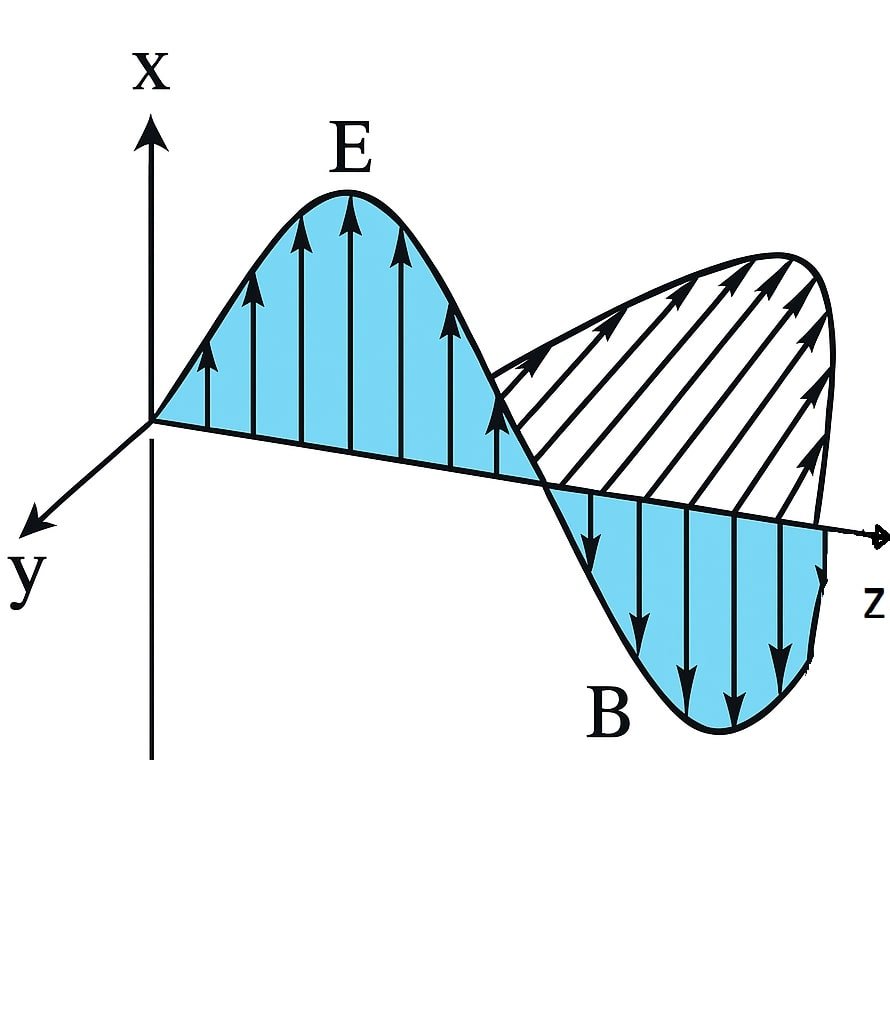
Electromagnetic waves form one of the cornerstones of modern physics. They are self-sustaining waves consisting of time-varying electric and magnetic fields that oscillate perpendicular to each other and also perpendicular to the direction of propagation.
💡 Fact: The beauty of EM waves is that they do not need any medium; they can travel through vacuum. This is why sunlight reaches Earth through empty space.
The foundation was laid by James Clerk Maxwell (1864), who mathematically unified electricity and magnetism. His equations predicted the existence of electromagnetic waves. Later, Heinrich Hertz (1887) experimentally produced and detected them.
✔️ This discovery unified three great fields: Electricity, Magnetism, and Optics.
🔵 Maxwell’s Equations and Displacement Current
✏️ Problem with Ampere’s Law
Ampere’s circuital law:
∮ B · dl = μ₀ I
➡️ Works fine for steady currents.
➡️ But fails for a charging capacitor: inside the gap, no real current flows, but magnetic field exists around the wire.
💡 Maxwell’s Correction
Maxwell introduced the concept of displacement current:
Id = ε₀ (dΦE/dt)
Here, ΦE is the electric flux. This current exists without actual charge flow, but due to changing electric field.
✔️ Modified Ampere’s Law
∮ B · dl = μ₀ (Ic + Id)
Ic = conduction current (actual flow of charges).
Id = displacement current (due to changing electric field).
➡️ With this correction, laws became consistent, and Maxwell showed how varying fields generate EM waves.
🟢 Electromagnetic Waves: Formation & Nature
✔️ How EM Waves Are Generated
A changing electric field produces a magnetic field.
A changing magnetic field produces an electric field.
Together they sustain each other and travel outward as a wave.
✏️ Properties of EM Waves
Transverse in nature
E ⟂ B ⟂ Direction of propagation.
In phase
E and B oscillate sinusoidally and reach maxima/minima simultaneously.
Relation of magnitudes
E₀ / B₀ = c
Equation of fields
E = E₀ sin(kx – ωt)
B = B₀ sin(kx – ωt)
💡 This shows EM waves are simply light waves and other radiations.
🔴 Speed of EM Waves
From Maxwell’s theory:
c = 1 / √(μ₀ ε₀)
μ₀ = permeability of free space = 4π × 10⁻⁷ H/m
ε₀ = permittivity of free space = 8.85 × 10⁻¹² C²/N·m²
➡️ Substituting: c = 3 × 10⁸ m/s
✔️ This is exactly the measured speed of light, proving light is an EM wave.
🟡 Energy in Electromagnetic Waves
Electromagnetic waves carry both energy and momentum.
✏️ Energy Density
Due to electric field: uE = (1/2) ε₀ E²
Due to magnetic field: uB = (1/2μ₀) B²
✔️ On average, uE = uB.
💡 Poynting Vector
Represents energy flux (energy flow per unit area per unit time):
S = (1/μ₀)(E × B)
➡️ Direction of S = direction of wave propagation.
✔️ EM waves can exert pressure → radiation pressure.
🌈 Electromagnetic Spectrum
EM waves extend over a vast frequency range. Classification depends on wavelength/frequency, not speed (since all travel with c in vacuum).
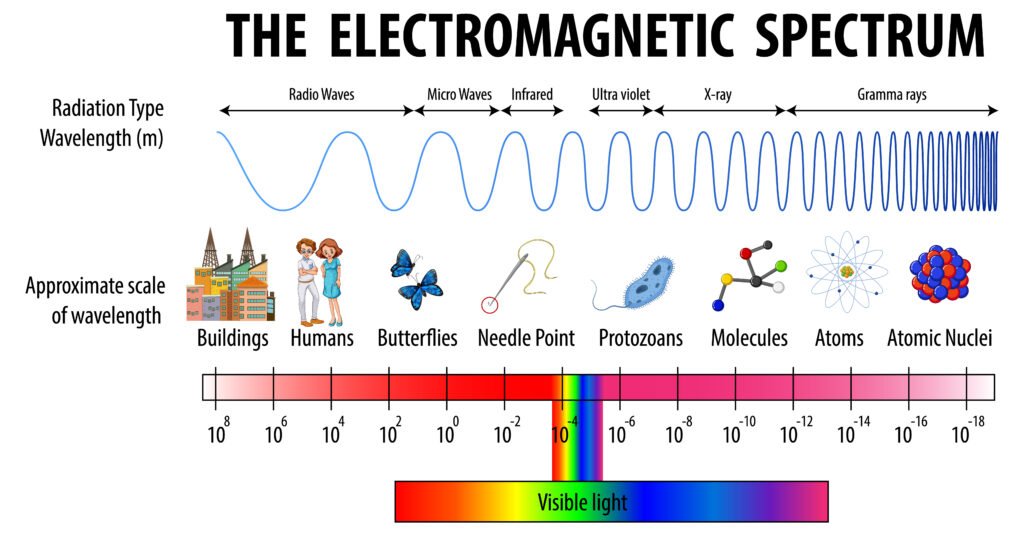
🔵 Radio Waves (λ > 0.1 m)
Produced by oscillating currents in antennas.
Used in: AM/FM radio, TV, mobile communication.
🟢 Microwaves (10⁻³ – 0.1 m)
Produced by magnetrons/klystrons.
Used in: Radar, satellite links, ovens, GPS.
🔴 Infrared Rays (10⁻³ – 7×10⁻⁷ m)
Produced by hot bodies.
Applications: Remote controls, thermal imaging, night vision.
🟡 Visible Light (400–700 nm)
The only band detected by human eye.
Enables vision and photosynthesis.
🔵 Ultraviolet (10⁻⁸ – 4×10⁻⁷ m)
Produced by sun, special lamps.
Uses: Sterilization, tanning, fluorescent tubes.
🟢 X-Rays (10⁻¹² – 10⁻⁸ m)
Produced when fast electrons hit heavy metals.
Uses: Medical imaging, security scanning.
🔴 Gamma Rays (λ < 10⁻¹² m)
Produced in nuclear reactions.
Uses: Cancer therapy, sterilization, astrophysics.
✔️ Order to remember:
Radio → Microwave → Infrared → Visible → UV → X-ray → Gamma
🧠 Polarization
EM waves can be polarized.
Polarization means restricting oscillations of electric field vector to one plane.
Polarization experiments confirm the transverse nature of EM waves.
📡 Applications of EM Waves
🔵 Communication: Radio, TV, satellites, mobiles.
🟢 Domestic: Microwave ovens, infrared remotes.
🔴 Medical: X-rays (imaging), Gamma rays (therapy).
🟡 Scientific: Spectroscopy, astronomy, sterilization.
✔️ Virtually every technology relies on EM waves.
✏️ Important Formulas Recap
Speed: c = 1/√(μ₀ ε₀)
Energy densities: uE = (1/2) ε₀ E², uB = (1/2μ₀) B²
Relation: E₀ / B₀ = c
Poynting vector: S = (1/μ₀)(E × B)
📘 Summary (~300 words)
Electromagnetic waves are disturbances in which electric and magnetic fields oscillate perpendicularly to each other and to the direction of propagation, making them transverse waves. They travel in vacuum with speed c = 1/√(μ₀ε₀) ≈ 3 × 10⁸ m/s, which is the speed of light.
The concept emerged from Maxwell’s modification of Ampere’s law by adding displacement current, resolving the inconsistency of charging capacitors. This unification of electricity and magnetism predicted EM waves, later verified by Hertz.
Key properties:
E and B are in phase, perpendicular, and sinusoidal.
Relation: E₀/B₀ = c.
Energy is equally shared between electric and magnetic fields.
Transport of energy and momentum is described by the Poynting vector.
The electromagnetic spectrum spans:
Radio waves (communication),
Microwaves (radar, ovens),
Infrared (thermal imaging),
Visible light (vision),
Ultraviolet (sterilization),
X-rays (medical imaging),
Gamma rays (cancer therapy).
All travel with same speed in vacuum but differ in wavelength and frequency. Polarization of EM waves confirms their transverse nature.
Applications include radio/TV transmission, mobile phones, medical diagnosis, sterilization, GPS, and astronomy.
✔️ Thus, this chapter completes the unification of electricity, magnetism, and optics, firmly establishing that light itself is an electromagnetic wave.
📝 Quick Recap
🔵 Maxwell’s displacement current unified Ampere’s law.
🟢 EM waves are transverse: E ⟂ B ⟂ direction.
🔴 Speed in vacuum: c = 1/√(μ₀ε₀).
🟡 Energy transport via Poynting vector.
✔️ Spectrum order: Radio → Microwave → IR → Visible → UV → X-ray → Gamma.
💡 Applications: Communication, medical imaging, sterilization, astronomy.
————————————————————————————————————————————————————————————————————————————
QUESTIONS FROM TEXTBOOK
Question 8.1
Figure 8.5 shows a capacitor made of two circular plates each of radius 12 cm, and separated by 5.0 cm. The capacitor is being charged by an external source (not shown in the figure). The charging current is constant and equal to 0.15 A.
(a) Calculate the capacitance and the rate of change of potential difference between the plates.
(b) Obtain the displacement current across the plates.
(c) Is Kirchhoff’s first rule (junction rule) valid at each plate of the capacitor? Explain.
Answer
✏️ Data: r = 0.12 m, d = 0.050 m, I = 0.15 A, ε0 = 8.85×10^−12 F/m.
➡️ Step 1: Area of plates
A = πr² = π(0.12)² = 4.52×10^−2 m²
➡️ Step 2: Capacitance
C = ε0 A/d = (8.85×10^−12 × 4.52×10^−2) / 0.050 ≈ 8.01×10^−12 F = 8.01 pF
➡️ Step 3: Rate of change of potential
I = C (dV/dt) ⇒ dV/dt = I/C = 0.15 / 8.01×10^−12 ≈ 1.87×10^10 V/s
➡️ Step 4: Displacement current
Id = C (dV/dt) = 0.15 A
✔️ Both displacement and conduction currents are equal.
➡️ Step 5: Kirchhoff’s rule
Yes ✔️, junction rule remains valid when displacement current is considered, ensuring current continuity at each plate.
Question 8.2
A parallel plate capacitor (Fig. 8.6) made of circular plates each of radius R = 6.0 cm has a capacitance C = 100 pF. The capacitor is connected to a 230 V ac supply with an (angular) frequency of 300 rad s^−1.
(a) What is the rms value of the conduction current?
(b) Is the conduction current equal to the displacement current?
(c) Determine the amplitude of B at a point 3.0 cm from the axis between the plates.
Answer
✏️ Data: R = 0.060 m, C = 1.0×10^−10 F, Vrms = 230 V, ω = 300 rad/s.
➡️ (a) Irms = ω C Vrms = 300 × 1.0×10^−10 × 230 = 6.90 μA
➡️ (b) Yes ✔️, in AC steady state, conduction current = displacement current.
➡️ (c) Magnetic field amplitude at r = 0.030 m:
Peak voltage V0 = √2 Vrms = 325 V
Peak current I0 = ω C V0 = 300 × 1.0×10^−10 × 325 = 9.76×10^−6 A
Enclosed current at radius r: I_enc = I0 (r²/R²)
From Ampère–Maxwell law: B0 (2πr) = μ0 I_enc
B0 = μ0 I0 r / (2π R²) = (4π×10^−7 × 9.76×10^−6 × 0.030) / (2π × 0.060²) ≈ 1.63×10^−11 T
Question 8.3
What physical quantity is the same for X-rays of wavelength 10^−10 m, red light of wavelength 6800 Å and radiowaves of wavelength 500 m?
Answer
✔️ All electromagnetic waves travel at the same speed in vacuum, c = 3.0×10^8 m/s.
Question 8.4
A plane electromagnetic wave travels in vacuum along z-direction. What can you say about the directions of its electric and magnetic field vectors? If the frequency of the wave is 30 MHz, what is its wavelength?
Answer
➡️ Nature: EM waves are transverse.
If propagation is along +z, one choice:
E along x
B along y
✔️ Both perpendicular to each other and to direction of wave.
➡️ Wavelength: λ = c/f = 3.0×10^8 / 30×10^6 = 10 m.
Question 8.5
A radio can tune in to any station in the 7.5 MHz to 12 MHz band. What is the corresponding wavelength band?
Answer
λ = c/f
For f = 7.5 MHz: λmax = 3.0×10^8 / 7.5×10^6 = 40 m
For f = 12 MHz: λmin = 3.0×10^8 / 12×10^6 = 25 m
✔️ Wavelength band = 25 m to 40 m.
Question 8.6
A charged particle oscillates about its mean equilibrium position with a frequency of 10^9 Hz. What is the frequency of the electromagnetic waves produced by the oscillator?
Answer
✔️ Frequency of EM wave = frequency of oscillation of charge = 10^9 Hz.
Question 8.7
The amplitude of the magnetic field of a harmonic electromagnetic wave in vacuum is B0 = 510 nT. What is the amplitude of the electric field part of the wave?
Answer
E0 = c B0 = 3.0×10^8 × 510×10^−9 = 153 V/m.
Question 8.8
Suppose that the electric field amplitude of an electromagnetic wave is E0 = 120 N C^−1 and that its frequency is ν = 50.0 MHz.
(a) Determine B0, k, and λ.
(b) Find expressions for E and B.
Answer
➡️ (a)
B0 = E0/c = 120 / 3.0×10^8 = 4.0×10^−7 T
λ = c/ν = 3.0×10^8 / 5.0×10^7 = 6.0 m
k = 2π/λ = 2π/6.0 = 1.05 rad/m
ω = 2πν = 3.14×10^8 rad/s
➡️ (b) Wave equations (propagation +z):
E(z,t) = 120 cos(kz − ωt) x̂ (V/m)
B(z,t) = 4.0×10^−7 cos(kz − ωt) ŷ (T)
✔️ E ⟂ B ⟂ direction of propagation.
Question 8.9
Use the formula E = hν to obtain the photon energy (eV) for:
(a) Radio frequency of 3.0 MHz
(b) Visible light of wavelength 6000 Å
(c) X-rays of frequency 10^18 Hz
(d) Gamma rays of frequency 2×10^22 Hz
Answer
✏️ h = 6.63×10^−34 J·s, 1 eV = 1.6×10^−19 J
(a) ν = 3.0×10^6 Hz ⇒ E = 1.24×10^−8 eV
(b) λ = 6000 Å = 6.0×10^−7 m ⇒ ν = 5.0×10^14 Hz ⇒ E = 2.07 eV
(c) ν = 1.0×10^18 Hz ⇒ E = 4.14 keV
(d) ν = 2.0×10^22 Hz ⇒ E = 82.9 MeV
Question 8.10
In a plane EM wave, E oscillates sinusoidally at frequency 2.0×10^10 Hz and amplitude 48 V/m.
(a) What is wavelength?
(b) What is amplitude of B?
(c) Show ⟨uE⟩ = ⟨uB⟩.
Answer
➡️ (a) λ = c/f = 3.0×10^8 / 2.0×10^10 = 1.5×10^−2 m
➡️ (b) B0 = E0/c = 48 / 3.0×10^8 = 1.6×10^−7 T
➡️ (c) Average energy densities:
⟨uE⟩ = (1/4) ε0 E0²
⟨uB⟩ = (1/4μ0) B0²
Since E0 = cB0 and c² = 1/(μ0 ε0), ✔️ ⟨uE⟩ = ⟨uB⟩
————————————————————————————————————————————————————————————————————————————
OTHER IMPORTANT QUESTIONS
(CBSE MODEL QUESTION PAPER)
ESPECIALLY MADE FROM THIS LESSON ONLY
Section A – Multiple Choice Questions (Q1–Q18)
Question 1
The speed of electromagnetic waves in free space depends on:
🔵 (A) Frequency only
🟢 (B) Wavelength only
🟠 (C) Medium properties (μ₀, ε₀)
🔴 (D) Amplitude
Answer: (C) Medium properties (μ₀, ε₀) ✔️
💡 Justification: c = 1/√(μ₀ε₀), independent of f or λ.
Question 2
Which component did Maxwell add to Ampere’s law?
🔵 (A) Induction current
🟢 (B) Displacement current
🟠 (C) Eddy current
🔴 (D) Drift current
Answer: (B) Displacement current ✔️
💡 This term resolved the inconsistency in charging capacitors.
Question 3
In an EM wave, electric and magnetic fields are:
🔵 (A) Parallel
🟢 (B) Perpendicular
🟠 (C) At 45°
🔴 (D) Independent
Answer: (B) Perpendicular ✔️
💡 E ⟂ B ⟂ direction of propagation, proving transverse nature.
Question 4
The relation between E and B in vacuum is:
🔵 (A) E = B
🟢 (B) E/B = c
🟠 (C) E = cB²
🔴 (D) E·B = c
Answer: (B) E/B = c ✔️
💡 Ratio of field magnitudes equals speed of light.
Question 5
Which EM wave has the longest wavelength?
🔵 (A) Microwaves
🟢 (B) Radio waves
🟠 (C) X-rays
🔴 (D) Ultraviolet
Answer: (B) Radio waves ✔️
💡 λ of radio waves can be >100 m.
Question 6
Polarization of light proves that it is:
🔵 (A) Longitudinal
🟢 (B) Transverse
🟠 (C) Scalar
🔴 (D) Mechanical
Answer: (B) Transverse ✔️
💡 Only transverse waves can be polarized.
Question 7
The SI unit of displacement current is:
🔵 (A) V
🟢 (B) A
🟠 (C) W
🔴 (D) C
Answer: (B) Ampere ✔️
💡 Same as conduction current.
Question 8
Which part of the spectrum is used in radar?
🔵 (A) Infrared
🟢 (B) Microwave
🟠 (C) Ultraviolet
🔴 (D) X-rays
Answer: (B) Microwave ✔️
💡 Used in radar and satellite communication.
Question 9
The average energy densities of electric and magnetic fields in EM waves are:
🔵 (A) Unequal
🟢 (B) Equal
🟠 (C) Zero
🔴 (D) Opposite in sign
Answer: (B) Equal ✔️
💡 On average, energy is equally shared between E and B.
Question 10
The Poynting vector gives:
🔵 (A) Wave speed
🟢 (B) Energy flux
🟠 (C) Frequency
🔴 (D) Polarization
Answer: (B) Energy flux ✔️
💡 Represents rate of energy transfer per unit area.
Question 11
The electromagnetic spectrum arranged in increasing frequency is:
🔵 (A) Gamma → UV → IR
🟢 (B) Radio → Microwave → IR → Visible → UV → X-ray → Gamma
🟠 (C) Visible → Radio → Microwave
🔴 (D) None
Answer: (B) Radio → Microwave → IR → Visible → UV → X-ray → Gamma ✔️
💡 Correct NCERT order of spectrum.
Question 12
The origin of X-rays is:
🔵 (A) Nuclear transitions
🟢 (B) Electron transitions in inner shells
🟠 (C) Oscillations of charges in antenna
🔴 (D) Vibrating molecules
Answer: (B) Electron transitions in inner shells ✔️
Question 13
The wavelength of visible light lies in:
🔵 (A) 400–700 nm
🟢 (B) 100–200 nm
🟠 (C) 1–10 μm
🔴 (D) >1 m
Answer: (A) 400–700 nm ✔️
Question 14
Infrared rays are mainly associated with:
🔵 (A) Heat radiation
🟢 (B) Nuclear radiation
🟠 (C) Sterilization
🔴 (D) Gamma emission
Answer: (A) Heat radiation ✔️
Question 15
The amplitude of the electric field in an EM wave is 100 V/m. What is amplitude of magnetic field? (c = 3×10⁸ m/s)
🔵 (A) 3.3×10⁻⁷ T
🟢 (B) 2.0×10⁻⁶ T
🟠 (C) 6.0×10⁻⁷ T
🔴 (D) 1.0×10⁻⁸ T
Answer: (A) 3.3×10⁻⁷ T ✔️
💡 B₀ = E₀/c.
Question 16
Which spectrum band is used for sterilization?
🔵 (A) Infrared
🟢 (B) UV rays
🟠 (C) Radio
🔴 (D) Microwave
Answer: (B) UV rays ✔️
Question 17
Gamma rays are produced during:
🔵 (A) Radioactive nuclear transitions
🟢 (B) Oscillating charges in antenna
🟠 (C) Electron transitions in atoms
🔴 (D) Vibrations of molecules
Answer: (A) Radioactive nuclear transitions ✔️
Question 18
The direction of propagation of EM waves is given by:
🔵 (A) E × B
🟢 (B) B × E
🟠 (C) E + B
🔴 (D) E · B
Answer: (A) E × B ✔️
💡 Right-hand rule: E, B, propagation mutually perpendicular.
Section B – Short Answer (Q19–Q23)
Question 19
Define displacement current.
Answer:
✏️ Displacement current is the current due to changing electric flux, defined as:
Id = ε₀ (dΦE/dt).
✔️ It produces the same magnetic effect as conduction current.
Question 20
What is the ratio of average energy densities of E and B fields in an EM wave?
Answer:
✔️ Ratio = 1:1.
💡 On average, energy is equally shared between electric and magnetic fields.
Question 21
What are electromagnetic waves?
Answer:
➡️ Electromagnetic waves are self-sustaining oscillations of electric and magnetic fields.
➡️ They are transverse in nature (E ⟂ B ⟂ propagation).
➡️ They travel in vacuum with speed c = 3×10⁸ m/s.
Question 22
Write two properties of EM waves.
Answer:
🔵 They are transverse; E and B perpendicular to propagation.
🟢 They carry energy and momentum, transported via the Poynting vector.
💡 Also, E and B are in phase and have equal average energy densities.
Question 23
Name two uses of infrared rays.
Answer:
🔵 Used in remote control systems (TV, AC).
🟢 Used in thermal imaging and night vision devices.
💡 Also useful in physiotherapy (heat lamps).
Section C – Mid-length (Q24–Q28)
Question 24
Calculate the wavelength of EM waves of frequency 100 MHz.
Answer:
λ = c/f = 3.0×10⁸ / 1.0×10⁸ = 3.0 m.
Question 25
Derive expression for Poynting vector.
Answer:
➡️ Rate of energy transfer per unit area:
S = (1/μ₀)(E × B).
✔️ It points in direction of wave propagation.
Question 26
A radio wave has wavelength 300 m. What is its frequency?
Answer:
f = c/λ = 3.0×10⁸ / 300 = 1.0 MHz.
Question 27
Which part of EM spectrum is used for (i) Eye surgery, (ii) Satellite communication?
Answer:
(i) Eye surgery → Laser (infrared/visible).
(ii) Satellite communication → Microwaves.
Question 28
Write two differences between displacement current and conduction current.
Answer:
🔵 Conduction current: due to actual charge flow.
🟢 Displacement current: due to time-varying electric field.
✔️ Both produce magnetic fields.
Section D – Long Answer (Q29–Q31)
Question 29
Derive expression for displacement current in a charging capacitor.
Answer:
➡️ For capacitor: Q = CV.
➡️ Ic = dQ/dt = C (dV/dt).
➡️ Electric flux: ΦE = EA = (V/d)A.
➡️ Displacement current: Id = ε₀ dΦE/dt = C (dV/dt).
✔️ Hence Id = Ic.
Question 30
Explain electromagnetic spectrum with uses of different radiations.
Answer:
Radio → Broadcasting, communication.
Microwave → Radar, ovens.
Infrared → Remote controls, night vision.
Visible → Vision, photosynthesis.
UV → Sterilization, fluorescence.
X-rays → Imaging, security scanning.
Gamma rays → Cancer therapy, nuclear research.
✔️ Spectrum covers λ from >100 m to <10⁻¹² m.
Question 31
Show that average energy densities of electric and magnetic fields in EM waves are equal.
Answer:
⟨uE⟩ = (1/4) ε₀ E₀²
⟨uB⟩ = (1/4μ₀) B₀²
Using E₀ = cB₀, c² = 1/(μ₀ε₀) ⇒ ⟨uE⟩ = ⟨uB⟩.
✔️ Hence energy densities are equal.
Section E – Case/Application (Q32–Q33)
Question 32
A capacitor of 100 pF is connected to 230 V AC, f = 50 Hz. Find Irms.
Answer:
Irms = ω C Vrms = (2π×50×100×10⁻¹²×230) = 7.22 μA.
Question 33
An EM wave has electric field amplitude 100 V/m. Find B₀ and intensity.
Answer:
➡️ B₀ = E₀/c = 100 / 3×10⁸ = 3.33×10⁻⁷ T.
➡️ Intensity I = (1/2) c ε₀ E₀² = 0.5 × 3×10⁸ × 8.85×10⁻¹² × (100)² = 1.33 W/m².
————————————————————————————————————————————————————————————————————————————