
Class 12 : Physics (English) – Chapter 5: Magnetism and Matter

EXPLANATION & SUMMARY
🌿 Introduction
Magnetism is one of the oldest and most fascinating natural phenomena. Ancient people discovered naturally magnetised iron ore, called lodestone, which had the property of attracting iron pieces. Later, this property was studied systematically and understood as the result of moving charges inside matter.
Every atom is like a miniature magnet because of two main sources of magnetic moment:
The orbital motion of electrons around the nucleus.
The intrinsic spin of electrons.
When these tiny magnetic moments add up in bulk, the material exhibits observable magnetism. This chapter focuses on bar magnets, the Earth’s magnetism, magnetic properties of materials, and hysteresis.
🔴 1. The Bar Magnet
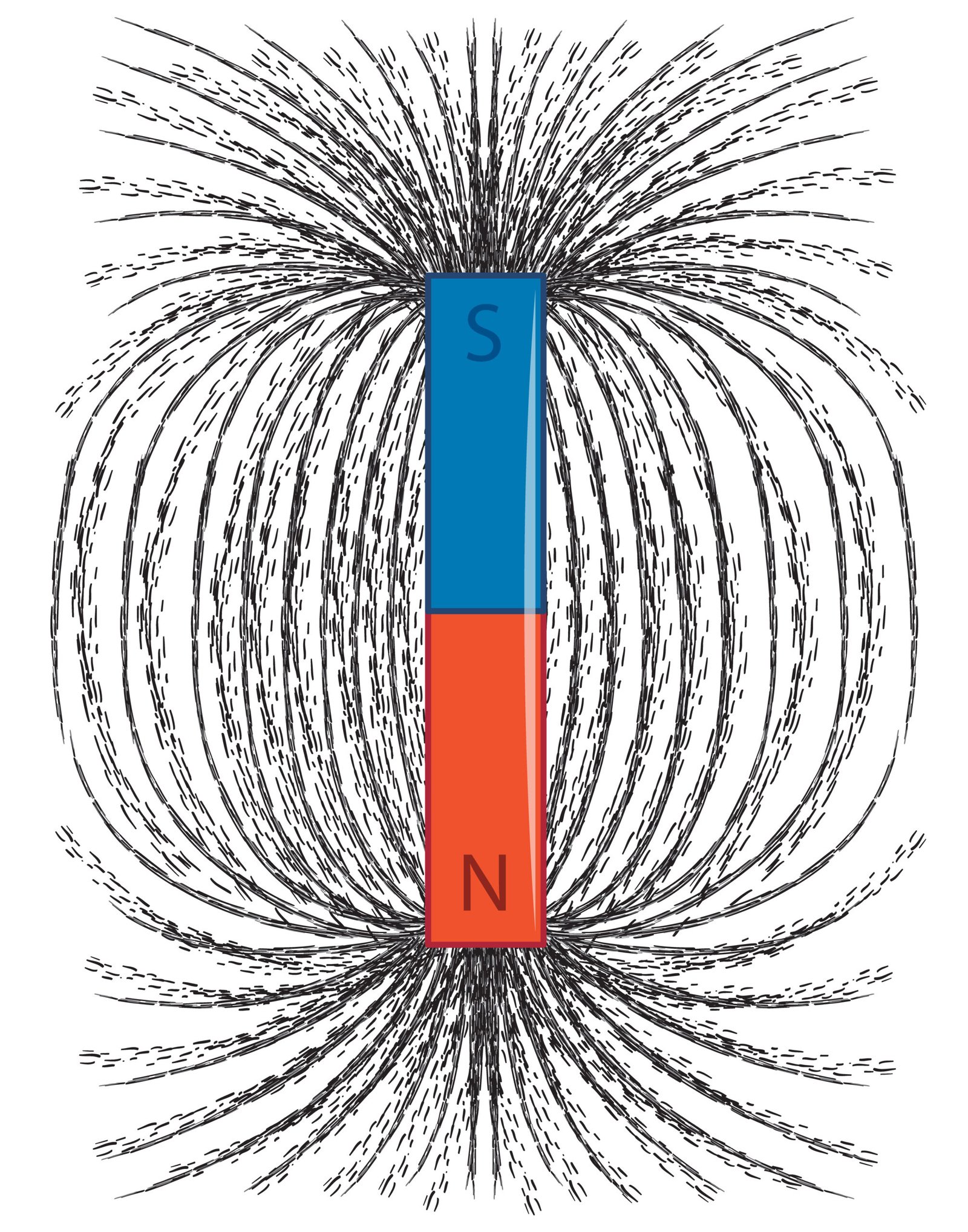
Magnet bar isolated on white background illustration
A bar magnet has two poles: North pole and South pole.
Magnetic field lines emerge from the North pole and enter the South pole, forming closed loops inside the magnet.
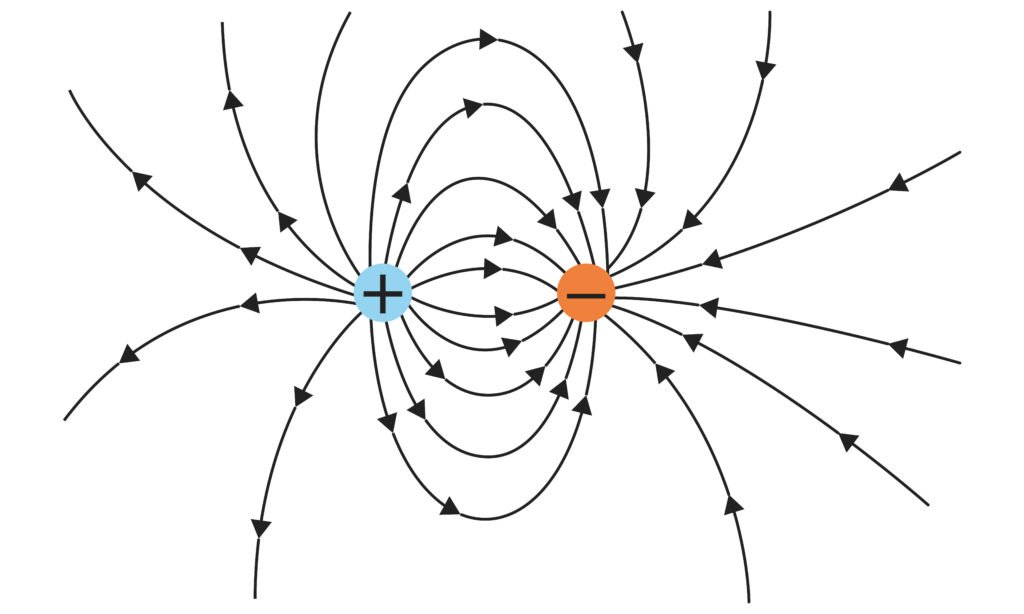
Unlike electric charges, magnetic monopoles do not exist; poles always occur in pairs.

Bar and Horseshoe Magnets, Educational Magnetism Physics Science, Induction and Attraction. Compass Navigation Tool and Electromagnetic Field and Magnetic Force Schemes.
💡 Magnetic Dipole Moment (M):
M = m × 2l
where m is the pole strength and 2l is the distance between poles.
✔️ It is a vector quantity pointing from South pole to North pole.
✔️ SI Unit: A·m².
🟢 2. Magnetic Field of a Bar Magnet
The magnetic field due to a bar magnet resembles that of a magnetic dipole.
(a) Field at Axial Point
Consider a point on the axial line of the magnet at distance r from its centre.
Field due to North pole = μ₀m / (4π(r – l)²)
Field due to South pole = μ₀m / (4π(r + l)²)
Resultant field (for r >> l):
➡️ B_axial = (μ₀ / 4π) × (2M / r³)
(b) Field at Equatorial Point
On the equatorial line at distance r:
Field due to North pole = μ₀m / (4π(r² + l²))
Field due to South pole = same magnitude, opposite direction.
Resultant (for r >> l):
➡️ B_equatorial = (μ₀ / 4π) × (M / r³)
✔️ Thus, field varies inversely with r³, similar to an electric dipole.
🔴 3. Torque on a Bar Magnet in a Uniform Magnetic Field
When a bar magnet with dipole moment M is placed in a uniform external field B, it experiences:
Force: Zero (net force cancels).
Torque:
➡️ τ = MB sinθ
This tends to align the magnet with the external field.
💡 Potential Energy:
U = –M·B = –MB cosθ
✔️ Minimum energy occurs when the magnet aligns parallel to the external field.
🟢 4. Earth’s Magnetism
Earth behaves like a giant bar magnet with its magnetic axis tilted at about 11.3° to the geographical axis. The south magnetic pole lies near the geographic north, and vice versa.
Important Quantities:
Magnetic Declination (D): Angle between geographic meridian and magnetic meridian.
Magnetic Dip (I): Angle made by Earth’s magnetic field with the horizontal.
Horizontal component (Bh): Bh = B cos I.
Vertical component (Bv): Bv = B sin I.
✏️ Note: Navigators use correction for declination while using a magnetic compass.
🔴 5. Magnetisation and Magnetic Intensity
When a material is placed in a magnetic field, atomic dipoles tend to align.
✔️ Magnetisation (M):
M = (magnetic moment) / (volume)
✔️ Magnetic Intensity (H):
External magnetising field applied.
Relationship:
B = μ₀(H + M)
✔️ Magnetic Susceptibility (χm):
M = χm H
✔️ Permeability (μ):
B = μH, where μ = μ₀(1 + χm)
🟢 6. Magnetic Properties of Materials
Materials respond differently to applied magnetic fields:
(a) Diamagnetic
Weakly repelled by a magnetic field.
χm negative.
Example: Copper, Bismuth.
No magnetisation remains after field removal.
(b) Paramagnetic
Weakly attracted by a magnetic field.
χm small, positive.
Example: Aluminium, Platinum.
Magnetisation vanishes when field removed.
(c) Ferromagnetic
Strongly attracted, retain magnetisation.
χm very large, positive.
Example: Iron, Cobalt, Nickel.
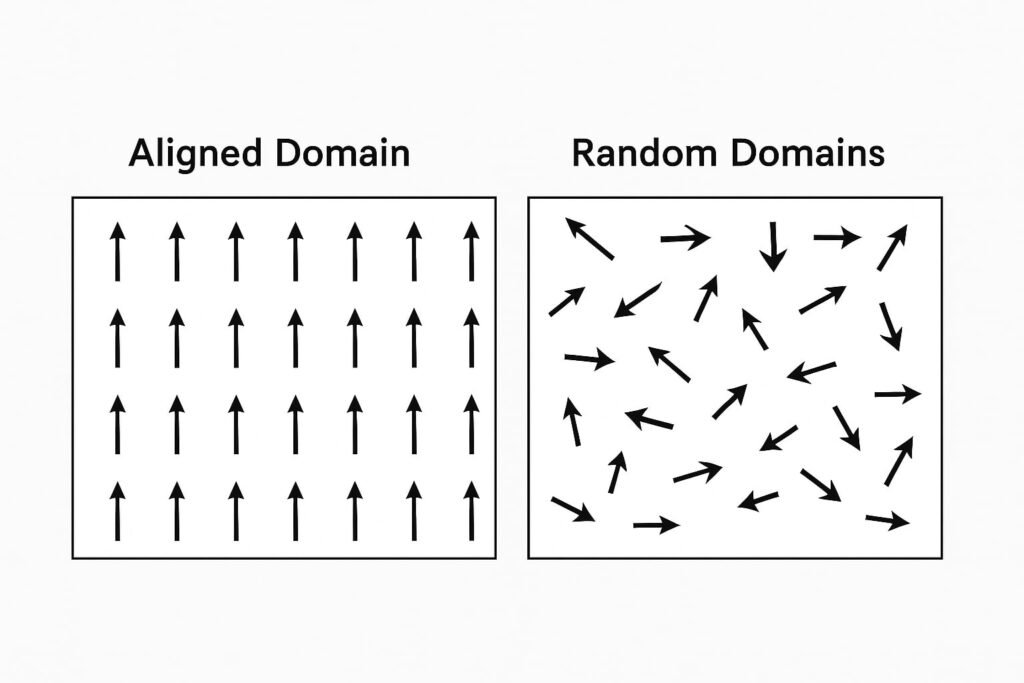
Exhibit domain structure (regions of aligned dipoles).
✔️ Ferromagnets are widely used in technology (transformers, motors, magnetic recording).
🔴 7. Hysteresis Phenomenon
Ferromagnetic materials show magnetic hysteresis, meaning magnetisation does not vanish immediately when the external field is removed.
Hysteresis Loop (B–H curve):
O to A: Magnetisation increases with H.
A to B: Even when H → 0, magnetisation remains (retentivity).
B to C: Negative H needed to remove residual magnetisation (coercivity).
Loop area: Energy loss per cycle.
✔️ Retentivity: Determines suitability for permanent magnets.
✔️ Coercivity: Determines suitability for electromagnets.
🟢 8. Permanent Magnets vs Electromagnets
Permanent Magnet:
High retentivity and coercivity.
Example: Steel.
Electromagnet:
High permeability, low coercivity.
Example: Soft iron.
✔️ Electromagnets are used in cranes, relays, and MRI machines.
🔴 9. Magnetic Elements of Earth (Variations)
Secular variation: Gradual change in magnetic elements over centuries.
Diurnal variation: Daily change due to Earth’s rotation.
Magnetic storms: Disturbances due to solar activity.
These affect navigation and space communication.
🟢 10. Magnetic Dipole and Electric Dipole Analogy
Both have dipole moments.
Field ∝ 1/r³ at large distances.
Torque aligns them with the external field.
Difference: Electric monopoles exist, magnetic monopoles don’t.
🔴 11. Applications of Magnetism
Compass navigation (declination correction essential).
Motors and generators (electromagnets).
Transformers (soft iron cores).
Data storage (hard disks).
Medical imaging (MRI).
Security devices and credit card strips.
✔️ Magnetism finds wide applications in daily life and advanced technology.
🟡 Expanded Conceptual Depth Additions
Derivation of Torque Formula:
Consider a dipole of length 2l and pole strength m in field B.
Force on N pole = mB, on S pole = –mB.
Both forces form a couple → torque = mB × 2l sinθ = MB sinθ.
Energy in Magnetic Field:
Work done in rotating dipole from θ₁ to θ₂ = ∫ τ dθ = MB(cosθ₁ – cosθ₂).
So potential energy = –MB cosθ.
Hysteresis in practice:
In transformers, low energy loss (small loop) is desirable → soft iron.
For permanent magnets, large loop desirable → steel.
Earth’s Magnetic Field Estimation:
Gauss first measured it using deflection magnetometer.
🟢 Summary (~300 words)
Magnetism and Matter explains the magnetic behaviour of natural and artificial materials.
Bar Magnet: Acts like a dipole with moment M = m × 2l.
Magnetic Field:
Axial → (μ₀/4π)(2M/r³).
Equatorial → (μ₀/4π)(M/r³).
Torque & Energy: τ = MB sinθ, U = –MB cosθ.
Earth’s Magnetism: Earth is a tilted dipole; key elements: Declination (D), Dip (I), Bh = B cos I, Bv = B sin I.
Magnetisation & Intensity:
M = dipole moment/volume.
B = μ₀(H + M).
χm = M/H.
μ = μ₀(1 + χm).
Classification:
Diamagnetic (χm < 0).
Paramagnetic (χm > 0, small).
Ferromagnetic (χm large, positive).
Hysteresis Loop: Explains retentivity, coercivity, energy loss.
Magnets:
Permanent: steel (high retentivity).
Electromagnets: soft iron (low coercivity, high permeability).
Earth’s field variations: Secular, diurnal, magnetic storms.
Applications: Navigation, motors, generators, transformers, MRI, storage devices.
✔️ Thus, the chapter links microscopic origins of magnetism with macroscopic applications.
📝 Quick Recap
✔️ Bar magnet ≈ dipole (M = m × 2l).
✔️ B_axial ∝ 2M/r³, B_equatorial ∝ M/r³.
✔️ Torque = MB sinθ, U = –MB cosθ.
✔️ Earth’s magnetism → D, I, Bh, Bv.
✔️ Diamagnetic, paramagnetic, ferromagnetic.
✔️ Hysteresis → retentivity, coercivity, energy loss.
✔️ Permanent vs electromagnets.
✔️ Applications → compasses, transformers, MRI, data storage.
————————————————————————————————————————————————————————————————————————————
QUESTIONS FROM TEXTBOOK
Question 5.1
A short bar magnet placed with its axis at 30° with a uniform external magnetic field of 0.25 T experiences a torque of magnitude equal to 4.5 × 10⁻² J. What is the magnitude of magnetic moment of the magnet?
Answer
➡️ Given: τ = 4.5 × 10⁻² J, B = 0.25 T, θ = 30° (sinθ = 0.5)
✏️ Formula: τ = M B sinθ
🧠 Calculation: M = τ/(B sinθ) = (4.5 × 10⁻²)/(0.25 × 0.5) = 0.36 A·m²
✔️ Magnetic moment = 0.36 A·m²
Question 5.2
A short bar magnet of magnetic moment m = 0.32 J T⁻¹ is placed in a uniform magnetic field of 0.15 T. If the bar is free to rotate in the plane of the field, which orientation would correspond to (a) stable equilibrium and (b) unstable equilibrium? What is the potential energy of the magnet in each case?
Answer
➡️ Given: M = 0.32 J T⁻¹, B = 0.15 T
✏️ Potential energy: U = –MB cosθ
(a) Stable equilibrium → θ = 0° ⇒ U = –(0.32)(0.15)(1) = –0.048 J
(b) Unstable equilibrium → θ = 180° ⇒ U = –(0.32)(0.15)(–1) = +0.048 J
✔️ Stable at θ = 0°, unstable at θ = 180°.
Question 5.3
A closely wound solenoid of 800 turns and area of cross section 2.5 × 10⁻⁴ m² carries a current of 3.0 A. Explain the sense in which the solenoid behaves like a bar magnet. What is its associated magnetic moment?
Answer
➡️ Given: N = 800, A = 2.5 × 10⁻⁴ m², I = 3.0 A
✏️ Magnetic moment of a current loop/solenoid: M = N I A
🧠 Calculation: M = 800 × 3.0 × 2.5 × 10⁻⁴ = 0.60 A·m²
💡 The solenoid’s surface current produces a dipole moment; its ends act like N/S poles, so it behaves like a bar magnet with moment NIA.
Question 5.4
If the solenoid in Exercise 5.3 is free to turn about the vertical direction and a uniform horizontal magnetic field of 0.25 T is applied, what is the magnitude of torque on the solenoid when its axis makes an angle of 30° with the direction of field?
Answer
➡️ From Q5.3: M = 0.60 A·m²; B = 0.25 T; θ = 30°
✏️ τ = MB sinθ = 0.60 × 0.25 × 0.5 = 0.075 N·m
Question 5.5
A bar magnet of magnetic moment 1.5 J T⁻¹ lies aligned with the direction of a uniform magnetic field of 0.22 T.
(a) What is the amount of work required by an external torque to turn the magnet so as to align its magnetic moment (i) normal to the field, (ii) opposite to the field?
(b) What is the torque on the magnet in cases (i) and (ii)?
Answer
➡️ Given: M = 1.5 J T⁻¹, B = 0.22 T
✏️ Potential energy: U = –MB cosθ
(a) Work done = ΔU
(i) 0° → 90°: ΔU = [–MB cos90°] – [–MB cos0°] = 0 – (–MB) = MB = 0.33 J
(ii) 0° → 180°: ΔU = [–MB cos180°] – [–MB cos0°] = (+MB) – (–MB) = 2MB = 0.66 J
(b) Torque τ = MB sinθ
(i) At 90°: τ = MB = 0.33 N·m
(ii) At 180°: τ = 0 (since sin180° = 0)
Question 5.6
A closely wound solenoid of 2000 turns and area of cross-section 1.6 × 10⁻⁴ m², carrying a current of 4.0 A, is suspended through its centre allowing it to turn in a horizontal plane.
(a) What is the magnetic moment associated with the solenoid?
(b) What is the force and torque on the solenoid if a uniform horizontal magnetic field of 7.5 × 10⁻² T is set up at an angle of 30° with the axis of the solenoid?
Answer
➡️ Given: N = 2000, A = 1.6 × 10⁻⁴ m², I = 4.0 A, B = 7.5 × 10⁻² T, θ = 30°
(a) ✏️ M = N I A = 2000 × 4.0 × 1.6 × 10⁻⁴ = 1.28 A·m²
(b) ✔️ Net force on a dipole in a uniform field = 0
✏️ Torque: τ = MB sinθ = 1.28 × 7.5 × 10⁻² × 0.5 = 0.048 N·m
Question 5.7
A short bar magnet has a magnetic moment of 0.48 J T⁻¹. Give the direction and magnitude of the magnetic field produced by the magnet at a distance of 10 cm from the centre of the magnet on (a) the axis, (b) the equatorial lines (normal bisector) of the magnet.
Answer
➡️ Given: M = 0.48 J T⁻¹, r = 10 cm = 0.10 m; μ₀/4π = 1 × 10⁻⁷ T·m/A
✏️ Formulae:
Axial: B_axial = (μ₀/4π) × (2M / r³)
Equatorial: B_eq = (μ₀/4π) × (M / r³)
(a) Axial magnitude: B_axial = 10⁻⁷ × (2 × 0.48)/(0.1)³ = (0.96 × 10⁻⁷)/(10⁻³) = 9.6 × 10⁻⁵ T
🔎 Direction: Along the magnet’s axis in the same direction as the magnetic dipole moment (i.e., on the N-pole side, away from the magnet; outside, field lines are from N to S).
(b) Equatorial magnitude: B_eq = 10⁻⁷ × 0.48/(0.1)³ = (0.48 × 10⁻⁷)/(10⁻³) = 4.8 × 10⁻⁵ T
🔎 Direction: Along the equatorial line opposite to the magnetic dipole moment.
————————————————————————————————————————————————————————————————————————————
OTHER IMPORTANT QUESTIONS
(CBSE MODEL QUESTIONS PAPER)
ESPECIALLY MADE FROM THIS LESSON ONLY
Section A (Q1–Q18: MCQs)
Question 1
Magnetic dipole moment of a bar magnet is defined as:
🔵 (A) Product of pole strength and distance between poles
🟢 (B) Product of pole strength and radius of atom
🟠 (C) Ratio of magnetic flux to pole strength
🔴 (D) Product of current and resistance
Answer: (A) Product of pole strength and distance between poles
Question 2
Unit of magnetic dipole moment in SI system is:
🔵 (A) Tesla
🟢 (B) A·m²
🟠 (C) Weber
🔴 (D) N·m
Answer: (B) A·m²
Question 3
Magnetic field along the axial line of a bar magnet at distance r is proportional to:
🔵 (A) 1/r
🟢 (B) 1/r²
🟠 (C) 1/r³
🔴 (D) r
Answer: (C) 1/r³
Question 4
For a bar magnet placed in a uniform field, maximum torque occurs when:
🔵 (A) Axis parallel to field
🟢 (B) Axis perpendicular to field
🟠 (C) Axis opposite to field
🔴 (D) Axis at any angle
Answer: (B) Axis perpendicular to field
Question 5
Potential energy of a magnetic dipole in uniform field is:
🔵 (A) MB cosθ
🟢 (B) –MB cosθ
🟠 (C) MB sinθ
🔴 (D) –MB sinθ
Answer: (B) –MB cosθ
Question 6
Earth’s magnetic dip is 0° at:
🔵 (A) Magnetic poles
🟢 (B) Magnetic equator
🟠 (C) Geographic poles
🔴 (D) Tropics
Answer: (B) Magnetic equator
Question 7
Earth’s magnetic dip is 90° at:
🔵 (A) Equator
🟢 (B) Geographic poles
🟠 (C) Magnetic poles
🔴 (D) Mid-latitudes
Answer: (C) Magnetic poles
Question 8
Which relation is correct?
🔵 (A) Bh = B sin I
🟢 (B) Bh = B cos I
🟠 (C) Bv = B cos I
🔴 (D) Bh = Bv tan I
Answer: (B) Bh = B cos I
Question 9
Diamagnetic materials are:
🔵 (A) Strongly repelled by field
🟢 (B) Weakly repelled by field
🟠 (C) Strongly attracted by field
🔴 (D) Retain magnetisation permanently
Answer: (B) Weakly repelled by field
Question 10
Magnetic susceptibility of paramagnetic materials is:
🔵 (A) Large positive
🟢 (B) Small positive
🟠 (C) Small negative
🔴 (D) Zero
Answer: (B) Small positive
Question 11
Which property characterises ferromagnets?
🔵 (A) Weak attraction by field
🟢 (B) Strong magnetisation retained even after field removal
🟠 (C) Always repelled by field
🔴 (D) Do not respond to field
Answer: (B) Strong magnetisation retained even after field removal
Question 12
Hysteresis loop area represents:
🔵 (A) Magnetic field strength
🟢 (B) Energy loss per cycle
🟠 (C) Torque
🔴 (D) Magnetic permeability
Answer: (B) Energy loss per cycle
Question 13
Material suitable for making electromagnets must have:
🔵 (A) High coercivity
🟢 (B) Low coercivity and high permeability
🟠 (C) High retentivity
🔴 (D) No susceptibility
Answer: (B) Low coercivity and high permeability
Question 14
Material suitable for making permanent magnets must have:
🔵 (A) Low retentivity and low coercivity
🟢 (B) High retentivity and high coercivity
🟠 (C) High susceptibility but low retentivity
🔴 (D) Small hysteresis loop area
Answer: (B) High retentivity and high coercivity
Question 15
If magnetic dipole is aligned anti-parallel to field, its potential energy is:
🔵 (A) Maximum positive
🟢 (B) Maximum negative
🟠 (C) Zero
🔴 (D) Infinite
Answer: (A) Maximum positive
Question 16
Which instrument works on Earth’s magnetism?
🔵 (A) Compass
🟢 (B) Barometer
🟠 (C) Thermometer
🔴 (D) Galvanometer
Answer: (A) Compass
Question 17
Which of the following is NOT ferromagnetic?
🔵 (A) Iron
🟢 (B) Nickel
🟠 (C) Cobalt
🔴 (D) Aluminium
Answer: (D) Aluminium
Question 18
Which of the following quantities is a vector?
🔵 (A) Magnetic intensity H
🟢 (B) Magnetic permeability μ
🟠 (C) Magnetic susceptibility χ
🔴 (D) Relative permeability μr
Answer: (A) Magnetic intensity H
Section B (Q19–Q23: Very Short Answer)
Question 19
Define magnetic declination.
Answer: Angle between geographic meridian and magnetic meridian.
Question 20
What is meant by magnetic dip or inclination?
Answer: Angle between Earth’s magnetic field and the horizontal plane at a place.
Question 21
What is the horizontal component of Earth’s magnetic field?
Answer: Bh = B cos I, the component of total field parallel to horizontal plane.
Question 22
Why is soft iron used to make electromagnets?
Answer: High permeability and low coercivity → easy to magnetise/demagnetise.
Question 23
Give two examples of ferromagnetic substances.
Answer: Iron, Cobalt, Nickel.
Section C (Q24–Q28: Mid-length)
Question 24
Derive torque on a bar magnet in a uniform field.
Answer: τ = MB sinθ (derived from couple of forces on poles).
Question 25
Derive potential energy of a dipole in uniform field.
Answer: U = –MB cosθ (obtained from work = ∫ τ dθ).
Question 26
A needle of dipole moment 0.02 A·m² in 0.002 T makes 60°. Find torque.
Answer: τ = MB sinθ = 0.02 × 0.002 × √3/2 = 3.46 × 10⁻⁵ N·m.
Question 27
Bar magnet: M = 1.2 J T⁻¹, B = 0.20 T, θ = 30°. Find (a) torque, (b) energy.
Answer:
(a) τ = MB sinθ = 0.12 N·m.
(b) U = –MB cosθ = –0.208 J.
Section D (Q28–Q31: Long Answer)
Question 28
Classification of magnetic materials.
Answer:
Diamagnetic (χ < 0, weakly repelled, e.g., Cu).
Paramagnetic (χ small +, weakly attracted, e.g., Al).
Ferromagnetic (χ large +, strongly attracted, domain structure, e.g., Fe).
Question 29
Hysteresis loop.
Answer:
Retentivity: residual magnetisation at H = 0.
Coercivity: reverse field to demagnetise.
Loop area = energy loss.
✔️ Applications: permanent magnets vs electromagnets.
Question 30
Derive field at axial point of bar magnet.
Answer:
B = (μ₀ / 4π) × [2M / r³] (for r >> l).
Question 31
Compare bar magnet and solenoid.
Answer:
Similarities: N/S poles, field patterns, dipole moment.
Differences: Magnet = atomic dipoles, solenoid = current; magnet fixed moment, solenoid adjustable.
Section E (Q32–Q33: Case/Application)
Question 32
Magnet (M = 0.5 A·m²) in Earth’s Bh = 3.6 × 10⁻⁵ T, rotated 0°→90°.
(a) Torque at 90° = MB = 1.8 × 10⁻⁵ N·m.
(b) Work = MB = 1.8 × 10⁻⁵ J.
Question 33
Which material for electromagnet vs permanent magnet?
Answer:
Electromagnets → soft iron (high μ, low coercivity).
Permanent magnets → steel/Alnico (high retentivity & coercivity).
————————————————————————————————————————————————————————————————————————————