
Class 12 : Biology (English) – Lesson 1 Sexual Reproduction in Flowering Plants

EXPLANATION & SUMMARY
🌼 Introduction
Flowering plants (angiosperms) reproduce sexually through a complex, coordinated process that ensures genetic variation and survival of the species. This chapter explores how male and female gametes are formed, how pollination and fertilisation occur, and how fruits and seeds are developed. It also introduces processes like apomixis and parthenocarpy.
🌱 1. Flower – A Reproductive Unit
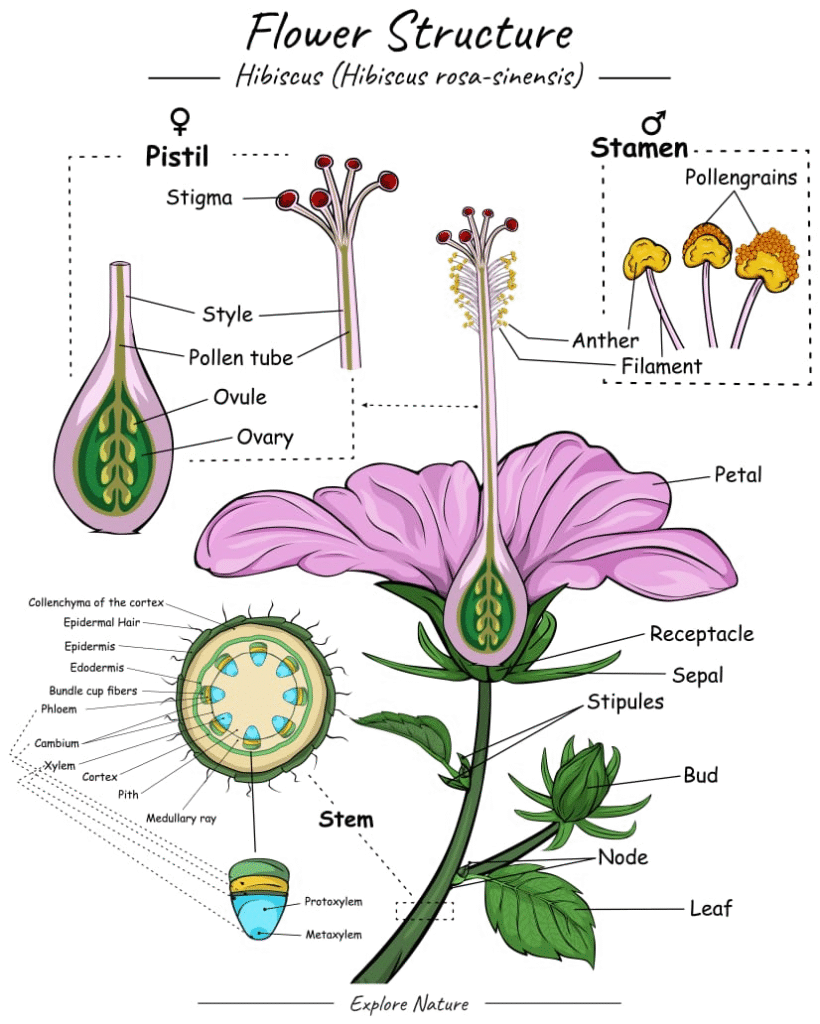
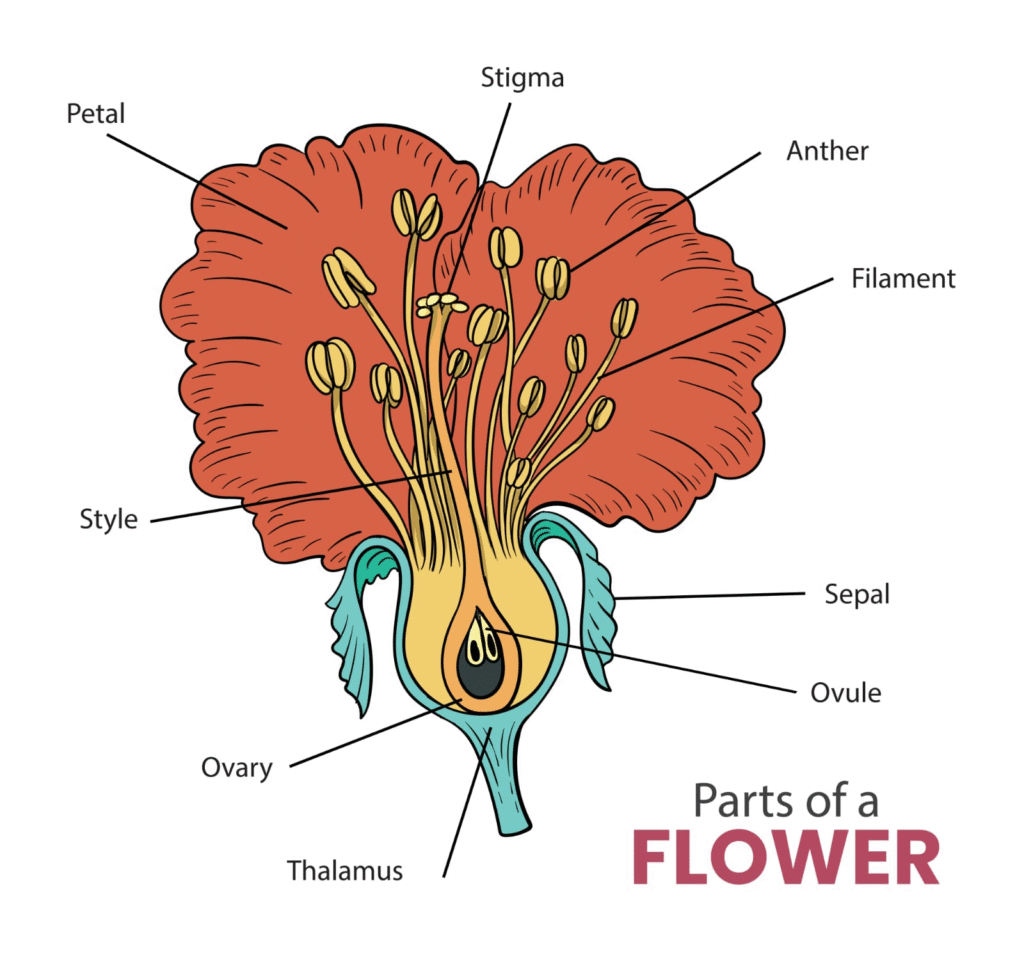
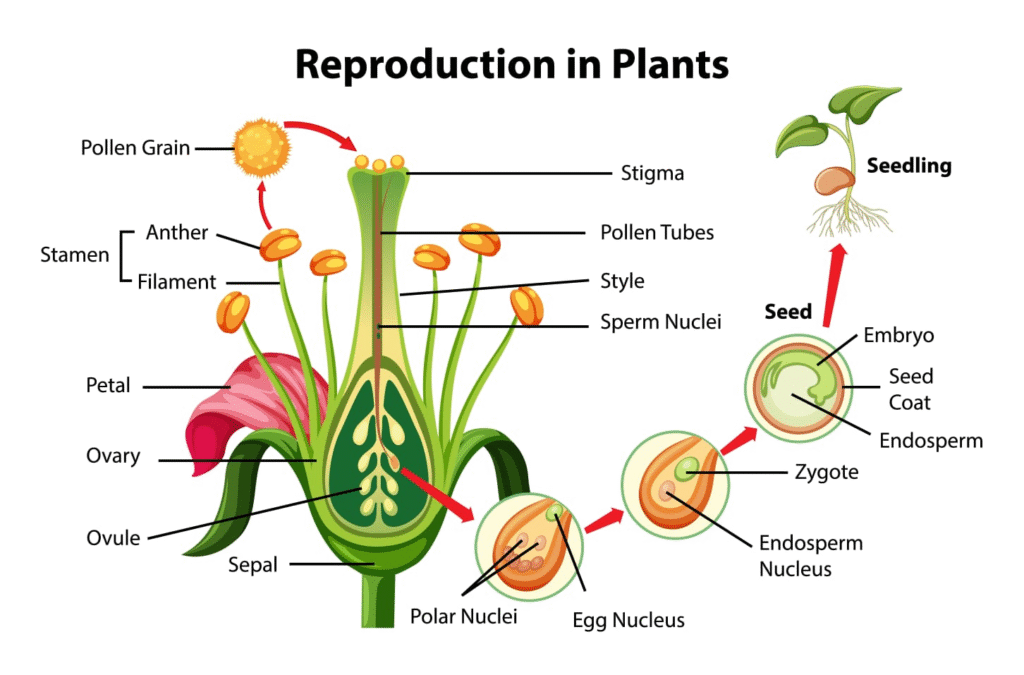
The flower is the site of sexual reproduction in angiosperms. A typical flower has four concentric whorls:
Calyx (sepals) – protection
Corolla (petals) – attraction
Androecium (stamens) – male reproductive part
Gynoecium (carpels) – female reproductive part
♂️ 2. Development of Male Gametophyte
🧬 2.1 Structure of Stamen
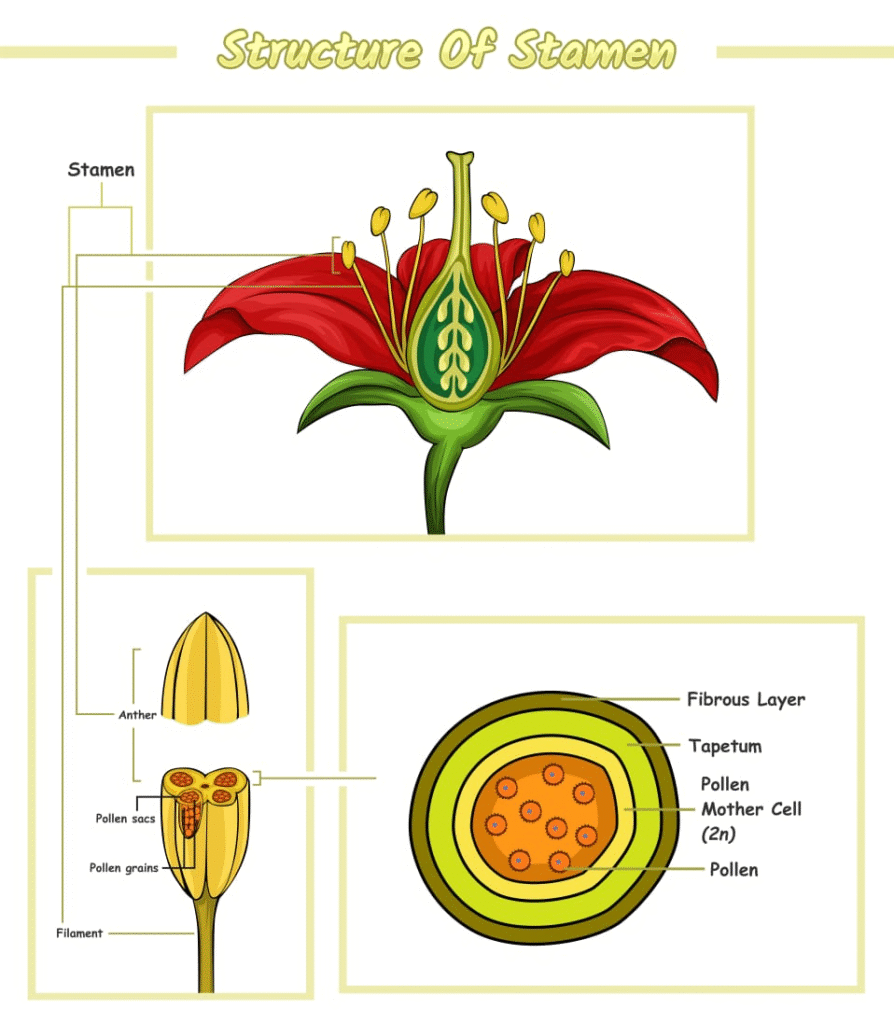
A stamen consists of a filament and an anther. The anther is bilobed and each lobe contains two pollen sacs. A typical anther is tetrasporangiate.
🔍 2.2 Microsporogenesis
Microsporogenesis is the process by which pollen mother cells (PMCs) undergo meiosis to form haploid microspores.
These microspores remain together temporarily in a tetrad.
Each microspore develops into a pollen grain, the male gametophyte.
🧪 2.3 Pollen Grain Structure
Pollen grains are surrounded by a two-layered wall:
Exine: tough, made of sporopollenin (chemically inert)
Intine: inner cellulose and pectin wall
Mature pollen contains:
Vegetative cell (large)
Generative cell (small) → divides into two male gametes
♀️ 3. Development of Female Gametophyte
🌸 3.1 Structure of Ovule
The ovule is attached to the placenta by a funicle.
It has one or two integuments with a micropyle at one end.
The central mass, nucellus, contains the embryo sac (female gametophyte).
🔁 3.2 Megasporogenesis
The megaspore mother cell (MMC) inside the nucellus undergoes meiosis forming four megaspores, only one of which survives.
This functional megaspore develops into the embryo sac.
🔍 3.3 Structure of Embryo Sac
The typical embryo sac is 7-celled and 8-nucleate:
3 cells at micropylar end: one egg cell + 2 synergids
2 polar nuclei in central cell
3 antipodal cells at chalazal end
Monosporic development: only one megaspore forms the gametophyte.
🍃 4. Pollination
Pollination is the transfer of pollen from anther to stigma. It is of three types:
Autogamy – same flower
Geitonogamy – different flowers of same plant
Xenogamy – flowers of different plants
💡 4.1 Chasmogamy and Cleistogamy
Chasmogamous flowers: open flowers
Cleistogamous flowers: closed flowers – ensure autogamy
🔄 4.2 Agents of Pollination
Abiotic agents: wind (anemophily), water (hydrophily)
Biotic agents: insects, birds, bats
🚫 4.3 Outbreeding Devices
Plants avoid self-pollination through:
Herkogamy (physical barrier)
Dichogamy (different timing of maturity)
Self-incompatibility (genetic mechanism)
Male and female flowers on different plants (dioecy)
🧪 5. Pollen-Pistil Interaction
The interaction between the pollen grain and stigma determines compatibility.
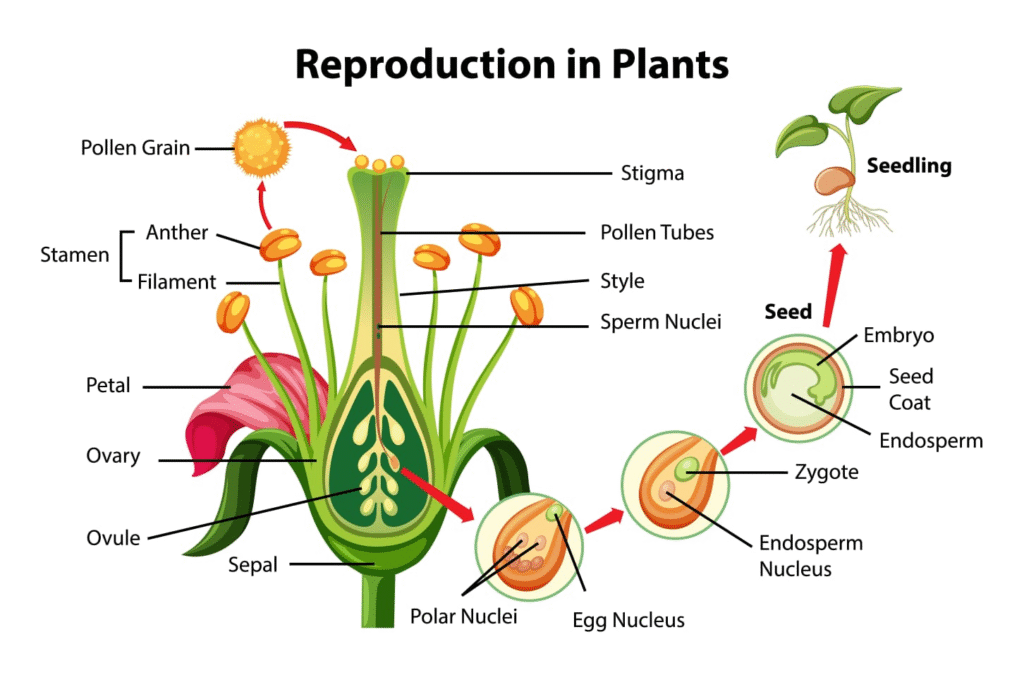
In compatible pollen, the pollen tube grows through the style, guided by chemical cues, and enters the ovule through the micropyle.
🌟 6. Double Fertilisation
A unique feature of angiosperms is double fertilisation:
One male gamete fuses with egg → zygote (syngamy)
Other gamete fuses with polar nuclei → triploid endosperm nucleus (triple fusion)
Thus:
Syngamy + Triple fusion = Double fertilisation
🍼 7. Post-Fertilisation Events
After fertilisation, the following changes occur:
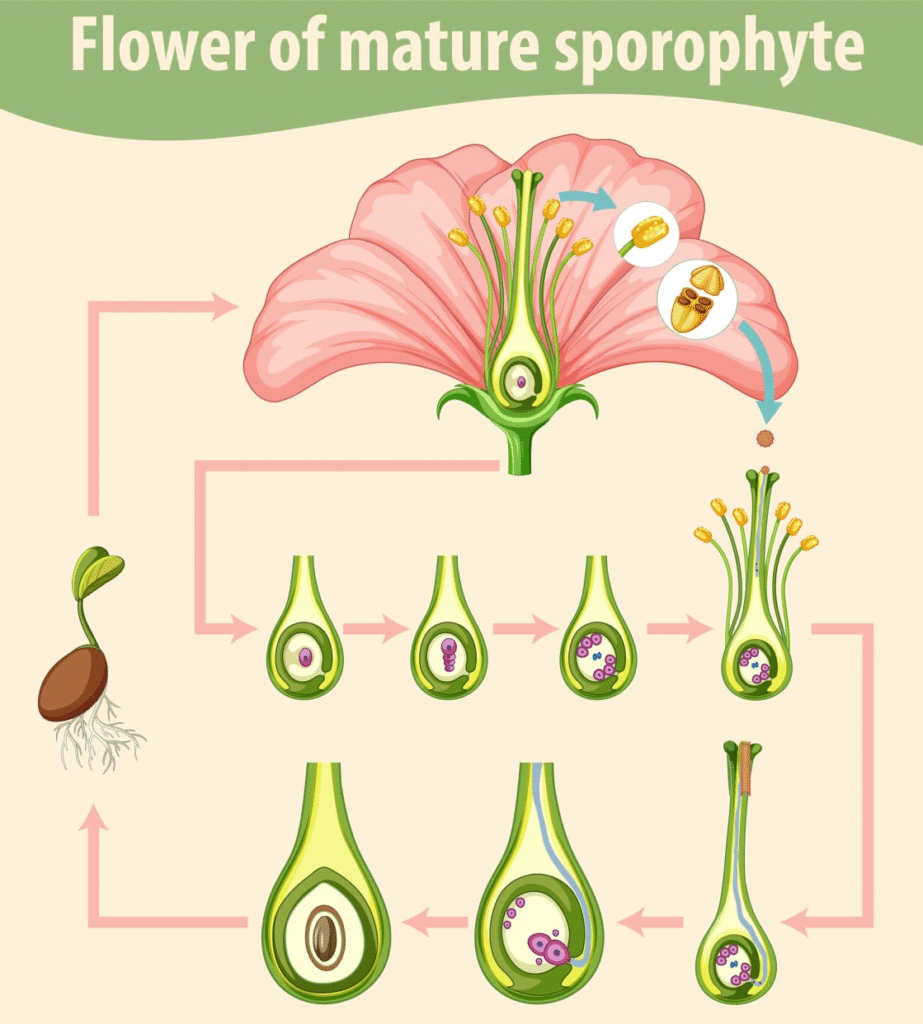
🌿 7.1 Endosperm Development
Endosperm provides nourishment to the embryo.
Formed before the embryo.
Types:
Nuclear – free nuclear divisions (most common)
Cellular – wall formation after each division
Helobial – intermediate
🌱 7.2 Embryo Development
Zygote divides to form embryo with:
Radicle (root tip)
Plumule (shoot tip)
Cotyledons
Hypocotyl and epicotyl
Monocot embryos (like maize) have one cotyledon and structures like scutellum, coleoptile, and coleorhiza.
🌰 8. Seed and Fruit Formation
Ovules → seeds
Ovary → fruit
Integuments → seed coat (testa and tegmen)
🍎 8.1 True and False Fruits
True fruit: formed from ovary only
False fruit: formed from ovary + other floral parts (e.g., apple – thalamus)
🌾 9. Special Modes of Reproduction
🧬 9.1 Apomixis
Seeds formed without fertilisation.
Common in grasses.
Ensures clonal propagation and maintains hybrid vigour.
🍌 9.2 Parthenocarpy
Development of seedless fruit without fertilisation (e.g., banana).
Can be induced by applying growth hormones.
🧬 10. Significance of Sexual Reproduction
Introduces genetic variation
Ensures adaptation and evolution
Maintains genetic lineage
Important for plant breeding, agriculture, and biodiversity
✍️ SUMMARY (Approx. 300 Words)
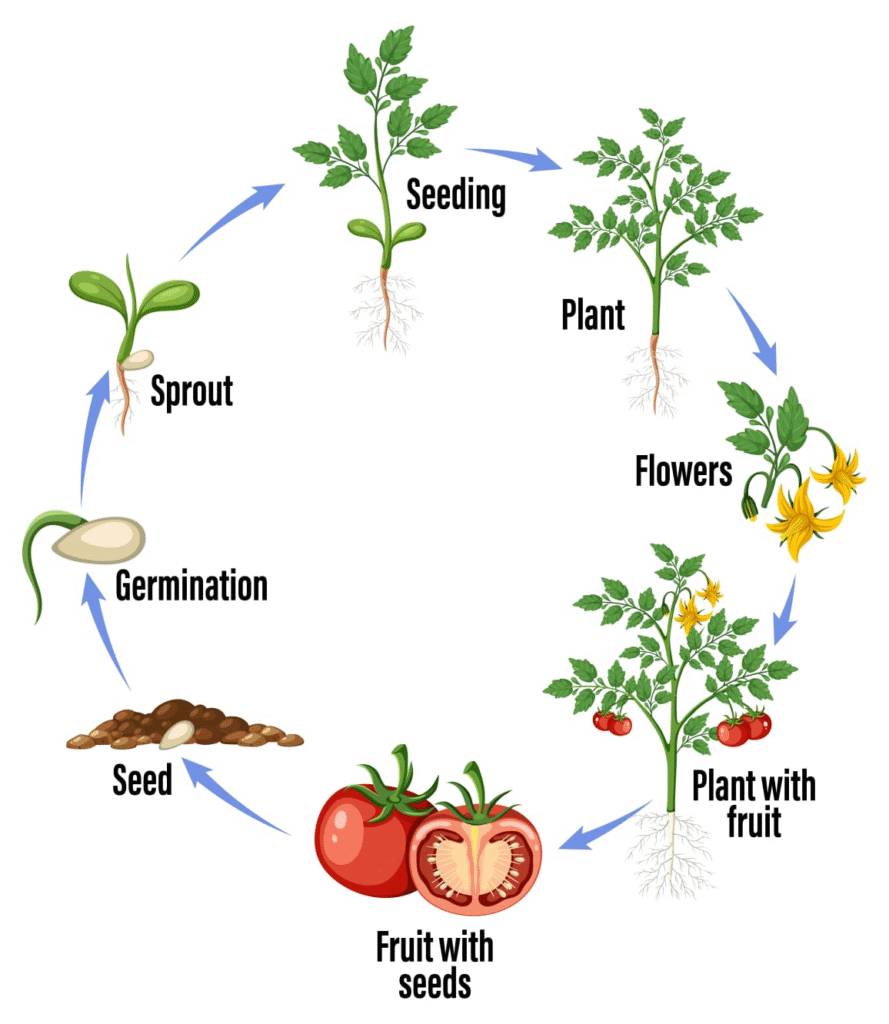
The flower is the reproductive unit of angiosperms, consisting of stamens (male) and carpels (female).
Microsporogenesis forms microspores from pollen mother cells via meiosis, developing into pollen grains.
Each pollen grain contains a vegetative and generative cell, the latter producing two male gametes.
Megasporogenesis occurs inside the ovule, where one megaspore from a tetrad survives and forms the embryo sac. The mature female gametophyte is 7-celled and 8-nucleate.
Pollination is the transfer of pollen to stigma, with autogamy, geitonogamy, and xenogamy as types. Self-pollination is avoided by mechanisms like herkogamy, dichogamy, and self-incompatibility.
Pollen-pistil interaction ensures compatibility. The pollen tube guides male gametes to the embryo sac via the micropyle.
Double fertilisation is a unique angiosperm process where:
One sperm fertilises the egg (forms zygote)
Another fuses with polar nuclei (forms endosperm)
Post-fertilisation events include:
Zygote forming embryo (radicle, plumule, cotyledons)
Endosperm development for embryo nourishment
Ovule converting into seed, ovary into fruit
Seeds may be formed without fertilisation in apomixis, and parthenocarpy leads to seedless fruits, useful in horticulture.
Sexual reproduction introduces variation, supports evolution, and enhances adaptation. It is critical for maintaining diversity and is harnessed in plant breeding programs for crop improvement.
————————————————————————————————————————————————————————————————————————————
QUESTIONS FROM TEXTBOOK
Q1. Name the parts of an angiosperm flower in which development of male and female gametophyte take place.
Answer:
Male gametophyte development takes place in the anther (part of the stamen).
Female gametophyte development takes place in the ovule (located inside the ovary of the pistil).
Q2. Differentiate between microsporogenesis and megasporogenesis. Which type of cell division occurs during these events? Name the structures formed at the end of these two events.
Answer:
Feature Microsporogenesis Megasporogenesis
Occurs in Anther Ovule
Starting cell Microspore mother cell (MMC) Megaspore mother cell (MMC)
End products Microspore tetrad (4 haploid microspores) One functional megaspore (3 degenerate)
Cell division type Meiosis Meiosis
Gametophyte formed Male gametophyte (pollen grain) Female gametophyte (embryo sac)
Type of division: Both involve meiosis.
Final structure formed:
Microsporogenesis → Microspore (male gametophyte precursor)
Megasporogenesis → Functional megaspore (female gametophyte precursor)
Q3. Arrange the following terms in the correct developmental sequence:
Pollen grain, sporogenous tissue, microspore tetrad, pollen mother cell, male gametes
Answer:
Correct sequence:
Sporogenous tissue → Pollen mother cell → Microspore tetrad → Pollen grain → Male gametes
Q4. With a neat, labelled diagram, describe the parts of a typical angiosperm ovule.
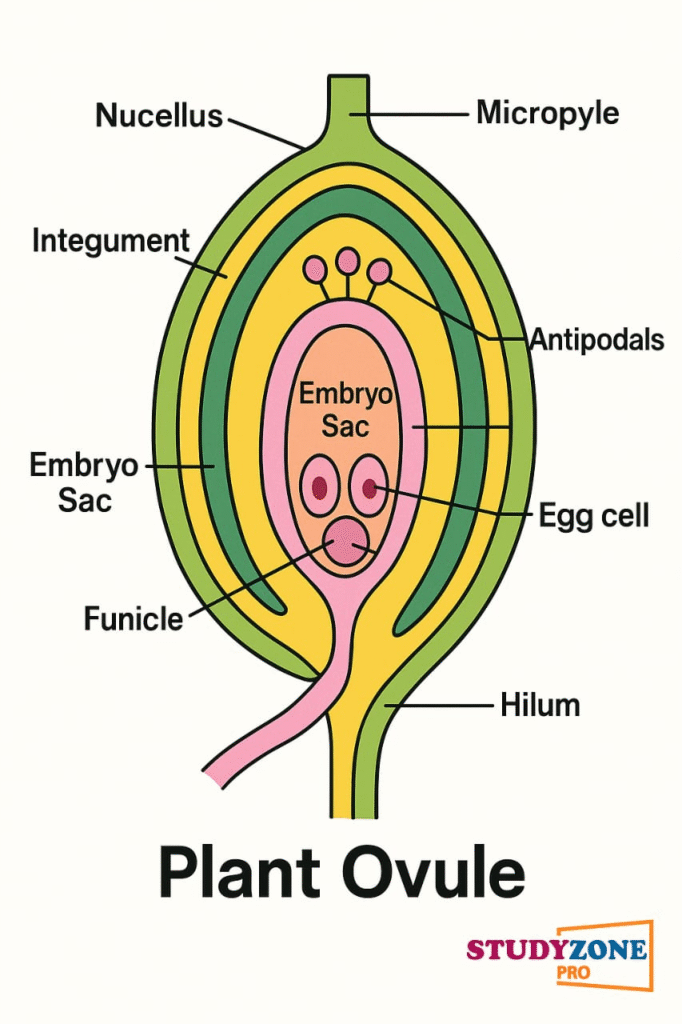
Answer:
Description:
A typical ovule is also called megasporangium. It is composed of the following parts:
Funicle – stalk that attaches ovule to the placenta.
Hilum – junction between the ovule and funicle.
Integuments – protective layers surrounding the ovule (usually two).
Micropyle – small opening at the tip of the ovule where pollen tube enters.
Nucellus – central mass of parenchymatous cells, provides nutrition.
Embryo sac – female gametophyte formed inside the nucellus.
Diagram: (Textual format)
Micropyle
↓
/ \
Integuments |
/ \ |
| |← Nucellus (with embryo sac)
___/ |
__________/
↑
Chalaza
|
Funicle
Q5. What is meant by monosporic development of female gametophyte?
Answer:
Monosporic development refers to the formation of the female gametophyte (embryo sac) from a single functional megaspore out of the four megaspores produced by meiosis of the megaspore mother cell.
The other three megaspores degenerate.
The remaining megaspore undergoes three mitotic divisions to form the 8-nucleate, 7-celled embryo sac.
Q6. With a neat diagram explain the 7-celled, 8-nucleate nature of the female gametophyte.
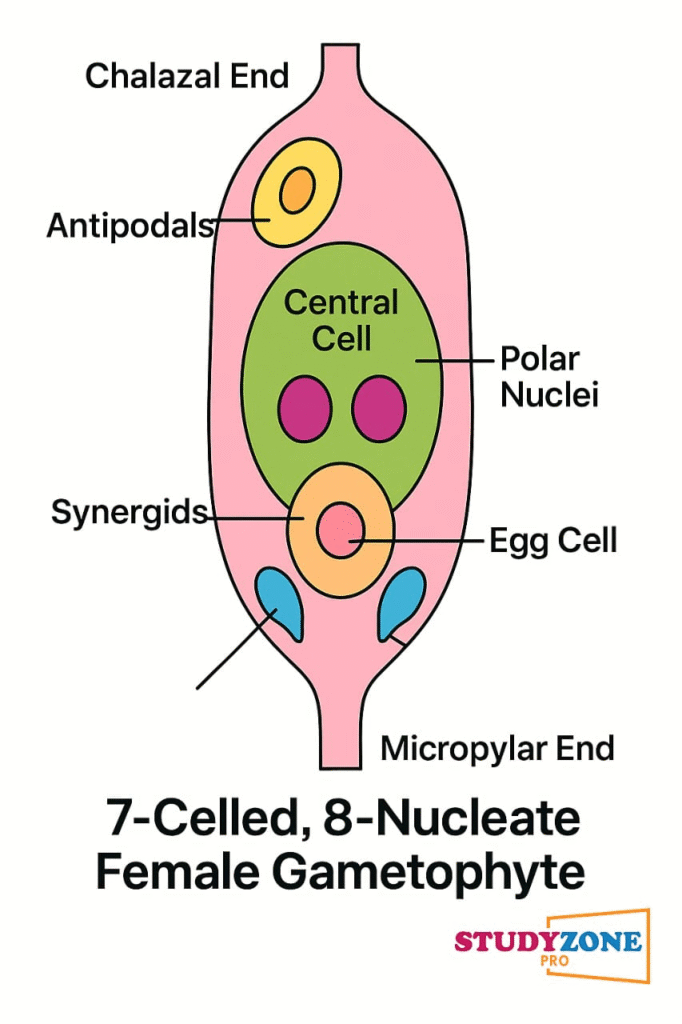
Answer:
Explanation:
The functional megaspore undergoes three mitotic divisions:
First division → 2 nuclei
Second division → 4 nuclei
Third division → 8 nuclei
These nuclei are arranged as follows:
3 at micropylar end → 1 egg cell + 2 synergids (1 cell each)
3 at chalazal end → 3 antipodal cells
2 in center → polar nuclei (remain in a single central cell)
Thus, 8 nuclei are distributed in 7 cells:
1 egg cell
2 synergids
3 antipodals
1 central cell with 2 nuclei
Diagram: (Textual format)
Chalazal end
| Antipodals (3) |
| |
| Central Cell | ← 2 Polar Nuclei
| |
| Synergids (2) |
| Egg Cell (1) | ← Micropylar end
Q7. What are chasmogamous flowers? Can cross-pollination occur in cleistogamous flowers? Give reasons for your answer.
Answer:
Chasmogamous flowers are flowers which open at maturity and expose their reproductive organs (anthers and stigma) for pollination.
Cleistogamous flowers are flowers that never open. Since the stigma and anthers are enclosed together, only self-pollination occurs in them.
Can cross-pollination occur in cleistogamous flowers?
No, because the flowers remain closed, the entry of pollen from other flowers is not possible.
Hence, cross-pollination does not occur in cleistogamous flowers; only autogamy (self-pollination) takes place.
Q8. Mention two strategies evolved to prevent self-pollination in flowers.
Answer:
Two strategies to prevent self-pollination are:
Herkogamy:
Structural barrier between anthers and stigma of the same flower (e.g., stigma is at a higher position than anthers).
Prevents physical contact between pollen and stigma.
Example: Hibiscus.
Dichogamy:
Maturation of anther and stigma at different times.
Two types:
Protandry: Anthers mature before stigma (e.g., Sunflower)
Protogyny: Stigma matures before anthers (e.g., Datura)
Q9. What is self-incompatibility? Why does self-pollination not lead to seed formation in self-incompatible species?
Answer:
Self-incompatibility is a genetic mechanism in flowering plants that prevents self-pollen from fertilizing the ovule.
It prevents inbreeding and promotes genetic diversity.
Reason for failure of seed formation:
In self-incompatible species, the pollen grain fails to germinate on the stigma or the pollen tube is blocked.
Therefore, even though pollen from the same plant lands on the stigma, fertilization doesn’t occur, and seeds are not formed.
Q10. What is bagging technique? How is it useful in a plant breeding programme?
Answer:
Bagging is the process of covering the flower with a butter paper or polythene bag to prevent unwanted pollination.
This is done before anthesis (opening of the flower).
Use in plant breeding:
It ensures that the stigma receives pollen only from desired parent plants.
After bagging, controlled pollination is done by introducing selected pollen, ensuring hybrid formation.
Q11. What is triple fusion? Where and how does it take place? Name the nuclei involved in triple fusion.
Answer:
Triple fusion is the process in which one male gamete fuses with the two polar nuclei present in the central cell of the embryo sac.
It occurs in the central cell of the embryo sac during fertilization.
Process:
Pollen tube releases two male gametes into the embryo sac.
One gamete fuses with egg → syngamy → zygote
Other gamete fuses with two polar nuclei → triple fusion → primary endosperm nucleus (PEN)
Nuclei involved:
One male gamete nucleus
Two polar nuclei of the central cell
Q12. Why do you think the zygote is dormant for sometime in a fertilised ovule?
Answer:
The zygote remains dormant until the endosperm is formed because:
Endosperm serves as the nutritive tissue for the developing embryo.
Development of embryo (from zygote) requires a ready supply of nutrients.
Conclusion:
Dormancy ensures that the zygote does not start division until the endosperm (which forms earlier via triple fusion) is developed and available.
Q13. Differentiate between:
(a) Hypocotyl and epicotyl
(b) Coleoptile and coleorrhiza
(c) Integument and testa
(d) Perisperm and pericarp
Answer:
Feature First Term Second Term
(a) Hypocotyl Part of embryo below cotyledons; forms root Part of embryo above cotyledons; forms shoot
(b) Coleoptile Protective sheath covering plumule in monocots Protective sheath covering radicle in monocots
(c) Integument Protective layer(s) of ovule Seed coat developed from integuments
(d) Perisperm Remnant of nucellus in some seeds; may store food Wall of ovary that develops into fruit wall
Q14. Why is apple called a false fruit? Which part(s) of the flower forms the fruit?
Answer:
Apple is called a false fruit because it is formed from the thalamus, not just the ovary.
In false fruits, parts other than the ovary also contribute to fruit formation.
In apple, the thalamus becomes fleshy and forms the edible part of the fruit.
Q15. What is meant by emasculation? When and why does a plant breeder employ this technique?
Answer:
Emasculation is the removal of anthers from a bisexual flower before they mature.
This prevents self-pollination and ensures controlled cross-pollination.
Used when:
The flower is bisexual (has both male and female parts).
Plant breeders want to cross-pollinate the flower using desired pollen from another plant.
Q16. If one can induce parthenocarpy through the application of growth substances, which fruits would you select to induce parthenocarpy and why?
Answer:
Fruits such as banana, grapes, watermelon, and orange are selected for induced parthenocarpy.
Why:
These fruits have high consumer demand in seedless form.
Seedless varieties improve edibility and market value.
Q17. Explain the role of tapetum in the formation of pollen-grain wall.
Answer:
Tapetum is the innermost layer of the anther wall, surrounding the sporogenous tissue.
It is nutritive and secretes materials essential for pollen development.
Role in pollen wall formation:
Tapetum secretes sporopollenin precursors, which form the exine layer (outer tough wall) of pollen grain.
It also helps in the formation of pollen coat, enzymes, and proteins important for pollen viability.
Q18. What is apomixis and what is its importance?
Answer:
Apomixis is a form of asexual reproduction that mimics sexual reproduction but does not involve fertilization.
Seeds are formed without fusion of gametes.
Importance:
Produces genetically identical offspring (clones).
Maintains hybrid vigour in successive generations.
Useful in agriculture and horticulture to produce uniform high-yielding crops.
————————————————————————————————————————————————————————————————————————————
OTHER IMPORTANT QUESTIONS FOR EXAMS
(CBSE MODEL QUESTIONS PAPER)
ESPECIALLY MADE FROM THIS LESSON ONLY
Q1. In a typical angiosperm, male gametophyte is represented by:
(A) Microspore mother cell
(B) Pollen grain
(C) Anther
(D) Generative cell
Answer: (B) Pollen grain
Q2. Which one of the following is the outermost layer in a mature anther?
(A) Endothecium
(B) Tapetum
(C) Epidermis
(D) Middle layer
Answer: (C) Epidermis
Q3. The term ‘double fertilisation’ refers to:
(A) Fertilisation involving two ovules
(B) Fusion of two male gametes
(C) Two fertilisation events in the same embryo sac
(D) Fusion of one male gamete with antipodals
Answer: (C) Two fertilisation events in the same embryo sac
Q4. Pollen viability refers to:
(A) The capacity of pollen to stick to stigma
(B) The ability of pollen to germinate
(C) The ability of pollen to cause self-incompatibility
(D) The number of nuclei in pollen
Answer: (B) The ability of pollen to germinate
Q5. Assertion (A): Cleistogamous flowers show guaranteed self-pollination.
Reason (R): Their anthers and stigma are exposed to air.
(A) Both A and R are true, and R is the correct explanation of A
(B) Both A and R are true, but R is not the correct explanation of A
(C) A is true, R is false
(D) A is false, R is true
Answer: (C) A is true, R is false
Q6. The exine of a pollen grain is made of:
(A) Lignin
(B) Cellulose
(C) Cutin
(D) Sporopollenin
Answer: (D) Sporopollenin
Q7. The function of the tapetum in the anther is to:
(A) Protect the pollen sac
(B) Provide nutrition to developing microspores
(C) Form the filament
(D) Develop into pollen grains
Answer: (B) Provide nutrition to developing microspores
Q8. Which structure in a flower is responsible for the formation of the seed coat?
(A) Endosperm
(B) Nucellus
(C) Integuments
(D) Funicle
Answer: (C) Integuments
Q9. In which type of endosperm development does free nuclear division occur?
(A) Nuclear
(B) Cellular
(C) Helobial
(D) Syncytial
Answer: (A) Nuclear
Q10. Arrange the following in the correct order of embryo sac development:
Functional megaspore
Megaspore mother cell
Embryo sac
Megaspore tetrad
(A) 2 → 4 → 1 → 3
(B) 2 → 1 → 4 → 3
(C) 1 → 2 → 3 → 4
(D) 3 → 2 → 1 → 4
Answer: (A) 2 → 4 → 1 → 3
Q11. Very short answer:
What is the role of synergids in the embryo sac?
Answer:
Synergids help guide the pollen tube into the embryo sac by secreting chemical attractants.
Q12. Very short answer:
Name the three components of a mature embryo sac at the micropylar end.
Answer:
One egg cell and two synergids.
Q13. Very short answer:
Which part of the ovule becomes the seed after fertilisation?
Answer:
The ovule itself becomes the seed.
Q14. Very short answer:
Define emasculation.
Answer:
Emasculation is the removal of anthers from a bisexual flower to prevent self-pollination.
Q15. Case-based MCQ:
Read the following passage and answer the question:
“In some plants, both male and female reproductive organs mature at different times in a flower to prevent self-pollination.”
Which of the following terms describes this condition?
(A) Herkogamy
(B) Dichogamy
(C) Cleistogamy
(D) Apomixis
Answer: (B) Dichogamy
Q16. Case-based MCQ:
“In grass species, seeds are formed without fertilisation and produce progeny genetically identical to the parent.”
This type of reproduction is:
(A) Parthenogenesis
(B) Polyembryony
(C) Apomixis
(D) Cleistogamy
Answer: (C) Apomixis
Q17. Assertion (A): Polar nuclei participate in triple fusion.
Reason (R): They fuse with a male gamete to form a diploid nucleus.
(A) Both A and R are true, and R is the correct explanation of A
(B) Both A and R are true, but R is not the correct explanation of A
(C) A is true, R is false
(D) A is false, R is true
Answer: (C) A is true, R is false
Q18. MCQ:
Which plant hormone is commonly used to induce parthenocarpy in fruits?
(A) Cytokinin
(B) Ethylene
(C) Auxin
(D) Gibberellin
Answer: (D) Gibberellin
Q19. Define geitonogamy. How is it both similar to and different from autogamy?
Answer:
Geitonogamy is the transfer of pollen grains from the anther of one flower to the stigma of another flower on the same plant.
Similarity to autogamy: Both involve pollen from the same genetic individual.
Difference: Geitonogamy requires a pollinating agent, while autogamy is within the same flower and often doesn’t.
Q20. Why is sporopollenin considered the most resistant biological material? Mention one significance of this property.
Answer:
Sporopollenin is highly resistant to physical and biological decomposition due to its stable chemical structure.
Significance: It ensures the preservation of pollen grains for a long time in fossil records, helping in palynology.
Q21. Explain the role of synergids in the fertilisation process in flowering plants.
Answer:
Synergids secrete chemical attractants (like LURE peptides) that guide the pollen tube into the embryo sac.
One of the synergids degenerates to facilitate entry of the pollen tube and release of male gametes.
Q22. Why are cleistogamous flowers considered highly adapted for ensuring seed formation? Give one advantage and one disadvantage.
Answer:
Advantage: Guaranteed self-pollination even in absence of pollinators, ensuring reproductive success.
Disadvantage: No genetic variation occurs, which can make plants vulnerable to diseases or environmental changes.
Q23. Distinguish between perisperm and endosperm. Mention one example where each is found.
Answer:
Perisperm: Remnant of nucellus in seed; e.g., black pepper.
Endosperm: Triploid tissue formed after fertilisation, stores nutrients; e.g., wheat.
Q24. Describe the development of a pollen grain from a microspore mother cell.
Answer:
Step 1: Microspore mother cell undergoes meiosis → forms microspore tetrad (4 haploid cells).
Step 2: Each microspore separates and develops a thick wall – exine and intine.
Step 3: The microspore nucleus divides mitotically to form two cells:
A large vegetative cell
A small generative cell
This forms the mature male gametophyte (pollen grain).
Q25. What is emasculation? In which type of flowers is it done, and why?
Answer:
Emasculation is the removal of anthers from bisexual flowers before they dehisce.
Done in: Bisexual flowers.
Purpose: To prevent self-pollination during hybridisation, allowing only desired pollen from another plant to fertilise the flower.
Q26. Explain the process of triple fusion in angiosperms. Why is it termed as such?
Answer:
One male gamete fuses with two polar nuclei in the central cell of the embryo sac.
This results in the formation of a triploid primary endosperm nucleus.
Called triple fusion because three haploid nuclei (2 polar + 1 male) fuse.
It is part of the double fertilisation event unique to angiosperms.
Q27. Differentiate between autogamy, geitonogamy, and xenogamy with one example each.
Answer:
Type Description Example
Autogamy Pollen transfer within the same flower Pea
Geitonogamy Pollen transfer between flowers of same plant Maize
Xenogamy Pollen transfer between different plants Apple
Q28. Describe the development of a female gametophyte (embryo sac) in a monosporic ovule.
Answer:
A megaspore mother cell undergoes meiosis to form a linear tetrad of four haploid megaspores.
Only one functional megaspore (usually the chalazal one) survives; others degenerate.
This megaspore undergoes three mitotic divisions to form 8 nuclei.
These arrange into seven cells:
1 egg cell, 2 synergids at micropylar end
3 antipodals at chalazal end
1 central cell with 2 polar nuclei
→ This forms the 7-celled, 8-nucleate embryo sac.
Q29. Read the passage below and answer the following:
Pollen grains are essential for plant reproduction. They need to be viable for successful fertilisation. Pollen grains are preserved for years in pollen banks, helping in crop improvement and hybridisation.
(a) What is pollen viability and how long can it be retained under natural conditions?
(b) Name two factors that affect pollen viability.
(c) Why are pollen banks important in modern agriculture?
(d) Which two crops have pollen grains that remain viable for months?
Answer:
(a) Pollen viability refers to the ability of pollen to germinate and effect fertilisation. Under natural conditions, viability ranges from a few minutes to months depending on species.
(b) Factors affecting viability:
Temperature
Humidity
(c) Pollen banks store viable pollen for years, enabling cross-breeding across seasons and conserving rare germplasm.
(d) Rye and tomato are known to have pollen grains that remain viable for several months.
Q30. Read the passage below and answer the following:
Double fertilisation is a unique feature of angiosperms where two fertilisation events occur inside the same embryo sac.
(a) Name the two products of double fertilisation.
(b) Which cells or nuclei participate in these two events?
(c) Write the ploidy of zygote and endosperm.
(d) Explain why the endosperm develops before the embryo.
Answer:
(a) Zygote and primary endosperm nucleus.
(b)
Zygote: Egg cell + one male gamete
Endosperm: Two polar nuclei + other male gamete
(c)
Zygote: Diploid (2n)
Endosperm: Triploid (3n)
(d) Endosperm forms first to nourish the developing embryo; it serves as a source of nutrition.
Q31. Read the following and answer:
A plant breeder is attempting hybridisation between two varieties of plants. He removes the anthers of one plant and bags the flowers. Later he applies pollen from another plant.
(a) What is the name of this technique?
(b) Why is bagging done?
(c) What would happen if emasculation was not done?
(d) Write one limitation of this technique.
Answer:
(a) This technique is called artificial hybridisation.
(b) Bagging prevents unwanted cross-pollination by insects or air.
(c) If emasculation is not done, self-pollination may occur, defeating the purpose of hybridisation.
(d) Limitation: Time-consuming and labour-intensive, especially in small flowers.
Q32. Explain the process of fertilisation in flowering plants. Describe how the male gametes are delivered to the embryo sac and the significance of double fertilisation.
Answer:
After pollination, the pollen grain germinates on the stigma, forming a pollen tube.
The tube grows through the style, guided by chemical signals, and enters the ovule through the micropyle.
The pollen tube releases two male gametes into the embryo sac via a degenerating synergid.
Double fertilisation:
Syngamy – One male gamete fuses with the egg cell → diploid zygote (2n)
Triple fusion – The second male gamete fuses with two polar nuclei → triploid endosperm nucleus (3n)
Significance:
Ensures simultaneous formation of zygote and nutritive tissue (endosperm).
Unique to angiosperms, promotes coordinated development.
Economically important – edible endosperm (e.g., wheat, rice).
Q33. Describe the post-fertilisation changes that take place in a flowering plant. Explain the changes in ovule, ovary, and embryo sac.
Answer:
Ovule → Seed:
Integuments → Seed coat (testa and tegmen)
Zygote → Embryo
Central cell → Endosperm
Ovary → Fruit:
Ovary wall → Pericarp
Sometimes thalamus may also contribute (e.g., apple)
Embryo sac:
Degenerates after fertilisation.
Zygote divides → embryo
Embryo has root (radicle), shoot (plumule), cotyledons, hypocotyl, and epicotyl
Endosperm development:
Begins before embryo
Provides nourishment for embryonic development
Q34. With the help of a neat labelled diagram, describe the structure of a typical anatropous ovule and state the function of each part.
Answer:
Structure description:
Funicle: Stalk connecting ovule to placenta
Hilum: Junction of ovule and funicle
Integuments: Protective layers
Micropyle: Pore for pollen tube entry
Chalaza: Opposite end of micropyle
Nucellus: Nutritive tissue
Embryo sac: Female gametophyte with 7 cells and 8 nuclei
Functions:
Micropyle: Entry point for pollen tube
Nucellus: Provides nourishment
Integuments: Protect embryo sac
Embryo sac: Site of fertilisation and embryo development
(Diagram to be drawn during exam with labels: micropyle, integuments, funicle, chalaza, embryo sac)
Q35. Explain apomixis. How is it different from parthenocarpy? What is the importance of apomixis in agriculture?
Answer:
Apomixis: Formation of seeds without fertilisation.
Parthenocarpy: Formation of fruit without fertilisation (seedless).
Differences:
Apomixis produces seeds; parthenocarpy results in seedless fruit
Apomixis involves embryo formation; parthenocarpy doesn’t
Importance in agriculture:
Helps maintain hybrid vigour in crops
Produces uniform progeny
Reduces cost of hybrid seed production
Important for clonal propagation in plants where vegetative propagation is not easy
————————————————————————————————————————————————————————————————————————————