
Class 12 : History (English) – Lesson 4 Thinkers, Beliefs and Buildings II

EXPLANATION & SUMMARY
This chapter explores the intellectual and cultural developments in ancient India between the 6th century BCE and the early centuries of the Common Era. It focuses on the rise of new philosophical schools, religious movements, and architectural traditions that laid the foundation for the Indian cultural landscape. It also looks at how these traditions interacted, coexisted, and influenced each other over time.
The Background of Cultural Churning
Around the 6th century BCE, a wave of social and political changes began to take place across the Indian subcontinent. The growth of towns, the emergence of new economic classes, and the questioning of Vedic rituals created space for new ways of thinking. The result was a vibrant intellectual environment in which many schools of thought emerged.
The Rise of New Philosophies
Numerous thinkers began to question the authority of the Vedas and the ritualistic practices advocated by Brahmanas. These thinkers and schools were called shramanas. Among the most important shramana traditions were Buddhism and Jainism. These challenged the rigid caste system and emphasized ethical living, renunciation, and spiritual liberation.
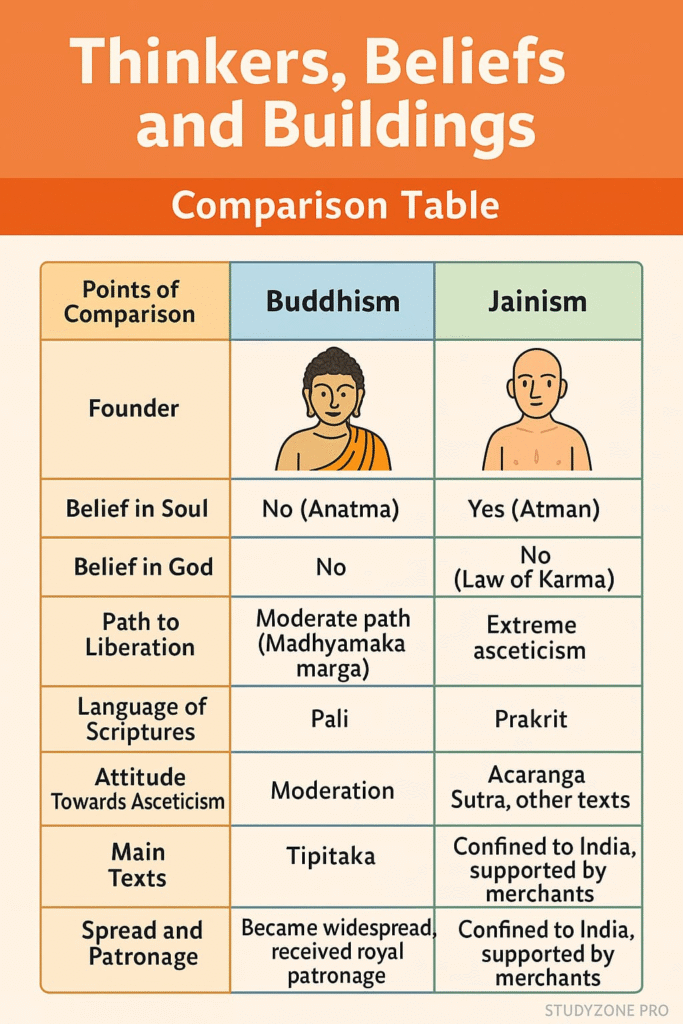
Buddhism, founded by Siddhartha Gautama (Buddha), emphasized the Four Noble Truths and the Eightfold Path as the means to overcome suffering (dukkha). It rejected the authority of the Vedas and the concept of God as a creator. Buddhism promoted a monastic life and encouraged followers to seek enlightenment through self-discipline and meditation.
Jainism, founded by Vardhamana Mahavira, also rejected Vedic authority and emphasized non-violence (ahimsa), truth, and asceticism. Jain monks and nuns practiced extreme self-control, and the religion laid strong emphasis on individual spiritual effort for liberation.
Both traditions gained wide popularity, particularly among the merchants, artisans, and common people.
The Upanishadic Tradition
While Buddhism and Jainism were gaining followers, another intellectual tradition was also developing within the Brahmanical fold — the Upanishads. These philosophical texts discussed concepts like Brahman (universal soul), atman (individual soul), karma, moksha, and rebirth. The Upanishads tried to go beyond ritual and sought inner truth, thus marking the beginning of philosophical reflection within Vedic thought.
The Role of Monasteries and Supporters
Monasteries became central to the development of Buddhism and Jainism. These institutions offered shelter to monks and nuns and became centers of learning and spiritual practice. Kings, merchants, and lay followers supported these institutions through donations of land, wealth, and even infrastructure.
Ashoka, the Mauryan emperor, is particularly remembered for his patronage of Buddhism. His inscriptions show his commitment to Dhamma (righteous conduct), tolerance for all sects, and non-violence. His efforts helped spread Buddhism across Asia.
Transmission of Ideas through Texts
Buddhist ideas were preserved in Tipitaka (Pali Canon), which includes the Vinaya Pitaka (monastic rules), Sutta Pitaka (teachings of the Buddha), and Abhidhamma Pitaka (philosophical analysis). Jain texts were compiled in Prakrit, including the Agamas.
Oral transmission remained the norm for a long time, and these texts were eventually written down to preserve the teachings for future generations. The recitations by monks and nuns kept these traditions alive across centuries.
Growth of Buddhist Stupas and Monuments
One of the most lasting contributions of Buddhist culture is its architecture, especially the stupa. Stupas were dome-shaped structures built to house relics of the Buddha or Buddhist saints. The most famous among them is the Sanchi Stupa in Madhya Pradesh.
Stupas were not only religious monuments but also centers of artistic expression. They were decorated with intricate carvings, Jataka tales (stories of Buddha’s previous lives), and symbols like the lotus, wheel, and Bodhi tree.
The construction of stupas was funded by kings, merchants, and even lay people. Inscriptions found on them show that donors came from all walks of life, including women and lower castes.
Cave Architecture and Artistic Developments
Apart from stupas, Buddhist and Jain monks also lived in rock-cut caves such as those at Ajanta, Ellora, and Karla. These caves were carved into hillsides and served as prayer halls and residences for monks.
The caves and their frescoes reveal advanced artistic techniques, narrative themes, and a sophisticated understanding of design and space. These architectural efforts reflect both religious devotion and royal patronage.
Coexistence and Debate Among Traditions
Although Buddhism and Jainism emerged as alternatives to Brahmanical Hinduism, they did not remain entirely outside its influence. Over time, mutual exchange of ideas took place. For example, the ideas of karma, rebirth, and moksha are found in all three traditions, albeit with different interpretations.
Intellectual debates and public discussions were common. Competing traditions often shared spaces, patrons, and followers, reflecting a culture of coexistence despite differences.
Conclusion
This chapter highlights the immense intellectual and spiritual vibrancy of early Indian society. It was a period marked by deep philosophical inquiry, religious reform, and cultural creativity. Thinkers like Buddha and Mahavira, along with philosophers of the Upanishadic tradition, profoundly influenced Indian thought. The development of stupas, cave temples, and monasteries shows how these ideas found physical expression in architecture. Most importantly, this period represents a tradition of debate, diversity, and tolerance that shaped Indian civilization for centuries to come.
————————————————————————————————————————————————————————————————————————————
QUESTIONS FROM TEXTBOOK
🔷 Q1. Were the ideas of the Upanishadic thinkers different from those of the fatalists and materialists? Give reasons for your answer.
🔖 Answer:
🔹 Upanishadic thinkers believed in the concept of Brahman (universal soul) and Atman (individual soul).
🔸 They emphasized self-realization, inner knowledge, and moksha (liberation) through wisdom.
🔹 Fatalists (like Ajivikas) believed that everything was pre-determined by fate, and no effort could change one’s destiny.
🔸 Materialists (like Charvakas) rejected all religious ideas, denied rebirth and soul, and believed only in sense-based experience.
✅ Hence, Upanishadic thought was spiritual and philosophical, while fatalists and materialists offered non-spiritual, deterministic, or atheistic worldviews.
🔷 Q2. Summarise the central teachings of Jainism.
🔖 Answer:
🔹 Jainism was founded by Vardhamana Mahavira, the 24th Tirthankara.
🔸 It preached ahimsa (non-violence) as the supreme virtue.
🔹 Jainism rejected Vedic rituals and sacrifices.
🔸 It emphasized right faith, right knowledge, and right conduct for liberation (moksha).
🔹 Jains believed in karma and reincarnation, but said karma could be removed through austerity and penance.
✅ Strict moral conduct, vegetarianism, and asceticism form the core of Jain ethics.
🔷 Q3. Discuss the role of the Begums of Bhopal in preserving the stupa at Sanchi.
🔖 Answer:
🔹 During the 19th century, the stupa at Sanchi was in ruins due to neglect.
🔸 The Begums of Bhopal played a key role in its restoration and preservation.
🔹 Shah Jahan Begum and Sultan Jahan Begum, despite being Muslim rulers, funded its conservation.
🔸 They built a museum and guesthouse, and supported archaeological excavations.
🔹 Their work reflects secular commitment to heritage conservation.
✅ Thanks to them, Sanchi is now a UNESCO World Heritage Site and preserved for future generations.
🔷 Q4. (Inscription-based sub-questions)
Read this inscription and answer:
(a) How did Dhanavati date her inscription?
🔖 Answer:
🔹 Dhanavati dated the inscription by mentioning the year of the reign of Maharaja Huviska—Year 33—and the eighth day of the first hot month.
(b) Why do you think she installed an image of the Bodhisattva?
🔖 Answer:
🔹 As a devout Buddhist, Dhanavati likely installed the image as an act of piety and merit.
🔸 It reflects devotional offering, and possibly a way to accumulate spiritual merit for herself and her family.
(c) Who were the relatives she mentioned?
🔖 Answer:
🔹 She mentioned her aunt (sister’s daughter of Bhikkhuni Buddhimata), her teacher (Bhikkhu Bala), and her parents.
(d) What Buddhist text did she know?
🔖 Answer:
🔹 Dhanavati knew the Tipitaka, the sacred Buddhist scripture.
(e) From whom did she learn this text?
🔖 Answer:
🔹 She learned it from Bhikkhu Bala, who was a female pupil of Buddhimata.
🔷 Q5. Why do you think women and men joined the sangha?
🔖 Answer:
🔹 People joined the sangha to lead a life of simplicity, discipline, and spiritual focus.
🔸 Many sought liberation (nirvana) from the cycle of birth and death.
🔹 Others joined to escape social constraints like caste and gender discrimination.
🔸 Some became teachers, scholars, or meditation practitioners.
✅ The sangha provided an inclusive space for spiritual growth and learning, open to all regardless of background.
🟨 Long Essay Type Questions (500 words each)
🔶 Q6. To what extent does knowledge of Buddhist literature help in understanding the sculpture at Sanchi?
🔖 Answer:
🔹 Buddhist literature like the Jatakas, Tripitakas, and Ashokan inscriptions provide narrative context to Sanchi’s sculptures.
🔸 The Jataka tales are engraved on the gateways—depicting past lives of the Buddha as animals, kings, or sages.
🔹 These stories explain the moral values, devotion, and symbolism of the carvings.
🔸 Knowledge of texts helps decode non-figural representations of Buddha—through symbols like lotus, wheel, or empty throne.
🔹 Literary sources clarify rituals, beliefs, and cosmology that influenced the artists.
🔸 They show the unity between popular worship and elite philosophy in Buddhist thought.
✅ Thus, Buddhist literature is vital to interpreting Sanchi, as it links art with religious meaning.
🔶 Q7. Figs. 4.32 and 4.33 are two scenes from Sanchi. Describe what you see in each, focusing on the architecture, plants and animals, and the activities. Identify which one shows a rural scene and which an urban scene, giving reasons for your answer.
🔖 Answer:
🔹 Fig 4.32 (Left Image):
Shows bulls, elephants, trees, and villagers engaged in daily life.
There are small huts, a natural setting, and a focus on agricultural or pastoral life.
✅ This is a rural scene, emphasizing harmony with nature and community life.
🔹 Fig 4.33 (Right Image):
Shows pillared buildings, multiple levels, and gathered figures, possibly traders or worshippers.
There is organized structure, architectural complexity, and a sense of busy social activity.
✅ This is an urban scene, showing temple-like architecture, public interaction, and developed society.
🔸 The contrast in setting, attire, and environment helps differentiate rural and urban life through visual storytelling.
🔶 Q8. Discuss the development in sculpture and architecture associated with the rise of Vaishnavism and Shaivism.
🔖 Answer:
🔹 With the rise of Bhakti movements, Vaishnavism (worship of Vishnu) and Shaivism (worship of Shiva) influenced temple art.
🔸 Temples were now built with shikharas (spires) and garbhagrihas (sanctum sanctorum).
🔹 Vishnu was depicted in forms like Vamana, Varaha, Krishna, and Rama.
🔸 Shiva was shown as Nataraja, Ardhanarishvara, or Linga.
🔹 Temples at Ellora, Mahabalipuram, and Chola temples show elaborate carvings, mythology, and symbolic sculpture.
🔸 Sculptors used stone, bronze, and stucco, often sponsored by royalty and guilds.
✅ These developments reflected devotionalism, regional identity, and artistic brilliance of post-Mauryan India.
🔶 Q9. Discuss how and why stupas were built.
🔖 Answer:
🔹 Stupas were dome-shaped religious monuments built to house Buddha’s relics and commemorate key events.
🔸 Initially built using mud and bricks, later stupas used stone and decorative gateways (toranas).
🔹 They symbolized cosmic unity, with the dome as the world, and the harmika and chatra representing spiritual ascent.
🔸 Ashoka is credited with building many stupas, spreading Buddhism.
🔹 Local kings, merchants, and guilds funded stupas as acts of merit.
🔸 Stupas served as pilgrimage sites, teaching spaces, and visual storytelling through carved panels.
✅ Their construction reflected faith, community effort, and the desire to preserve Buddha’s teachings in enduring form.
————————————————————————————————————————————————————————————————————————————
OTHER IMPORTANT QUESTIONS FOR EXAMS
(CBSE MODEL QUESTIONS PAPER)
ESPECIALLY MADE FROM THIS LESSON ONLY
Question 1: Who founded Buddhism?
a) Mahavira
b) Patanjali
c) Siddhartha Gautama
d) Kapila
Answer: c) Siddhartha Gautama
Question 2: Which of the following is a Buddhist text?
a) Agamas
b) Tripitaka
c) Manusmriti
d) Ramayana
Answer: b) Tripitaka
Question 3: Which term is associated with Jain philosophy?
a) Dhamma
b) Ahimsa
c) Nirvana
d) Karma
Answer: b) Ahimsa
Question 4: Which king patronised Buddhism and spread it to other parts of Asia?
a) Harshavardhana
b) Chandragupta Maurya
c) Ashoka
d) Samudragupta
Answer: c) Ashoka
Question 5: Which structure is associated with Buddhist architecture?
a) Mandir
b) Stupa
c) Gurudwara
d) Vimana
Answer: b) Stupa
Question 6: The Upanishads focus mainly on:
a) Sacrificial rituals
b) Political power
c) Inner spiritual knowledge
d) Trade and commerce
Answer: c) Inner spiritual knowledge
Question 7: Which of the following is a common feature in Buddhism and Jainism?
a) Acceptance of Vedic rituals
b) Belief in God
c) Rejection of caste system
d) Emphasis on yajnas
Answer: c) Rejection of caste system
Question 8: What language were the earliest Jain texts written in?
a) Sanskrit
b) Pali
c) Prakrit
d) Tamil
Answer: c) Prakrit
Question 9: The Eightfold Path is a part of which religion?
a) Hinduism
b) Buddhism
c) Jainism
d) Zoroastrianism
Answer: b) Buddhism
Question 10: Which of the following is not part of the Buddhist Tripitaka?
a) Vinaya Pitaka
b) Sutta Pitaka
c) Agama Pitaka
d) Abhidhamma Pitaka
Answer: c) Agama Pitaka
II. Fill in the Blanks (3 Questions)
Question 11: The __ is a dome-shaped structure that houses Buddhist relics.
Answer: Stupa
Question 12: Emperor __ supported the spread of Buddhism through inscriptions and missionary work.
Answer: Ashoka
Question 13: The concept of __ is central to Jainism and means non-violence.
Answer: Ahimsa
III. Right or Wrong (2 Questions)
Question 14: The Upanishads rejected the Vedic tradition of sacrifices.
Answer: Right
Question 15: Buddhist monks never accepted donations from kings or merchants.
Answer: Wrong
IV. Assertion and Reason Questions (3 Questions)
Question 16:
Assertion (A): Buddhism rejected the authority of the Vedas.
Reason (R): Buddhism believed in direct experience and ethical conduct over rituals.
a) Both A and R are true, and R is the correct explanation of A.
b) Both A and R are true, but R is not the correct explanation of A.
c) A is true, R is false.
d) A is false, R is true.
Answer: a) Both A and R are true, and R is the correct explanation of A.
Question 17:
Assertion (A): Jain monks practiced extreme forms of asceticism.
Reason (R): They believed in attaining liberation through self-discipline and non-possession.
Answer: a) Both A and R are true, and R is the correct explanation of A.
Question 18:
Assertion (A): Ashoka built stupas all across his empire.
Reason (R): He wanted to display military power through religious monuments.
Answer: c) A is true, R is false.
V. One-word/Two-word Answer Questions (7 Questions)
Question 19: Name the founder of Jainism.
Answer: Mahavira
Question 20: What was the language of early Buddhist texts?
Answer: Pali
Question 21: Which Buddhist monument is located in Madhya Pradesh?
Answer: Sanchi Stupa
Question 22: Which practice did Jainism strictly promote?
Answer: Non-violence
Question 23: Which tree is associated with Buddha’s enlightenment?
Answer: Bodhi Tree
Question 24: What do we call the monastic community of Buddhists?
Answer: Sangha
Question 25: Name one important cave site of Buddhist monks.
Answer: Ajanta
VI. Case Study-Based Questions (5 Questions: 2 MCQs + 3 Others)
Case Study Passage:
During Ashoka’s reign, numerous stupas were built across the subcontinent to house the relics of Buddha. Sanchi in Madhya Pradesh is among the most prominent. These structures were funded not only by kings but also by commoners. Inscriptions on railings and gateways reveal donations from merchants, women, and guilds. The stupa architecture often included symbolic decorations like wheels, animals, and scenes from the Jataka tales.
Question 26 (MCQ): What was the primary purpose of building stupas?
a) Storing scriptures
b) Housing Buddha’s relics
c) Royal meditation halls
d) Administrative offices
Answer: b) Housing Buddha’s relics
Question 27 (MCQ): Who among the following were not donors to stupas?
a) Merchants
b) Kings
c) Women
d) Soldiers
Answer: d) Soldiers
Question 28: What does the presence of donor inscriptions on stupas indicate?
Answer: It shows widespread public support for Buddhism, beyond royal patronage.
Question 29: Name one symbolic element commonly found in stupa carvings.
Answer: Wheel (Dharmachakra)
Question 30: What do Jataka tales on stupas represent?
Answer: Stories of Buddha’s previous lives that teach moral and ethical lessons.
————————————————————————————————————————————————————————————————————————————
QUESTIONS FROM COMPETITION EXAMS
————————————————————————————————————————————————————————————————————————————
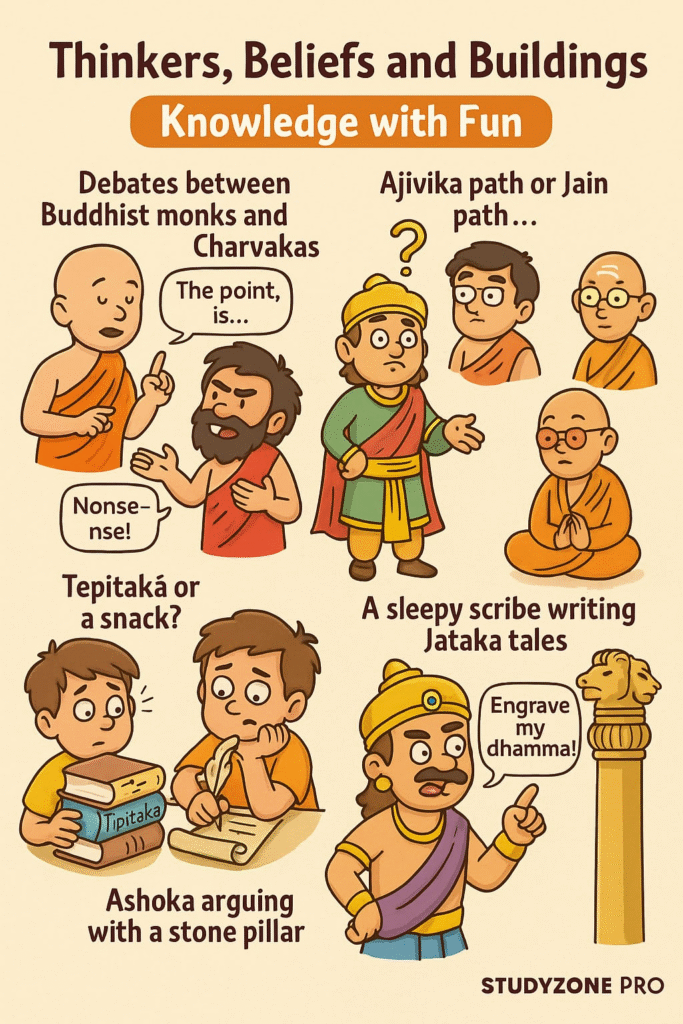
KNOWLEDGE WITH FUN
—————————————————————————————————————————————————————————————————————————————
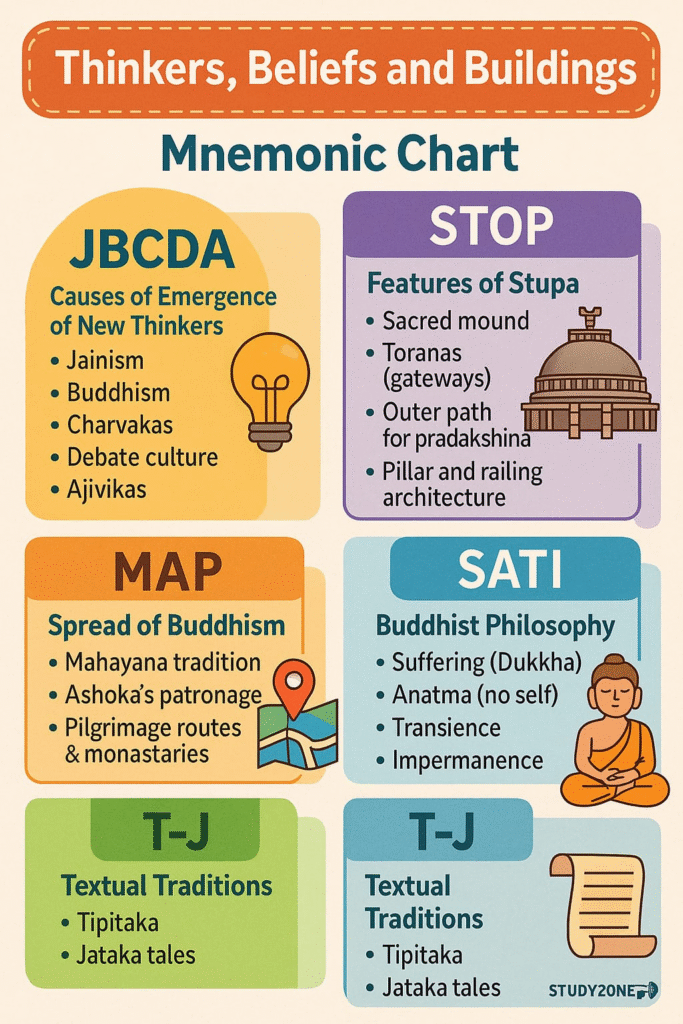
MNEMONICS
—————————————————————————————————————————————————————————————————————————————
MIND MAPS