
Class 11 : Physics (In English) – Chapter 9: Mechanical Properties of Fluids
EXPLANATION & SUMMARY
🔶 1. Introduction
This chapter studies how fluids (liquids and gases) behave when external forces act on them. Unlike solids, fluids flow and cannot resist shear stress. Their mechanical properties are different and are described using pressure, buoyancy, viscosity, surface tension, etc.

🔶 2. Pressure in a Fluid
Pressure (P) = Force / Area = F / A
Unit: Pascal (Pa) = N/m²
Pressure is a scalar quantity but acts equally in all directions at a point in a fluid.
🔶 3. Variation of Pressure with Depth
In a fluid of density ρ at depth h:
P = P₀ + ρgh
Where:
P = pressure at depth h
P₀ = atmospheric pressure at surface
ρ = density of fluid
g = acceleration due to gravity
h = depth from surface
This shows that pressure increases linearly with depth.
🔶 4. Pascal’s Law
Pascal’s Law: A change in pressure applied to an enclosed fluid is transmitted undiminished to every part of the fluid and to the walls of the container.
📌 Applications:
Hydraulic lifts
Hydraulic brakes
Hydraulic press
🔶 5. Atmospheric Pressure
Standard atmospheric pressure: 1 atm = 1.013 × 10⁵ Pa
Measured using barometer
🔶 6. Gauge Pressure and Absolute Pressure
Absolute pressure = atmospheric pressure + gauge pressure
Gauge pressure = pressure measured above atmospheric pressure
(negative gauge pressure = vacuum)
🔶 7. Buoyancy and Archimedes’ Principle
A body immersed in a fluid experiences an upward force (buoyant force) equal to the weight of fluid displaced.
Buoyant force (Fb) = ρ × V × g
Where:
ρ = density of fluid
V = volume displaced
g = acceleration due to gravity
📌 Archimedes’ Principle: Upthrust = weight of displaced fluid
🔶 8. Conditions for Floating
Object floats if its density < fluid density
Object sinks if its density > fluid density
Weight of floating object = buoyant force
🔶 9. Streamline and Turbulent Flow
Streamline flow: Fluid particles move in smooth paths; velocity at a point remains constant.
Turbulent flow: Irregular motion with eddies and fluctuations.
Critical velocity (vₛ): Maximum velocity below which flow is streamline. Beyond this, it becomes turbulent.
🔶 10. Reynolds Number (Re)
Re = (ρ × v × D) / η
Where:
ρ = fluid density
v = velocity
D = diameter
η = viscosity
Flow is:
Streamline if Re < 2000
Turbulent if Re > 3000
Transition zone: 2000 < Re < 3000
🔶 11. Viscosity
Viscosity is the internal friction within a fluid resisting flow.
Viscous force (F) = η × A × (dv/dx)
η = coefficient of viscosity
SI unit of viscosity = N·s/m² = Pa·s
Stoke’s Law: For a sphere of radius r moving with velocity v in a fluid:
F = 6π η r v
🔶 12. Terminal Velocity
When a falling body in a fluid reaches constant velocity (net force = 0), it’s called terminal velocity.
Using Stoke’s law:
Vₜ = (2/9) × (r² × g × (ρ – σ)) / η
Where:
ρ = density of object
σ = density of fluid
η = viscosity
🔶 13. Bernoulli’s Theorem
Bernoulli’s principle: For an incompressible, non-viscous fluid in streamline flow:
P + (1/2)ρv² + ρgh = constant
Where:
P = pressure
v = speed of fluid
h = height from reference level
Interpretation: Increase in speed → decrease in pressure.
📌 Applications:
Flight of airplanes (lift)
Venturimeter
Atomizer and sprayer
🔶 14. Surface Tension
Surface tension (T) is the force per unit length acting along the surface of a liquid due to intermolecular forces.
T = F / L
Unit: N/m
Water forms droplets due to surface tension trying to minimize surface area.
🔶 15. Capillarity
Capillary rise (h) in a tube of radius r:
h = (2T cosθ) / (rρg)
Where:
T = surface tension
θ = angle of contact
ρ = fluid density
g = gravity
Water rises (concave meniscus), mercury falls (convex meniscus) due to contact angle.

📘 PART B: CRISP SUMMARY (~300 WORDS)
🔷 Summary – Mechanical Properties of Fluids
Fluids exert pressure: P = F / A
Pressure increases with depth: P = P₀ + ρgh
Pascal’s law: Pressure is transmitted equally in all directions.
Buoyant force = ρ × V × g
Object floats if its density is less than fluid’s.
Flow types:
Streamline: orderly
Turbulent: chaotic
Critical velocity marks the shift
Reynolds number predicts flow type:
Re < 2000: streamline
Re > 3000: turbulent
Viscosity is internal friction in fluids:
Stoke’s law: F = 6π η r v
Terminal velocity: velocity when net force = 0
Bernoulli’s equation:
P + (1/2)ρv² + ρgh = constant
Shows inverse relationship between pressure and speed.
Surface tension makes liquids form spherical drops.
Capillary action explains rise/fall of liquid in narrow tubes:
h = (2T cosθ) / (rρg)
Fluids behave differently from solids but obey physical laws related to force, energy, and motion. This chapter helps in understanding atmospheric, biological, and industrial fluid systems.
————————————————————————————————————————————————————————————————————————————
QUESTIONS FROM TEXTBOOK
🔷 Question 9.1
Explain why:
(a) The blood pressure in humans is greater at the feet than at the brain.
(b) Atmospheric pressure at a height of about 6 km decreases to nearly half of its value at the sea level, though the height of the atmosphere is more than 100 km.
(c) Hydrostatic pressure is a scalar quantity even though pressure is force divided by area.
🔶 Answer:
(a) ⬇️ Pressure increases with depth in fluids due to gravity. Feet are lower than the brain, so blood exerts more pressure at the feet:
📌 P = ρgh (greater h ⇒ greater pressure)
(b) 🌬️ Air is compressible. Most of the atmospheric mass is concentrated in the lower layers.
At 6 km, about 50% of atmospheric pressure is lost due to rapid decrease in density.
(c) 🧪 Though pressure = force/area, it acts equally in all directions in a fluid at rest.
No specific direction ⇒ scalar quantity ✅
🔷 Question 9.2
Explain why:
(a) The angle of contact of mercury with glass is obtuse, while that of water with glass is acute.
(b) Water on a clean glass surface tends to spread out while mercury on the same surface tends to form drops.
🔶 Answer:
(a)
🔹 Mercury has stronger cohesive forces than adhesive forces with glass ⇒ obtuse angle.
🔹 Water has stronger adhesive forces ⇒ acute angle with glass.
(b)
💧 Water wets glass → adhesive > cohesive
🌑 Mercury doesn’t wet glass → cohesive > adhesive
Hence, water spreads, mercury forms drops.
🔷 Question 9.3
Fill in the blanks using the word(s) from the list appended with each statement:
(a) Surface tension of liquids generally decreases with temperature.
(b) Viscosity of gases increases with temperature, whereas viscosity of liquids decreases with temperature.
(c) For solids with elastic modulus of rigidity, the shearing force is proportional to shear strain, while for fluids it is proportional to rate of shear strain.
(d) For a fluid in steady flow, the increase in flow speed at a constriction follows Bernoulli’s principle.
(e) For the model of a plane in a wind tunnel, turbulence occurs at a greater speed for turbulence in an actual plane.
🔷 Question 9.4
Explain why:
(a) To keep a piece of paper horizontal, you should blow over, not under it.
(b) When we try to close a water tap with our fingers, fast jets of water gush through the openings between our fingers.
🔶 Answer:
(a) 💨 Air moves faster over the top → pressure above decreases → paper rises and stays horizontal (Bernoulli’s principle).
(b) 🚿 Smaller opening ⇒ faster speed of water ⇒ higher kinetic energy ⇒ strong jets escape between fingers.
(c) The size of the needle of a syringe controls flow rate better than the thumb.
(d) A fluid flowing out of a small hole in a vessel results in a backward thrust on the vessel.
(e) A spinning cricket ball in air does not follow a parabolic trajectory.
🔶 Answer:
(c) ✒️ A needle has a much smaller area ⇒ velocity of flow increases significantly ⇒ pressure drops sharply ⇒ controlled flow.
(d) 🔁 Backward thrust is a reaction (Newton’s 3rd law) to forward momentum of fluid.
(e) 🏏 Spinning ball creates uneven airflow ⇒ pressure difference ⇒ Magnus effect ⇒ curved trajectory, not parabolic.
🔷 Question 9.5
A 50 kg girl wearing high heel shoes balances on a single heel. The heel is circular with a diameter 1.0 cm. What is the pressure exerted by the heel on the horizontal floor?
🔶 Answer:
Given:
m = 50 kg, d = 1.0 cm = 0.01 m
Radius r = 0.005 m ⇒ A = πr² = 3.14 × (0.005)² = 7.85 × 10⁻⁵ m²
P = F/A = (mg)/A = (50 × 9.8) / 7.85×10⁻⁵ = 6.24 × 10⁵ Pa
🔷 Question 9.6
Torricelli’s barometer used mercury. Pascal duplicated it using French wine of density 984 kg/m³. Determine the height of the wine column for normal atmospheric pressure.
🔶 Answer:
Given:
P = 1.01×10⁵ Pa, ρ = 984 kg/m³, g = 9.8 m/s²
P = ρgh ⇒ h = P / (ρg) = 1.01×10⁵ / (984 × 9.8) = 10.44 m
🔷 Question 9.7
A vertical off-shore structure is built to withstand a maximum stress of 10⁹ Pa. Is the structure suitable for putting up on top of an oil well in the ocean? Take depth = 3 km, ignore ocean currents.
🔶 Answer:
Given:
h = 3×10³ m, ρ (water) ≈ 1000 kg/m³
P = ρgh = 1000 × 9.8 × 3000 = 2.94 × 10⁷ Pa
Stress limit = 10⁹ Pa > pressure ⇒ ✅ Structure is safe.
🔷 Question 9.8
A hydraulic automobile lift is designed to lift cars with a max mass of 3000 kg. The area of the piston is 425 cm². What is the max pressure the piston must bear?
🔶 Answer:
Given:
m = 3000 kg, A = 425 cm² = 4.25×10⁻² m²
F = mg = 3000 × 9.8 = 29400 N
P = F/A = 29400 / 4.25×10⁻² = 6.91 × 10⁵ Pa
🔷 Question 9.9
A U-tube contains water and methylated spirit separated by mercury. The mercury columns in the two arms are in level with 10.0 cm of water in one arm and 12.5 cm of spirit in the other. What is the specific gravity of spirit?
🔶 Answer:
📌 Principle: Mercury levels are equal ⇒ pressure by water = pressure by spirit
Let ρₛ = density of spirit
ρₛ × g × 0.125 = 1000 × g × 0.10
⇒ ρₛ = (1000 × 0.10)/0.125 = 800 kg/m³
✅ Specific gravity = ρₛ / 1000 = 0.8
🔷 Question 9.10
If 15.0 cm of water and spirit (of SG = 0.8) are poured into the respective arms of a U-tube, what is the difference in mercury levels?
🔶 Answer:
📌 Pressure balance:
P_water = ρ × g × h = 1000 × g × 0.15 = 150g
P_spirit = 0.8 × 1000 × g × h = 120g
🧮 Pressure difference = 30g ⇒ balanced by mercury column
Let h = difference in mercury levels:
ρHg × g × h = 30g ⇒ h = 30 / 13.6 = 2.21 cm
🔷 Question 9.11
Can Bernoulli’s equation be used for flow of water through a rapid in a river? Explain.
🔶 Answer:
❌ No, because Bernoulli’s equation is valid only for steady, incompressible, non-viscous, and streamlined flow.
🌊 Rapids cause turbulent flow → invalid conditions ⇒ Bernoulli’s equation not applicable.
🔷 Question 9.12
Does it matter if one uses gauge instead of absolute pressures in applying Bernoulli’s equation? Explain.
🔶 Answer:
🟢 No, it doesn’t matter.
✅ Bernoulli’s equation involves pressure differences, and both absolute and gauge pressures differ by a constant (atmospheric pressure), which cancels out in differences.
🔄 So, result remains same.
🔷 Question 9.13
Glycerine flows steadily through a horizontal tube of length 1.5 m and radius 1.0 cm. If the amount of glycerine collected per second at one end is 4.0 × 10⁻³ kg/s, what is the pressure difference between the two ends?
(Density = 1.3 × 10³ kg/m³, viscosity η = 0.83 Pa·s)
🔶 Answer:
📌 Use Poiseuille’s equation:
Q = (πR⁴ΔP)/(8ηlρ) ⇒ Rearranged:
ΔP = (8ηlQρ) / (πR⁴)
Given:
R = 0.01 m, l = 1.5 m, η = 0.83 Pa·s, Q = 4.0×10⁻³ kg/s
⇒ Volume flow rate = Q/ρ = 4.0×10⁻³ / 1300 = 3.08×10⁻⁶ m³/s
ΔP = (8 × 0.83 × 1.5 × 3.08×10⁻⁶) / (π × (0.01)⁴)
= 1227 Pa (approx.)
🔷 Question 9.14
In a wind tunnel, flow speeds on upper and lower surfaces of wing are 70 m/s and 63 m/s. If wing area is 2.5 m², density of air is 1.3 kg/m³, what is the lift?
🔶 Answer:
📌 Use Bernoulli’s principle:
ΔP = ½ ρ(v²_upper – v²_lower)
= 0.5 × 1.3 × (70² – 63²) = 0.65 × (4900 – 3969)
= 0.65 × 931 = 605.15 Pa
Lift = ΔP × A = 605.15 × 2.5 = 1513 N
🔷 Question 9.15
Figures 9.20 (a) and (b) refer to steady flow of a (non-viscous) liquid. Which figure is incorrect? Why?
🔶 Answer:
✅ Figure (b) is incorrect.
➡ In a narrow section, speed increases (continuity), so pressure decreases (Bernoulli).
➡ But in (b), height of fluid is higher in narrow part ⇒ higher pressure, which contradicts Bernoulli’s principle.
❌ So, (b) violates physics of flow.
🔷 Question 9.16
Can Bernoulli’s equation be applied to the flow of water through a hole in a large tank? Explain briefly.
🔶 Answer:
✅ Yes, it can be applied.
📌 Conditions satisfied:
• Flow is steady
• Water behaves like an incompressible, non-viscous fluid
• Streamline flow exists at the hole
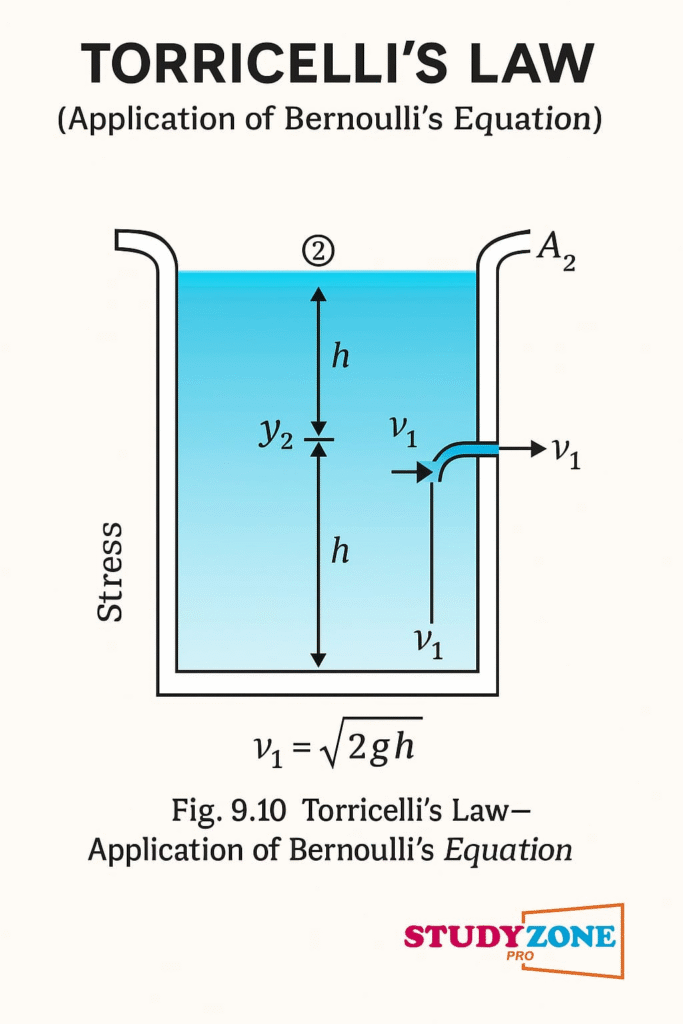
🧪 From Bernoulli’s equation:
v = √(2gh), where h is height of water above the hole
Hence, applicable and gives accurate speed of outflow.
🔷 Question 9.17
A fluid of viscosity 1.5 × 10⁻³ Pa·s and density ρ = 1.5 × 10³ kg/m³ flows through a pipe of radius 1.0 cm. The flow is streamlined. What is the max velocity with which the fluid can flow so that the flow remains laminar? (Reynolds number = 2000)
🔶 Answer:
📌 Use: Re = (ρvd)/η ⇒ v = Re × η / (ρ × d)
Given: Re = 2000, η = 1.5×10⁻³, ρ = 1.5×10³, d = 2 × 1.0 cm = 0.02 m
v = (2000 × 1.5×10⁻³) / (1.5×10³ × 0.02)
= 3.0 / 30 = 0.1 m/s
🔷 Question 9.18
A tank is 2.0 m deep. Water is filled up to 1.5 m. An oil layer of 0.5 m (SG = 0.8) is above the water. Find pressure at bottom of tank due to liquids.
(g = 9.8 m/s²)
🔶 Answer:
Pressure due to water:
P₁ = ρg h = 1000 × 9.8 × 1.5 = 14700 Pa
Pressure due to oil:
P₂ = 800 × 9.8 × 0.5 = 3920 Pa
Total Pressure = P₁ + P₂ = 18620 Pa
🔷 Question 9.19
What is the speed of efflux of water (through a sharp-edged hole) at a depth of 2.5 m below the free surface?
🔶 Answer:
📌 By Torricelli’s Law:
v = √(2gh) = √(2 × 9.8 × 2.5) = √49 = 7.0 m/s
🔷 Question 9.20
A vessel has two identical small holes at depths of 10 cm and 40 cm. Find ratio of speeds of efflux.
🔶 Answer:
📌 From Torricelli’s Law:
v = √(2gh)
v₁/v₂ = √h₁ / √h₂ = √10 / √40 = 1 / 2 ⇒ Ratio = 1:2
————————————————————————————————————————————————————————————————————————————
OTHER IMPORTANT QUESTIONS FOR EXAMS
(CBSE MODEL QUESTIONS PAPER)
ESPECIALLY MADE FROM THIS LESSON ONLY
⚙️ SECTION A — Multiple Choice Questions (Q1–Q18)
Question 1:
Pressure in a liquid at rest depends on
🔵 (A) Depth only
🟢 (B) Density and depth
🟠 (C) Volume
🔴 (D) Surface area
Answer: (B) Density and depth
Question 2:
The SI unit of pressure is
🔵 (A) dyne/cm²
🟢 (B) N/m²
🟠 (C) erg/cm³
🔴 (D) N/cm²
Answer: (B) N/m²
Question 3:
Which of the following is a scalar quantity?
🔵 (A) Pressure
🟢 (B) Force
🟠 (C) Torque
🔴 (D) Momentum
Answer: (A) Pressure
Question 4:
If pressure at a point inside a liquid increases linearly with depth, the liquid must be
🔵 (A) Non-viscous
🟢 (B) Ideal and incompressible
🟠 (C) Compressible
🔴 (D) Inviscid
Answer: (B) Ideal and incompressible
Question 5:
Pascal’s law states that
🔵 (A) Pressure at a point is same in all directions
🟢 (B) Force per unit area is constant
🟠 (C) Liquids flow from higher to lower pressure
🔴 (D) Density depends on pressure
Answer: (A) Pressure at a point is same in all directions
Question 6:
The pressure due to a liquid column of height h is given by
🔵 (A) ρgh
🟢 (B) gh/ρ
🟠 (C) ρ/hg
🔴 (D) h/ρg
Answer: (A) ρgh
Question 7:
The atmospheric pressure at sea level is approximately
🔵 (A) 10⁴ N/m²
🟢 (B) 10⁵ N/m²
🟠 (C) 10⁶ N/m²
🔴 (D) 10⁷ N/m²
Answer: (B) 10⁵ N/m²
Question 8:
Hydraulic brakes in automobiles work on
🔵 (A) Archimedes’ principle
🟢 (B) Pascal’s law
🟠 (C) Bernoulli’s theorem
🔴 (D) Conservation of energy
Answer: (B) Pascal’s law
Question 9:
When an object is immersed in a liquid, it experiences an upward force equal to
🔵 (A) Weight of liquid displaced
🟢 (B) Its own weight
🟠 (C) Density of liquid
🔴 (D) Volume of liquid
Answer: (A) Weight of liquid displaced
Question 10:
The buoyant force depends on
🔵 (A) Volume of body
🟢 (B) Volume of liquid displaced
🟠 (C) Mass of object
🔴 (D) Shape of container
Answer: (B) Volume of liquid displaced
Question 11:
A floating body displaces liquid
🔵 (A) Equal to its volume
🟢 (B) Equal to its weight
🟠 (C) Less than its weight
🔴 (D) Equal to the density of liquid
Answer: (B) Equal to its weight
Question 12:
Streamline flow means
🔵 (A) Random motion of molecules
🟢 (B) Flow of fluid where velocity at a point is constant
🟠 (C) Flow with irregular motion
🔴 (D) None of these
Answer: (B) Flow of fluid where velocity at a point is constant
Question 13:
Equation of continuity is based on
🔵 (A) Law of conservation of momentum
🟢 (B) Law of conservation of mass
🟠 (C) Law of conservation of energy
🔴 (D) Archimedes’ principle
Answer: (B) Law of conservation of mass
Question 14:
Bernoulli’s theorem is based on
🔵 (A) Conservation of energy
🟢 (B) Conservation of mass
🟠 (C) Conservation of momentum
🔴 (D) Conservation of volume
Answer: (A) Conservation of energy
Question 15:
For an ideal fluid, viscosity is
🔵 (A) Very high
🟢 (B) Zero
🟠 (C) One
🔴 (D) Infinite
Answer: (B) Zero
Question 16:
The unit of coefficient of viscosity is
🔵 (A) N·m⁻²·s
🟢 (B) N·s·m⁻²
🟠 (C) N·m/s
🔴 (D) m²/s
Answer: (B) N·s·m⁻²
Question 17:
Poiseuille’s formula gives the rate of flow of
🔵 (A) Ideal fluid
🟢 (B) Real viscous fluid
🟠 (C) Compressible gas
🔴 (D) None of these
Answer: (B) Real viscous fluid
Question 18:
The terminal velocity of a spherical body in a viscous medium depends on
🔵 (A) Radius of body
🟢 (B) Density of body and fluid
🟠 (C) Viscosity of medium
🔴 (D) All of these
Answer: (D) All of these
⚙️ SECTION B — Very Short / Short Answer Questions (Q19–Q23)
Question 19:
State Pascal’s Law.
Answer:
💡 Pascal’s Law: Pressure applied to a confined fluid is transmitted equally and undiminished in all directions throughout the fluid and on the walls of the container.
➡️ Mathematically:
P₁ = P₂ = P₃ = constant
✔️ Applications:
Hydraulic brakes and lifts
Hydraulic presses
Question 20:
What is the difference between gauge pressure and absolute pressure?
Answer:
✔️ Gauge pressure: It is the pressure measured above atmospheric pressure.
➡️ P_g = P_abs − P_atm
✔️ Absolute pressure: It is the total pressure including atmospheric pressure.
➡️ P_abs = P_g + P_atm
💡 Example: A tire gauge reading of 2×10⁵ Pa means its absolute pressure is 3×10⁵ Pa (since 1×10⁵ Pa = atmospheric).
Question 21:
State Archimedes’ Principle.
Answer:
💧 When a body is fully or partially immersed in a fluid, it experiences an upward force equal to the weight of the fluid displaced by the body.
➡️ Buoyant force, F_b = ρ_f × V × g
where ρ_f = density of fluid, V = volume displaced, g = acceleration due to gravity.
✔️ Used to determine density and purity of solids or liquids.
Question 22:
Define viscosity.
Answer:
💡 Viscosity: It is the property of a fluid that opposes the relative motion between its layers.
➡️ For a velocity gradient (dv/dx), viscous force F = ηA(dv/dx)
where η = coefficient of viscosity.
✔️ Unit: N·s·m⁻²
✔️ Fluids with higher η (like honey) flow slowly.
Question 23:
What is meant by streamline flow?
Answer:
💡 Streamline flow: It is a steady flow of fluid in which velocity at every point remains constant in time.
✔️ Streamlines never cross each other.
✔️ Kinetic energy per unit mass is constant along a streamline (Bernoulli’s principle).
⚡ SECTION C — Mid-Length Numericals / Theory (Q24–Q27)
Question 24:
Derive the expression for pressure at a depth h in a liquid.
Answer:
✏️ Step 1:
Consider a liquid column of height h, density ρ, and base area A.
✏️ Step 2:
Weight of column = mg = ρVg = ρ(Ah)g
✏️ Step 3:
Pressure = Force / Area = (ρAhg)/A = ρgh
✔️ Therefore:
➡️ P = ρgh
💡 Pressure increases linearly with depth and acts equally in all directions.
Question 25:
Explain Bernoulli’s Theorem and write its expression.
Answer:
💡 Statement:
For a steady, incompressible, and non-viscous fluid, the total mechanical energy per unit volume (pressure energy + kinetic energy + potential energy) remains constant along a streamline.
➡️ P + ½ρv² + ρgh = constant
✔️ Terms:
P → Pressure energy
½ρv² → Kinetic energy
ρgh → Potential energy
✔️ Applications:
Airplane lift
Flow of blood in arteries
Venturimeter
Question 26:
State and derive the Equation of Continuity.
Answer:
💡 Statement:
For an incompressible fluid flowing in a tube, the mass flow rate remains constant.
✏️ Step 1:
Mass flow rate = ρAV
✏️ Step 2:
For steady flow: ρ₁A₁v₁ = ρ₂A₂v₂
✏️ Step 3:
For incompressible liquid (ρ constant):
➡️ A₁v₁ = A₂v₂ = constant
✔️ Meaning: Narrow tube ⇒ higher velocity (inverse relation).
Question 27:
What is terminal velocity? Derive its expression using Stokes’ Law.
Answer:
💡 Definition:
Terminal velocity is the constant velocity attained by a body falling through a viscous medium when net force = 0.
✏️ Forces acting:
Downward weight = mg = (4/3)πr³ρg
Upward buoyant force = (4/3)πr³ρ_f g
Upward viscous drag = 6πηrv
✏️ At terminal velocity:
mg = 6πηrv_t + buoyant force
✏️ Simplify:
(4/3)πr³(ρ − ρ_f)g = 6πηr v_t
➡️ v_t = [2r²(ρ − ρ_f)g] / [9η]
✔️ Conclusion:
Heavier, larger spheres fall faster in less viscous fluids.
⚙️ SECTION D — Long Answer Questions (Q28–Q31)
Question 28:
Derive Bernoulli’s Equation from the principle of conservation of energy.
Answer:
💡 Concept:
For a non-viscous, incompressible, steady-flowing fluid, the sum of pressure energy, kinetic energy, and potential energy per unit volume remains constant along a streamline.
✏️ Step 1: Consider two points A and B
At A: P₁, v₁, h₁ At B: P₂, v₂, h₂
✏️ Step 2: Work done by pressure forces
Work = (P₁ − P₂)V
✏️ Step 3: Change in energy
ΔKE = ½ ρV (v₂² − v₁²)
ΔPE = ρVg (h₂ − h₁)
✏️ Step 4: Apply Work–Energy Theorem
(P₁ − P₂)V = ½ ρV (v₂² − v₁²) + ρVg (h₂ − h₁)
➡️ P₁ + ½ ρv₁² + ρgh₁ = P₂ + ½ ρv₂² + ρgh₂ = constant
✔️ Bernoulli’s Equation: P + ½ ρv² + ρgh = constant
Question 29:
Explain Torricelli’s Theorem and derive its expression.
Answer:
At the free surface: P₁ = atmospheric, v₁ ≈ 0, h₁ = h
At the orifice: P₂ = atmospheric, v₂ =?, h₂ = 0
Apply Bernoulli’s equation:
P₁ + ½ ρv₁² + ρgh₁ = P₂ + ½ ρv₂² + ρgh₂
Cancel P₁ = P₂, neglect v₁ ⇒ ρgh = ½ ρv₂²
➡️ v₂ = √(2gh)
✔️ Torricelli’s Theorem: Speed of efflux through depth h equals speed of free fall through height h.
Question 30:
Derive expression for viscous force and state Stokes’ Law.
Answer:
💡 Concept:
When a sphere moves through a viscous medium, a drag force acts opposite to its motion.
✏️ Step 1: According to Stokes,
➡️ F = 6 π η r v
✏️ Step 2: At terminal velocity (vₜ):
(4⁄3) π r³ ρ g = (4⁄3) π r³ ρ_f g + 6 π η r vₜ
Simplify ⇒ vₜ = [ 2 r² ( ρ − ρ_f ) g ] ⁄ 9 η
✔️ Stokes’ Law: F ∝ r v η
💡 Applications: Motion of raindrops, measurement of viscosity by falling-sphere method.
Question 31:
What is the Equation of Continuity and how does it show mass conservation?
Answer:
💡 Statement: For steady incompressible flow, mass flow rate is constant.
ρ₁ A₁ v₁ = ρ₂ A₂ v₂
If ρ₁ = ρ₂ = ρ (constant), then ➡️ A₁ v₁ = A₂ v₂ = constant
Hence, when A ↓ ⇒ v ↑ to conserve mass.
💡 Example: River narrows ⇒ flow speed increases.
🌊 SECTION E — Case / Application Based Questions (Q32–Q33)
Question 32:
A horizontal pipe has area A₁ = 4 cm², v₁ = 2 m/s. Find v₂ when A₂ = 2 cm².
Answer:
✏️ Step 1: Use continuity equation: A₁ v₁ = A₂ v₂
(4×10⁻⁴)(2) = (2×10⁻⁴) v₂
v₂ = 4 m/s
✔️ Result: v₂ = 4 m/s
💡 As area halves, velocity doubles.
Question 33:
A steel ball of radius r = 1 mm falls through glycerine (η = 1.2 N·s·m⁻²). ρ = 7800 kg/m³, ρ_f = 1260 kg/m³. Find terminal velocity vₜ.
Answer:
✏️ Step 1: Formula from Stokes’ Law:
vₜ = [ 2 r² ( ρ − ρ_f ) g ] ⁄ 9 η
✏️ Step 2: Substitute values:
vₜ = [ 2 (1×10⁻³)² (7800 − 1260) (9.8) ] ⁄ [ 9 × 1.2 ]
= (2×10⁻⁶ × 6540 × 9.8) ⁄ 10.8
= 0.0119 m/s
✔️ vₜ = 1.19 × 10⁻² m/s
💡 Dense small spheres quickly reach constant speed in viscous fluids.
————————————————————————————————————————————————————————————————————————————
NEET QUESTIONS FROM THIS LESSON
Q1. The excess pressure inside a soap bubble is (T = surface tension, r = radius):
(A) T/r
(B) 2T/r
(C) 4T/r
(D) 8T/r
Answer: (C) 4T/r
📅 NEET 2024, Set Q1
Q2. Terminal velocity of a small sphere falling through a viscous fluid varies as:
(A) radius
(B) square of radius
(C) cube of radius
(D) inversely proportional to radius
Answer: (C) cube of radius
📅 NEET 2024, Set Q2
Q3. A capillary tube of radius r is immersed in water and rise of liquid is h. If the tube is replaced with another of radius 2r, rise of water will be:
(A) h
(B) 2h
(C) h/2
(D) h/4
Answer: (C) h/2
📅 NEET 2023, Set S1
Q4. The angle of contact between glass and water is:
(A) acute
(B) obtuse
(C) 90°
(D) 0°
Answer: (A) acute
📅 NEET 2023, Set T2
Q5. A liquid does not wet the solid surface if:
(A) angle of contact is acute
(B) angle of contact is obtuse
(C) angle of contact is 90°
(D) surface tension is zero
Answer: (B) angle of contact is obtuse
📅 NEET 2022, Set R2
Q6. A fluid is in streamline flow. Bernoulli’s theorem is applicable only if:
(A) fluid is non-viscous and incompressible
(B) fluid is compressible
(C) flow is turbulent
(D) friction is considered
Answer: (A) fluid is non-viscous and incompressible
📅 NEET 2022, Set Q1
Q7. A drop of water breaks up into smaller droplets. This results in:
(A) increase in total surface area
(B) decrease in total surface area
(C) constant surface area
(D) zero surface tension
Answer: (A) increase in total surface area
📅 NEET 2021, Set M2
Q8. Venturimeter works on the principle of:
(A) Archimedes’ Principle
(B) Bernoulli’s Theorem
(C) Pascal’s Law
(D) Newton’s Law
Answer: (B) Bernoulli’s Theorem
📅 NEET 2021, Set Q1
Q9. SI unit of coefficient of viscosity is:
(A) Pa
(B) N·s/m²
(C) N/m²
(D) dyne/cm²
Answer: (B) N·s/m²
📅 NEET 2020, Set R1
Q10. Pressure inside a liquid increases with:
(A) height only
(B) density only
(C) depth and density
(D) none
Answer: (C) depth and density
📅 NEET 2020, Set Q2
Q11. The terminal velocity of a sphere moving through a fluid depends on:
(A) mass and surface area
(B) only viscosity
(C) radius, viscosity, density difference
(D) height
Answer: (C) radius, viscosity, density difference
📅 NEET 2019, Set P1
Q12. Streamline flow is characterized by:
(A) turbulence
(B) irregular paths
(C) orderly motion
(D) random collisions
Answer: (C) orderly motion
📅 NEET 2019, Set Q2
Q13. The value of Reynolds number below which flow is always streamlined is approximately:
(A) 100
(B) 2000
(C) 500
(D) 4000
Answer: (B) 2000
📅 NEET 2018, Set M1
Q14. When a bubble rises in water, its potential energy:
(A) decreases
(B) remains constant
(C) increases
(D) zero
Answer: (C) increases
📅 NEET 2018, Set N1
Q15. Excess pressure in a liquid drop is due to:
(A) viscosity
(B) surface tension
(C) density
(D) temperature
Answer: (B) surface tension
📅 NEET 2017, Set Q1
Q16. Surface tension of a liquid acts:
(A) upward
(B) downward
(C) along tangent to surface
(D) normal to surface
Answer: (C) along tangent to surface
📅 NEET 2017, Set Q2
Q17. According to Bernoulli’s theorem, the sum of pressure energy, kinetic energy and potential energy per unit volume is:
(A) constant
(B) zero
(C) minimum
(D) maximum
Answer: (A) constant
📅 NEET 2016, Set R2
Q18. The force of surface tension acts:
(A) perpendicular to interface
(B) along the surface
(C) upward
(D) downward
Answer: (B) along the surface
📅 NEET 2016, Set S1
Q19. The SI unit of surface tension is:
(A) N/m
(B) N/m²
(C) N
(D) m/N
Answer: (A) N/m
📅 AIPMT 2015, Set Q2
Q20. Pressure is a:
(A) scalar quantity
(B) vector quantity
(C) tensor
(D) none
Answer: (A) scalar quantity
📅 AIPMT 2015, Set M1
Q21. A capillary tube is dipped in water and mercury separately. Which shows concave meniscus?
(A) Water
(B) Mercury
(C) Both
(D) Neither
Answer: (A) Water
📅 AIPMT 2014, Set N2
Q22. Stokes’ law is applicable when Reynolds number is:
(A) very low
(B) very high
(C) moderate
(D) undefined
Answer: (A) very low
📅 AIPMT 2013, Set P1
Q23. If the radius of a drop becomes half, then excess pressure becomes:
(A) 2 times
(B) 4 times
(C) same
(D) half
Answer: (B) 4 times
📅 AIPMT 2012, Set Q1
Q24. In streamline flow, every particle has:
(A) same velocity
(B) constant acceleration
(C) same direction
(D) same path as previous particle
Answer: (D) same path as previous particle
📅 AIPMT 2012, Set M2
Q25. The ratio of coefficients of viscosity of two liquids A and B is 2:1. If same sphere falls in both liquids, then terminal velocity in A compared to B is:
(A) same
(B) half
(C) double
(D) one-fourth
Answer: (B) half
📅 AIPMT 2011, Set Q1
Q26. Water rises to a height h in a capillary tube. If the tube is inclined at an angle θ, the length of the liquid column is:
(A) h
(B) h/sinθ
(C) h cosθ
(D) h tanθ
Answer: (B) h/sinθ
📅 AIPMT 2011, Set M2
Q27. Bernoulli’s equation is based on the conservation of:
(A) mass
(B) momentum
(C) energy
(D) angular momentum
Answer: (C) energy
📅 AIPMT 2010, Set Q2
Q28. Which of the following does not affect terminal velocity?
(A) Radius of sphere
(B) Density of fluid
(C) Surface tension
(D) Viscosity
Answer: (C) Surface tension
📅 AIPMT 2010, Set M1
Q29. A small air bubble rises with constant speed in water because:
(A) viscous force balances weight
(B) buoyant force equals viscous force
(C) net force is zero
(D) surface tension acts upward
Answer: (C) net force is zero
📅 AIPMT 2009, Set N1
Q30. The angle of contact of water with glass is:
(A) obtuse
(B) acute
(C) 90°
(D) zero
Answer: (B) acute
📅 AIPMT 2009, Set S2
Q31. Which one has lowest surface tension?
(A) Water
(B) Mercury
(C) Alcohol
(D) Benzene
Answer: (C) Alcohol
📅 AIPMT 2008, Set P1
Q32. The property of liquid by which it rises in a narrow tube is called:
(A) Viscosity
(B) Surface Tension
(C) Capillarity
(D) Fluidity
Answer: (C) Capillarity
📅 AIPMT 2008, Set Q1
Q33. Capillary rise does not depend upon:
(A) Radius of tube
(B) Density of liquid
(C) Acceleration due to gravity
(D) Length of the tube
Answer: (D) Length of the tube
📅 AIPMT 2007, Set N2
Q34. When two capillaries of different diameters are dipped, the rise is:
(A) more in wider tube
(B) same in both
(C) more in narrow tube
(D) zero in both
Answer: (C) more in narrow tube
📅 AIPMT 2007, Set P2
Q35. Excess pressure in a soap bubble of radius r and surface tension T is:
(A) 2T/r
(B) 4T/r
(C) T/r
(D) 3T/r
Answer: (B) 4T/r
📅 AIPMT 2006, Set Q2
Q36. Coefficient of viscosity has dimensions of:
(A) ML⁻¹T⁻²
(B) ML⁻¹T⁻¹
(C) MLT⁻²
(D) M²L⁻²T⁻¹
Answer: (B) ML⁻¹T⁻¹
📅 AIPMT 2006, Set M1
Q37. The flow becomes turbulent when:
(A) Reynolds number < 2000 (B) Reynolds number > 3000
(C) Reynolds number = 0
(D) Viscosity is zero
Answer: (B) Reynolds number > 3000
📅 AIPMT 2005, Set R1
Q38. Pressure at a depth h in a fluid of density ρ is:
(A) ρgh
(B) gh
(C) ρg/h
(D) h/ρg
Answer: (A) ρgh
📅 AIPMT 2005, Set Q1
Q39. Which factor has no effect on surface tension?
(A) Temperature
(B) Impurities
(C) Area of surface
(D) Nature of liquid
Answer: (C) Area of surface
📅 AIPMT 2004, Set P2
Q40. The shape of a liquid meniscus in a capillary depends on:
(A) viscosity
(B) mass
(C) angle of contact
(D) temperature only
Answer: (C) angle of contact
📅 AIPMT 2004, Set Q1
Q41. In SI, the unit of pressure is:
(A) N/m²
(B) dyne/cm²
(C) atm
(D) mmHg
Answer: (A) N/m²
📅 AIPMT 2003, Set N1
Q42. The velocity profile in laminar flow is:
(A) uniform
(B) parabolic
(C) linear
(D) sinusoidal
Answer: (B) parabolic
📅 AIPMT 2003, Set R1
Q43. Bernoulli’s theorem is a consequence of:
(A) Conservation of momentum
(B) Conservation of energy
(C) Newton’s law
(D) Archimedes’ principle
Answer: (B) Conservation of energy
📅 AIPMT 2002, Set Q2
Q44. In an ideal fluid flow through a pipe, total energy per unit volume:
(A) remains constant
(B) increases
(C) decreases
(D) becomes zero
Answer: (A) remains constant
📅 AIPMT 2002, Set M1
Q45. Surface tension is due to:
(A) gravitational force
(B) intermolecular attraction
(C) viscosity
(D) capillary action
Answer: (B) intermolecular attraction
📅 AIPMT 2001, Set N1
Q46. Capillary rise is maximum when:
(A) angle of contact = 90°
(B) angle of contact = 0°
(C) angle of contact = 180°
(D) angle of contact = 45°
Answer: (B) angle of contact = 0°
📅 AIPMT 2001, Set Q2
Q47. In streamline flow:
(A) Velocity of particle remains constant
(B) Acceleration is zero
(C) Each particle follows its path
(D) Pressure is uniform
Answer: (C) Each particle follows its path
📅 NEET 2020 Retest, Set Q1
Q48. Two identical capillaries are joined in series. The rise in combination is:
(A) Same as one
(B) Double
(C) Half
(D) One-fourth
Answer: (A) Same as one
📅 NEET 2021 (UG), Set R1
Q49. The height of liquid in a capillary tube is independent of:
(A) surface tension
(B) density
(C) acceleration due to gravity
(D) atmospheric pressure
Answer: (D) atmospheric pressure
📅 NEET 2018, Set S1
Q50. When a fluid flows steadily through a pipe, the flow is called:
(A) Laminar
(B) Turbulent
(C) Viscous
(D) Rotational
Answer: (A) Laminar
📅 NEET 2023, Set M1
————————————————————————————————————————————————————————————————————————————
JEE MAINS QUESTIONS FROM THIS LESSON
Q1. A small spherical ball is falling through a viscous medium. In due course of time, it attains:
(A) Uniform acceleration
(B) Uniform velocity
(C) Zero velocity
(D) Constant retardation
Answer: (B)
Year: 2024 | Shift: 1 | Set: A
Q2. Bernoulli’s equation is a consequence of the:
(A) Law of conservation of energy
(B) Law of conservation of momentum
(C) Newton’s second law of motion
(D) First law of thermodynamics
Answer: (A)
Year: 2023 | Shift: 2 | Set: B
Q3. The velocity of liquid flow through a capillary tube is inversely proportional to:
(A) Viscosity of the liquid
(B) Radius of tube
(C) Length of tube
(D) Square of radius
Answer: (C)
Year: 2022 | Shift: 1 | Set: C
Q4. Streamline flow is possible when the Reynolds number is:
(A) Greater than 4000
(B) Between 2000 and 4000
(C) Less than 2000
(D) Greater than 6000
Answer: (C)
Year: 2022 | Shift: 2 | Set: A
Q5. When a liquid is in streamline flow, Bernoulli’s equation cannot be applied if:
(A) Viscosity is zero
(B) The liquid is incompressible
(C) Friction is present
(D) Flow is along a horizontal pipe
Answer: (C)
Year: 2021 | Shift: 1 | Set: B
Q6. The terminal velocity of a sphere falling through a viscous fluid increases with:
(A) Increase in radius
(B) Increase in viscosity
(C) Decrease in density of sphere
(D) Increase in acceleration due to gravity
Answer: (A)
Year: 2021 | Shift: 2 | Set: C
Q7. The dimension of viscosity coefficient is:
(A) ML⁻¹T⁻¹
(B) ML⁻²T
(C) ML⁻²T⁻²
(D) MLT⁻²
Answer: (A)
Year: 2020 | Shift: 1 | Set: B
Q8. With increase in temperature, the viscosity of gases:
(A) Increases
(B) Decreases
(C) First increases then decreases
(D) Remains constant
Answer: (A)
Year: 2020 | Shift: 2 | Set: A
Q9. The pressure in a liquid increases with:
(A) Increase in height
(B) Decrease in depth
(C) Decrease in density
(D) Increase in surface area
Answer: (A)
Year: 2019 | Shift: 1 | Set: C
Q10. A water tank has a hole at depth h. The velocity of water coming out of the hole is:
(A) √(gh)
(B) √(2gh)
(C) gh
(D) 2gh
Answer: (B)
Year: 2019 | Shift: 2 | Set: A
Q11. Which of the following has the highest viscosity?
(A) Water
(B) Honey
(C) Alcohol
(D) Petrol
Answer: (B)
Year: 2018 | Shift: 1 | Set: B
Q12. Reynold’s number is defined as:
(A) Inertial force / Viscous force
(B) Viscous force / Inertial force
(C) Pressure force / Inertial force
(D) Viscous force × Inertial force
Answer: (A)
Year: 2018 | Shift: 2 | Set: C
Q13. The SI unit of coefficient of viscosity is:
(A) Pa·s
(B) N·m
(C) N·m⁻²
(D) m²/s
Answer: (A)
Year: 2017 | Shift: 1 | Set: A
Q14. The pressure difference between two points in a horizontal fluid flow can be explained using:
(A) Pascal’s law
(B) Bernoulli’s theorem
(C) Newton’s law
(D) Archimedes’ principle
Answer: (B)
Year: 2017 | Shift: 2 | Set: B
Q15. According to Stokes’ law, the force acting on a spherical object falling in a fluid is proportional to:
(A) Radius
(B) Radius squared
(C) Radius cubed
(D) Radius to the power four
Answer: (A)
Year: 2016 | Shift: 1 | Set: C
Q16. The volume flow rate of a fluid through a pipe depends on:
(A) Radius of pipe and pressure gradient
(B) Mass of fluid
(C) Acceleration due to gravity
(D) Atmospheric pressure
Answer: (A)
Year: 2016 | Shift: 2 | Set: A
Q17. The excess pressure inside a soap bubble of radius r is:
(A) 4T/r
(B) 2T/r
(C) T/r
(D) 8T/r
Answer: (A)
Year: 2015 | Shift: 1 | Set: B
Q18. Capillary rise of a liquid in a tube is due to:
(A) Gravity
(B) Cohesion only
(C) Adhesion only
(D) Surface tension
Answer: (D)
Year: 2015 | Shift: 2 | Set: C
Q19. A body floats in water when:
(A) Density of body > density of water
(B) Density of body = density of water
(C) Density of body < density of water
(D) Shape of body is irregular
Answer: (C)
Year: 2014 | Shift: 1 | Set: A
Q20. For a floating body, the buoyant force is equal to:
(A) Its weight
(B) Weight of displaced liquid
(C) Zero
(D) Pressure at base
Answer: (B)
Year: 2014 | Shift: 2 | Set: B
Q21. Pressure due to a column of liquid is independent of:
(A) Density
(B) Gravitational acceleration
(C) Depth
(D) Shape of container
Answer: (D)
Year: 2013 | Shift: 1 | Set: C
Q22. A hydraulic press works on the principle of:
(A) Bernoulli’s theorem
(B) Pascal’s law
(C) Stokes’ law
(D) Newton’s law
Answer: (B)
Year: 2013 | Shift: 2 | Set: A
Q23. The capillary rise in a narrow tube is directly proportional to:
(A) Radius
(B) Surface tension
(C) Density
(D) Pressure
Answer: (B)
Year: 2012 | Shift: 1 | Set: C
Q24. Terminal velocity of a spherical body in a fluid is independent of:
(A) Radius of the body
(B) Density of the fluid
(C) Gravitational field
(D) Shape of container
Answer: (D)
Year: 2012 | Shift: 2 | Set: A
Q25. The condition for floating of a body in a fluid is:
(A) Net downward force = 0
(B) Buoyant force = weight
(C) Density of body > fluid
(D) Pressure is same at all depths
Answer: (B)
Year: 2011 | Shift: 1 | Set: B
Q26. The angle of contact between water and glass is:
(A) Acute
(B) Obtuse
(C) Right angle
(D) Zero
Answer: (A)
Year: 2011 | Shift: 2 | Set: A
Q27. Which of the following is not a unit of pressure?
(A) Pascal
(B) Newton per square meter
(C) Torr
(D) Watt
Answer: (D)
Year: 2010 | Shift: 1 | Set: B
Q28. The surface tension of a liquid decreases with:
(A) Decrease in temperature
(B) Increase in temperature
(C) Addition of salt
(D) Increase in density
Answer: (B)
Year: 2010 | Shift: 2 | Set: C
Q29. A mercury drop forms a spherical shape due to:
(A) Viscosity
(B) Surface tension
(C) Capillary action
(D) Gravity
Answer: (B)
Year: 2009 | Shift: 1 | Set: A
Q30. Terminal velocity of a sphere in a viscous fluid depends on:
(A) Radius and density
(B) Radius and pressure
(C) Mass and area
(D) Density and area
Answer: (A)
Year: 2009 | Shift: 2 | Set: C
Q31. Bernoulli’s equation is not applicable when:
(A) The flow is rotational
(B) The flow is steady
(C) The fluid is ideal
(D) The fluid is incompressible
Answer: (A)
Year: 2008 | Shift: 1 | Set: B
Q32. The ratio of cohesive force to adhesive force is more in:
(A) Mercury
(B) Water
(C) Kerosene
(D) Alcohol
Answer: (A)
Year: 2008 | Shift: 2 | Set: A
Q33. A water drop assumes spherical shape because of:
(A) Gravitational force
(B) Adhesive force
(C) Viscous force
(D) Surface tension
Answer: (D)
Year: 2007 | Shift: 1 | Set: C
Q34. Which physical quantity is same in the entire fluid at rest?
(A) Pressure
(B) Velocity
(C) Density
(D) Temperature
Answer: (A)
Year: 2007 | Shift: 2 | Set: B
Q35. The excess pressure inside a liquid drop is:
(A) 2T/r
(B) 4T/r
(C) 8T/r
(D) T/r
Answer: (A)
Year: 2006 | Shift: 1 | Set: C
Q36. Capillary rise is more in:
(A) Wider tube
(B) Narrower tube
(C) Depends on length
(D) Depends on temperature only
Answer: (B)
Year: 2006 | Shift: 2 | Set: A
Q37. In streamline flow, every particle of the fluid:
(A) Moves in irregular path
(B) Has different speed
(C) Follows the same path as its predecessor
(D) Has same kinetic energy
Answer: (C)
Year: 2005 | Shift: 1 | Set: B
Q38. The pressure at a depth h in a liquid is:
(A) hρg
(B) ρhg
(C) hgρ
(D) All are same
Answer: (B)
Year: 2005 | Shift: 2 | Set: A
Q39. Which of the following is not affected by atmospheric pressure?
(A) Barometer
(B) Fountain pen
(C) Syringe
(D) Thermometer
Answer: (D)
Year: 2004 | Shift: 1 | Set: C
Q40. Unit of surface tension is:
(A) N/m
(B) N/m²
(C) N·m
(D) kg/m
Answer: (A)
Year: 2004 | Shift: 2 | Set: A
Q41. The bulk modulus of an ideal gas at constant pressure is:
(A) Zero
(B) Infinity
(C) Equal to atmospheric pressure
(D) Undefined
Answer: (A)
Year: 2003 | Shift: 1 | Set: B
Q42. If two bubbles of different radii are joined by a tube, then:
(A) Air flows from bigger to smaller
(B) Air flows from smaller to bigger
(C) No flow
(D) Both collapse
Answer: (B)
Year: 2003 | Shift: 2 | Set: C
Q43. Reynold’s number is a measure of:
(A) Turbulence
(B) Pressure
(C) Speed
(D) Density
Answer: (A)
Year: 2002 | Shift: 1 | Set: A
Q44. When a body floats in a liquid, its apparent weight is:
(A) Greater than real weight
(B) Less than real weight
(C) Zero
(D) Infinite
Answer: (C)
Year: 2002 | Shift: 2 | Set: B
Q45. A tube of small bore is called:
(A) Venturi tube
(B) Capillary tube
(C) Resonance tube
(D) Jet tube
Answer: (B)
Year: 2001 | Shift: 1 | Set: A
Q46. Terminal velocity is defined as the velocity at which:
(A) Acceleration is maximum
(B) Net force becomes zero
(C) Viscous force becomes zero
(D) Buoyant force becomes zero
Answer: (B)
Year: 2001 | Shift: 2 | Set: B
Q47. For an ideal fluid, the viscosity is:
(A) Infinity
(B) Zero
(C) One
(D) Constant
Answer: (B)
Year: 2001 | Shift: 1 | Set: C
Q48. Fluid pressure is always:
(A) Perpendicular to the surface
(B) Parallel to the surface
(C) Tangential to the surface
(D) Diagonal to the surface
Answer: (A)
Year: 2001 | Shift: 2 | Set: A
Q49. Buoyant force on a body depends on:
(A) Volume of fluid displaced
(B) Mass of body
(C) Height of fluid column
(D) Weight of body
Answer: (A)
Year: 2001 | Shift: 1 | Set: B
Q50. In capillary rise, surface tension acts:
(A) Downward
(B) Horizontally
(C) At an angle to the tube
(D) Along the tangent to the liquid surface
Answer: (C)
Year: 2001 | Shift: 2 | Set: C
————————————————————————————————————————————————————————————————————————————
JEE ADVANCED QUESTIONS FROM THIS LESSON
🔹 Q1–Q17: JEE Advanced – Paper 1
Q1. According to Bernoulli’s theorem, in a streamline flow:
(A) Total energy is constant
(B) Pressure increases with velocity
(C) Kinetic energy is zero
(D) Potential energy increases
Answer: (A)
Year: 2025 | Paper: 1 | Set: 1
Q2. Reynold’s number is the ratio of:
(A) Viscous force to inertial force
(B) Inertial force to viscous force
(C) Surface tension to pressure
(D) Pressure to viscosity
Answer: (B)
Year: 2024 | Paper: 1 | Set: 2
Q3. Streamline flow is observed when Reynolds number is:
(A) Greater than 4000
(B) Between 2000 and 4000
(C) Less than 2000
(D) Infinite
Answer: (C)
Year: 2024 | Paper: 1 | Set: 1
Q4. The excess pressure inside a soap bubble of radius r is:
(A) 2T/r
(B) 4T/r
(C) T/r
(D) 8T/r
Answer: (B)
Year: 2023 | Paper: 1 | Set: 2
Q5. Capillary rise is due to:
(A) Viscosity
(B) Surface tension
(C) Gravitational force
(D) Volume
Answer: (B)
Year: 2023 | Paper: 1 | Set: 1
Q6. Bernoulli’s equation is derived by applying:
(A) Newton’s second law
(B) Law of conservation of energy
(C) Law of conservation of momentum
(D) Newton’s third law
Answer: (B)
Year: 2022 | Paper: 1 | Set: 2
Q7. The SI unit of coefficient of viscosity is:
(A) Pa·s
(B) N/m²
(C) N·s
(D) kg/m³
Answer: (A)
Year: 2022 | Paper: 1 | Set: 1
Q8. A body is falling in a viscous medium. Eventually, it:
(A) Stops
(B) Falls with constant velocity
(C) Keeps accelerating
(D) Oscillates
Answer: (B)
Year: 2021 | Paper: 1 | Set: 2
Q9. Terminal velocity varies with radius of sphere r as:
(A) r
(B) r²
(C) r³
(D) √r
Answer: (C)
Year: 2021 | Paper: 1 | Set: 1
Q10. In a capillary tube, rise is more when:
(A) Radius is small
(B) Radius is large
(C) Length is large
(D) Liquid is dense
Answer: (A)
Year: 2020 | Paper: 1 | Set: 2
Q11. The pressure inside a liquid increases with:
(A) Depth
(B) Surface area
(C) Volume
(D) Shape of container
Answer: (A)
Year: 2020 | Paper: 1 | Set: 1
Q12. The angle of contact for water and glass is:
(A) 0°
(B) Acute
(C) Obtuse
(D) 90°
Answer: (B)
Year: 2019 | Paper: 1 | Set: 2
Q13. In streamline flow, velocity of liquid is maximum at:
(A) Walls of tube
(B) Centre of tube
(C) Surface
(D) Between centre and surface
Answer: (B)
Year: 2019 | Paper: 1 | Set: 1
Q14. Pascal’s law deals with:
(A) Transfer of energy
(B) Increase of pressure
(C) Conservation of volume
(D) Fluid pressure transmission
Answer: (D)
Year: 2018 | Paper: 1 | Set: 2
Q15. Bulk modulus is defined as:
(A) Pressure / volume strain
(B) Stress / strain
(C) Force / area
(D) Mass / volume
Answer: (A)
Year: 2018 | Paper: 1 | Set: 1
Q16. Viscosity of liquids decreases with:
(A) Decrease in temperature
(B) Increase in temperature
(C) Increase in pressure
(D) Decrease in pressure
Answer: (B)
Year: 2017 | Paper: 1 | Set: 2
Q17. A drop of liquid becomes spherical due to:
(A) Viscosity
(B) Surface tension
(C) Gravity
(D) Buoyant force
Answer: (B)
Year: 2016 | Paper: 1 | Set: 1
🔹 Q18–Q34: JEE Advanced – Paper 2
Q18. The pressure difference in a capillary tube is due to:
(A) Surface tension
(B) Adhesion
(C) Gravity
(D) Capillary depression
Answer: (A)
Year: 2025 | Paper: 2 | Set: 1
Q19. A cube of side 1 m is immersed in water. Pressure at bottom face is:
(A) ρg
(B) ρgh
(C) ρg/2
(D) ρgV
Answer: (B)
Year: 2024 | Paper: 2 | Set: 1
Q20. Which pair has same dimension?
(A) Viscosity and pressure
(B) Pressure and stress
(C) Buoyant force and energy
(D) Surface tension and force
Answer: (B)
Year: 2024 | Paper: 2 | Set: 2
Q21. Reynolds number depends on:
(A) Density, viscosity, velocity
(B) Area, mass
(C) Radius, temperature
(D) Time only
Answer: (A)
Year: 2023 | Paper: 2 | Set: 1
Q22. The pressure at a point inside a fluid at rest depends on:
(A) Depth and density
(B) Volume
(C) Temperature
(D) Area
Answer: (A)
Year: 2023 | Paper: 2 | Set: 2
Q23. A steel ball falls in oil. Initially it accelerates, then moves at constant speed. Why?
(A) Buoyancy balances gravity
(B) Net force becomes zero
(C) Viscosity becomes zero
(D) Gravity becomes zero
Answer: (B)
Year: 2022 | Paper: 2 | Set: 1
Q24. In Bernoulli’s equation, all terms represent:
(A) Power
(B) Energy per unit volume
(C) Momentum
(D) Pressure
Answer: (B)
Year: 2022 | Paper: 2 | Set: 2
Q25. A body floats when:
(A) Buoyant force = weight
(B) Buoyant force > weight
(C) Density of body > fluid
(D) None
Answer: (A)
Year: 2021 | Paper: 2 | Set: 1
Q26. Which quantity has no unit?
(A) Strain
(B) Pressure
(C) Stress
(D) Density
Answer: (A)
Year: 2021 | Paper: 2 | Set: 2
Q27. Capillary rise is inversely proportional to:
(A) Radius
(B) Height
(C) Density
(D) Adhesion
Answer: (A)
Year: 2020 | Paper: 2 | Set: 1
Q28. Terminal velocity increases with:
(A) Radius²
(B) Radius³
(C) Radius
(D) √radius
Answer: (B)
Year: 2020 | Paper: 2 | Set: 2
Q29. The upward force on a submerged object is due to:
(A) Buoyancy
(B) Weight
(C) Pressure
(D) Surface tension
Answer: (A)
Year: 2019 | Paper: 2 | Set: 1
Q30. A liquid rises in a tube of radius r. Height is proportional to:
(A) 1/r
(B) r²
(C) r
(D) √r
Answer: (A)
Year: 2018 | Paper: 2 | Set: 2
Q31. Unit of surface tension:
(A) N/m
(B) N/m²
(C) J
(D) N
Answer: (A)
Year: 2017 | Paper: 2 | Set: 1
Q32. In laminar flow, the velocity gradient is:
(A) Constant
(B) Zero
(C) Infinite
(D) Variable
Answer: (A)
Year: 2016 | Paper: 2 | Set: 1
Q33. Fluid is incompressible when:
(A) Bulk modulus is infinite
(B) Bulk modulus is zero
(C) Density is zero
(D) Volume is maximum
Answer: (A)
Year: 2015 | Paper: 2 | Set: 1
Q34. For ideal fluid, which is not valid?
(A) Non-viscous
(B) Incompressible
(C) Rotational
(D) Irrotational
Answer: (C)
Year: 2014 | Paper: 2 | Set: 1
————————————————————————————————————————————————————————————————————————————
PRACTICE SETS FROM THIS LESSON
🧩 NEET Level (Q1–Q20)
Q1. The pressure at a depth h in a liquid of density ρ is
🔵 (A) ρgh
🟢 (B) ρ/hg
🟠 (C) ρg/h
🔴 (D) h/ρg
Answer: (A) ρgh
Q2. The SI unit of pressure is
🔵 (A) Joule
🟢 (B) Pascal
🟠 (C) Dyne
🔴 (D) N·m
Answer: (B) Pascal
Q3. Which of the following is a scalar quantity?
🔵 (A) Force
🟢 (B) Torque
🟠 (C) Pressure
🔴 (D) Angular momentum
Answer: (C) Pressure
Q4. Pascal’s law applies to
🔵 (A) Solids
🟢 (B) Liquids only
🟠 (C) Fluids (liquids and gases)
🔴 (D) Gases only
Answer: (C) Fluids (liquids and gases)
Q5. The pressure in a liquid increases with
🔵 (A) Decrease in depth
🟢 (B) Increase in depth
🟠 (C) Decrease in density
🔴 (D) Decrease in g
Answer: (B) Increase in depth
Q6. Pressure has the same dimensions as
🔵 (A) Energy
🟢 (B) Power
🟠 (C) Stress
🔴 (D) Torque
Answer: (C) Stress
Q7. Which of the following instruments works on Pascal’s law?
🔵 (A) Thermometer
🟢 (B) Hydraulic lift
🟠 (C) Barometer
🔴 (D) Venturimeter
Answer: (B) Hydraulic lift
Q8. The buoyant force on an object is equal to
🔵 (A) Its volume
🟢 (B) Weight of fluid displaced
🟠 (C) Density of the fluid
🔴 (D) Weight of object
Answer: (B) Weight of fluid displaced
Q9. When a body floats, its weight is
🔵 (A) Greater than buoyant force
🟢 (B) Equal to buoyant force
🟠 (C) Less than buoyant force
🔴 (D) Zero
Answer: (B) Equal to buoyant force
Q10. Archimedes’ principle is used in
🔵 (A) Designing submarines
🟢 (B) Measuring viscosity
🟠 (C) Measuring temperature
🔴 (D) Measuring sound
Answer: (A) Designing submarines
Q11. Bernoulli’s theorem is based on
🔵 (A) Law of mass conservation
🟢 (B) Law of momentum conservation
🟠 (C) Law of energy conservation
🔴 (D) Archimedes’ principle
Answer: (C) Law of energy conservation
Q12. In streamline flow, the velocity of a fluid particle
🔵 (A) Changes randomly
🟢 (B) Remains constant at a point
🟠 (C) Always increases
🔴 (D) Always decreases
Answer: (B) Remains constant at a point
Q13. The equation of continuity expresses
🔵 (A) Conservation of charge
🟢 (B) Conservation of mass
🟠 (C) Conservation of volume
🔴 (D) Conservation of velocity
Answer: (B) Conservation of mass
Q14. If the area of cross-section decreases, the fluid velocity
🔵 (A) Increases
🟢 (B) Decreases
🟠 (C) Remains constant
🔴 (D) Becomes zero
Answer: (A) Increases
Q15. The unit of viscosity is
🔵 (A) N·m⁻²
🟢 (B) N·s·m⁻²
🟠 (C) N/m²·s⁻¹
🔴 (D) m²/s
Answer: (B) N·s·m⁻²
Q16. For an ideal fluid, viscosity is
🔵 (A) Zero
🟢 (B) One
🟠 (C) Very large
🔴 (D) Infinite
Answer: (A) Zero
Q17. The pressure at the same depth in a liquid
🔵 (A) Increases horizontally
🟢 (B) Is same in all directions
🟠 (C) Decreases vertically
🔴 (D) Depends on shape of container
Answer: (B) Is same in all directions
Q18. A barometer measures
🔵 (A) Liquid pressure
🟢 (B) Gas pressure
🟠 (C) Atmospheric pressure
🔴 (D) Pressure difference
Answer: (C) Atmospheric pressure
Q19. Terminal velocity depends on
🔵 (A) Density and viscosity
🟢 (B) Only viscosity
🟠 (C) Only radius
🔴 (D) Only gravity
Answer: (A) Density and viscosity
Q20. The rise or fall of liquid in a capillary tube is due to
🔵 (A) Viscosity
🟢 (B) Surface tension
🟠 (C) Density
🔴 (D) Temperature
Answer: (B) Surface tension
⚡ JEE Main Level (Q21–Q40)
Q21. The relation between pressure difference and height in a liquid column is
🔵 (A) ΔP = ρgh
🟢 (B) ΔP = gh/ρ
🟠 (C) ΔP = hρ/g
🔴 (D) ΔP = g/ρh
Answer: (A) ΔP = ρgh
Q22. When fluid flows from wider to narrower tube, velocity increases and pressure
🔵 (A) Increases
🟢 (B) Decreases
🟠 (C) Remains same
🔴 (D) Becomes zero
Answer: (B) Decreases
Q23. For two points 1 and 2 in steady flow, Bernoulli’s theorem gives
🔵 (A) P₁ − P₂ = ½ρ(v₁² − v₂²)
🟢 (B) P₁ + ½ρv₁² = P₂ + ρgh₂
🟠 (C) P₁ + ½ρv₁² + ρgh₁ = P₂ + ½ρv₂² + ρgh₂
🔴 (D) P₁v₁ = P₂v₂
Answer: (C) P₁ + ½ρv₁² + ρgh₁ = P₂ + ½ρv₂² + ρgh₂
Q24. A floating body displaces water
🔵 (A) Equal to its volume
🟢 (B) Equal to its weight
🟠 (C) Equal to its density
🔴 (D) Less than its weight
Answer: (B) Equal to its weight
Q25. The buoyant force does not depend on
🔵 (A) Volume displaced
🟢 (B) Density of fluid
🟠 (C) Gravitational acceleration
🔴 (D) Shape of the object
Answer: (D) Shape of the object
Q26. The flow of honey is
🔵 (A) Streamline
🟢 (B) Laminar and viscous
🟠 (C) Turbulent
🔴 (D) Ideal
Answer: (B) Laminar and viscous
Q27. Terminal velocity vₜ of a sphere is proportional to
🔵 (A) r
🟢 (B) r²
🟠 (C) r³
🔴 (D) r⁴
Answer: (B) r²
Q28. Stokes’ Law is valid for
🔵 (A) Turbulent flow
🟢 (B) Laminar flow at low Reynolds number
🟠 (C) Ideal fluids
🔴 (D) Compressible fluids
Answer: (B) Laminar flow at low Reynolds number
Q29. The rise of water in a capillary is inversely proportional to
🔵 (A) Radius of the tube
🟢 (B) Square of radius
🟠 (C) Cube of radius
🔴 (D) None of these
Answer: (A) Radius of the tube
Q30. The viscosity of gases
🔵 (A) Decreases with temperature
🟢 (B) Increases with temperature
🟠 (C) Remains constant
🔴 (D) Becomes zero
Answer: (B) Increases with temperature
Q31. The equation of continuity ensures
🔵 (A) Constant energy
🟢 (B) Constant pressure
🟠 (C) Constant mass flow
🔴 (D) Constant momentum
Answer: (C) Constant mass flow
Q32. For an ideal fluid in horizontal flow, total pressure energy per unit volume is
🔵 (A) P + ρv²
🟢 (B) P + ½ρv²
🟠 (C) P + ρgh
🔴 (D) P + ½ρv² + ρgh
Answer: (B) P + ½ρv²
Q33. The dimension of viscosity η is
🔵 (A) [ML⁻¹T⁻²]
🟢 (B) [ML⁻¹T⁻¹]
🟠 (C) [MLT⁻²]
🔴 (D) [M⁰L⁰T⁰]
Answer: (B) [ML⁻¹T⁻¹]
Q34. Bernoulli’s equation can be derived from
🔵 (A) Work–Energy theorem
🟢 (B) Newton’s second law
🟠 (C) Archimedes’ principle
🔴 (D) Equation of continuity
Answer: (A) Work–Energy theorem
Q35. The surface tension of water decreases with
🔵 (A) Temperature
🟢 (B) Surface area
🟠 (C) Pressure
🔴 (D) Viscosity
Answer: (A) Temperature
Q36. When area doubles, velocity reduces to
🔵 (A) Half
🟢 (B) One-fourth
🟠 (C) Twice
🔴 (D) Constant
Answer: (A) Half
Q37. Bernoulli’s theorem is not applicable for
🔵 (A) Ideal fluid
🟢 (B) Steady flow
🟠 (C) Viscous flow
🔴 (D) Streamline flow
Answer: (C) Viscous flow
Q38. Terminal velocity is attained when
🔵 (A) Viscous force = Buoyant force
🟢 (B) Net force = 0
🟠 (C) Gravitational force = 0
🔴 (D) Pressure constant
Answer: (B) Net force = 0
Q39. The pressure at bottom of tank depends on
🔵 (A) Depth of liquid
🟢 (B) Volume of liquid
🟠 (C) Mass of liquid
🔴 (D) Shape of tank
Answer: (A) Depth of liquid
Q40. The flow of fluid through a narrow pipe is laminar if Reynolds number is
🔵 (A) < 2000
🟢 (B) > 2000
🟠 (C) = 4000
🔴 (D) = 10000
Answer: (A) < 2000
🧠 JEE Advanced Level (Q41–Q50)
Q41. For water flow in a horizontal pipe, if velocity doubles, pressure drop is
🔵 (A) Unchanged
🟢 (B) Four times
🟠 (C) Half
🔴 (D) Decreases
Answer: (D) Decreases
Q42. The work done per unit volume by pressure forces equals
🔵 (A) P
🟢 (B) ΔP
🟠 (C) vΔP
🔴 (D) P/ρ
Answer: (B) ΔP
Q43. A raindrop reaches terminal velocity when
🔵 (A) Weight = Buoyant + Viscous force
🟢 (B) Weight = Viscous only
🟠 (C) Weight < Buoyant
🔴 (D) Weight = 0
Answer: (A) Weight = Buoyant + Viscous force
Q44. Pressure difference between two points in flowing liquid arises due to
🔵 (A) Change in velocity
🟢 (B) Constant velocity
🟠 (C) Density variation
🔴 (D) Constant height
Answer: (A) Change in velocity
Q45. The rise of liquid in capillary tube is given by
🔵 (A) h = 2T cosθ / (rρg)
🟢 (B) h = rρg / (2T cosθ)
🟠 (C) h = ρgr / (2T)
🔴 (D) h = 2rT / ρg
Answer: (A) h = 2T cosθ / (rρg)
Q46. If the diameter of capillary is halved, height of liquid column
🔵 (A) Doubles
🟢 (B) Becomes four times
🟠 (C) Halves
🔴 (D) Remains constant
Answer: (B) Becomes four times
Q47. The terminal velocity vₜ ∝
🔵 (A) r
🟢 (B) r²
🟠 (C) (ρ − ρ_f)
🔴 (D) η⁻¹
Answer: (B) r²
Q48. Bernoulli’s theorem fails when
🔵 (A) Viscosity ≠ 0
🟢 (B) Flow is laminar
🟠 (C) Fluid is incompressible
🔴 (D) Energy is conserved
Answer: (A) Viscosity ≠ 0
Q49. The lift of an airplane is due to
🔵 (A) Equal pressure on wings
🟢 (B) Higher velocity of air above wing
🟠 (C) Lower density of air
🔴 (D) Surface tension of air
Answer: (B) Higher velocity of air above wing
Q50. In a fluid of density ρ and viscosity η, the Reynolds number is defined as
🔵 (A) Re = ρvr/η
🟢 (B) Re = η/ρvr
🟠 (C) Re = ρv/ηr
🔴 (D) Re = ηρr/v
Answer: (A) Re = ρvr/η
————————————————————————————————————————————————————————————————————————————
MIND MAP


————————————————————————————————————————————————————————————————————————————