
Class 11 : Physics (In English) – Chapter 6: System of Particles and Rotational Motion

EXPLANATION & SUMMARY
⚙️ Explanation
🔵 1. Introduction
In everyday life, most bodies are not point objects — they consist of many particles. Such a collection of particles is called a system of particles.
The motion of this system can be understood by studying the motion of its center of mass and the rotation about an axis.
💡 Concept:
Every extended body can perform two types of motion:
➡️ Translational motion – every particle moves in the same direction.
➡️ Rotational motion – the body spins about a fixed line (axis).
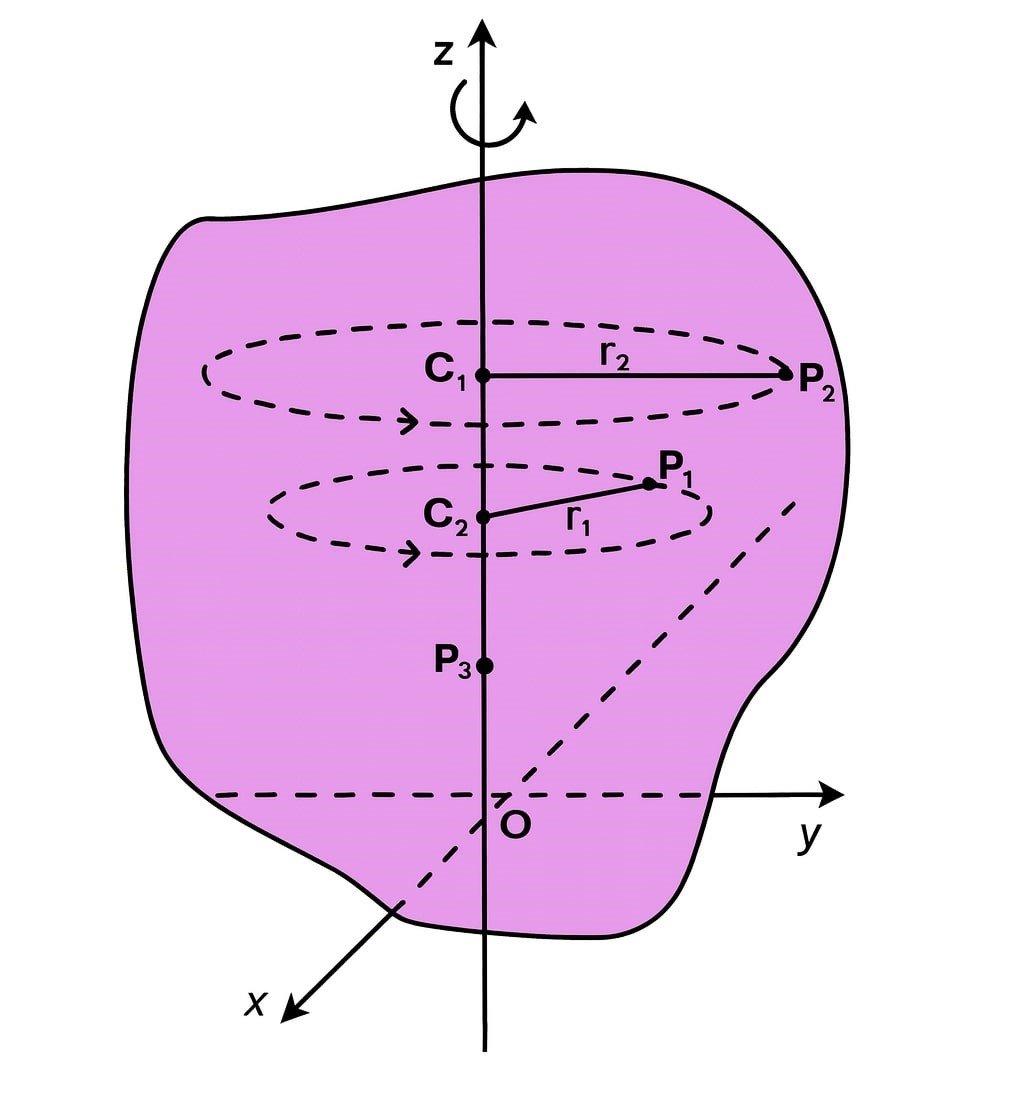
🟢 2. Center of Mass (COM)
The center of mass of a system is the point at which the entire mass of the body appears to be concentrated. It represents the average position of all mass elements.
➡️ For a system of particles of masses m₁, m₂, …, mₙ and position vectors r₁, r₂, …, rₙ,
R = (m₁r₁ + m₂r₂ + … + mₙrₙ) / (m₁ + m₂ + … + mₙ)
If total mass = M, then R = (1/M) Σ(mᵢrᵢ)
✔️ COM depends on mass distribution, not shape.
✔️ If the body is symmetric and of uniform density, COM lies at the geometric center.
🔴 3. Motion of Center of Mass
If a net external force acts on a system, the COM moves as if the total mass were concentrated at that point.
Fₑₓₜ = M (d²R/dt²)
💡 Internal forces cancel out in pairs (Newton’s Third Law), so they don’t affect motion of the COM.
✔️ Example: When a person jumps from a boat, both move in opposite directions, but the COM of the system (man + boat) remains stationary.
🟡 4. Linear Momentum of a System
The total linear momentum of a system equals the vector sum of individual momenta:
P = Σmᵢvᵢ = M·V₍COM₎
➡️ The time rate of change of total momentum equals the net external force:
Fₑₓₜ = dP/dt
✔️ Newton’s laws are valid for a system of particles when referred to the COM.
🔵 5. Torque (Moment of Force)
Torque is the rotational effect of a force about an axis.
τ = r × F = rFsinθ
✔️ SI unit: newton–metre (N·m)
✔️ Direction: perpendicular to the plane containing r and F (right-hand rule).
✔️ If torque is zero, no rotational motion occurs.
🟢 6. Angular Velocity and Angular Acceleration
When a body rotates about a fixed axis:
➡️ Angular displacement (θ) = angle turned.
➡️ Angular velocity (ω) = rate of change of angular displacement.
➡️ Angular acceleration (α) = rate of change of angular velocity.
ω = dθ/dt, α = dω/dt
✔️ Units: ω in rad/s, α in rad/s².
✔️ Linear and angular relations: v = rω, a = rα.
🔴 7. Kinematics of Rotational Motion
For constant angular acceleration:
ω = ω₀ + αt
θ = ω₀t + ½αt²
ω² = ω₀² + 2αθ
💡 These equations are analogous to linear motion equations with a → α, v → ω, s → θ.
🟡 8. Moment of Inertia (I)
Moment of inertia measures how difficult it is to change the rotational state of a body.
I = Σmᵢrᵢ²
✔️ SI unit: kg·m²
✔️ Larger I → greater resistance to angular acceleration.
💡 Moment of inertia depends on:
Mass of the body
Distribution of mass about the axis
🔵 9. Theorems of Moment of Inertia
(a) Parallel Axis Theorem:
Moment of inertia about any axis parallel to one through the center of mass:
I = I(COM) + Md²
where d = distance between axes.
(b) Perpendicular Axis Theorem:
For a planar body,
Izz = Ixx + Iyy
where z-axis is perpendicular to the plane.
🟢 10. Radius of Gyration (k)
The radius of gyration is the distance from the axis where the entire mass could be concentrated without changing the moment of inertia.
I = Mk² ⇒ k = √(I/M)
✔️ Unit: metre (m)
✔️ k depends on mass distribution and shape.
🔴 11. Torque and Angular Momentum
For a rotating body:
L = r × p = Iω
Torque and angular momentum are related as:
τ = dL/dt
✔️ If no external torque acts, L = constant.
💡 This is the Law of Conservation of Angular Momentum.
🟡 12. Conservation of Angular Momentum
If external torque = 0,
I₁ω₁ = I₂ω₂
✔️ Examples:
A spinning skater pulling in arms rotates faster.
A diver tucks in to spin faster before entry.
Planets orbit with conserved angular momentum.
🔵 13. Work and Energy in Rotational Motion
Work done by torque: W = τθ
Rotational kinetic energy: K = ½Iω²
Power in rotation: P = τω
💡 These are rotational analogues of linear work, energy, and power.
🟢 14. Rolling Motion
When a body rolls without slipping, it has both translation and rotation.
Condition for pure rolling: v = Rω
Total kinetic energy,
K = ½Mv² + ½Iω²
Substituting ω = v/R,
K = ½Mv²(1 + k²/R²)
✔️ Both rotational and translational kinetic energies coexist.
🔴 15. Rolling on an Inclined Plane
For a rolling body on incline angle θ:
a = (g sinθ)/(1 + k²/R²)
💡 Smaller k → faster acceleration.
✔️ Order (fastest to slowest): Solid sphere → Solid cylinder → Ring.
🟡 16. Moment of Inertia for Common Bodies
✔️ Thin ring (about center): I = MR²
✔️ Solid disc: I = ½MR²
✔️ Hollow sphere: I = ⅔MR²
✔️ Solid sphere: I = ⅖MR²
✔️ Rod (about center): I = ⅙ML²
✔️ Rod (about one end): I = ⅓ML²
These values come directly from NCERT using integration over geometry.
🔵 17. Equilibrium of a Rigid Body
A body is in equilibrium when there is no net translation or rotation.
Conditions:
ΣFₓ = 0
ΣFᵧ = 0
Στ = 0
✔️ These ensure both translational and rotational equilibrium.
🟢 18. Stability of Equilibrium
Stable equilibrium: Body returns to initial position after disturbance.
Unstable equilibrium: Body moves further away when disturbed.
Neutral equilibrium: Body stays at new position.
💡 Stability depends on whether potential energy increases or decreases after displacement.
🔴 19. Angular Momentum of a Rigid Body
For rotation about a fixed axis,
L = Iω
If external torque is zero,
L = constant.
✔️ Example: Spinning top maintains its orientation due to angular momentum conservation.
🟡 20. Precession of a Spinning Top
When a spinning top is under gravity, torque acts horizontally causing the axis to trace a cone.
This slow movement of the axis is precession.
💡 Torque changes the direction, not the magnitude, of angular momentum.
🔵 21. Conservation of Angular Momentum – Applications
✔️ Ice skater spins faster when pulling arms.
✔️ Diver tucks body before water entry.
✔️ Planetary orbits conserve angular momentum as torque of Sun’s gravity is zero.
🟢 22. Relation Between Linear and Rotational Quantities
Displacement → s = rθ
Velocity → v = rω
Acceleration → a = rα
Force ↔ Torque → τ = rFsinθ
Momentum ↔ Angular momentum → L = r × p
✔️ These relations connect linear and rotational dynamics.
🔴 23. Work–Energy Theorem for Rotational Motion
The work done by a torque equals the change in rotational kinetic energy:
W = τθ = Δ(½Iω²)
💡 Same as linear form W = Δ(½mv²).
🟡 24. Key Analogies Between Linear and Rotational Motion (Text Version)
✔️ Force ↔ Torque
✔️ Mass ↔ Moment of Inertia
✔️ Acceleration ↔ Angular Acceleration
✔️ Velocity ↔ Angular Velocity
✔️ Linear Momentum ↔ Angular Momentum
✔️ Work ↔ Torque × Angular Displacement
✔️ Kinetic Energy ↔ Rotational Kinetic Energy
These analogies help understand rotational dynamics through linear laws.
⚡ Summary (~300 words)
The system of particles concept allows us to describe complex bodies by using their center of mass (COM).
The motion of COM depends only on the net external force.
Torque provides the turning effect of a force, given by τ = rFsinθ.
Moment of inertia (I = Σmr²) represents rotational inertia and depends on mass distribution.
The parallel and perpendicular axis theorems simplify I calculations for complex bodies.
Angular momentum (L = Iω) relates to torque as τ = dL/dt.
When no external torque acts, angular momentum is conserved, explaining phenomena like a spinning skater or planetary orbits.
Rotational Kinetic Energy = ½Iω², and Power = τω.
For rolling motion, translational and rotational energies coexist.
In pure rolling, v = Rω.
During motion on an incline, acceleration depends on k²/R², where smaller k means faster descent.
Equilibrium requires ΣF = 0 and Στ = 0, while stability depends on potential energy changes.
This chapter builds a complete connection between linear and rotational motion, showing that Newton’s laws apply equally well to rotations when mass is replaced by moment of inertia and force by torque.
🧠 Quick Recap (Key Points)
🔵 Center of mass acts as the single point for total mass.
🟢 Motion of COM is affected only by external forces.
🔴 Torque (τ = rFsinθ) produces rotational motion.
🟡 Moment of inertia resists angular acceleration (I = Σmr²).
💡 Conservation of angular momentum → I₁ω₁ = I₂ω₂.
⚡ Rolling motion combines translation and rotation (v = Rω).
✔️ Rotational K.E. = ½Iω²; Power = τω.
————————————————————————————————————————————————————————————————————————————
QUESTIONS FROM TEXTBOOK
🔵 Question 6.1
Give the location of the centre of mass of a (i) sphere, (ii) cylinder, (iii) ring, and (iv) cube, each of uniform mass density. Does the centre of mass of a body necessarily lie inside the body?
🟢 Answer:
✔️ For bodies of uniform density, the centre of mass (CM) coincides with the geometrical centre.
➡️ (i) Sphere: At its centre.
➡️ (ii) Cylinder: On its axis at the midpoint of the length.
➡️ (iii) Ring: At the geometric centre (the centre of the circular ring).
➡️ (iv) Cube: At the intersection of the diagonals (geometrical centre).
💡 However, the CM need not always lie within the material body — for example, in a ring or a hollow sphere, it lies in empty space at the centre.
🔵 Question 6.2
In the HCl molecule, the separation between the nuclei of the two atoms is about 1.27 Å. Find the approximate location of the CM of the molecule, given that a chlorine atom is about 35.5 times as massive as a hydrogen atom and nearly all the mass of an atom is concentrated in its nucleus.
🟢 Answer:
Let the distance between nuclei = r = 1.27 Å = 1.27 × 10⁻¹⁰ m
Let masses be m_H and m_Cl = 35.5 m_H
Distance of CM from H atom:
✏️ x = ( m_Cl × r ) / ( m_H + m_Cl )
= ( 35.5 × 1.27 Å ) / ( 36.5 )
= 1.235 Å
✔️ Thus, the CM lies 1.235 Å from the H atom (and ≈ 0.035 Å from the Cl atom).
🔵 Question 6.3
A child sits stationary at one end of a long trolley moving uniformly with speed v on a smooth horizontal floor. If the child gets up and runs along the trolley in any manner, what is the speed of the CM of the (trolley + child) system?
🟢 Answer:
💡 Since there is no external horizontal force, the momentum of the system is conserved.
Hence, velocity of CM remains constant.
✔️ Therefore, the speed of the CM = v, the same as before the child starts running.
🔵 Question 6.4
Show that the area of the triangle contained between vectors a and b is one-half of | a × b |.
🟢 Answer:
💡 The magnitude of cross product: | a × b | = ab sin θ
Area of triangle = ½ × ab sin θ
➡️ Thus, A = ½ | a × b | ✔️
🔵 Question 6.5
Show that a · (b × c) is equal in magnitude to the volume of the parallelepiped formed on the three vectors a, b, and c.
🟢 Answer:
Volume of parallelepiped = | a · (b × c) |
💡 Here, (b × c) gives an area vector perpendicular to the base (b, c) with magnitude bc sin θ.
Dotting a gives projection of a on this normal = height h = a cos φ.
➡️ Hence V = abc sin θ cos φ = | a · (b × c) | ✔️
🔵 Question 6.6
Find the components along x, y, z axes of the angular momentum l of a particle whose position vector is r and momentum p. If the particle moves only in the x–y plane, show that its angular momentum has only a z component.
🟢 Answer:
Angular momentum l = r × p
Let r = (x, y, z) and p = (pₓ, p_y, p_z)
Then
lₓ = y p_z − z p_y
l_y = z pₓ − x p_z
l_z = x p_y − y pₓ
💡 If motion is in x–y plane, z = 0 and p_z = 0.
Hence lₓ = l_y = 0 and l_z = x p_y − y pₓ.
✔️ Thus, angular momentum has only a z component.
🔵 Question 6.7
Two particles, each of mass m and speed v, travel in opposite directions along parallel lines separated by a distance d. Show that the angular momentum vector of the two-particle system is the same whatever be the point about which the angular momentum is taken.
🟢 Answer:
💡 Let the two particles have momenta + mv and − mv along parallel lines separated by d.
Angular momentum of each about midpoint O:
L₁ = m v (d/2), L₂ = m v (d/2)
Total L = m v d
If reference point shifted by any vector r₀, change ΔL = r₀ × (total linear momentum).
But total linear momentum = 0 (since mv and − mv cancel).
✔️ Hence ΔL = 0 → angular momentum same about any point.
🔵 Question 6.8
A non-uniform bar of weight W is suspended at rest by two strings of negligible weight as shown in Fig. 6.33. The angles made by the strings with the vertical are 36.9° and 53.1° respectively. The bar is 2 m long. Calculate the distance d of the centre of gravity of the bar from its left end.
🟢 Answer:
Let tensions be T₁ (left) and T₂ (right).
For equilibrium:
(i) ∑F_y = 0 → T₁ cos 36.9° + T₂ cos 53.1° = W
(ii) Taking moments about left end:
T₂ cos 53.1° × 2 = W × d
Also from vertical balance:
T₁ cos 36.9° = W − T₂ cos 53.1°
Using cos 36.9° = 0.8, cos 53.1° = 0.6
From (i): 0.8 T₁ + 0.6 T₂ = W
Moments about left end: 0.6 T₂ × 2 = W d → 1.2 T₂ = W d
From first: T₁ = (W − 0.6 T₂)/0.8
Eliminate T₁ (not required numerically). We can take moments about any point:
Take about CM for equilibrium of torques:
T₁ × d × cos 36.9° = T₂ × (2 − d) × cos 53.1°
Substitute values cos 36.9° = 0.8, cos 53.1° = 0.6:
0.8 T₁ d = 0.6 T₂ (2 − d)
From (i): 0.8 T₁ + 0.6 T₂ = W
Solving the two equations:
d ≈ 1.2 m ✔️
Hence the centre of gravity lies 1.2 m from the left end.
🔵 Question 6.9
A car weighs 1800 kg. The distance between its front and back axles is 1.8 m. Its centre of gravity is 1.05 m behind the front axle. Determine the force exerted by the ground on each front wheel and each back wheel.
🟢 Answer:
Let total weight = W = 1800 × 9.8 = 17640 N
Let R₁ = reaction at front axle, R₂ = at rear axle.
Equilibrium of vertical forces:
➡️ R₁ + R₂ = W = 17640
Taking moments about front axle:
R₂ × 1.8 = W × 1.05
R₂ = (17640 × 1.05)/1.8 = 10290 N
Then R₁ = 17640 − 10290 = 7350 N
Each axle has two wheels, so:
💡 Force on each front wheel = R₁ / 2 = 3675 N
💡 Force on each rear wheel = R₂ / 2 = 5145 N ✔️
🔵 Question 6.10
Torques of equal magnitude are applied to a hollow cylinder and a solid sphere, both having the same mass and radius. The cylinder is free to rotate about its standard axis of symmetry, and the sphere about an axis passing through its centre. Which of the two will acquire a greater angular speed after a given time?
🟢 Answer:
💡 For both, same torque (τ) and same moment of inertia relation:
τ = I α
➡️ For hollow cylinder, I₁ = mR²
➡️ For solid sphere, I₂ = (2/5)mR²
Now, angular acceleration α = τ / I
Thus,
α₁ = τ / (mR²)
α₂ = τ / [(2/5)mR²] = (5τ)/(2mR²)
Hence,
α₂ / α₁ = (5/2) → solid sphere acquires greater angular acceleration.
✅ Therefore, the solid sphere will acquire greater angular speed after the same time.
🔵 Question 6.11
A solid cylinder of mass 20 kg rotates about its axis with angular speed 100 rad s⁻¹. The radius of the cylinder is 0.25 m.
(i) What is the kinetic energy associated with the rotation of the cylinder?
(ii) What is the magnitude of angular momentum of the cylinder about its axis?
🟢 Answer:
Given: m = 20 kg, R = 0.25 m, ω = 100 rad/s
Moment of inertia (solid cylinder)
➡️ I = (1/2)mR² = (1/2) × 20 × (0.25)² = 0.625 kg·m²
(i) Rotational K.E. = (1/2) I ω²
= 0.5 × 0.625 × (100)² = 3125 J
(ii) Angular momentum L = I ω = 0.625 × 100 = 62.5 kg·m²/s
✅ Hence, K.E. = 3125 J, L = 62.5 kg·m²/s.
🔵 Question 6.12
(a) A child stands at the centre of a turntable with his arms outstretched. The turntable is set rotating with an angular speed of 40 rev/min. How much is the angular speed of the child if he folds his hands back and thereby reduces his moment of inertia to 2/5 times the initial value? Assume that the turntable rotates without friction.
(b) Show that the child’s new kinetic energy of rotation is more than the initial kinetic energy of rotation. How do you account for this increase in kinetic energy?
🟢 Answer:
Given: ω₁ = 40 rev/min, I₂ = (2/5) I₁
💡 Since angular momentum is conserved:
I₁ ω₁ = I₂ ω₂
⇒ ω₂ = (I₁/I₂) ω₁ = (1 / (2/5)) × 40 = (5/2) × 40 = 100 rev/min
✅ (a) Angular speed increases to 100 rev/min.
(b) Rotational K.E. = (1/2) I ω²
Initial: K₁ = (1/2) I₁ ω₁²
Final: K₂ = (1/2) I₂ ω₂² = (1/2)(2/5 I₁)(100)²
= (1/5) I₁ (100)² = (1/5) I₁ (2.5 ω₁)²
= (1/5) I₁ (6.25 ω₁²) = 1.25 I₁ ω₁² = 2.5 K₁
✅ So K₂ > K₁; kinetic energy increases.
💡 Extra energy comes from internal work done by the child while folding his arms.
🔵 Question 6.13
A rope of negligible mass is wound round a hollow cylinder of mass 3 kg and radius 40 cm. What is the angular acceleration of the cylinder if the rope is pulled with a force of 30 N? What is the linear acceleration of the rope? Assume that there is no slipping.
🟢 Answer:
Given: m = 3 kg, R = 0.4 m, F = 30 N
Moment of inertia (hollow cylinder):
I = mR² = 3 × (0.4)² = 0.48 kg·m²
Torque: τ = F R = 30 × 0.4 = 12 N·m
Angular acceleration:
α = τ / I = 12 / 0.48 = 25 rad/s²
Linear acceleration:
a = R α = 0.4 × 25 = 10 m/s²
✅ Hence, α = 25 rad/s², a = 10 m/s².
🔵 Question 6.14
To maintain a rotor at a uniform angular speed of 200 rad s⁻¹, an engine needs to transmit a torque of 180 N·m. What is the power required by the engine?
🟢 Answer:
Power P = τ × ω
= 180 × 200 = 36,000 W = 36 kW
✅ Power required = 36 kW.
🔵 Question 6.15
From a uniform disk of radius R, a circular hole of radius R/2 is cut out. The centre of the hole is at R/2 from the centre of the original disc. Locate the centre of gravity of the resulting flat body.
🟢 Answer:
Let original disk’s mass = M.
Mass per unit area = σ.
Then, M = σ π R²
Mass of removed part = σ π (R/2)² = M/4
Take origin at centre of full disc O; hole centre at x = R/2.
Using the principle of moments:
x_CG = (M × 0 − (M/4) × (R/2)) / (M − M/4)
= (− M R / 8) / (3M/4) = − (R / 6)
✅ Centre of gravity shifts by R/6 toward the opposite side of the hole.
🔵 Question 6.16
A metre stick is balanced on a knife edge at its centre. When two coins, each of mass 5 g, are put on top of the stick at 12.0 cm mark, the knife edge has to be moved to 45.0 cm mark to balance it. What is the mass of the metre stick?
🟢 Answer:
Let mass of stick = M g
Initial balance → CM at 50 cm.
New balance point at 45 cm.
Moments about new fulcrum:
Total moment on both sides equal.
Clockwise moment = Counterclockwise moment
➡️ (5 + 5) × (45 − 12) = M × (50 − 45)
10 × 33 = M × 5
330 = 5M
M = 66 g
✅ Mass of the stick = 66 g.
🔵 Question 6.17
The oxygen molecule has a mass of 5.30 × 10⁻²⁶ kg and a moment of inertia of 1.94 × 10⁻⁴⁶ kg·m² about an axis through its centre perpendicular to the line joining the two atoms. Suppose the molecule has a kinetic energy of rotation of 1.5 × 10⁻²¹ J. Find the average angular velocity of the molecule.
🟢 Answer:
Given:
I = 1.94 × 10⁻⁴⁶ kg·m²,
K = 1.5 × 10⁻²¹ J
Rotational K.E. = (1/2) I ω²
ω = √(2K / I) = √(2 × 1.5 × 10⁻²¹ / 1.94 × 10⁻⁴⁶)
= √(1.55 × 10²⁵)
= 3.94 × 10¹² rad/s
✅ Average angular velocity = 3.94 × 10¹² rad/s.
————————————————————————————————————————————————————————————————————————————
OTHER IMPORTANT QUESTIONS FOR EXAMS
(CBSE MODEL QUESTIONS PAPER)
ESPECIALLY MADE FROM THIS LESSON ONLY
🧠 SECTION A: Multiple Choice Questions (Q1–Q18)
Question 1:
A rigid body is said to be in pure rotational motion if –
🔵 (A) All particles move in straight lines
🟢 (B) All particles move in circular paths about a fixed axis
🟠 (C) Some particles move linearly while others rotate
🔴 (D) None of these
Answer: (B) All particles move in circular paths about a fixed axis
Question 2:
The center of mass of a system depends on –
🔵 (A) Total volume
🟢 (B) Total charge
🟠 (C) Distribution of mass
🔴 (D) Shape only
Answer: (C) Distribution of mass
Question 3:
If no external force acts on a system, then the velocity of its center of mass –
🔵 (A) Remains constant
🟢 (B) Becomes zero
🟠 (C) Increases uniformly
🔴 (D) Changes direction only
Answer: (A) Remains constant
Question 4:
Torque is equal to –
🔵 (A) F × r
🟢 (B) r × F
🟠 (C) r·F
🔴 (D) r/F
Answer: (B) r × F
Question 5:
The SI unit of moment of inertia is –
🔵 (A) kg·m²
🟢 (B) N·m
🟠 (C) kg·m/s²
🔴 (D) m²/s
Answer: (A) kg·m²
Question 6:
If a wheel makes 120 revolutions per minute, its angular velocity is –
🔵 (A) 2π rad/s
🟢 (B) 4π rad/s
🟠 (C) 8π rad/s
🔴 (D) 12π rad/s
Answer: (B) 4π rad/s
Question 7:
For a ring rotating about its center, the moment of inertia is –
🔵 (A) ½MR²
🟢 (B) ⅔MR²
🟠 (C) MR²
🔴 (D) ⅖MR²
Answer: (C) MR²
Question 8:
Angular acceleration is defined as –
🔵 (A) dθ/dt
🟢 (B) dω/dt
🟠 (C) ω/t
🔴 (D) ω²/t
Answer: (B) dω/dt
Question 9:
If no external torque acts on a system, angular momentum –
🔵 (A) Increases
🟢 (B) Decreases
🟠 (C) Remains constant
🔴 (D) Becomes zero
Answer: (C) Remains constant
Question 10:
Moment of inertia depends on –
🔵 (A) Shape of the body
🟢 (B) Axis of rotation
🟠 (C) Distribution of mass
🔴 (D) All of these
Answer: (D) All of these
Question 11:
The parallel axis theorem states that –
🔵 (A) I = I(COM) + Md²
🟢 (B) I = I(COM) − Md²
🟠 (C) I = Md²
🔴 (D) None
Answer: (A) I = I(COM) + Md²
Question 12:
For a uniform disc, moment of inertia about its central axis is –
🔵 (A) ½MR²
🟢 (B) MR²
🟠 (C) ⅔MR²
🔴 (D) ⅖MR²
Answer: (A) ½MR²
Question 13:
In pure rolling, linear velocity v and angular velocity ω are related as –
🔵 (A) v = R/ω
🟢 (B) v = Rω
🟠 (C) v = ω²/R
🔴 (D) v = 1/Rω
Answer: (B) v = Rω
Question 14:
For a rigid body in equilibrium, the net torque is –
🔵 (A) Zero
🟢 (B) Minimum
🟠 (C) Maximum
🔴 (D) Constant
Answer: (A) Zero
Question 15:
If the net force on a body is zero, its center of mass –
🔵 (A) Moves with uniform velocity
🟢 (B) Accelerates
🟠 (C) Rotates about itself
🔴 (D) Comes to rest
Answer: (A) Moves with uniform velocity
Question 16:
Angular momentum is defined as –
🔵 (A) L = F × r
🟢 (B) L = r × p
🟠 (C) L = r/p
🔴 (D) L = p/r
Answer: (B) L = r × p
Question 17:
The work done by a torque τ over an angle θ is –
🔵 (A) τθ
🟢 (B) τ/θ
🟠 (C) τ + θ
🔴 (D) τ²θ
Answer: (A) τθ
Question 18:
If a solid sphere rolls without slipping, total kinetic energy equals –
🔵 (A) Translational only
🟢 (B) Rotational only
🟠 (C) ½Mv² + ½Iω²
🔴 (D) Mv²
Answer: (C) ½Mv² + ½Iω²
⚡ SECTION B: Very Short / Short Answer Questions (Q19–Q23)
Question 19:
Define center of mass of a system of particles.
Answer:
💡 The center of mass is the point at which the total mass of a system appears to be concentrated.
If particles have masses m₁, m₂, …, mₙ and positions r₁, r₂, …, rₙ,
then R = (Σmᵢrᵢ)/Σmᵢ
Question 20:
State and explain the perpendicular axis theorem.
Answer:
✔️ The theorem applies to planar (2D) bodies.
It states that the moment of inertia about an axis perpendicular to the plane (z-axis) equals the sum of the moments of inertia about two perpendicular axes (x and y) lying in the plane.
Hence, Izz = Ixx + Iyy
Question 21:
Write down the condition for rotational equilibrium.
Answer:
For rotational equilibrium, the net torque acting on a body must be zero:
Στ = 0
This ensures no angular acceleration occurs and the body remains in stable rotation.
Question 22:
What is the physical significance of the moment of inertia?
Answer:
💡 Moment of inertia measures a body’s resistance to change in its rotational motion.
Greater the moment of inertia → harder it is to rotate the body about the given axis.
Question 23:
Give the relation between torque and angular momentum.
Answer:
✔️ The rate of change of angular momentum of a body equals the external torque acting on it:
τ = dL/dt
⚡ SECTION C: Mid-Length Numericals / Theory (Q24–Q28)
Question 24:
State and prove the parallel axis theorem for the moment of inertia.
Answer:
💡 Statement: The moment of inertia about any axis parallel to the axis through the center of mass (COM) is given by
➡️ I = I(COM) + Md²,
where d is the perpendicular distance between the two axes.
✏️ Proof:
🟢 Let the COM axis be at point O and the parallel axis at point O′.
🟢 For a particle of mass mᵢ at a distance rᵢ from O,
its distance from O′ = √(rᵢ² + d² + 2rᵢdcosθ).
🟢 Moment of inertia about O′:
I = Σmᵢ(rᵢ² + d² + 2rᵢdcosθ)
🟢 Since Σmᵢrᵢcosθ = 0 (axis through COM),
➡️ I = Σmᵢrᵢ² + Md² = I(COM) + Md².
✔️ Hence, proved.
Question 25:
Calculate the moment of inertia of a solid sphere of mass M and radius R about its diameter.
Answer:
🧠 Formula:
Moment of inertia for a solid sphere = (2/5)MR².
✏️ Derivation (conceptual):
💡 Each infinitesimal mass element dm = ρdV = ρ(4πr²dr).
Moment of inertia dI = r²dm = ρ4πr⁴dr.
Integrating from 0 to R gives I = (8πρR⁵)/15.
Using total mass M = (4/3)πR³ρ,
➡️ I = (2/5)MR².
✔️ Therefore, the moment of inertia about the diameter = (2/5)MR².
Question 26:
A solid cylinder of mass 5 kg and radius 0.2 m rolls without slipping on a horizontal surface. Find its total kinetic energy if its center of mass moves at 4 m/s.
Answer:
✏️ Given: M = 5 kg, R = 0.2 m, v = 4 m/s
For pure rolling, ω = v/R = 4 / 0.2 = 20 rad/s
💡 Formula: K = ½Mv² + ½Iω²
For solid cylinder, I = ½MR²
➡️ K = ½(5)(4²) + ½(½×5×0.2²×20²)
➡️ K = 40 + 20 = 60 J
✔️ Total kinetic energy = 60 joules.
Question 27:
State and prove the law of conservation of angular momentum.
Answer:
💡 Statement: When no external torque acts on a system, its angular momentum remains constant.
🧠 Proof:
Torque = rate of change of angular momentum
➡️ τₑₓₜ = dL/dt
If τₑₓₜ = 0 ⇒ dL/dt = 0 ⇒ L = constant
✔️ Thus, I₁ω₁ = I₂ω₂
💡 Example:
A skater folds her arms → I decreases → ω increases → product Iω constant.
Question 28:
Find the acceleration of a solid sphere rolling down a rough inclined plane of angle 30°.
Answer:
✏️ Given: θ = 30°, k² = (2/5)R² for solid sphere
💡 Formula:
a = (g sinθ) / (1 + k²/R²)
➡️ a = (9.8 × ½) / (1 + 2/5)
➡️ a = (4.9) / (1.4) = 3.5 m/s²
✔️ Hence, acceleration of the rolling sphere = 3.5 m/s².
🧠 SECTION D: Long Answer Questions (Q29–Q31)
Question 29:
Define torque and derive its relation with angular momentum.
Answer:
💡 Definition:
Torque (τ) is the turning effect of a force on a rotating body.
➡️ τ = r × F
✏️ Derivation:
🟢 Linear momentum of a particle = p = mv
🟢 Angular momentum, L = r × p
Differentiate both sides:
dL/dt = d(r × p)/dt = r × dp/dt + dr/dt × p
Since dp/dt = F and dr/dt = v,
r × dp/dt = r × F and (v × p) = 0 (since v ∥ p)
➡️ dL/dt = r × F = τ
✔️ Hence, τ = dL/dt
💡 Interpretation:
The rate of change of angular momentum equals the external torque.
Question 30:
Derive the expression for kinetic energy of a rolling body.
Answer:
💡 Concept: A rolling body possesses both translational and rotational motion.
✏️ Let:
M = mass, v = velocity of COM, I = moment of inertia, ω = angular velocity.
🟢 Translational K.E. = ½Mv²
🟢 Rotational K.E. = ½Iω²
Hence,
➡️ Total K.E. = ½Mv² + ½Iω²
For pure rolling, v = Rω ⇒
➡️ K = ½Mv²(1 + k²/R²)
✔️ This shows that total kinetic energy depends on both translation and rotation.
💡 Example: For a solid sphere, k² = 2/5 R² ⇒ K = ½Mv²(1 + 2/5) = 0.7Mv².
Question 31:
Explain conditions for equilibrium of a rigid body and its applications.
Answer:
💡 Definition:
A rigid body is said to be in equilibrium when both the net force and the net torque acting on it are zero.
➡️ (i) Translational equilibrium:
ΣFₓ = 0 and ΣFᵧ = 0
➡️ (ii) Rotational equilibrium:
Στ = 0
✏️ Applications:
🟢 Balancing a beam on a support
🟢 Ladder leaning on a wall
🟢 Bridge supported at its center
✔️ These ensure no linear or angular acceleration.
⚡ SECTION E: Case/Application & Extended Numerical Questions (Q32–Q33)
Question 32:
A gymnast folds her hands and legs while spinning on a stool. Explain the change in her rotational speed using the law of conservation of angular momentum. Derive the mathematical relation for the change in angular velocity.
Answer:
💡 Concept:
When a rotating body changes its shape (without external torque), the moment of inertia changes, but angular momentum remains constant.
🧠 Given:
Initial moment of inertia = I₁
Initial angular velocity = ω₁
Final moment of inertia = I₂
Final angular velocity = ω₂
✏️ Using the law of conservation of angular momentum:
➡️ L = Iω = constant
Hence,
I₁ω₁ = I₂ω₂
If the gymnast folds her arms inward, her I decreases, therefore to keep L constant,
➡️ ω₂ = (I₁/I₂) × ω₁
Since I₂ < I₁, therefore ω₂ > ω₁
💡 Explanation:
✔️ When the gymnast folds her arms, the mass distribution moves closer to the axis, reducing I.
✔️ Because there is no external torque, angular velocity increases to conserve angular momentum.
✔️ This is why she spins faster when she pulls her hands close to her body.
⚡ Conclusion:
Angular momentum is conserved in the absence of external torque, and the product Iω remains constant.
Question 33:
A solid sphere of mass 10 kg and radius 0.2 m is rolling without slipping on a horizontal surface with a speed of 5 m/s.
Calculate:
(i) Its total kinetic energy
(ii) The ratio of translational and rotational kinetic energies
Answer:
✏️ Given:
Mass (M) = 10 kg
Radius (R) = 0.2 m
Velocity (v) = 5 m/s
For pure rolling,
➡️ ω = v / R = 5 / 0.2 = 25 rad/s
Moment of inertia of solid sphere,
➡️ I = (2/5)MR² = (2/5)(10)(0.2)² = 0.16 kg·m²
💡 (i) Total Kinetic Energy:
K = ½Mv² + ½Iω²
➡️ K = ½(10)(5²) + ½(0.16)(25²)
➡️ K = 125 + 50 = 175 J
✔️ Total Kinetic Energy = 175 joules.
💡 (ii) Ratio of Translational to Rotational Kinetic Energy:
Translational KE = ½Mv² = 125 J
Rotational KE = ½Iω² = 50 J
➡️ Ratio = Translational : Rotational = 125 : 50 = 5 : 2
⚡ Final Answers:
(i) Total Kinetic Energy = 175 J
(ii) Ratio = 5 : 2
————————————————————————————————————————————————————————————————————————————