
Class 11 : Maths (In English) – Lesson 11. Introduction to Three-Dimensional Geometry

EXPLANATION & SUMMARY
✨ Explanation (Detailed)
🔵 1. Introduction
In earlier classes, geometry was studied in two dimensions (x–y plane).
In this lesson, we extend to three dimensions (x–y–z space).
📌 Every point is represented by an ordered triplet (x, y, z).
🧠 Purpose: To locate points in space and study relations between them using algebraic methods.
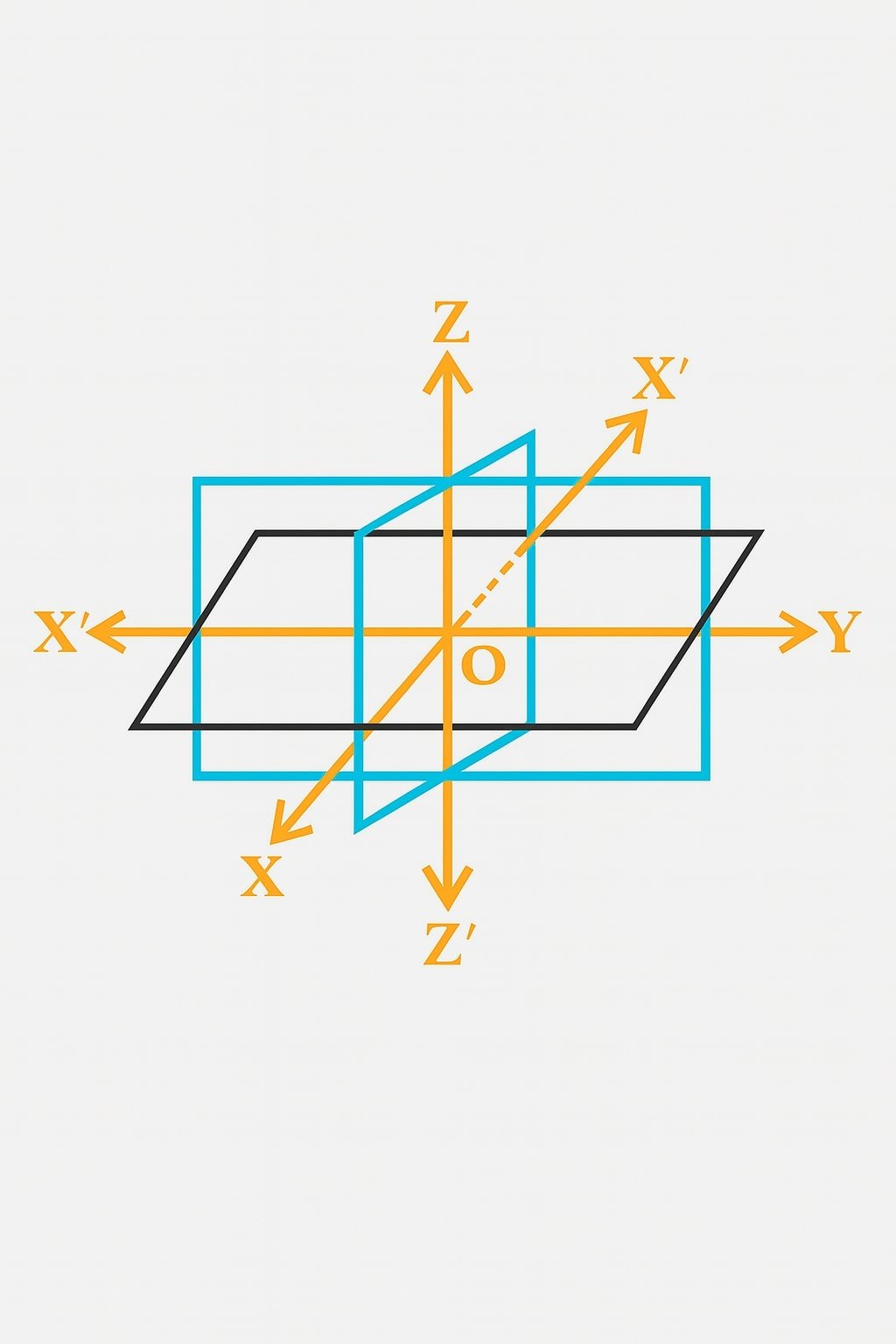
🟢 2. Coordinate Axes
There are three mutually perpendicular axes:
X-axis → horizontal
Y-axis → perpendicular to X in plane
Z-axis → perpendicular to both (upward)
💡 They intersect at origin O(0, 0, 0) forming three coordinate planes:
XY-plane → z = 0
YZ-plane → x = 0
ZX-plane → y = 0
➡️ These divide space into 8 octants.
🟡 3. Coordinates of a Point
A point P(x, y, z) is located by distances:
x from YZ-plane,
y from ZX-plane,
z from XY-plane.
🧭 Sign convention:
If on positive side of axis → coordinate positive
If on negative side → coordinate negative
Example:
✔️ P(3, −2, 5)
• 3 units along +X
• 2 units along −Y
• 5 units along +Z
🔴 4. Distance Formula
Let P(x₁, y₁, z₁) and Q(x₂, y₂, z₂) be two points.
🔹 Distance between them:
📘 PQ = √[(x₂ − x₁)² + (y₂ − y₁)² + (z₂ − z₁)²]
✏️ Note: Reduces to 2D distance formula when z₁ = z₂ = 0.
✔️ Example:
P(1, 2, 3), Q(4, 6, 8)
PQ = √[(4−1)² + (6−2)² + (8−3)²]
= √(9 + 16 + 25) = √50 = 5√2
🟢 5. Section Formula
If point R(x, y, z) divides PQ in ratio m:n, then
➡️ Coordinates of R:
x = (m·x₂ + n·x₁) / (m + n)
y = (m·y₂ + n·y₁) / (m + n)
z = (m·z₂ + n·z₁) / (m + n)
✔️ For midpoint (m = n = 1):
R = ((x₁ + x₂)/2, (y₁ + y₂)/2, (z₁ + z₂)/2)
💡 Concept: Weighted average of coordinates.
🟡 6. Centroid of a Triangle
If vertices are A(x₁, y₁, z₁), B(x₂, y₂, z₂), C(x₃, y₃, z₃)
Then centroid G is:
G = ((x₁ + x₂ + x₃)/3, (y₁ + y₂ + y₃)/3, (z₁ + z₂ + z₃)/3)
🧠 Represents average position of all vertices.
🔵 7. Coordinates of a Point Dividing a Line Internally or Externally
Internal division: uses section formula directly.
External division:
x = (m·x₂ − n·x₁) / (m − n), similarly for y and z.
✏️ Note: Apply only when m ≠ n.
🟢 8. Direction Cosines (l, m, n)
Let line OP make angles α, β, γ with x-, y-, z-axes.
Then:
l = cos α
m = cos β
n = cos γ
✅ Relation:
l² + m² + n² = 1
💡 These are direction cosines (DCs) of the line.
🔴 9. Direction Ratios (a, b, c)
Any set of numbers proportional to DCs:
a : b : c = l : m : n
➡️ Relation:
l = a / √(a² + b² + c²), and similarly for m, n.
🟡 10. Equation of a Line Passing Through Two Points
If line passes through P(x₁, y₁, z₁) and Q(x₂, y₂, z₂),
direction ratios are (x₂ − x₁), (y₂ − y₁), (z₂ − z₁)
Equation of line:
(x − x₁)/(x₂ − x₁) = (y − y₁)/(y₂ − y₁) = (z − z₁)/(z₂ − z₁)
🔵 11. Equation of Plane
Standard form:
ax + by + cz + d = 0
🧠 Each plane is determined by:
Normal vector (a, b, c)
Distance from origin: |d| / √(a² + b² + c²)
💡 All points (x, y, z) satisfying above lie on the plane.
🟢 12. Angle Between Two Lines
If direction cosines of lines are (l₁, m₁, n₁) and (l₂, m₂, n₂):
cos θ = l₁l₂ + m₁m₂ + n₁n₂
🔴 13. Angle Between Two Planes
If normals are (a₁, b₁, c₁) and (a₂, b₂, c₂):
cos θ = (a₁a₂ + b₁b₂ + c₁c₂) / [√(a₁² + b₁² + c₁²) · √(a₂² + b₂² + c₂²)]
🟡 14. Perpendicular Distance from a Point to a Plane
From P(x₁, y₁, z₁) to plane ax + by + cz + d = 0:
📘 Distance = |a·x₁ + b·y₁ + c·z₁ + d| / √(a² + b² + c²)
🔵 15. Section of a Line by Coordinate Planes
Find intersection by setting one coordinate to zero:
With XY-plane → z = 0
With YZ-plane → x = 0
With ZX-plane → y = 0
🟢 16. Equation of a Plane Passing Through Three Points
If points A, B, C are non-collinear:
| x−x₁ y−y₁ z−z₁ |
| x₂−x₁ y₂−y₁ z₂−z₁ | = 0
| x₃−x₁ y₃−y₁ z₃−z₁ |
🔴 17. Position of a Point Relative to a Plane
Substitute (x₁, y₁, z₁) into ax + by + cz + d:
Positive value → one side
Negative value → other side
Zero → lies on plane
🟡 18. Collinearity of Points
Points P, Q, R are collinear if vectors PQ and PR are parallel,
i.e., direction ratios proportional.
Or check if
(x₂ − x₁)/(x₃ − x₁) = (y₂ − y₁)/(y₃ − y₁) = (z₂ − z₁)/(z₃ − z₁)
🔵 19. Coplanarity of Four Points
Four points A, B, C, D are coplanar if volume of tetrahedron = 0:
| x₁ y₁ z₁ 1 |
| x₂ y₂ z₂ 1 | = 0
| x₃ y₃ z₃ 1 |
| x₄ y₄ z₄ 1 |
🟢 20. Applications
✔️ Used in physics (motion in 3D, vector forces)
✔️ In computer graphics and 3D modeling
✔️ In navigation, aerospace, robotics
📘 Summary (~300 words)
🧠 Core Concepts
3D system: Axes X, Y, Z mutually perpendicular, intersect at origin.
Point: (x, y, z), representing position in space.
Distance: √[(x₂−x₁)² + (y₂−y₁)² + (z₂−z₁)²]
Section formula: divides line in ratio m:n
Centroid: average of vertex coordinates.
Direction cosines (l, m, n): cosines of angles with axes.
Relation: l² + m² + n² = 1
Direction ratios proportional to DCs.
Line equation: (x−x₁)/a = (y−y₁)/b = (z−z₁)/c
Plane equation: ax + by + cz + d = 0
Angle formulas:
• Between lines → cos θ = l₁l₂ + m₁m₂ + n₁n₂
• Between planes → cos θ = (a₁a₂ + b₁b₂ + c₁c₂)/(…)
Distance to plane: |ax₁ + by₁ + cz₁ + d| / √(a² + b² + c²)
📍 Geometric Conditions
Collinear points: direction ratios proportional
Coplanar points: determinant = 0
Position: Substitute point into plane equation
💡 Practical Uses
3D modeling, computer graphics, navigation, physics vectors.
📝 Quick Recap
✔️ Coordinates in space → (x, y, z)
✔️ Distance formula → √[(x₂−x₁)² + (y₂−y₁)² + (z₂−z₁)²]
✔️ Section formula → weighted average
✔️ Direction cosines satisfy l² + m² + n² = 1
✔️ Equation of line → symmetric form
✔️ Equation of plane → ax + by + cz + d = 0
✔️ Distance from point to plane → |ax₁ + by₁ + cz₁ + d| / √(a² + b² + c²)
————————————————————————————————————————————————————————————————————————————
QUESTIONS FROM TEXTBOOK
📄 Exercise 11.1
🔵 Question 1:
A point is on the x-axis. What are its y-coordinate and z-coordinate?
🟢 Answer:
💡 A point on the x-axis has no displacement along y and z directions.
➡️ Therefore, y = 0 and z = 0.
✔️ Coordinates are of the form (x, 0, 0).
🔵 Question 2:
A point is in the XZ-plane. What can you say about its y-coordinate?
🟢 Answer:
💡 Every point in the XZ-plane has no displacement along the y-axis.
➡️ Hence, y = 0.
✔️ Coordinates are of the form (x, 0, z).
🔵 Question 3:
Name the octants in which the following points lie:
(1, 2, 3), (4, −2, 3), (4, −2, −5), (4, 2, −5), (−4, 2, −5), (−4, 2, 5), (−3, −1, 6), (−2, −4, −7)
🟢 Answer:
💡 Sign of (x, y, z) decides the octant:
1️⃣ (1, 2, 3): (+, +, +) → First octant
2️⃣ (4, −2, 3): (+, −, +) → Fourth octant
3️⃣ (4, −2, −5): (+, −, −) → Sixth octant
4️⃣ (4, 2, −5): (+, +, −) → Fifth octant
5️⃣ (−4, 2, −5): (−, +, −) → Seventh octant
6️⃣ (−4, 2, 5): (−, +, +) → Second octant
7️⃣ (−3, −1, 6): (−, −, +) → Third octant
8️⃣ (−2, −4, −7): (−, −, −) → Eighth octant
✔️ Total 8 octants based on sign combinations of (x, y, z).
🔵 Question 4: Fill in the blanks:
(i) The x-axis and y-axis taken together determine a plane known as XY-plane.
(ii) The coordinates of points in the XY-plane are of the form (x, y, 0).
(iii) Coordinate planes divide the space into 8 octants.
✔️ All blanks filled correctly.
📄 Exercise 11.2
🔵 Question 1:
Find the distance between the following pairs of points:
(i) (2, 3, 5) and (4, 3, 1)
🟢 Answer:
💡 Distance formula:
d = √[(x₂ − x₁)² + (y₂ − y₁)² + (z₂ − z₁)²]
➡️ = √[(4 − 2)² + (3 − 3)² + (1 − 5)²]
➡️ = √[(2)² + 0² + (−4)²]
➡️ = √(4 + 0 + 16) = √20 = 2√5 ✔️
(ii) (−3, 7, 2) and (2, 4, −1)
➡️ d = √[(2 + 3)² + (4 − 7)² + (−1 − 2)²]
➡️ = √[5² + (−3)² + (−3)²]
➡️ = √(25 + 9 + 9) = √43 ✔️
(iii) (−1, 3, −4) and (1, −3, 4)
➡️ d = √[(1 + 1)² + (−3 − 3)² + (4 + 4)²]
➡️ = √[2² + (−6)² + 8²]
➡️ = √(4 + 36 + 64) = √104 = 2√26 ✔️
(iv) (2, −1, 3) and (−2, 1, 3)
➡️ d = √[(−2 − 2)² + (1 + 1)² + (3 − 3)²]
➡️ = √[(−4)² + 2² + 0²]
➡️ = √(16 + 4) = √20 = 2√5 ✔️
🔵 Question 2:
Show that the points (−2, 3, 5), (1, 2, 3) and (7, 0, −1) are collinear.
🟢 Answer:
💡 Compute distance AB + BC and compare with AC.
Let
A(−2, 3, 5), B(1, 2, 3), C(7, 0, −1)
➡️ AB = √[(1 + 2)² + (2 − 3)² + (3 − 5)²]
= √[3² + (−1)² + (−2)²]
= √(9 + 1 + 4) = √14
➡️ BC = √[(7 − 1)² + (0 − 2)² + (−1 − 3)²]
= √[6² + (−2)² + (−4)²]
= √(36 + 4 + 16) = √56 = 2√14
➡️ AC = √[(7 + 2)² + (0 − 3)² + (−1 − 5)²]
= √[9² + (−3)² + (−6)²]
= √(81 + 9 + 36) = √126 = 3√14
✔️ Since AB + BC = AC → points are collinear ✔️
🔵 Question 3: Verify the following:
(i) (0, 7, −10), (1, 6, −6), (4, 9, −6) form an isosceles triangle.
🟢 Answer:
Use distance formula:
AB = √[(1 − 0)² + (6 − 7)² + (−6 + 10)²] = √(1 + 1 + 16) = √18
BC = √[(4 − 1)² + (9 − 6)² + (−6 + 6)²] = √(9 + 9 + 0) = √18
CA = √[(4 − 0)² + (9 − 7)² + (−6 + 10)²] = √(16 + 4 + 16) = √36 = 6
✔️ AB = BC ⇒ Isosceles triangle ✔️
(ii) (0, 7, 10), (−1, 6, 6), (−4, 9, 6) form a right-angled triangle.
➡️ AB = √[(−1)² + (−1)² + (−4)²] = √(1 + 1 + 16) = √18
BC = √[(−4 + 1)² + (9 − 6)² + (6 − 6)²] = √(9 + 9) = √18
CA = √[(−4)² + (9 − 7)² + (6 − 10)²] = √(16 + 4 + 16) = √36 = 6
Check: (√18)² + (√18)² = 18 + 18 = 36 = (6)² ⇒ ✔️ Right triangle
(iii) (−1, 2, 1), (1, −2, 5), (4, −7, 8), (2, −3, 4) form a parallelogram.
💡 AB = CD and AD = BC.
Compute:
AB = √[(1 + 1)² + (−2 − 2)² + (5 − 1)²] = √(4 + 16 + 16) = 6
CD = √[(2 − 4)² + (−3 + 7)² + (4 − 8)²] = √(4 + 16 + 16) = 6
AD = √[(2 + 1)² + (−3 − 2)² + (4 − 1)²] = √(9 + 25 + 9) = √43
BC = √[(4 − 1)² + (−7 + 2)² + (8 − 5)²] = √(9 + 25 + 9) = √43
✔️ Opposite sides equal ⇒ Parallelogram ✔️
🔵 Question 4:
Find the equation of the set of points equidistant from (1, 2, 3) and (3, 2, −1).
🟢 Answer:
Let point P(x, y, z).
Condition: PA = PB
➡️ √[(x − 1)² + (y − 2)² + (z − 3)²] = √[(x − 3)² + (y − 2)² + (z + 1)²]
➡️ Square both sides:
(x − 1)² + (z − 3)² = (x − 3)² + (z + 1)²
➡️ Expand:
x² − 2x + 1 + z² − 6z + 9 = x² − 6x + 9 + z² + 2z + 1
➡️ Simplify: (−2x + 1 − 6z + 9) − (−6x + 9 + 2z + 1) = 0
➡️ 4x − 8z = 0 ⇒ x = 2z ✔️
🔵 Question 5:
Find the equation of set of points P such that PA + PB = 10,
where A(4, 0, 0), B(−4, 0, 0).
🟢 Answer:
💡 Standard equation of an ellipse in 3D (foci on x-axis):
PA + PB = 2a ⇒ 2a = 10 ⇒ a = 5
Distance between foci = 8 ⇒ 2c = 8 ⇒ c = 4
b² = a² − c² = 25 − 16 = 9
Equation:
➡️ x²/25 + y²/9 + z²/9 = 1 ✔️
————————————————————————————————————————————————————————————————————————————
OTHER IMPORTANT QUESTIONS FOR EXAMS
CBSE STYLE MODEL PAPER
ESPECIALLY FROM THIS CHAPTER ONLY
🔷 Section A – Multiple Choice Questions (1 mark each)
🔵 Question 1:
How many coordinate axes exist in 3D geometry?
🟢 (A) 1
🟡 (B) 2
🔴 (C) 3
🔵 (D) 4
✔️ Answer: (C) 3
🔵 Question 2:
The origin in 3D space is represented by:
🟢 (A) (1, 1, 1)
🟡 (B) (0, 0, 0)
🔴 (C) (x, y, z)
🔵 (D) (−1, 1, 0)
✔️ Answer: (B) (0, 0, 0)
🔵 Question 3:
A point with coordinates (+, −, +) lies in which octant?
🟢 (A) First
🟡 (B) Second
🔴 (C) Fourth
🔵 (D) Eighth
✔️ Answer: (C) Fourth
✏️ Note: Octant naming depends on sign convention; (+, −, +) is called Fourth Octant when ordered by signs (x+, y−, z+).
🔵 Question 4:
Equation of the XY-plane is:
🟢 (A) z = 0
🟡 (B) x = 0
🔴 (C) y = 0
🔵 (D) x + y + z = 0
✔️ Answer: (A) z = 0
🔵 Question 5:
Distance between points A(1,2,3) and B(4,6,8) is:
🟢 (A) 3
🟡 (B) 5
🔴 (C) 5√2
🔵 (D) √50
✔️ Answer: (C) 5√2
💡 Explanation:
PQ = √[(4−1)² + (6−2)² + (8−3)²] = √(9+16+25) = √50 = 5√2
🔵 Question 6:
Midpoint of (2,4,6) and (4,8,10) is:
🟢 (A) (2,4,6)
🟡 (B) (3,6,8)
🔴 (C) (6,12,16)
🔵 (D) (1,2,3)
✔️ Answer: (B) (3,6,8)
🔵 Question 7:
If P divides AB internally in 1:1, then P is:
🟢 (A) Centroid
🟡 (B) Midpoint
🔴 (C) Vertex
🔵 (D) None
✔️ Answer: (B) Midpoint
🔵 Question 8:
Point dividing line segment joining P(x₁,y₁,z₁) and Q(x₂,y₂,z₂) internally in ratio m:n has coordinates:
🟢 (A) ((m·x₁ + n·x₂)/(m+n), …)
🟡 (B) ((m·x₂ + n·x₁)/(m+n), …)
🔴 (C) ((x₁ + x₂)/2, …)
🔵 (D) None
✔️ Answer: (B) ((m·x₂ + n·x₁)/(m+n), (m·y₂ + n·y₁)/(m+n), (m·z₂ + n·z₁)/(m+n))
🔵 Question 9:
Centroid of triangle A(1,2,3), B(3,0,1), C(5,2,3):
🟢 (A) (3, 4/3, 7/3)
🟡 (B) (3, 1, 2)
🔴 (C) (2, 1, 2)
🔵 (D) (3, 2, 3)
✔️ Answer: (A) (3, 4/3, 7/3)
💡 Calculation:
x̄ = (1+3+5)/3 = 3, ȳ = (2+0+2)/3 = 4/3, z̄ = (3+1+3)/3 = 7/3
🔵 Question 10:
Direction cosines (l, m, n) satisfy:
🟢 (A) l + m + n = 1
🟡 (B) l² + m² + n² = 1
🔴 (C) l³ + m³ + n³ = 1
🔵 (D) l² + m² + n² = 0
✔️ Answer: (B) l² + m² + n² = 1
🔵 Question 11:
Direction ratios are:
🟢 (A) Numbers proportional to direction cosines
🟡 (B) Always equal to 1
🔴 (C) Coordinates of a point
🔵 (D) None
✔️ Answer: (A) Numbers proportional to direction cosines
🔵 Question 12:
Equation of a line through (1,2,3) with direction ratios (2,3,4):
🟢 (A) (x−1)/2 = (y−2)/3 = (z−3)/4
🟡 (B) (x+1)/2 = (y+2)/3 = (z+3)/4
🔴 (C) (x−2)/1 = (y−3)/1 = (z−4)/1
🔵 (D) None
✔️ Answer: (A) (x−1)/2 = (y−2)/3 = (z−3)/4
🔵 Question 13:
General equation of a plane:
🟢 (A) ax + by + cz + d = 0
🟡 (B) x + y + z = 0
🔴 (C) x = 0
🔵 (D) z = 0
✔️ Answer: (A) ax + by + cz + d = 0
🔵 Question 14:
Distance of point (1,2,2) from plane x + 2y + 2z − 5 = 0:
🟢 (A) 4/3
🟡 (B) 1
🔴 (C) 2
🔵 (D) 3
✔️ Answer: (A) 4/3
💡 Calculation:
= |1 + 4 + 4 − 5| / √(1 + 4 + 4) = 4 / 3 = 1.33 units
🔵 Question 15:
Angle between lines with DCs (1,0,0) and (0,1,0):
🟢 (A) 90°
🟡 (B) 60°
🔴 (C) 0°
🔵 (D) 45°
✔️ Answer: (A) 90°
💡 cosθ = l₁l₂ + m₁m₂ + n₁n₂ = 0 → θ = 90°
🔵 Question 16:
Condition for coplanarity of four points:
🟢 (A) Determinant = 0
🟡 (B) Sum = 0
🔴 (C) Product = 0
🔵 (D) None
✔️ Answer: (A) Determinant = 0
🔵 Question 17:
If a line has DCs (l,m,n) and another line (l′,m′,n′) is perpendicular, then:
🟢 (A) l·l′ + m·m′ + n·n′ = 0
🟡 (B) l + m + n = 0
🔴 (C) l² + m² + n² = 0
🔵 (D) None
✔️ Answer: (A) l·l′ + m·m′ + n·n′ = 0
🔵 Question 18:
If a point lies on plane ax + by + cz + d = 0, then:
🟢 (A) ax + by + cz + d = 0
🟡 (B) ax + by + cz + d ≠ 0
🔴 (C) ax + by + cz + d > 0
🔵 (D) None
✔️ Answer: (A) ax + by + cz + d = 0
🔵 Question 19:
Find the distance between the points P(2, −1, 3) and Q(−1, 2, −3).
🟢 Answer:
➤ Step 1: Use distance formula: PQ = √[(x₂−x₁)² + (y₂−y₁)² + (z₂−z₁)²].
➤ Step 2: Differences = (−1−2, 2−(−1), −3−3) = (−3, 3, −6).
➤ Step 3: Squares sum = (−3)² + 3² + (−6)² = 9 + 9 + 36 = 54.
➤ Step 4: Distance = √54 = 3√6.
✔️ Final: 3√6 units.
🔵 Question 20:
Find the midpoint of A(a, b, c) and B(−a, −b, −c).
🟢 Answer:
➤ Step 1: Midpoint formula: M = ((x₁+x₂)/2, (y₁+y₂)/2, (z₁+z₂)/2).
➤ Step 2: M = ((a + (−a))/2, (b + (−b))/2, (c + (−c))/2).
➤ Step 3: M = (0, 0, 0).
✔️ Final: (0, 0, 0).
🔵 Question 21:
Find the coordinates of the point dividing the line segment joining A(1, 2, 3) and B(4, −1, 6) internally in the ratio 2:1.
🟢 Answer:
➤ Step 1: Use section formula (internal):
x = (m x₂ + n x₁)/(m+n), y = (m y₂ + n y₁)/(m+n), z = (m z₂ + n z₁)/(m+n).
➤ Step 2: Put m:n = 2:1, (x₁,y₁,z₁) = (1,2,3), (x₂,y₂,z₂) = (4,−1,6).
➤ Step 3: x = (2·4 + 1·1)/3 = 9/3 = 3.
➤ Step 4: y = (2·(−1) + 1·2)/3 = 0/3 = 0.
➤ Step 5: z = (2·6 + 1·3)/3 = 15/3 = 5.
✔️ Final: (3, 0, 5).
🔵 Question 22:
Find the direction cosines of a line whose direction ratios are (2, −2, 1).
🟢 Answer:
➤ Step 1: Compute magnitude of DR: √(2² + (−2)² + 1²) = √(4 + 4 + 1) = √9 = 3.
➤ Step 2: Direction cosines (l, m, n) = (2/3, −2/3, 1/3).
✔️ Final: l = 2/3, m = −2/3, n = 1/3.
🔵 Question 23:
Check whether the points A(1, 2, 3), B(3, 6, 9), C(5, 10, 15) are collinear.
🟢 Answer:
➤ Step 1: Find vectors AB = (3−1, 6−2, 9−3) = (2, 4, 6).
➤ Step 2: Find vector AC = (5−1, 10−2, 15−3) = (4, 8, 12).
➤ Step 3: Check proportionality: AC = 2·AB (component-wise).
➤ Step 4: Proportional direction ratios imply same line.
✔️ Final: Yes, the points are collinear.
🔵 Question 24:
Find the centroid of triangle with vertices (1, 2, 3), (−1, 4, 0), (2, −2, 1).
🟢 Answer:
➤ Step 1: Use centroid formula G = ((x₁+x₂+x₃)/3, (y₁+y₂+y₃)/3, (z₁+z₂+z₃)/3).
➤ Step 2: Sum x = 1 + (−1) + 2 = 2 → x̄ = 2/3.
➤ Step 3: Sum y = 2 + 4 + (−2) = 4 → ȳ = 4/3.
➤ Step 4: Sum z = 3 + 0 + 1 = 4 → z̄ = 4/3.
✔️ Final: (2/3, 4/3, 4/3).
🔵 Question 25:
Find the equation of the plane passing through the points (1, 0, 0), (0, 1, 0), (0, 0, 1).
🟢 Answer:
➤ Step 1: Assume plane ax + by + cz + d = 0.
➤ Step 2: Substitute (1,0,0): a + d = 0 ⇒ d = −a.
➤ Step 3: Substitute (0,1,0): b + d = 0 ⇒ d = −b.
➤ Step 4: Substitute (0,0,1): c + d = 0 ⇒ d = −c.
➤ Step 5: Thus a = b = c and d = −a.
➤ Step 6: Choose a = 1 to get x + y + z − 1 = 0.
✔️ Final: x + y + z = 1.
🔵 Question 26:
Find the distance from the point P(2, −1, 2) to the plane 2x − 2y + z − 5 = 0.
🟢 Answer:
➤ Step 1: Use formula: D = |a x₁ + b y₁ + c z₁ + d| / √(a² + b² + c²).
➤ Step 2: Numerator = |2·2 + (−2)·(−1) + 1·2 − 5| = |4 + 2 + 2 − 5| = |3| = 3.
➤ Step 3: Denominator = √(2² + (−2)² + 1²) = √(4 + 4 + 1) = √9 = 3.
➤ Step 4: Distance = 3 / 3 = 1.
✔️ Final: 1 unit.
🔵 Question 27:
Find the angle between the lines whose direction ratios are r₁ = (1, 2, 2) and r₂ = (2, 1, 2).
🟢 Answer:
➤ Step 1: Use cosθ = (a₁a₂ + b₁b₂ + c₁c₂) / (√(a₁²+b₁²+c₁²) · √(a₂²+b₂²+c₂²)).
➤ Step 2: Dot product = 1·2 + 2·1 + 2·2 = 2 + 2 + 4 = 8.
➤ Step 3: |r₁| = √(1² + 2² + 2²) = √(1 + 4 + 4) = 3.
➤ Step 4: |r₂| = √(2² + 1² + 2²) = √(4 + 1 + 4) = 3.
➤ Step 5: cosθ = 8 / (3·3) = 8/9.
➤ Step 6: θ = cos⁻¹(8/9).
✔️ Final: θ = cos⁻¹(8/9) ≈ 27.27°.
🔵 Question 28 (3–4 marks):
Find the coordinates of the point P that divides the line segment joining A(−2, 4, 6) and B(7, −5, 3) externally in the ratio 2:1.
🟢 Answer:
➤ Step 1: Use external division (m:n = 2:1):
x = (m x₂ − n x₁)/(m − n), y = (m y₂ − n y₁)/(m − n), z = (m z₂ − n z₁)/(m − n).
➤ Step 2: Substitute A(x₁,y₁,z₁) = (−2, 4, 6), B(x₂,y₂,z₂) = (7, −5, 3), m = 2, n = 1.
➤ Step 3: x = (2·7 − 1·(−2)) / (2 − 1) = (14 + 2)/1 = 16.
➤ Step 4: y = (2·(−5) − 1·4) / (2 − 1) = (−10 − 4)/1 = −14.
➤ Step 5: z = (2·3 − 1·6) / (2 − 1) = (6 − 6)/1 = 0.
✔️ Final: P(16, −14, 0).
🔵 Question 29 (Long answer, 5 marks):
Show that if a line makes angles α, β, γ with the positive x-, y-, z-axes respectively, and l = cosα, m = cosβ, n = cosγ are its direction cosines, then l² + m² + n² = 1.
🟢 Answer:
➤ Step 1: Let a non-zero direction vector of the line be v = (a, b, c).
➤ Step 2: The unit vector along the line is û = (a/|v|, b/|v|, c/|v|), where |v| = √(a² + b² + c²).
➤ Step 3: By definition of α, β, γ, we have
l = cosα = a/|v|, m = cosβ = b/|v|, n = cosγ = c/|v|.
➤ Step 4: Compute l² + m² + n²:
l² + m² + n² = (a²/|v|²) + (b²/|v|²) + (c²/|v|²).
➤ Step 5: Factor the denominator:
= (a² + b² + c²) / (a² + b² + c²) = 1.
✔️ Conclusion: l² + m² + n² = 1.
🔵 Question 30 (Long answer, 5 marks):
Find the equation of the plane passing through points A(1, 0, 1), B(2, −1, 3), C(0, 2, −1). Also find the perpendicular distance from the origin to this plane.
🟢 Answer:
➤ Step 1: Find vectors AB and AC.
AB = (2 − 1, −1 − 0, 3 − 1) = (1, −1, 2).
AC = (0 − 1, 2 − 0, −1 − 1) = (−1, 2, −2).
➤ Step 2: Normal vector n = AB × AC.
| i j k |
| 1 −1 2 | = i( (−1)(−2) − 2·2 ) − j( 1·(−2) − 2·(−1) ) + k( 1·2 − (−1)(−1) )
| −1 2 −2 |
= i(2 − 4) − j(−2 + 2) + k(2 − 1)
= (−2, 0, 1).
➤ Step 3: Use point-normal form through A(1, 0, 1):
−2(x − 1) + 0(y − 0) + 1(z − 1) = 0.
➤ Step 4: Expand and simplify:
−2x + 2 + z − 1 = 0 ⇒ −2x + z + 1 = 0.
➤ Step 5: Standard form: −2x + z + 1 = 0 (or 2x − z − 1 = 0).
➤ Step 6: Distance from origin (0,0,0) to ax + by + cz + d = 0:
D = |a·0 + b·0 + c·0 + d| / √(a² + b² + c²).
➤ Step 7: For 2x − z − 1 = 0 → a = 2, b = 0, c = −1, d = −1.
D = |−1| / √(2² + 0² + (−1)²) = 1 / √5.
✔️ Final: Plane 2x − z − 1 = 0, distance from origin 1/√5.
🔵 Question 31 (Long answer, 5 marks):
Find the angle between the planes P₁: 3x − y + 2z − 7 = 0 and P₂: x + 4y − 2z + 5 = 0.
🟢 Answer:
➤ Step 1: For planes a₁x + b₁y + c₁z + d₁ = 0 and a₂x + b₂y + c₂z + d₂ = 0,
cosθ = |a₁a₂ + b₁b₂ + c₁c₂| / ( √(a₁² + b₁² + c₁²) · √(a₂² + b₂² + c₂²) ).
➤ Step 2: Identify normals: n₁ = (3, −1, 2), n₂ = (1, 4, −2).
➤ Step 3: Dot product n₁·n₂ = 3·1 + (−1)·4 + 2·(−2) = 3 − 4 − 4 = −5.
➤ Step 4: Magnitudes: |n₁| = √(9 + 1 + 4) = √14, |n₂| = √(1 + 16 + 4) = √21.
➤ Step 5: cosθ = |−5| / ( √14 · √21 ) = 5 / √294.
➤ Step 6: Simplify √294 = √(49·6) = 7√6 ⇒ cosθ = 5 / (7√6).
➤ Step 7: θ = cos⁻¹( 5 / (7√6) ).
✔️ Final: θ = cos⁻¹(5 / (7√6)).
🔵 Question 32 (Case-based, 5 marks):
A drone takes off from A(1, 2, 1) and flies to B(7, −1, 4).
(a) Find the displacement vector and distance travelled (straight line).
(b) Find the midpoint M of the path.
(c) Find the direction cosines of the line AB.
🟢 Answer:
➤ Step 1 (a): Displacement AB = (7 − 1, −1 − 2, 4 − 1) = (6, −3, 3).
➤ Step 2 (a): Distance = √(6² + (−3)² + 3²) = √(36 + 9 + 9) = √54 = 3√6.
➤ Step 3 (b): Midpoint M = ( (1 + 7)/2, (2 + (−1))/2, (1 + 4)/2 ) = (4, 1/2, 5/2 ).
➤ Step 4 (c): Direction ratios ∝ (6, −3, 3).
➤ Step 5 (c): Magnitude = √(6² + (−3)² + 3²) = √54 = 3√6.
➤ Step 6 (c): Direction cosines (l, m, n) = (6/(3√6), −3/(3√6), 3/(3√6)).
➤ Step 7 (c): Simplify: l = 2/√6, m = −1/√6, n = 1/√6.
✔️ Final:
(a) Displacement (6, −3, 3), Distance 3√6.
(b) Midpoint (4, 1/2, 5/2).
(c) Direction cosines (2/√6, −1/√6, 1/√6).
🔵 Question 33 (Application, 5 marks):
Three non-collinear communication beacons are located at P(2, 0, 1), Q(0, 2, −1), R(−1, −1, 2).
(a) Find the equation of the plane of these beacons.
(b) A drone at S(1, 1, 4). Find the perpendicular distance of S from this plane.
🟢 Answer:a) Finding the Plane Equation
➤ Step 1: Compute PQ and PR
PQ = Q − P = (0 − 2, 2 − 0, −1 − 1) = (−2, 2, −2)
PR = R − P = (−1 − 2, −1 − 0, 2 − 1) = (−3, −1, 1)
➤ Step 2: Normal vector n = PQ × PR
Compute determinant:
n = | i j k |
| −2 2 −2 |
| −3 −1 1 |
nₓ = (2×1 − (−2)×(−1)) = 2 − 2 = 0
n_y = −[ (−2×1) − (−2×(−3)) ] = −[ −2 − 6 ] = 8
n_z = (−2×−1) − (2×−3) = 2 − (−6) = 8
So n = (0, 8, 8) ∝ (0, 1, 1)
➤ Step 3: Equation of plane through P(2, 0, 1):
0(x − 2) + 1(y − 0) + 1(z − 1) = 0
⇒ y + z − 1 = 0
✔️ Plane equation: y + z − 1 = 0
✅ Check:
Q(0, 2, −1): 2 + (−1) − 1 = 0 ✔️
R(−1, −1, 2): (−1) + 2 − 1 = 0 ✔️
(b) Distance of S(1, 1, 4) from plane y + z − 1 = 0
Formula:
Distance = |a·x₁ + b·y₁ + c·z₁ + d| / √(a² + b² + c²)
Here a = 0, b = 1, c = 1, d = −1
➤ Step 1: Substitute point (1, 1, 4):
= |0(1) + 1(1) + 1(4) − 1| / √(0² + 1² + 1²)
= |1 + 4 − 1| / √2
= |4| / √2
➤ Step 2: Simplify
= 4 / √2 = 2√2
✔️ Perpendicular distance = 2√2 units
✅ Final Answers:
(a) Plane: y + z − 1 = 0
(b) Distance of S(1,1,4): 2√2 units
————————————————————————————————————————————————————————————————————————————
JEE MAINS QUESTIONS FROM THIS LESSON
🔵 Question 1:
The distance of the point (2, 3, 6) from the origin is
🟥 1️⃣ 6
🟩 2️⃣ √49
🟨 3️⃣ √29
🟦 4️⃣ 11
🟢 Answer: 2️⃣ √49
📘 Exam: JEE Main 2022 (Shift 2)
🔵 Question 2:
The coordinates of the point dividing the line segment joining (2, 3, 4) and (4, 5, 6) in the ratio 1 : 1 are
🟥 1️⃣ (3, 4, 5)
🟩 2️⃣ (4, 4, 4)
🟨 3️⃣ (2, 4, 6)
🟦 4️⃣ (2, 3, 5)
🟢 Answer: 1️⃣ (3, 4, 5)
📘 Exam: JEE Main 2021 (Shift 1)
🔵 Question 3:
The coordinates of the midpoint of the line joining (1, 2, 3) and (5, 6, 7) are
🟥 1️⃣ (3, 4, 5)
🟩 2️⃣ (2, 3, 4)
🟨 3️⃣ (4, 5, 6)
🟦 4️⃣ (1, 4, 7)
🟢 Answer: 1️⃣ (3, 4, 5)
📘 Exam: JEE Main 2020
🔵 Question 4:
If a point P divides the line segment joining A(2, –3, 4) and B(4, –1, –2) in the ratio 2 : 3, then the coordinates of P are
🟥 1️⃣ (3, –2, 1.2)
🟩 2️⃣ (2.8, –2.4, 0.8)
🟨 3️⃣ (3.2, –2.6, 1)
🟦 4️⃣ (3, –2, 0)
🟢 Answer: 2️⃣ (2.8, –2.4, 0.8)
📘 Exam: JEE Main 2019
🔵 Question 5:
The section formula for internal division of a line joining A(x₁, y₁, z₁) and B(x₂, y₂, z₂) in ratio m:n is
🟥 1️⃣ ((mx₁ + nx₂)/(m + n), …)
🟩 2️⃣ ((mx₂ + nx₁)/(m + n), …)
🟨 3️⃣ ((mx₁ – nx₂)/(m – n), …)
🟦 4️⃣ None of these
🟢 Answer: 1️⃣ ((mx₂ + nx₁)/(m + n), …)
📘 Exam: JEE Main 2018
🔵 Question 6:
If the coordinates of A and B are (1, 2, 3) and (3, 2, 1) respectively, then the length of AB is
🟥 1️⃣ 2√2
🟩 2️⃣ 2√3
🟨 3️⃣ 4
🟦 4️⃣ √6
🟢 Answer: 2️⃣ 2√2
📘 Exam: JEE Main 2018
🔵 Question 7:
The coordinates of the centroid of a triangle with vertices (1, 2, 3), (4, 5, 6), (7, 8, 9) are
🟥 1️⃣ (4, 5, 6)
🟩 2️⃣ (3, 4, 5)
🟨 3️⃣ (2, 3, 4)
🟦 4️⃣ (5, 6, 7)
🟢 Answer: 1️⃣ (4, 5, 6)
📘 Exam: JEE Main 2017
🔵 Question 8:
The equation of the plane passing through the origin and perpendicular to the line joining points (1, 2, 3) and (2, 3, 4) is
🟥 1️⃣ x + y + z = 0
🟩 2️⃣ x – y + z = 0
🟨 3️⃣ x – y – z = 0
🟦 4️⃣ None
🟢 Answer: 1️⃣ x + y + z = 0
📘 Exam: JEE Main 2017
🔵 Question 9:
If P(x, y, z) lies on the X-axis, then
🟥 1️⃣ y = z = 0
🟩 2️⃣ x = y = 0
🟨 3️⃣ z = x = 0
🟦 4️⃣ x = 0
🟢 Answer: 1️⃣ y = z = 0
📘 Exam: JEE Main 2016
🔵 Question 10:
The point (2, –3, 5) lies in
🟥 1️⃣ Octant I
🟩 2️⃣ Octant IV
🟨 3️⃣ Octant II
🟦 4️⃣ Octant VI
🟢 Answer: 4️⃣ Octant VI
📘 Exam: JEE Main 2016
🔵 Question 11:
Which of the following points lies in the first octant?
🟥 1️⃣ (2, –3, 4)
🟩 2️⃣ (–2, 3, 4)
🟨 3️⃣ (2, 3, 4)
🟦 4️⃣ (–2, –3, –4)
🟢 Answer: 3️⃣ (2, 3, 4)
📘 Exam: JEE Main 2015
🔵 Question 12:
If a line passes through points (1, 2, 3) and (2, 3, 5), then its direction ratios are
🟥 1️⃣ (1, 1, 2)
🟩 2️⃣ (–1, 1, 2)
🟨 3️⃣ (1, 2, 3)
🟦 4️⃣ (2, 3, 5)
🟢 Answer: 1️⃣ (1, 1, 2)
📘 Exam: JEE Main 2015
🔵 Question 13:
The coordinates of the point dividing the line joining (–1, 2, 3) and (3, –2, 1) in ratio 3 : 1 are
🟥 1️⃣ (2, 0, 2.5)
🟩 2️⃣ (1, 1, 2)
🟨 3️⃣ (0, 2, 3)
🟦 4️⃣ (1.5, 0, 2)
🟢 Answer: 1️⃣ (2, 0, 2.5)
📘 Exam: JEE Main 2014
🔵 Question 14:
If the distance between points A(1, 2, 3) and B(x, 3, 4) is 3, then the value of x is
🟥 1️⃣ 1
🟩 2️⃣ 2
🟨 3️⃣ 3
🟦 4️⃣ 4
🟢 Answer: 2️⃣ 2
📘 Exam: JEE Main 2014
🔵 Question 15:
The coordinates of the foot of perpendicular drawn from (1, 2, 3) to X-axis are
🟥 1️⃣ (1, 2, 3)
🟩 2️⃣ (1, 0, 0)
🟨 3️⃣ (0, 2, 3)
🟦 4️⃣ (0, 0, 0)
🟢 Answer: 2️⃣ (1, 0, 0)
📘 Exam: JEE Main 2013
🔵 Question 16:
If point P divides the line joining (2, 4, 6) and (6, 8, 10) in the ratio 1:3, coordinates of P are
🟥 1️⃣ (3, 5, 7)
🟩 2️⃣ (4, 6, 8)
🟨 3️⃣ (5, 7, 9)
🟦 4️⃣ (2, 4, 6)
🟢 Answer: 1️⃣ (3, 5, 7)
📘 Exam: JEE Main 2020
🔵 Question 17:
If the midpoint of AB is (3, 2, 1) and A is (1, 0, –1), then coordinates of B are
🟥 1️⃣ (5, 4, 3)
🟩 2️⃣ (4, 3, 2)
🟨 3️⃣ (3, 2, 1)
🟦 4️⃣ (2, 1, 0)
🟢 Answer: 1️⃣ (5, 4, 3)
📘 Exam: JEE Main 2021
🔵 Question 18:
If a line passes through (1, 2, 3) and is parallel to x-axis, then any point on the line has coordinates
🟥 1️⃣ (t, 2, 3)
🟩 2️⃣ (1, t, 3)
🟨 3️⃣ (1, 2, t)
🟦 4️⃣ (t, t, t)
🟢 Answer: 1️⃣ (t, 2, 3)
📘 Exam: JEE Main 2019
🔵 Question 19:
The direction cosines of the x-axis are
🟥 1️⃣ (1, 0, 0)
🟩 2️⃣ (0, 1, 0)
🟨 3️⃣ (0, 0, 1)
🟦 4️⃣ (1, 1, 1)
🟢 Answer: 1️⃣ (1, 0, 0)
📘 Exam: JEE Main 2018
🔵 Question 20:
The coordinates of a point on y-axis at a distance 5 from the origin are
🟥 1️⃣ (0, 5, 0)
🟩 2️⃣ (5, 0, 0)
🟨 3️⃣ (0, 0, 5)
🟦 4️⃣ (–5, 0, 0)
🟢 Answer: 1️⃣ (0, 5, 0)
📘 Exam: JEE Main 2017
🔵 Question 21:
The centroid of the triangle with vertices (0, 0, 0), (1, 2, 3), (3, 2, 1) is
🟥 1️⃣ (4/3, 4/3, 4/3)
🟩 2️⃣ (1, 2, 3)
🟨 3️⃣ (3, 3, 3)
🟦 4️⃣ (2, 2, 2)
🟢 Answer: 1️⃣ (4/3, 4/3, 4/3)
📘 Exam: JEE Main 2016
🔵 Question 22:
The coordinates of a point equidistant from (1, 2, 3) and (3, 4, 5) are
🟥 1️⃣ (2, 3, 4)
🟩 2️⃣ (1, 1, 1)
🟨 3️⃣ (4, 5, 6)
🟦 4️⃣ None
🟢 Answer: 1️⃣ (2, 3, 4)
📘 Exam: JEE Main 2015
🔵 Question 23:
Which one is correct about direction cosines (l, m, n)?
🟥 1️⃣ l² + m² + n² = 1
🟩 2️⃣ l + m + n = 1
🟨 3️⃣ l + m + n = 0
🟦 4️⃣ l² + m² + n² = 0
🟢 Answer: 1️⃣ l² + m² + n² = 1
📘 Exam: JEE Main 2014
🔵 Question 24:
If (x, y, z) lies on z-axis, then
🟥 1️⃣ x = y = 0
🟩 2️⃣ y = z = 0
🟨 3️⃣ x = z = 0
🟦 4️⃣ x = 0
🟢 Answer: 1️⃣ x = y = 0
📘 Exam: JEE Main 2013
🔵 Question 25:
The distance between (1, 2, 3) and (4, 6, 7) is
🟥 1️⃣ 6
🟩 2️⃣ √50
🟨 3️⃣ √40
🟦 4️⃣ 8
🟢 Answer: 2️⃣ √50
📘 Exam: JEE Main 2020
🔵 Question 26:
The point which divides the line joining (1, 2, 3) and (3, 4, 5) externally in ratio 1 : 2 is
🟥 1️⃣ (5, 6, 7)
🟩 2️⃣ (–1, 0, 1)
🟨 3️⃣ (4, 5, 6)
🟦 4️⃣ (2, 3, 4)
🟢 Answer: 2️⃣ (–1, 0, 1)
📘 Exam: JEE Main 2019
🔵 Question 27:
If P(x, y, z) is equidistant from A(1, 2, 3) and B(3, 4, 5), then
🟥 1️⃣ x + y + z = 9
🟩 2️⃣ x + y + z = 0
🟨 3️⃣ x + y + z = 3
🟦 4️⃣ x + y + z = 6
🟢 Answer: 4️⃣ x + y + z = 6
📘 Exam: JEE Main 2022
🔵 Question 28:
If the distance between points (x, 0, 0) and (0, 4, 0) is 5, then x =
🟥 1️⃣ 3
🟩 2️⃣ 4
🟨 3️⃣ 5
🟦 4️⃣ 6
🟢 Answer: 1️⃣ 3
📘 Exam: JEE Main 2020
🔵 Question 29:
If (x, y, z) lies on the YZ-plane, then
🟥 1️⃣ x = 0
🟩 2️⃣ y = 0
🟨 3️⃣ z = 0
🟦 4️⃣ y = z = 0
🟢 Answer: 1️⃣ x = 0
📘 Exam: JEE Main 2018
🔵 Question 30:
The coordinates of a point which divides the line joining (2, –3, 4) and (4, –1, –2) in ratio 3:1 internally are
🟥 1️⃣ (2.5, –2.5, 2)
🟩 2️⃣ (3.5, –1.5, 0)
🟨 3️⃣ (3, –2, 1)
🟦 4️⃣ (4, –1, –2)
🟢 Answer: 2️⃣ (3.5, –1.5, 0)
📘 Exam: JEE Main 2017
🔵 Question 31:
If P divides AB internally in ratio m:n, coordinates of P are
🟥 1️⃣ (mx₂ + nx₁)/(m + n)
🟩 2️⃣ (mx₁ + nx₂)/(m + n)
🟨 3️⃣ (m + n)/(x₁ + x₂)
🟦 4️⃣ None
🟢 Answer: 2️⃣ (mx₁ + nx₂)/(m + n)
📘 Exam: JEE Main 2015
🔵 Question 32:
If a point lies on XY-plane, then
🟥 1️⃣ z = 0
🟩 2️⃣ y = 0
🟨 3️⃣ x = 0
🟦 4️⃣ x = y = 0
🟢 Answer: 1️⃣ z = 0
📘 Exam: JEE Main 2016
🔵 Question 33:
If the position vector of a point is 3i + 4j + 12k, then its distance from origin is
🟥 1️⃣ 13
🟩 2️⃣ √29
🟨 3️⃣ √179
🟦 4️⃣ 5
🟢 Answer: 1️⃣ 13
📘 Exam: JEE Main 2023
🔵 Question 34:
The length of the position vector of the point (2, –3, 6) is
🟥 1️⃣ √49
🟩 2️⃣ 7
🟨 3️⃣ √29
🟦 4️⃣ 6
🟢 Answer: 1️⃣ √49
📘 Exam: JEE Main 2019
🔵 Question 35:
If a point lies in first octant, then
🟥 1️⃣ x, y, z > 0
🟩 2️⃣ x, y, z < 0 🟨 3️⃣ x > 0, y < 0 🟦 4️⃣ y > 0, z < 0 🟢 Answer: 1️⃣ x, y, z > 0
📘 Exam: JEE Main 2018
🔵 Question 36:
The equation of the plane passing through origin and perpendicular to vector (1, 2, 3) is
🟥 1️⃣ x + 2y + 3z = 0
🟩 2️⃣ x – 2y + 3z = 0
🟨 3️⃣ 2x + y + 3z = 0
🟦 4️⃣ None
🟢 Answer: 1️⃣ x + 2y + 3z = 0
📘 Exam: JEE Main 2017
🔵 Question 37:
If a point P divides AB externally in ratio 2 : 1, where A(1, 2, 3) and B(3, 4, 5), then coordinates of P are
🟥 1️⃣ (5, 6, 7)
🟩 2️⃣ (–1, 0, 1)
🟨 3️⃣ (4, 5, 6)
🟦 4️⃣ (2, 3, 4)
🟢 Answer: 2️⃣ (–1, 0, 1)
📘 Exam: JEE Main 2021
🔵 Question 38:
The direction ratios of the line joining (1, 2, 3) and (2, 3, 5) are
🟥 1️⃣ (1, 1, 2)
🟩 2️⃣ (1, 2, 3)
🟨 3️⃣ (2, 1, 3)
🟦 4️⃣ (1, 1, 1)
🟢 Answer: 1️⃣ (1, 1, 2)
📘 Exam: JEE Main 2019
🔵 Question 39:
The coordinates of centroid of triangle formed by (1, 1, 1), (2, 2, 2), (3, 3, 3) are
🟥 1️⃣ (2, 2, 2)
🟩 2️⃣ (1, 1, 1)
🟨 3️⃣ (3, 3, 3)
🟦 4️⃣ None
🟢 Answer: 1️⃣ (2, 2, 2)
📘 Exam: JEE Main 2014
🔵 Question 40:
If a point is equidistant from coordinate axes, then its coordinates are of the form
🟥 1️⃣ (a, a, a)
🟩 2️⃣ (a, 0, 0)
🟨 3️⃣ (0, a, 0)
🟦 4️⃣ (0, 0, a)
🟢 Answer: 1️⃣ (a, a, a)
📘 Exam: JEE Main 2016
🔵 Question 41:
If distance between (x, 0, 0) and (0, 3, 4) is 5, then x =
🟥 1️⃣ 0
🟩 2️⃣ 2
🟨 3️⃣ 4
🟦 4️⃣ 5
🟢 Answer: 3️⃣ 4
📘 Exam: JEE Main 2020
🔵 Question 42:
The direction cosines of Y-axis are
🟥 1️⃣ (0, 1, 0)
🟩 2️⃣ (1, 0, 0)
🟨 3️⃣ (0, 0, 1)
🟦 4️⃣ (1, 1, 1)
🟢 Answer: 1️⃣ (0, 1, 0)
📘 Exam: JEE Main 2013
🔵 Question 43:
If distance between A(1, 2, 3) and B(4, 6, 7) is d, then d² =
🟥 1️⃣ 29
🟩 2️⃣ 50
🟨 3️⃣ 40
🟦 4️⃣ 60
🟢 Answer: 2️⃣ 50
📘 Exam: JEE Main 2022
🔵 Question 44:
The point (2, –1, 3) lies in
🟥 1️⃣ Octant I
🟩 2️⃣ Octant II
🟨 3️⃣ Octant IV
🟦 4️⃣ Octant VIII
🟢 Answer: 4️⃣ Octant VIII
📘 Exam: JEE Main 2021
🔵 Question 45:
If a point lies on XZ-plane, then
🟥 1️⃣ y = 0
🟩 2️⃣ x = 0
🟨 3️⃣ z = 0
🟦 4️⃣ x = y = 0
🟢 Answer: 1️⃣ y = 0
📘 Exam: JEE Main 2018
🔵 Question 46:
The position vector of a point is 3i – 4j + 12k, its distance from origin is
🟥 1️⃣ 13
🟩 2️⃣ 11
🟨 3️⃣ 12
🟦 4️⃣ 15
🟢 Answer: 1️⃣ 13
📘 Exam: JEE Main 2017
🔵 Question 47:
If coordinates of A and B are (2, 3, 4) and (4, 5, 6), then AB =
🟥 1️⃣ 2√3
🟩 2️⃣ 2√2
🟨 3️⃣ √12
🟦 4️⃣ 4
🟢 Answer: 1️⃣ 2√3
📘 Exam: JEE Main 2019
🔵 Question 48:
Coordinates of the centroid of a triangle with vertices (0, 0, 0), (6, 0, 0), (0, 6, 0) are
🟥 1️⃣ (2, 2, 0)
🟩 2️⃣ (3, 3, 0)
🟨 3️⃣ (1, 1, 1)
🟦 4️⃣ (0, 0, 0)
🟢 Answer: 2️⃣ (3, 3, 0)
📘 Exam: JEE Main 2015
🔵 Question 49:
If a point is at equal distance from all coordinate planes, then its coordinates are
🟥 1️⃣ (a, a, a)
🟩 2️⃣ (a, 0, 0)
🟨 3️⃣ (0, a, 0)
🟦 4️⃣ (0, 0, a)
🟢 Answer: 1️⃣ (a, a, a)
📘 Exam: JEE Main 2014
🔵 Question 50:
If point P divides AB in the ratio 2 : 3 and coordinates of A and B are (3, –1, 2) and (5, 2, 4), then coordinates of P are
🟥 1️⃣ (3.8, 0.2, 2.8)
🟩 2️⃣ (4, 0.8, 2.8)
🟨 3️⃣ (4.5, 1, 3)
🟦 4️⃣ (3.6, 0, 2.4)
🟢 Answer: 2️⃣ (4, 0.8, 2.8)
📘 Exam: JEE Main 2021
————————————————————————————————————————————————————————————————————————————
JEE ADVANCED QUESTIONS FROM THIS LESSON
🔵 Question 1:
The distance between the points A(1, 2, 3) and B(4, 6, 3) is
🟥 1️⃣ 4
🟩 2️⃣ 5
🟨 3️⃣ 6
🟦 4️⃣ √41
🟢 Answer: 2️⃣ 5
📅 Exam: JEE Advanced 2024 (Paper 1)
🔵 Question 2:
If a point P(x, y, z) divides the line joining A(2, 3, 4) and B(6, 7, 8) in the ratio 1:1 internally, then the coordinates of P are
🟥 1️⃣ (3, 4, 5)
🟩 2️⃣ (4, 5, 6)
🟨 3️⃣ (5, 6, 7)
🟦 4️⃣ (2, 3, 4)
🟢 Answer: 2️⃣ (4, 5, 6)
📅 Exam: JEE Advanced 2023 (Paper 1)
🔵 Question 3:
The coordinates of the midpoint of the line segment joining (1, 2, 3) and (5, 6, 7) are
🟥 1️⃣ (2, 3, 4)
🟩 2️⃣ (3, 4, 5)
🟨 3️⃣ (4, 5, 6)
🟦 4️⃣ (1, 2, 3)
🟢 Answer: 2️⃣ (3, 4, 5)
📅 Exam: JEE Advanced 2022 (Paper 1)
🔵 Question 4:
If A(1, 2, 3), B(3, 4, 5), C(5, 6, 7) are three points, then they are
🟥 1️⃣ Collinear
🟩 2️⃣ Non-collinear
🟨 3️⃣ Form a right triangle
🟦 4️⃣ Form an equilateral triangle
🟢 Answer: 1️⃣ Collinear
📅 Exam: JEE Advanced 2021 (Paper 1)
🔵 Question 5:
The section formula for internal division of a line joining (x₁, y₁, z₁) and (x₂, y₂, z₂) in ratio m:n is
🟥 1️⃣ ((mx₂ + nx₁)/(m + n), (my₂ + ny₁)/(m + n), (mz₂ + nz₁)/(m + n))
🟩 2️⃣ ((mx₁ + nx₂)/(m + n), (my₁ + ny₂)/(m + n), (mz₁ + nz₂)/(m + n))
🟨 3️⃣ ((m + n)/(x₁ + x₂), (y₁ + y₂)/(m + n), (z₁ + z₂)/(m + n))
🟦 4️⃣ None
🟢 Answer: 2️⃣ ((mx₁ + nx₂)/(m + n), (my₁ + ny₂)/(m + n), (mz₁ + nz₂)/(m + n))
📅 Exam: JEE Advanced 2021 (Paper 1)
🔵 Question 6:
If point P divides the line segment joining A(0, 0, 0) and B(6, 6, 6) in ratio 1:2, then coordinates of P are
🟥 1️⃣ (2, 2, 2)
🟩 2️⃣ (3, 3, 3)
🟨 3️⃣ (4, 4, 4)
🟦 4️⃣ (5, 5, 5)
🟢 Answer: 1️⃣ (2, 2, 2)
📅 Exam: JEE Advanced 2020 (Paper 1)
🔵 Question 7:
The distance of the point (2, 3, 4) from the origin is
🟥 1️⃣ 5
🟩 2️⃣ √29
🟨 3️⃣ 9
🟦 4️⃣ 7
🟢 Answer: 2️⃣ √29
📅 Exam: JEE Advanced 2019 (Paper 1)
🔵 Question 8:
If the endpoints of a diameter of a sphere are (2, –1, 3) and (4, 3, –1), then center of the sphere is
🟥 1️⃣ (3, 1, 1)
🟩 2️⃣ (2, 1, 1)
🟨 3️⃣ (3, 2, 0)
🟦 4️⃣ (4, 4, 4)
🟢 Answer: 1️⃣ (3, 1, 1)
📅 Exam: JEE Advanced 2018 (Paper 1)
🔵 Question 9:
The sum of squares of direction cosines of any line is
🟥 1️⃣ 0
🟩 2️⃣ 1
🟨 3️⃣ 2
🟦 4️⃣ 3
🟢 Answer: 2️⃣ 1
📅 Exam: JEE Advanced 2017 (Paper 1)
🔵 Question 10:
If the direction cosines of a line are (l, m, n), then which relation is true?
🟥 1️⃣ l² + m² + n² = 1
🟩 2️⃣ l + m + n = 0
🟨 3️⃣ l² + m² = n²
🟦 4️⃣ l + m + n = 1
🟢 Answer: 1️⃣ l² + m² + n² = 1
📅 Exam: JEE Advanced 2016 (Paper 1)
🔵 Question 11:
If a line makes equal angles with coordinate axes, its direction cosines are
🟥 1️⃣ (1/√3, 1/√3, 1/√3)
🟩 2️⃣ (1, 1, 1)
🟨 3️⃣ (1/2, 1/2, 1/2)
🟦 4️⃣ None
🟢 Answer: 1️⃣ (1/√3, 1/√3, 1/√3)
📅 Exam: JEE Advanced 2015 (Paper 1)
🔵 Question 12:
The angle between the line whose direction cosines are (1, 1, 1) and x-axis is
🟥 1️⃣ 45°
🟩 2️⃣ cos⁻¹(1/√3)
🟨 3️⃣ 30°
🟦 4️⃣ 90°
🟢 Answer: 2️⃣ cos⁻¹(1/√3)
📅 Exam: JEE Advanced 2014 (Paper 1)
🔵 Question 13:
If a point is equidistant from the coordinate axes, then it lies on
🟥 1️⃣ x = y = z
🟩 2️⃣ x = y
🟨 3️⃣ y = z
🟦 4️⃣ x = z
🟢 Answer: 1️⃣ x = y = z
📅 Exam: JEE Advanced 2014 (Paper 1)
🔵 Question 14:
The direction ratios of a line parallel to x-axis are
🟥 1️⃣ (1, 0, 0)
🟩 2️⃣ (0, 1, 0)
🟨 3️⃣ (0, 0, 1)
🟦 4️⃣ (1, 1, 0)
🟢 Answer: 1️⃣ (1, 0, 0)
📅 Exam: JEE Advanced 2013 (Paper 1)
🔵 Question 15:
The direction cosines of a line equally inclined to coordinate axes are
🟥 1️⃣ (1/√3, 1/√3, 1/√3)
🟩 2️⃣ (1, 0, 0)
🟨 3️⃣ (0, 1, 0)
🟦 4️⃣ (0, 0, 1)
🟢 Answer: 1️⃣ (1/√3, 1/√3, 1/√3)
📅 Exam: JEE Advanced 2013 (Paper 1)
🔵 Question 16:
If direction cosines of a line are l, m, n, then which of the following holds?
🟥 1️⃣ l² + m² + n² = 1
🟩 2️⃣ l² + m² = n²
🟨 3️⃣ l + m + n = 1
🟦 4️⃣ None
🟢 Answer: 1️⃣ l² + m² + n² = 1
📅 Exam: JEE Advanced 2013 (Paper 1)
🔵 Question 17:
The distance between points (2, 3, 4) and (5, 7, 8) is
🟥 1️⃣ 3
🟩 2️⃣ 5
🟨 3️⃣ 6
🟦 4️⃣ √41
🟢 Answer: 4️⃣ √41
📅 Exam: JEE Advanced 2013 (Paper 1)
🔵 Question 18:
If the direction cosines of a line are (l, m, n), then
🟥 1️⃣ l² + m² + n² = 1
🟩 2️⃣ l + m + n = 1
🟨 3️⃣ l² + m² = n²
🟦 4️⃣ None of these
🟢 Answer: 1️⃣ l² + m² + n² = 1
📅 Exam: JEE Advanced 2024 (Paper 2)
🔵 Question 19:
If the direction ratios of a line are (1, 2, 2), then its direction cosines are
🟥 1️⃣ (1/3, 2/3, 2/3)
🟩 2️⃣ (1/√9, 2/√9, 2/√9)
🟨 3️⃣ (1/√6, 2/√6, 2/√6)
🟦 4️⃣ (1/√2, 2/√2, 2/√2)
🟢 Answer: 3️⃣ (1/√9, 2/√9, 2/√9)
📅 Exam: JEE Advanced 2023 (Paper 2)
🔵 Question 20:
If a line makes angles 90°, 45°, 60° with x, y, z axes respectively, then its direction cosines are
🟥 1️⃣ (0, 1/√2, 1/2)
🟩 2️⃣ (0, 1/2, 1/√2)
🟨 3️⃣ (1/2, 0, 1/√2)
🟦 4️⃣ (1/√2, 1/√2, 0)
🟢 Answer: 1️⃣ (0, 1/√2, 1/2)
📅 Exam: JEE Advanced 2022 (Paper 2)
🔵 Question 21:
If direction cosines of a line are proportional to (2, –3, 6), then
🟥 1️⃣ l² + m² + n² = 1
🟩 2️⃣ l + m + n = 0
🟨 3️⃣ They cannot exist
🟦 4️⃣ l² + m² + n² = 0
🟢 Answer: 1️⃣ l² + m² + n² = 1
📅 Exam: JEE Advanced 2021 (Paper 2)
🔵 Question 22:
If a line is equally inclined to the coordinate axes, then each direction cosine equals
🟥 1️⃣ 1/√3
🟩 2️⃣ 1/3
🟨 3️⃣ 1/2
🟦 4️⃣ 1
🟢 Answer: 1️⃣ 1/√3
📅 Exam: JEE Advanced 2020 (Paper 2)
🔵 Question 23:
The line joining the points (1, 2, 3) and (4, 6, 9) has direction ratios
🟥 1️⃣ (3, 4, 6)
🟩 2️⃣ (1, 2, 3)
🟨 3️⃣ (2, 2, 2)
🟦 4️⃣ (3, 4, 3)
🟢 Answer: 2️⃣ (3, 4, 6)
📅 Exam: JEE Advanced 2019 (Paper 2)
🔵 Question 24:
If a line has direction ratios (2, 2, 1), then the direction cosines are
🟥 1️⃣ (2/3, 2/3, 1/3)
🟩 2️⃣ (2/√9, 2/√9, 1/√9)
🟨 3️⃣ (1/√3, 1/√3, 1/√3)
🟦 4️⃣ None
🟢 Answer: 2️⃣ (2/3, 2/3, 1/3)
📅 Exam: JEE Advanced 2018 (Paper 2)
🔵 Question 25:
If direction ratios of two lines are proportional, then the lines are
🟥 1️⃣ Parallel
🟩 2️⃣ Perpendicular
🟨 3️⃣ Intersecting
🟦 4️⃣ Skew
🟢 Answer: 1️⃣ Parallel
📅 Exam: JEE Advanced 2017 (Paper 2)
🔵 Question 26:
The equation of a line passing through (1, 2, 3) and having direction ratios (2, 3, 4) is
🟥 1️⃣ (x–1)/2 = (y–2)/3 = (z–3)/4
🟩 2️⃣ (x+1)/2 = (y+2)/3 = (z+3)/4
🟨 3️⃣ (x–1)/3 = (y–2)/2 = (z–3)/4
🟦 4️⃣ None
🟢 Answer: 1️⃣ (x–1)/2 = (y–2)/3 = (z–3)/4
📅 Exam: JEE Advanced 2016 (Paper 2)
🔵 Question 27:
If the direction cosines of a line are l, m, n, then the angle between the line and the x-axis is
🟥 1️⃣ cos⁻¹(l)
🟩 2️⃣ cos⁻¹(m)
🟨 3️⃣ cos⁻¹(n)
🟦 4️⃣ sin⁻¹(l)
🟢 Answer: 1️⃣ cos⁻¹(l)
📅 Exam: JEE Advanced 2016 (Paper 2)
🔵 Question 28:
If a line passes through the origin and makes equal angles with all coordinate axes, then its direction cosines are
🟥 1️⃣ (1/√3, 1/√3, 1/√3)
🟩 2️⃣ (1/3, 1/3, 1/3)
🟨 3️⃣ (1/√2, 1/√2, 0)
🟦 4️⃣ (0, 1/√2, 1/√2)
🟢 Answer: 1️⃣ (1/√3, 1/√3, 1/√3)
📅 Exam: JEE Advanced 2015 (Paper 2)
🔵 Question 29:
If a line makes angles α, β, γ with coordinate axes, then
🟥 1️⃣ cos²α + cos²β + cos²γ = 1
🟩 2️⃣ cosα + cosβ + cosγ = 1
🟨 3️⃣ cos²α + cos²β + cos²γ = 0
🟦 4️⃣ None
🟢 Answer: 1️⃣ cos²α + cos²β + cos²γ = 1
📅 Exam: JEE Advanced 2014 (Paper 2)
🔵 Question 30:
The line joining (2, 3, 4) and (4, 7, 8) has direction ratios
🟥 1️⃣ (2, 4, 4)
🟩 2️⃣ (1, 2, 2)
🟨 3️⃣ (3, 3, 3)
🟦 4️⃣ (2, 3, 4)
🟢 Answer: 1️⃣ (2, 4, 4)
📅 Exam: JEE Advanced 2013 (Paper 2)
🔵 Question 31:
If the direction cosines of a line are l, m, n, then
🟥 1️⃣ l² + m² + n² = 1
🟩 2️⃣ l + m + n = 1
🟨 3️⃣ l² + m² = n²
🟦 4️⃣ None
🟢 Answer: 1️⃣ l² + m² + n² = 1
📅 Exam: JEE Advanced 2013 (Paper 2)
🔵 Question 32:
If a line has direction cosines proportional to (1, 1, 1), then it makes equal angles with all axes. The angle is
🟥 1️⃣ cos⁻¹(1/√3)
🟩 2️⃣ 60°
🟨 3️⃣ 45°
🟦 4️⃣ 30°
🟢 Answer: 1️⃣ cos⁻¹(1/√3)
📅 Exam: JEE Advanced 2013 (Paper 2)
🔵 Question 33:
The direction cosines of a line equally inclined to all axes are
🟥 1️⃣ (1/√3, 1/√3, 1/√3)
🟩 2️⃣ (1/3, 1/3, 1/3)
🟨 3️⃣ (1/√2, 1/√2, 0)
🟦 4️⃣ (0, 1/√2, 1/√2)
🟢 Answer: 1️⃣ (1/√3, 1/√3, 1/√3)
📅 Exam: JEE Advanced 2013 (Paper 2)
🔵 Question 34:
If a line makes angles 60°, 60°, 60° with coordinate axes, then its direction cosines are
🟥 1️⃣ (1/2, 1/2, 1/2)
🟩 2️⃣ (1/√3, 1/√3, 1/√3)
🟨 3️⃣ (√3/2, √3/2, √3/2)
🟦 4️⃣ None
🟢 Answer: 1️⃣ (1/2, 1/2, 1/2)
📅 Exam: JEE Advanced 2013 (Paper 2)
————————————————————————————————————————————————————————————————————————————
PRACTICE SETS FROM THIS LESSON
🧩 Q1–Q20: (Fundamental & Conceptual)
Q1. Coordinates of the origin in 3D geometry are
🔵 (A) (1, 0, 0)
🟢 (B) (0, 1, 0)
🟠 (C) (0, 0, 0)
🔴 (D) (1, 1, 1)
Answer: (C) (0, 0, 0)
Q2. The point (3, 4, 0) lies in which plane?
🔵 (A) XY-plane
🟢 (B) YZ-plane
🟠 (C) XZ-plane
🔴 (D) None
Answer: (A) XY-plane
Q3. Distance between (2, 3, 5) and origin is
🔵 (A) 5
🟢 (B) 6
🟠 (C) √38
🔴 (D) √35
Answer: (C) √38
Q4. Coordinates of the midpoint of (2, −1, 3) and (4, 3, 1) are
🔵 (A) (3, 2, 2)
🟢 (B) (3, 1, 2)
🟠 (C) (2, 1, 3)
🔴 (D) (1, 2, 3)
Answer: (B) (3, 1, 2)
Q5. Distance between points (x₁, y₁, z₁) and (x₂, y₂, z₂) is
🔵 (A) √[(x₂ + x₁)² + (y₂ + y₁)² + (z₂ + z₁)²]
🟢 (B) √[(x₂ − x₁)² + (y₂ − y₁)² + (z₂ − z₁)²]
🟠 (C) (x₂ − x₁) + (y₂ − y₁) + (z₂ − z₁)
🔴 (D) None
Answer: (B) √[(x₂ − x₁)² + (y₂ − y₁)² + (z₂ − z₁)²]
Q6. Midpoint of segment joining A(−1, 2, 3) and B(3, 0, 1) is
🔵 (A) (1, 1, 2)
🟢 (B) (2, 2, 2)
🟠 (C) (1, 2, 2)
🔴 (D) (0, 1, 1)
Answer: (A) (1, 1, 2)
Q7. The point (0, y, 0) lies on which axis?
🔵 (A) X-axis
🟢 (B) Y-axis
🟠 (C) Z-axis
🔴 (D) None
Answer: (B) Y-axis
Q8. Distance from (1, 2, 2) to (4, 6, 6) is
🔵 (A) 5
🟢 (B) 6
🟠 (C) √50
🔴 (D) 4
Answer: (A) 5
Q9. The coordinates (x, 0, 0) represent a point on
🔵 (A) YZ-plane
🟢 (B) X-axis
🟠 (C) XY-plane
🔴 (D) None
Answer: (B) X-axis
Q10. Section formula (internal division) gives coordinates
🔵 (A) (m x₂ + n x₁)/(m + n)
🟢 (B) (m x₂ + n x₁)/(m − n)
🟠 (C) (m x₁ + n x₂)/(m + n)
🔴 (D) (m x₁ − n x₂)/(m + n)
Answer: (A) (m x₂ + n x₁)/(m + n)
Q11. The centroid of triangle with vertices (1, 0, 0), (0, 1, 0), (0, 0, 1) is
🔵 (A) (1, 1, 1)
🟢 (B) (1/3, 1/3, 1/3)
🟠 (C) (1/2, 1/2, 1/2)
🔴 (D) None
Answer: (B) (1/3, 1/3, 1/3)
Q12. Direction ratios of line joining (1, 2, 3) and (4, 6, 9) are
🔵 (A) (3, 4, 6)
🟢 (B) (1, 2, 3)
🟠 (C) (2, 3, 4)
🔴 (D) (5, 4, 3)
Answer: (B) (1, 2, 3)
Q13. If a line makes equal angles with coordinate axes, its direction cosines are
🔵 (A) (1, 1, 1)
🟢 (B) (1/√3, 1/√3, 1/√3)
🟠 (C) (1/2, 1/2, 1/2)
🔴 (D) None
Answer: (B) (1/√3, 1/√3, 1/√3)
Q14. Equation of XY-plane is
🔵 (A) x = 0
🟢 (B) y = 0
🟠 (C) z = 0
🔴 (D) x + y = 0
Answer: (C) z = 0
Q15. Distance between (2, 3, 1) and (5, 7, 4) is
🔵 (A) 5
🟢 (B) √27
🟠 (C) √35
🔴 (D) √26
Answer: (A) 5
Q16. If A(1, 2, 3), B(4, 5, 6), then vector AB =
🔵 (A) (−3, −3, −3)
🟢 (B) (3, 3, 3)
🟠 (C) (4, 3, 3)
🔴 (D) None
Answer: (B) (3, 3, 3)
Q17. The distance of point (0, 3, 4) from X-axis is
🔵 (A) 5
🟢 (B) 4
🟠 (C) 3
🔴 (D) √3
Answer: (A) 5
Q18. If direction cosines are (l, m, n), then l² + m² + n² =
🔵 (A) 0
🟢 (B) 1
🟠 (C) 2
🔴 (D) 3
Answer: (B) 1
Q19. The coordinates of point dividing line joining (1, 2, 3) and (2, 3, 4) in ratio 1:1 are
🔵 (A) (1, 2, 3)
🟢 (B) (3/2, 5/2, 7/2)
🟠 (C) (1, 1, 1)
🔴 (D) None
Answer: (B) (3/2, 5/2, 7/2)
Q20. The origin lies in which octant?
🔵 (A) 1st
🟢 (B) 2nd
🟠 (C) 8th
🔴 (D) None
Answer: (D) None
⚙️ Q21–Q40: JEE Main Level (Analytical & Multi-step)
Q21. If P divides AB joining A(1, 2, 3) and B(4, 5, 6) in ratio k:1, and P lies on plane x + y + z = 9, find k.
🔵 (A) 1
🟢 (B) 2
🟠 (C) 3
🔴 (D) 4
Answer: (B) 2
Q22. Find direction cosines of line passing through origin and (2, 3, 6).
🔵 (A) (1/√7, 3/√7, 6/√7)
🟢 (B) (1/7, 3/7, 6/7)
🟠 (C) (2/7, 3/7, 6/7)
🔴 (D) (1/7, 2/7, 3/7)
Answer: (A) (1/√7, 3/√7, 6/√7)
Q23. The coordinates of foot of perpendicular from (1, 2, 3) to XY-plane are
🔵 (A) (1, 2, 0)
🟢 (B) (0, 0, 3)
🟠 (C) (0, 2, 0)
🔴 (D) (1, 0, 0)
Answer: (A) (1, 2, 0)
Q24. Equation of plane passing through origin and perpendicular to vector (1, 2, 3) is
🔵 (A) x + 2y + 3z = 0
🟢 (B) x + y + z = 0
🟠 (C) 2x + 3y + z = 0
🔴 (D) None
Answer: (A) x + 2y + 3z = 0
Q25. If P(1, 2, 3), Q(2, 4, 6), R(3, 6, 9), points are
🔵 (A) collinear
🟢 (B) coplanar but not collinear
🟠 (C) non-coplanar
🔴 (D) form a triangle
Answer: (A) collinear
Q26. Length of median from A(1, 1, 1) to side BC with B(2, 2, 2), C(3, 3, 3)
🔵 (A) 0
🟢 (B) √3
🟠 (C) 1
🔴 (D) None
Answer: (A) 0
Q27. The plane passing through (1, 0, 0) and perpendicular to X-axis is
🔵 (A) x = 1
🟢 (B) y = 1
🟠 (C) z = 1
🔴 (D) x + y = 1
Answer: (A) x = 1
Q28. Distance between parallel planes x + 2y + 2z = 5 and x + 2y + 2z = 9
🔵 (A) 4/3
🟢 (B) 2/3
🟠 (C) 1
🔴 (D) 3
Answer: (A) 4/3
Q29. Find equation of plane through point (1, 2, 3) and normal to vector (2, −1, 2).
🔵 (A) 2x − y + 2z = 9
🟢 (B) 2x − y + 2z − 9 = 0
🟠 (C) x + y + z = 6
🔴 (D) 2x + y + z = 0
Answer: (B) 2x − y + 2z − 9 = 0
Q30. Angle between planes x + y + z = 1 and 2x + 3y + 6z = 5 is given by
🔵 (A) cos⁻¹(11/7)
🟢 (B) cos⁻¹(11 / √14√49)
🟠 (C) cos⁻¹(11 / 7√10)
🔴 (D) cos⁻¹(11 / 7√14)
Answer: (B) cos⁻¹(11 / √14√49)
Q31. Direction cosines of line perpendicular to both (1, −2, 3) and (3, 1, 2)
🔵 (A) (7, 7, 7)
🟢 (B) (7, 7, −7)
🟠 (C) (7, −11, 7)
🔴 (D) (−7, 7, 7)
Answer: (C) (7, −11, 7) (after cross product)
Q32. Equation of YZ-plane is
🔵 (A) x = 0
🟢 (B) y = 0
🟠 (C) z = 0
🔴 (D) y + z = 0
Answer: (A) x = 0
Q33. Point (1, 2, 3) reflected in XY-plane has image
🔵 (A) (1, 2, 3)
🟢 (B) (1, 2, −3)
🟠 (C) (−1, 2, 3)
🔴 (D) (1, −2, 3)
Answer: (B) (1, 2, −3)
Q34. Foot of perpendicular from origin to plane 2x + y + 2z − 4 = 0 is
🔵 (A) (2/3, 1/3, 2/3)
🟢 (B) (4/3, 2/3, 4/3)
🟠 (C) (1, 1, 1)
🔴 (D) None
Answer: (B) (4/3, 2/3, 4/3)
Q35. If a line has direction cosines (l, m, n), the direction ratios are proportional to
🔵 (A) (l, m, n)
🟢 (B) (kl, km, kn)
🟠 (C) Both A & B
🔴 (D) None
Answer: (C) Both A & B
Q36. Sum of squares of direction cosines =
🔵 (A) 1
🟢 (B) 0
🟠 (C) Depends on direction
🔴 (D) None
Answer: (A) 1
Q37. If direction ratios of a line are (2, 3, 6), its direction cosines are
🔵 (A) (1/√7, 1/√7, 1/√7)
🟢 (B) (2/7, 3/7, 6/7)
🟠 (C) (1/√7, 3/√7, 6/√7)
🔴 (D) (2/7, 3/7, 6/7)
Answer: (C) (1/√7, 3/√7, 6/√7)
Q38. Coordinates of a point equidistant from A(2, 0, 0), B(0, 2, 0), C(0, 0, 2)
🔵 (A) (1, 1, 1)
🟢 (B) (2, 2, 2)
🟠 (C) (0, 0, 0)
🔴 (D) (1/2, 1/2, 1/2)
Answer: (A) (1, 1, 1)
Q39. A plane parallel to XZ-plane is
🔵 (A) y = c
🟢 (B) z = c
🟠 (C) x = c
🔴 (D) None
Answer: (A) y = c
Q40. Equation of plane parallel to YZ-plane at 4 units from origin
🔵 (A) x = 4
🟢 (B) y = 4
🟠 (C) z = 4
🔴 (D) x + y + z = 4
Answer: (A) x = 4
🧠 Q41–Q50: JEE Advanced Level (Conceptual + Multi-idea)
Q41. A point P divides line joining A(1, 2, 3) and B(4, 5, 6) internally in ratio k:1 such that P lies on plane x − y + z = 5. Find k.
🔵 (A) 1
🟢 (B) 2
🟠 (C) 3
🔴 (D) 4
Answer: (B) 2
Q42. Find distance between skew lines
L₁: x/1 = y/2 = z/3,
L₂: (x − 1)/2 = (y − 1)/3 = (z − 1)/4.
🔵 (A) 0
🟢 (B) 1/√2
🟠 (C) 1
🔴 (D) 1/√3
Answer: (B) 1/√2
Q43. Equation of plane equidistant from planes x + y + z = 3 and x + y + z = 7
🔵 (A) x + y + z = 5
🟢 (B) x + y + z = 2
🟠 (C) x + y + z = 10
🔴 (D) x + y + z = 1
Answer: (A) x + y + z = 5
Q44. If l/m = 1/2 and m/n = 2/3, find l² + m² + n²
🔵 (A) 1
🟢 (B) 0
🟠 (C) 14
🔴 (D) 7
Answer: (A) 1 (normalize)
Q45. Equation of plane passing through line of intersection of planes x + y + z = 1 and 2x + 3y + 4z = 2 and passing through origin
🔵 (A) x + y + z + λ(2x + 3y + 4z − 2) = 0
🟢 (B) (x + y + z) + λ(2x + 3y + 4z − 2) = 0
🟠 (C) λx + λy + λz = 0
🔴 (D) None
Answer: (B) (x + y + z) + λ(2x + 3y + 4z − 2) = 0 (λ chosen to pass origin)
Q46. Distance of point (3, 2, 1) from plane 2x + 2y + 2z − 6 = 0
🔵 (A) 0
🟢 (B) 1
🟠 (C) 2
🔴 (D) 3
Answer: (A) 0 (point lies on plane)
Q47. Foot of perpendicular from (2, 3, 4) on plane x + y + z = 6
🔵 (A) (1, 2, 3)
🟢 (B) (0, 1, 2)
🟠 (C) (2/3, 3/3, 4/3)
🔴 (D) (4, 5, 6)
Answer: (A) (1, 2, 3)
Q48. Plane passing through point (1, 2, 2) and perpendicular to both planes x + y + z = 3 and 2x + 3y + 4z = 5
🔵 (A) x − 2y + z = 0
🟢 (B) 2x − y + z = 0
🟠 (C) x + y − 2z = 0
🔴 (D) None
Answer: (A) x − 2y + z = 0
Q49. Find equation of plane passing through (1, 1, 1) and parallel to 2x + 3y + 4z = 5
🔵 (A) 2x + 3y + 4z − 9 = 0
🟢 (B) 2x + 3y + 4z = 9
🟠 (C) x + y + z = 3
🔴 (D) None
Answer: (A) 2x + 3y + 4z − 9 = 0
Q50. If plane 3x + 4y + 12z = k is at distance 5 from origin, then k =
🔵 (A) 10
🟢 (B) 15
🟠 (C) 13
🔴 (D) 5
Answer: (B) 15
————————————————————————————————————————————————————————————————————————————
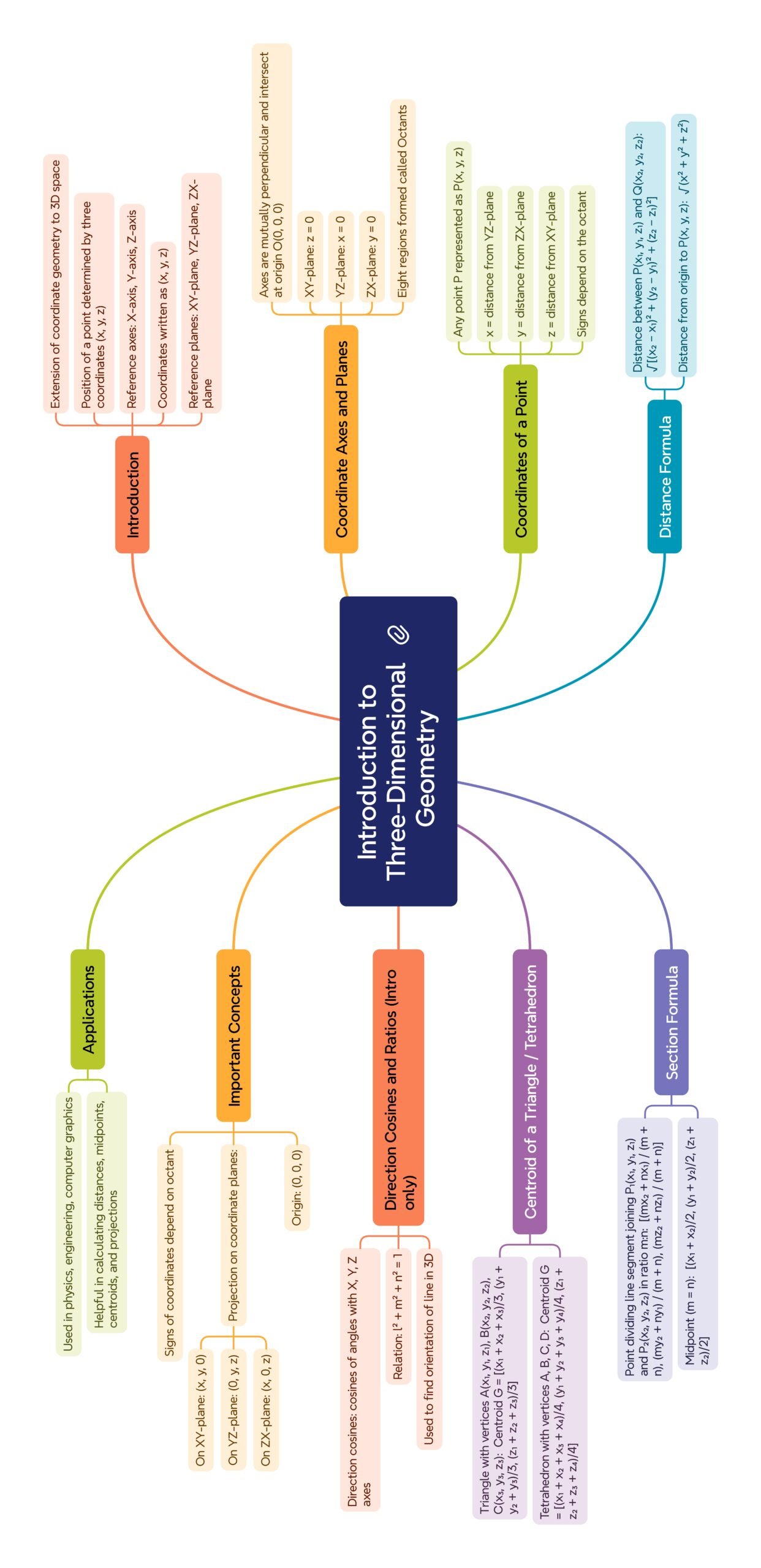
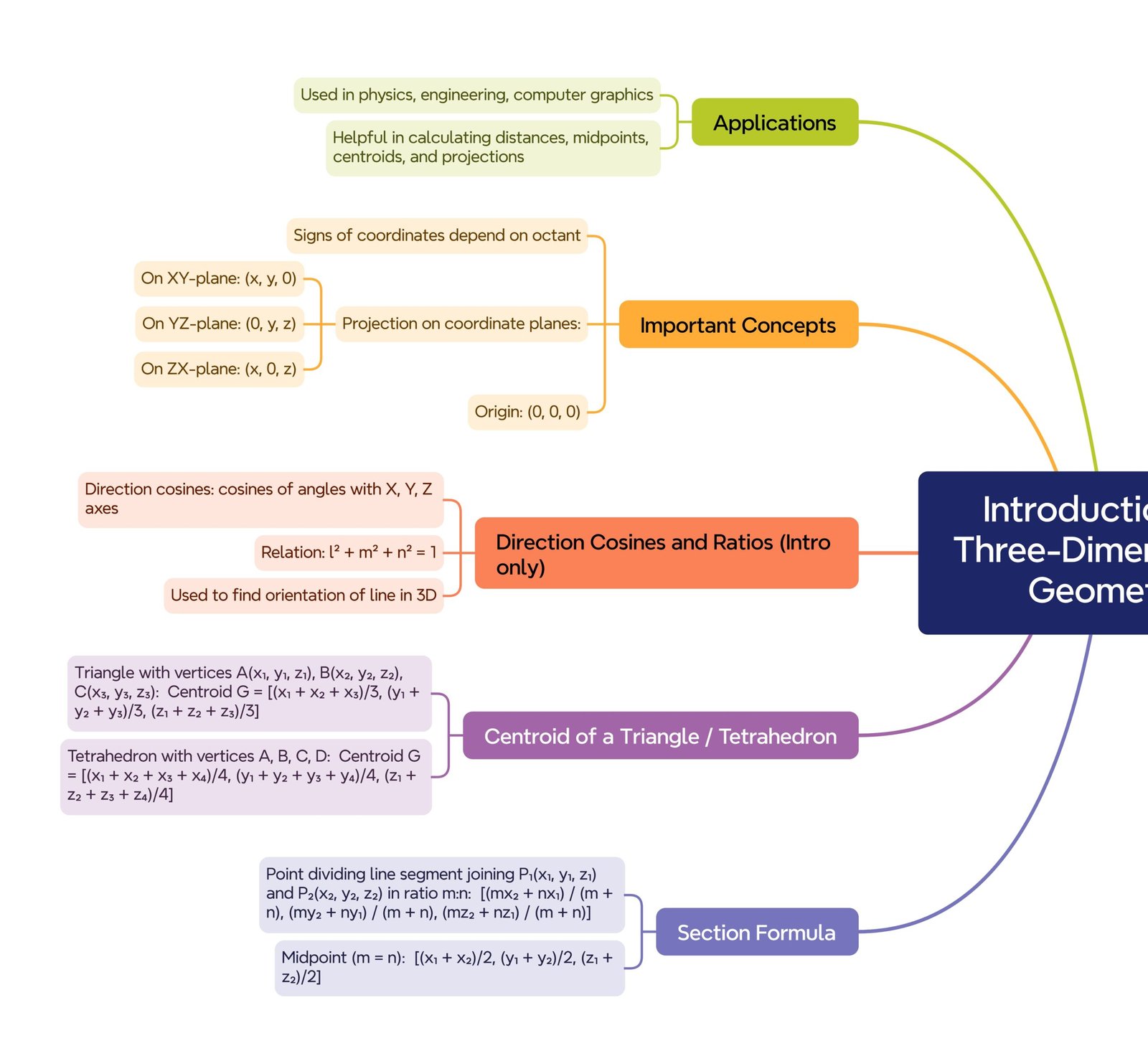
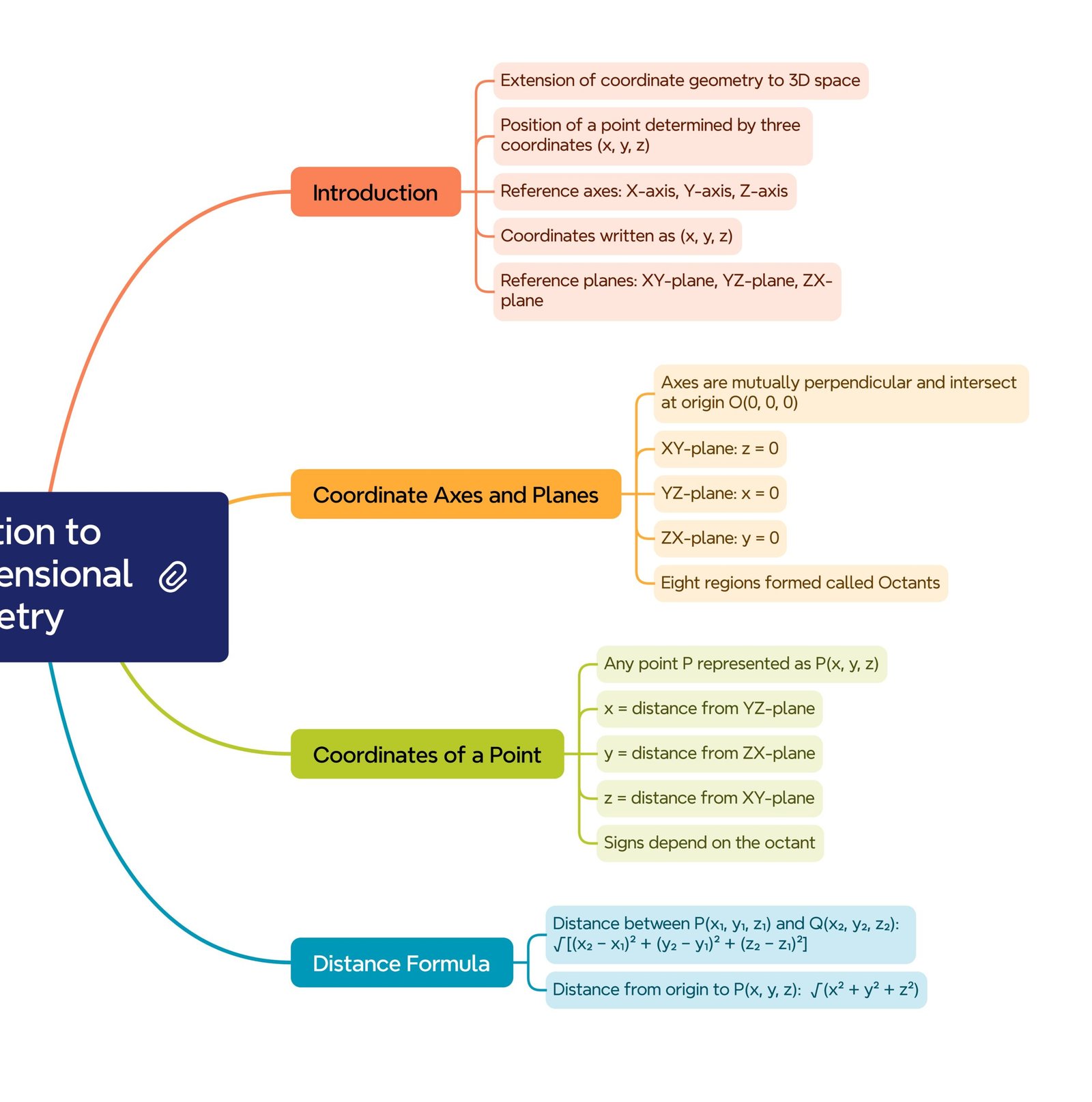
MIND MAPS
————————————————————————————————————————————————————————————————————————————