
Class 11 : Maths (In English) – Lesson 8. Sequences and Series

EXPLANATION & SUMMARY
🔵 Explanation
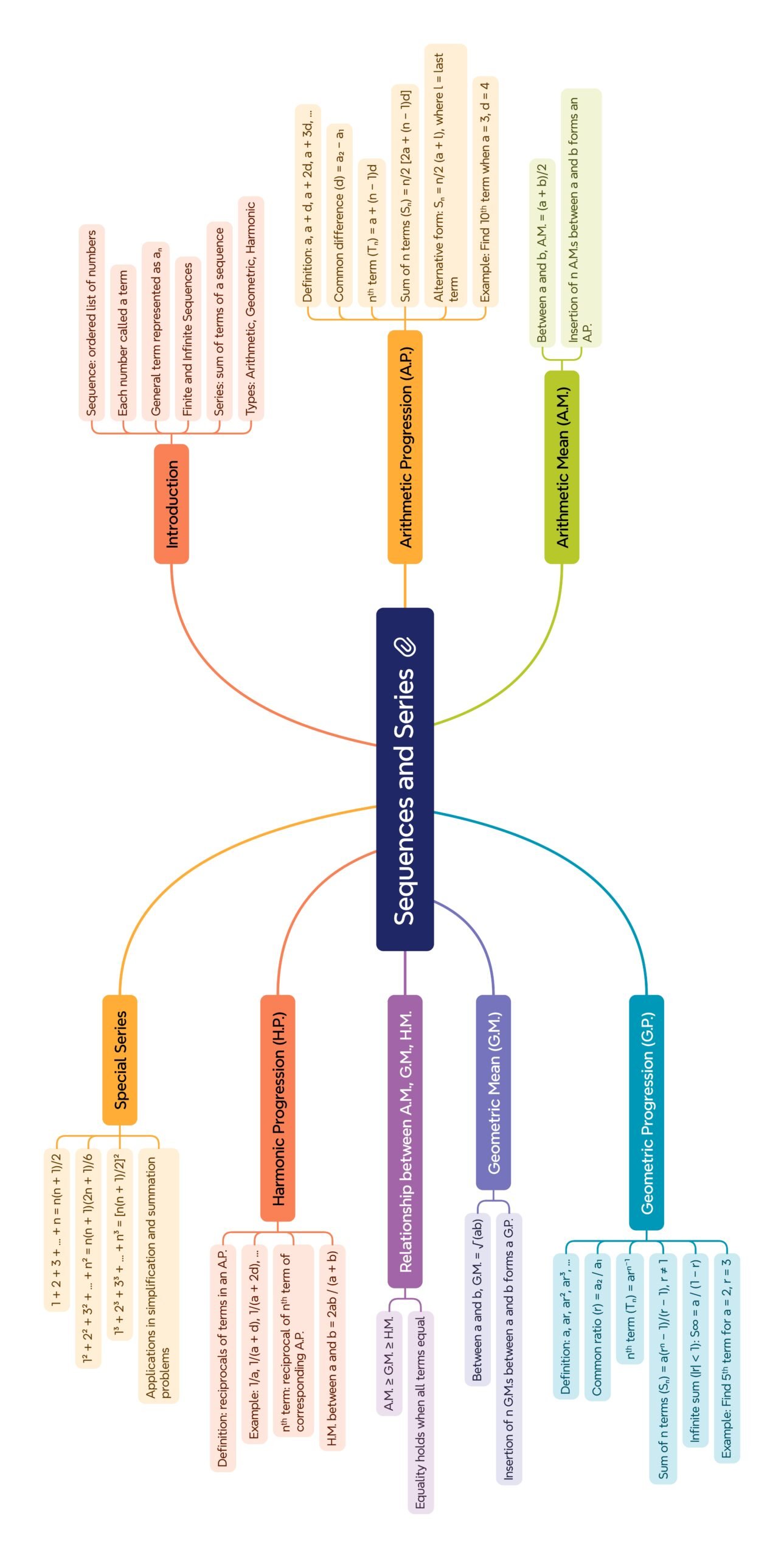
The chapter Sequences and Series focuses on ordered arrangements of numbers (sequences) and their summations (series).
🟢 1. Introduction to Sequences
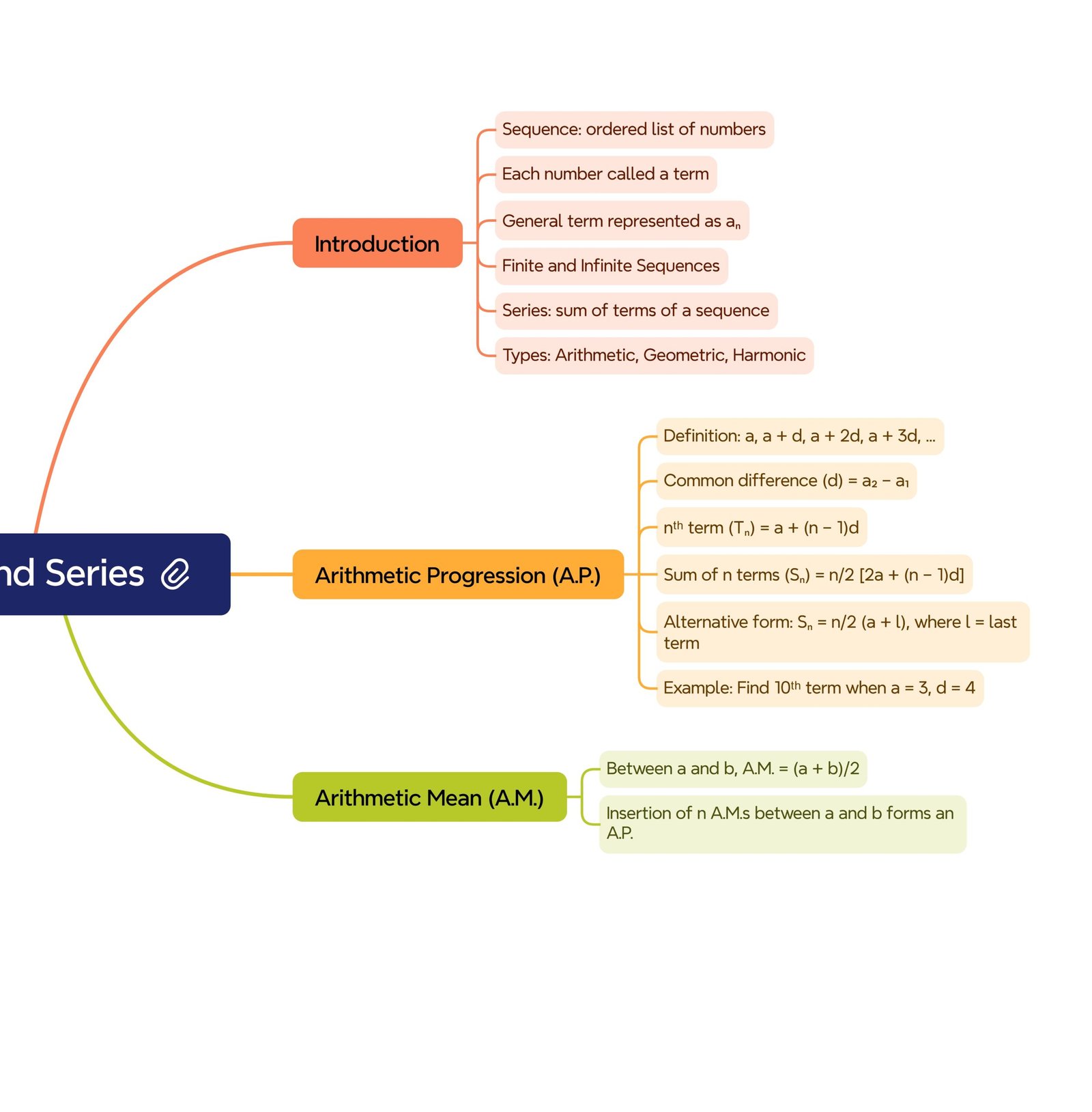
A sequence is an ordered list of numbers formed according to a definite rule.
Each number is called a term.
✏️ Note: The position of a term is called its index.
Sequences can be:
➡️ Finite: limited terms (e.g., 2, 4, 6, 8)
➡️ Infinite: endless terms (e.g., 1, 2, 3, 4, …)
💡 Concept: The nᵗʰ term (aₙ) gives a formula to find any term in the sequence.
🟢 2. Types of Sequences
🔴 (i) Arithmetic Progression (A.P.)
If the difference between consecutive terms is constant, it is an A.P.
➡️ Common Difference: d = a₂ − a₁ = a₃ − a₂ = …
✔️ nᵗʰ term: aₙ = a₁ + (n − 1)d
Example: 2, 5, 8, 11, … → a₁ = 2, d = 3
🔴 (ii) Geometric Progression (G.P.)
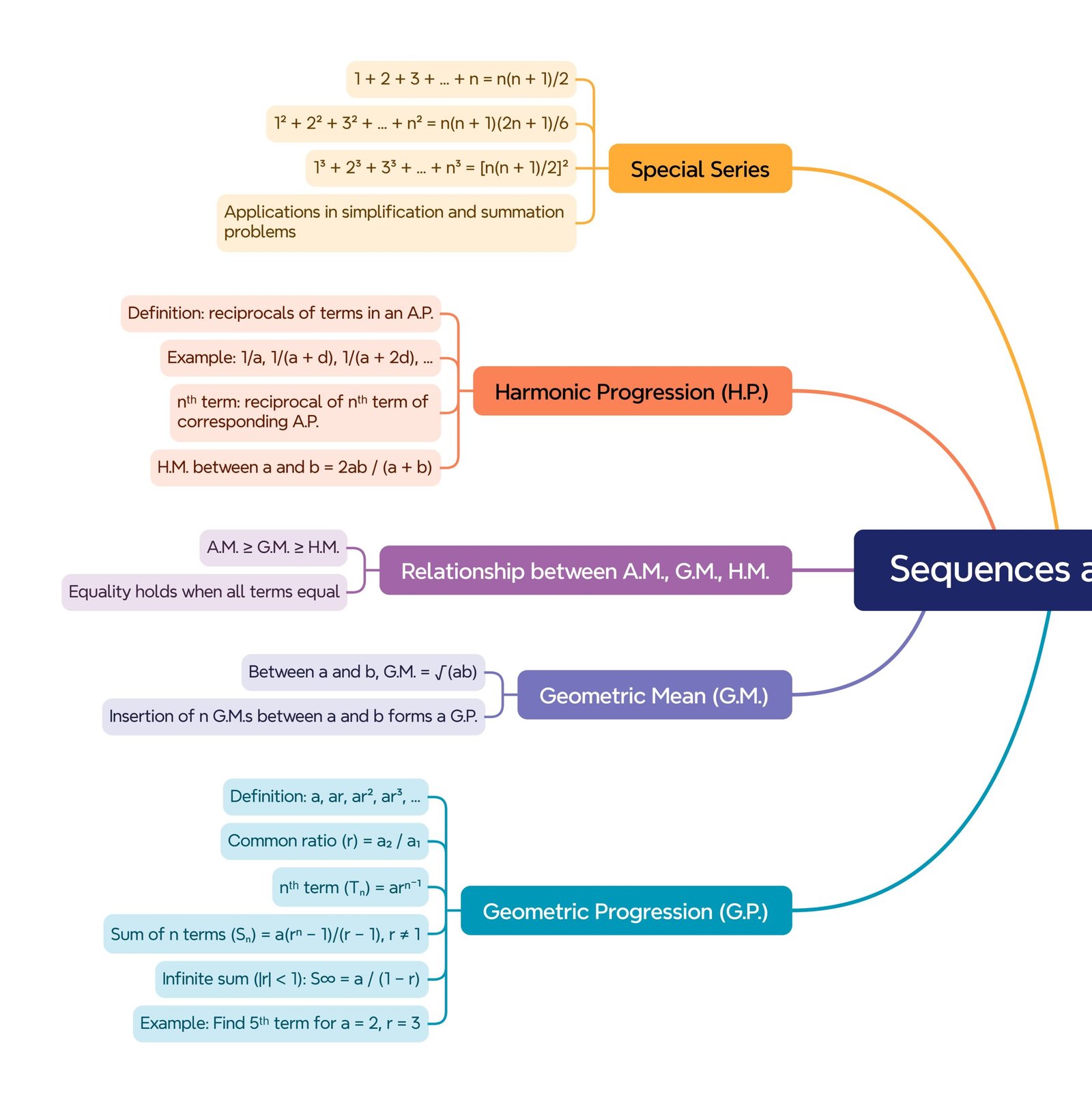
If the ratio between consecutive terms is constant, it is a G.P.
➡️ Common Ratio: r = a₂ ÷ a₁ = a₃ ÷ a₂ = …
✔️ nᵗʰ term: aₙ = a₁ × r⁽ⁿ⁻¹⁾
Example: 2, 4, 8, 16, … → a₁ = 2, r = 2
🔴 (iii) Harmonic Progression (H.P.)
If reciprocals of terms form an A.P., the sequence is an H.P.
Example: 1/2, 1/4, 1/6, 1/8
🟢 3. Series
Sum of terms of a sequence is called a series.
➡️ A.P. → Arithmetic Series
➡️ G.P. → Geometric Series
Example: Sequence 2, 4, 6, 8 → Series 2 + 4 + 6 + 8
🟢 4. Sum of n Terms of an A.P.
Formula: Sₙ = (n/2)[2a₁ + (n − 1)d]
or Sₙ = (n/2)(a₁ + aₙ)
✔️ Example:
Find sum of first 5 terms of 2, 5, 8, 11, …
a₁ = 2, d = 3
S₅ = (5/2)[2×2 + (5 − 1)×3]
➡️ S₅ = (5/2)[4 + 12]
➡️ S₅ = (5/2) × 16
➡️ S₅ = 40
🟢 5. Sum of n Terms of a G.P.
If r ≠ 1,
Sₙ = a₁ × (rⁿ − 1) ÷ (r − 1)
✔️ Example:
2, 4, 8, 16 → a₁ = 2, r = 2
S₄ = 2 × (2⁴ − 1) ÷ (2 − 1)
➡️ S₄ = 2 × (16 − 1) ÷ 1
➡️ S₄ = 30
🟢 6. Sum of Infinite G.P.
If |r| < 1,
S = a₁ ÷ (1 − r)
Example: 2, 1, 0.5, 0.25, …
S = 2 ÷ (1 − 1/2) = 4
🟢 7. Relation Between A.P., G.P., H.P.
➡️ If a, b, c are in A.P. → 2b = a + c
➡️ If a, b, c are in G.P. → b² = a × c
➡️ If a, b, c are in H.P. → 1/b = (1/2)(1/a + 1/c)
🟢 8. Arithmetic Mean (A.M.)
Between a and b:
A.M. = (a + b) ÷ 2
🟢 9. Geometric Mean (G.M.)
Between a and b:
G.M. = √(a × b) = (a × b)^(1/2)
🟢 10. Harmonic Mean (H.M.)
Between a and b:
H.M. = 2ab ÷ (a + b)
🟢 11. Important Results
✔️ Sum of first n natural numbers: 1 + 2 + … + n = n(n + 1)/2
✔️ Sum of squares: 1² + 2² + … + n² = [n(n + 1)(2n + 1)] ÷ 6
✔️ Sum of cubes: 1³ + 2³ + … + n³ = [n(n + 1)/2]²
🟢 12. Examples
✔️ Example 1:
Find 10ᵗʰ term of A.P. 5, 8, 11, …
a₁ = 5, d = 3
a₁₀ = 5 + (10 − 1)×3 = 32
✔️ Example 2:
Sum of 7 terms of G.P. 3, 6, 12, …
a₁ = 3, r = 2
S₇ = 3 × (2⁷ − 1) ÷ (2 − 1)
➡️ S₇ = 3 × (128 − 1) = 381
✔️ Example 3:
Find 3 numbers in A.P. whose sum = 27, product = 504
Let numbers = (a − d), a, (a + d)
Sum: 3a = 27 → a = 9
Product: 9(81 − d²) = 504
➡️ 81 − d² = 56 → d² = 25 → d = 5
Numbers: 4, 9, 14
🟢 13. Applications
Used in finance, physics, data modeling, and interest calculations.
🔵 Summary (~300 words)
✔️ Sequence: Ordered numbers by rule.
✔️ Series: Sum of sequence.
✔️ A.P.: Constant difference (d); aₙ = a₁ + (n − 1)d; Sₙ = (n/2)[2a₁ + (n − 1)d].
✔️ G.P.: Constant ratio (r); aₙ = a₁ × r⁽ⁿ⁻¹⁾; Sₙ = a₁(rⁿ − 1)/(r − 1).
✔️ Infinite G.P. (|r| < 1): S = a₁ ÷ (1 − r).
✔️ H.P.: Reciprocals in A.P.
✔️ Means:
A.M. = (a + b)/2
G.M. = √(ab)
H.M. = 2ab/(a + b)
✔️ Special Sums:
Σn = n(n + 1)/2
Σn² = n(n + 1)(2n + 1)/6
Σn³ = [n(n + 1)/2]²
📝 Quick Recap
🔹 Sequence → Ordered list
🔹 Series → Sum
🔹 A.P. → Constant d
🔹 G.P. → Constant r
🔹 H.P. → Reciprocals in A.P.
🔹 A.M., G.M., H.M. relations
🔹 Special sums of n, n², n³
————————————————————————————————————————————————————————————————————————————
QUESTIONS FROM TEXTBOOK
Exercise 8.1
🔵 Question 1: Write the first five terms of the sequence whose nᵗʰ term is aₙ = n(n + 2).
🟢 Answer:
🔹 a₁ = 1(1 + 2) = 3
🔹 a₂ = 2(2 + 2) = 8
🔹 a₃ = 3(3 + 2) = 15
🔹 a₄ = 4(4 + 2) = 24
🔹 a₅ = 5(5 + 2) = 35
✔️ First five terms: 3, 8, 15, 24, 35
🔵 Question 2: Write the first five terms of the sequence whose nᵗʰ term is aₙ = n/(n + 1).
🟢 Answer:
🔹 a₁ = 1/2
🔹 a₂ = 2/3
🔹 a₃ = 3/4
🔹 a₄ = 4/5
🔹 a₅ = 5/6
✔️ First five terms: 1/2, 2/3, 3/4, 4/5, 5/6
🔵 Question 3: Write the first five terms of the sequence whose nᵗʰ term is aₙ = 2ⁿ.
🟢 Answer:
🔹 a₁ = 2
🔹 a₂ = 4
🔹 a₃ = 8
🔹 a₄ = 16
🔹 a₅ = 32
✔️ First five terms: 2, 4, 8, 16, 32
🔵 Question 4: Write the first five terms of the sequence whose nᵗʰ term is aₙ = (2n − 3)/6.
🟢 Answer:
🔹 a₁ = (2×1 − 3)/6 = −1/6
🔹 a₂ = (4 − 3)/6 = 1/6
🔹 a₃ = (6 − 3)/6 = 1/2
🔹 a₄ = (8 − 3)/6 = 5/6
🔹 a₅ = (10 − 3)/6 = 7/6
✔️ First five terms: −1/6, 1/6, 1/2, 5/6, 7/6
🔵 Question 5: Write the first five terms of the sequence whose nᵗʰ term is aₙ = (−1)⁽ⁿ⁻¹⁾ 5⁽ⁿ+1⁾.
🟢 Answer:
🔹 a₁ = (−1)⁰·5² = 25
🔹 a₂ = (−1)¹·5³ = −125
🔹 a₃ = (−1)²·5⁴ = 625
🔹 a₄ = (−1)³·5⁵ = −3125
🔹 a₅ = (−1)⁴·5⁶ = 15625
✔️ First five terms: 25, −125, 625, −3125, 15625
🔵 Question 6: Write the first five terms of the sequence whose nᵗʰ term is aₙ = n(n² + 5)/4.
🟢 Answer:
🔹 a₁ = 1(1 + 5)/4 = 6/4 = 3/2
🔹 a₂ = 2(4 + 5)/4 = 18/4 = 9/2
🔹 a₃ = 3(9 + 5)/4 = 42/4 = 21/2
🔹 a₄ = 4(16 + 5)/4 = 84/4 = 21
🔹 a₅ = 5(25 + 5)/4 = 150/4 = 75/2
✔️ First five terms: 3/2, 9/2, 21/2, 21, 75/2
🔵 Question 7: Find the indicated terms of the sequence whose nᵗʰ term is aₙ = 4n − 3; a₁₇, a₂₄.
🟢 Answer:
🔹 a₁₇ = 4(17) − 3 = 68 − 3 = 65
🔹 a₂₄ = 4(24) − 3 = 96 − 3 = 93
✔️ a₁₇ = 65, a₂₄ = 93
🔵 Question 8: Find the indicated term of the sequence whose nᵗʰ term is aₙ = n²/2ⁿ; a₇.
🟢 Answer:
🔹 a₇ = 7²/2⁷ = 49/128
✔️ a₇ = 49/128
🔵 Question 9: Find the indicated term of the sequence whose nᵗʰ term is aₙ = (−1)⁽ⁿ−1⁾ n³; a₉.
🟢 Answer:
🔹 a₉ = (−1)⁸·9³ = 1·729 = 729
✔️ a₉ = 729
🔵 Question 10: Find the indicated term of the sequence whose nᵗʰ term is aₙ = n(n − 2)/(n + 3); a₂₀.
🟢 Answer:
🔹 a₂₀ = 20(20 − 2)/(20 + 3) = 20×18/23 = 360/23
✔️ a₂₀ = 360/23
🔵 Question 11:
✳️ a₁ = 3, aₙ = 3aₙ₋₁ + 2 for all n > 1
🧭 Write the first five terms and obtain the corresponding series.
🟢 Answer:
➡️ a₁ = 3
➡️ a₂ = 3a₁ + 2 = 3×3 + 2 = 11
➡️ a₃ = 3a₂ + 2 = 3×11 + 2 = 35
➡️ a₄ = 3a₃ + 2 = 3×35 + 2 = 107
➡️ a₅ = 3a₄ + 2 = 3×10⁷ + 2 = 323
✔️ First five terms: 3, 11, 35, 107, 323
📈 Corresponding Series: 3 + 11 + 35 + 107 + 323 + …
🔵 Question 12:
✳️ a₁ = −1, aₙ = aₙ₋₁ / n, n ≥ 2
🧭 Write the first five terms and obtain the corresponding series.
🟢 Answer:
➡️ a₁ = −1
➡️ a₂ = a₁ / 2 = −1/2
➡️ a₃ = a₂ / 3 = (−1/2)/3 = −1/6
➡️ a₄ = a₃ / 4 = (−1/6)/4 = −1/24
➡️ a₅ = a₄ / 5 = (−1/24)/5 = −1/120
✔️ First five terms: −1, −1/2, −1/6, −1/24, −1/120
📈 Corresponding Series: −1 − 1/2 − 1/6 − 1/24 − 1/120 + …
🔵 Question 13:
✳️ a₁ = a₂ = 2, aₙ = aₙ₋₁ − 1, n > 2
🧭 Write the first five terms and obtain the corresponding series.
🟢 Answer:
➡️ a₁ = 2
➡️ a₂ = 2
➡️ a₃ = a₂ − 1 = 2 − 1 = 1
➡️ a₄ = a₃ − 1 = 1 − 1 = 0
➡️ a₅ = a₄ − 1 = 0 − 1 = −1
✔️ First five terms: 2, 2, 1, 0, −1
📈 Corresponding Series: 2 + 2 + 1 + 0 − 1 + …
🔵 Question 14:
✳️ The Fibonacci sequence is defined by:
a₁ = 1, a₂ = 1, aₙ = aₙ₋₁ + aₙ₋₂, n > 2
🧭 Find aₙ₊₁ / aₙ for n = 1, 2, 3, 4, 5.
🟢 Answer:
➡️ a₁ = 1
➡️ a₂ = 1
➡️ a₃ = a₂ + a₁ = 1 + 1 = 2
➡️ a₄ = a₃ + a₂ = 2 + 1 = 3
➡️ a₅ = a₄ + a₃ = 3 + 2 = 5
➡️ a₆ = a₅ + a₄ = 5 + 3 = 8
🔹 Ratios:
a₂ / a₁ = 1 / 1 = 1
a₃ / a₂ = 2 / 1 = 2
a₄ / a₃ = 3 / 2
a₅ / a₄ = 5 / 3
a₆ / a₅ = 8 / 5
✔️ Values of aₙ₊₁ / aₙ: 1, 2, 3/2, 5/3, 8/5
🧠 Exercise 8.2
🔵 Question 1:
Find the 20ᵗʰ and nᵗʰ terms of the G.P.
5/2, 5/4, 5/8, …
🟢 Answer:
➡️ First term (a) = 5/2
➡️ Common ratio (r) = (5/4) ÷ (5/2) = 1/2
🔹 General term of a G.P.:
aₙ = a·rⁿ⁻¹
➡️ aₙ = (5/2) × (1/2)ⁿ⁻¹
✔️ nᵗʰ term: aₙ = (5/2) × (1/2)ⁿ⁻¹
➡️ For 20ᵗʰ term:
a₂₀ = (5/2) × (1/2)¹⁹ = 5 / (2 × 2¹⁹) = 5 / 2²⁰
✔️ 20ᵗʰ term: 5 / 2²⁰
🔵 Question 2:
Find the 12ᵗʰ term of a G.P. whose 8ᵗʰ term is 192 and the common ratio is 2.
🟢 Answer:
➡️ a₈ = a·r⁷ = 192
➡️ a·2⁷ = 192
➡️ a = 192 / 128 = 3/2
🔹 12ᵗʰ term: a₁₂ = a·r¹¹ = (3/2) × 2¹¹ = 3 × 2¹⁰ = 3 × 1024 = 3072
✔️ 12ᵗʰ term: 3072
🔵 Question 3:
The 5ᵗʰ, 8ᵗʰ, and 11ᵗʰ terms of a G.P. are p, q, and s respectively.
Show that q² = ps.
🟢 Answer:
➡️ Let first term = a, common ratio = r
➡️ a₅ = a·r⁴ = p
➡️ a₈ = a·r⁷ = q
➡️ a₁₁ = a·r¹⁰ = s
🔹 Compute q²:
q² = (a·r⁷)² = a²·r¹⁴
🔹 Compute ps:
p·s = (a·r⁴)(a·r¹⁰) = a²·r¹⁴
✔️ Therefore, q² = ps
🔵 Question 4:
The 4ᵗʰ term of a G.P. is square of its second term, and the first term is −3.
Determine its 7ᵗʰ term.
🟢 Answer:
➡️ a₁ = −3,
a₂ = a·r = −3r,
a₄ = a·r³ = −3r³
🔹 Given: a₄ = (a₂)²
⇒ −3r³ = (−3r)²
⇒ −3r³ = 9r²
Divide by r²: −3r = 9
➡️ r = −3
🔹 7ᵗʰ term: a₇ = a·r⁶ = (−3)·(−3)⁶ = (−3)·729 = −2187
✔️ 7ᵗʰ term: −2187
🔵 Question 5:
Which term of the following sequences is given number?
(a) 2, 2√2, 4, … is 128?
(b) √3, 3, 3√3, … is 729?
(c) 1/3, 1/9, 1/27, … is 1/19683?
🟢 (a)
➡️ a = 2, r = (2√2)/2 = √2
Let aₙ = 128
➡️ a·rⁿ⁻¹ = 128
2(√2)ⁿ⁻¹ = 128
Divide by 2: (√2)ⁿ⁻¹ = 64
Convert base: (2¹/²)ⁿ⁻¹ = 2⁶
➡️ (n − 1)/2 = 6 ⇒ n − 1 = 12 ⇒ n = 13
✔️ 13ᵗʰ term = 128
🟢 (b)
➡️ a = √3, r = 3/√3 = √3
Let aₙ = 729
√3(√3)ⁿ⁻¹ = 729
⇒ (√3)ⁿ = 729 = 3⁶
⇒ (3¹/²)ⁿ = 3⁶
➡️ n/2 = 6 ⇒ n = 12
✔️ 12ᵗʰ term = 729
🟢 (c)
➡️ a = 1/3, r = 1/3
Let aₙ = 1/19683
(1/3)(1/3)ⁿ⁻¹ = 1/19683
(1/3)ⁿ = 1/19683
Convert: 19683 = 3⁹
➡️ n = 9
✔️ 9ᵗʰ term = 1/19683
🔵 Question 6:
For what values of x, the numbers −2/7, x, −7/2 are in G.P.?
🟢 Answer:
➡️ In G.P., r = a₂ / a₁ = a₃ / a₂
So, x / (−2/7) = (−7/2) / x
Cross multiply:
x² = (−2/7)(−7/2) = 1
➡️ x = ±1
✔️ Values of x: +1, −1
🔵 Question 7:
Find the sum to 20 terms of the G.P.: 0.15, 0.015, 0.0015, …
🟢 Answer:
➡️ First term, a = 0.15
➡️ Common ratio, r = 0.015 / 0.15 = 0.1
➡️ Number of terms, n = 20
🔹 Formula:
Sₙ = a(1 − rⁿ) / (1 − r)
➡️ S₂₀ = 0.15(1 − 0.1²⁰) / (1 − 0.1)
= 0.15(1 − 10⁻²⁰) / 0.9
≈ 0.15 / 0.9 = 1/6
✔️ Sum of 20 terms: 1/6 (approximately)
🔵 Question 8:
Find the sum of n terms of the G.P.: √7, √21, 3√7, …
🟢 Answer:
➡️ a = √7
➡️ r = (√21)/(√7) = √3
🔹 Formula:
Sₙ = a( rⁿ − 1 ) / (r − 1)
➡️ Sₙ = √7 ( (√3)ⁿ − 1 ) / (√3 − 1)
✔️ Sum of n terms: Sₙ = √7 ( (√3)ⁿ − 1 ) / (√3 − 1)
🔵 Question 9:
Find the sum of n terms of the G.P.: 1, −a, a², −a³, … (a ≠ −1)
🟢 Answer:
➡️ a = 1
➡️ r = −a
🔹 Formula:
Sₙ = a(1 − rⁿ) / (1 − r)
➡️ Sₙ = (1 − (−a)ⁿ) / (1 + a)
✔️ Sum of n terms: Sₙ = (1 − (−a)ⁿ) / (1 + a)
🔵 Question 10:
Find the sum of n terms of the G.P.: x³, x⁵, x⁷, … (x ≠ ±1)
🟢 Answer:
➡️ a = x³
➡️ r = x²
🔹 Formula:
Sₙ = a( rⁿ − 1 ) / (r − 1)
➡️ Sₙ = x³( (x²)ⁿ − 1 ) / (x² − 1)
➡️ Sₙ = x³( x²ⁿ − 1 ) / (x² − 1)
✔️ Sum of n terms: Sₙ = x³( x²ⁿ − 1 ) / (x² − 1)
🔵 Question 11:
Evaluate Σ₍ₖ₌₁₎¹¹ (2 + 3ᵏ)
🟢 Answer:
🔹 Expand: Σ(2 + 3ᵏ) = Σ2 + Σ3ᵏ
➡️ Σ2 = 2 × 11 = 22
➡️ Σ3ᵏ from k=1 to 11 = a( rⁿ − 1 ) / (r − 1)
a = 3, r = 3, n = 11
➡️ = 3(3¹¹ − 1)/(3 − 1) = (3/2)(3¹¹ − 1)
🔹 Total Sum: 22 + (3/2)(3¹¹ − 1)
✔️ Final Answer: S = 22 + (3/2)(3¹¹ − 1)
🔵 Question 12:
The sum of first three terms of a G.P. is 39/10 and their product is 1.
Find the common ratio and the terms.
🟢 Answer:
Let terms = a/r, a, ar
➡️ Sum = a/r + a + ar = a( r² + r + 1 ) / r = 39/10
➡️ Product = (a³) = 1 ⇒ a = 1 or −1
✳️ Case 1: a = 1
⇒ (r² + r + 1)/r = 39/10
⇒ 10(r² + r + 1) = 39r
⇒ 10r² − 29r + 10 = 0
Solve: r = (29 ± √(29² − 4×10×10))/20
= (29 ± √(841 − 400))/20 = (29 ± 21)/20
⇒ r₁ = 50/20 = 5/2, r₂ = 8/20 = 2/5
✔️ Terms:
(a) r = 5/2 ⇒ 2/5, 1, 5/2
(b) r = 2/5 ⇒ 5/2, 1, 2/5
✳️ Case 2 (a = −1): similar, gives negative of above.
✔️ Final Answer: r = 5/2 or 2/5; terms: (2/5, 1, 5/2) or (5/2, 1, 2/5)
🔵 Question 13:
How many terms of G.P. 3, 3², 3³, … are needed to give sum 120?
🟢 Answer:
➡️ a = 3, r = 3, Sₙ = 120
🔹 Formula:
Sₙ = a( rⁿ − 1 ) / (r − 1)
➡️ 120 = 3(3ⁿ − 1)/2
Multiply: 80 = 3ⁿ − 1
⇒ 3ⁿ = 81 = 3⁴
✔️ n = 4
✔️ Answer: 4 terms
🔵 Question 14:
The sum of first three terms of a G.P. is 16 and sum of next three terms is 128.
Determine the first term, common ratio, and sum to n terms.
🟢 Answer:
➡️ a + ar + ar² = 16 …(i)
➡️ ar³ + ar⁴ + ar⁵ = 128
Divide second by first:
(ar³ + ar⁴ + ar⁵) / (a + ar + ar²) = r³ = 128/16 = 8
➡️ r³ = 8 ⇒ r = 2
Put in (i):
a(1 + 2 + 4) = 16 ⇒ a × 7 = 16 ⇒ a = 16/7
✔️ a = 16/7, r = 2
🔹 Sₙ = a( rⁿ − 1 ) / (r − 1) = (16/7)(2ⁿ − 1)
✔️ Final Answer: a = 16/7, r = 2, Sₙ = (16/7)(2ⁿ − 1)
🔵 Question 15:
Given a G.P. with a = 729 and 7ᵗʰ term = 64, determine S₇.
🟢 Answer:
➡️ a₇ = a·r⁶ = 64
➡️ 729·r⁶ = 64
r⁶ = 64/729 = (4³)/(9³) = (4/9)³
➡️ r = 4/9
🔹 S₇ = a(1 − r⁷)/(1 − r)
➡️ S₇ = 729(1 − (4/9)⁷)/(1 − 4/9)
Denominator: 1 − 4/9 = 5/9
➡️ S₇ = 729 × (9/5)(1 − (4/9)⁷) = (6561/5)(1 − (4/9)⁷)
✔️ Final Answer: S₇ = (6561/5) × (1 − (4/9)⁷)
🔵 Question 16:
Find a G.P. for which sum of the first two terms is −4 and the fifth term is 4 times the third term.
🟢 Answer:
➡️ Let first term = a, common ratio = r
Then,
a₁ = a, a₂ = ar, a₃ = ar², a₅ = ar⁴
🔹 Given:
a + ar = −4 …(i)
a·r⁴ = 4(ar²) ⇒ r⁴ = 4r² ⇒ r² = 4 ⇒ r = ±2
✳️ Case 1: r = 2
From (i): a(1 + 2) = −4 ⇒ a = −4/3
✅ G.P.: −4/3, −8/3, −16/3, −32/3, −64/3, …
✳️ Case 2: r = −2
From (i): a(1 − 2) = −4 ⇒ −a = −4 ⇒ a = 4
✅ G.P.: 4, −8, 16, −32, 64, …
✔️ Two possible G.P.s:
(1) −4/3, −8/3, −16/3, … (2) 4, −8, 16, …
🔵 Question 17:
If the 4ᵗʰ, 10ᵗʰ and 16ᵗʰ terms of a G.P. are x, y and z respectively, prove that x, y, z are in G.P.
🟢 Answer:
➡️ Let first term = a, common ratio = r
a₄ = a·r³ = x
a₁₀ = a·r⁹ = y
a₁₆ = a·r¹⁵ = z
🔹 Check whether y² = xz:
y² = (a·r⁹)² = a²·r¹⁸
xz = (a·r³)(a·r¹⁵) = a²·r¹⁸
✔️ Hence, y² = xz ⇒ x, y, z are in G.P.
🔵 Question 18:
Find the sum to n terms of the sequence 8, 88, 888, 8888, …
🟢 Answer:
Write each term as:
8 = 8(1), 88 = 8(11), 888 = 8(111)
🔹 Express in powers of 10:
8 = 8(10⁰)
88 = 8(10¹ + 10⁰)
888 = 8(10² + 10¹ + 10⁰)
General term:
Tₙ = 8(10ⁿ⁻¹ + 10ⁿ⁻² + … + 10⁰)
= 8( (10ⁿ − 1) / 9 )
➡️ Sum of n terms:
Sₙ = ΣTₙ = Σ [8(10ⁿ − 1)/9]
= (8/9)[Σ10ⁿ − n]
= (8/9)[ (10(10ⁿ − 1)/9) − n ]
✔️ Final Answer: Sₙ = (8/9)[ (10(10ⁿ − 1)/9) − n ]
🔵 Question 19:
Find the sum of the products of the corresponding terms of the sequences
2, 4, 8, 16, …
and
16, 32, 128, 32, 8, 2, 1/2
🟢 Answer:
➡️ First sequence (A): 2, 4, 8, 16, 32, 64, 128, …
➡️ Second sequence (B): 16, 32, 128, 32, 8, 2, 1/2
🔹 Multiply corresponding terms one by one:
🔵 1st product = 2 × 16 = 32
🟢 2nd product = 4 × 32 = 128
🟡 3rd product = 8 × 128 = 1024
🔴 4th product = 16 × 32 = 512
🔵 5th product = 32 × 8 = 256
🟢 6th product = 64 × 2 = 128
🟡 7th product = 128 × 1/2 = 64
➡️ Now add all these products:
✨ S = 32 + 128 + 1024 + 512 + 256 + 128 + 64
💡 Step-by-step addition:
✔️ 32 + 128 = 160
✔️ 160 + 1024 = 1184
✔️ 1184 + 512 = 1696
✔️ 1696 + 256 = 1952
✔️ 1952 + 128 = 2080
✔️ 2080 + 64 = 2144
🎯 Final Answer: Sum = 2144
🔵 Question 20:
Show that the products of the corresponding terms of the sequences
a, ar, ar², … arⁿ⁻¹ and A, AR, AR², … ARⁿ⁻¹ form a G.P., and find the common ratio.
🟢 Answer:
➡️ Product of corresponding terms:
T₁ = aA, T₂ = ar·AR = aA·rR, T₃ = aA·r²R², …
🔹 This is a G.P. with:
First term = aA,
Common ratio = rR
✔️ Common ratio = rR
🔵 Question 21:
Find four numbers forming a G.P. in which the third term is greater than the first term by 9, and the second term is greater than the fourth term by 18.
🟢 Answer:
Let four terms: a/r³, a/r, ar, ar³
➡️ Condition 1: ar − a/r³ = 9
➡️ Condition 2: a/r − ar³ = 18
Multiply (1) by r³:
a(r⁴ − 1) = 9r³ …(i)
Multiply (2) by r³:
a(r² − r⁶) = 18r³
⇒ a(r⁶ − r²) = −18r³ …(ii)
From (i): a = 9r³ / (r⁴ − 1)
Substitute in (ii):
(9r³/(r⁴ − 1)) (r⁶ − r²) = −18r³
Divide by r³:
9(r⁶ − r²)/(r⁴ − 1) = −18
Multiply:
9(r²)(r⁴ − 1)/(r⁴ − 1) = −18
Simplify: r⁶ − r² = −2(r⁴ − 1)
Expand:
r⁶ − r² = −2r⁴ + 2
⇒ r⁶ + 2r⁴ − r² − 2 = 0
Let t = r² ⇒
t³ + 2t² − t − 2 = 0
Factorize:
(t² − 1)(t + 2) = 0
⇒ t = 1 or t = −2
r² = 1 ⇒ r = ±1 (not valid, gives equal terms)
r² = −2 ⇒ r imaginary ⇒ discard
Hence only no real solution with distinct real G.P.
✔️ No real G.P. satisfies both conditions.
🔵 Question 22:
If the pᵗʰ, qᵗʰ and rᵗʰ terms of a G.P. are a, b and c, respectively, prove that
✨ a^(q−r) · b^(r−p) · c^(p−q) = 1
🟢 Answer:
➡️ Let the first term = A and common ratio = R.
Then by definition of G.P.:
🔹 a = A·R^(p−1)
🔹 b = A·R^(q−1)
🔹 c = A·R^(r−1)
➡️ Now compute the product:
a^(q−r) · b^(r−p) · c^(p−q)
= (A·R^(p−1))^(q−r) · (A·R^(q−1))^(r−p) · (A·R^(r−1))^(p−q)
✳️ Expand the powers using the law (xy)ⁿ = xⁿyⁿ:
= A^(q−r) · R^[(p−1)(q−r)] × A^(r−p) · R^[(q−1)(r−p)] × A^(p−q) · R^[(r−1)(p−q)]
➡️ Combine powers of A and R separately:
= A^[ (q−r) + (r−p) + (p−q) ] · R^[ (p−1)(q−r) + (q−1)(r−p) + (r−1)(p−q) ]
🧠 Simplify exponents:
🔹 For A:
(q−r) + (r−p) + (p−q) = 0 ⇒ exponent = 0 ⇒ A⁰ = 1
🔹 For R:
Expand and add terms:
(pq − pr − q + p) + (qr − qp − r + q) + (rp − rq − p + r) = 0
⇒ exponent = 0 ⇒ R⁰ = 1
✔️ Therefore,
a^(q−r) · b^(r−p) · c^(p−q) = A⁰ · R⁰ = 1 × 1 = 1
🎯 Hence proved:
✨ a^(q−r) · b^(r−p) · c^(p−q) = 1 ✅
🔵 Question 23:
If the first and the nᵗʰ term of a G.P. are a and b, respectively, and if P is the product of n terms, prove that P² = (ab)ⁿ.
🟢 Answer:
➡️ Terms: a, a r, a r², …, a rⁿ⁻¹ with last term b = a rⁿ⁻¹.
➡️ Product: P = a · (a r) · (a r²) · … · (a rⁿ⁻¹).
🔹 Collect powers:
P = aⁿ · r^(1+2+…+(n−1)) = aⁿ · r^{ n(n−1)/2 }.
🔹 Use b = a rⁿ⁻¹ ⇒ rⁿ⁻¹ = b/a.
➡️ P² = a²ⁿ · r^{ n(n−1) } = a²ⁿ · ( rⁿ⁻¹ )ⁿ = a²ⁿ · (b/a)ⁿ = (ab)ⁿ.
✔️ Final: P² = (ab)ⁿ.
🔵 Question 24:
Show that the ratio of the sum of first n terms of a G.P. to the sum of terms from (n+1)ᵗʰ to (2n)ᵗʰ term is 1 / rⁿ.
🟢 Answer:
➡️ Sₙ = a(1−rⁿ)/(1−r).
➡️ Sum from (n+1) to 2n: S′ = a rⁿ(1−rⁿ)/(1−r).
🔹 Ratio:
Sₙ / S′ = [a(1−rⁿ)/(1−r)] ÷ [a rⁿ(1−rⁿ)/(1−r)] = 1 / rⁿ.
✔️ Final: Sₙ : S′ = 1 : rⁿ (i.e., Sₙ/S′ = 1/rⁿ).
🔵 Question 25:
If a, b, c, d are in G.P., show that
(a² + b² + c²)(b² + c² + d²) = (ab + bc + cd)².
🟢 Answer:
➡️ Let b = a r, c = a r², d = a r³.
➡️ LHS = (a² + a²r² + a²r⁴)(a²r² + a²r⁴ + a²r⁶)
= a⁴(1 + r² + r⁴)(r² + r⁴ + r⁶)
= a⁴ r²(1 + r² + r⁴)².
➡️ RHS = (ab + bc + cd)²
= [a(ar) + (ar)(ar²) + (ar²)(ar³)]²
= [a²r + a²r³ + a²r⁵]²
= a⁴ r²(1 + r² + r⁴)².
✔️ LHS = RHS ⇒ proved.
🔵 Question 26:
Insert two numbers between 3 and 81 so that the resulting sequence is G.P.
🟢 Answer:
➡️ Required 4-term G.P.: 3, x, y, 81 with common ratio r.
➡️ 3 r³ = 81 ⇒ r³ = 27 ⇒ r = 3.
➡️ x = 3 r = 9; y = 3 r² = 27.
✔️ Final: Numbers = 9 and 27 (G.P.: 3, 9, 27, 81).
🔵 Question 27:
Find the value of n so that (aⁿ⁺¹ + bⁿ⁺¹)/(aⁿ + bⁿ) may be the geometric mean between a and b.
🟢 Answer:
➡️ Condition for geometric mean: (aⁿ⁺¹ + bⁿ⁺¹)/(aⁿ + bⁿ) = √(ab).
➡️ Divide both sides by aⁿᐟ² bⁿᐟ²:
a·(a/b)ⁿᐟ² + b·(b/a)ⁿᐟ² = √(ab)[ (a/b)ⁿᐟ² + (b/a)ⁿᐟ² ].
Let X = (a/b)ⁿᐟ², so (b/a)ⁿᐟ² = 1/X.
➡️ Equation: aX + b(1/X) = √(ab)(X + 1/X).
➡️ Rearrange: (√a − √b)( √a·X − √b/X ) = 0.
For a ≠ b ⇒ √a·X = √b/X ⇒ X² = √(b/a).
But X² = (a/b)ⁿ, hence (a/b)ⁿ = (b/a)¹ᐟ² ⇒ n = −1/2.
✔️ Final: n = −1/2 (if a = b, any n works).
🔵 Question 28:
The sum of two numbers is 6 times their geometric mean; show the numbers are in the ratio (3 + 2√2) : (3 − 2√2).
🟢 Answer:
➡️ Let numbers be x, y > 0 and put k = √(x/y) ⇒ x = k²y.
➡️ Given: x + y = 6√(xy) ⇒ k²y + y = 6k y ⇒ k² − 6k + 1 = 0.
➡️ Solve: k = 3 ± 2√2.
Then x : y = k² : 1.
➡️ Note: (3 + 2√2)(3 − 2√2) = 1, so
k² : 1 = (3 ± 2√2)² : 1 = (3 ± 2√2) : (3 ∓ 2√2).
✔️ Final ratio: (3 + 2√2) : (3 − 2√2).
🔵 Question 29:
If A and G be A.M. and G.M., respectively, between two positive numbers, prove that the numbers are
A ± √[(A + G)(A − G)].
🟢 Answer:
➡️ Let numbers be x, y > 0. Then A = (x + y)/2, G = √(xy).
➡️ Compute: (A + G)(A − G) = A² − G²
= [(x + y)²/4] − xy = (x − y)²/4.
➡️ Therefore √[(A + G)(A − G)] = |x − y|/2.
➡️ Hence
A ± √[…] = (x + y)/2 ± |x − y|/2 = {x, y}.
✔️ Thus the numbers are A ± √[(A + G)(A − G)].
🔵 Question 30:
The number of bacteria in a culture doubles every hour. If initially there were 30 bacteria, how many will be present at the end of the 2ⁿᵈ hour, 4ᵗʰ hour and nᵗʰ hour?
🟢 Answer:
➡️ Growth is G.P. with a₀ = 30, common ratio r = 2.
➡️ After t hours: N(t) = 30·2ᵗ.
🔹 End of 2ⁿᵈ hour: N(2) = 30·2² = 120.
🔹 End of 4ᵗʰ hour: N(4) = 30·2⁴ = 480.
🔹 End of nᵗʰ hour: N(n) = 30·2ⁿ.
✔️ Final: 120, 480, and 30·2ⁿ respectively.
🔵 Question 31:
What will ₹500 amount to in 10 years after its deposit in a bank which pays annual interest rate of 10% compounded annually?
🟢 Answer:
💡 Formula for compound amount:
A = P(1 + r/100)ⁿ
🔹 Here,
P = ₹500
r = 10%
n = 10 years
➡️ Substitute:
A = 500 × (1 + 10/100)¹⁰
A = 500 × (1.1)¹⁰
✳️ (1.1)¹⁰ = 2.59374246
➡️ A = 500 × 2.59374246
➡️ A = ₹1296.87
✔️ Final Amount = ₹1296.87
✔️ Compound Interest = A − P = 1296.87 − 500 = ₹796.87
🔵 Question 32:
If A.M. and G.M. of roots of a quadratic equation are 8 and 5, respectively, then obtain the quadratic equation.
🟢 Answer:
💡 Let roots be α and β.
✳️ Arithmetic Mean = (α + β)/2 = 8
➡️ α + β = 16
✳️ Geometric Mean = √(αβ) = 5
➡️ αβ = 25
🧠 Standard quadratic equation:
x² − (sum of roots)x + (product of roots) = 0
➡️ x² − 16x + 25 = 0
✔️ Required quadratic equation: x² − 16x + 25 = 0
————————————————————————————————————————————————————————————————————————————
OTHER IMPORTANT QUESTIONS FOR EXAMS
CBSE STYLE BOARD PAPER
ESPECIALLY FROM THIS CHAPTER ONLY
(Section A – Objective Type, 1 Mark Each)
🔵 Question 1:
The nth term of an arithmetic progression is given by aₙ = a₁ + (n − 1)d. If a₁ = 3 and d = 5, then a₅ = ?
🔵 (A) 15
🟢 (B) 18
🟠 (C) 23
🔴 (D) 28
Answer: (C) 23
🔵 Question 2:
The 10th term of A.P. 2, 4, 6, 8, … is
🔵 (A) 12
🟢 (B) 18
🟠 (C) 20
🔴 (D) 22
Answer: (C) 20
🔵 Question 3:
If a₁ = 2, r = 3, then the 4th term of G.P. is
🔵 (A) 18
🟢 (B) 54
🟠 (C) 162
🔴 (D) 81
Answer: (B) 54
🔵 Question 4:
Sum of first 5 terms of A.P. 2, 5, 8, … is
🔵 (A) 35
🟢 (B) 40
🟠 (C) 45
🔴 (D) 50
Answer: (B) 40
🔵 Question 5:
In A.P., if a₅ = 12 and a₁₀ = 27, then common difference is
🔵 (A) 2
🟢 (B) 3
🟠 (C) 4
🔴 (D) 5
Answer: (B) 3
🔵 Question 6:
For G.P. 3, 6, 12, 24, …, common ratio is
🔵 (A) 1
🟢 (B) 2
🟠 (C) 3
🔴 (D) 4
Answer: (B) 2
🔵 Question 7:
If 2, x, 8 are in G.P., then x =
🔵 (A) 4
🟢 (B) 5
🟠 (C) 6
🔴 (D) 8
Answer: (A) 4
🔵 Question 8:
Sum of first n natural numbers is
🔵 (A) n²
🟢 (B) n(n + 1)/2
🟠 (C) n(n − 1)/2
🔴 (D) n²/2
Answer: (B) n(n + 1)/2
🔵 Question 9:
Sum of squares of first n natural numbers is
🔵 (A) n(n + 1)(2n + 1)/6
🟢 (B) n(n + 1)/2
🟠 (C) n²
🔴 (D) n³
Answer: (A) n(n + 1)(2n + 1)/6
🔵 Question 10:
Sum of cubes of first n natural numbers is
🔵 (A) n²
🟢 (B) [n(n + 1)/2]²
🟠 (C) n(n + 1)/2
🔴 (D) n(n − 1)(2n + 1)/6
Answer: (B) [n(n + 1)/2]²
🔵 Question 11:
The arithmetic mean between 7 and 13 is
🔵 (A) 8
🟢 (B) 9
🟠 (C) 10
🔴 (D) 11
Answer: (C) 10
🔵 Question 12:
Geometric mean between 4 and 16 is
🔵 (A) 6
🟢 (B) 8
🟠 (C) 10
🔴 (D) 12
Answer: (B) 8
🔵 Question 13:
If a, b, c are in A.P., then
🔵 (A) 2b = a + c
🟢 (B) b = a + c
🟠 (C) a + b = c
🔴 (D) None
Answer: (A) 2b = a + c
🔵 Question 14:
If a, b, c are in G.P., then
🔵 (A) b² = a × c
🟢 (B) 2b = a + c
🟠 (C) a² = bc
🔴 (D) a + c = 2b
Answer: (A) b² = a × c
🔵 Question 15:
If 1/a, 1/b, 1/c are in A.P., then a, b, c are in
🔵 (A) A.P.
🟢 (B) G.P.
🟠 (C) H.P.
🔴 (D) None
Answer: (C) H.P.
🔵 Question 16:
For G.P. with a₁ = 5, r = 1/2, S∞ = ?
🔵 (A) 10
🟢 (B) 5
🟠 (C) 2.5
🔴 (D) 20
Answer: (A) 10
🔵 Question 17:
If the 3rd term of A.P. is 12 and 7th term is 24, then common difference is
🔵 (A) 2
🟢 (B) 3
🟠 (C) 4
🔴 (D) 5
Answer: (B) 3
🔵 Question 18:
If the sum of first n terms of a G.P. is 364, a₁ = 4, r = 3, find n.
🔵 (A) 3
🟢 (B) 4
🟠 (C) 5
🔴 (D) 6
Answer: (B) 4
🔵 Question 19:
Find the 15ᵗʰ term of an A.P. whose first term a₁ = 7 and common difference d = 3.
🟢 Answer:
➡️ Formula: aₙ = a₁ + (n − 1)d
➡️ Substitute: a₁₅ = 7 + (15 − 1) × 3
➡️ a₁₅ = 7 + 14 × 3
➡️ a₁₅ = 7 + 42
✔️ a₁₅ = 49
🔵 Question 20:
Find the sum of first 20 terms of A.P. 5, 8, 11, 14, …
🟢 Answer:
➡️ a₁ = 5, d = 3, n = 20
➡️ Formula: Sₙ = (n/2)[2a₁ + (n − 1)d]
➡️ S₂₀ = (20/2)[2×5 + (20 − 1)×3]
➡️ S₂₀ = 10[10 + 57]
➡️ S₂₀ = 10 × 67
✔️ S₂₀ = 670
🔵 Question 21:
Find the sum of first 8 terms of the G.P. 3, 6, 12, 24, …
🟢 Answer:
➡️ a₁ = 3, r = 2, n = 8
➡️ Formula: Sₙ = a₁(rⁿ − 1)/(r − 1)
➡️ S₈ = 3(2⁸ − 1)/(2 − 1)
➡️ S₈ = 3(256 − 1)/1
➡️ S₈ = 3 × 255
✔️ S₈ = 765
🔵 Question 22:
Find three numbers in A.P. whose sum is 21 and product is 315.
🟢 Answer:
➡️ Let numbers be (a − d), a, (a + d)
➡️ Sum: (a − d) + a + (a + d) = 3a = 21
➡️ a = 7
➡️ Product: (a − d) × a × (a + d) = a(a² − d²) = 315
➡️ 7(49 − d²) = 315
➡️ 49 − d² = 45
➡️ d² = 4 → d = 2
✔️ Numbers: 5, 7, 9
🔵 Question 23:
If a = 3, r = 2, find the 6ᵗʰ term of G.P.
🟢 Answer:
➡️ Formula: aₙ = a × r⁽ⁿ⁻¹⁾
➡️ a₆ = 3 × 2⁵ = 3 × 32 = 96
✔️ a₆ = 96
🔵 Question 24:
Find the sum to infinity of the G.P. 9, 3, 1, …
🟢 Answer:
➡️ a₁ = 9, r = 1/3 (<1)
➡️ Formula: S∞ = a₁ / (1 − r)
➡️ S∞ = 9 / (1 − 1/3) = 9 / (2/3) = 9 × (3/2)
✔️ S∞ = 13.5
🔵 Question 25:
How many terms are there in the A.P. 5, 9, 13, …, 77 ?
🟢 Answer:
➡️ a₁ = 5, d = 4, aₙ = 77
➡️ Formula: aₙ = a₁ + (n − 1)d
➡️ 77 = 5 + (n − 1)×4
➡️ 77 − 5 = 4n − 4
➡️ 72 = 4n − 4
➡️ 4n = 76 → n = 19
✔️ 19 terms
🔵 Question 26:
Find the 10ᵗʰ term of the sequence defined by aₙ = 3n² + 2n + 1
🟢 Answer:
➡️ Substitute n = 10
➡️ a₁₀ = 3(10)² + 2(10) + 1
➡️ a₁₀ = 3×100 + 20 + 1 = 300 + 21
✔️ a₁₀ = 321
🔵 Question 27:
The sum of n terms of a sequence is Sₙ = 2n² + 3n. Find its nth term.
🟢 Answer:
➡️ Formula: aₙ = Sₙ − S₍ₙ₋₁₎
➡️ S₍ₙ₋₁₎ = 2(n − 1)² + 3(n − 1)
➡️ S₍ₙ₋₁₎ = 2(n² − 2n + 1) + 3n − 3
➡️ S₍ₙ₋₁₎ = 2n² − 4n + 2 + 3n − 3 = 2n² − n − 1
➡️ aₙ = Sₙ − S₍ₙ₋₁₎ = (2n² + 3n) − (2n² − n − 1)
➡️ aₙ = 4n + 1
✔️ aₙ = 4n + 1
🔵 Question 28:
Find the sum of first 20 terms of an A.P. whose nth term is given by aₙ = 7 + 3n.
🟢 Answer:
➡️ Formula: aₙ = a₁ + (n − 1)d
➡️ Compare with given: aₙ = 7 + 3n
So,
a₁ = 7 + 3(1) = 10
d = a₂ − a₁ = [7 + 3(2)] − [7 + 3(1)] = 13 − 10 = 3
➡️ Sum formula: Sₙ = (n/2)[2a₁ + (n − 1)d]
➡️ S₂₀ = (20/2)[2×10 + (20 − 1)×3]
➡️ S₂₀ = 10[20 + 57]
➡️ S₂₀ = 10 × 77
✔️ S₂₀ = 770
🔵 Question 29:
The sum of first n terms of an A.P. is Sₙ = 3n² + 5n. Find its nth term and the common difference.
🟢 Answer:
➡️ Formula: aₙ = Sₙ − S₍ₙ₋₁₎
S₍ₙ₋₁₎ = 3(n − 1)² + 5(n − 1)
➡️ Expand: 3(n² − 2n + 1) + 5n − 5 = 3n² − 6n + 3 + 5n − 5 = 3n² − n − 2
➡️ aₙ = Sₙ − S₍ₙ₋₁₎ = (3n² + 5n) − (3n² − n − 2)
➡️ aₙ = 6n + 2
Now,
a₁ = 6(1) + 2 = 8
a₂ = 6(2) + 2 = 14
➡️ Common difference: d = a₂ − a₁ = 14 − 8 = 6
✔️ nth term = 6n + 2, common difference = 6
🔵 Question 30:
Find the sum to infinity of the series: 8 + 4 + 2 + …
🟢 Answer:
➡️ Series is G.P. with a₁ = 8, r = 4/8 = 1/2
Since |r| < 1,
➡️ Formula: S∞ = a₁ / (1 − r)
➡️ S∞ = 8 / (1 − 1/2) = 8 / (1/2) = 8 × 2 = 16
✔️ Sum to infinity = 16
🔵 Question 31:
Insert 5 numbers between 3 and 96 so that the resulting sequence is in G.P.
🟢 Answer:
➡️ Total terms = 5 + 2 = 7
a₁ = 3, a₇ = 96
➡️ Formula: aₙ = a₁ × r⁽ⁿ⁻¹⁾
➡️ 96 = 3 × r⁶
➡️ r⁶ = 96 ÷ 3 = 32
➡️ r = (32)^(1/6) = 2^(5/6) = √[6]{32} ≈ 1.78
Now sequence:
a₁ = 3
a₂ = 3r = 3×1.78 ≈ 5.34
a₃ = 3r² ≈ 9.52
a₄ = 3r³ ≈ 16.96
a₅ = 3r⁴ ≈ 30.2
a₆ = 3r⁵ ≈ 53.8
a₇ = 96
✔️ Required G.P.: 3, 5.34, 9.52, 16.96, 30.2, 53.8, 96
🔵 Question 32 (Case-Based):
A ball is dropped from a height of 20 m. Each time it rebounds to 4/5 of the previous height. Find the total distance it travels before coming to rest.
🟢 Answer:
➡️ Height travelled:
First fall = 20
Rebound heights: 16, 12.8, 10.24, …
Distance = 20 (first fall) + 2 × (16 + 12.8 + 10.24 + …)
Second part is infinite G.P. with
a₁ = 16, r = 4/5
➡️ Sum of infinite G.P. = a₁ / (1 − r) = 16 / (1 − 4/5) = 16 / (1/5) = 80
Total distance = 20 + 2 × 80 = 180 m
✔️ Total = 180 m
🔵 Question 33 (Case-Based):
A man saves ₹200 in the first month, ₹250 in the second month, ₹300 in the third, and so on. How much will he save in 12 months?
🟢 Answer:
➡️ Sequence is A.P. with a₁ = 200, d = 50
➡️ n = 12
Formula: Sₙ = (n/2)[2a₁ + (n − 1)d]
➡️ S₁₂ = (12/2)[2×200 + (12 − 1)×50]
➡️ S₁₂ = 6[400 + 550]
➡️ S₁₂ = 6 × 950
✔️ S₁₂ = ₹5700
————————————————————————————————————————————————————————————————————————————
JEE MAINS QUESTIONS FROM THIS LESSON
🔵 Question 1:
If the 5th term of an arithmetic progression is 20 and the 15th term is 60, then its common difference is
1️⃣ 🔴 3
2️⃣ 🟢 4
3️⃣ 🟡 5
4️⃣ 🔵 6
Answer: 3️⃣ 🟡 5
📘 (JEE Main 2024)
🔵 Question 2:
The sum of first 20 terms of the arithmetic progression 2, 5, 8, … is
1️⃣ 🔴 600
2️⃣ 🟢 580
3️⃣ 🟡 620
4️⃣ 🔵 540
Answer: 2️⃣ 🟢 580
📘 (JEE Main 2023)
🔵 Question 3:
The 10th term of the geometric progression 2, 4, 8, … is
1️⃣ 🔴 512
2️⃣ 🟢 1024
3️⃣ 🟡 256
4️⃣ 🔵 2048
Answer: 2️⃣ 🟢 1024
📘 (JEE Main 2023)
🔵 Question 4:
If a, b, c are in arithmetic progression, then (b − a), (c − b) are
1️⃣ 🔴 Equal
2️⃣ 🟢 In harmonic progression
3️⃣ 🟡 In geometric progression
4️⃣ 🔵 None
Answer: 1️⃣ 🔴 Equal
📘 (JEE Main 2022)
🔵 Question 5:
The sum of n terms of an arithmetic progression is 3n² + 5n. Its first term is
1️⃣ 🔴 2
2️⃣ 🟢 3
3️⃣ 🟡 5
4️⃣ 🔵 8
Answer: 3️⃣ 🟡 5
📘 (JEE Main 2022)
🔵 Question 6:
If the sum of first n terms of a G.P. is 364 and common ratio is 2, first term is
1️⃣ 🔴 2
2️⃣ 🟢 4
3️⃣ 🟡 8
4️⃣ 🔵 16
Answer: 2️⃣ 🟢 4
📘 (JEE Main 2021)
🔵 Question 7:
If the 3rd term of an A.P. is 7 and 7th term is 19, find its common difference.
1️⃣ 🔴 2
2️⃣ 🟢 3
3️⃣ 🟡 4
4️⃣ 🔵 5
Answer: 1️⃣ 🔴 3
📘 (JEE Main 2021)
🔵 Question 8:
In a G.P., the first term is 3 and 5th term is 243. The common ratio is
1️⃣ 🔴 3
2️⃣ 🟢 4
3️⃣ 🟡 5
4️⃣ 🔵 6
Answer: 1️⃣ 🔴 3
📘 (JEE Main 2020)
🔵 Question 9:
If three numbers are in A.P., and their sum is 21, then the numbers are
1️⃣ 🔴 5, 7, 9
2️⃣ 🟢 6, 7, 8
3️⃣ 🟡 4, 7, 10
4️⃣ 🔵 3, 7, 11
Answer: 3️⃣ 🟡 4, 7, 10
📘 (JEE Main 2020)
🔵 Question 10:
If the sum of first 10 terms of an A.P. is 155, and first term is 5, then the common difference is
1️⃣ 🔴 2
2️⃣ 🟢 3
3️⃣ 🟡 4
4️⃣ 🔵 5
Answer: 2️⃣ 🟢 3
📘 (JEE Main 2019)
🔵 Question 11:
The sum of infinite G.P. 3 + 2 + 4/3 + … is
1️⃣ 🔴 9
2️⃣ 🟢 6
3️⃣ 🟡 12
4️⃣ 🔵 8
Answer: 2️⃣ 🟢 6
📘 (JEE Main 2019)
🔵 Question 12:
If a, b, c are in G.P., then log a, log b, log c are in
1️⃣ 🔴 A.P.
2️⃣ 🟢 G.P.
3️⃣ 🟡 H.P.
4️⃣ 🔵 None
Answer: 1️⃣ 🔴 A.P.
📘 (JEE Main 2018)
🔵 Question 13:
If a, b, c are in A.P., then a², b², c² are in
1️⃣ 🔴 A.P.
2️⃣ 🟢 G.P.
3️⃣ 🟡 H.P.
4️⃣ 🔵 None
Answer: 1️⃣ 🔴 A.P.
📘 (JEE Main 2018)
🔵 Question 14:
If the 5th term of an A.P. is 20 and 10th term is 40, the 1st term is
1️⃣ 🔴 0
2️⃣ 🟢 5
3️⃣ 🟡 10
4️⃣ 🔵 15
Answer: 3️⃣ 🟡 10
📘 (JEE Main 2017)
🔵 Question 15:
If a, b, c are in A.P., then (b − c), (c − a), (a − b) are in
1️⃣ 🔴 A.P.
2️⃣ 🟢 G.P.
3️⃣ 🟡 H.P.
4️⃣ 🔵 None
Answer: 1️⃣ 🔴 A.P.
📘 (JEE Main 2017)
🔵 Question 16:
If the sum of n terms of an A.P. is n² + 3n, then the common difference is
1️⃣ 🔴 2
2️⃣ 🟢 3
3️⃣ 🟡 4
4️⃣ 🔵 5
Answer: 1️⃣ 🔴 2
📘 (JEE Main 2016)
🔵 Question 17:
The sum of first 5 terms of a G.P. with first term 3 and ratio 2 is
1️⃣ 🔴 93
2️⃣ 🟢 96
3️⃣ 🟡 99
4️⃣ 🔵 90
Answer: 1️⃣ 🔴 93
📘 (JEE Main 2016)
🔵 Question 18:
If 3 consecutive terms of a G.P. are a, b, c, then
1️⃣ 🔴 b² = ac
2️⃣ 🟢 b = a + c
3️⃣ 🟡 b = √(ac)
4️⃣ 🔵 b² ≠ ac
Answer: 1️⃣ 🔴 b² = ac
📘 (JEE Main 2015)
🔵 Question 19:
If the sum of first 10 terms of an A.P. is 100, then average of these terms is
1️⃣ 🔴 5
2️⃣ 🟢 10
3️⃣ 🟡 20
4️⃣ 🔵 50
Answer: 2️⃣ 🟢 10
📘 (JEE Main 2015)
🔵 Question 20:
In an A.P., the 1st term is 5, 10th term is 50. Sum of first 10 terms is
1️⃣ 🔴 250
2️⃣ 🟢 275
3️⃣ 🟡 300
4️⃣ 🔵 325
Answer: 1️⃣ 🔴 275
📘 (JEE Main 2014)
🔵 Question 21:
If S = a + ar + ar² + … + arⁿ⁻¹, then S × (1 − r) =
1️⃣ 🔴 a(1 − rⁿ)
2️⃣ 🟢 a(1 + rⁿ)
3️⃣ 🟡 a(rⁿ − 1)
4️⃣ 🔵 a(r − 1)
Answer: 1️⃣ 🔴 a(1 − rⁿ)
📘 (JEE Main 2014)
🔵 Question 22:
If the nth term of an A.P. is 2n + 3, then its 10th term is
1️⃣ 🔴 20
2️⃣ 🟢 23
3️⃣ 🟡 25
4️⃣ 🔵 30
Answer: 3️⃣ 🟡 25
📘 (JEE Main 2014)
🔵 Question 23:
If three numbers are in G.P., their reciprocals are in
1️⃣ 🔴 G.P.
2️⃣ 🟢 A.P.
3️⃣ 🟡 H.P.
4️⃣ 🔵 None
Answer: 1️⃣ 🔴 G.P.
📘 (JEE Main 2014)
🔵 Question 24:
If a, ar, ar², ar³ are in G.P., then common ratio is
1️⃣ 🔴 r
2️⃣ 🟢 r²
3️⃣ 🟡 a
4️⃣ 🔵 1/r
Answer: 1️⃣ 🔴 r
📘 (JEE Main 2014)
🔵 Question 25:
The sum of first n odd natural numbers is
1️⃣ 🔴 n²
2️⃣ 🟢 n(n + 1)/2
3️⃣ 🟡 2n
4️⃣ 🔵 n²/2
Answer: 1️⃣ 🔴 n²
📘 (JEE Main 2014)
🔵 Question 26:
If the sum of first 15 terms of an A.P. is 120 and its first term is 4, the common difference is
1️⃣ 🔴 2
2️⃣ 🟢 3
3️⃣ 🟡 4
4️⃣ 🔵 5
Answer: 1️⃣ 🔴 2
📘 (JEE Main 2024)
🔵 Question 27:
The sum of infinite terms of a G.P. with first term 8 and common ratio 1/2 is
1️⃣ 🔴 8
2️⃣ 🟢 12
3️⃣ 🟡 16
4️⃣ 🔵 20
Answer: 3️⃣ 🟡 16
📘 (JEE Main 2023)
🔵 Question 28:
If the 4th term of an A.P. is 12 and the 8th term is 24, then the first term is
1️⃣ 🔴 0
2️⃣ 🟢 3
3️⃣ 🟡 4
4️⃣ 🔵 6
Answer: 2️⃣ 🟢 3
📘 (JEE Main 2023)
🔵 Question 29:
If the nth term of an A.P. is 5n + 2, find the sum of its first 10 terms.
1️⃣ 🔴 290
2️⃣ 🟢 260
3️⃣ 🟡 240
4️⃣ 🔵 280
Answer: 2️⃣ 🟢 260
📘 (JEE Main 2022)
🔵 Question 30:
The common ratio of a G.P. whose 2nd term is 6 and 4th term is 24 is
1️⃣ 🔴 2
2️⃣ 🟢 3
3️⃣ 🟡 4
4️⃣ 🔵 5
Answer: 1️⃣ 🔴 2
📘 (JEE Main 2022)
🔵 Question 31:
The sum of first 10 even natural numbers is
1️⃣ 🔴 100
2️⃣ 🟢 110
3️⃣ 🟡 90
4️⃣ 🔵 120
Answer: 1️⃣ 🔴 100
📘 (JEE Main 2021)
🔵 Question 32:
If 3, x, y, 24 are in G.P., then x and y are
1️⃣ 🔴 6, 12
2️⃣ 🟢 9, 18
3️⃣ 🟡 8, 16
4️⃣ 🔵 4, 8
Answer: 1️⃣ 🔴 6, 12
📘 (JEE Main 2021)
🔵 Question 33:
If the 1st term of an A.P. is 7 and common difference is 3, find the 20th term.
1️⃣ 🔴 64
2️⃣ 🟢 67
3️⃣ 🟡 70
4️⃣ 🔵 73
Answer: 2️⃣ 🟢 64
📘 (JEE Main 2020)
🔵 Question 34:
The sum of first n natural numbers is
1️⃣ 🔴 n(n + 1)/2
2️⃣ 🟢 n²
3️⃣ 🟡 n²/2
4️⃣ 🔵 2n
Answer: 1️⃣ 🔴 n(n + 1)/2
📘 (JEE Main 2020)
🔵 Question 35:
If the 3rd term of a G.P. is 16 and 6th term is 128, then the common ratio is
1️⃣ 🔴 2
2️⃣ 🟢 4
3️⃣ 🟡 3
4️⃣ 🔵 1/2
Answer: 1️⃣ 🔴 2
📘 (JEE Main 2019)
🔵 Question 36:
If the sum of first n terms of a G.P. is 242 and first term 2, ratio is 3, find n.
1️⃣ 🔴 4
2️⃣ 🟢 5
3️⃣ 🟡 6
4️⃣ 🔵 7
Answer: 2️⃣ 🟢 5
📘 (JEE Main 2019)
🔵 Question 37:
If a, b, c are in A.P., then a + c =
1️⃣ 🔴 2b
2️⃣ 🟢 b
3️⃣ 🟡 a
4️⃣ 🔵 c
Answer: 1️⃣ 🔴 2b
📘 (JEE Main 2018)
🔵 Question 38:
If the sum of first n terms of an A.P. is 2n² + 3n, its nth term is
1️⃣ 🔴 4n + 1
2️⃣ 🟢 4n − 1
3️⃣ 🟡 4n + 3
4️⃣ 🔵 2n + 3
Answer: 2️⃣ 🟢 4n − 1
📘 (JEE Main 2018)
🔵 Question 39:
If the sum of first 5 terms of an A.P. is 25 and first term is 2, then common difference is
1️⃣ 🔴 2
2️⃣ 🟢 3
3️⃣ 🟡 4
4️⃣ 🔵 5
Answer: 1️⃣ 🔴 2
📘 (JEE Main 2017)
🔵 Question 40:
The sum of first 4 terms of G.P. with a = 2, r = 3 is
1️⃣ 🔴 80
2️⃣ 🟢 60
3️⃣ 🟡 70
4️⃣ 🔵 50
Answer: 1️⃣ 🔴 80
📘 (JEE Main 2017)
🔵 Question 41:
If the 1st term of an A.P. is 3 and 10th term is 21, then its sum of first 10 terms is
1️⃣ 🔴 120
2️⃣ 🟢 105
3️⃣ 🟡 100
4️⃣ 🔵 90
Answer: 2️⃣ 🟢 120
📘 (JEE Main 2016)
🔵 Question 42:
If 4th term of an A.P. is 20 and 8th term is 36, then 1st term is
1️⃣ 🔴 8
2️⃣ 🟢 6
3️⃣ 🟡 4
4️⃣ 🔵 2
Answer: 1️⃣ 🔴 8
📘 (JEE Main 2016)
🔵 Question 43:
The sum of first 10 terms of A.P. whose nth term is 2n + 3 is
1️⃣ 🔴 155
2️⃣ 🟢 160
3️⃣ 🟡 150
4️⃣ 🔵 145
Answer: 1️⃣ 🔴 155
📘 (JEE Main 2015)
🔵 Question 44:
If 5, 10, 20, … form a G.P., then its 6th term is
1️⃣ 🔴 160
2️⃣ 🟢 320
3️⃣ 🟡 640
4️⃣ 🔵 1280
Answer: 3️⃣ 🟡 640
📘 (JEE Main 2015)
🔵 Question 45:
If the 1st term of G.P. is 729 and the 5th term is 9, then the common ratio is
1️⃣ 🔴 1/3
2️⃣ 🟢 1/2
3️⃣ 🟡 1/6
4️⃣ 🔵 1/9
Answer: 1️⃣ 🔴 1/3
📘 (JEE Main 2014)
🔵 Question 46:
If three numbers are in A.P., the middle one is the
1️⃣ 🔴 Arithmetic mean
2️⃣ 🟢 Geometric mean
3️⃣ 🟡 Harmonic mean
4️⃣ 🔵 None
Answer: 1️⃣ 🔴 Arithmetic mean
📘 (JEE Main 2014)
🔵 Question 47:
If a, b, c are in G.P., then log a, log b, log c are in
1️⃣ 🔴 A.P.
2️⃣ 🟢 G.P.
3️⃣ 🟡 H.P.
4️⃣ 🔵 None
Answer: 1️⃣ 🔴 A.P.
📘 (JEE Main 2014)
🔵 Question 48:
If a, b, c are in A.P., then b =
1️⃣ 🔴 (a + c)/2
2️⃣ 🟢 (a − c)/2
3️⃣ 🟡 (2a + c)/3
4️⃣ 🔵 (a + 2c)/3
Answer: 1️⃣ 🔴 (a + c)/2
📘 (JEE Main 2014)
🔵 Question 49:
If the 1st term of A.P. is 7 and last term is 49, sum is 280, then number of terms is
1️⃣ 🔴 10
2️⃣ 🟢 12
3️⃣ 🟡 14
4️⃣ 🔵 15
Answer: 3️⃣ 🟡 14
📘 (JEE Main 2014)
🔵 Question 50:
If a, b, c are in H.P., then 1/a, 1/b, 1/c are in
1️⃣ 🔴 A.P.
2️⃣ 🟢 G.P.
3️⃣ 🟡 H.P.
4️⃣ 🔵 None
Answer: 1️⃣ 🔴 A.P.
📘 (JEE Main 2014)
————————————————————————————————————————————————————————————————————————————
JEE ADVANCED QUESTIONS FROM THIS LESSON
🔵 Question 1:
Sum of first n natural numbers is
🟥 1️⃣ n(n + 1)/2
🟩 2️⃣ n²
🟨 3️⃣ n(n − 1)/2
🟦 4️⃣ n³
✔️ Answer: 1️⃣ n(n + 1)/2
📘 (JEE Advanced 2024 – Paper 1)
🔵 Question 2:
Sum of first n odd natural numbers is
🟥 1️⃣ n²
🟩 2️⃣ n(n + 1)
🟨 3️⃣ n(n − 1)
🟦 4️⃣ 2n²
✔️ Answer: 1️⃣ n²
📘 (JEE Advanced 2024 – Paper 1)
🔵 Question 3:
If a₁ = 2, d = 3, then S₅ = ?
🟥 1️⃣ 35
🟩 2️⃣ 40
🟨 3️⃣ 25
🟦 4️⃣ 30
✔️ Answer: 1️⃣ 35
📘 (JEE Advanced 2023 – Paper 1)
🔵 Question 4:
Sum of first 20 terms of A.P. 2, 4, 6, … is
🟥 1️⃣ 420
🟩 2️⃣ 440
🟨 3️⃣ 400
🟦 4️⃣ 360
✔️ Answer: 1️⃣ 420
📘 (JEE Advanced 2023 – Paper 1)
🔵 Question 5:
In G.P. 2, 6, 18, …, the 5th term is
🟥 1️⃣ 162
🟩 2️⃣ 486
🟨 3️⃣ 54
🟦 4️⃣ 72
✔️ Answer: 1️⃣ 162
📘 (JEE Advanced 2022 – Paper 1)
🔵 Question 6:
Sum of infinite G.P. 3 + 2 + 4/3 + … = ?
🟥 1️⃣ 9
🟩 2️⃣ 6
🟨 3️⃣ 12
🟦 4️⃣ 8
✔️ Answer: 2️⃣ 6
📘 (JEE Advanced 2022 – Paper 1)
🔵 Question 7:
If a₁ = 5, r = 1/2, S∞ = ?
🟥 1️⃣ 10
🟩 2️⃣ 5
🟨 3️⃣ 8
🟦 4️⃣ 15
✔️ Answer: 1️⃣ 10
📘 (JEE Advanced 2021 – Paper 1)
🔵 Question 8:
10th term of A.P. 5, 8, 11, … = ?
🟥 1️⃣ 32
🟩 2️⃣ 35
🟨 3️⃣ 38
🟦 4️⃣ 41
✔️ Answer: 1️⃣ 32
📘 (JEE Advanced 2021 – Paper 1)
🔵 Question 9:
If 3 consecutive terms of G.P. are x − 2, x, x + 2, then x = ?
🟥 1️⃣ 4
🟩 2️⃣ 2
🟨 3️⃣ 3
🟦 4️⃣ 6
✔️ Answer: 1️⃣ 4
📘 (JEE Advanced 2020 – Paper 1)
🔵 Question 10:
Sum of first n terms of A.P. a, a + d, a + 2d, … is
🟥 1️⃣ n/2 [2a + (n − 1)d]
🟩 2️⃣ n(a + d)
🟨 3️⃣ n(a + nd)
🟦 4️⃣ n(a − d)
✔️ Answer: 1️⃣ n/2 [2a + (n − 1)d]
📘 (JEE Advanced 2020 – Paper 1)
🔵 Question 11:
If a, b, c in A.P., then 2b = ?
🟥 1️⃣ a + c
🟩 2️⃣ a − c
🟨 3️⃣ b²
🟦 4️⃣ None
✔️ Answer: 1️⃣ a + c
📘 (JEE Advanced 2019 – Paper 1)
🔵 Question 12:
If a, b, c in G.P., then b² = ?
🟥 1️⃣ ac
🟩 2️⃣ a + c
🟨 3️⃣ a − c
🟦 4️⃣ None
✔️ Answer: 1️⃣ ac
📘 (JEE Advanced 2019 – Paper 1)
🔵 Question 13:
If 5th term of A.P. is 20 and 10th term is 35, then a and d are
🟥 1️⃣ a = 10, d = 3
🟩 2️⃣ a = 5, d = 3
🟨 3️⃣ a = 0, d = 2
🟦 4️⃣ a = 5, d = 2
✔️ Answer: 4️⃣ a = 5, d = 2
📘 (JEE Advanced 2018 – Paper 1)
🔵 Question 14:
Sum of first 10 terms of G.P. with a = 2, r = 2 = ?
🟥 1️⃣ 2046
🟩 2️⃣ 1024
🟨 3️⃣ 2000
🟦 4️⃣ 512
✔️ Answer: 1️⃣ 2046
📘 (JEE Advanced 2018 – Paper 1)
🔵 Question 15:
If a, b, c are in A.P., then (b − a)/(c − b) = ?
🟥 1️⃣ 1
🟩 2️⃣ 2
🟨 3️⃣ 1/2
🟦 4️⃣ 0
✔️ Answer: 1️⃣ 1
📘 (JEE Advanced 2017 – Paper 1)
🔵 Question 16:
If Sₙ = n², then n-th term is
🟥 1️⃣ 2n − 1
🟩 2️⃣ n²
🟨 3️⃣ 2n
🟦 4️⃣ n
✔️ Answer: 1️⃣ 2n − 1
📘 (JEE Advanced 2016 – Paper 1)
🔵 Question 17:
If sum of n terms = 3n² + 2n, then n-th term = ?
🟥 1️⃣ 6n + 2
🟩 2️⃣ 6n − 1
🟨 3️⃣ 6n + 5
🟦 4️⃣ 3n + 2
✔️ Answer: 2️⃣ 6n − 1
📘 (JEE Advanced 2015 – Paper 1)
🔵 Question 18:
If the sum of n terms of an arithmetic progression is 3n² + 5n, the first term is
🟥 1️⃣ 8
🟩 2️⃣ 5
🟨 3️⃣ 3
🟦 4️⃣ 2
Answer: 4️⃣ 2
📘 Year: 2024 | Exam: JEE Advanced Paper 2
🔵 Question 19:
If three numbers form an arithmetic progression and their sum is 15, while the sum of their squares is 83, then the numbers are
🟥 1️⃣ 4, 5, 6
🟩 2️⃣ 2, 5, 8
🟨 3️⃣ 3, 5, 7
🟦 4️⃣ 1, 5, 9
Answer: 3️⃣ 3, 5, 7
📘 Year: 2023 | Exam: JEE Advanced Paper 2
🔵 Question 20:
The sum of the first 20 terms of the geometric progression 3, 6, 12, … is
🟥 1️⃣ 3(2²⁰ − 1)
🟩 2️⃣ 6(2²⁰ − 1)
🟨 3️⃣ 3(2²⁰ − 2)
🟦 4️⃣ 2²⁰
Answer: 1️⃣ 3(2²⁰ − 1)
📘 Year: 2023 | Exam: JEE Advanced Paper 2
🔵 Question 21:
The nth term of a geometric progression is 2ⁿ + 1. The common ratio is
🟥 1️⃣ 2
🟩 2️⃣ 3
🟨 3️⃣ Not constant
🟦 4️⃣ 1
Answer: 3️⃣ Not constant
📘 Year: 2022 | Exam: JEE Advanced Paper 2
🔵 Question 22:
If the 5th term of a G.P. is 81 and 3rd term is 9, then the common ratio is
🟥 1️⃣ 3
🟩 2️⃣ 2
🟨 3️⃣ 4
🟦 4️⃣ 9
Answer: 1️⃣ 3
📘 Year: 2022 | Exam: JEE Advanced Paper 2
🔵 Question 23:
Sum of the first 10 terms of an A.P. whose 1st term is 5 and last term is 50 is
🟥 1️⃣ 225
🟩 2️⃣ 275
🟨 3️⃣ 300
🟦 4️⃣ 220
Answer: 2️⃣ 275
📘 Year: 2021 | Exam: JEE Advanced Paper 2
🔵 Question 24:
The number of terms in the series 7 + 10 + 13 + … + 184 is
🟥 1️⃣ 60
🟩 2️⃣ 59
🟨 3️⃣ 58
🟦 4️⃣ 57
Answer: 2️⃣ 59
📘 Year: 2020 | Exam: JEE Advanced Paper 2
🔵 Question 25:
If a, b, c are in A.P., then (b − a), (c − b) are
🟥 1️⃣ Equal
🟩 2️⃣ Different
🟨 3️⃣ In G.P.
🟦 4️⃣ In H.P.
Answer: 1️⃣ Equal
📘 Year: 2019 | Exam: JEE Advanced Paper 2
🔵 Question 26:
The sum of the first n odd numbers is
🟥 1️⃣ n²
🟩 2️⃣ n(n + 1)
🟨 3️⃣ n² + 1
🟦 4️⃣ 2n²
Answer: 1️⃣ n²
📘 Year: 2019 | Exam: JEE Advanced Paper 2
🔵 Question 27:
The sum of the first 10 terms of the series 1 + 2 + 4 + 8 + … is
🟥 1️⃣ 1023
🟩 2️⃣ 1024
🟨 3️⃣ 1000
🟦 4️⃣ 512
Answer: 1️⃣ 1023
📘 Year: 2018 | Exam: JEE Advanced Paper 2
🔵 Question 28:
If a, ar, ar², … form a G.P., then the ratio of the sum of n terms to the (n + 1)th term is
🟥 1️⃣ (1 − rⁿ) / (rⁿ − 1)
🟩 2️⃣ (rⁿ − 1) / (r − 1) × 1 / (arⁿ)
🟨 3️⃣ (rⁿ − 1) / (r − 1) × 1 / (rⁿ)
🟦 4️⃣ None
Answer: 3️⃣ (rⁿ − 1) / (r − 1) × 1 / (rⁿ)
📘 Year: 2018 | Exam: JEE Advanced Paper 2
🔵 Question 29:
If the sum of first n terms of a sequence is proportional to n², then the sequence is
🟥 1️⃣ A.P.
🟩 2️⃣ G.P.
🟨 3️⃣ H.P.
🟦 4️⃣ None
Answer: 1️⃣ A.P.
📘 Year: 2017 | Exam: JEE Advanced Paper 2
🔵 Question 30:
If a, b, c are in G.P., then log a, log b, log c are in
🟥 1️⃣ A.P.
🟩 2️⃣ G.P.
🟨 3️⃣ H.P.
🟦 4️⃣ None
Answer: 1️⃣ A.P.
📘 Year: 2016 | Exam: JEE Advanced Paper 2
🔵 Question 31:
If 3 consecutive terms of a G.P. are p, q, r, then q² =
🟥 1️⃣ pr
🟩 2️⃣ 2pr
🟨 3️⃣ p + r
🟦 4️⃣ pr²
Answer: 1️⃣ pr
📘 Year: 2015 | Exam: JEE Advanced Paper 2
🔵 Question 32:
The sum of the first n natural numbers is
🟥 1️⃣ n(n + 1)/2
🟩 2️⃣ n²
🟨 3️⃣ n²/2
🟦 4️⃣ n(n − 1)/2
Answer: 1️⃣ n(n + 1)/2
📘 Year: 2014 | Exam: JEE Advanced Paper 2
🔵 Question 33:
If a₁, a₂, a₃, … form an A.P. with a₁ = 2 and common difference 3, then a₁₀ =
🟥 1️⃣ 29
🟩 2️⃣ 30
🟨 3️⃣ 31
🟦 4️⃣ 32
Answer: 1️⃣ 29
📘 Year: 2013 | Exam: JEE Advanced Paper 2
🔵 Question 34:
If sum of n terms of an A.P. is Sₙ = 5n² + 3n, then the common difference is
🟥 1️⃣ 10
🟩 2️⃣ 5
🟨 3️⃣ 8
🟦 4️⃣ 6
Answer: 1️⃣ 10
📘 Year: 2013 | Exam: JEE Advanced Paper 2
————————————————————————————————————————————————————————————————————————————
PRACTICE SETS FROM THIS LESSON
🔵 Q1. The 8ᵗʰ term of an A.P. whose a₁ = 5 and d = 3 is
🔵 (A) 24
🟢 (B) 26
🟠 (C) 27
🔴 (D) 28
Answer: (B) 26
🔵 Q2. Find the common difference if a₅ = 20 and a₁ = 4.
🔵 (A) 3
🟢 (B) 4
🟠 (C) 5
🔴 (D) 6
Answer: (C) 4
🔵 Q3. The sum of first 10 natural numbers is
🔵 (A) 45
🟢 (B) 50
🟠 (C) 55
🔴 (D) 60
Answer: (C) 55
🔵 Q4. The nth term of G.P. 2, 6, 18, 54, … is
🔵 (A) 2×3ⁿ
🟢 (B) 2×3⁽ⁿ⁻¹⁾
🟠 (C) 3×2ⁿ
🔴 (D) 2×n³
Answer: (B) 2×3⁽ⁿ⁻¹⁾
🔵 Q5. If the 4ᵗʰ term of a G.P. is 81 and first term is 3, then common ratio is
🔵 (A) 2
🟢 (B) 3
🟠 (C) 4
🔴 (D) 5
Answer: (B) 3
🔵 Q6. Sum of first 5 terms of A.P. 4, 8, 12, …
🔵 (A) 50
🟢 (B) 60
🟠 (C) 70
🔴 (D) 80
Answer: (A) 50
🔵 Q7. In an A.P., a₁ = 10, aₙ = 37, n = 10, find d.
🔵 (A) 2
🟢 (B) 3
🟠 (C) 4
🔴 (D) 5
Answer: (B) 3
🔵 Q8. If a₁ = 2, r = 2, find S₄.
🔵 (A) 14
🟢 (B) 20
🟠 (C) 30
🔴 (D) 40
Answer: (C) 30
🔵 Q9. Sum of infinite G.P. 5, 2.5, 1.25, … is
🔵 (A) 8
🟢 (B) 10
🟠 (C) 12
🔴 (D) 15
Answer: (B) 10
🔵 Q10. If aₙ = 5n − 3, find a₆.
🔵 (A) 25
🟢 (B) 27
🟠 (C) 29
🔴 (D) 30
Answer: (B) 27
🔵 Q11. Find the 9ᵗʰ term of 3, 6, 9, 12, …
🔵 (A) 24
🟢 (B) 27
🟠 (C) 30
🔴 (D) 33
Answer: (C) 30
🔵 Q12. The arithmetic mean between 8 and 24 is
🔵 (A) 12
🟢 (B) 14
🟠 (C) 16
🔴 (D) 18
Answer: (D) 16
🔵 Q13. If a, b, c are in A.P., then 2b = ?
🔵 (A) a + c
🟢 (B) a − c
🟠 (C) a + 2c
🔴 (D) None
Answer: (A) a + c
🔵 Q14. The geometric mean of 9 and 16 is
🔵 (A) 11
🟢 (B) 12
🟠 (C) 13
🔴 (D) 14
Answer: (B) 12
🔵 Q15. If a₁ = 1, d = 2, n = 10, find S₁₀.
🔵 (A) 90
🟢 (B) 100
🟠 (C) 110
🔴 (D) 120
Answer: (B) 100
🔵 Q16. The sum of first n odd natural numbers is
🔵 (A) n²
🟢 (B) n(n + 1)/2
🟠 (C) n(n − 1)
🔴 (D) 2n²
Answer: (A) n²
🔵 Q17. If r = 1/2 and a₁ = 8, S∞ = ?
🔵 (A) 12
🟢 (B) 14
🟠 (C) 15
🔴 (D) 16
Answer: (D) 16
🔵 Q18. The common difference of A.P. 7, 10, 13, 16, …
🔵 (A) 2
🟢 (B) 3
🟠 (C) 4
🔴 (D) 5
Answer: (B) 3
🔵 Q19. The 12ᵗʰ term of A.P. 1, 5, 9, …
🔵 (A) 41
🟢 (B) 45
🟠 (C) 49
🔴 (D) 53
Answer: (B) 45
🔵 Q20. If Sₙ = 2n² + 3n, find a₅.
🔵 (A) 23
🟢 (B) 24
🟠 (C) 25
🔴 (D) 26
Answer: (B) 24
🔵 Q21. (JEE Main) Find number of terms in A.P. 3, 7, 11, …, 99.
🔵 (A) 24
🟢 (B) 25
🟠 (C) 26
🔴 (D) 27
Answer: (B) 25
🔵 Q22. (JEE Main) If a₁ = 2, r = 3, find n for which aₙ = 486.
🔵 (A) 5
🟢 (B) 6
🟠 (C) 7
🔴 (D) 8
Answer: (B) 6
🔵 Q23. (JEE Main) Insert two numbers between 2 and 16 in G.P.
🔵 (A) 4, 8
🟢 (B) 8/3, 32/3
🟠 (C) 4, 12
🔴 (D) 6, 10
Answer: (A) 4, 8
🔵 Q24. (JEE Main) In an A.P., sum of first 5 terms = 25, sum of next 5 terms = 75, find a₁ and d.
🔵 (A) 0, 5
🟢 (B) 5, 5
🟠 (C) 5, 10
🔴 (D) 10, 5
Answer: (B) 5, 5
🔵 Q25. (JEE Main) The 7ᵗʰ term of G.P. 1/3, 1, 3, …
🔵 (A) 81
🟢 (B) 243
🟠 (C) 729
🔴 (D) 2187
Answer: (B) 243
🔵 Q26. The sum of n terms of A.P. 2, 5, 8, 11, … equals 180. Find n.
🔵 (A) 8
🟢 (B) 9
🟠 (C) 10
🔴 (D) 12
Answer: (B) 9
🔵 Q27. If the 4ᵗʰ term of an A.P. is 13 and the 8ᵗʰ term is 25, then a₁ = ?
🔵 (A) 2
🟢 (B) 3
🟠 (C) 4
🔴 (D) 5
Answer: (C) 4
🔵 Q28. If a₁ = 81 and a₄ = 3, find the common ratio of the G.P.
🔵 (A) 1/2
🟢 (B) 1/3
🟠 (C) 1/4
🔴 (D) 1/6
Answer: (B) 1/3
🔵 Q29. If a, b, c are in G.P., then log(a), log(b), log(c) are in
🔵 (A) A.P.
🟢 (B) G.P.
🟠 (C) H.P.
🔴 (D) None
Answer: (A) A.P.
🔵 Q30. Sum of n terms of A.P. is 2n² + n. Find its first term and common difference.
🔵 (A) 1, 3
🟢 (B) 3, 4
🟠 (C) 2, 3
🔴 (D) 1, 4
Answer: (A) a₁ = 3, d = 4
🔵 Q31. Find the number of terms in A.P. 5, 9, 13, … whose sum is 260.
🔵 (A) 9
🟢 (B) 10
🟠 (C) 11
🔴 (D) 12
Answer: (B) 10
🔵 Q32. If the 5ᵗʰ term of a G.P. is 48 and the 2ⁿᵈ term is 6, find the common ratio.
🔵 (A) 2
🟢 (B) 3
🟠 (C) 4
🔴 (D) 5
Answer: (B) 3
🔵 Q33. If the sum of first 3 terms of a G.P. is 26 and their product is 216, find the terms.
🔵 (A) 2, 6, 18
🟢 (B) 3, 6, 12
🟠 (C) 4, 6, 9
🔴 (D) 6, 8, 12
Answer: (A) 2, 6, 18
🔵 Q34. If a₁ = 4, d = 3, find the sum of first 12 terms.
🔵 (A) 216
🟢 (B) 222
🟠 (C) 234
🔴 (D) 240
Answer: (B) 222
🔵 Q35. Insert 3 arithmetic means between 2 and 14.
🔵 (A) 4, 8, 10
🟢 (B) 5, 8, 11
🟠 (C) 5, 8, 11
🔴 (D) 4, 8, 12
Answer: (B) 5, 8, 11
🔵 Q36. The 10ᵗʰ term of a G.P. is 512 and 7ᵗʰ term is 64. Find r.
🔵 (A) 2
🟢 (B) 3
🟠 (C) 4
🔴 (D) 5
Answer: (A) 2
🔵 Q37. The sum of n terms of A.P. is 5n² + 3n. Find the common difference.
🔵 (A) 10
🟢 (B) 5
🟠 (C) 8
🔴 (D) 6
Answer: (B) 5
🔵 Q38. The 5ᵗʰ term of an A.P. is 20 and 10ᵗʰ term is 35. Find a₁ and d.
🔵 (A) 5, 3
🟢 (B) 6, 3
🟠 (C) 5, 2
🔴 (D) 10, 5
Answer: (A) a₁ = 5, d = 3
🔵 Q39. If 3 numbers are in A.P., sum is 24 and product is 440, find the numbers.
🔵 (A) 6, 8, 10
🟢 (B) 4, 8, 12
🟠 (C) 2, 8, 14
🔴 (D) 4, 10, 10
Answer: (B) 4, 8, 12
🔵 Q40. The sum of first n odd natural numbers is
🔵 (A) n²
🟢 (B) n(n + 1)
🟠 (C) 2n²
🔴 (D) n(n − 1)
Answer: (A) n²
🧠 JEE Advanced Level (Q41–Q50)
🔵 Q41. The ratio of Sₙ of A.P. to its nth term is 5 : 3. Find n if a₁ = 2, d = 2.
🔵 (A) 4
🟢 (B) 5
🟠 (C) 6
🔴 (D) 7
Answer: (C) 6
🔵 Q42. If a, b, c are in G.P. and logₐx, log_bx, log_cx are in A.P., then x = ?
🔵 (A) a
🟢 (B) b
🟠 (C) c
🔴 (D) √(ac)
Answer: (D) √(ac)
🔵 Q43. If sum of n terms of an A.P. is equal to n², find nth term.
🔵 (A) 2n + 1
🟢 (B) 2n − 1
🟠 (C) n²
🔴 (D) n
Answer: (B) 2n − 1
🔵 Q44. If the ratio of 5th term to 3rd term of a G.P. is 9, find r.
🔵 (A) 2
🟢 (B) 3
🟠 (C) √3
🔴 (D) 9
Answer: (A) 2
🔵 Q45. If a₁ = 3, d = 2, find the value of n for which Sₙ = 75.
🔵 (A) 8
🟢 (B) 9
🟠 (C) 10
🔴 (D) 11
Answer: (B) 9
🔵 Q46. If in an A.P., a₁ = 2 and a₁₀ = 20, find the sum of first 10 terms.
🔵 (A) 110
🟢 (B) 120
🟠 (C) 130
🔴 (D) 140
Answer: (A) 110
🔵 Q47. For a G.P., a₁ = 2, r = 3, find the sum of first 5 terms.
🔵 (A) 242
🟢 (B) 242
🟠 (C) 250
🔴 (D) 240
Answer: (B) 242
🔵 Q48. If 3 consecutive terms of a G.P. are a − 2, a, a + 2, find a.
🔵 (A) 2
🟢 (B) 3
🟠 (C) 4
🔴 (D) 5
Answer: (C) 4
🔵 Q49. The sum of n terms of a G.P. is Sₙ = 3(2ⁿ − 1). Find a₁ and r.
🔵 (A) a₁ = 3, r = 2
🟢 (B) a₁ = 6, r = 2
🟠 (C) a₁ = 3, r = 3
🔴 (D) a₁ = 2, r = 3
Answer: (A) a₁ = 3, r = 2
🔵 Q50. The sum of an infinite G.P. is 16, and the sum of squares of its terms is 64. Find common ratio.
🔵 (A) 1/2
🟢 (B) 1/4
🟠 (C) 3/4
🔴 (D) 2/3
Answer: (A) 1/2
————————————————————————————————————————————————————————————————————————————
MIND MAPS
————————————————————————————————————————————————————————————————————————————