
Class 8 : Science – ( English ) : Lesson 6. Pressure, Winds, Storms, and Cyclones

EXPLANATION AND ANALYSIS
🧭 Air surrounds the Earth all the time, even though we cannot see it.
This air exerts pressure on everything around us 🌬️. The movement of air due to pressure differences creates winds, and under special conditions, strong winds can turn into storms and cyclones.
🧠 Understanding air pressure and wind helps us explain weather changes and natural disasters logically.
🔍 This lesson connects invisible air with powerful natural forces.
🧪 Air pressure is the force exerted by air on surfaces.
Air presses from all directions ⬆️⬇️⬅️➡️.
🧠 Although air is light, the weight of air above us creates pressure.
🧭 Air pressure is not the same everywhere.
It changes with height 📏 and temperature 🌡️.
🧠 At higher places like mountains 🏔️, air pressure is lower.
At lower places, air pressure is higher.
🌡️ Temperature affects air pressure.
Warm air becomes lighter 🔥⬆️.
Cold air becomes heavier ❄️⬇️.
🧠 This difference in pressure causes air to move.
🧭 Wind is moving air.
Air always moves from a region of high pressure to a region of low pressure 🌬️➡️.
🧠 The greater the pressure difference, the stronger the wind.
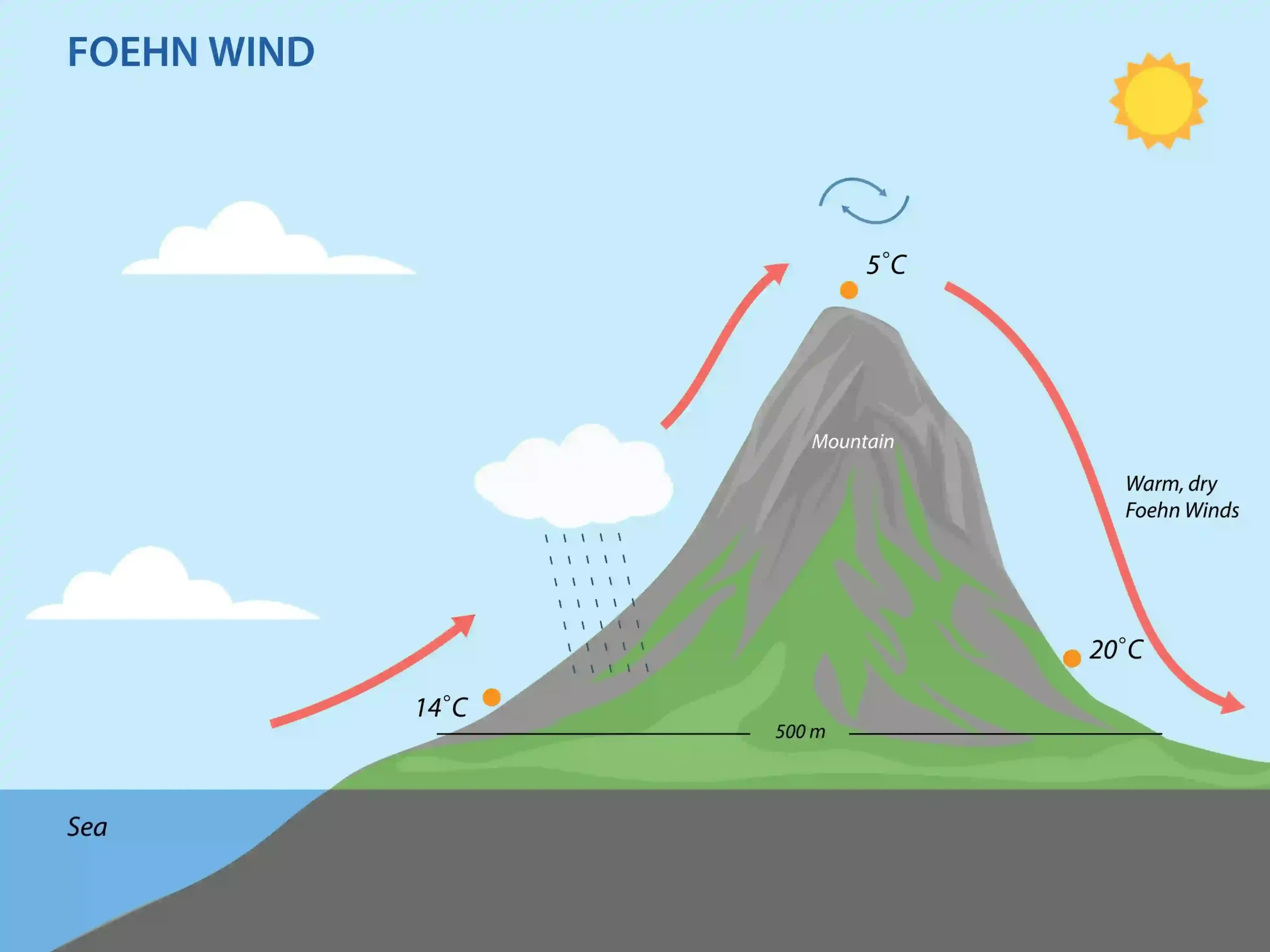
🌊 Winds play an important role in nature.
They help in pollination 🌼.
They help birds fly 🐦.
They influence weather 🌦️.
🧠 Winds also help in distributing heat on Earth 🌍.
🧭 During the day, land heats faster than water ☀️.
Warm air over land rises.
🧠 Cooler air from the sea moves toward land 🌊➡️🏖️.
This is called sea breeze.
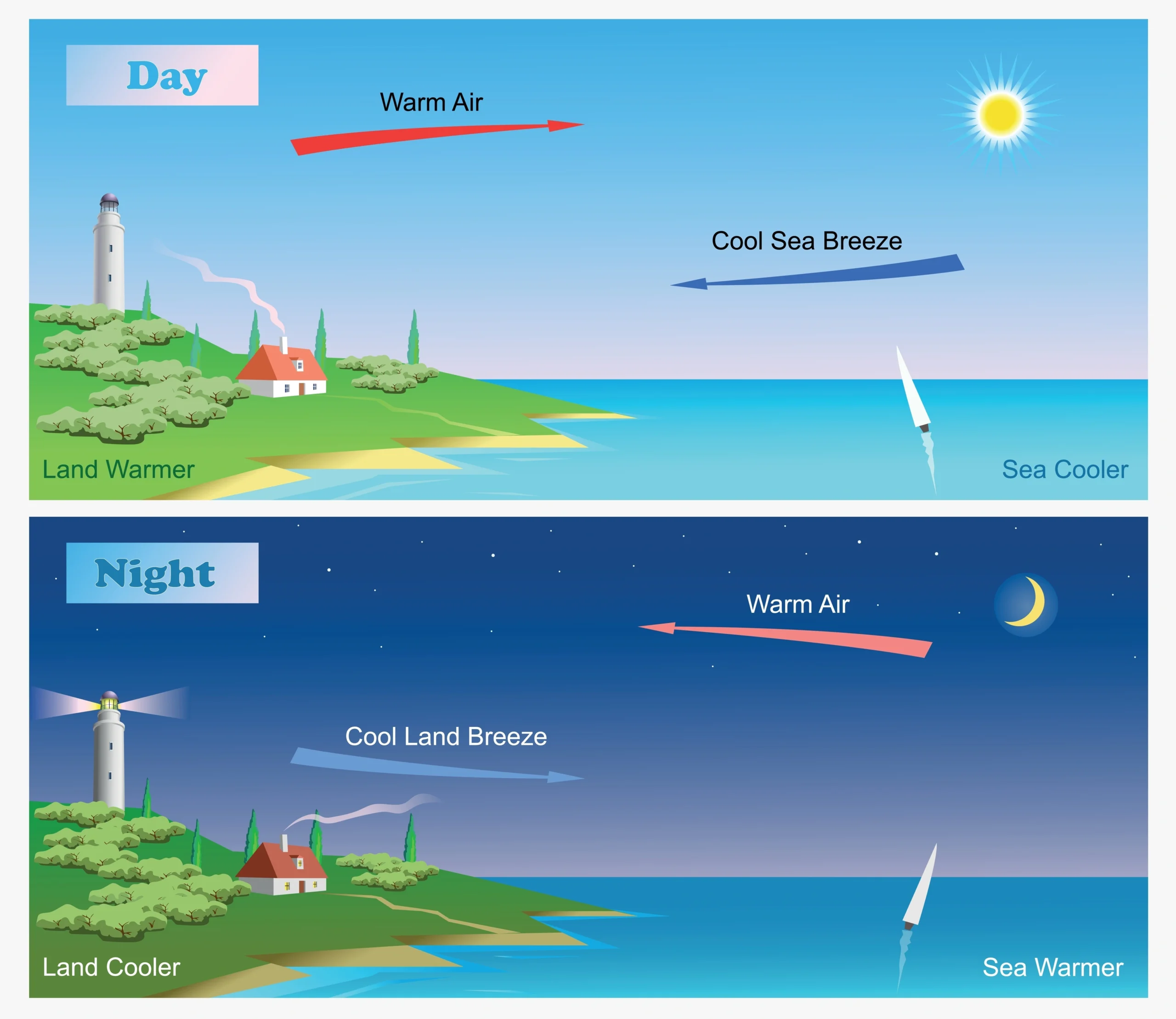
🌙 At night, land cools faster than water.
Warm air over sea rises.
🧠 Cool air from land moves toward the sea 🏖️➡️🌊.
This is called land breeze.
🧭 Sometimes, winds become very strong and violent.
Such winds cause storms 🌪️.
🧠 Storms bring strong winds, heavy rain 🌧️, thunder ⚡, and lightning.
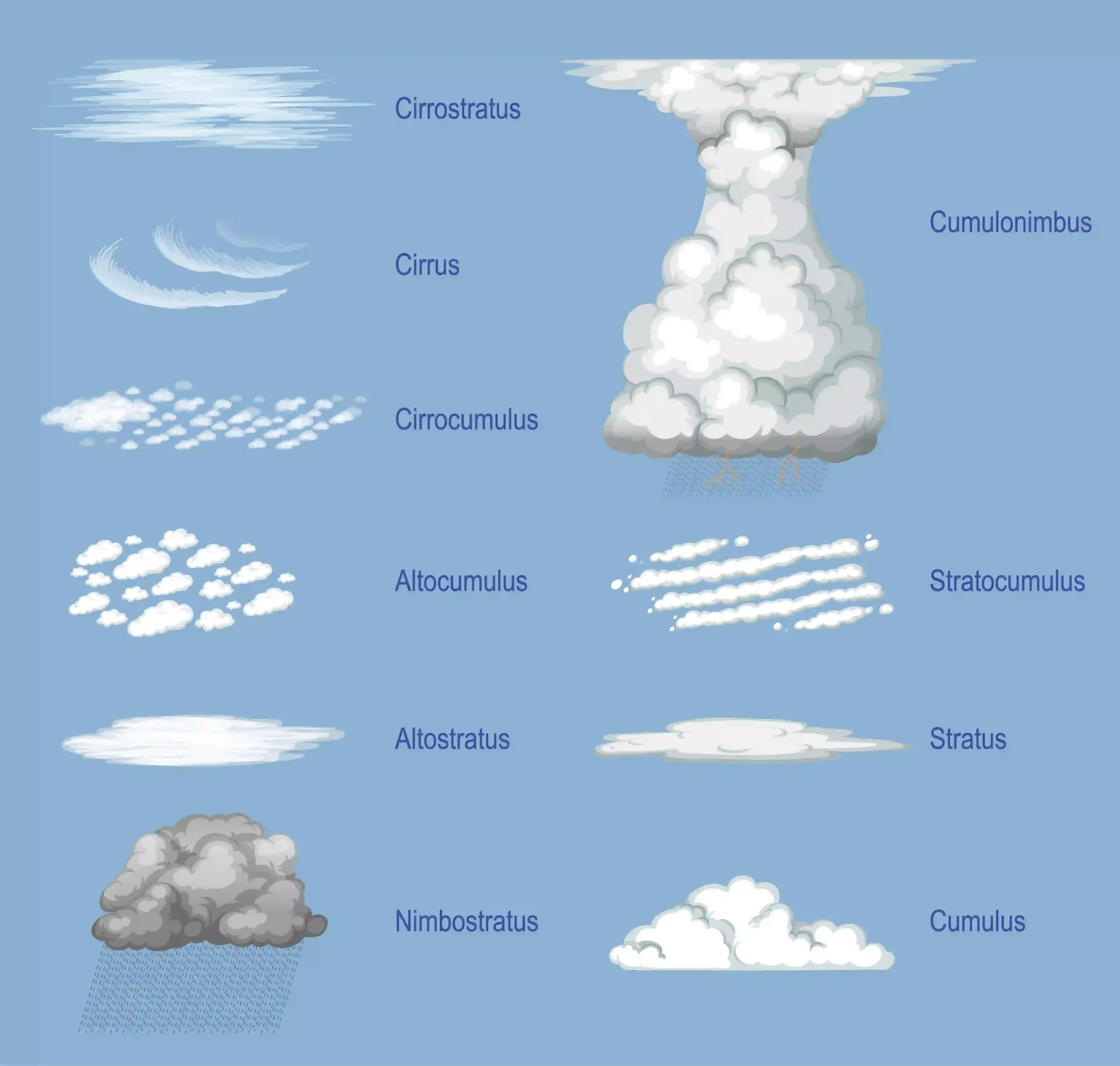
⚡ Thunderstorms occur due to rapid rising of warm air.
Clouds become very tall ☁️⬆️.
🧠 Electrical charges build up, causing lightning ⚡ and thunder 🔊.
🧭 A cyclone is a powerful storm with very high-speed winds.
It forms over warm oceans 🌊🔥.
🧠 Low pressure at the center pulls air inward and upward.
🌀 Cyclones rotate rapidly around a calm center called the eye.
The eye has low pressure and less wind.
🧠 Surrounding areas experience destructive winds and heavy rain.
🌍 Cyclones cause large-scale damage.
Strong winds destroy houses 🏠❌.
Heavy rain causes floods 🌊.
Waves damage coastal areas ⚠️.
🧠 Understanding cyclones helps in disaster management.
🧭 Early warning systems save lives.
Satellites 🛰️
Weather radars 📡
Forecasting models 📊
🧠 These tools help predict storms and cyclones.
🧭 Safety during storms is very important.
Stay indoors 🏠.
Avoid open areas 🚫.
Do not touch electric poles ⚠️.
🧠 Preparedness reduces risk.
🌱 Winds and pressure differences are part of natural balance.
They support climate systems 🌍.
They help circulate air and moisture.
🧠 Nature uses air movement to maintain stability.
🧭 Studying pressure and winds builds scientific thinking.
Observation 👀.
Cause–effect reasoning 🧠.
Environmental awareness 🌱.
🧠 It helps us respect natural forces.
📜 Pressure, winds, storms, and cyclones show the power of air.
Invisible air can create visible effects.
🚀 Understanding these processes helps protect life and property.
📝 Summary of the Lesson
Air exerts pressure on everything around us. Differences in air pressure are caused by changes in temperature and height. Air moves from regions of high pressure to low pressure, creating wind. Winds influence weather and natural processes. Land and sea breezes are caused by unequal heating of land and water. Sometimes strong winds form storms and thunderstorms. Cyclones are powerful storms that develop over warm oceans due to very low pressure at the center. Cyclones cause heavy rain, strong winds, and destruction. Early warning systems and safety measures help reduce damage. Understanding air pressure and wind helps us understand weather and natural disasters.
⚡ Quick Recap
⭐ Air exerts pressure
⭐ Pressure varies with height and temperature
⭐ Wind is moving air
⭐ Pressure difference causes wind
⭐ Storms bring strong winds
⭐ Cyclones form over warm oceans
⭐ Preparedness saves lives
——————————————————————————————————————————————————————————————————————————–
TEXTBOOK QUESTIONS
🔒 ❓ Question 1. Choose the correct statement
📌 Answer:
🔵 (i) (d) equal in all three vessels
Water seeks its own level. Since the vessels are connected and contain the same liquid, the water level becomes the same in P, Q, and R irrespective of shape.
🟢 (ii) (c) M will stick but N will not stick
A rubber sucker sticks only on a smooth surface where air can be pushed out and low pressure is created. Rough surfaces allow air to enter, preventing suction.
🟣 (iii) (a) increase the height ‘H’ at which the tank is placed
Water pressure increases with height. A higher tank creates greater pressure on the ground floor.
🟡 (iv) (b) Pₐ = Pᵦ, Fₐ < Fᵦ
Pressure depends on height of water column, which is same. Force depends on area, and vessel B has a larger base area, so force is greater.
🔒 ❓ Question 2. State whether the following statements are True [T] or False [F]
📌 Answer:
🔵 (i) True — Air always moves from a region of higher pressure to lower pressure.
🟢 (ii) False — Liquids exert pressure in all directions, not only at the bottom.
🟣 (iii) False — The eye of a cyclone is calm, not stormy.
🟡 (iv) True — A car acts as a Faraday cage, offering protection during lightning.
🔒 ❓ Question 3
Fig. 6.23(a) shows a boy lying horizontally, and Fig. 6.23(b) shows the boy standing vertically on loose sand. In which case does the boy sink more? Give reasons.
📌 Answer:
🔵 The boy sinks more when standing vertically.
🟢 Pressure = Force / Area.
🟣 When standing, the area of contact is small, so pressure is large.
🔴 When lying down, the area is larger, so pressure is less and sinking reduces.
🔒 ❓ Question 4
An elephant stands on four feet. If the area of one foot is 0.25 m² and its weight is 20000 N, calculate the pressure on the ground.
📌 Answer:
🔵 Total area = 4 × 0.25 = 1 m²
🟢 Pressure = Force / Area
🟣 Pressure = 20000 / 1
🔴 Pressure = 20000 Pa
🔒 ❓ Question 5
Two boats A and B have base areas 7 m² and 3.5 m² respectively. Boat A has 5 persons and Boat B has 3 persons. Each person weighs 700 N. Which boat experiences more pressure and by how much?
📌 Answer:
🔵 Boat A:
Force = 5 × 700 = 3500 N
Pressure = 3500 / 7 = 500 Pa
🟢 Boat B:
Force = 3 × 700 = 2100 N
Pressure = 2100 / 3.5 = 600 Pa
🟣 Boat B experiences more pressure
🔴 Difference = 600 − 500 = 100 Pa
🔒 ❓ Question 6
Would lightning occur if air and clouds were good conductors of electricity? Give reasons.
📌 Answer:
🔵 No, lightning would not occur.
🟢 Charges would flow smoothly without accumulation.
🟣 Lightning occurs due to sudden discharge of built-up charges.
🔴 Conducting air would prevent charge build-up.
🔒 ❓ Question 7
What will happen to two identical balloons A and B in Fig. 6.24 when water is filled into the bottle? Will they bulge equally?
📌 Answer:
🔵 Both balloons will bulge.
🟢 Water pressure increases with depth.
🟣 The lower balloon experiences more pressure.
🔴 Therefore, they will not bulge equally; the lower one bulges more.
🔒 ❓ Question 8
Explain how a storm becomes a cyclone.
📌 Answer:
🔵 Warm moist air rises, creating low pressure.
🟢 Surrounding air rushes in rapidly.
🟣 Earth’s rotation causes the air to spin.
🔴 Continuous rotation and energy form a cyclone.
🔒 ❓ Question 9
Fig. 6.25 shows trees along the sea coast in a summer afternoon. Identify which side is land—A or B. Explain.
📌 Answer:
🔵 Side A is land.
🟢 During daytime, land heats faster than sea.
🟣 Warm air over land rises, creating low pressure.
🔴 Cool air from sea moves towards land, bending trees landward.
🔒 ❓ Question 10
Describe an activity to show that air flows from high pressure to low pressure.
📌 Answer:
🔵 Inflate a balloon and release its mouth.
🟢 Air rushes out from inside the balloon.
🟣 Inside pressure is higher than outside.
🔴 This shows air moves from high to low pressure.
🔒 ❓ Question 11
What is a thunderstorm? Explain its formation.
📌 Answer:
🔵 A thunderstorm is a violent weather condition.
🟢 Warm air rises rapidly.
🟣 Cooling causes condensation and cloud formation.
🔴 Strong winds, rain, lightning, and thunder occur.
🔒 ❓ Question 12
Explain the process that causes lightning.
📌 Answer:
🔵 Charges develop inside clouds due to collisions.
🟢 Upper cloud becomes positively charged.
🟣 Lower cloud becomes negatively charged.
🔴 Sudden discharge between clouds or ground produces lightning.
🔒 ❓ Question 13
Explain why holes are made in banners and hoardings.
📌 Answer:
🔵 Holes allow air to pass through.
🟢 This reduces air pressure on the banner.
🟣 Strong winds do not tear it easily.
🔴 Thus, banners remain stable during storms.
——————————————————————————————————————————————————————————————————————————–
OTHER IMPORTANT QUESTIONS
SECTION 1 — MCQs (5 Questions)
🔒 ❓ Q1. What happens to air pressure as altitude increases?
🟢 1️⃣ Increases
🔵 2️⃣ Decreases
🟡 3️⃣ Remains same
🟣 4️⃣ Becomes zero
✔️ Answer: 🔵 2️⃣ Decreases
🔒 ❓ Q2. Winds are mainly caused due to differences in:
🟢 1️⃣ Temperature
🔵 2️⃣ Pressure
🟡 3️⃣ Humidity
🟣 4️⃣ Rainfall
✔️ Answer: 🔵 2️⃣ Pressure
🔒 ❓ Q3. Which instrument measures atmospheric pressure?
🟢 1️⃣ Thermometer
🔵 2️⃣ Barometer
🟡 3️⃣ Hygrometer
🟣 4️⃣ Anemometer
✔️ Answer: 🔵 2️⃣ Barometer
🔒 ❓ Q4. Which condition leads to formation of cyclones?
🟢 1️⃣ High pressure only
🔵 2️⃣ Low pressure region
🟡 3️⃣ Cold air only
🟣 4️⃣ Dry weather
✔️ Answer: 🔵 2️⃣ Low pressure region
🔒 ❓ Q5. Which safety measure is correct during a cyclone?
🟢 1️⃣ Stand near windows
🔵 2️⃣ Go outdoors
🟡 3️⃣ Stay indoors
🟣 4️⃣ Climb trees
✔️ Answer: 🟡 3️⃣ Stay indoors
SECTION 2 — Very Short Answer (5 Questions)
🔒 ❓ Q6. Name the force exerted by air on surfaces.
📌 ✅ Answer: Air pressure
🔒 ❓ Q7. What causes wind to blow?
📌 ✅ Answer: Pressure difference
🔒 ❓ Q8. Name a violent rotating storm.
📌 ✅ Answer: Cyclone
🔒 ❓ Q9. Which air moves from high to low pressure?
📌 ✅ Answer: Wind
🔒 ❓ Q10. Name the instrument to measure wind speed.
📌 ✅ Answer: Anemometer
SECTION 3 — Short Answer (3 Questions)
🔒 ❓ Q11. Why does air move from high pressure to low pressure areas?
📌 ✅ Answer:
🔹 Air moves to balance pressure differences.
🔸 High-pressure air pushes towards low-pressure regions.
🔹 This movement of air creates wind.
🔒 ❓ Q12. How does temperature affect air pressure?
📌 ✅ Answer:
🔹 Warm air expands and becomes lighter.
🔸 It creates a low-pressure area.
🔹 Cool air is heavier and forms high pressure.
🔒 ❓ Q13. Why are cyclones dangerous?
📌 ✅ Answer:
🔹 Cyclones bring very strong winds and heavy rain.
🔸 They cause flooding and damage to houses and crops.
🔹 Life and property are at high risk.
SECTION 4 — Long Answer (1 Question)
🔒 ❓ Q14. Explain how cyclones are formed and list safety measures.
📌 ✅ Answer:
🔹 Cyclones form over warm oceans due to low air pressure.
🔸 Warm moist air rises and cooler air rushes in.
🔹 This creates a rotating system with strong winds and rain.
🔸 During cyclones, people should stay indoors and follow warnings.
🔹 Emergency kits and evacuation plans reduce loss of life.
——————————————————————————————————————————————————————————————————————————–
ADVANCE KNOWLEDGE
🌍 Air: Invisible, Powerful, and Always Moving
Air looks light and harmless, but it is one of the most powerful forces on Earth. Gentle breezes cool us, while violent cyclones can reshape coastlines. All this power comes from one simple idea—pressure difference.
🧠 Big idea:
Where pressure is uneven, air must move.
🧠 Pressure: The Hidden Force of Air
Pressure is the force exerted per unit area.
🧠 Air pressure exists because:
Air has mass
Gravity pulls air downward
⭐ Air presses on everything—land, water, buildings, and even our bodies—yet we do not feel it because pressure is balanced from all sides.
⚠️ Misconception vs Reality
⚠️ Misconception: Air is weightless
✅ Reality: Air has mass and exerts pressure
⚠️ Misconception: Only strong winds create pressure
✅ Reality: Pressure exists even when air is still
🌬️ Wind: Air on the Move
Wind is simply moving air.
🧠 Wind moves because:
Warm air rises (low pressure)
Cool air sinks (high pressure)
⭐ Air always moves from high pressure to low pressure.
🧠 This single rule explains breezes, storms, and global winds.
🌞 Heating of Earth: The Real Cause of Winds
The Sun heats Earth unevenly.
🌍 Reasons:
Earth’s spherical shape
Land heats faster than water
Day–night cycle
🧠 Uneven heating creates pressure differences → winds.
⭐ Without the Sun, winds would stop completely.
🌍 Local Winds: Small but Important
Local winds affect daily life.
🌬️ Sea breeze:
Daytime wind from sea to land
🌬️ Land breeze:
Nighttime wind from land to sea
⭐ Fishermen have used these winds for centuries.
🌪️ Storms: When Wind Gains Strength
Storms form when pressure differences become large.
🧠 Features of storms:
Strong winds
Heavy rain
Thunder and lightning
⭐ Storms release huge amounts of stored energy from warm air.
🌩️ Thunderstorms: Vertical Power
Thunderstorms form when warm air rises rapidly.
🧠 Inside thunderstorms:
Strong upward air currents
Formation of clouds
Electrical charges build up
⭐ Lightning is a giant electrical discharge caused by air movement.
🌪️ Cyclones: The Giants of the Atmosphere
Cyclones are large rotating storm systems.
🧠 Conditions needed:
Warm ocean water
Low pressure center
Coriolis effect (Earth’s rotation)
⭐ Cyclones rotate because Earth itself is spinning.
⚠️ Why Cyclones Are Dangerous
Cyclones bring:
Extremely strong winds
Heavy rainfall
Storm surges
⚠️ Storm surges can flood coastal areas far inland.
🧠 Damage comes from combined forces, not wind alone.
🌍 Global Wind Systems
Earth has permanent wind belts.
🌍 Examples:
Trade winds
Westerlies
Polar winds
⭐ These winds influence:
Climate
Ocean currents
Rainfall patterns
🧠 Global winds connect continents and oceans into one system.
🌡️ Pressure, Winds, and Climate
Climate depends on long-term wind patterns.
🧠 Winds:
Distribute heat
Carry moisture
Shape ecosystems
⭐ Deserts, forests, and monsoon regions exist because of wind patterns.
🚀 Modern Science: Studying Storms
🚀 Scientists use:
Satellites
Weather radars
Computer models
🧠 These tools help:
Predict cyclones
Save lives
Plan evacuations
⭐ Early warning systems are science protecting humanity.
⚠️ Climate Change and Extreme Weather
Rising temperatures increase storm energy.
⚠️ Results:
Stronger cyclones
Unpredictable winds
Heavier rainfall
🧠 Understanding pressure and winds is essential for climate safety.
🌍 Pressure Beyond Earth
Pressure works on other planets too.
🌌 Examples:
Mars has very low air pressure
Venus has extremely high pressure
⭐ Pressure decides whether humans can survive on a planet.
🧠 Forces at the Microscopic Level
Air pressure comes from:
Constant motion of air molecules
Collisions with surfaces
⭐ Even calm air is microscopically violent.
⭐ Amazing Facts
⭐ Air pressure decreases with height
⭐ Cyclones rotate in opposite directions in different hemispheres
⭐ Winds can travel thousands of kilometres
⭐ A cyclone releases energy equal to many nuclear bombs
🧠 Why Curious Minds Must Understand Air
This topic teaches:
Energy transfer
System thinking
Climate awareness
🧠 It shows how small pressure differences create massive natural events.
🌟 Final Thought
Air may be invisible,
but its power shapes oceans, lands, and lives.
🧠 To understand pressure and winds is to understand how Earth breathes.
——————————————————————————————————————————————————————————————————————————–