
Class 10 : Social Science (In English) – Lesson 2. NATONALISM IN INDIA

EXPLANATION & SUMMARY
Modern nationalism in India emerged during the anti-colonial movement against British rule . Unlike European nationalism which developed organically, Indian nationalism was intimately connected to the struggle against colonialism .
The sense of being oppressed under colonial rule provided a shared bond that tied different groups together . However, each class and group experienced colonialism differently, leading to varied notions of freedom .
The First World War and Its Impact
The First World War created a new economic and political situation in India . The war led to increased defense expenditure, introduction of income tax, and doubling of customs duties between 1913 and 1918 .
Crop failures in 1918-19 and the influenza epidemic caused widespread hardship . Food shortages and economic difficulties created conditions for mass mobilization against British rule .
The war also saw forced recruitment of soldiers from villages, causing resentment in rural areas . These harsh conditions prepared the ground for nationalist movements .
The Idea of Satyagraha
Mahatma Gandhi introduced the concept of Satyagraha, emphasizing truth and non-violence . This new method of struggle differed from earlier approaches of petitions and moderate protests .
Gandhi’s first Satyagraha was launched in Champaran, Bihar in 1917 . He organized peasants against the oppressive indigo plantation system .
In 1918, Gandhi organized a Satyagraha in Kheda, Gujarat . These early movements established Gandhi’s reputation as a leader who could mobilize masses through non-violent resistance .
The Rowlatt Act and Satyagraha
The Rowlatt Act of 1919 allowed detention without trial and restricted press freedom . This repressive legislation was seen as a direct assault on Indian civil liberties .
Gandhi launched the Rowlatt Satyagraha in February 1919 . The movement aimed to mobilize masses against the unjust law through civil disobedience .
The Jallianwala Bagh massacre on April 13, 1919, marked a turning point . General Dyer’s troops fired on unarmed civilians celebrating Baisakhi, killing hundreds .
The Khilafat Movement
The Khilafat Movement (1919-1922) was launched by Indian Muslims to protect the Ottoman Caliph . Muslim leaders like Maulana Mohammad Ali and Shaukat Ali organized this pan-Islamic movement .
Gandhi supported the Khilafat Movement to achieve Hindu-Muslim unity . This alliance brought together nationalist and religious concerns against British policies .
The movement merged with the Non-Cooperation Movement in 1920 . This collaboration demonstrated the potential for communal harmony in the independence struggle .
The Non-Cooperation Movement (1920-1922)
Gandhi believed British rule survived only through Indian cooperation . He argued that withdrawal of cooperation would collapse British authority within a year .
The movement included boycott of government schools, courts, and foreign goods . Students left government institutions, lawyers abandoned courts, and people burned foreign cloth .
The movement saw participation from various social groups . Middle-class professionals, peasants, and tribal communities joined the struggle with their own interpretations of Swaraj .
The Chauri Chaura incident in February 1922 led Gandhi to suspend the movement . When protesters turned violent and killed policemen, Gandhi called off the campaign .
The Civil Disobedience Movement (1930-1934)
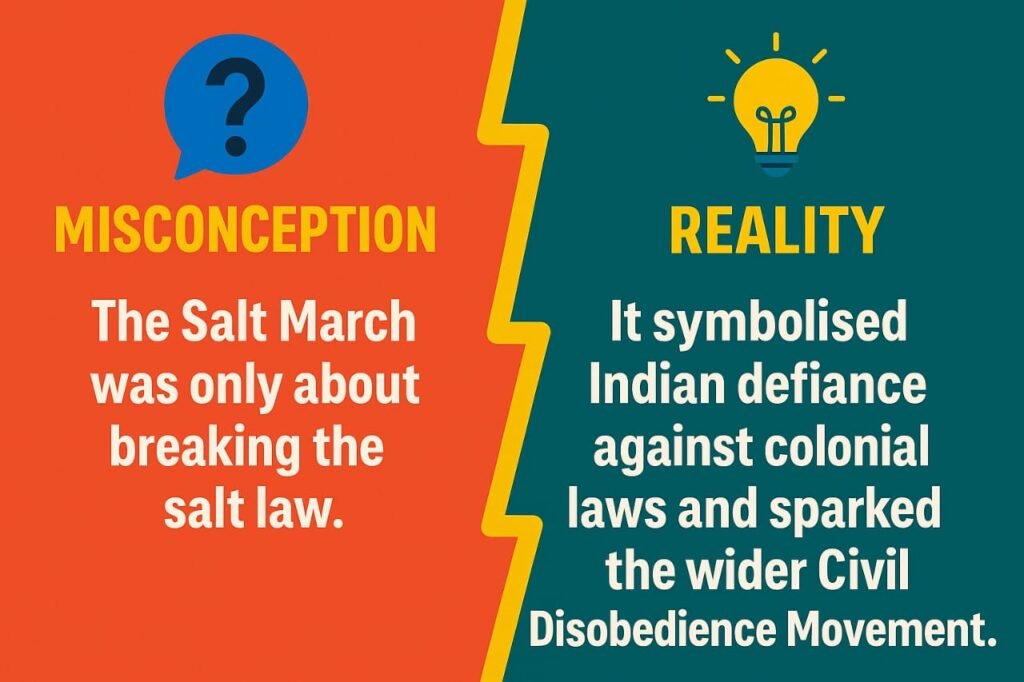
The Salt March began on March 12, 1930, from Sabarmati Ashram to Dandi . Gandhi walked 387 kilometers with 78 followers to break the salt law .
The march sparked nationwide civil disobedience against British rule . Breaking the salt law on April 6, 1930, inspired millions to join the movement .
The movement spread across India with different regional variations . Leaders like C. Rajagopalachari in Tamil Nadu and Sardar Patel in Gujarat organized local campaigns .
Over 60,000 people were arrested during the Salt Satyagraha . Despite massive participation, the British made few immediate concessions .
Different Strands of the Movement
Various social groups participated with different expectations . Peasants sought relief from high taxes, workers wanted better conditions, and women challenged traditional roles .
Tribal communities like the Gudem rebels had their own understanding of Swaraj . Alluri Sitarama Raju led guerrilla warfare believing force was necessary for liberation .
Plantation workers interpreted freedom as the right to move freely . Thousands defied the Inland Emigration Act during the Non-Cooperation Movement .
The Sense of Collective Belonging
Nationalism created symbols and ideas that forged new identities . The tricolor flag, national anthem, and images of Bharat Mata became unifying symbols .
Cultural processes helped create a sense of collective belonging . Folk tales, songs, and nationalist literature spread the idea of a unified Indian nation .
However, communal tensions also emerged during this period . Different communities sometimes had conflicting visions of the future nation .
Conclusion
The nationalist movement transformed from elite politics to mass struggle . From the formation of Congress in 1885 to mass movements of the 1930s, the scope and intensity of resistance expanded .
Gandhi’s leadership unified diverse groups under the nationalist banner . His methods of non-violent resistance provided a framework for sustained struggle against colonial rule .
The movement laid the foundation for India’s independence in 1947 . Despite limitations and internal conflicts, nationalism succeeded in mobilizing millions against British rule .
————————————————————————————————————————————————————————————————————————————
QUESTIONS FROM TEXTBOOK
Question 1: Explain
a) Why growth of nationalism in the colonies is linked to an anti-colonial movement.
A : The growth of nationalism in colonies is fundamentally connected to anti-colonial movements because colonial rule created shared experiences of oppression that united diverse groups of people. When foreign powers imposed their authority over local populations, people from different regions, classes, and communities began to recognize their common struggle against external domination. The colonial system extracted resources, imposed unfair laws, and denied basic freedoms to the colonized people, which created a collective sense of injustice. This shared suffering became the foundation for nationalist feelings, as people realized they belonged to one nation that was being exploited by outsiders. The fight against colonial rule naturally brought together various social groups who might otherwise have remained divided, creating a unified national identity through their common resistance to foreign control.
b) How the First World War helped in the growth of the National Movement in India.
A : The First World War significantly accelerated India’s national movement by creating severe economic hardships and exposing British vulnerability. During the war, the colonial government imposed heavy taxes, including new income tax and doubled customs duties, which caused immense financial burden on ordinary Indians. The war also led to forced recruitment of soldiers from rural areas, creating widespread resentment among villagers. Additionally, crop failures in 1918-19 and 1920-21, combined with an influenza epidemic, resulted in the death of millions of Indians while Britain continued to extract resources for the war effort. These conditions made Indians realize that British rule prioritized imperial interests over Indian welfare. The war also demonstrated that the British Empire was not invincible, as it struggled against other European powers, encouraging Indians to believe that independence was achievable through organized resistance.
Question 2: What is meant by the idea of satyagraha?
A : Satyagraha is a philosophy and method of non-violent resistance developed by Mahatma Gandhi, which literally means “holding onto truth” or “truth-force.” This concept emphasizes that if a cause is just and true, physical violence is unnecessary to achieve victory over oppression. According to Gandhi, satyagraha required protesters to remain completely non-violent while refusing to cooperate with unjust laws or systems. The method involved appealing to the conscience of the oppressor through moral pressure rather than physical force. Satyagrahis were expected to be willing to suffer imprisonment, beatings, or other hardships without retaliating violently. Gandhi believed this approach was more powerful than armed resistance because it could transform the hearts and minds of both the oppressed and the oppressor. The technique aimed to create moral awakening and bring about lasting social change through the power of truth and non-violence, making it a spiritual as well as political weapon.
Question 3: Write a newspaper report on:
a) The Jallianwala Bagh massacre
A : TRAGIC MASSACRE SHOCKS NATION
Hundreds Killed in Amritsar as British Forces Open Fire on Peaceful Gathering
AMRITSAR, April 13, 1919 – In a horrific incident that has sent shockwaves across India, British forces under General Dyer opened fire on a peaceful gathering at Jallianwala Bagh, killing hundreds of innocent civilians. The enclosed garden was filled with men, women, and children who had gathered for the annual Baisakhi fair, while others were there to protest against recent repressive government measures. Many villagers were unaware of the martial law imposed in the city.
General Dyer arrived at the scene with his troops, immediately blocked all exit points, and without any warning, ordered his soldiers to fire continuously into the crowd. The firing continued for several minutes until ammunition ran low. With no escape routes available, people desperately tried to save themselves by jumping into the well or climbing walls, but many perished in the chaos.
General Dyer later stated that his intention was to create a “moral effect” and instill fear among Indians who dared to oppose British authority. This brutal act has been widely condemned as a cold-blooded massacre of innocent people and has intensified anti-British sentiment throughout the country.
b) The Simon Commission
A : ALL-BRITISH COMMISSION FACES NATIONWIDE PROTESTS
“Go Back Simon” Slogan Echoes Across India as Leaders Demand Indian Representation
NEW DELHI, 1928 – The arrival of the Simon Commission in India has triggered massive protests and demonstrations across the country, with political parties unitedly opposing the constitutional review body. The Commission, headed by Sir John Simon and appointed by the British government to examine India’s constitutional system, has been met with widespread resistance due to its complete lack of Indian representation.
All major political parties, including the Indian National Congress and the Muslim League, have joined hands in protesting against the Commission, raising the slogan “Go Back Simon” wherever the members travel. The exclusion of any Indian member from a commission meant to decide India’s constitutional future has been seen as a grave insult to Indian aspirations for self-governance.
Political leaders argue that Indians are perfectly capable of determining their own constitutional needs and that the British government’s decision to form an all-white commission reflects its continued disregard for Indian opinion. The protests have been largely peaceful but determined, with black flag demonstrations and hartals organized in various cities to express the nation’s rejection of this unrepresentative body.
Question 4: Compare the images of Bharat Mata in this chapter with the image of Germania in Chapter 1.
Both Bharat Mata and Germania were powerful female symbolic representations created to personify their respective nations during periods of nationalist awakening, yet they embodied different cultural values and historical contexts. Germania was portrayed as a strong, warrior-like figure wearing armor and carrying a sword, representing the German nation’s struggle for unification through strength and military power. She wore a crown of oak leaves symbolizing heroism and was often depicted breaking chains to represent liberation from foreign domination.
In contrast, Bharat Mata was depicted as a motherly, spiritual figure dressed in saffron-colored robes, holding a trishul, sheaves of rice, and a piece of cloth, representing India’s agricultural abundance and spiritual heritage. Unlike Germania’s martial appearance, Bharat Mata’s image emphasized nurturing, sacrifice, and dharmic qualities that resonated with Indian cultural traditions. While Germania represented political unity and military strength, Bharat Mata embodied cultural unity and moral strength rooted in Hindu traditions.
Both figures served similar purposes in fostering national consciousness – they made abstract concepts of nationhood tangible and emotionally appealing to common people. However, Germania emphasized political liberation and state formation, while Bharat Mata focused on cultural revival and spiritual awakening as paths to freedom. These different representations reflected the distinct historical circumstances and cultural contexts in which German and Indian nationalism developed.
————————————————————————————————————————————————————————————————————————————
OTHER IMPORTANT QUESTIONS FOR EXAMS
[CBSE MODEL QUESTION PAPER]
🔹 Section A: Multiple Choice Questions (1 × 6 = 6)
Q1. The Rowlatt Act of 1919 was opposed because:
(a) It allowed Indians to form regional parties
(b) It banned the use of Indian languages
(c) It allowed the British to detain anyone without trial
(d) It granted voting rights to Indians
Answer: (c)
Q2. Who among the following was the leader of the Awadh peasants during the Non-Cooperation Movement?
(a) Baba Ramchandra
(b) Maulana Azad
(c) Subhas Chandra Bose
(d) Dr. B.R. Ambedkar
Answer: (a)
Q3. The Jallianwala Bagh massacre occurred in which city?
(a) Lucknow
(b) Lahore
(c) Amritsar
(d) Delhi
Answer: (c)
Q4. In which session did the Congress declare ‘Purna Swaraj’ as its goal?
(a) Bombay Session, 1920
(b) Calcutta Session, 1928
(c) Lahore Session, 1929
(d) Karachi Session, 1931
Answer: (c)
Q5. The Civil Disobedience Movement was started with:
(a) The Dandi March
(b) The Khilafat Movement
(c) Quit India Movement
(d) The Lucknow Pact
Answer: (a)
Q6. What was the main demand of the Khilafat Movement?
(a) Boycott of British goods
(b) Restoration of the Caliph of Turkey
(c) Tax reduction
(d) Abolition of salt tax
Answer: (b)
🔹 Section B: Very Short Answer Questions (2 × 6 = 12)
Answer in 30–40 words.
Q7. Why was the Simon Commission boycotted in India?
Answer: Because it had no Indian member. Indians considered it an insult to their self-respect and demanded self-rule.
Q8. How did the Jallianwala Bagh massacre affect the national movement?
Answer: It shocked the country, united people against British rule, and led to widespread protests and resignations from British institutions.
Q9. Mention two reasons why Gandhiji launched the Non-Cooperation Movement.
Answer:
To protest against the Rowlatt Act and Jallianwala Bagh massacre.
To support the Khilafat cause and unite Hindus and Muslims.
Q10. How did the Salt March become a symbol of resistance against British rule?
Answer: It united people around a basic necessity. Breaking the salt law was a simple, non-violent act that inspired nationwide protest.
Q11. Why did Gandhiji call off the Non-Cooperation Movement in 1922?
Answer: Due to the violent Chauri Chaura incident where protesters killed policemen. Gandhiji suspended the movement to uphold non-violence.
Q12. What was the outcome of the Round Table Conference that Gandhiji attended?
Answer: It failed. The British did not concede to Indian demands and continued repressive policies, prompting the relaunch of the Civil Disobedience Movement.
🔹 Section C: Short Answer Questions (3 × 12 = 36)
Answer in 80–100 words.
Q13. Describe any three economic effects of the First World War on India.
Answer:
Heavy military expenditure led to increased taxes.
Scarcity of goods led to price rises and hardships.
Forced recruitment and inflation created unrest, boosting nationalism.
Q14. Explain three reasons why Gandhiji chose to break the salt law in 1930.
Answer:
Salt was a daily necessity for all, especially the poor.
Salt law symbolized British oppression.
It offered a simple act of defiance with mass appeal.
Q15. How did different social groups participate in the Civil Disobedience Movement?
Answer:
Rich peasants refused revenue.
Urban classes boycotted goods.
Women joined picketing and salt making.
Participation varied in motive and impact.
Q16. How did the sense of collective belonging develop among Indians?
Answer:
Symbols like Bharat Mata, national songs, revival of history, and swadeshi goods helped forge unity across caste, class, and region.
Q17. What was the role of tribal peasants in the nationalist movement?
Answer:
They protested forest laws and British oppression. They supported Gandhi but used violence, differing from Congress’s peaceful approach.
Q18. What were the limitations of the Civil Disobedience Movement?
Answer:
Dalits and many Muslims stayed away.
Workers weren’t mobilized.
Women’s roles remained symbolic without political gains.
Q19. Why did Gandhiji suspend the Civil Disobedience Movement in 1931?
Answer:
Due to intense repression and arrests. It was suspended after the Gandhi-Irwin Pact, hoping for a political solution.
Q20. How was the Salt March different from earlier mass movements?
Answer:
It had broad participation, targeted a symbolic law, and was entirely non-violent, gaining massive national and international support.
Q21. What led to the formation of the Swaraj Party in 1923?
Answer:
After the Non-Cooperation Movement ended, leaders like C.R. Das and Motilal Nehru formed it to enter councils and oppose British rule from within.
Q22. How did reinterpretation of history help spread nationalism?
Answer:
Leaders glorified India’s ancient past to boost pride and counter colonial narratives. History united people by reminding them of past greatness.
Q23. How was Satyagraha different from other political struggles?
Answer:
Satyagraha was based on non-violence and moral force, not armed rebellion. It sought truth and justice through peaceful resistance.
Q24. Why did many Muslims not participate in the Civil Disobedience Movement?
Answer:
They felt alienated after the Khilafat collapse, feared Hindu dominance in Congress, and were influenced by communal politics.
🔹 Section D: Long Answer Questions (5 × 5 = 25)
Answer in 120–150 words.
Q25. Describe the main features of the Civil Disobedience Movement.
Answer:
Launched with the Dandi March.
Boycott of British goods and refusal to pay taxes.
Participation of peasants, women, students.
Nationwide defiance of laws like forest and salt laws.
Severe repression by the British.
Marked a deeper phase in the struggle for independence.
Q26. Discuss the significance of the Lahore Session of the Congress in 1929.
Answer:
Purna Swaraj was declared as the final goal.
26 January was observed as Independence Day.
Shift from dominion status to full freedom.
Boosted mass confidence.
Paved the way for Civil Disobedience Movement.
Q27. How did Mahatma Gandhi transform the national movement into a mass movement?
Answer:
Mobilized peasants, tribals, workers, and women.
Promoted local grievances to build national unity.
Led simple yet symbolic protests (e.g., Salt March).
Used khadi, non-cooperation, and Satyagraha to involve common people.
Q28. Compare the role of rich and poor peasants in the Civil Disobedience Movement.
Answer:
Rich peasants wanted tax relief and led no-revenue campaigns.
Poor peasants demanded rent reduction and land rights.
Rich withdrew when demands unmet; poor lacked organized leadership.
Both were disappointed with the outcomes.
Q29. Describe the causes, events, and outcomes of the Salt March.
Answer:
Causes: Salt tax symbolized colonial oppression.
Events: Gandhi’s 240-mile march, salt-making at Dandi, mass protests.
Outcomes:
National and international attention.
Massive arrests.
Start of Civil Disobedience.
Strengthened nationalist resolve.
🔹 Section E: Map-Based Questions (1 × 1 = 1)
Q30. On the outline map of India, locate and label the place where the Dandi March started.
Answer: Sabarmati (Ahmedabad, Gujarat)
🔹 Section F: Case/Source-Based Questions (4 × 6 = 24)
Q31. (No geography map – skipped as paper is only from one History lesson)
Q32. Source on Salt and 11 Demands
(i) 31 Jan 1930
(ii) It was universal and symbolic
(iii) To involve all classes
(iv) It warned British rule of mass protest
Q33. Source on Baba Ramchandra and Awadh peasants
(i) Baba Ramchandra
(ii) Forced unpaid labour
(iii) Lower rent, end begar
(iv) Social boycott of landlords
Q34. Source on Simon Commission
(i) British committee for reforms
(ii) No Indian member
(iii) “Simon Go Back”
(iv) Invited Indians to Round Table
Q35. Source on cultural nationalism
(i) Bharat Mata
(ii) Inspired pride and unity
(iii) Abanindranath Tagore
(iv) Evoked devotion and sacrifice
Q36. Source on Muslim non-participation
(i) Khilafat and Non-Cooperation
(ii) Congress seen as Hindu dominated
(iii) Muhammad Ali
(iv) Lower participation in Civil Disobedience
Q37. Source on women in movement
(i) Essential to the struggle
(ii) Salt making, picketing shops
(iii) Broke traditional roles
(iv) Brave and active contributors
————————————————————————————————————————————————————————————————————————————
QUESTIONS FROM COMPETITION EXAMS
————————————————————————————————————————————————————————————————————————————
ONE PAGE REVISION SHEET
First World War & Its Impact:
The war led to economic hardships, forced recruitment, and inflation in India, sparking nationalist sentiments among Indians.
Rowlatt Act (1919):
Allowed detention without trial. Gandhi launched a nationwide protest; it was seen as a violation of civil rights.
Jallianwala Bagh Massacre (1919):
General Dyer ordered open fire on a peaceful gathering. It shocked the nation and intensified the demand for independence.
Non-Cooperation Movement (1920–22):
Launched by Gandhi after the Khilafat and Jallianwala Bagh incidents. Indians boycotted British goods, schools, courts, and titles.
Chauri Chaura Incident (1922):
Protesters clashed with police; 22 policemen were killed. Gandhi called off the Non-Cooperation Movement to prevent violence.
Simon Commission (1927):
Came without Indian members. It was boycotted across India with slogans like “Simon Go Back”.
Salt March / Civil Disobedience Movement (1930):
Gandhi marched from Sabarmati to Dandi to break the salt law. This triggered mass defiance of British laws across the country.
Round Table Conferences (1930–32):
Gandhi attended the second round table conference but returned disappointed as no agreement was reached on Indian self-rule.
Quit India Movement (1942):
Launched during WWII. Gandhi gave the call “Do or Die”. It led to mass protests and arrests, marking a crucial step toward independence.
Role of Different Social Groups:
Peasants, tribal communities, industrial workers, women, and students all participated in the nationalist movement in diverse ways.
————————————————————————————————————————————————————————————————————————————
MISCONCEPTIONS “ALERTS”
————————————————————————————————————————————————————————————————————————————