
Class : 9 – Science (English) : Lesson 11. Sound

EXPLANATION & SUMMARY
🌟 Introduction
Sound is a form of energy that is produced by vibrations.
It travels through a medium (solid, liquid, or gas) in the form of longitudinal waves.
Without a medium, sound cannot travel — hence it does not propagate in a vacuum.
🎵 Production of Sound
A vibrating object sets the particles of the surrounding medium in motion.
These vibrating particles collide with neighbouring particles, transferring energy.
This process continues in the form of compressions (high pressure, particles close) and rarefactions (low pressure, particles far apart).
🌊 Nature of Sound Waves
Sound waves are mechanical (need medium) and longitudinal (particles oscillate parallel to wave propagation).
Wavefronts: The regions of compressions and rarefactions move forward, carrying energy.
📏 Characteristics of Sound Waves
Wavelength (λ):
Distance between two successive compressions or rarefactions.
Frequency (f):
Number of oscillations per second.
Unit: Hertz (Hz).
Higher frequency → higher pitch.
Time Period (T):
Time taken for one complete oscillation.
Relation: T = 1/f
Amplitude (A):
Maximum displacement of particles from mean position.
Larger amplitude → louder sound.
Velocity (v):
Distance travelled by wave per second.
Formula: v = λ × f
📡 Speed of Sound
Depends on the medium:
Fastest in solids
Slower in liquids
Slowest in gases
In air at 25°C → ~346 m/s
🎶 Range of Hearing
Human ear: 20 Hz – 20,000 Hz (audible range).
Infrasonic waves: < 20 Hz (e.g., earthquake waves).
Ultrasonic waves: > 20,000 Hz (e.g., used by bats, SONAR, medical imaging).
🎧 Reflection of Sound
Sound follows laws of reflection like light:
Angle of incidence = Angle of reflection
Incident wave, reflected wave, and normal lie in same plane.
Echo: Reflection of sound heard distinctly after 0.1 s.
Condition: Distance between source and reflector ≥ 17 m (in air).
🏠 Applications of Reflection
Megaphones, horns, stethoscopes, soundboards in auditoriums.
Echoes used to measure distance, depth of sea, speed of sound.
🌐 Refraction of Sound
Change in speed and direction of sound due to variation in medium.
Example: Sound heard clearer at night than daytime due to cooler, denser air layers near the ground.
🌪️ Diffraction of Sound
Bending of sound waves around obstacles.
Explains why we can hear sound even when source is not visible.
🎼 Superposition of Sound
When two sound waves meet, they interfere:
Constructive interference: louder sound
Destructive interference: weaker or no sound
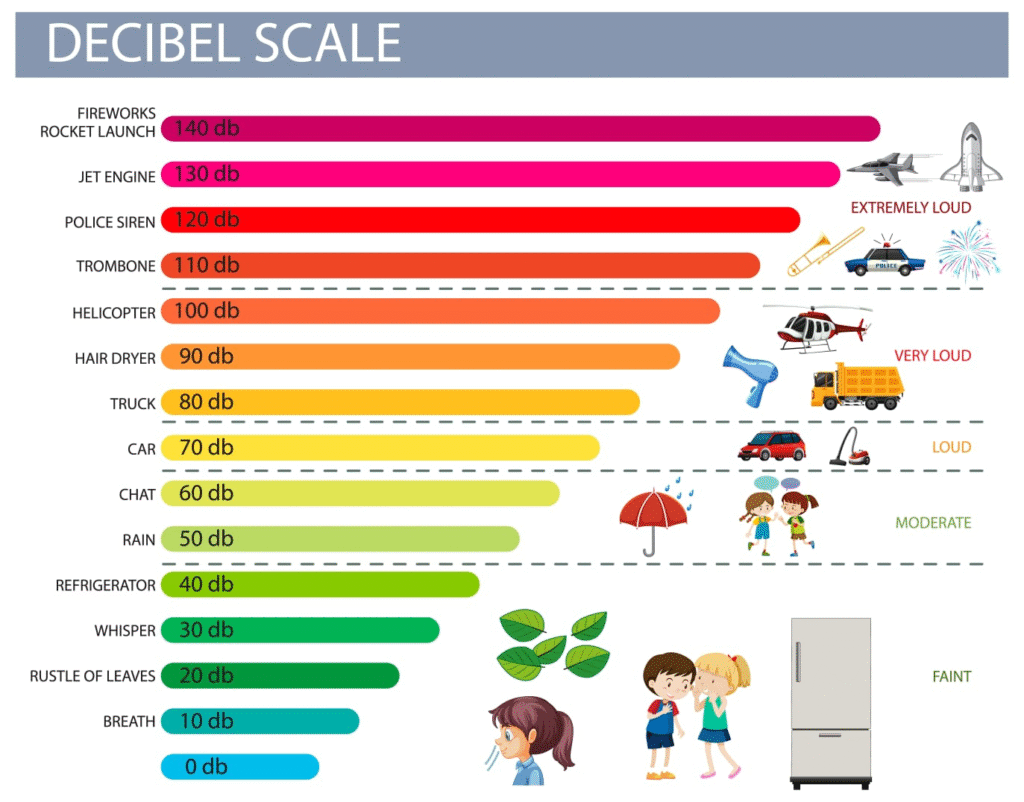
🔊 Intensity and Loudness
Intensity: Power per unit area carried by sound.
Loudness: Human perception of intensity.
Loudness ∝ (Amplitude)²
🧑🔬 Applications of Ultrasound
Medical imaging (ultrasound scans)
SONAR (Sound Navigation and Ranging):
Used to detect depth of sea, locate objects.
Works on principle of echo/reflection.
Cleaning delicate parts using ultrasonic vibrations.
🎤 Musical Sound vs Noise
Music: Pleasant, regular wave pattern.
Noise: Unpleasant, irregular wave pattern.
Noise pollution causes stress, lack of sleep, hearing problems.
📝 Summary
Sound is a mechanical, longitudinal wave.
Travels fastest in solids, slowest in gases.
Audible range: 20 Hz – 20,000 Hz.
Reflection → echo, SONAR.
Infrasonic (<20 Hz) and ultrasonic (>20,000 Hz) waves have unique applications.
Sound follows principles of reflection, refraction, diffraction, interference, and conservation of energy.
————————————————————————————————————————————————————————————————————————————
QUESTIONS FROM TEXTBOOK
🔵 Question 1
What is sound and how is it produced?
Answer:
Sound is a form of energy that travels in the form of longitudinal mechanical waves.
It is produced when an object vibrates.
These vibrations set the particles of the medium (air, liquid, solid) into motion, creating compressions and rarefactions.
The disturbance travels forward while the particles oscillate about their mean positions.
🟢 Question 2
Describe with the help of a diagram, how compressions and rarefactions are produced in air near a source of sound.
Answer:
When a vibrating body moves forward, it pushes air particles, creating a region of high pressure and high density → Compression.
When it moves backward, air particles spread apart, creating a region of low pressure and low density → Rarefaction.
This alternation of compressions and rarefactions travels through the medium as a longitudinal wave.
💡 (In textbook diagram: parallel lines close = compression, far apart = rarefaction.)
🔴 Question 3
Why is sound wave called a longitudinal wave?
Answer:
Because in sound waves, the oscillations of particles of the medium are parallel to the direction of wave propagation.
This parallel motion forms compressions and rarefactions, which is the property of longitudinal waves.
🟡 Question 4
Which characteristic of the sound helps you to identify your friend by his voice while sitting with others in a dark room?
Answer:
The quality or timbre of sound.
Timbre is the property that distinguishes two sounds of the same pitch and loudness.
Every person’s voice has a unique waveform, so we can identify friends by their voice.
🔵 Question 5
Flash and thunder are produced simultaneously. But thunder is heard a few seconds after the flash is seen. Why?
Answer:
Speed of light = 3 × 10⁸ m/s (very fast).
Speed of sound in air = ~344 m/s (much slower).
Hence, light reaches our eyes almost instantly, while sound takes more time to travel the same distance.
🟢 Question 6
A person has a hearing range from 20 Hz to 20 kHz. What are the typical wavelengths of sound waves in air corresponding to these frequencies? (Speed of sound in air = 344 m/s)
Answer:
Formula: λ = v / f
For f = 20 Hz:
λ = 344 / 20
λ = 17.2 m
For f = 20,000 Hz:
λ = 344 / 20000
λ = 0.0172 m = 1.72 cm
✔️ Range of wavelengths = 17.2 m to 1.72 cm
🔴 Question 7
Two children are at opposite ends of an aluminium rod. One strikes the rod with a stone. Find the ratio of times taken by the sound wave in air and in aluminium to reach the second child.
Answer:
Speed of sound in air = 344 m/s
Speed of sound in aluminium = 6420 m/s
Time = Distance / Speed
Let distance = d.
Time in air = d / 344
Time in aluminium = d / 6420
Ratio = (d/344) : (d/6420)
= 6420 : 344
= 18.66 : 1 ≈ 19 : 1
🟡 Question 8
The frequency of a source of sound is 100 Hz. How many times does it vibrate in a minute?
Answer:
Frequency = 100 vibrations per second.
In 1 minute = 60 seconds
Number of vibrations = 100 × 60 = 6000 vibrations
🔵 Question 9
Does sound follow the same laws of reflection as light does? Explain.
Answer:
Yes. ✔️
Sound follows laws of reflection:
Angle of incidence = Angle of reflection.
Incident wave, reflected wave, and normal lie in the same plane.
That’s why we can hear echoes or soundboards work in auditoriums.
🟢 Question 10
When a sound is reflected from a distant object, an echo is produced. Let the distance between the reflecting surface and the source of sound production remain the same. Do you hear echo sound on a hotter day?
Answer:
On a hotter day, the speed of sound increases because air temperature is higher.
Hence sound travels faster, reducing the time interval between original sound and echo.
If this time interval becomes < 0.1 s, our ears cannot distinguish → echo not heard clearly.
🔴 Question 11
Give two practical applications of reflection of sound waves.
Answer:
Megaphones, horns, loudspeakers use reflection to direct sound in a particular direction.
Stethoscope: sound of heartbeat reaches doctor’s ear by multiple reflections.
Soundboards in auditoriums reflect sound evenly in all directions.
🟡 Question 12
A stone is dropped from the top of a tower 500 m high into a pond of water at the base. When is the splash heard at the top? (g = 10 m/s², speed of sound = 340 m/s)
Answer:
Step 1: Find time taken by stone to fall.
s = 500 m, u = 0, g = 10 m/s²
s = (1/2) g t²
500 = (1/2) × 10 × t²
500 = 5t²
t² = 100
t = 10 s
Step 2: Time taken by sound to travel upward.
t = distance / speed
= 500 / 340
≈ 1.47 s
Step 3: Total time = 10 + 1.47 = 11.47 s ≈ 11.5 s
🔵 Question 13
A sound wave travels at a speed of 339 m/s. If its wavelength is 1.5 cm, what is the frequency of the wave? Will it be audible?
Answer:
λ = 1.5 cm = 0.015 m
v = 339 m/s
f = v / λ
= 339 / 0.015
= 22600 Hz
✔️ Since audible range = 20 Hz – 20,000 Hz, this wave is ultrasonic, not audible.
🟢 Question 14
What is reverberation? How can it be reduced?
Answer:
Reverberation: Persistence of sound due to multiple reflections in a hall/room.
It causes overlapping of sounds, reducing clarity.
Reduction methods:
Use of sound absorbing materials (curtains, carpets, wall panels).
Installing false ceilings with acoustic tiles.
Seats made of cushioned materials.
🔴 Question 15
What is loudness of sound? What factors does it depend on?
Answer:
Loudness is the sensation of sound energy perceived by ear.
It depends on:
Amplitude → larger amplitude = louder sound.
Distance from source.
Surface area of vibrating body.
Density of medium.
🟡 Question 16
How is ultrasound used for cleaning?
Answer:
Ultrasound waves are passed through cleaning solution.
Due to high frequency vibrations, dirt and grease particles detach from surfaces of objects (like electronic components, watches, jewellery).
Thus ultrasound provides precise cleaning.
🔵 Question 17
Explain how defects in a metal block can be detected using ultrasound.
Answer:
Ultrasound waves are passed into the metal block.
If block is defect-free, waves travel uniformly and are detected at the other end.
If cracks/holes are present, waves get reflected back earlier.
By analyzing reflections, defects can be located and measured.
————————————————————————————————————————————————————————————————————————————
OTHER IMPORTANT QUESTIONS FOR EXAMS
🔵 Section A (Q1–Q20): MCQs, 1 mark each
🔒 ❓ Q1. Sound is produced due to:
🟢 1️⃣ Vibrations of objects
🔵 2️⃣ Reflection of light
🟡 3️⃣ Heat energy
🟣 4️⃣ Chemical reactions
✔ Answer: 🟢1️⃣ Vibrations of objects
🔒 ❓ Q2. Sound travels through a medium in the form of:
🟢 1️⃣ Transverse waves
🔵 2️⃣ Longitudinal waves
🟡 3️⃣ Electromagnetic waves
🟣 4️⃣ Light waves
✔ Answer: 🔵2️⃣ Longitudinal waves
🔒 ❓ Q3. The maximum displacement of a vibrating particle from its mean position is called:
🟢 1️⃣ Wavelength
🔵 2️⃣ Amplitude
🟡 3️⃣ Frequency
🟣 4️⃣ Time period
✔ Answer: 🔵2️⃣ Amplitude
🔒 ❓ Q4. The number of vibrations per second is called:
🟢 1️⃣ Frequency
🔵 2️⃣ Amplitude
🟡 3️⃣ Time period
🟣 4️⃣ Wavelength
✔ Answer: 🟢1️⃣ Frequency
🔒 ❓ Q5. The SI unit of frequency is:
🟢 1️⃣ Hertz
🔵 2️⃣ Decibel
🟡 3️⃣ Meter
🟣 4️⃣ Second
✔ Answer: 🟢1️⃣ Hertz
🔒 ❓ Q6. The time taken to complete one vibration is called:
🟢 1️⃣ Frequency
🔵 2️⃣ Time period
🟡 3️⃣ Amplitude
🟣 4️⃣ Wavelength
✔ Answer: 🔵2️⃣ Time period
🔒 ❓ Q7. The loudness of sound mainly depends on:
🟢 1️⃣ Amplitude of vibration
🔵 2️⃣ Frequency of vibration
🟡 3️⃣ Speed of sound
🟣 4️⃣ Wavelength
✔ Answer: 🟢1️⃣ Amplitude of vibration
🔒 ❓ Q8. The pitch of a sound depends on:
🟢 1️⃣ Amplitude
🔵 2️⃣ Frequency
🟡 3️⃣ Speed
🟣 4️⃣ Distance
✔ Answer: 🔵2️⃣ Frequency
🔒 ❓ Q9. The audible range of hearing for human beings is approximately:
🟢 1️⃣ 20 Hz to 20,000 Hz
🔵 2️⃣ 10 Hz to 10,000 Hz
🟡 3️⃣ 50 Hz to 50,000 Hz
🟣 4️⃣ 100 Hz to 100,000 Hz
✔ Answer: 🟢1️⃣ 20 Hz to 20,000 Hz
🔒 ❓ Q10. The repeated reflection of sound that results in persistence of sound is called:
🟢 1️⃣ Echo
🔵 2️⃣ Reverberation
🟡 3️⃣ Reflection
🟣 4️⃣ Refraction
✔ Answer: 🔵2️⃣ Reverberation
🟢 Q11–Q20: Assertion–Reason MCQs
Use these options for each question:
Both A and R true; R is the correct explanation of A
Both A and R true; R is NOT the correct explanation of A
A true; R false
A false; R true
Q11. Question: A: Sound cannot travel in vacuum. R: Sound is a mechanical wave and needs a material medium.
Answer: 1
Q12. Question: A: Echo is heard only if reflected sound reaches after ≥ 0.1 s. R: Human ear retains a sound for about 0.1 s.
Answer: 1
Q13. Question: A: Speed of sound in iron is greater than in water. R: Particles in iron are closely packed and elasticity is higher.
Answer: 1
Q14. Question: A: Pitch of a sound increases when amplitude increases. R: Pitch depends on frequency of sound.
Answer: 4
Q15. Question: A: Loudness ∝ (Amplitude)². R: Larger amplitude means greater energy reaching the ear per second.
Answer: 1
Q16. Question: A: In longitudinal waves, particles vibrate parallel to the direction of propagation. R: Sound consists of compressions and rarefactions that move along the wave direction.
Answer: 1
Q17. Question: A: Sound obeys the laws of reflection. R: Angle of incidence equals angle of reflection for sound.
Answer: 1
Q18. Question: A: Ultrasound can clean fine holes and parts. R: Very high frequency causes intense agitation in liquids.
Answer: 1
Q19. Question: A: Sound travels faster on a hot day. R: The speed of sound in air increases with temperature.
Answer: 1
Q20. Question: A: Heavy reverberation improves clarity in a hall. R: Multiple reflections overlap and reduce clarity.
Answer: 4
🟡 Section B (Q21–Q26): Very Short Answers, 2 marks each
Q21. Question: Define amplitude of a sound wave. How does loudness depend on it?
Answer: Amplitude is the maximum displacement of particles from the mean position. Loudness is directly proportional to (Amplitude)²; doubling amplitude makes sound much louder.
Q22. Question: A wall is 68 m away. After how much time is the echo heard? (v = 340 m/s)
Answer:
Step 1: Round-trip distance = 2 × 68 = 136 m
Step 2: Time = Distance / Speed = 136 / 340 = 0.40 s
Q23. Question: Differentiate between loudness and intensity (two points).
Answer: Loudness is a subjective sensation depending on amplitude and ear response; intensity is objective power per unit area (W m⁻²). Loudness is measured in dB (log scale); intensity is measured directly from energy flow.
Q24. Question: What is quality (timbre) of a sound?
Answer: The property that distinguishes two sounds of the same pitch and loudness; it depends on waveform/overtones produced by the source.
Q25. Question: State the principle of SONAR.
Answer: Measurement by echo—ultrasonic pulses reflect from objects; time of flight gives distance (Depth = v × time/2).
Q26. Question: Why is sound often clearer at night near the ground?
Answer: Cooler, denser air near the ground causes refraction, bending sound waves downward toward listeners, improving audibility.
🔴 Section C (Q27–Q33): Short Answers, 3 marks each
Q27. Question: A source emits sound of frequency 680 Hz in air (v = 340 m/s). Find (a) wavelength, (b) time period.
Answer:
Step 1: λ = v / f = 340 / 680 = 0.50 m
Step 2: T = 1 / f = 1 / 680 = 0.00147 s (≈ 1.47 ms)
Q28. Question: State the condition to hear a distinct echo. Find the minimum reflector distance for v = 330 m/s.
Answer:
Step 1: Ear’s persistence ≈ 0.1 s, so round-trip time ≥ 0.1 s
Step 2: Round-trip distance = v × t = 330 × 0.1 = 33 m
Step 3: One-way minimum distance = 33 / 2 = 16.5 m
Q29. Question: A 2 kHz source emits sound. Find wavelength in (a) air (v = 340 m/s) and (b) water (v = 1500 m/s).
Answer:
Step 1: λ_air = 340 / 2000 = 0.17 m
Step 2: λ_water = 1500 / 2000 = 0.75 m
Q30. Question: Two children at ends of a 20 m aluminium rod communicate by tapping. Compare travel times in aluminium and in air. (v_Al = 6420 m/s, v_air = 340 m/s)
Answer:
Step 1: t_Al = 20 / 6420 = 0.00312 s
Step 2: t_air = 20 / 340 = 0.0588 s
Step 3: Ratio (t_air : t_Al) = 0.0588 : 0.00312 ≈ 18.8 : 1 (≈ 19 : 1)
Q31. Question: Thunder is heard 4.0 s after lightning is seen. Estimate cloud distance (v = 340 m/s).
Answer:
Step 1: d = v × t = 340 × 4.0 = 1360 m
Step 2: Distance ≈ 1.36 km
Q32. Question: Why can’t two astronauts on the Moon talk without radios?
Answer: There is no atmosphere on the Moon, so there is no medium for sound propagation; radios convert sound to electromagnetic waves that travel in vacuum.
Q33. Question: What is ultrasound? Give two medical uses.
Answer: Ultrasound has frequency > 20 kHz. Uses: (i) ultrasonography to image internal organs/foetus; (ii) lithotripsy to break kidney stones.
🟠 Section D (Q34–Q36): Long Answers, 5 marks each
Q34. Question: Derive v = fλ for a wave and list three factors affecting the speed of sound in air.
Answer:
Step 1: In one oscillation, the wave travels one wavelength (λ).
Step 2: Number of oscillations per second = frequency (f).
Step 3: Distance travelled in one second = f × λ.
Step 4: Distance per second = speed (v).
Step 5: Therefore, v = f λ.
➡️ Factors: (i) Temperature ↑ ⇒ v ↑; (ii) Humidity ↑ ⇒ v ↑ (moist air is lighter); (iii) Nature of gas / density & elasticity—lighter gases and higher bulk modulus give higher v.
Q35. Question: A stone is dropped from a height of 78.4 m into a lake. After the splash, sound travels back to the top. Find the total time between release and hearing the splash. (g = 9.8 m/s², v_sound = 343 m/s)
Answer:
Step 1: s = ½ g t_fall² ⇒ 78.4 = 0.5 × 9.8 × t_fall²
Step 2: 78.4 = 4.9 t_fall² ⇒ t_fall² = 16
Step 3: t_fall = 4.0 s
Step 4: t_sound = distance / speed = 78.4 / 343 = 0.2287 s
Step 5: Total time = 4.0 + 0.2287 = 4.2287 s (≈ 4.23 s)
Q36. Question: A ship’s SONAR receives an echo 3.2 s after emitting an ultrasonic pulse. (v_water = 1500 m/s)
Answer:
Step 1: One-way time = 3.2 / 2 = 1.6 s
Step 2: Depth = v × time = 1500 × 1.6 = 2400 m
Step 3: Ultrasound is preferred because of short wavelength (good resolution) and strong reflection from boundaries; it is also safe in water.
🟣 Section E (Q37–Q39): Case/Source-Based, 4 marks each
Q37. Question: Auditorium Acoustics — A new school hall with bare walls/floor gives poor audibility at the back.
Answer:
Step 1: Cause = Reverberation due to multiple reflections.
Step 2: Improvements = add curtains/carpets/acoustic panels and false ceiling/soundboards.
Step 3: If nearest wall is 10 m away, echo time = (2 × 10)/340 = 0.0588 s < 0.1 s ⇒ no distinct echo, adds to reverberation.
Step 4: A seated audience absorbs sound, reducing reflections and improving clarity.
Q38. Question: Lightning & Thunder — At night thunder is heard 7.0 s after lightning is seen.
Answer:
Step 1: Light reaches almost instantly; sound is slower.
Step 2: Distance = v × t = 340 × 7.0 = 2380 m (≈ 2.38 km).
Step 3: On a hot, humid night the speed is higher, so for the same 7.0 s the actual storm is slightly farther than 2.38 km.
Step 4: A clear thunder echo needs a reflector ≥ 17 m away; in open fields it is rarely distinct.
Q39. Question: Ultrasonic Testing (NDT) — A steel slab of thickness 0.12 m is tested. Echo returns in 40 μs. (v_steel = 5900 m/s)
Answer:
Step 1: Round-trip distance = v × t = 5900 × 40×10⁻⁶ = 0.236 m
Step 2: One-way depth = 0.236 / 2 = 0.118 m
Step 3: Back face would be at 0.12 m, so the reflection is from a defect ~0.118 m below the top (≈ 2 mm before the back).
Step 4: Advantage of ultrasonic NDT = detects internal flaws without ionising radiation; other use = thickness/corrosion measurement of pipes/tanks.
————————————————————————————————————————————————————————————————————————————